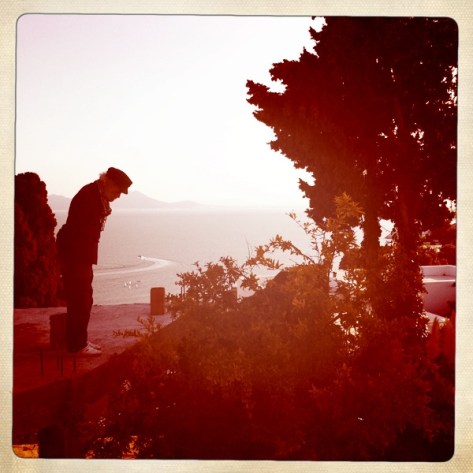
This guest post for Kafila by ALIA ALLANA from Sidi Bou Said on the outskirts of the capital Tunis captures the mood a day before Tunisia goes to the polls. Photos by Alia Allana
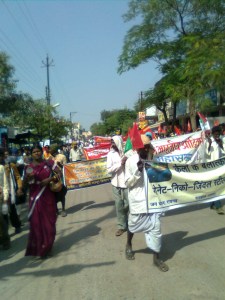
Last weekend, I attended a wonderful rally by the Adivasi Mahasabha in Raipur – some 10-15 busloads of people came from Dantewada and Bastar alone, while large numbers came from other parts of Chhattisgarh and even other states like Maharashtra, Orissa and West Bengal. The procession was flagged off by Dhurwa dancers while the rear end was brought up by Marias with their large dhols and bison horns. In between were thousands of militant marchers shouting slogans against militarization, demanding peace talks, the release of their arrested leaders, the implementation of the Supreme Court judgement on Salwa Judum, and all their constitutional rights with respect to land, forest and water. These were men and women who had lost everything to arson and loot by Salwa Judum, who had been interned in camps but managed to return home and pick up their ploughs again, who face the daily threat of arrests, beatings and encounters by the security forces, who have to negotiate with the Maoists everytime they wanted to access panchayat funds, who live a life on the razor edge of survival. And yet here they were, laughing, cheering and vowing to fight till the last breath, fight for their constitutional rights and in a constitutional way.
This remarkable struggle has been waged, not just over one weekend, but over years. Indeed, the Salwa Judum leaders themselves credit the CPI with the destruction of their movement – both through mass actions and through legal means.
I wish I could start with the ritual “I love you” which the Occupy Movement is supposed to inspire. To be honest, it has been a space of turmoil. But also, virulent optimism.
What I outline below are not criticisms of the Occupy movement. I am inspired that the dynamic of the movement thus far has been organic, so that all those who choose to participate are collectively responsible for its evolution and development. To all those participating — I offer my deepest gratitude and respect. I am writing today with Grace Lee Boggs on the forefront of my mind: “The coming struggle is a political struggle to take political power out of the hands of the few and put it into the hands of the many. But in order to get this power into the hands of the many, it will be necessary for the many not only to fight the powerful few but to fight and clash among themselves as well.” This may sound dramatic and counter-productive, but I find it a poignant reminder that, in our state of elation, we cannot underestimate the difficult terrain ahead and I look forward to the processes that will further these conversations.
Rahul Gandhi’s answer to that question, given to American diplomats who seem to have his ear more than the people of India, was unequivocal: it’s the Hindu right whose violence he fears more. But fellow-Kafila-ite Subhash Gatade makes the point in an interview to Rediff.com that such violence is difficult to quantify and compare because it takes only a few from a community to perpetrate it:
…one sincerely feels that it is difficult to quantify the relative threats. Remember the period when India witnessed Khalistani terrorism, which involved a fraction of the misguided youth of the Sikh community and the danger it posed to peace and tranquility in the country then. [Link]
Threatening people whose views you don’t like with violence is a sure-shot way of letting the world know who is right and whose argument is morally superior. To those who attacked Prashant Bhushan today for the comments he made in this video below, thank you for bringing more attention to them!
This is how “integral” a part of India Kashmir is – so integral that voices that doubt it must be silenced with vigilante force!
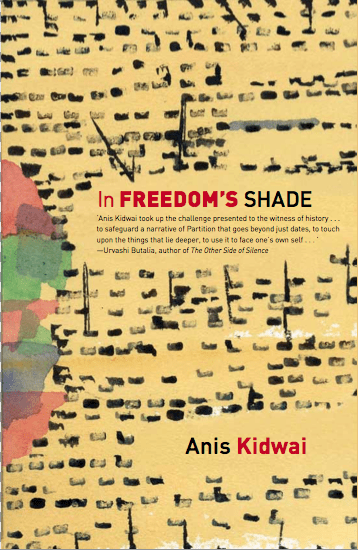
In Freedom’s Shade, by Anis Kidwai; translated from Urdu by Ayesha Kidwai; Penguin Books India 2011, Pp 382, price Rs. 450
Anis Kidwai belonged to the illustrious Kidwai family of Barabanki. The family has made more than a signal contribution to the making of India. Not only in politics and governance but also in diverse fields of creative endeavour. This short piece, though, is not about her or about her family but her most remarkable record of the unfolding tragedy in the Capital of India and in its surroundings in the aftermath of independence and partition.
Anis Kidwai, though extremely politically aware with sharp and clear views on what she saw happening, was not a political activist and would have probably continued to lead a well settled, almost sedentary life in Mussoorie, had the unthinkable not happened. Her husband, Shafi Ahmad Kidwai, the administrator of the Municipality, who had almost single handedly tried to keep peace in Mussoorie when everyone else had either given up or joined the rioters, was murdered.
Justice Markandey Katju, who has upon retirement just been appointed head of the Press Council of India, today addressed the media at his residence in Delhi. Towards the end of his speech, he said:
Before I conclude, I once again repeat my appeal to the Indian Government through the Prime Minister to release Dr Khaleel Chishty who is in Ajmer Jail. He is 80 years old and has not very long to live. He was an eminent virologist in Karachi Medical College and was a PhD from Edinburgh University. He is a heart patient and has many other ailments also. He is unable to walk. In the name of humanity I appeal to the Indian Government to release him and allow him to get back to home in Karachi to his wife and daughter who live there. The Pakistan Government honoured my appeal and released Gopal Das from a Pakistani jail. I am sad that the Indian Government has not yet honoured my appeal made several months ago to the Hon’ble Prime Minister, the Hon’ble Home Minister, and His Excellency the Governor of Rajasthan. In my opinion, the prestige of our country will be invreased if Dr. Chishty is released, whereas if he dies in jail, we will be disgraced. Continue reading Gopal Das is free, Khaleel Chishty is not→
PRESS STATEMENT: We, the undersigned, express our deep concern regarding the continuous arrests of Indian and Pakistani fishermen and confiscation of their boats by each country of the other. The poor, innocent fishermen go to sea to catch fish and in the deep sea it becomes virtually impossible for them to recognise where their countries waters end and other’s start.
The fishing season has begun couple of days ago and boats in a big number go to the mid-sea to catch and earn some money. Both the governments need to recognise the fact that these traditional fishermen go to the mid-sea for their livelihood. Arresting them and confiscating their boats means depriving their families from the livelihood, and causing them extreme distress. Continue reading Release Indian and Pakistani fishermen with their boats→
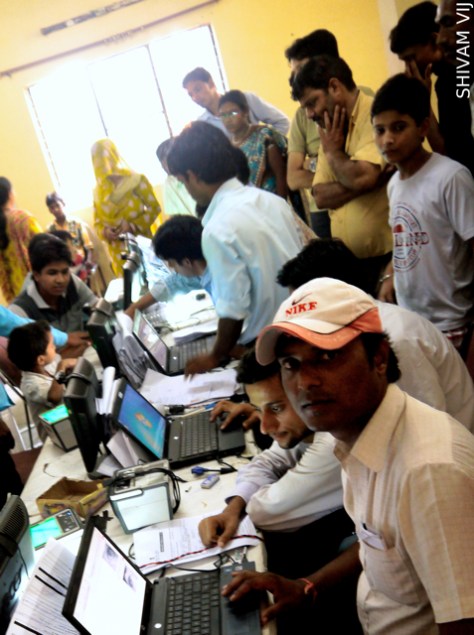
Contrary to what his name suggests, Bechu Lal Yadav, 29, isn’t a seller of goods. He is a recordist of identity. He is amongst a new breed of technical professionals that have come up overnight – the Biometricwallahs. Continue reading The Biometricwallah→
Guest post by A. SUNEETHA, VASUDHA NAGARAJ, R. SRIVATSAN, GOGU SHYAMALA, SARATH DAVALA and R.V. RAMANA MURTHY
[This post was sent to us on the 23rd of September, when the strike, still on-going, entered its tenth day. On the date of posting this, the strike had entered its sixteenth day].
Sakala Janula Samme (extraordinary general strike) in the ten districts of Telangana has entered its tenth day today. Miners in the Singareni Collieries, private college teachers and students, road transport employees unions, school teachers, university staff, lawyers in the lower and high courts, the electricity employees union—in short almost all employees (who usually refuse to see beyond their immediate benefits) and contract workers (who under normal circumstances cannot afford to lose wages) needed by the state to “govern” its people—have gone on strike.
Telengana general strike, photo courtesy: msn news
Government in this region, already seriously impaired and facing severe challenges from the movement since 2009 has come to a standstill. In an extraordinary “do or die” battle for the formation of a separate Telangana state, the various joint action committees promise to continue this strike till a separate Telangana state is formed.
[JAGANNATH SARKAR, who passed away in April, was among those who led the spectacular rise of CPI in Bihar in the 1960s and 1970s. He was among a handful of Bihar CPI leaders who envisioned the crisis in CPI in the mid-1970s. Today is his first birthday after he passed away – he was born on 25 September 1919. The piece below is an important document that gives a glimpse of the debate on new caste assertions in the CPI. It was written by Sarkar in 1998, following the National Council meeting of the CPI. It has been translated by Raj Ballabh from Hindi. – AN]
The National Council of the CPI accepted, if belatedly, in its review report of March 1998 that there has been a serious decline in the basic mass base of the party and its class-based mass base has fragmented on the basis of caste. It has accepted that the party could not face the deviation of ‘social justice’ in the form of ‘backward casteism’ in its theatricality, or indeed politically and practically; that the party could not maintain its distinct identity, as a party that was politically and practically different from the Laloo-led Janata Dal Government. What is more, the toxin of casteism began to show its effects within the party as well. Indeed, it is an issue of serious concern which should be analyzed in detail.
Readers of Kafila might have heard of the horrific shootings that took place at Paramakudi and Madurai on September 11. Officially seven people died when police opened fire on dalits who had gathered to pay their respects to Immanuel Sekaran, a dalit leader who was brutally killed in 1957 in circumstances that pointed to the complicity of dominant caste thevars in carrying out this murder. (The thevars are an important constituent of the ‘Mukkulathor’ complex of castes that includes the kallars and the maravars.) Subsequently, U Muthuramalinga Thevar, Forward Bloc leader was arrested in connection with Sekaran’s death – he stood trail and was released two years later, because the case against him was not established and proved. (Thevar was proud of his anti-communism and his Hinduism; to him he claimed that patriotism and theistic belief constituted his very vision, they were the ‘eyes’ through which he saw the world.) Continue reading Desecrating Memory – The Paramakudi Police Shootings: V Geetha→
It is the sort of place you will not find unless you are looking for it. Even if you find the address in Hardevpuri near Shahdara, you will not know where to knock. There is no signboard that will tell you this is Gautam Book Center. “A signboard will attract the attention of those who don’t like our books,” explains AK Gautam.
This release comes from thePEOPLE’S UNION FOR CIVIL LIBERTIES, Rajasthan
Gopalgarh (Bharatpur, Mewat) Police Firing Incident Preliminary Findings of the Fact Finding Team released in the Press Conference on 19th Sept, 2011
Photo credit: PUCL Rajasthan
This preliminary report of the PUCL team pertains to the incident of the police firing in Gopalgarh, district Bharatpur, Rajasthan. As per the media reports, the police resorted to firing to quell rioting mobs. The government has acknowledged eight deaths and 23 injured in this incident. Following this, the PUCL, Rajasthan constituted a Fact Finding Team to conduct independent inquiry into this incident. The team comprised Kavita Srivastava, National Secretary, PUCL, Professor Shail Mayaram (Delhi), Professor Yogendra Yadav(Delhi), Ms. Nishat Hussain (Vice President, PUCL, Rajasthan) Mr. Sawai Singh (Organising Secretary PUCL, Rajasthan), Mr. Noor Mohammed (PUCL, Alwar), Mr Virendra Vidrohi (PUCL, Alwar), Adv. Ramjan Chowdhary (PUCL, Mewat district, Haryana), Mr Gaurav Srivastava(PUCL intern). Mr. Neelabh Mishra, Editor, Outlook (Hindi) and a section of progressive members of the Gurjar and Meo community also accompanied and assisted the fact finding team. Continue reading ‘Every eye-witness said there was no death before the police intervened’→
Wars, insurgencies, floods, an economy in the doldrums, and now dengue. If Pakistan is not a “failed state,” some credit must go to the Pakistani sense of humour.
There’s been terrible out break of Dengue fever in Lahore. 39 have died and the toll keeps rising – it was 36 when I began collecting the material for this post. Sohaib Gulbadan tweets: “My Hizb-ut-Tahrir friend is sharing articles suggesting dengue outbreak in Lahore is a CIA strategy. Acha.”
Perhaps it is in response to that sort of stuff that Haseeb Asif writes this hilarious blog post:
Faced with the never-ending agony to which the members of the Dalit Human Rights Movement (DHRM) in Kerala seem to be subject to, it appears that that the more familiar ways of marginalizing of dalit people in Malayalee people do not work anymore. The past few days have seen horrendous attacks on these people near the town of Varkala in Thiruvanathapuram district. The DHRM has accused the Siva Sena and the BJP of violence, but it appears that both the authorities and the press are equally and irremediably deaf. Continue reading Out of Development’s Waiting Room, Out of Democracy: The Continuing Agony of the DHRM→
This is a statement put out by the JAMIA TEACHERS’ SOLIDARITY ASSOCIATION
Punish those guilty of misleading probes Compensate the victims NOW!
13 September 2011: The NIA has finally put the official seal on what many activists, the families of the accused and the people of Malegaon had been saying for long: that the arrest of nine Muslim men for the 2008 Malegaon blast was a result of a communal witch-hunt, which passes for investigations into terror charges. As a consequence of the investigating agencies’ hubris and prejudice, nine innocent men had to spend five long years in jail, while their families suffered and they were stigmatized. Continue reading Lessons from Malegaon: JTSA→
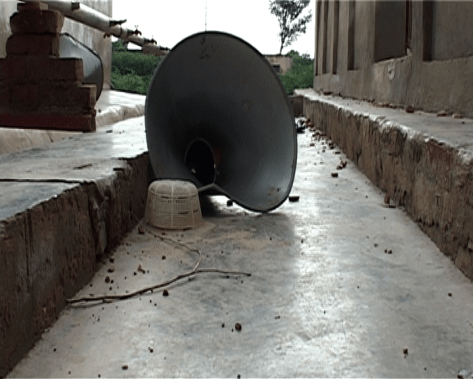
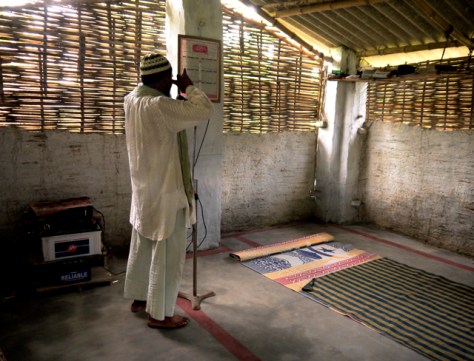
Imam Shamsuddin calls for prayer. Photo credit: Shivam Vij
Like nearly every village in South Asia, Allahpur, in the east Indian state of Bihar, is geographically divided on the lines of caste. On one side of a dirt track live the upper-caste Muslims (Syeds, Sheikhs and Pathans) and on the other side live the lower-caste Muslims (Ansaris, Dhunias and Raains). There are only four Hindu families in Allahpur, and they are all lower castes, their houses amid the low-caste Muslim houses.
For five years now, the low caste Muslims have been praying at a ramshackle mosque they built, boycotting the mosque in the upper-caste Muslim area, a stone’s throw away.
This guest post bySIMI CHACKOandPRATIKSHA KHANDURI is the full text of a booklet released in August 2011. A .pdf version of the booklet (41 pages, 304 KB) can be downloaded here.
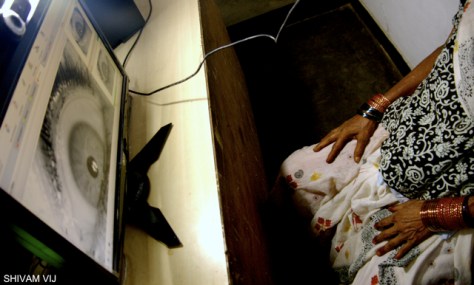
A citizen gets her iris scanned for a UID 'Aadhar' card in Delhi.
Introduction
A. UID: The Basics
B. The Enrolment Process
C. Benefits of UID
D. Concerns: Biometrics, Privacy, Data security, Surveillance
The news of the ‘postponement’ of Harud, a literary festival scheduled to be held in Kashmir in September, should be read with concern by those who believe in, and fight for, the right to express themselves freely. How the self-righteousness of some fighters for democracy actually forecloses any possibility of democracy can be seen from this incident.
In a statement last week, the organizers of Harud explained that they were forced to put off their festival as there was a concerted campaign by some people on the Internet, on Facebook and some other sites attacking the festival. According to these critics, “We fear, therefore, that holding such a festival would, willy-nilly, dovetail with the state’s concerted attempt to portray that all is normal in Kashmir. Even as the reality on the ground is one of utter abnormality and a state of acute militarisation and suppression of dissent, rights and freedoms.” Continue reading Killing poetry and other possibilities of life→




 KAFILA - COLLECTIVE EXPLORATIONS SINCE 2006