Category Archives: Identities

Bring Dr Chishty home – alive

An elderly, bed-ridden man sentenced to life imprisonment in an ‘enemy’ country for a murder he didn’t commit awaits the signature on his clemency petition. By Beena Sarwar and Shivam Vij

Human rights activists in India are renewing their efforts for the release of the elderly Pakistani prisoner Dr Khalil Chishty lodged in Ajmer prison hospital, whose mercy petition awaits just one signature from the Rajasthan Governor Shivraj Patil. The mercy petition had earlier been approved by the state government and had reached Patil in June this year. At that point, it was expected that Dr Chishty, 78, a renowned virologist bed-ridden with various illnesses in jail, would soon be released.

Instead, Governor Patil raised a set of questions for the state government to answer. The Rajasthan government has answered all the queries, but has not submitted the file to the Governor again – perhaps because, according to sources, the Governor has already indicated that he will not sign the petition. Continue reading Bring Dr Chishty home – alive

Let us break the ‘silence’on Telengana movement: Sridhar Modugu

Guest post by SRIDHAR MODUGU

It is no exaggeration to say today that Telangana is burning. Nor will we be far off the mark if we suspect that a paralyzing fear has encased its ‘intellectuals”. Everyone is lost in providing testimonies to prove themselves to be pro-Telangana and everybody is a self-accomplished activist.  In fact, the intellectuals have lost themselves as spectators. They have become immune to understand what is happening before them.

The demand for statehood for Telangana is undoubtedly a democratic and judicious demand. It has been held back since 1950s and suppressed time and again.  No doubt Mr. Kalvakuntla Chandra Sekhar Rao (KCR), the President of Telangana Rastra Samithi (TRS) did maintain the public talk with occasional tactical moves and has been considered an icon of “Telangana vaadam” as last ten years of Telangana politics are referred to.  Since 2009 November the movement could attract large mass of diversified sections of people from all walks of life and engage the attention of the people with hopes of achieving the state any day thanks to the enthusiastic role play of the media and political parties – in power or opposition. It is indeed noteworthy that since November 2009 the movement has been able to attract a large number of diverse sections of people from all walks of life in thousands. They have mobilized voluntarily and have conducted meetings in the most democratic way. That there has been considerable restraint among the people who have been dishonored, alienated and humiliated under the Andhra Pradesh rulers is without dispute. These people have mobilized democratically despite the war-like surveillance and suppression of both the para-military and the state police force.  Historical injustice – political, economic and cultural of the people of this region is well highlighted.

Continue reading Let us break the ‘silence’on Telengana movement: Sridhar Modugu

In the Courtyard of the Beloved

*

In the Courtyard of the Beloved is a visual and aural portrait of Nizamuddin Auliya Dargah, a Sufi shrine in New Delhi, India. Made from over 18,000 still images and ambient sounds recorded on-site, rapid-fire bursts of kaleidoscopic imagery assemble into fractured collages.

Each day, hundreds of pilgrims travel by airplane, train, car, rickshaw and foot to reach this shrine, which honors a 12th century Sufi mystic who believed in drawing close to God through renunciation of the world and service to humanity. Beginning with imagery from these journeys, the film then enters the physical space of the shrine; a unique nexus of marketplace, social space and spiritual haven, where devotees come to offer their prayers and find a moment of reflection away from the din of Delhi traffic. As the sun sets behind the dome, musicians begin the qawwali, a style of Sufi devotional music that ranges from contemplative religious elegy to raucous crescendo.

Executive Producer Samina Quraeshi
Original tabla score by Suphala
Audio post-production by Paul Bercovitch
Produced by Sadia Shepard
Photographed and edited by Andreas Burgess

[via]

On the Harud Literary Festival, setting the record straight

It is sad that a literature festival that was to be held in Srinagar later this month has been indefinitely postponed. What is even sadder is that while announcing its postponement on HarudLitFest.org, the organisers of the Harud Literature Festival (the same team that puts up the acclaimed Jaipur Literature Festival) have sought to blame those who signed an “open letter” expressing a set of concerns about the festival. The statement reads, “A few people who began the movement to boycott the festival have no qualms in speaking on and about Kashmir across international forums, but have refused to allow other voices, including writers, poets and theatre people from the Valley and across India to enjoy the right to express themselves at the Harud festival.”

As one of the over two hundred signatories of the open letter posted on Kafila.org, I am dismayed at the deliberate and disingenuous misrepresentation of the open letter as a “movement to boycott” What does such deliberate misrepresentation of dissent by the organisers of a literature festival say about them, their honesty and intent?

Two news reports appeared on 28 July 2011. One, by Agence France-Presse, quoted organiser Namita Gokhale as saying, “it will be an apolitical dialogue concerning literature”. The other report, by Randeep Singh Nandal in The Times of India, datelined Srinagar, did not quote anyone, and claimed: “There is speculation that Salman Rushdie might drop by…”

The term “apolitical” offended Kashmiris, who were seen objecting to it widely on Facebook and Twitter. Some of these were also aghast with the idea of Salman Rushdie, who they consider a blasphemer against Islam, sitting on a stage in Srinagar. Even though some of those named in these and subsequent news reports had told the festival organisers even before the news was in the papers that they would not be able to attend, their names were falsely put out in the media. They were thus forced to publicly state they would not attend a lit-fest termed “apolitical”.

Kashmir is a place where people live under the shadow of the gun, their political grievances against the Indian state silenced with draconian laws, criminalisation of dissent and heavy militarisation. You can get two years in jail without charge for a Facebook status update, a pamphlet, a mass gathering, a call for strike. Around the time the Harud controversy was gaining momentum, the Jammu and Kashmir Police beat up over several hours a photojournalist, allegedly because they didn’t like his work on the Al-Jazeera website.

Now, a group of people from the Indian capital decide to go to the place described above, to hold a literary festival, and announce that the festival would be “apolitical”. Were Kashmiri writers and journalists, including some acclaimed ones, wrong in feeling offended?

On 12 August 2011, Namita Gokhale was quoted as saying in the London-based newspaper The Guardian (no relation to this publication), “There was perhaps some misinterpretation of my use of the word ‘apolitical’.” She chose not to withdraw the word. If by apolitical she meant non-partisan, the choice of venues, Delhi Public School’s Srinagar franchise and the Kashmir University, was not seen as non-partisan in Srinagar. If your intent is to be neutral in a conflict zone, surely, you must attempt to be seen to be neutral?

he open letter, signed initially by fourteen people, including me, was published on 25 August. It said, “Our concerns are also heightened by reports that the festival is sought to be denoted as being an ‘apolitical’ event, that, yet, people will be free to speak what they want and that no one has the right to deny Kashmiris a chance to listen to writers. Beyond the absurdity of asserting that art and literature has nothing to do with politics, our issue is precisely that people are not allowed to speak their minds in Kashmir.” The open letter did not use the word boycott, did not urge anyone to not attend it, did not ask for it to be cancelled. It did say, “We would firmly support the idea of a literary/artistic festival in Kashmir if we were convinced that its organising was wholly free from state interference and designs, and was not meant to give legitimacy to a brutal, repressive regime.”

Two days later, their response on Kafila.org said, “We wish to categorically state that the Harud literature festival is not government sponsored.” It did not withdraw the word ‘apolitical’. An expanded version of this 27 July release, sent to the media, mentioned false rumours spread by a Facebook group about Rushdie coming to attend. Why did it put the blame of the Rushdie rumour on Kashmiris and not on The Times of India, and on themselves for choosing to not deny the rumour for a whole month?

Then, suddenly, on 29 August they announced indefinite postponement of the festival, in a dishonest release that blamed the signatories of the open letter for being against free speech! It also cited security threats emanating from that Facebook page with nearly 5,000 ordinary Kashmiris supporting the boycott call on account of Rushdie’s rumoured attendance.

Given that so many Kashmiris have expressed reservations about the festival’s intent, including many Kashmiri writers and journalists, even young, aspiring, as yet-unpublished ones, it is surprising that we are hearing patronising comments about how Kashmiris have been ‘denied an opportunity’. It is high time Kashmiris started their own literary festival, something they have tried to do before but were not allowed to by the state government. They should do it in Delhi or Jaipur, giving Indian writers an opportunity to learn what it means to be political.

(First published in The Sunday Guardian, Delhi, and The Friday Times, Lahore.)

From Kafila archives:


‘Muslim Quota’: Keep it Simple, Silly! – Khalid Anis Ansari

Guest post by KHALID ANIS ANSARI

In an interview last month, Mr. Salman Khursheed was posed the query: ‘There are reports that you are considering Muslim reservations within the OBC quota?’ He responded affirmatively: ‘Absolutely. Sachar described them as SEBC, socially and educationally backward classes. This is a special segment within OBC.’

Nowhere in the Sachar report are Muslims categorized as SEBC (Socially and Educational Backward Classes). They are categorised merely as one of many SRCs (Socio-Religious Communities). Moreover, the Sachar Report has acknowledged caste-based stratification within Muslims and has suggested quite unequivocally: ‘Thus, one can discern three groups among Muslims: (1) those without any social disabilities, the ashrafs; (2) those equivalent to Hindu OBCs, the ajlafs, and (3) those equivalent to Hindu SCs, the arzals. Those who are referred to as Muslim OBCs combine (2) and (3) [p. 193 (emphasis added)]’.

So, according to the Sachar Report all Muslims cannot be conceived as a socially and educationally backward class (OBC) because the forward Muslims (ashrafs) are ‘without any social disabilities’. Well, one may ask if the minister who exhorted everyone to read the Sachar Report critically and not as gospel truth, has failed to practice what he himself preached. The honorable minister seems to have read the report incorrectly.

Strange are the ways politics affects one’s judgment! Continue reading ‘Muslim Quota’: Keep it Simple, Silly! – Khalid Anis Ansari

Hypocrisy in Any Season: Mridu Rai responds to Rahul Pandita on the Harud Literature Festival

Guest post by MRIDU RAI

Rahul Pandita has written a misleading piece—in the tone of high dudgeon and ethical outrage no less—in the ‘essays’ section of the 3 September 2011 issue of Open magazine titled “The Autumn of Hypocrisy”. I think it is a piece that, nevertheless, requires some examination mostly because it makes several assertions in ways that queer any possibility of debate around the important question of what a literary festival held in Kashmir today might mean. Whether or not it was the author’s intention to do so, its effect is also to discredit, off-hand, several literary and artistic voices whose greatest sin would appear to be to have disagreed with the kind of literary festival in Kashmir Rahul Pandita and his fellow organizers had in mind. Of course, it is also troubling to hear from Mr. Pandita on this question since he is both an aggrieved party, deprived of his right to express himself at the festival, and also, as the credit at the bottom of his piece elaborates, a former “member of the advisory committee for the Harud literary festival”. I wonder if this conflict of interest bothers anyone other than me. Continue reading Hypocrisy in Any Season: Mridu Rai responds to Rahul Pandita on the Harud Literature Festival

Politics of Anna Hazare Anti-Corruption Movement by Sanjay Kumar

Guest post by SANJAY KUMAR

Sonia Gandhi Hinsak Hai
Rahul Gandhi Napunsak Hai
(Sonia Gandhi is violent, Rahul Gandhi is impotent)
(placard displayed by a young man on Barakhamba road crossing, during anti-corruption march on 21st August, Delhi)

Rahul Bhaiyya! Why don’t you get married so that Bhabhi can take care of Sonia Aunty, and you do not have to spend so much (black) money to get her treated outside the country? (placard carried by a three year old girl child)

Manuvadi Krantikari Morcha supports Anna Hazare
(a banner heading for a group of 20-30 middle aged men)

Bihari Nahin Ham Jaat hain
Ham Anna ke saath hain
(We are not Biharis we are Jaats, we are with Anna)
(shout of youth in open jeep in Darya Ganj, after the 21st Aug march)

Continue reading Politics of Anna Hazare Anti-Corruption Movement by Sanjay Kumar

A Response to SHRC’s Report on Unknown and Unmarked Graves of Kashmir: IPTK

This press statement comes from the INTERNATIONAL PEOPLE’S TRIBUNAL ON
HUMAN RIGHTS AND JUSTICE IN INDIAN-ADMINISTERED KASHMIR (IPTK) 
together with the ASSOCIATION OF PARENTS OF DISAPPEARED PERSONS

29 August 2011: We welcome the report of the State Human Rights Commission of Jammu and Kashmir (SHRC) on unmarked graves in north Indian-administered Kashmir (dated July 2011 and recently released; download 3.2 MB .pdf here), taking suo moto cognizance of the matter, and appreciate the courage and labour that this work signifies.

The SHRC’s report acknowledges and corroborates the research documented in the report, BURIED EVIDENCE, released by the International People’s Tribunal on Human Rights and Justice (IPTK) in December 2009. The SHRC investigated unmarked graves in Bandipora, Baramulla, Kupwara, and Handwara districts across 38 graveyards and verified 2156 unidentified bodies in unidentified graves.

Based on investigative research conducted between November 2006-November 2009, BURIED EVIDENCE had documented 2700 unknown, unmarked, and mass graves, containing 2943+ bodies, across 55 villages (in 62 sites within these villages) in Bandipora, Baramulla, and Kupwara districts of Kashmir. Of these, 2373 were unidentified and unnamed graves.   Continue reading A Response to SHRC’s Report on Unknown and Unmarked Graves of Kashmir: IPTK

The North-South Question in Punjab: Umair Javed

click to enlarge

‘Sayeen, ham nay toh kabhee 5,000 banday kaa jaloos bhi nahee nikaala. Siyaasat kay liyay aik laash kya, aik zakham bhi nahee hay hamaray paas toh. Aur aaj lag aisay raha hay kay hamaari dheemi dheemi baaton ko sun kar yay Punjab kay tukray karnay lagain hain’  (Sayeen, we’ve never taken out a rally with 5,000 people. Forget martyrs, we don’t even have a bruise to flaunt for political mileage. And today, it seems they’ve heard our whispers and taken them to heart. Today, they’re talking about splitting Punjab.)

While talking to a few last month, I realized that most independent Seraiki activists privately acknowledge that the issue of a new province, or at the very least, a wholesale recognition of Seraiki grievances, was a cause that could only be made actionable when the People’s Party thought it to be worthwhile – and 9 times out of ten, a cause’s worth for a national level party is determined by its weight in the electoral matrix.  Continue reading The North-South Question in Punjab: Umair Javed

The Lokpal debate from a Dalit-Bahujan perspective

The video above shows a protest in Delhi demanding a Bahujan Lokpal Bill, and protesting against Anna Hazare. This was hardly given any coverage in the media. The video was made and uploaded by KHALID ANIS ANSARI, who writes at the Round Table India:

A supra-parliamentary Jan Lokpal and a very interventionist and unaccountable judiciary are a horror for the dalit-bahujan masses. All said and done the legislature is most respectful of social diversity as far as the three organs of government are concerned. The executive is bad and the judiciary is the worst in this regard. So I am presently in favor of taking the ‘political’ route than the civil society one which is in any way a club of the chattering classes. [Read the full post]

Given below is a note expressing a Dalit-Bahujan perspective on the Lokpal debate. The note has been put out by DINESH MAURYA: Continue reading The Lokpal debate from a Dalit-Bahujan perspective

Some Thoughts from Ramlila Maidan

This slideshow requires JavaScript.

Why Jai Karan supports Anna Hazare

Jai Karan in The Times of India

My own feelings about the Anna Hazare movement are mixed, or you could say confused. I like the way the movement is bringing an arrogant government to its knees, and though I don’t know if their version of the Lokpal Bill is the best way to fight corruption, I appreciate how they have exposed the UPA’s farce of a bill. I get the point that fellow-travellers Nivedita Menon and Aditya Nigam are making about democracy and political movements, but as one unit of ‘the people’, I don’t see why I should support a movement just because it is popular. Perhaps it is my elitism and naivete and cynicism. Or perhaps I’m just confused by now. The taste of the pudding is in the eating, and I’d like to see where this takes us.

While I sort out my confusion, I see a message on Facebook, attributed to Anu Ramdas, that says:

Continue reading Why Jai Karan supports Anna Hazare

The Banality of Bengal: Jyoti Rahman on the Tribulations of the Bangladeshi Hindus

Guest post by JYOTI RAHMAN

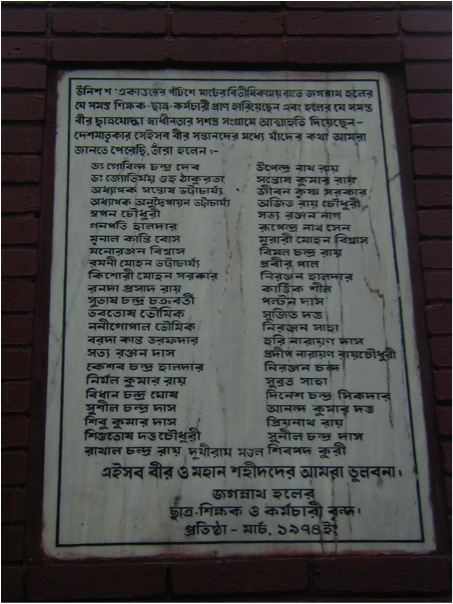
List of names of Hindu students and professors massacred at Jagannath Hall on night of 25th March, 1971 by the Pakistani Army. Click to enlarge. Photo credit: Udayan Chattopadhyay.

Nirad C Chaudhuri and Jatin Sarker were both born in Hindu families in the Mymensingh district of eastern Bengal, now Bangladesh. Chaudhuri, about four decades older than Sarkar, wrote his autobiography before India held its first election, and ceased to be an unknown Indian. Sarker also wrote his life story. Unlike Chaudhuri, Sarker’s was in Bangla, published in Bangladesh, never translated in English, and not available in India or beyond. He remains unknown. Which is a pity, because if you want to know what has happened to the land where both these men were born, Sarker is a far, far better guide than Chaudhuri.

Sarker, of course, stopped being an Indian on 14 August 1947, when Mymensingh became part of East Pakistan — the eastern wing of Jinnah’s moth-nibbled land of the pure. His family didn’t move to India. They were not atypical. Many Hindu families remained in East Pakistan. Perhaps it was the presence of Gandhi. Perhaps it was the fantastical belief that Subhas Chandra Bose would return in 1957 — a century after the Great Uprising, two centuries after the Battle of Plassey — to reunite Mother Bengal.   Continue reading The Banality of Bengal: Jyoti Rahman on the Tribulations of the Bangladeshi Hindus

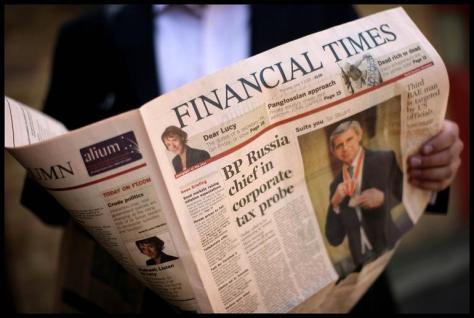
What caste do you think the Financial Times is?

See update below.

So… I get a phone call yesterday. It’s a reporter from the Financial Times who wants to know what I feel about the recent ban on the movie Aarakshan in certain states, and also what do I feel about caste-based reservations in general, whether caste is still relevant in the India of today, the theory that quotas just increase inequality etc.. I tell her I haven’t seen the movie, and if she still wants to know what I feel about caste-based reservations we could talk for a bit. She says she absolutely wants to know. So I say fine, and we have a 45-minute conversation. Allow me to reproduce a very simplified version of that conversation (in Q&A forrmat):

1. Q: Do you believe movies like Aarakshan can be provocative or controversial; as in, are certain groups justified in taking offence and asking for a ban? Continue reading What caste do you think the Financial Times is?

Breivik’s model nation and migrants in South Korea: Bonojit Hussain

Guest post by Bonojit Hussain

Norwegian mass killer Anders Behring Breivik, in his manifesto, hailed Hindutva forces in India as an important ally in his envisaged fight against what he calls the “cultural Marxist/social humanist” world order. But he seems to be far more impressed by the conservative cultural milieu of South Korea as far as migrants are concerned; so much so that his manifesto is not only replete with praises for South Korean society and State but also his stated goal for Europe is to achieve a “mono-cultural” ethos, modeled on South Korea. Breivik believes that South Korea being a “scientifically advanced, economically progressive” society “out rightly rejects multiculturalism and Marxist cultural principles”.

Breivik’s manifesto might appear to be full of rambling political rants; but it seems he is not radically off the mark in understanding Korea’s hatred for migrants. So much so that right wing groups in Korea must have smiled and said in Unison “At last! Somebody recognizes our real value”.

Continue reading Breivik’s model nation and migrants in South Korea: Bonojit Hussain

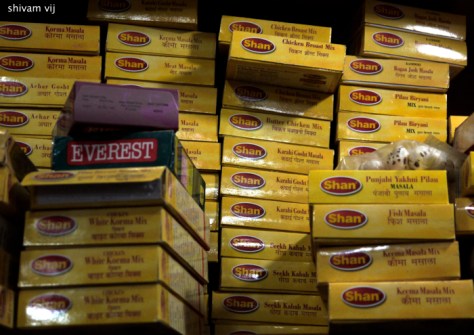
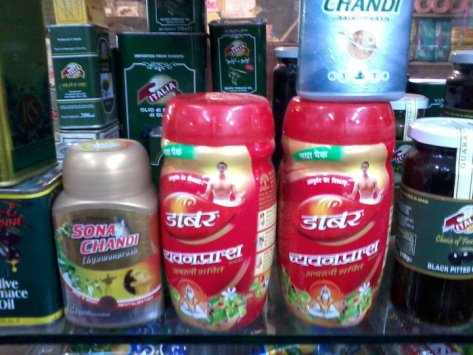
India and Pakistan: A Matter of Taste

Imported from Karachi, Shan masalas are a hit in Delhi. They make sure anyone can make good Biryani or Korma. Photo taken at a grocery store in south Delhi by Shivam Vij
Dabur Chawanprash at a grocery store in Lahore. The Devnagiri script on the pack would be a rarity in Pakistan! Photo credit: Shiraz Hassan

Every time there is a bomb blast in India

Jyoti Punwani writes:

Expectedly, the questions were the same. What were you doing on the day of the blasts? Had you gone to Cheetah Camp? Do you know anyone from the Indian Mujahideen? How many times have you been to Pakistan? Why does only your information come to us? Get your house documents.

Amanullah was ready with the answers and documents… [Must Read]

From Kafila archives:
What does it mean to be a Muslim in India today?

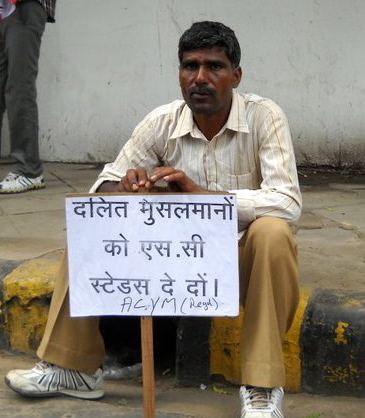
The Unending Struggle of Dalit Christians and Dalit Muslims for Equality: S. Japhet and Y. Moses

On the sidelines of a protest at Delhi's Jantar Mantar today

Guest post by S. JAPHET and Y. MOSES

Religious minorities, both Christians and Muslims from different parts of the country have converged in Delhi to demand reservations for Dalit Christians and Dalit Muslims. This is part of a long standing struggle demanding the Government to introduce a bill to amend the constitution to include Dalit Christians and Dalit Muslims in the scheduled Castes list. The Christian community has been agitating since the promulgation of the Presidential Order Government of India 1950 that effectively prevents those professing religions other than Hinduism from being considered as Scheduled Castes. It has been argued that the 1950 Order violates Article 15 that prohibits discrimination on grounds of religion, race or caste and Article 25 that gives the right to all citizens to profess and practise any religion according to his or her choice. The demand is that affirmative action or positive discrimination of dalits, providing reservations in government jobs, educational institutions and representation in Parliament and state legislatures should be extended to all dalits irrespective of whatever religion they may profess and practise. Continue reading The Unending Struggle of Dalit Christians and Dalit Muslims for Equality: S. Japhet and Y. Moses

Statement of Indian Women’s Rights Activists in Solidarity with Women in Sri Lanka

It’s been more than two years since the supposed end of the war in Sri Lanka. The issues of concern are many, particularly with regard to the period after the end of direct combat. The Sri Lankan government has been abysmal in acknowledging the range of human rights violations that have been committed by the armed forces, which has been documented without a kernel of doubt by the United Nations report as well as the Channel 4 documentary. This documentation has been made in spite of circumstances where any neutral observation of the last stages of the conflict was made impossible by the Sri Lankan government and its army.

Continue reading Statement of Indian Women’s Rights Activists in Solidarity with Women in Sri Lanka

Two Years On: No War but No Peace for Women still facing the Consequences of the War – CMTPC

Statement by COALITION OF MUSLIMS AND TAMILS FOR PEACE AND COEXISTENCE

The coalition of Muslims and Tamils is a Sri Lanka based organization-comprising Muslim and Tamil identified persons who as a general principle are committed to pluralism and social justice in all its forms. Specifically, we are committed to the peaceful coexistence of Muslims and Tamils in the country, particularly in the north and east, and to a just and equitable solution to the ethnic conflict.

We can be contacted at: ctmpc_srilanka@yahoo.com

We have changed our blog site and the new address will be up soon!
Old blogsite: http://www.ctmpc.blogspot.com/

Two Years On: No War but no peace for women still facing the consequences of the war

Women in the north and the east of Sri Lanka have undergone severe hardships during the war, including the loss of loved ones, family’s support structures, livelihoods, houses and also a loss of life and dignity. While there have been numerous changes announced by the Government the situation for women on ground, however, has continued to be challenging. It is sad since the end of the brutal war women’s lives have not seen a dramatic transformation over the last two years and they have continued to face the basic challenges of safety, shelter and basic facilities. It in this light that we wish to put forward a few issues that these women have been facing within the broader context of life in the north and east for the communities living there.   We have chosen to highlight these issues because of their gravity, the State’s involvement in the same and the inability of women to seek justice in such cases owing to the lack of an effective civilian administration, security threats and the lack of a concrete remedy within the local legal system.  While we write of the issues relating to women, they raise broader concerns impacting the families and communities. The incidents and the report cover only the Northern and Eastern Province of Sri Lanka.     Continue reading Two Years On: No War but No Peace for Women still facing the Consequences of the War – CMTPC

Martyrs’ Days: Memorializing 13 July 1931 in Kashmir: Mridu Rai

Guest post by Mridu Rai

It is widely believed that the Kashmir conflict has its roots in the Partition of India in August 1947. This view perpetuates the understanding of the conflict as one between India and Pakistan. However, recognising that the roots of the conflict lie in an earlier history – indeed, that there was a history before August 1947 – changes our understanding of the ‘intractable’ conflict in Kashmir. This guest post by MRIDU RAI, author of the book, Hindu Rulers, Muslim Subjects: Islam, Rights and the History of Kashmir (2004), discusses the salience of the events in Srinagar on this day, exactly 80 years ago.

While "separatists" were placed under house arrest to prevent commemorative mass gatherings, policemen took part in Kashmir Martyrs' Day ceremonies at the Martyrs' graveyard in Srinagar, July 13, 2011. Photo credit: Reuters

Continue reading Martyrs’ Days: Memorializing 13 July 1931 in Kashmir: Mridu Rai