Category Archives: Identities

Madhuri and Zeenat

I recieved a mail today about the  deafening silence on the 24X7 newsbreakers regarding La affaire Madhuri and it got me thinking.

Is it not a bit strange that an OB van is not stationed permanently at the Vikaspuri residence of Ms Gupta? How is it that her milk man, her vegetable seller, the retired army major/ or a school principal or an old acquaintance who lives a few houses away have not been interviewed 200 times in the last two days?

How is it that archival shots of Ms Gupta driving away in her car, or recent shots of her being led away  in hand-cuffs, pan shots of her house from across the road, shots of authentic looking documents, of the schools she went to, of interviews with her old parents asking them how does it feel to be parents of a traitor? etc., etc. are not being run in a 24 hour loop? Continue reading Madhuri and Zeenat

Peeing in Peace and the Revival of Labour Activism in Kerala

The city of Kozhikode in northern Kerala has seen many a spectacular public protest by women since the 1930s. Recently, it witnessed a truly unique protest which hopefully reveal the shape of things to come. This was over the denial of safe toilet facilities to women, especially the large numbers of underpaid and overworked women employees in the city shops.The issue was successfully raised by the action committee organized by Penkoottu,an organisation of women workers in the city–  which included many  organizations including the feminist group Anveshi,the Muslim women’s organization Nisa, some activists of the Mahila Congress, and independent activists. Continue reading Peeing in Peace and the Revival of Labour Activism in Kerala

Two Overheard Conversations, Delhi 2010

Guest post by ANAND VIVEK TANEJA

Conversation One. I’m sitting in a barber-shop in Sector 34, Noida, getting a haircut. The older guy sitting next to me, getting a shave, asks this younger fellow who’s just got up from a haircut –

  • Tu kahaan se hai bhai? Where are you from?
  • Main to Noida se hi hoon. I’m from Noida only.
  • Noida ka to na laage hai. You don’t look like you’re from Noida.

The young man in question was slight and skinny, and was dressed in what could be described as  generic global college student/hipster style. The conversation continued. The barber said, no he’s definitely not from Noida. The young man turned on him and said, Tum kaunse Noida ke ho, Well, you’re not from Noida either. The barber says, Main to Bihar se hoon. Main thodai hi chhupa ke rahkta hoon. I’m from Bihar. I don’t hide the fact. Then the barber says, Yeh to lawaris hai ji. He has no parentage, sir.

Statement on the death of Dr Srinivas Ramachandra Siras under suspicious circumstances

FOR IMMEDIATE RELEASE – 7th April, 2010

News reports on several media channels have just reported the death of Dr Srinivas Ramachandra Siras, 64, Reader and Chair of Modern Indian Languages at Aligarh Muslim University. According to reports, Dr Siras’ body was found “in mysterious circumstances” with bleeding from the mouth in his home in Aligarh.

Dr Siras, as is known, had recently fought against his unlawful and unethical suspension from AMU on the grounds of “gross indecency”. After decades of teaching, he was suspended merely a few months before his retirement on the basis of videotapes filmed by intruders into own home without his consent in a blatant and homophobic violation of his privacy. Right after, he said: “I have spent two decades here. I love my University. I have always loved it and will continue to do so no matter what. I wonder if they have stopped loving me because I am gay.” Continue reading Statement on the death of Dr Srinivas Ramachandra Siras under suspicious circumstances

‘constitutional’ Realities: Priya Thangarajah

Guest post by PRIYA THANGARAJAH

The piece is unfinished, consciously so. The thought is unfinished and needs to be fleshed out and thus posting this, so that this important idea can be evolved collectively. It raises a range of questions and contributes to existing debates on constitutional law from a social change/human rights perspective. (consciously the words ‘constitution’ and ‘india’ are not capitalised. ) It contributes significantly to an understanding, not just of north east india but the realities of chattisgarh, jharkhand, bihar, kashmir to name a few. It helps us understand all the wars fought within the country – ‘constitutionally’ about which much is being said in the media and elsewhere by state and non-state actors.

The constitution, some argue, is an aspirational document. Baxi states that it is created to protect the rights of the impoverished. Created to protect the weaker sections of society and that’s how the Dworkinian trumping of rights works. Rights of the weaker parties always trumps that of the stronger. But whatever the aim of the constitution maybe, its sacrosanct. Sacred. Amendments can be made with great difficulty but the constitution per se cannot be done away with for a new one. Continue reading ‘constitutional’ Realities: Priya Thangarajah

Sree Narayana Guru, the Left, and Chitralekha: Joe.M.S.

This is a guest post by JOE M. S.

The recent controversy associated with the brutal persecution of a Dalit working woman, Chitralekha  by the hoodlums of a ‘leftist’ union has gained wide attention, bringing into limelight the plight of  Dalits in Kerala. The men who participated in this ’festival of masses’, according to reports, predominantly belong to the  backward caste Ezhava/ Theeya community. Anybody with a bit of social concern would have definitely condemned the incident . They would even have expressed their regrets at the deviation of the people belonging to Ezhava caste, the disciples of Srinarayana guru, the famous social reformer, from the avowed policies advocated  by him. But I think, here lies a problem. A re-look at the social history of Kerala is needed   to understand whether the Chitralekha incident is a deviation from the pronounced objectives of the Srinarayana movement as  such, as it is popularly understood, or  the roots for  such a development  was inherent in the   trajectory of   the Narayana movement itself. This does not belittle  the genuine intentions Guru had for social emancipation, at a personal level.

In spite of the cultural specificities of northern Kerala  where  these atrocities were perpetrated on Chitralekha, I think a general study of the impact of Srinarayanism on the whole of Kerala may be of some help to analyse the increasing backward caste arrogance vis-a-vis Dalits. This is particularly so as the discourse on the assumed efficacy of Sri Narayana Guru’s thought is  invoked constantly  by the civil society of Kerala, eternalising his importance  in all spheres. So  I think, a glance at the  impact of his life and efforts  can shed light on the of the constitution/ construction of modern Ezhava identity and the problems associated with it.

Continue reading Sree Narayana Guru, the Left, and Chitralekha: Joe.M.S.

While we thank A.P.Shah, some reflections

The text below was written as an email on many LGBT lists in India. Followed by the text of the email are a few after thoughts on the email itself and the reaction to it.

Dear all,
It’s been interesting to watch all the reactions to A.P.Shah’s unfair retirement. This has been from various quarters including the LGBT community.
One must admit, among all the communities whose lives his judgments have attempted to change, we have been rather vocal in thanking him profusely. This is a good trend to set in general as sometimes I feel others working on various issues whose work has been vindicated rather literally by him have not taken the time out to do an analysis and express their gratitude towards the existence of a judge like him, in the otherwise difficult judiciary in this country. This might make a difference to him. He is hurt by the judiciary which he dedicated his life to which has now slighted him through opaque, undemocratic processes, thus going against all that he stands for and what the judiciary claims to stand for. So am glad we are doing this! Continue reading While we thank A.P.Shah, some reflections

Johannesburg – Notes from a Mother City

Mother City?!? What is a Mother City?

We arrived at the Tambo airport, waiting to be received by the taxi driver. The taxi driver, also the initiator of the taxi services company led us from the arrival hall into the parking lot. He was an old, white man, with a completely white beard. He looked a bit like Santa Claus. Upon reaching the car, he opened the door to the boot and started lifting our heavy bags, one by one, to load into the boot. I said I would lift my bag myself (because somewhere inside my conscience, it seemed incorrect for an elderly person, my grandfather’s age, to lift my bags and put into the boot). He looked up and said,

In this country, we are all slaves. Let me do this. Continue reading Johannesburg – Notes from a Mother City

Undermining Political Reconciliation with Post-Election Repression

The following are my prepared remarks at the Global South Asia conference at New York University on 13 February 2010.  My prepared remarks on the Sri Lanka panel in titled, ‘Return of the Displaced and Political Reconciliation’ are below.  The remarks in the Sri Lanka panel which I chaired were to complement the presentations by Sharika Thiranagama, New School for Social Research titled, ‘Houses of the Future: Return and Reconciliation amongst Northern Muslims and Tamils’ and V. V. (Sugi) Ganeshananthan, University of Michigan, Lanka Solidarity, journalist and author of Love Marriage titled, ‘Dialogue in the Diaspora’.  The February 2010 issue of Himal Southasian magazine is a special issue on Jaffna, Sri Lanka and has a number of articles that address the post-war moment. The Sri Lanka Democracy Forum (SLDF) statement on 18 January 2010 titled, ‘SLDF Calls for National Attention on Demilitarization and a Political Solution’ details many of these issues in depth.

I want to begin with the end of the war, which inevitably leads to a shift in politics.  Post-war politics can not be same as war politics.

During the last couple years of the war, President Rajapaksa put together a war coalition comprised of a broad spectrum, from Sinhala nationalists to sections of the Old Left.  Despite the end of the war, the President and his government attempted to keep the war mentality alive, as we have seen through the continued suffering of the displaced as they were herded into internment camps with no freedom of movement.  It was indeed a lost opportunity for political reconciliation. Continue reading Undermining Political Reconciliation with Post-Election Repression

The Many ‘Vices’ of Chitralekha

Chitralekha, a dalit woman from Payyanur, Kannur, has been in the news since 2005, for her open challenge to the CITU in that left bastion. An autorickshaw driver, she had protested at the CITU’s constant interference at work and the intensely male hostility against her presence in an almost exclusively male line of work. Braving ‘character-assault’ from the CITU which called her a ‘loose woman’, a ‘regular drunk’ and so on, she continued working until,in December 2005, her autorickshaw was burned down. She fought, however, and was supported by various Dalit, Feminists and Citizen’s initiatives. In June 2008, she procured a new autorickshaw with their support. This did not mean that she was now acceptable to the CITU . Now recently, she complained that the CITU had seized a chance encounter to beat her and her husband, and the police, who arrived on the scene, took them to the police station and unleashed even worse violence. Her complaints have been ignored or treated with hostility by the mainstream media in Kerala. Activists and concerned persons in and outside Kerala, however, have rallied to her support. Continue reading The Many ‘Vices’ of Chitralekha

A Republic of Cities

From the Indian Express this morning.

Independent India was built, imagined and judged by its villages; by gram swaraj. The nation was rarely, if ever, imagined by its founders to be led (Chandigarh aside) by its cities. Cities were spaces of the other — of colonial empires and cantonments, of a modernity that had come first in the garb of colonialism — separate from the “inner” nation, which, authentic and unsullied, lived on in the villages. As Nehru once famously said: “we want to urbanise India’s villages; not take away the people from villages to towns.”

This ambiguity over the city and the reductive stereotypes it inhabits has had a long innings; and yet has begun to change. The urban has begun to rise not just demographically but politically, electorally, socially, culturally and economically to become the defining problem space of the ‘new India.’ Cities, for better and worse, have caught our imagination.

Enemy Property

There have been several news reports recently about attempts by the builder Mafia to capture properties near the Jama Masjid in Shahjehanabad (popularly, known as old Delhi) to build a 100 room hotel. Reports have also suggested the involvement of a local politician, though the politician has refuted the allegations very firmly.

This piece is not about the builder mafia or the local politician, but about another issue that has cropped up during the investigation of the attempted land grab. It has been found that the ownership of one of the properties is under dispute and a case has been going on for close to two decades.

The reports say that the disputed property belongs to the “custodian of enemy properties”. Even a cursory reading of the reports would reveal the identity of the original owners of these properties. The original owners of these properties were Muslims of Delhi.

Muslims, who had lived in Shahjehanabad for generations, some for centuries like the families of my ancestors. Continue reading Enemy Property

Protest and Terrorism, Is there a Difference?

Sufiya Madani of the PDP has been granted conditional bail by the Ernakulam Sessions Court Judge after a tense wait following her arrest on 17 December. She was remanded to judicial custody by the first class magistrate court at Aluva which had refused her bail. Meanwhile, the mainstream media went on a speculation-spree, even publishing ‘evidence’ that she had abetted terrorism and violence — the burning of a bus owned by the Tamil Nadu Road Transport Corporation at Kalamassery in 2005 during protests against the PDP leader Abdul Nasser Madani’s (Sufiya’s husband) continued detention in the Coimbatore jail . Continue reading Protest and Terrorism, Is there a Difference?

Media Induced Morbidity Syndrome: Anant Maringanti

Or, when suicide threat becomes political strategy

Guest post by ANANT MARINGANTI

I am witnessing a bizarre phenomenon in Andhra Pradesh which I can at the moment only call Media Induced Morbidity Syndrome. That this is pathological, and that this has to do with the media I am certain. But it is difficult to pin down what the pathogen is.

First, in the days and weeks following the then chief minister Y S Rajasekhar Reddy’s (YSR) death on September 2nd, 2009; over 450 people were reported to have died either of heart attacks or suicides. Newspapers kept a daily tally and the numbers kept mounting. Being in Singapore at the time, several thousands of miles away from Hyderabad during those weeks, I had no first hand experience of the mood in Hyderabad. I dismissed the reportage as a silly political gimmick. It was easy to surmise that vested interests had simply been collecting daily death reports from various government hospitals in different towns and attributing them to grief over YSR’s death. The largest number of these deaths – 227 occurred on the day of the funeral and the following day. Continue reading Media Induced Morbidity Syndrome: Anant Maringanti

Savarna Terror Erupts in Kerala

(with inputs from Mythri Prasad Aleyamma)
I admit, this title sounds sensationalist. But one can hardly avoid resorting to it when confronted with utterly stupefying news of attacks on dalit colonies almost next door to Kerala’s capital city and nerve centre of Malayalee politics, and that too, by a minor anti-political force that has a legacy of anti-South Indian hatred — the Siva Sena. And of course when one is confronted with the hard, stony silence of almost all sections of the media about this. The mystery of the murder of an elderly, innocent morning-walker in Varkala, a town close to Thiruvananthapuram (of which I wrote in an earlier post) still remains a mystery; the police story is so full of holes that it looks like a sieve. But the Guardians of our Free Press are still lapping police versions and not conducting independent investigation. Activists who have dared to do so have been heckled and hounded, even senior and respected human rights activists like B.R.P.Bhaskar, by the Siva Sena, and their protests have been ignored. Meanwhile violence continues to be unleashed against the supporters of the group that has been accused of murder, the Dalit Human Rights Movement (DHRM).

Continue reading Savarna Terror Erupts in Kerala

Who’s at ‘Jihad’? : ‘Love Jihad’ and the Judge in Kerala

It looked as if the controversy over ‘Love Jihad’ ( ‘jihad defined as ‘war by other means’) had  blown over with state authorities in Kerala and Karnatake denying that such a threat ever existed.The Central Government informed the Kerala High Court early this month that there was no such thing and that the term ‘love jihad’ was being used by the media.However, today, the Kerala High Court openly voiced its scepticism of police reports, claiming that the reports were inconsistent and citing various technical flaws.The Court claims that it is abiding by the secular spirit of the Indian Constitution: it agrees that the freedoms to choose one’s faith and one’s partner in marriage are fundamental rights. However, it feels that the present instances of marriage and conversions that have been brought to its attention are not the exercise of freedom by individuals — specifically, by young women, though the Court does not say it that way. It is difficult to imagine a more anti-Muslim and anti-woman position; and it is a serious matter that the muddle-headed reasoning of the judge has been uncritically circulated in the dominant media.
Continue reading Who’s at ‘Jihad’? : ‘Love Jihad’ and the Judge in Kerala

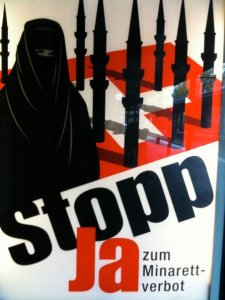
Minarett-Verbot

This is a guest post by Naeem, an artist friend. The post is a cull from a conversation regarding the recent ban in Switzerland imposed on building minarets.

In a vote that displayed a widespread anxiety about Islam and undermined the country’s reputation for religious tolerance, the Swiss on Sunday overwhelmingly imposed a national ban on the construction of minarets, the prayer towers of mosques, in a referendum drawn up by the far right and opposed by the government. The referendum passed with 57.5 percent of the vote and in 22 of Switzerland’s 26 cantons.

Continue reading Minarett-Verbot

Tilting at Wind Mills Aren’t We

The Jamiat Ulama-e-Hind Conference held recently, has raised Cain through one of the 25 resolutions that were passed at the conference. The kind of noise that has been generated by this resolution has virtually air-brushed the other resolution out of reckoning. Did the remaining 24 resolutions not deserve closer scrutiny, especially in view of the fact that many of these resolutions had taken off from the recommendations of the Sachar Committee report.

The 24X7 “News” channels that claim to keep us updated on developments even before they occur, have by and large concentrated all their energies on this one resolution which claims that the “Singing of Vande Maatram is Un-Islamic”. Given the kind of attention that this resolution has already received, it may be worth our while to talk about some of the other resolutions before getting into the raging debate of Vande Maatram. Continue reading Tilting at Wind Mills Aren’t We

Tatte Girao, Hijra Hattao: Satya Rai Nagpaul

This guest post was sent to us by  SATYA RAI NAGPAUL, Transman, Cinematographer, Founder Member: SAMPOORNA: A Network for Asian & Diasporic Asian Trans Persons.

‘Tatte Girao, Hijra Hattao’ was written in response to Farrukh Dhondy’s article ‘The male eunuch & other chromosomes’ in The Asian Age newspaper, August 29th, 2009.  The Asian Age did not publish Satya’s response, and so it has been circulating on relevant e-lists for a while.


Caster Semenya’s record breaking run in the Berlin World Athletic Games this August, not only raised doubts in the organisers about her ‘real sex”, but back home, has precipitated our very own Mr Farrukh Dhondy’s jounalistic activism to save our boys from falling into any possible sexual/gender ambiguity.
His prescription: Get ‘the apparatus’ and you shall be a ‘man’!

If the medical and legal communities were not enough, we have now to fight our so called “progressive” journalists who write columns about ‘so called eunuchs’, who their medical friends tell them ‘were not eunuchs at all’.

The transphobia, gender essentialism and high moral ground in Mr Dhondy’s article couldn’t have been more naked. What appears throughout the article as his well meaning and sympathetic concern, finally reveals its true face in that last draconian sentence: ‘Make hijras history’. How could the corporeal realities of the hijra be so lost on a journalist [and one who is himself a minority, being a parsi, as stated in his article] that he can wish for the wiping out of an entire way of life? Instead of espousing their human rights, he wishes them not to exist at all?!

Mr Dhondy’s statement that all hijras suffer from Cryptorchidism, and that it is a simple medical procedure that will make men out of them, not only reveals his journalistic smugness but also that he has been completely absent from all discourses on sex/gender emerging ever since the years of the second world war. The binary conceptualisation of sex/gender is long dead in cutting edge academia and even the medical sciences have begun to open out their sex/gender categories to the new conceptualisations.
Continue reading Tatte Girao, Hijra Hattao: Satya Rai Nagpaul

Interview with Ins Kromminga, German intersex activist and artist

Below are excerpts from an interview I did with a fascinating artists and activist who initiated a process in me, simple and obvious, and yet complicated and hardly ever embarked upon- vis-a-vis the politics of gender and sexuality. Ins has challenged the routine of the politics we engage in and the world view we sometimes unintentionally take for granted and thus make static, Hoping for an engaging discussion on the issues Ins lays out below.

Also, something to think about: how we write articles in popular media about difficult, unspoken of issues to just put them out there. To bring about some visibility but at the cost of some of the complexity? Sometimes visibility even at the cost of compromise on our politics of how we speak of pain and pleasure in all our lives and in the context of the frameworks of oppression? I see myself having done this below in my fleeting account of Ins’s life and work. How then do we engage with the mainstream media and find the language to articulate complexities approachably and regularly? It’s the eternal question but lets ask it again because, as we all know, we have to. :) Continue reading Interview with Ins Kromminga, German intersex activist and artist

Caste and Modernity

A friend remarked the other day that this is an “unendingly interesting” country. The phrase is stuck in my head, and it recurs when I come across stuff like this:

There were no Hindu untouchables in the West Punjab, and such work as that of sweepers, skin-flayers and leather workers was done by Muslims. They were presumably untouchable Hindus who had at one time become Muslims to escape their lot, which they apparently did not manage to do…

As I boy I would feel quite ashamed when my mother, asking for a glass of water at some Muslim house, would be told with ingratiating courtesy that both the glass and the water had come from a neighbouring Hindu family. But slowly I saw the change come in. Our father made no bones about eating with Muslims and bringing them home. Interestingly, this problem was solved in our home, as in many other homes where a similar change was at work, by the introduction of chinaware. Continue reading Caste and Modernity