Category Archives: Images

നിലനില്പിനു വേണ്ടിത്തന്നെയുള്ള സമരം : ഫാസിസ്റ്റ് വിരുദ്ധ ചുംബനസമരം തിരുവനന്തപുരത്ത്

നിങ്ങൾക്ക് സദാചാരപ്പോലീസിനെതിരെയുള്ള സമരം ഓപ്ഷണൽ ആയിരിക്കും. ഞങ്ങൾക്ക് അത് ജീവൻമരണപോരാട്ടമാണ്.


അടക്കാൻ ഞങ്ങൾ ശവങ്ങളല്ല.

ഒതുക്കാൻ ഞങ്ങൾ വീട്ടുസാമാനങ്ങളല്ല.

ഫോട്ടോ എടുത്തുകളിക്കാൻ ഞങ്ങൾ

കടമുന്നിൽ തുണി ഉടുത്തും ഉടുക്കാതെയും

ചിരിച്ചു കൈകൂപ്പുന്ന പാവകളല്ല. Continue reading നിലനില്പിനു വേണ്ടിത്തന്നെയുള്ള സമരം : ഫാസിസ്റ്റ് വിരുദ്ധ ചുംബനസമരം തിരുവനന്തപുരത്ത്

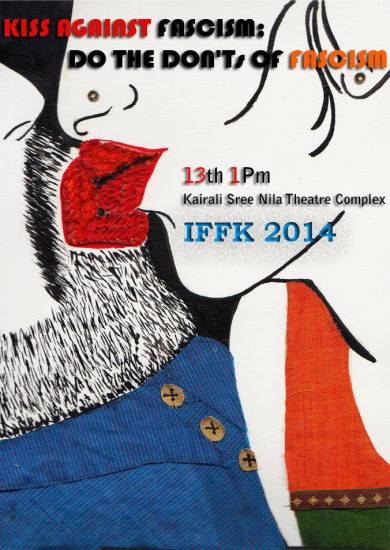
Wave after Wave, We Refuse to Die Down: Kiss Protest Against Fascism at IFFK

If you are in Thiruvananthapuram, please do join us at one o’clock at noon in front of the Kairali-Sree theatre complex at Thampanoor, the main venue of IFFK.

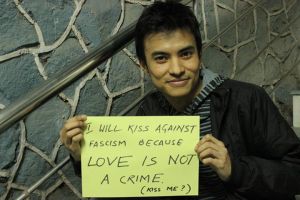
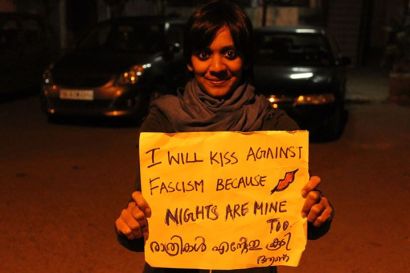
We do believe that the rising tide of fascism in Kerala, the creeping fear of the sheer violence of fascist goons, can be combated only through love, humor, and moral courage. The victory of Hindutva right wing forces in the national scene seems to have emboldened them in Kerala. They are attempting to import here the instruments of terror that they brazenly unleash on people in the states which have become laboratories of their hate-politics. We will not let their evil grow; we will fight it with love.

We will use as an instrument of self-defense precisely all that which fascist forces deny us in this society. We will reclaim that ultimate symbol of tender and intimate human contact, the Kiss; we will kiss against fascism.

And each of us has different, but interconnected reasons, for kissing against fascism.

sunilKissable boymikek edited 3aswatyrenuedited 2nisaaratrikasinghabipshaKAF solidarity


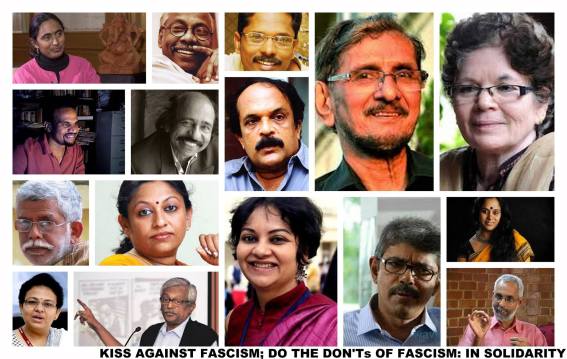
ഫാസിസത്തിനെതിരെ സമരചുംബനം; ചെയ്യുക, ഫാസിസം അനുശാസിക്കുന്ന അരുതായ്മകളെ


Kiss against Fascism

Continue reading ഫാസിസത്തിനെതിരെ സമരചുംബനം; ചെയ്യുക, ഫാസിസം അനുശാസിക്കുന്ന അരുതായ്മകളെ

അഴിക്കാനും ആടാനും തുനിഞ്ഞിറങ്ങിയവർ തന്നെ നാം : തെരുവിൽചുംബനസമരക്കാർക്ക് ഒരു സന്ദേശം

സുഹൃത്തുക്കളെ,


കിസ് ഒഫ് ലൌ സമരങ്ങളുടെ രാഷ്ട്രീയത്തെക്കുറിച്ച് പലതരം ആശങ്കകൾ കേട്ടുതുടങ്ങിയിരിക്കുന്നു.

അത് ആഗോളീകരണ അഴിഞ്ഞാട്ടമാണെന്നും,

അതല്ല, മദ്ധ്യവർഗ്ഗ സന്തതികളുടെ എടുത്തുചാട്ടമാണെന്നും,

അതുമല്ല, അതിനു രാഷ്ട്രീയമേ ഇല്ലെന്നു വരെയും, കേരളത്തിലെ ബദൽരാഷ്ട്രീയങ്ങളിലെ പ്രമുഖവ്യക്തിത്വങ്ങൾ അടക്കമുള്ള പലരും മുറുമുറുക്കുന്നു.

Continue reading അഴിക്കാനും ആടാനും തുനിഞ്ഞിറങ്ങിയവർ തന്നെ നാം : തെരുവിൽചുംബനസമരക്കാർക്ക് ഒരു സന്ദേശം

‘Kiss of Love’ in Delhi, confronting the RSS: Vasundhara Jairath and Bonojit Hussain

Guest Post by Vasundhara Jairath and Bonojit Hussain 

In the first of its kind in India, youth in Kochi launched a campaign called ‘Kiss of Love’ to challenge the moral policing of the Hindu Right. While that protest was attacked by right wing thugs and suppressed by the police, this form of protest has since spread to different parts of the country like Hyderabad, Bombay and Calcutta. Today, the ‘Kiss of Love’ protest was held at nowhere short of the Rashtriya Swayamsevak Sangh (RSS) head office in New Delhi. A few individuals took the initiative and gave a call for this protest on Facebook with the title, ‘Sanghi Gunde Hoshiyar, Tere Samne Karenge Pyaar’ (Sanghi thugs beware, we will love in front you). Continue reading ‘Kiss of Love’ in Delhi, confronting the RSS: Vasundhara Jairath and Bonojit Hussain

Resist the Sangh Parivar’s Hatred of Love: Nayanjyoti and Subhashini

Guest Post by Nayanjyoti and Subhashini

In late October, the youth wing of the Sangh Pariwar among others vandalised a café in Calicut on the pretext that lovers ‘date’ each another sitting in this café. When many young men and women in Kochi gathered together to protest by expressing their love in public, they got beaten up by various right wing groups and the police in response. The students and youths in different regions of the country gathered in solidarity of this protest going by the name of ‘Kiss of Love’. At the same time, as the news spread rapidly through the media and social networking site, a polarization continues to develop in the society, even among the individual activists and similar organizations, for and against the form of this movement.

Continue reading Resist the Sangh Parivar’s Hatred of Love: Nayanjyoti and Subhashini

Statement Condemning Rape on EFLU Campus: EFLU Alumni and Other Concerned Individuals

Guest Post by EFLU Alumni and Other Concerned Individuals

[ This is a statement prepared by some alumni of EFLU, in the aftermath of the rape of a woman student on campus last week. The statement was then shared on the social media for endorsement. Those who had drafter the statement say that they “…were overwhelmed by the support shown by a cross section of people including alumni, not just practicing academics and students of other universities, but also techies and bankers, journalists and professionals.” The statement is intended to be seen as an expression of solidarity with the complainant, in appreciation of her bravery and as a means of extending support to the EFLU community who are trying to fight for gender justice in innovative and inclusive ways. ]

This is a public statement condemning the rape of a girl student in the hostels of The English and Foreign Languages University, Hyderabad. We express our solidarity with the complainant and demand that the guilty be punished. Happening within the university space, this action by the student’s peers shocks and saddens us, but also points at the deep entrenchment of patriarchy even within the most radical of spaces.

Continue reading Statement Condemning Rape on EFLU Campus: EFLU Alumni and Other Concerned Individuals

Hok Kolorob! A Strange Chatter in the Air – Ranabir Samaddar’s Fictofacts: Anindya Sengupta

This post continues the ongoing debate on Kafila occasioned by the charge made by Prof. Ranabir Samaddar in the DNA Newspaper about what he thinks is the ‘elitist’ character of the students movement that is continuing at Jadavpur University, Kolkata.

Guest Post by Anindya Sengupta

Now Ranabir Samaddar has done it. This charge of elitism – as evident in his article’s title ‘Elitist Protest in Jadavpur’ – is not new; it was in the air right from the onset of the movement, evident in numerous threads of comments in social networks. But when such labelling, as is regularly dished out by a Trinamul Congress backed Bengali daily like Khobor 365 Din, finds an echo in left-wing scholars, it hurts. It was almost a relief that Prof. Samaddar didn’t repeat the accusation that these rebelling students are a doped and debauched lot.

Looking up for the word ‘elite’ in the dictionaries yielded this among many: “A group or class of persons enjoying superior intellectual or social or economic status”.

Continue reading Hok Kolorob! A Strange Chatter in the Air – Ranabir Samaddar’s Fictofacts: Anindya Sengupta

Thirty Years On (from November, 1984): Jaspreet Singh

Kafila normally never publishes poems. But sometimes, we make an exception. Because poetry give voice to memory in ways that prose can’t always. And because we must never forget November, 1984.

Guest Post by Jaspreet Singh

30 YEARS ON

One hears that the grass has grown again

and old domes have been plated

with gold. Children of ashened fathers

have acquired autos and crystals, and Lutyens’

stones have bloomed

Continue reading Thirty Years On (from November, 1984): Jaspreet Singh

“Haider” – Hamlet in Kashmir: Suhas Munshi

This is a guest post by SUHAS MUNSHI

The challenge of telling stories of a conflict is its victims. Each, traumatized in their own way, needs their own story. The narrator is bound to fail not only those he didn’t include but those who didn’t see their stories recreated faithfully. Had Basharat Peer set himself the task of faithfully adapting the violence done to Kashmiris he would have had to script a pornographic narrative for the screen. Some of the bile directed at him from Kashmiris comes from a dissatisfaction of not depicting the true extent of the brutality of the Indian army and rendering its casualties adequately pitiful. An opinion piece written on the movie in ‘The Parallel Post’ titled ‘Setting the wrong precedent’ condemns torture scenes in the movie as having actually undermined the actual extent of army atrocity in Kashmir. The piece goes on to say, ‘army excesses wane out by the time movie reaches its climax.’

However, the only service that a story teller from Kashmir could do to art and to humanity is to depict the people living there, especially the victims, as humans; as people, just as they are found anywhere else in the world, and not continue to peddle the cliché of the valley being a dehumanized pastoral paradise. Accusations of betrayal, conceit and condescension are being hurled at Basharat Peer, the writer, when he has got, for the first time ever, the words ‘plebiscite’, ‘half-widows’ and the rousing call of ‘Azadi’ in a script, through a movie, on mainstream cinema. Continue reading “Haider” – Hamlet in Kashmir: Suhas Munshi

On The Real Tragedy of Secular Modernity: Anand Vivek Taneja

This is a guest post by ANAND VIVEK TANEJA

anandpost

In the discussion around Aarti Sethi’s essay on Remembering Maqsood Pardesi some very important questions arose. As these questions are directly relevant to my work, but also to the larger concerns of the Kafila community, I decided to dwell on them at some length. As these reflections were written in response to the comments of one particular person, I address him directly in what follows below.

Dear Imtiaz,

In your comments on Aarti’s essay, you say the following things about my work:

The tragedy of secular moderns of India is their fascination with Islam… And it appears secular modern Hindus are too busy analyzing jinns of Delhi, which is really sad!

… what do I do with the knowledge of emerging liberal ideologues working for the empire writing enchanting texts about chattan baba or the jinns?


I think that your opening statement is profound. But to understand its true depth, we need to revisit the terms “secular”, and “modern”, as well as our understandings of “Hinduism” and “Islam.” As an entry point into these questions, I will address your (rhetorical) question about what one should, and can do with “enchanting” texts about jinns. Continue reading On The Real Tragedy of Secular Modernity: Anand Vivek Taneja

Unwrapping the Soldier from the Flag – Kashmir after the Flood: Chirag Thakkar

Guest Post by Chirag Thakkar

Witnessing a culture of wounds trying to put itself together in times of a grave catastrophe is a difficult pursuit. For the archivist of State violence, the horror with which TRP-hungry television studios build a spectacle that is acutely wedded to a deep-rooted, pungent nationalism around catastrophe and relief in Kashmir, is frustrating. The insensitivity with which the Indian media has rubbed salt in the wounds of a people is appalling. One wonders if ours is a culture of calculated amnesia or of sightless apathy.
There is something very unique about the way in which we relate with the pain of the other. What is unique is the precision with which we reproduce perceptions about the masculine, hardened sons of soil – the security forces – and yet, at the same time, remain unmoved in failing to recognise the state of exception Kashmir has been in. What is also unique is how measured and stingy we are with our sympathy. Continue reading Unwrapping the Soldier from the Flag – Kashmir after the Flood: Chirag Thakkar

#Hokkolorob – The Politics of Making Noise: Rajarshi Dasgupta

Guest Post by RAJARSHI DASGUPTA

We must not celebrate every time we see a movement. Movements can be very popular without being very meaningful, disturbing only the surface of society. Some can be pretty and harmless like candle light vigils; others dangerous and ugly like ‘love jihad’. Some want efficient governance like Hazaare; others regime change like Nandigram. For those tired with political apathy, it is of course good news that a spate of new movements is emerging thanks to new technologies and media coverage. But it is equally true that they seem to be going indifferent directions, without any common end. The picture is not clear. Who knows better than us how ‘change’ can be purely rhetorical? It is not difficult to imagine why people are weary of dramatic social unrest. They hardly fail to bring yet more conservative and unscrupulous sections to power. If we don’t want to get carried away, it is because of repeated disillusionments with the promise of change that everybody makes but nobody keeps. Politics is not, we better understand, about promise but manipulation, bargaining for daily needs, livelihood and resources, and so it should be. Movements may come and go like fashion, they are incidental to reality, which changes very slowly if at all. There is an institutional process of elections we have put in place, and it has proven to be resilient and reliable.

Bandh Bhengey Dao – Break All Bonds –
Lyrics and Music – Rabindranath Tagore & Asian Dub Foundation
From the Original Sound Track of ‘Tasher Desh’ a film adaptation by Q
of Rabindranath Tagore’s Joyous Anarchist Opera

Continue reading #Hokkolorob – The Politics of Making Noise: Rajarshi Dasgupta

Freedom and the University – Reflections from a Teacher: Rimi.B.Chatterjee

Guest Post by RIMI B.CHATTERJEE. Photographs by RONNY SEN.

Graffiti on Jadavpur University Walls. Photograph by Ronny Sen

There has been a lot of noise about the recent agitation at Jadavpur University, and a lot of slanted media coverage. Allow me to set the record straight on a number of points.

Continue reading Freedom and the University – Reflections from a Teacher: Rimi.B.Chatterjee

Prose of Power and the Poetry of Protest – An Outsider’s Attempt to Make Sense of the ‘Kolorob’ in Kolkata: Uditi Sen

Guest Post by UDITI SEN

51288650-29337-hokkolorob
#Hokkolorob – Embodied

It’s been more than a week since tens of thousands of students marched in a rain drenched Saturday in Kolkata, in solidarity with Jadavpur University students and their fight for justice. Much has happened since to delegitimise this mammoth, genuinely popular and student-led march. A counter-march, the co-optation of the victim’s father by the ruling party, adverse propaganda in the press and fatigue and confusion amongst the protestors have been some of the dampening developments that followed the unexpected show of student power. True to their clarion call, hok kolorob (let there be clamour), the marchers made a lot of noise. A week later, as the numbers of protestors on the streets have dissipated as fast as they had congregated, it is perhaps time to step back from the euphoria of the gathering and the intimidation and murky co-optation of protest that followed, to reflect on the political meanings and potential of this uprising.

The march was not organised by any single political party, though many with experience or background in student politics of one ilk or the other, marched. The vast majority, however, were students who had never marched before and had no experience of politics. The question therefore arises, what, if anything is the unifying ideology of this body of protestors? What goals motivate them? Above all, the question that is doing the rounds the most, on social media, on mainstream news and on the streets is what are the politics of the protestors? The question of politics is seldom posed directly. Its ubiquitous presence, however, can be clearly read in the answers provided regarding the nature of the march, the motivations of the protestors and the identity of the marchers. Unsurprisingly, diametrically opposite sets of answers emerge from members of the ruling party, inside and outside Jadavpur University; and the people who took to the streets on Saturday. From the Vice Chancellor, the Education Minister and officially ordained leaders of the ‘youth’, such as Abhishek Banerjee and Shankudeb Panda, characterisations emerge that focus on indiscipline on campus, presence of Maoist and other outsiders and deep conspiracies. From students of Jadavpur University and their sympathisers, assertions emerge that this protest is about justice and not about politics. Both characterisations fail to capture what is at stake.

Continue reading Prose of Power and the Poetry of Protest – An Outsider’s Attempt to Make Sense of the ‘Kolorob’ in Kolkata: Uditi Sen

Terror, Performance and Anxieties of Our Times – Reading Rustom Bharucha and Reliving Terror: Sasanka Perera

Guest Post by SASANKA PERERA

[ This post by Sasanka Perera is a review of  Terror and Performance by Rustom Bharucha (2014). Tulika Books, New Delhi. Kafila does not ordinarily post book reviews. An exception is being made for this post because we feel that the subject of terrorism, which has interested Kafila readers in the past, is an important one, and needs to be thought through with seriousness. We hope that this post initiates a debate on Kafila regarding terror, the state, performance, and the performances – serious, or otherwise – that typically attend to the discussions of terror, whether undertaken by the agents of the state or by non-state actors, commentators in the media, or by intellectual interlocutors. ]

When I started reading Rustom Bharucha’s latest book, Terror and Performance, it immediately became an intensely personal and gripping engagement. It was difficult to read in a single attempt as the mind kept wandering from one unpleasant moment in our recent annals of terror to another in some of which I had also become an unwitting part – mostly as a spectator. From the beginning, my reading was a conversation with Bharucha’s text through detours of my own experiences and an interrogation to a lesser extent. In 1986, as a young man when I went to the Colombo International Airport to pick up my father who was returning from the Middle East, I was shaken by a tremendously loud sound for which I had no immediate references. I had not heard such a sound before. People started running towards the sound. It was a bomb that had blown up an Air Lanka flight which had come from Gatwick. The Central Telegraph Office in Colombo was bombed in the same year. We learnt that everyone was running towards the sound and not away from it. Dry local political humor very soon informed us that people were trying to get inside the bombed out telegraph office hoping that they could get free phone calls to their relatives in the Middle East as they had heard phones were dangling from the walls with no operators in sight. That was long before mobile phones and call boxes. We were still young in terms of our experiences with terror. However, we soon had very viable references to what all this meant as the political narrative of Lanka unfolded with devastating consequences. But in 1986, when the kind of terror that was to follow in all its fury was still relatively new and quite unknown, we were acutely unaware of the dynamics of the actual act of terror and the structure of feeling it could unleash. This is why many of us in these initial years were naively attracted towards the epicenter of the act rather than being mindful to run away from it. But as the society grew in experience, people soon learned their lessons. Though an academic text in every conceivable way, I was reminded one could always find a few rare books of this kind which might personally and emotionally touch a reader in addition to whatever intellectual stimulation it might also usher in. Terror and Performance is clearly one such book. From the perspective of the writer, Bharucha himself recognizes this personal emotional engagement and investment early in the book. For him, “this writing demands stamina as it faces an onslaught of uncertainties and cruelties at the global level that challenges the basic assumptions of what it means to be human” (xi). It is the same kind of stamina that one also needs to read it as most of us in South Asia would be reading it squarely sitting in the midst of our own worlds of unfolding terror. This is why all those thoughts came gushing into my mind throughout the reading. I was not only reading Bharucha; I was also reading my own past.

Continue reading Terror, Performance and Anxieties of Our Times – Reading Rustom Bharucha and Reliving Terror: Sasanka Perera

#Hokkolorob – Images from a Jadavpur Solidarity Meeting in Jantar Mantar, Delhi

Here are some images from a  meeting held in solidarity with Jadavpur University Students at Jantar Mantar, New Delhi, on Thursday, September 2014. Students from Delhi University, Jawaharlal Nehru University, Jamia Millia Islamia, Indian Institute of Mass Communications, teachers and professors from different universities in Delhi, Jadavpur University Ex-Students, Workers and Professionals from the Delhi NCR Region spoke at the meeting. A signature campaign was undertaken, and the assembled people wrote their statements on to a scroll in support of their friends at Jadavpur.

All Photographs are by Akhil Kumar, Youth Ki Awaaz. 

This slideshow requires JavaScript.

Khushi Ram, a terminated worker from the Maruti Suzuki Factory at Manesar had come from Haryana to express the solidarity that the workers of the Delhi-NCR region have for the students of Jadavpur University. He read a poem at the gathering. Kafila caught up with him as the meeting was about to end. Here is a video of him reading his poem for the readers of Kafila, and a brief record of a conversation with him about solidarity between workers and students.

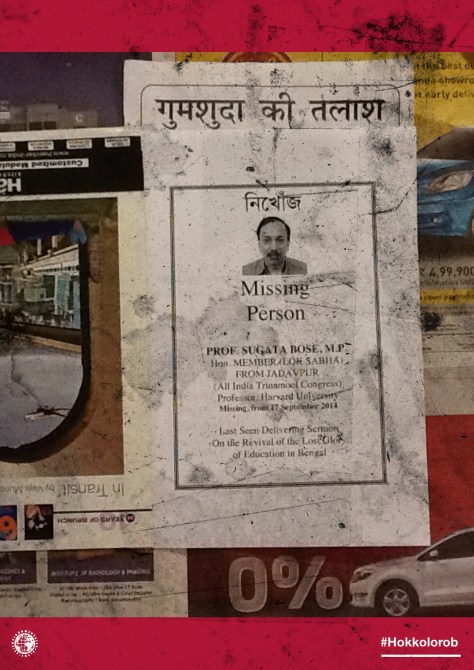
Missing Person Notice: Ben Zachariah

Guest Post by Benjamin Zachariah

Looking for Prof. Bose

It was not so long ago that Sugata Bose, now Lok Sabha Member for Jadavpur, made his way back from Harvard to serve his people. West Bengal had voted for ‘poriborton’, ‘change’, and as everybody assumed that Bengalis loved their fellow-men who had been anointed abroad, Sugata Bose returned to conquer the heights of Bengali higher education. The plan was to use a brand name within a brand name to shore up another brand name : Harvard, Netaji, Presidency. The Trinamul Congress, Bose was confident, would not interfere with his plans. Or so he said in public; his mother, Krishna Bose, had been the Trinamul Congress’s Presidential candidate, and long regarded as the force behind the attempted bhadramahilafication of Didi, apparently a prerequisite for political acceptability in West Bengal (otherwise known as Waste Bengal or Poschimbongobongo). It was therefore no surprise that his plans did not diverge from the plans of the TMC, although ‘internal differences’ were often heard of. It was also no surprise that, as the attempts to turn Presidency ‘University’ into the font of moral and intellectual legitimation for the TMC faltered, Bose took the mantle of his great-uncle upon himself and stood as a candidate for the TMC in the Lok Sabha elections, from the Jadavpur constituency. There was not even the pretence that Sugata Bose stood on his own credentials: his campaign marches were led by a child in Netaji uniform and Netaji glasses, prompting a complaint to the National Commission for Protection of Child Rights.

Now, in the Jadavpur constituency, duly won by Netaji’s heir, and not by a hair’s breadth, developments at Jadavpur University are cause for concern.

Continue reading Missing Person Notice: Ben Zachariah

A Letter to the Vice Chancellor of Jadavpur University, Kolkata: Ahona Panda

Guest Post by AHONA PANDA

[Ek Je Cchilo VC / Once There Was a VC – Thanks to Utsavdan, and to Manik-da of Bishop Lefroy Road]

To

The Vice Chancellor,
Jadavpur University,

and the Education System of West Bengal.

Respected Sir,

I would like to return to this university a gold medal that it awarded me, then a girl of 21, in the year 2009. I’ve never worn that medal since my convocation, and it lies in the box it was awarded in. I was a student of the English department in this university, and went on to study at Oxford and University of Chicago. Continue reading A Letter to the Vice Chancellor of Jadavpur University, Kolkata: Ahona Panda

Partha Chatterjee on Partha Chatterjee – An Interview with an Impostor: Partha Chatterjee

Guest Post by PARTHA CHATTERJEE

Continue reading Partha Chatterjee on Partha Chatterjee – An Interview with an Impostor: Partha Chatterjee

Media Landscape and the Making of an Unconventional Journalist: Monobina Gupta

Guest post by MONOBINA GUPTA

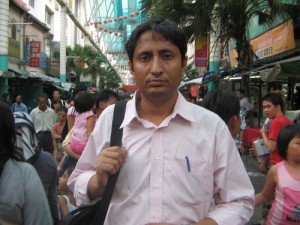
A profile of Ravish Kumar, this post tells the story of the media from a uniquely interesting vantage point – even as it presents before us a slice of contemporary social conflicts. 

I

Five days a week at 9 PM, Ravish Kumar begins his news programme, Prime Time, on NDTV India with “namashkaar, main Ravish Kumar…” At the same time when English news channel anchors scramble over each other for ratings, putting on display wild (often unsubstantial) discussions on the day’s events, Prime Time – in style and news content – strikes a very different note.

A journalist on the move
Journalist on the move

Ravish starts his programme with a 5-minute introduction, which is its unique selling point and also one of the highlights of the show. Packaging the topic of debate with a well-researched perspective, Ravish speaks in lucid, eloquent Hindi, interspersed with subtle and witty asides. Meticulously, he references the news reports, analyses, blog posts and opinion pieces he has swotted over during the day. In his mindful reference to every author whose work he has accessed through both mainstream and social media, Ravish has created a new media morality. The cutthroat universe of corporate media is more dedicated to grabbing information first rather than acknowledging sources or granting space to insights generated by others.

“Firstpost.com is our rival but whenever I take any news or analysis from the website, I acknowledge it. You could say this is NDTV India’s inherent culture. English channels don’t have that system. But they can have it if they want to. I do that consciously. I want viewers (a lot of them are students) to follow up these references,” Ravish told me. Continue reading Media Landscape and the Making of an Unconventional Journalist: Monobina Gupta