Category Archives: Images

Freezing History in a Pedagogy-proof Textbook: Kishore Darak

Guest Post by KISHORE DARAK

In the current academic year, the fourth grade history textbook in Maharashtra titled Shivchhatrapati depicting the valiant life of Chhatrapati Shivaji Maharaj (1630-1680) completed 43 long years of its existence, this being in itself a record. More than 3 million children in the 75000 plus schools affiliated to the Maharashtra State Board follow the textbook presently. It is probably the only example of textbook in the world which teaches the life of a single historical personality to 9 year old pupils.

The textbook shows remarkable similarity with a 1952 Marathi film, Chhatrapati Shivaji, directed by Bhalji Pendharkar who is known for his support of right wing ideology. The original version of 1970 and subsequent editions of the textbook follow an exact sequence of scenes and contain similar visuals as we see in the movie, as the first two images demonstrate.

Meeting between Afzhal Khan and Shivaji Maharaj 

In the 1952 film

Untitled 3In the text-book (Republished 2000)

Untitled 4

Continue reading Freezing History in a Pedagogy-proof Textbook: Kishore Darak

An Incomplete Reunion – Ruining the Post-Partition Party: Archit Guha

Guest post by ARCHIT GUHA

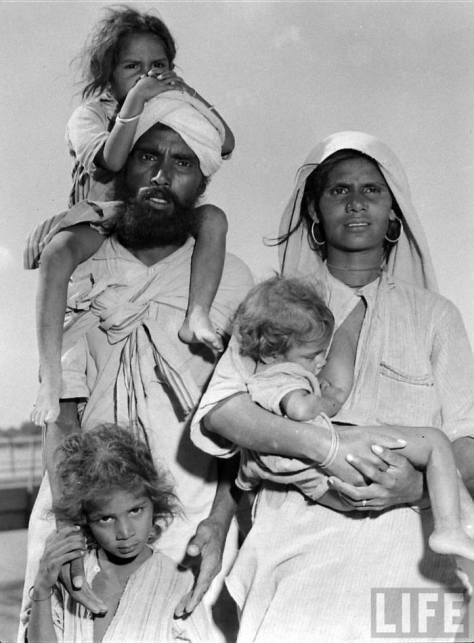
Reproduced without Permission from Life

By this point, every Indian, Pakistani, and their grandfathers has watched the Google Partition ad, tears welled up in their eyes. For the uninitiated, Google’s recent advertisement tugs at heartstrings, telling the tale of two chaddi buddies, separated by Partition, and reunited by their grandchildren nearly seventy years later. When the ad went viral via Facebook, sitting thousands of miles away in America, I bawled as I watched the granddaughter listening to her grandfather’s nostalgic retelling of the idyllic life he led in Lahore, eating jhajhariya, with his buddy Yusuf, and his granddaughter’s instant Google fixes to reunite him with Yusuf in Delhi. Continue reading An Incomplete Reunion – Ruining the Post-Partition Party: Archit Guha

Petition to Withdraw the ‘Golden Mother’ Award by the University of Calicut

To
Prof. M. Abdul Salam, Vice-Chancellor, University of Calicut
Members of the Syndicate, University of Calicut

The University of Calicut has recently announced the institution of a ‘Golden Mother Award,’ with the stated objective of highlighting “the contribution of mothers to societal development and nation building and to provide exemplary models to youngsters.” Mothers in the age group of 50+ and who are actively contributing to their domains of service will be considered for awards in eighteen categories such as Art, Literature, Teaching, Social work, Politics, Administration, Media, Sports, Agriculture, Entrepreneurship, Engineering, Medicine, Research, Law and judiciary, Police and Banking, Nominations from educational institutions, trade unions, LSGIs, NGOs and other organizations or from individuals themselves are to be submitted to the Director, Centre for Women’s Studies at the University.

Firstly, this attempt to glorify motherhood is blatantly patriarchal, anti-woman, anti-democratic and a move that pulls society back to the mores of a traditional morality. It implies that a woman’s place is at home and that her principal responsibility (and hers alone) is giving birth to children and rearing them. It pays little heed to contemporary feminist critiques of motherhood as not primarily a biological destiny, one that is made problematic by conditions of poverty, deprivation and societal violence. In ignoring new forms of motherhood and parentage such as adoption, single mothers, and so on, it also upholds elitist, casteist, and patriarchal conceptions of family and womanhood. Continue reading Petition to Withdraw the ‘Golden Mother’ Award by the University of Calicut

Tehelka, Jhatka and now Tamasha:Satya Sagar

Guest post by Satya Sagar

Eight years ago I remember listening to Tarun Tejpal in Bangalore as he held forth on how the news media could change the world for the better. It was a gathering of journalism students from Catholic institutions around the country and Tejpal was impressive in his defense of media freedoms.

He was passionate, charismatic, extremely articulate and as Chief Editor of Tehelka- with some of the best stories of Indian journalism behind them- very credible too. After his speech Tejpal left in a hurry, like a star priest dashing off to his next flaming sermon and fawning audience. Continue reading Tehelka, Jhatka and now Tamasha:Satya Sagar

The Tangled “Tonalities” of Mr. Tejpal

By now the details are well known: a young journalist describes a harrowing encounter with Tarun Tejpal, owner and editor of Tehelka, in an elevator during Tehelka’s Think fest in Goa. The description of the incident alleges gross sexual misconduct and bodily violation of an aggravated nature.  Her description does not make for easy reading: it clearly demonstrates the incredibly vulnerable position in which young women are placed when confronted with the sexual misdemeanors of powerful men in positions of managerial authority. Indeed Mr. Tejpal says as much, that to cooperate with him is the best way for her to keep her job. She writes to Ms. Shoma Chaudhury the managing editor describing the incident and asks that she be tendered an official apology, and that Tehelka’s senior management constitute an enquiry and anti-sexual harassment committee as per the Vishaka guidelines. Instead what she is offered is a pathos-laden tale of fall and redemption: directed by and starring Mr. Tejpal, producer Ms. Shoma Chaudhury. There has been near continuous discussion across the web and the news and it can get difficult to keep track of all the various versions being produced on an hourly basis by Tehelka’s bullshit factories. So at this stage it might be useful to simply collate and compare various accounts. Continue reading The Tangled “Tonalities” of Mr. Tejpal

Sehwan in Monochrome: Farid Alvie

Guest post by FARID ALVIE

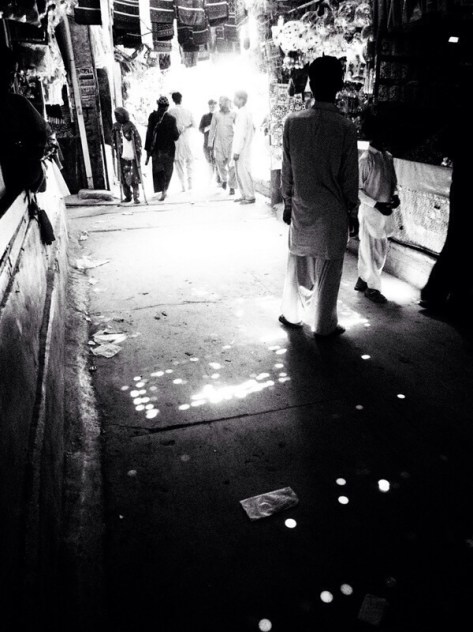
It could be other things. (It certainly was other things.) But it could quite as easily be its incomparable food and music that has drawn kings, foreign army generals, enlightened mystics and famous globe-trotters to ancient Sehwan. Standing on the west bank of the mighty Indus, Sehwan – or Siwasitan as Ibn Batuta describes it in his travel accounts – is most famous for being the place chosen by Hazrat Laal Shahbaz Qalandar to settle in in the 13th century. The shrine of the great sufi saint draws hundreds of thousands of people to its doors from all across Pakistan every year. The bazaar around the shrine plays host to a panoply of tongues and customs; the courtyard of the mazaar offering hospitality to visitors from out of town. The impressive gold dome of the shrine is the center from which all activity – cultural, social, religious, political – appears to emanate. Like many of Sindh’s other ancient towns, Sehwan is steeped in a history that continues to breathe.

Through the bazaar:
image

Inside Bodla Saeen’s shrine: Continue reading Sehwan in Monochrome: Farid Alvie

Rajendra Yadav:An era passes on

Rajendra Yadav,the last surviving member of the trio of the Nai Kahani,a major trend in Hindi literature, is gone. The large crowd which assembled at the Lodhi Road crematorium to bid adieu to him consisted of people from different age groups,a fair number of them being youth and women, with diverse professional and political backgrounds. It demonstrated the huge popularity he had earned for himself in the last quarter of his life as the editor of Hans, a literary monthly in Hindi. Continue reading Rajendra Yadav:An era passes on

From dynasty to plain nasty: Satya Sagar

  Guest post by SATYA SAGAR

The shocking spectacle of Siddharth Varadarajan, the Editor of The Hindu, being forced out of his post by a cabal of its owners is a brutal reminder to journalists all over the country that however fine a professional you may be you will always remain at the mercy of media proprietors.

Just around two years ago when N. Ram, the then Editor of The Hindu, passed on the mantle to Varadarajan, a highly respected and independent journalist, he had touted the move as a radical shift away from being a family run outfit to one headed by professionals.

Ram’s motives were neither clear nor very noble, engaged as he was in a bitter struggle with his siblings over control of the newspaper. Still, for the newspaper to move away from its long tradition of tight family control was a welcome, positive departure in a land where dynasties run everything from politics and religion to cricket and cinema.

Unfortunately, this flowering of corporate democracy was not to last too long. Ultimately the family managed to strike back with a vengeance, ganging up in a Board of Director’s meeting to demote Siddharth from the post of Editor to ‘Contributing Editor and Senior Columnist’ prompting his immediate resignation. Continue reading From dynasty to plain nasty: Satya Sagar

Thejas Daily: A Newspaper’s Encounters with the Ruling Powers : N P Chekkutty

This is a guest post by N P CHEKKUTTY

In normal circumstances, journalists are not people in the limelight– they are supposed to be the first witnesses to history in the making. Their role is as observers of incidents and purveyors of what goes on in the public sphere. And they discharge their duties as representatives of the citizens, generally enjoying the public confidence. That explains the key role of media in a democratic polity, as representatives of the various segments of people and as a forum where a dispassionate debate of public issues can take place. Like the Red Cross personnel on a war front, media-persons are expected to do their job without hindrance of harassment, keeping away from the sound and fury of public life.  Continue reading Thejas Daily: A Newspaper’s Encounters with the Ruling Powers : N P Chekkutty

The Public Secret of Savita Bhabhi: Jyoti Singh

This is a  guest post by JYOTI SINGH

In May 2013, makers of the erotic comic strip came out with the Savita Bhabhi movie, where apart from Savita Bhabhi doing what she is best at, she also helps the two nerds, who mistakenly teleport her into their Orwellian India of 2070, take their revenge upon the notorious I&B Minister who bans all online porn but engages in all offline porn. With this, Savita Bhabhi was back in our ever-so-fickle public memory after 4 years of ban, but yet not quite. Her resurfacing was not as resounding as her going away. One could ascribe this to the spoken language of the movie being Hindi instead of English, which is the original language of the strip and also the official language of all modern day revolutions of the middle class on social media. Perhaps they misjudged the ‘maximum reach’ bit, which rendered her an orphan. Nevertheless, that aside, why isn’t Savita Bhabhi missed enough anyway?

Continue reading The Public Secret of Savita Bhabhi: Jyoti Singh

Good Muslim, Bad Muslim – A Response to Ashish Khetan on the ‘IM’: Warisha Farasat

Guest Post by Warisha Farasat

The recent opinion piece by Ashish Khetan in the Hindu has yet again reiterated the false and malicious stereotype: that Muslims somehow have something or the other to do with terror, either when they are directly involved or when they are silent about others of the community being involved. It is disappointing that the debate is framed in the stereotypical, “good Muslim”, “bad Muslim” tenor rather than a real engagement with issues of shoddy investigation and communal bias that marks terror investigations in the country. Perhaps the greatest disservice that has been done to idea of justice has been linking an entire community to terrorism.

Continue reading Good Muslim, Bad Muslim – A Response to Ashish Khetan on the ‘IM’: Warisha Farasat

Minority Report – Deaths followed by Executions : Ramray Bhat

This is a guest post by RAMRAY BHAT

The collective conscience of our prominent democracies works in very strange ways. India is yet to come to terms with the killing of a nineteen-year-old Mumbaiite student Ishrat Jahan in an encounter by officers of the Gujarat Police in collaboration with the Intelligence Bureau. Along with three other individuals, Javed Sheikh (for whom Ishrat worked as a secretary), Amjad Ali Rana and Zeeshan Johar, Ishrat was first announced to have died in police firing and the alleged plan hatched by these four individuals to assassinate prominent politicians of India, thereby thwarted. Inquiries at the level of the Ahmedabad metropolitan magistrate court as well as by the Central Bureau of Investigation (CBI) as directed by the Gujarat High Court confirmed what had been suspected all along, that Ishrat had been murdered in cold blood while she was in police custody. Continue reading Minority Report – Deaths followed by Executions : Ramray Bhat

Gendered Violence and the Hall of Mirrors: Parnal Chirmuley

Guest Post by Parnal Chirmuley

A very young man, who should have been cheerfully devouring the world of ideas over samosas and tea from the canteen, tries instead to hack an equally young woman, his classmate, to death. With an axe, some say. Tries to shoot her too, but the pistol is too stubborn, they say. Then turns the blade and the poison on himself. There he sees success. Succumbs to both.

This leaves behind rivers of blood in the classroom and gashes in the minds of those who witnessed this, bravely intervened, or ran away from it. It leaves everybody entangled in a sea of Gordian knots that are just questions.

Continue reading Gendered Violence and the Hall of Mirrors: Parnal Chirmuley

GUANTANAMO II : K Satchidanandan

This is a guest post by K SATCHIDANANDAN

A poem by Ibrahim al-Rubaish, a Guantanamo Bay prisoner written in the tragic circumstances of illegal incarceration  has given rise to a baseless controversy in Kerala as it was included in a section titled ‘Literature and Contemporary Issues’ of the English  text book for the third semester undergraduates in the University of Calicut. The poem was recommended for inclusion by the Board of Studies chaired by Dr K. Rajagopalan, and rightly so as the section dealt with creative writing based on contemporary issues including the issue of human rights. The poem goes like this: Continue reading GUANTANAMO II : K Satchidanandan

The BJP’s very own Stalin

Yashwant  Sinha is a worried man these days. He is apprehensive of his leader Narendra Modi being taken for a ride by the Congress party. He says that the Congress party is laying a trap for him, a trap of the binary of Communalism and Secularism and  fears that his upward looking Narendra Modi might fall in it. So, well  wisher that he is of Narendra Bhai, he wants to alert him: do not get  entangled in the conspiracy of the wily Congress. He appeals to Narendra Modi to stick to people’s issues and not let the political discourse  shift to the terrain of the Secularism  versus Communalism debate. Continue reading The BJP’s very own Stalin

E-book: Sibaji Bandyopadhyay Reader

In the hope that more writers will make their books available online for free, Kafila is publishing an e-book version of Sibaji Bandyopadhyay Reader: An Anthology of Essays, published last year.

The Reader is an anthology of eight essays. The anthology focuses on a myriad of themes: politics of performance; nationalist appropriation and re-constitution of non-dualist Vedanta s tenets; double-take on remembering and forgetting; elusiveness of sexual identities; differences that engender terror. The essays take as their point of departure: a number of pre-modern Indian texts; a late nineteenth-early twentieth century archive of philosophical-cum journalistic writing in English published from Kolkata; specific art-works of Vivan Sundaram, Satyajit Ray, Ritwik Ghatak; the Pandora s Box that gets opened with the release of the film Fire ; Sigmund Freud s protracted struggles to establish fear, fright and anxiety as distinct conceptual categories; the grammar of terror that may be retrieved from the Mahabharata. Continue reading E-book: Sibaji Bandyopadhyay Reader

मोदी: तिलिस्म और हक़ीकत

– सुभाष गाताडे

जुल्म

तशद्दुद

झूठ

बग़ावत

आगजनी

खूं

कर्फ्यू

फायर ….

हमने इन्हें बिरसे में दिए हैं

ये बच्चे

क्या देंगे हमको ???

(कविता: बच्चे – मुसाफि़र पालनपुरी,

‘कुछ तो कहो यारों!’ सम्पादन: आयशा खान)

1

नूरा कुश्ती की समाप्ति के बाद


सियासत में आपसी सत्ता-संघर्ष अक्सर व्यक्तियों के इर्दगिर्द सिमटते दिखते हैं। Continue reading मोदी: तिलिस्म और हक़ीकत

In the Belly of the Beast: Peggy Mohan

Guest post by PEGGY MOHAN: When the size and complexity of a system pass a certain threshold there is a new feature that typically and suddenly appears: self-regulation. If traffic flow through a crossing exceeds a certain amount we wake up one morning and find a traffic light. It is not there to favor any motorist: what it really signifies is that the scale of things has changed.  We are no longer in the realm of the individual but of something much, much larger: a traffic system with compulsions of its own.

It is comforting to think that there is human agency behind the bewildering transitions we are now seeing the world over towards more state surveillance and control along with less regulation of big business. Clearly there are individuals who benefit from the new order. But there is another way of looking at the direction the world is taking. It is possible to see all this as evidence of a phase change, with the emergence of the megasystem itself as a new protagonist, and with human beings relegated to the status of bacteria proliferating in (and dying in) its gut. Continue reading In the Belly of the Beast: Peggy Mohan

Old Films: Habib Tanvir

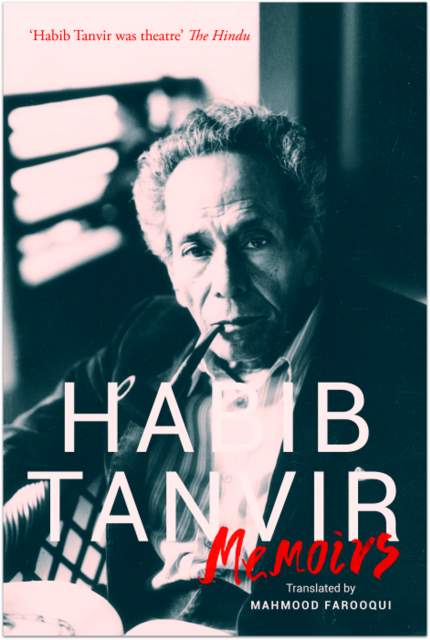
This is an excerpt from HABIB TANVIR’s Memoirs, translated by MAHMOOD FAROOQUI, to be released this evening 7 pm at the India Habitat Centre in Delhi.

1-habib-t-mahmood-cover
Memoirs by Habib Tanvir, translated by Mahmood Farooqui, Penguin Viking, Delhi, 2013; Rs. 599, pp. 400

First of all there was the bioscope. A woman wearing ghaghra and choli would roam around from mohalla to mohalla calling out to the children and gathering them at a chowk or in large courtyard, would take out a long stool from her arm pit and place it on the ground, would remove an octangular and muddy looking tin box from her head and place it on top which had a small mouth covered by a black cloth which the child would remove and peer inside. The women usually came from Rajasthan. The box would contain ten or fifteen cards of photographs, she would show them one after the other and also introduce them in a particular musical speech, ‘see the Rauza of Taj Bibi, see the Lal Qila of Dilli…etc.’ At one time only one child could see the pictures, which would be projected through a lens and lit up through a bulb inside the box which would make the photographs appear larger and more dramatic. When one child was through another would take his place. A large and restive crowd of children would be gathered around waiting their turn. Even the elders would be eager to see Hindustan through these pictures. She would charge two to three chhedams from everyone who took a peep. When the show was over, she would hawk her way to another mohalla. Continue reading Old Films: Habib Tanvir

No Time for Grieving – Or Why We Should Talk Some More About Kai Po Che: Debashree Mukherjee

Guest post by DEBASHREE MUKHERJEE

Okay, so the popular consensus is that Kai Po Che is a good film. Everyone agrees that it’s well shot and edited, the relatively unknown heroes are excellent, and the narrative is taut and emotionally resonant. It is competent and follows all the right cues worthy of a buddy movie about growing up and testing loyalties. But the film is hardly an event. It has been seized upon as a significant cinematic landmark for its depiction of the Gujarat pogrom of 2002. It might be worth our while to get some perspective here.

Today I will look at some other questions about our collective liberal attitude to this film, and what it indicates about our memory of select incidents of mass violence in this country. The main question to ponder is whether there is something dangerous about a historically-contextualized cultural product that can be coopted by a range of political perspectives? Is there something objectionable about a film (and the emotions it generates) which is deliberately toothless in the face of power? Over the last few weeks we have witnessed a range of informed cultural commentators  protest that critics of the film are making much to-do about what is in fact the first “realistic” and engaging Bollywood depiction of the Gujarat massacre. This post rejects that opinion and appeals for responsible film criticism and an alert, active mode of spectatorship.

Continue reading No Time for Grieving – Or Why We Should Talk Some More About Kai Po Che: Debashree Mukherjee

Modi and me: Sharad Mathur

This is a guest post by SHARAD MATHUR

1999

In the summer of 1999, practising our family tradition, we were availing a government LTC that my father was entitled to, being a senior central government officer.  Since we could travel by air, we decided to take a trip to Darjeeling, while halting at Allahabad, Varanasi, Lucknow, and Calcutta for some sight-seeing. Those were the days when flying was an experience for most Indians; yet the emotional memory of this trip did not record much of the excitement induced by flying, but took vivid account of disappointment – with a chance conversation and of missing another.

It was on our flight from Lucknow to Calcutta, I was sitting with my younger brother while my parents were sitting together in a row behind us. I was on the window seat and was too occupied with the process of luggage sliding inside the plane, to notice two gentlemen who came and sat next to my parents and my brother respectively. My gawking was however interrupted by my father excitedly introducing me to one Devi Singh ji, who I was told happened to be Personal Assistant to Shri Bhairon Singh Shekhawat. Being a big BJP enthusiast, partly because of their mesmerizingly bright coloured flags, I looked up to this BJP heavyweight and was elated to meet his personal assistant. My excitement was doubled when Devi Singh ji introduced us to a gentleman sitting next to my brother, on the aisle seat, as Modi ji who was accompanying Bhairon Singh ji to the Bihar convention of BJP. However, this excitement remained short lived.

Continue reading Modi and me: Sharad Mathur