Category Archives: Images

Confuse and deceive – Email interception in Kerala and the formula for political survival: Yaseen Ashraf

Guest post by YASEEN ASHRAFassociate editor of the Malayalam weekly, Madhyamam

An article by Viju V Nair in Madhyamam Weekly (issue 727, 23 January 2011) has raised the hackles of the Kerala Government and its political allies. Strange, because the report was about the excesses of the police intelligence, something which can be – and should be – investigated and corrected. The investigative report claimed that 268 email accounts were ordered by the Kerala state intelligence to be tapped, out of which a huge majority belong to Muslims. None of these persons has any previous criminal history. So it is not clear why they are put under the cyber scanner. Continue reading Confuse and deceive – Email interception in Kerala and the formula for political survival: Yaseen Ashraf

The BSF as Pornographer: Bravehearts with Bluetooth

So, this is how the borders of the Republic of India are also defended. With sticks, ropes and bluetooth enabled mobile phones. Eight soldiers of the Border Security Force, hold down a young Bangladeshi man accused of cattle smuggling. He is stripped naked, hogtied and then thrashed. He screams in agony and humiliation. The soldiers act as if they are out on a picnic. They discuss whether or not to give him some tea. Where to hurt him, on which body parts. How big a stick to use on him. Someone says “cut his ear off”. They stroll casually around him as he is humiliated. They laugh. He cries, as people usually do in these circumstances, and seems to call for his mother. Someone, probably one of the soldiers, records it all on video, on the 9th of December, 2010, somewhere along the Indo-Bangladesh border in Murshidabad, West Bengal

Continue reading The BSF as Pornographer: Bravehearts with Bluetooth
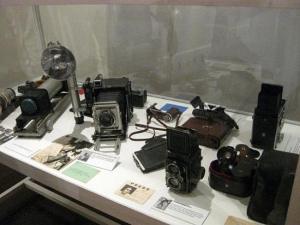
Tribute to Homai Vyarawalla, India’s first woman photojournalist

Homai Vyarawalla passed away at the age of 98 yesterday. We reproduce here the curator’s note written by cinematographer SABEENA GADIHOKE, biographer and friend of the legend, on the occasion of her staging a retrospective of Vyarawalla’s work at the National Gallery of Modern Art in 2011.

Having worked for thirty three years of her life Homai Vyarawalla gave it all up one day. Why did she give up photography?

Often meant for a fleeting glimpse in the newspaper, press photographs become visual archives of the future. Homai Vyarawalla’s photographs chronicling the defining moments of India’s Independence have acquired an iconic status and are now integral to a Nationalist version of history. According to this version, some people led and others followed. As important people dominated photographs, ordinary citizens or `the masses’ frequently found themselves relegated to the margins. Sometimes, they would be `cropped’ from the frame to accommodate more prominent figures.

Continue reading Tribute to Homai Vyarawalla, India’s first woman photojournalist

A Tribute to Narahari Kaviraj (1917-2011): Sankar Ray

Guest post by SANKAR RAY

Narahari Kaviraj, eminent Marxist historian and an ideoligue of CPI, breathed his last in the wee hours of Wednesday, the 28th of December 2011. He was born on 17 February 1917 and was the last disciple of Bhupendranath Dutta,the youngest brother of Swami Vivekananda, whom Lenin had once requested, in reply to an article (draft), to devote himself to studying and writing on agrarian issues in India. As a scholar, Narahari Kaviraj was also a favourite of Puran Chand Joshi, general secretary of CPI (1935–47). The anecdote goes that when PCJ first heard that Kaviraj’s son, Sudipta ( now a scholar of international repute as a political theorist and department chair of the Middle Eastern, South Asian, and African Studies department at Columbia University) , joined JNU, he asked, ” Is he more brilliant than his father Narahari ?”

Continue reading A Tribute to Narahari Kaviraj (1917-2011): Sankar Ray

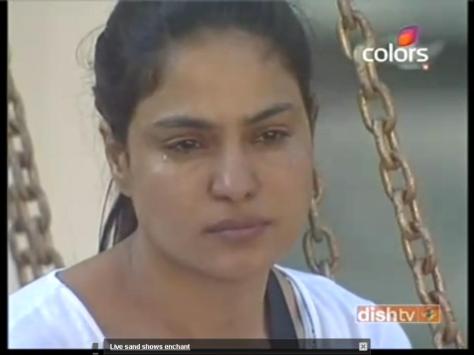
Who’s afraid of Veena Malik?

News broke of Veena Malik’s “nude” – more accurately, implied nude – photographs in FHM India magazine when the image of the magazine’s cover went viral on Twitter, even before the magazine was on newsstands. The media in India and all over the world reported “outrage” in Pakistan, in keeping with the international image of Pakistan as a country taken over by Islamists who would wreak havoc over a Pakistani woman posing without clothes for an Indian magazine with ISI tattooed on her arm.

FHM India itself magazine emphasised Malik’s nationality, calling her a “Pakistani WMD” and discussing burqas with her, even mentionining the word burqa on the cover, to reinforce the stereotype of a hot Pakistani model defying a country riven with Islamic extremism.

But in reality, there hasn’t been as much backlash in Pakistan as the world outside would expect or believe. Says Islamabad-based journalist Shiraz Hassan, “I am surprised that except a few news channels and papers nobody has been bothering about Veena Malik, as though they don’t care what she did. Haven’t seen anything from hardliners also.” Continue reading Who’s afraid of Veena Malik?

News TV – Caught Between an Anna and a Hard Place: Abhishek Upadhyay

Guest post by ABHISHEK UPADHYAY

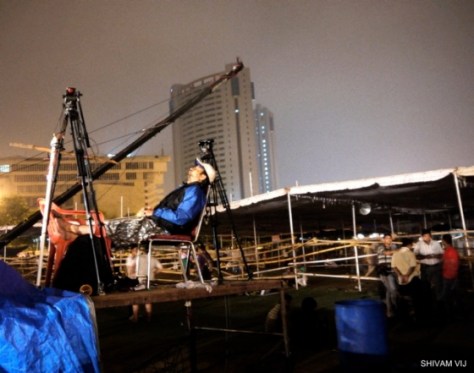
Taken in August 2011 at around 2 am one morning at Ramlila Maidan, this photo shows a news TV cameraperson taking sleeping on his chair.

Anna Hazare has returned with his protests and fasting. Should the media, particularly news TV, be more circumspect this time?

Is it time for the media to learn from the Ramlila Maidan experience in August, or should news channels stick to their earlier editorial line of broadcasting the Anna movement in great detail? Back in August, news TV broadcasted Anna’s “satyagrah” allegedly at the expense of the government. The stage is set again, the jury is out. Continue reading News TV – Caught Between an Anna and a Hard Place: Abhishek Upadhyay

An open letter from a photojournalist assaulted by Indian security forces in Kashmir: Yawar Kabli

Guest post by YAWAR KABLI

AP photo by Yasin Dar: Local Kashmiri photographers Yawar Nazir, left, and Showket Shafi wait for treatment after they said they were assaulted by police and paramilitary forces during a protest in Srinagar, India, on Nov. 25. At least four journalists said they were assaulted by police and paramilitary forces Friday as they covered a protest in Indian-controlled Kashmir.

All freedoms enshrined in the Constitution of India are being violated or altogether thrown away by the Jammu and Kashmir Police. One could substantiate that with any number of examples. We were not the first pressmen to be thrashed by the police while covering the stone-hurling protests in the Kashmir. On Friday, 25 November 2011, without any rhyme or reason policemen along with the Central Reserve Police Force (CRPF) thrashed four of us, including me, and snatched away our expensive cameras. They did not even hesitate to bundle us into police vehicles while taking us to the Khanyar police station.

Continue reading An open letter from a photojournalist assaulted by Indian security forces in Kashmir: Yawar Kabli

Uthao, uthao video ab, won’t you make the video now?

This photograph shows photojournalist Shahid Tantray being assaulted by the Central Reserve Police Force in Srinagar on 25 November 2011

No tears will be shed for press freedom for attacks on journalists in Srinagar by the Central Reserve Police Force and the Jammu and Kashmir Police. Fahad Shah reports what happened in Srinagar yesterday:

Journalists were beaten up and one of them detained, today, when they were covering the post-Friday prayers protests in the Old City, here at Srinagar. Umar Mehraj, who works as video journalist for Associated Press says he, along with other journalists, was covering protests when Central Reserve Police Force (CRPF) and local policemen start beating. He said while beating, the forces were shouting, “Uthao, uthao video ab (Shoot, shoot the video now.).” Umar says his camera was broken and they were abused too.

Continue reading Uthao, uthao video ab, won’t you make the video now?

Mobpublic vs. Counterpublic in Kerala

[with inputs from Baiju John]

Recent events in Kerala convince me that we need to think more closely about the ways in which our political public life is being slowly overwhelmed by something that is profoundly anti-public but somehow manages to resemble it — I’m tempted to call it the Mobpublic. I’m of course not referring to formal politics, where political parties and powerful communities continue to squabble without any serious difference in their programmes. Very little of either the political or the public survives in them; all one hears for most of the time are the tales of internal squabbling which is neither political (yes, despite all of V S Achuthanandan’s efforts to coopt oppositional civil social struggles) nor public. Perhaps the decline of the political is a condition for the rise of the mobpublic.

Continue reading Mobpublic vs. Counterpublic in Kerala

A prologue to memory: Arif Ayaz Parrey

Guest post by ARIF AYAZ PARREY

Over the corner shop at the busy crossing near home hangs a white board on which the words ‘Muzaffar Pan-House’ are painted in bright red. On the right side of the words, an artistic rendition of the side-view of Muzaffar’s face can be seen. His left hand is also painted in, holding a cigarette. The grey smoke emanating from the cigarette does not vanish before it touches the top of the board.
Continue reading A prologue to memory: Arif Ayaz Parrey

From Manhattan to Manesar: Naeem Moahaiemen

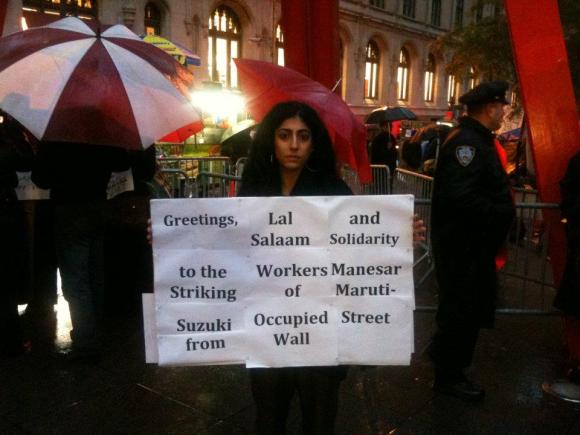
Greetings to the Workers of Manesar from Occupied Wall Street (Photograph by Naeem Moahaiemen)

A few days ago, in a post on the rally in solidarity with the (then) striking Maruti Suzuki, Suzuki Powertrain and Suzuki Motorcycles Factory workers in Manesar, Gugaon in Haryana, we had reported a worker saying: Continue reading From Manhattan to Manesar: Naeem Moahaiemen

Through the screen, not so darkly: Raza Rumi

Guest post by RAZA RUMI

Pakistanis love Bollywood. There is no question about that. Amidst the love-hate perceptions, Indian cinema has for decades fed public imagination. Before the 1965 war that took place when Ayub Khan, Pakistan’s first military ruler, was in power,  Indian films were released in Pakistan regularly. They competed with the local cinema. The healthy contest enriched filmmaking and gave choice to Pakistani cinema-goers. The war and competing imaginary nationalism halted this process and for decades, Indian films stayed away from cinemas until another military ruler, Parvez Musharraf, allowed limited releases. Such is the power of Bollywood and its commercial viability that for the past few years, Bollywood flicks have revived cinema in Pakistan. Continue reading Through the screen, not so darkly: Raza Rumi

Navratri in Karachi

The report above is by Zanobia Ilyas, who writes: Continue reading Navratri in Karachi

Out of Development’s Waiting Room, Out of Democracy: The Continuing Agony of the DHRM

[with inputs from Baiju John]

Faced with the never-ending agony to which the members of the Dalit Human Rights Movement (DHRM) in Kerala seem to be subject to, it appears that that the more familiar ways of marginalizing of dalit people in Malayalee people do not work anymore. The past few days have seen horrendous attacks on these people near the town of Varkala in Thiruvanathapuram district. The DHRM has accused the Siva Sena and the BJP of violence, but it appears that both the authorities and the press are equally and irremediably deaf. Continue reading Out of Development’s Waiting Room, Out of Democracy: The Continuing Agony of the DHRM

Growing up with PTV in Poonch: Saqib Mumtaz

Guest post by SAQIB MUMTAZ

Away from the revolution of direct to home (DTH) and cable TV networks, the nineties were the time of one channel, when Doordarshan was synonymous with Television for most Indians, especially in rural areas. There was not much on television for a kid growing up except the occasional cartoon clips and Shaktimaan. I was fond of Meena and her parrot Mithu. They were loveable unthreatening characters. The duo imparted important lessons on a variety of social issues. Movies were a strict no-no and the news was other things adults were interested in. Every evening my grandfather would tune in to the Hindi news which was followed by another news broadcast in English. Even as a kid I could sense the repetition but never the reason of watching the same news twice.
In my memory of those days, it’s not Doordarshan that I associate myself with. Luckily for many of us near the border there was PTV.

Continue reading Growing up with PTV in Poonch: Saqib Mumtaz

In the Courtyard of the Beloved

*

In the Courtyard of the Beloved is a visual and aural portrait of Nizamuddin Auliya Dargah, a Sufi shrine in New Delhi, India. Made from over 18,000 still images and ambient sounds recorded on-site, rapid-fire bursts of kaleidoscopic imagery assemble into fractured collages.

Each day, hundreds of pilgrims travel by airplane, train, car, rickshaw and foot to reach this shrine, which honors a 12th century Sufi mystic who believed in drawing close to God through renunciation of the world and service to humanity. Beginning with imagery from these journeys, the film then enters the physical space of the shrine; a unique nexus of marketplace, social space and spiritual haven, where devotees come to offer their prayers and find a moment of reflection away from the din of Delhi traffic. As the sun sets behind the dome, musicians begin the qawwali, a style of Sufi devotional music that ranges from contemplative religious elegy to raucous crescendo.

Executive Producer Samina Quraeshi
Original tabla score by Suphala
Audio post-production by Paul Bercovitch
Produced by Sadia Shepard
Photographed and edited by Andreas Burgess

[via]

Some Thoughts from Ramlila Maidan

This slideshow requires JavaScript.

Some people at Ramlila Maidan

This slideshow requires JavaScript.

यहाँ से शहर को देखो …..

[यह लेख “बस्ती तो बसते बसती है” शीर्षक से आउटलुक हिंदी  के  स्वाधीनता विशेषांक में छपा है.]

अब जबके हर तरफ यह एलान हो चुका है के दिल्ली १०० बरस की हो गयी है और चारों ओर नई दिल्ली के कुछ पुराने होने का ज़िक्र भी होने लगा है, इन दावों के साथ साथ कि “दिल्ली तो सदा जवान रहती” है और “देखिये ना अभी कामनवेल्थ खेलों के दौरान यह एक बार फिर दुल्हन बनी थी”, वगेरह वगेरह, तो हमने सोचा के क्यों न इन सभी एलाननामों की सत्यता पर एक नजर डाल ली जाए, और इसी बहाने उस दिल्लीवाले से भी मिल लिया जाए जो इस अति प्राचीन/ मध्यकालीन/ आधुनिक नगरी का नागरिक होते हुए भी वैशवीकरण के झांसे में इतना आ चुका है के वो अपने आप को २१वीं शताब्दी के पूर्वार्द्ध में आने वाले आर्थिक संकट को पछाड देने वाले चमचमाते भारत देश की राजधानी का शहरी  होने का भरम पाले हुए है.

अब सब से पहले तो यह फैसला कर लिया जाए के नई दिल्ली है किस चिड़िया का नाम? पाकिस्तान के मशहूर व्यंग कार इब्न-ए–इंशा ने अपनी विख्यात पुस्तक उर्दू की आखरी किताब में एक अध्याय लाहौर के बारे में लिखा है.  इस अध्याय में इंशा कहते हैं “ किसी ज़माने में लाहौर का एक हुदूद-ए–अरबा (विस्तार) हुआ करता था अब तो लाहौर के चारों तरफ लाहौर ही लाहौर वाके (स्थित) है और हर दिन वाके-तर  हो रहा है”

एक फर्क है, इब्न-ए-इंशा के लाहौर में पुराना लाहौर और नया लाहौर दो अलग अलग चीज़ें नहीं हैं मगर दिल्ली के मामले में ऐसा नहीं है, एक समय था के नई दिल्ली में बाबू बसा करते थे और नई दिल्ली के पास शाहजहानाबाद था जो शहर था, अब नई दिल्ली वालों के हिसाब से पुराना शहर सिर्फ शादी के कार्ड, आचार मुरब्बे और हार्डवेअर खरीदने की जगह है, या उसे इस लिए बनाया गया है के उनकी पार्टियों के लिए बिरयानी, चाट, कुल्फी वगेरह मुहैया करवाए और जब उनके विदेशी मित्र या एन आर आई सम्बन्धी यहाँ आयें तो उन्हें इस जीते जागते संघ्राल्य के दर्शन करवा सकें. मुसलमान और सिख वहाँ धार्मिक कारणों से भी जाते हैं, मगर उनकी बात अलग है वो तो अल्प संख्यक हैं हम तो आम लोगों की बात कर रहे हैं.

Continue reading यहाँ से शहर को देखो …..

Tagore in film


That is a clip from The Postmaster (the first story in Teen Kanya, directed by Satyajit Ray).

Trisha Gupta on Tagore’s characters, seen better in films than in English translation:

In film after film, we see events through the eyes of the educated Bengali man trying to deal with a world that has either changed too much—or too little. The protagonist is often a young man from the city who arrives at a small provincial outpost, armed with a modern Western education and little else, his head full of glimpses of another world that seem only to succeed in cutting him off from everything around him. Continue reading Tagore in film

And you thought the Valley was unsafe to visit?

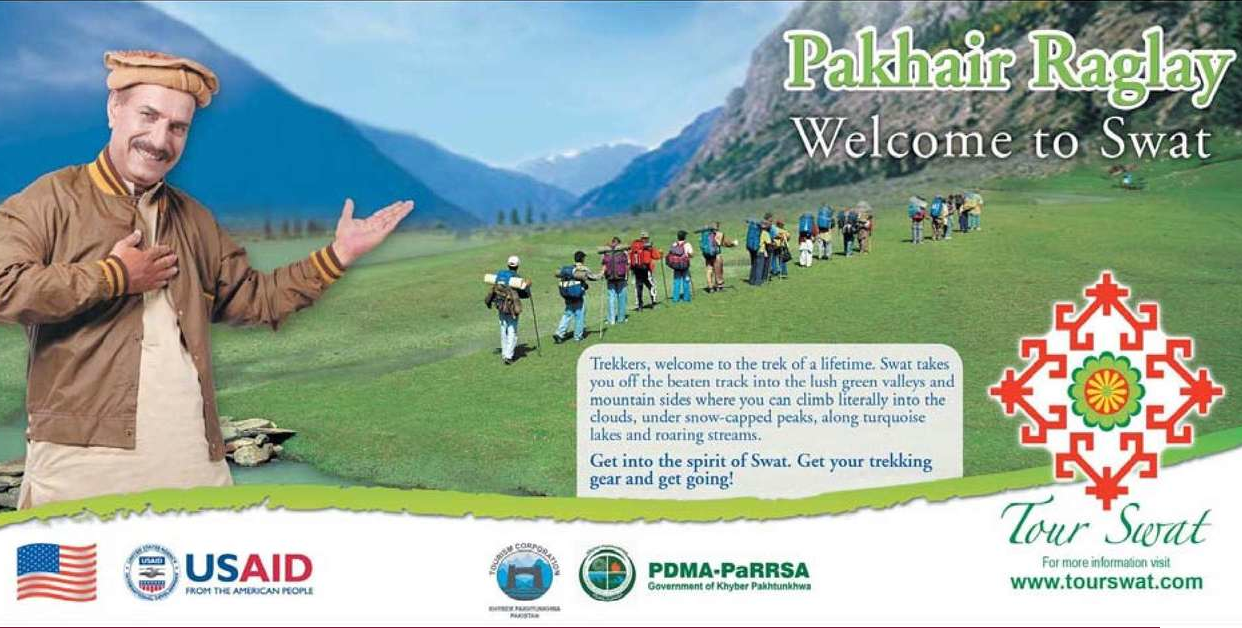
click to enlarge

That is an advertisement published on the front-page of the Pakistani newspaper Dawn this morning. Two days ago, the paper wrote in an editorial: Continue reading And you thought the Valley was unsafe to visit?