Category Archives: Language

Jadavpur’s Infectious Autumn Thunder Goes Viral: Kasturi

Guest post by Kasturi

One of the slogans churned out of the womb of turbulent Paris in the Maydays of 1968 was ‘Don’t trust anyone over 30’. The student uprising of May ‘68 with its audacity and exaggeration might have failed. Yet the mahamichhil (grand rally) called by students which took command over the heart and pulse of Kolkata on 20th September was a literal, vivid, living embodiment of this slogan. As I stood with a video camera on a spot on the Jawaharlal Nehru Road, with hope to capture the moments and 50,000 faces that made history with each footstep, all I could see was an ocean of people most of who had perhaps not even reached their twenty fifth year, and many of who were walking their very first rally. Those slightly older, those weathered yet young at heart paced alongside them in solidarity. ‘Such a student gathering – so huge, determined and disciplined – I have not seen in my life’, wrote poet Sankha Ghosh, ‘This really moved me. It’s very early to say if this will mark the beginning of a new era but I will reiterate this is one of the biggest student rallies I have seen in my life’.

The rally was replete with slogans reflecting basic demands of the movement, but there was a unifying chant, rather a call to action, that instantly bonded with and caught the fancy of the first timers that hit the street – Hok, Hok, Hok Kolorob (‘let there be clamour’). A call, ripped off from a popular song by Bangladeshi singer Ornob and used as hashtag on social media to mobilize – was surreal, refreshing, imaginative enough to break the deafening silence, stupor and suffocation strangling students’ aspirations for democracy, freedom of expression and association across education campuses of Bengal. The other interesting aspect of this call was that unlike regular slogans where someone leads and the rest follow, here there was no single lead but many voices all chanting the four words in unison, accompanied by clapping of hands. As a comrade observed, ‘the zeitgeist and slogan of the contemporary present is #hokkolorob’!’ (‘Kolorob’/ ‘kalrav’, roughly translated here as ‘clamour’, conveys the sense of a symphony of birdsong in many Indian languages.) Continue reading Jadavpur’s Infectious Autumn Thunder Goes Viral: Kasturi
A Letter to the Vice Chancellor of Jadavpur University, Kolkata: Ahona Panda

Guest Post by AHONA PANDA

[Ek Je Cchilo VC / Once There Was a VC – Thanks to Utsavdan, and to Manik-da of Bishop Lefroy Road]

To

The Vice Chancellor,
Jadavpur University,

and the Education System of West Bengal.

Respected Sir,

I would like to return to this university a gold medal that it awarded me, then a girl of 21, in the year 2009. I’ve never worn that medal since my convocation, and it lies in the box it was awarded in. I was a student of the English department in this university, and went on to study at Oxford and University of Chicago. Continue reading A Letter to the Vice Chancellor of Jadavpur University, Kolkata: Ahona Panda

Media Landscape and the Making of an Unconventional Journalist: Monobina Gupta

Guest post by MONOBINA GUPTA

A profile of Ravish Kumar, this post tells the story of the media from a uniquely interesting vantage point – even as it presents before us a slice of contemporary social conflicts. 

I

Five days a week at 9 PM, Ravish Kumar begins his news programme, Prime Time, on NDTV India with “namashkaar, main Ravish Kumar…” At the same time when English news channel anchors scramble over each other for ratings, putting on display wild (often unsubstantial) discussions on the day’s events, Prime Time – in style and news content – strikes a very different note.

A journalist on the move
Journalist on the move

Ravish starts his programme with a 5-minute introduction, which is its unique selling point and also one of the highlights of the show. Packaging the topic of debate with a well-researched perspective, Ravish speaks in lucid, eloquent Hindi, interspersed with subtle and witty asides. Meticulously, he references the news reports, analyses, blog posts and opinion pieces he has swotted over during the day. In his mindful reference to every author whose work he has accessed through both mainstream and social media, Ravish has created a new media morality. The cutthroat universe of corporate media is more dedicated to grabbing information first rather than acknowledging sources or granting space to insights generated by others.

“Firstpost.com is our rival but whenever I take any news or analysis from the website, I acknowledge it. You could say this is NDTV India’s inherent culture. English channels don’t have that system. But they can have it if they want to. I do that consciously. I want viewers (a lot of them are students) to follow up these references,” Ravish told me. Continue reading Media Landscape and the Making of an Unconventional Journalist: Monobina Gupta

A Short Memoir On the Arabisation of Islam in India: Shireen Azam

This is a guest post by SHIREEN AZAM

A Pakistani writer Mina Malik Hasan recently wrote about the Arabisation of Islam in Pakistan, (The Sheepification of Bakistan), a movement of sorts which is transforming Islam in the Indian subcontinent by the day, even though it is remarkably dispersed and often subtle. The Arabisation of Islam seeks to “correct” Islam as Muslims in the subcontinent have understood, practiced and lived it, and instead replace it with an Islam which is uniform, seemingly universal and which need not have any affiliation with our cultural and local identities and beliefs. Having been a participant observer of this change in India, I wish to supplement Mallik’s experience in Pakistan with my own, in the form of a short memoir of the nearing extinction of the urdu phrase “Khuda Hafiz”, a customary way to bid goodbye, with the phrase “Allah Hafiz”. While both the phrases literally mean ‘May god keep you safe’, the reason for the shift was likely because of a lack of clarity in the particular god being invoked term by the term ‘Khuda’, since Khuda has Persian roots. If anything, “Khuda” speaks of Muslims’ age-old assimilation in the Indian subcontinent, something that ‘Arabisation’ of Islam would conveniently want to ignore, and is sadly becoming successful in. Continue reading A Short Memoir On the Arabisation of Islam in India: Shireen Azam

Delhi Protests Gaza Bombing: 9 August 2014

Let it not be said that nobody cried when the news came. Let it not be remembered by the children that India “stood with” Israel through the Gaza bombings of August 2014 (God, let it not continue beyond August 2014). Let no-one assume that all 1.3 billion of us continued – as the bombs fell on fields and courtyards and washing hung up to dry in Gaza – that we in India defined our ethical positions purely within the unholy triad of family, community, nation. Let there be a tiny record of protest. A tiny record of a tiny protest, given the monstrosity of the crime. But we are in the business of remembering, since they are profiting from our forgetting. They profit from our forgetting language, since we can’t name what is going on in Gaza as war. They profit from our not being able to remember our mythologies, because this is a war in which one side is David and the other Goliath, but Goliath is winning, because the world has been told he is David. In a nation without language, without myths, without memory, without ethics, jealously holding a tattered banner, with a single word on it – ‘development’ – some Indians protested.

Global Day of Rage against Gaza, Jantar Mantar, New Delhi August 2014:

WP_20140809_001

Continue reading Delhi Protests Gaza Bombing: 9 August 2014

Breaking the Silence about Gaza from Israel: Yehuda Shaul

Guest Post by YEHUDA SHAUL

In November 2012, Israel launched a military operation in the Gaza Strip called “Amud Anan”, the literal English translation of which is, “Pillar of Clouds”. Though, the official name in English was deemed, “Pillar of Defense”. A few days ago we launched another operation named, “Mighty Cliff”, which is officially called, “Protective Edge”. Both chosen titles are highly defensive in their essence. When I hear the names given to military operations in Gaza – especially the versions chosen for an international audience – I am reminded of my military service as a combatant in the Israeli army, whose full name (both in Hebrew and English) is: the “Israel Defense Forces” (IDF).

Continue reading Breaking the Silence about Gaza from Israel: Yehuda Shaul

The Sheepification of Bakistan: Mina Malik-Hussain

We are reproducing this piece by Mina Malik-Hussain, which appeared in The Nation (Pakistan) as it deals with an important issue which concerns the changes that are taking place within subcontinental Islam. The piece underlines the great cultural battle underway within Islam which, in the final analysis is about being Muslim in many different ways. Mina Malik-Hussain is a feminist based in Lahore.

When we were small, there was a month and it used to be called Ramzan. It was Ramzan on television, it was Ramzan in the newspaper with the sehr-o-iftar timings and while nobody had a cell phone or Facebook to wish anyone, it would have been Ramzan Mubarik nonetheless. Sometimes if one was being quite linguistically adventurous it would be Ramazan, but nobody seemed to mind.
And then, insidiously, The Arabs crept up on us. It wasn’t like the return of Muhammad Bin Qasim, but somehow Ramzan became Ramadan. Nobody knew exactly how it happened, but almost overnight our crisp z’uad sound became a lisping Arab burr, and we—a nation of language speakers with no apparent consonant pronunciation difficulties—were flung into the downward spiral of an affectation obsession. Now it was cool to sound Arab, and soon enough it began to be increasingly desirable to look it. Cue Al Huda, cue our streets being lined with gangly palm trees that do nothing, either in terms of beauty or shade, cue the availability of the most bling Islamic cover-up gear you’ll see this side of Dubai.

Still, as a nation we were still fairly open-minded about this, so we fasted year after year and didn’t really pay attention to the semantics of it. We were busy trying to live our lives and be regular Pakistanis, but The Arabs kept making inroads onto our cultural minds. One year ‘khuda-hafiz’, that old and comfortable way of saying goodbye and Godspeed, became ‘Allah hafiz’ with the dubious reason of having to specify which deity to whose protection one was recommending you. Because here in multi-religious, multi-cultural and secular Pakistan there was actual leeway where one would wonder who exactly Khuda is, and perhaps not want to be entrusted to a pagan god. Some people resisted, and continue to resist Allah hafiz and keep saying khuda-hafiz with the logic and hope that whatever His name, He will still protect and love them. Also if it was good enough for one’s grandfather and great-grandfather, it was just fine for them too. Read the full article here

How Goldman Sachs Got it Wrong on Football, The World Cup and Economics: Tushar Dhara

Guest Post by TUSHAR DHARA

In May this year the investment banking powerhouse Goldman Sachs released a report that predicted Brazil would win the FIFA world cup. The prediction relied on statistical modelling and used tools like “Regression Analysis”, “Poisson Distribution”, “Stochastic model” and “Monte Carlo Simulation”. In other words, the methodology is incomprehensible to anyone except those with an advanced degree in Statistics or Econometrics. In hindsight, the prediction looks silly, given the 7-1 score line in the semi-final match between Germany and Brazil. However, the report is a perfect example of the failures of modern economics, particularly the financial voodoo economics pushed by the likes of Goldman Sachs.

When “The World Cup and Economics 2014” was released on May 27 it gained a lot of press publicity globally. The report predicted that Spain would reach the semi-final stage and lose to Argentina, which would lose to Brazil in the final. Goldman’s research division analyzed reams of data, including about 14,000 matches since 1960, national teams’ Elo rankings, average goals scored per team, home country and home continent advantage. To be sure, the report states that the predictions are just “probabilities” of teams advancing. Still the report states, “The most striking aspect of our model is how heavily it favours Brazil to win the World Cup”, and, “the extent of the Brazilian advantage in our model is nevertheless striking.” Continue reading How Goldman Sachs Got it Wrong on Football, The World Cup and Economics: Tushar Dhara

Whose Ambivalence – Modi’s or Varshney’s? Jyoti Punwani

Guest post by JYOTI PUNWANI

What is it about Narendra Modi that makes people suspend disbelief? Ashutosh Varshney in his Modi’s Ambivalence, Indian Express, June 28, actually considers it possible that the new Prime Minister has a chance of going  down as “one of the greatest leaders of independent India”.  Surely anyone qualifying for such a status must be acceptable to the majority of Indians? Last we heard, the magic of Modi had left almost two-thirds of the electorate untouched, not to forget the fact that he doesn’t exactly inspire respect among our largest minority.

Varshney makes some bewildering assertions in his evaluation of Modi’s first month as PM. From a “novel policy language for poverty alleviation”  to a new acceptance of Mahatma Gandhi as the Father of the Nation,  to his RSS-defying portfolio distribution,  Varshney sees signs of a new Modi, quite different from the man cursed forever with the burden of Gujarat 2002.

Continue reading Whose Ambivalence – Modi’s or Varshney’s? Jyoti Punwani

आम आदमी पार्टी: शहर अब भी संभावना है

“Consistency is the virtue of an ass”, पटना विश्वविद्यालय के अंग्रेज़ी के अध्यापक आर.के.सिन्हा अक्सर कहा करते थे.जीवन के किसी और क्षेत्र से ज़्यादा यह बात राजनीति पर लागू होती है.

अरविंद केजरीवाल और आम आदमी पार्टी पर ‘इन्कांसीस्टेंसी’ के आरोप उनेक पिछले दिनों के फैसलों के चलते जब लगाए जा रहे हैं तो यह वाक्य याद कर लिया जाना चाहिए. ताज्जुब है कि किसी और दल पर यह आरोप नहीं लगता. एक मित्र ने ध्यान दिलाया कि जनसंघ और भारतीय जनता पार्टी का पूरा इतिहास ही कुछ कहने और कुछ और करने का रहा है जिससे वे अपनी जनता को निरन्तर भरमाए रख सकें और प्रतिद्वंद्वियों को भी अनिश्चय में डाले रख सकें.

आम आदमी पार्टी और उसके नेता को ‘ड्रामेबाज’ कह कर उसकी भर्त्सना की जा रही है. लेकिन तुरत ख़त्म हुए चुनाव में इस ड्रामेबाजी और लफ्फाजी के सहारे ही एक व्यक्ति ने देश की सत्ता पर कब्जा कर लिया, इसे नज़र अंदाज किया जा रहा है. ड्रामा और जनतांत्रिक राजनीति का घनिष्ठ सम्बन्ध है. Continue reading आम आदमी पार्टी: शहर अब भी संभावना है

The Triumph of the Will(ie): Prasannarajan Anoints Modi in the Open

The televised coronation (or should I say Rajyabhishek) of Narendrabhai Damodardas Modi has featured a supremely photogenic set (the Dasashwamedh Ghat in Benaras), a chorus line of calisthenic priests lining the riverfront of the Ganga with blazing torches, a script (being written, even as the epic is being canned, in every television studio and editorial office) talented producers and art directors, an army of happy-clappy extras, and even its own battalion of masked stunt doubles.

Modi at Dasashwamedh Ghat, Varanasi/Benaras on 17 May 2014. Courtesy, Amar Ujala website.
Amit Shah, Rajnath Singh and Narendra Modi,  at Dasashwamedh Ghat, Varanasi/Benaras on 17 May 2014. Courtesy, Amar Ujala website.

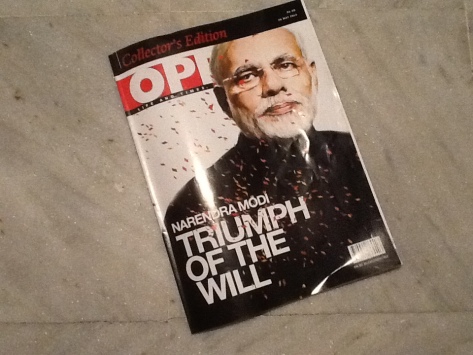
Like any good bollywood blockbuster, it cannot but be a homage to an extant cinematic classic. S. Prasannarajan, editor of the Open Magazine has even told us what that classic is. On the cover of Open, beneath a pensive, tight lipped and determined Narendrabhai looking out at the magazine’s reader through a shower of rose petals and rimless Bulgari glasses, four words spell out in bold capitals the film’s name – ‘TRIUMPH OF THE WILL’. Dejavu, anyone?

'Triumph Of the Will' Open Magazine, May 26, 2014
”Triumph Of the Will’ Open Magazine – ‘Collectors’ Issue’, May 2014

Continue reading The Triumph of the Will(ie): Prasannarajan Anoints Modi in the Open

How The AAP Won Punjab: Harjeshwar Pal Singh

 This is a guest post by HARJESHWAR PAL SINGH

Amidst the unprecedented Tsunami of Modi which swept away opposition in most of the country, one result stood out as truly exceptional. AAM AADMI PARTY’s (AAP) stunning debut in Punjab. The virtually unheard of party in Punjab even 5 months before won 4 Parliamentary seats out of 13 and secured 25% of the popular vote announcing itself to be an equal of the ruling SAD/BJP combine and the opposition Congress. Two of its candidates Bhagwant Maan (Sangrur) and Prof Sadhu Singh (Faidkot ) won with a stunning margin of over 2 lakhs and 1.7 lakhs respectively. This popular groundswell of support which was ignored by most political analysts, conventional media and political parties had begun to take visible form through buzz on the street, social media and in common discourse by the election day.

What explains this massive upsurge by a fledgling political outfit lacking money, muscle, men and a local organization to humble two of the most well equipped political machines -SAD/BJP and Congress? Continue reading How The AAP Won Punjab: Harjeshwar Pal Singh

The UAPA in Madhya Pradesh – The JTSA Report in Perspective, and Beyond: Sharib Ali

Guest Post by SHARIB ALI

REPEAL UAPA: JTSA REPORT IN PERSPECTIVE, AND BEYOND

The state fabricates terror. There is enough evidence to take it to court on that count. Yet, how does one construe ‘fabrication’- what is implied by it? First, that the state has orchestrated elaborate attacks- violence to terrorize its people for certain legal, electoral and political ends. Second, that it has, through the use of laws like Unlawful Activities Prevention Act (UAPA)  against specific segments of its population has consciously manufactured a state of terror- a collectively imagined perception of threat that the nation faces from a particular people. The ends, always remain the same.

Though there is evidence of the agencies of the state, or actors within them, expressly participating in orchestrating large scale terror attacks (think col. Purohit), it is the latter- where terror within specific communities is manufactured in the eyes of the law and the people- that I deal with here, today. ‘Guilt by Association’The JTSA (Jamia Teachers Solidarity Association) report on UAPA cases in Madhya Pradesh, is a crucial case in point.

Continue reading The UAPA in Madhya Pradesh – The JTSA Report in Perspective, and Beyond: Sharib Ali

Save the AP State Archives: Coalition of Concerned Citizens and Academics

This petition is being circulated by a coalition of concerned citizens, local and international academics and scholars

The historical collections at two major archives in Hyderabad, the Andhra Pradesh Government Oriental Manuscripts Library (APGOML) and the Andhra Pradesh State Archives and Research Institute (APSARI), are under threat in the bifurcation of Telangana and residuary Andhra Pradesh. The institutions’ collections are slated for division between the two new states. These collections have long suffered from neglect, and now face the likelihood of irreparable damage from arbitrary division, handling, and transfer.

Local and international scholars and activists have organized a petition to preserve these historical documents. Our primary concern is for the integrity of the collections and we seek to avoid entanglement in the Telangana/Andhra debates. The petition is aimed, in part, at demonstrating that there is a concerned audience of international scholars and interested parties who care about and use these collections. This wider expression of concern will help support the efforts of local citizens who plan to submit the petition to the Governor before the end of the month.

Please take a moment to add your voice:

http://www.ipetitions.com/petition/protect-the-andhra-pradesh-state-archives-and Continue reading Save the AP State Archives: Coalition of Concerned Citizens and Academics

बर्धन, ममता और मोदी

चुनाव के अनंतिम चरण के ठीक पहले भारतीय कम्युनिस्ट पार्टी के नेता ए. बी. बर्धन का बयान आया कि उनकी पार्टी नरेंद्र मोदी को सत्तासीन होने से रोकने के लिए ममता बनर्जी का साथ भी दे सकती है.बाद में इसकी कुछ सफाई भी दी गई लेकिन यह बयान अपने आप में बहुत महत्वपूर्ण है.उसके कुछ पहले कांग्रेस पार्टी की ओर से यह इशारा आया था कि चुनाव के बाद,ज़रूरी हुआ तो वह तीसरे मोर्चे की सरकार को समर्थन दे सकती है. बाद में उसके नेता राहुल गांधी ने इसका खंडन कर दिया. इन दोनों ही वक्तव्यों पर कुछ बात करने की आवश्यकता है.उसके पहले बनारस की कुछ बात कर ली जाए. Continue reading बर्धन, ममता और मोदी

नरेंद्र मोदी और मुसलमान

कुछ दिन पहले तक माफी की माँग की जा रही थी. पिछले कुछ सालों से नरेंद्र मोदी से बार बार अनुरोध-सा किया जा रहा था कि वे मुसलमानों से माफी भऱ माँग लें,बात रफ़ा दफ़ा हो जाएगी।मुसलमानों को सुझाव दिया जा रहा था कि वे माफी की सूरत में इंसाफ की अपनी जिद छोड़ दें.  ऐसे मुसलमान खोज लिए गए हैं जो यह बता रहे हैं कि इस्लाम में तीन दिन से ज़्यादा शोक की इजाजत नहीं है,अब तो बारह साल गुजर चुके हैं. यह भी कहा गया कि 2002 के बाद गुजरात में जो सामान्य विकास हुआ है, उसका लाभ आखिर वहाँ के मुसलमानों को भी हुआ है. मानो हत्याओं और बलात्कार की भरपाई उस विकास के माध्यम से कर दी गई है.

अब पिछले कुछ वक्त से यह कहा जाने लगा है कि नरेंद्र मोदी तो अपने अतीत से आगे बढ़ जाना चाहते  हैं, ये तो उनके निंदक हैँ जो उन्हेँ आगे बढ़ने देना नहीं चाहते. इस तर्क से नरेंद्र मोदी प्रगतिशील, भविष्यद्रष्टा और उनके आलोचक प्रतिक्रियावादी व शिकायती दिखने लगे हैं. मुसलमानों को पहले से ही कहा जाता रहा है कि उन्हें पीड़ित-ग्रंथि से बाहर निकलने और आगे देखने की आदत डालने की ज़रूरत है. इस प्रकार का सुझाव कई बार दबे-ढँके तरीके से और अब तो खुले आम दिया जाने लगा है कि उन्हें यथार्थवादी होना चाहिए. मतलब मान लेना चाहिए कि भारत में यह सब कुछ बीच-बीच में उनके साथ होता रहेगा. अगर वे इंसाफ वगैरह की जिद पर अड़े रहे तो उनकी बाकी जिंदगी का क्या होगा ! क्या वे तमाम ज़िंदगी रोते-कुढ़ते ही गुजार देंगे? Continue reading नरेंद्र मोदी और मुसलमान

Professors of Political Science and the Modi Phenomenon

Ashutosh Varshney has written yet another piece on the Modi phenomenon. This time he has invoked “the discipline of political science”, which he has “taught for two decades”, and underlined that it fundamentally disagrees with an “institutions-free” view of the rise of Narendra Modi. [See my response to his earlier piece here.] Before I examine Varshney’s ‘arguments’ about present politics, let me cite the following from nothing less than the American Political Science Review – a revealing chapter from the history of the discipline that he and I share:

Following World War I came the turbulence of the 1920s and 1930s. Communism and fascism rose to prominence as the world’s great powers fell to deflation and imperialism. Yet during this time of great political upheaval, political science became a study in irrelevance. Perhaps as a result of no longer sharing common theories and assumptions, the discipline fragmented and retreated inwards. Scanning the American Political Science Review from 1923 to 1936 for any sustained analysis of the great events of the day such as Mussolini’s march on Rome, Japan’s occupation of Manchuria, or even the Great Depression, one will come up empty. What one does find are, for example, reports of constitutional change in Estonia (Roucek 1936), predictions that the German administrative structure would stop Hitler becoming a dictator (Friedrich 1933), and analysis of the legal monism of Alfred Verdoross (Janzen 1935). [Mark Blythe, ‘Great Punctuations, Randomness, and the Evolution of Comparative Political Science’, APSR, Vol. 100, No. 4, November 2006. All emphasis added]

Perhaps this delusional business of waxing on the strength of institutions has been a professional pastime in the discipline but one could excuse the political scientists of the 1920s and 1930s, insofar as they were making the mistake for the first time. What do you say of someone who repeats the same error with ever greater self-righteousness, eighty/ ninety years down the line? And if this business of repeating the same error over and over again is something more than a pastime, if it is integral to political science, then all one can say is, so much the worse for political science! Continue reading Professors of Political Science and the Modi Phenomenon

What is ‘communal’? The problem of false equivalence: Sheba Tejani

Guest post by SHEBA TEJANI

Although the BJP has attempted to build a campaign around the issue of “vikas” during this election, the hate filled fumes of “communalism” keep slipping through the cracks. Last week, we heard Ramdas Kadam say that Modi would find a permanent solution for recalcitrant Muslims and ship them off to Pakistan, which he would also incidentally destroy in six months. Giriraj Singh wanted to send everyone who opposed Modi to Pakistan. A video clip showed Praveen Togadia inviting his audience in Bhavnagar to evict Muslims and forcibly occupy their homes, openly encouraging criminal activity. FIRs have been filed against Kadam and Togadia after the Election Commission took note of their speeches while Singh has been barred from campaigning.

But then some would say other candidates and parties are no better and make similarly incendiary remarks: Shazia Ilmi, AAP’s candidate from Ghaziabad recently urged a group of Muslims to be more “communal” and less “secular” in deciding whom to vote for. She urged them to defend their own interests and to vote for one of “their own”, including Arvind Kejriwal in that category. Continue reading What is ‘communal’? The problem of false equivalence: Sheba Tejani

A Wave is a Dangerous Thing: R. Umamaheshwari

This is a guest post by R. Umamaheshwari

A wave, as in, something that engulfs, leaving you to suffocate and die, is a dangerous thing. It smothers to the point of numbness, listlessness, leaving the subject of that smothering out of synch with even a basic natural harmony of simple breathing. So, if at all, as the mainstream TV media brands are shouting at us to believe (all brands are included in this, with little difference in terms of projection of images or blaring of sounds couched in very urbane elite language of ‘dialogue’ that essentially means shouting down or politely stating the bias towards that so-called ‘wave’) that the idea of Modi is a ‘wave’, and if it indeed is a ‘wave’, then it is indeed dangerous. If the current spate of interviews with Modi are analysed, what I see is a man with the craftiness of a character playing with and teasing and flirting with the media, and making them hear just two words (to the exclusion of all else) – “good governance” and “development” (not necessarily value-less, non-problematic, opaque terms by themselves). He sits there pontificating to the journalists interviewing him about these two terms as if they existed in a vacuum; he is perpetually in a teaching mode to the journalist in question who is either listening in awe or seems to beam in a strange elite, urbane, civility and sometimes veneration and respectability even as he or she asks him questions on the Muslim massacres of Gujarat, almost empathising with him even as he plays ‘victim’ with such panache. This Modi cannot be a cruel perpetrator of crimes against humanity, it seems, from the image constructed through advertising and clever make-up and PR (obviously by industry that truly wants him to win for a never-before free-market loot that is expected from him as a token of appreciation post-elections, if at all he wins, which at the moment, is a mere idea, or a prediction based on the construct of the ‘wave’). Continue reading A Wave is a Dangerous Thing: R. Umamaheshwari

Implausible Deniability – Reading Amish Tripathi’s ‘Shiva’ Trilogy: Eric Gurevitch

Guest Post by Eric .M. Gurevitch

A few years ago I had the pleasure of sitting in on a seminar Wendy Doniger taught on Hindu Mythology. On the final day of the class, Professor Doniger was addressing the continuing questions of students. A young man raised his hand and was called upon. “Professor Doniger,” he said somewhat sheepishly, “why do Indians keep retelling the same stories over and over again?” The rest of the students looked on somewhat aghast—clearly this student hadn’t understood the point of the class at all. But Doniger just chuckled. “Well,” she said, a sly grin creeping across her face, “because they can never get them quite right.” Her point is a simple but powerful one. As she went on to explain to the class (and in her book The Implied Spider), the stories we tell reflect the world around us. And as soon as we write a story down, the world we were trying to capture has changed. We cannot help but retell the stories that we value—after all, they are never quite right for us—in our time. And even if we manage to get them quite right, they are only right for us—other people living around us will have different reasons for telling similar stories, for appealing to the same stock of authoritative figures for different purposes. The importance of analyzing the implications of retelling of Indian stories takes on new meaning in a modern India where Wendy Dongier’s controversial book The Hindus, an Alternative History is no longer sold in stores.

Continue reading Implausible Deniability – Reading Amish Tripathi’s ‘Shiva’ Trilogy: Eric Gurevitch

The Pro-Establishment Intelligentsia and the Modi Phenomenon

For several months, I have been hearing Narendra Modi’s campaign speeches quite regularly, paying attention to his themes, rhetoric and imagery. As expected, he has vigorously attacked key political opponents — the Nehru-Gandhi family, Nitish Kumar, Mulayam Singh Yadav. But a systematic silence has also marked his campaign. Quite remarkably, Hindu nationalism has been absent from his speeches.

This is the opening paragraph from an article by an important US-based Indian political scientist, Ashutosh Varshney. This article, published in the Indian Express on 27 March 2014, under the caption “Modi the Moderate” has been now followed up by another piece in the same newspaper that somewhat modifies the earlier position, this time by “Hearing the Silence”. Strange that he did not hear the silence in the first instance, even after having listened to Modi’s speeches closely (‘paying attention to his rhetoric and imagery’). Not that he did not ‘hear the silence’ then. He did, but just two weeks ago, identified the silence as being about Hindu nationalism. In the second piece, the silence is apparently about  minority rights. How did he read the silence as one thing two weeks ago and as just the opposite two weeks down the line? What exactly was he reading?

Intellectuals generally take words very seriously. Words in their insularity, words in their most manifest meanings. But really, do words mean anything in and of themselves? One line of argument that derives from within the ancient Mimamsa tradition, for example, would argue that meaning lies in the way words are chosen, arranged and formed into sentences. There is something that happens in this process which Mimamsa scholars call ‘akanksha’ – or the expectation that this arrangement within a text generates in the reader of the text. The meaning that a text produces then, is a matter of a complex negotiations between the text and the reader – the bearer of akanksha. And since the reader is never one but many, the expectations that the text generates in different readers could arguably be many. Continue reading The Pro-Establishment Intelligentsia and the Modi Phenomenon