Category Archives: Law

Days and Nights in Manesar – Reflecting on the ASTI Workers’ Struggle: Anshita & Arya

Guest Post by Anshita & Arya (Krantikari Naujawan Sabha)

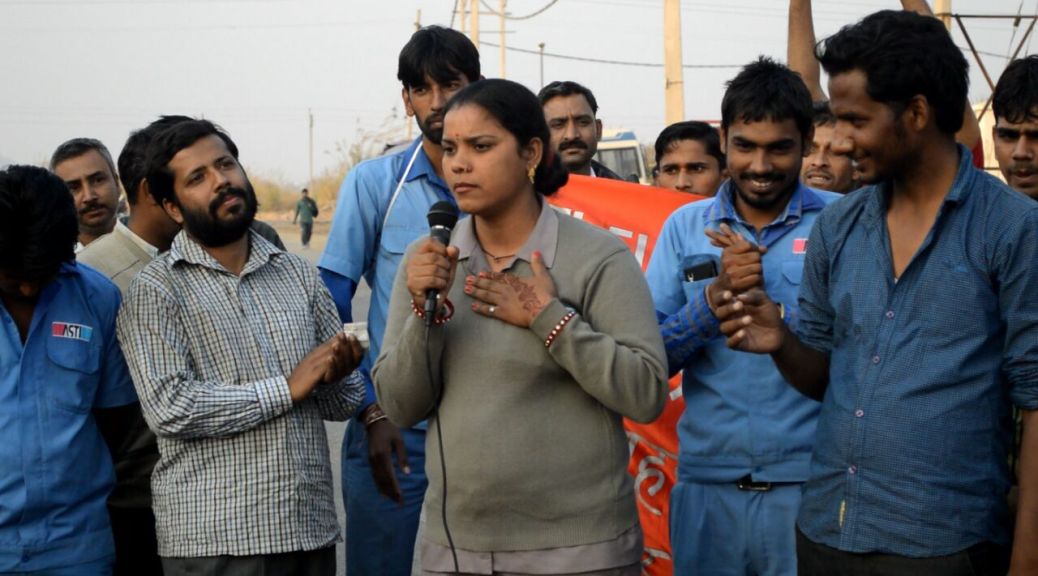
All 310 contract workers in ASTI Electronics factory in IMT Manesar in Gurgaon, Haryana have been on dharna since 3rd November 2014 after they were laid-off on 1st November 2014 citing low work demand. Seven of them are on fast-unto-death from 24th November, while ten workers and pro-worker activists each everyday sit on relay hunger strike.

 In a context where contract workers, increasing exponentially as a demand of the capitalists gleefully forced down by the government through labour law reforms, are finding it ever harder to organize/unite and sustain spontaneous outburts of discontent, due to the precarious nature of their life and work conditions, workers at ASTI Electronics (as a continuation of the 60-70 strikes in various factories in the industrial belt of Gurgaon-Manesar-Dharuhera-Bawal in the last few months) are fighting back and keeping the flame of new emergent struggles alive.

These workers are raising important questions on contractualisation and informalisation within the organized sector which even Central Trade Unions have constantly avoided. Over 250 of these 310 workers are women whose militancy in struggle and leadership is redefining the overall struggle and changing the gender relations within the workers movement.

This struggle for work-livelihood-life is unmasking the heart of the developmental model on DMIC (see current projects in makeinindia.com) which Mr Modi under the supervision of the capitalist class is proposing as the solution to all ills before so-called ‘progress of the country.What follows is a short reflection from the factory gate on the ongoing struggle. Continue reading Days and Nights in Manesar – Reflecting on the ASTI Workers’ Struggle: Anshita & Arya

The deadly land policies planned by Modi’s advisers and the links to Ukraine and Honduras: Aditya Velivelli

This is a guest post by ADITYA VELIVELLI

One year after the Land Acquisition Act was passed in Parliament with bipartisan support, commerce minister Nirmala Sitharaman stated that changes will be made to the Act during the upcoming Winter Session of Parliament.

The earliest indication that this would happen, came from of all people, a first-time MP and microfinance lobbyist Jayant Sinha. Sinha had mentioned in a CNBC interview right after BJP’s win that land acquisition policy was the first priority. For those wondering why CNBC interviewed Sinha and allowed Sinha to lay out the new Government’s priorities, and why Sinha has been appointed junior finance minister, they should refer – Who is guiding Modi’s economic thinking and what is their background? Continue reading The deadly land policies planned by Modi’s advisers and the links to Ukraine and Honduras: Aditya Velivelli

Debating Muslim Law after Shah Bano – the Model Nikahnama Initiative: A Suneetha

Guest Post by A SUNEETHA continuing the discussion on Uniform Civil Code on Kafila.

In popular imagination Muslim women’s unequal position in marriage is symbolized by cases such as Shah Bano or Imrana. It is understood this is the result of the religion-based Muslim personal law and the rigid control of women by the community in general and ulema in particular. Not many are aware that the same religion-based marriage law also offers tools for changing Muslim women’s position in marriage. In the last ten years, an ordinary document that every Muslim couple signs at the time of marriage – nikahnama or marriage contract – has assumed such a role. It has been innovatively used to initiate discussions and push for changes in the community’s thinking about the Muslim women’s position in marriage. In these efforts, a large number of “religious” and “non-religious” Muslim groups got into a conversation and set off a consensus-building process on the issue of a Muslim woman’s “entitlements”.

This discussion assumes importance in the context of the ongoing debate on UCC.  The debate on the UCC entered a new phase when, unhappy with the removal of Muslim women from the ambit of S 125 Crpc that guarantees all divorced women a minimum maintenance and the promulgation of a separate provision for divorced Muslim women called Muslim Women’s Maintenance Act 1986, many women’s groups renewed their demand for a UCC in 1990. Such a Code, it was hoped, would bring marital equality to women of all religions. When the Bharatiya Janata Party hijacked this demand to castigate Muslim men, (as if Hindu men were free of misogynist and patriarchal behaviour), such a hope was irretrievably lost. In the post-Babri Masjid demolition period, when there were pogroms against the Muslim communities, such a law would have found it impossible to garner support from the Muslims, especially if it were made by the BJP dominated Parliament. As anyone familiar with law knows, a consensus is important for law-making so that it is accepted and followed. But the changed situation of unparalleled parliamentary dominance of BJP brings newer challenges to all those working on issues of gender justice in all communities.

Muslim women were caught in this unenviable position since the 1990s – of having to address their own situation – under-age marriages, non-payment of mehr, arbitrary talaq, cruelty in marriage, maintenance after talaq, multiple marriages of men, resistance to women’s employment etc. while taking care that the Muslim men are not vilified further. Continue reading Debating Muslim Law after Shah Bano – the Model Nikahnama Initiative: A Suneetha

Concerns on proposed meetings of Intellectual Property Owners Association with IPAB and the Delhi High Court: Campaign for Affordable Trastuzumab

The Campaign for Affordable Trastuzumab was launched in November 2012 and has been endorsed by over 200 Indian and global patient associations, cancer survivors, health movements, women’s rights activists and eminent jurists.

Kalyani Menon-Sen, Leena Menghaney and KM Gopakumar from this campaign express serious concerns about  the intent and purpose of the “Innovation Dialog” being organised in India from November 16-22, 2014 by the Intellectual Property Owners Association (IPOA).

To: Hon’ble Justice Mr. H.L. Dattu (Hon’ble Chief Justice of India); Hon’ble Justice Smt. G. Rohini, (Chief Justice, Delhi High Court); Hon’ble Justice K.N. Basha (Chair, Intellectual Property Appellate Board)

Dear Hon’ble Justice Dattu, Hon’ble Justice Rohini and Hon’ble Justice K.N. Basha,

We write to you on behalf of the Campaign for Affordable Trastuzumab, a network of treatment activists, patients and public interest lawyers committed to making the breast cancer drug – trastuzumab – affordable in India. We have closely followed the misuse of patent rights and more recently the vexatious litigation of the Swiss pharmaceutical company Hoffmann-La Roche Ltd in India to maintain control over the market for the lifesaving drug (trastuzumab), thus blocking access to treatment for thousands of women with HER2+ breast cancer.

This letter is to express our grave concern about the intent and purpose of the “Innovation Dialog” being organised in India from November 16-22, 2014 by the Intellectual Property Owners Association (IPOA).

The IPOA is a US-based group consisting of large corporations and law firms which has been aggressively lobbying on issues of intellectual property standards and enforcement in India and pushing a pro-corporate agenda. The biased and unbalanced position taken by the IPOA is especially troubling when it concerns medicines, where the use of intellectual property protections have restricted access to affordable treatment and blocked competition.
Continue reading Concerns on proposed meetings of Intellectual Property Owners Association with IPAB and the Delhi High Court: Campaign for Affordable Trastuzumab

Understanding the De- Criminalisation Demand: Aarthi Pai and Meena Saraswathi Seshu

Guest post by AARTHI PAI and MEENA SARASWATHI SESHU

STOP Panic around Sex Work; by conflating it with Trafficking

VAMP, SANGRAM and The National Network of Sex Workers, India (NNSW); a network of sex worker organisations, collectives, federations and unions from Karnataka, Tamil Nadu, Maharashtra, Kerala and Andhra Pradesh;  seek decriminalization of sex work. 

First, a quick distinction between ‘decriminalization’ and ‘legalization’.

Decriminalisation is the repeal or amendment of laws or statutes which make certain acts criminal, so that those acts are no longer crimes or offenses.

Legalisation, on the other hand, will mean regulation and control by the state authority ushering a zone specific ‘licence raj’ with mandatory health check-up, criminalizing defaulters. It could also mean criminalizing of some aspects of sex work e.g. clients.

The UNDP Global Commission on HIV and the Law stated that, “Sex work and sex trafficking are not the same. The difference is that the former is consensual whereas the latter coercive. Any point of view that casts “voluntary prostitution” as an oxymoron erases the dignity and autonomy of the sex worker in myriad ways. It turns self – directed actors into victims in need of rescue.”[1] Sex work is adult consensual provision of sexual services and must not be equated with sexual exploitation or sex trafficking. Continue reading Understanding the De- Criminalisation Demand: Aarthi Pai and Meena Saraswathi Seshu

Challenging the Empire of Chicken Littles – Kiss of Love at Kochi

So the Kiss of Love event in Kochi did make waves that will stay in our memories for long. A very small group of young people did manage to publicly express affection and love at Kochi as planned despite all kinds of intimidation in the days leading up to the event. The lead organizers were constantly heckled and harassed; the event was grossly  misrepresented; there were attempts to stop it legally; threats galore were openly brandished against anyone who dared to participate; the police and the media, who ought to have been neutral, participated in the general hysteria that painted the event as a law-and-order problem. The core group was arrested and removed before the event to prevent trouble, apparently. Yet they did not back off; this event will indeed be remembered in the history of twenty-first century Kerala.

No one who knows life in Kerala would have expected it to ‘succeed’. The right-wing troll brigade has been celebrating obscenely, but then they clearly can’t see beyond their precious noses, because anyone who knows the strength of the united tightass coalition in Kerala and the depth of their irrational fear of touch (which, no doubt underlies much of the everyday mental and emotional pathologies in Kerala, the subject of much hand-wringing among the tightasses themselves) would know that there is no victory worth the name there. But of course they are also devoid of basic moral sense which would have made it evident that it is no big deal for an idiotic bully of a child, many times the size of a firefly, to kill it in a single swat. Nor can they be expected to have any inkling of the fact that the stupid hulk might crush the firefly with its sheer weight but is incapable of producing that speck of light which the firefly alone can ignite. Continue reading Challenging the Empire of Chicken Littles – Kiss of Love at Kochi

MNREGA’s Swan Song – Not everyone’s idea of ‘achche din’: Amitava Gupta

Guest Post by AMITAVA GUPTA

Concerned about the approach of the central government toward the Mahatma Gandhi National Rural Employment Guarantee Act (MNREGA), 28  development economists wrote a letter to the PM, urging him to stop tampering with the scheme. The letter, as one might have suspected, did not go down well with Jagdish Bhagwati. He, along with his Man Friday Arvind Panagariya, was quick to put forward a rebuttal. Though Bhagwati’s credentials as a trade theorist cannot but be acknowledged even by his bitterest critics, he is hitherto not known for his contribution toward development economics. Panagariya would merit even lesser mention. But, that should not ideally deny their argument a fair scrutiny.

The central government announced a set of measures over the last couple of months or so. Those include restricting the scheme to the poorest 200 districts; reducing the labour to material ratio from 60:40 to 51:49; freezing the real wage rate; imposing cap to state expenditure on the scheme.  Put together, those measures deliver a lethal blow to MNREGA. Bhagwati and Panagariya extend unconditional support to this rather brutal amputation. What they essentially do is to summarize the standard arguments against the scheme. The arguments can be clubbed under two heads— i) the scheme is marred in corruption; ii) it does not generate revenue to justify the spending from the exchequer and hence, it should be done away with. It is worthwhile to check whether any of these arguments has some merit or these are just political salvos packaged as economic wisdom.

Continue reading MNREGA’s Swan Song – Not everyone’s idea of ‘achche din’: Amitava Gupta

Un-owning – Archives in General, Ambedkar in Particular: Rajshree Chandra

Guest post by RAJSHREE CHANDRA

The immediate motivation for writing this piece has been the passionate and often partisan debate that surrounded the publication of the new, annotated critical edition of B. R. Ambedkar’s work, Annihilation of Caste (AoC) by Navayana Publishing. Sufficient water has flowed under the bridge to soften the various sharp edged stones and so it is perhaps time for some dispassionate perspective on the matter.

There are two kinds of debate that got triggered off by the publication of AoC. One of course relates to the 124 page provocative introduction to AoC written by Arundhati Roy titled ‘The Doctor and the Saint’ – The “Doctor” being Ambedkar and the “Saint” referring to Gandhi. The other relates to questions of ownership of archival material and questions of its fair dissemination. While the former has been hotly, and often intractably, debated by experts, scholars, followers and fans of Gandhi and Ambedkar, it is the latter that has received less attention than it deserves.

The question is important: It does not merely relate to the question of who owns Ambedkar, but in general relates to a wider question of authorship and representation of intellectual heritage. And as I have argued in my earlier posts on Kafila [1], for me the legal question is preceded by a normative concern and a political question, which is this: Should the answer to the question of who speaks for and about Ambedkar be selective? And relatedly, should ideas, works and publications of our thinkers and philosophers be policed and guarded by caretakers and/or representatives deemed to be “authentic” and/or “legal”? But before I come to these questions let me briefly contextualize the publication of AoC, as only a specific instance of his large body of work. Continue reading Un-owning – Archives in General, Ambedkar in Particular: Rajshree Chandra

A Response to ‘Uniform Civil Code – the women’s movement perspective’: Rohini Hensman

Guest Post by ROHINI HENSMAN

Nivedita has done us all a service in kicking off a wider debate on personal laws than the ones which have been taking place within feminist groups. One of the most important points she makes is that we have correctly moved away from the demand for uniformity. Uniform laws need not be either gender-just or secular, which is what we are aiming for; indeed, patriarchal theocracies have extremely uniform family laws! She has also raised several other questions that need to be discussed. I look at some of them here in the hope of taking the debate forward.

Polygamy: Unless polyandry is also allowed, polygyny is not gender-just, and ought ot be opposed. The fact that the vast majority of Muslim women, who are directly affected by the existence of legally sanctioned polygamy, are opposed to it, makes this an obvious move for feminists. To support polygamy on the grounds that it offers more protection to second or third wives sounds like a perverse argument. If we accept it, we should also be demanding that polygamy be made legal in other personal laws! Second or third wives would surely be better protected by being able to sue their fake husbands for fraud and get hefty damages.

Contractualising all intimate relationships: Although legal recognition of stable non-marital relationships would be desirable, contractualising all intimate relationships may not be such a good idea. Continue reading A Response to ‘Uniform Civil Code – the women’s movement perspective’: Rohini Hensman

Unwrapping the Soldier from the Flag – Kashmir after the Flood: Chirag Thakkar

Guest Post by Chirag Thakkar

Witnessing a culture of wounds trying to put itself together in times of a grave catastrophe is a difficult pursuit. For the archivist of State violence, the horror with which TRP-hungry television studios build a spectacle that is acutely wedded to a deep-rooted, pungent nationalism around catastrophe and relief in Kashmir, is frustrating. The insensitivity with which the Indian media has rubbed salt in the wounds of a people is appalling. One wonders if ours is a culture of calculated amnesia or of sightless apathy.
There is something very unique about the way in which we relate with the pain of the other. What is unique is the precision with which we reproduce perceptions about the masculine, hardened sons of soil – the security forces – and yet, at the same time, remain unmoved in failing to recognise the state of exception Kashmir has been in. What is also unique is how measured and stingy we are with our sympathy. Continue reading Unwrapping the Soldier from the Flag – Kashmir after the Flood: Chirag Thakkar

Uniform Civil Code – the women’s movement perspective

The BJP has once again raised the issue of a Uniform Civil Code (UCC) for all Indian citizens,  posed in a way that presents the BJP as ‘secular’ and pro-women, and opponents as communal or ‘pseudo-secular’ and anti-women. Since Independence, there has been very little change in the contours of the debate in the public domain, both within the BJP as well as among public intellectuals not necessarily aligned with the Hindu Right. The only change that has come about since the 1990s is that the UCC is now also posed as a ‘women’s rights’ issue and not only as a matter of national integrity, which requires the eradication of multiple legal systems. This new equation of ‘women’s rights’ with the UCC is at least partly a result of the interventions by the women’s movement in the debate in the 1990s. However, within BJP (and mainstream) discourse, it is assumed that only minority women need saving, for ‘we Hindus’ have already given ‘our’ women equal rights.

The women’s movement has developed this debate in complex and multiple directions over the decades, which this essay will briefly outline.

The debate over the UCC in contemporary India is produced by the tension between two notions of rights in the Fundamental Rights (Part III) of the constitution. The bearer of rights is both the individual citizen and the collectivity – the former is the subject of Articles 14 to 24 which ensure the individual’s rights to equality and freedom and the latter of Articles 25 to 30 which protect religious freedom and the educational and cultural rights of minorities [1]. It is from the latter that religious communities derive the right to be governed by their own ‘Personal Laws’. Since these Personal Laws cover matters of marriage, property inheritance and guardianship of children, and since all Personal Laws discriminate against women, the tension in Part III of the constitution can be read as a contradiction between the rights of women as individual citizens and those of religious communities as collective units of a democracy. Continue reading Uniform Civil Code – the women’s movement perspective

Terror, Performance and Anxieties of Our Times – Reading Rustom Bharucha and Reliving Terror: Sasanka Perera

Guest Post by SASANKA PERERA

[ This post by Sasanka Perera is a review of  Terror and Performance by Rustom Bharucha (2014). Tulika Books, New Delhi. Kafila does not ordinarily post book reviews. An exception is being made for this post because we feel that the subject of terrorism, which has interested Kafila readers in the past, is an important one, and needs to be thought through with seriousness. We hope that this post initiates a debate on Kafila regarding terror, the state, performance, and the performances – serious, or otherwise – that typically attend to the discussions of terror, whether undertaken by the agents of the state or by non-state actors, commentators in the media, or by intellectual interlocutors. ]

When I started reading Rustom Bharucha’s latest book, Terror and Performance, it immediately became an intensely personal and gripping engagement. It was difficult to read in a single attempt as the mind kept wandering from one unpleasant moment in our recent annals of terror to another in some of which I had also become an unwitting part – mostly as a spectator. From the beginning, my reading was a conversation with Bharucha’s text through detours of my own experiences and an interrogation to a lesser extent. In 1986, as a young man when I went to the Colombo International Airport to pick up my father who was returning from the Middle East, I was shaken by a tremendously loud sound for which I had no immediate references. I had not heard such a sound before. People started running towards the sound. It was a bomb that had blown up an Air Lanka flight which had come from Gatwick. The Central Telegraph Office in Colombo was bombed in the same year. We learnt that everyone was running towards the sound and not away from it. Dry local political humor very soon informed us that people were trying to get inside the bombed out telegraph office hoping that they could get free phone calls to their relatives in the Middle East as they had heard phones were dangling from the walls with no operators in sight. That was long before mobile phones and call boxes. We were still young in terms of our experiences with terror. However, we soon had very viable references to what all this meant as the political narrative of Lanka unfolded with devastating consequences. But in 1986, when the kind of terror that was to follow in all its fury was still relatively new and quite unknown, we were acutely unaware of the dynamics of the actual act of terror and the structure of feeling it could unleash. This is why many of us in these initial years were naively attracted towards the epicenter of the act rather than being mindful to run away from it. But as the society grew in experience, people soon learned their lessons. Though an academic text in every conceivable way, I was reminded one could always find a few rare books of this kind which might personally and emotionally touch a reader in addition to whatever intellectual stimulation it might also usher in. Terror and Performance is clearly one such book. From the perspective of the writer, Bharucha himself recognizes this personal emotional engagement and investment early in the book. For him, “this writing demands stamina as it faces an onslaught of uncertainties and cruelties at the global level that challenges the basic assumptions of what it means to be human” (xi). It is the same kind of stamina that one also needs to read it as most of us in South Asia would be reading it squarely sitting in the midst of our own worlds of unfolding terror. This is why all those thoughts came gushing into my mind throughout the reading. I was not only reading Bharucha; I was also reading my own past.

Continue reading Terror, Performance and Anxieties of Our Times – Reading Rustom Bharucha and Reliving Terror: Sasanka Perera

Temperance in the time of Rahu

So Onam is here again — despite the fact that several contradictory stars above  now form a malefic conjunction in the fate of poor Malayalis in Kerala. Indeed, rarely has a stranger gang dominated the starry heavens of our destiny: V M Sudheeran’s targeted gullet moralism that promises to close down a very large number of bars in Kerala and pave the way for total prohibition in the future, gangs of Hindu right wing youth and women forcing the government’s liquor outlets to close, policemen puffed up with jingoistic nationalism who hallucinate about Maoists in wake and sleep and declare social activists like Ajitha “dead”, CPM offspring who think that making foul, putrid public statements justifying murder is politics. All these are, well, rather drunk on self-righteousness and to be true, present a slightly ridiculous sight. Even the weather looks ridiculously inebriated – the sky alternates between bright sunny spells and horrid, harsh showers, crazily swinging between sunny smiles and bursts of tears. Continue reading Temperance in the time of Rahu

If Gail Omvedt is Katherine Mayo, then Sugatha Kumari is …? Thoughts on Salman’s Predicaments

Salman Zalman is a young man from Kerala who has recently been arrested for an alleged act of disrespect towards the Indian National Anthem. As an observer in Kerala, I think young people like him who choose to get involved in public struggles for justice face a number of predicaments that were perhaps not so severe for my generation when we were young. For this reason, I do feel that members of my generation, those of us alive to public issues, need to be more open to the challenges that public-minded younger people face today. Continue reading If Gail Omvedt is Katherine Mayo, then Sugatha Kumari is …? Thoughts on Salman’s Predicaments

The Chunduru Caste Atrocity – Discussing a Retrograde Judgment: Anonymous

Guest post by An Anonymous Advocate from the AP High Court 

On 22nd April, 2014, two Judges of the Andhra Pradesh High Court held that there was no evidence in the Chunduru atrocity case. The court acquitted all the accused. Not just that. They blamed the Dalits for not being responsible enough in alerting the police immediately, and obliquely cast a doubt on their integrity.

The Chunduru atrocity has gained national importance as much for the atrocity itself as for its place in the Dalit movement. On 6th August 1991, eight dalits were hacked to death by the upper caste men of Chunduru village, located in Guntur district of Andhra Pradesh. The political mobilization that was generated around this atrocity became the corner stone for the Dalit movement in Andhra Pradesh, and an inspiration for Dalit movements elsewhere in the country. On the legal side, it has been one of those long-drawn trials, resiliently overcoming one hurdle after another, be it the controversy around who the victims are (Dalits or Christians), or regarding the choice of the Special Public Prosecutor for the trial, or the venue of the trial. The case went back and forth between the High Court and the trial court, having been contested viciously by the Reddy accused, their lawyers and their ideologues.

Continue reading The Chunduru Caste Atrocity – Discussing a Retrograde Judgment: Anonymous

Big media has become bigger – Media Diversity and Reliance’s takeover of Network 18: Smarika Kumar

Guest Post by Smarika Kumar

Big media has become bigger. The takeover of Network 18 by Reliance has consolidated news media in the country like nothing before. The Reliance-Network18 combination is, in fact, not exactly new. It was actually executed a couple of years ago in a very telling, roundabout fashion when Reliance lent money to Network18 through a trust called IMT, among other things, to buy all of its media properties. As a result of Network18’s debt, Reliance could then dictate to it the terms of repayment, which were agreed between the two entities in the form of debentures convertible to shares.

The resulting combination brings TV channels like CNBC-TV18, CNBC Awaaz, CNN-IBN, IBN7, IBN-Lokmat, ETV-Rajasthan, ETV-Bihar, ETV-Uttar Pradesh, ETV-Urdu, ETV-Marathi, ETV-Bangla, ETV-Gujarati, ETV-Kannada, ETV-Oriya, ETV-Telegu, ETV-2, Colors, MTV, VH1 and Nick; web content properties such as moneycontrol.com, ibnlive.com, and firstpost.com; as well as magazines like Forbes India under a single umbrella of ownership and control. (For a complete list of media properties held by Reliance currently, scroll to the end of this article.)

  Continue reading Big media has become bigger – Media Diversity and Reliance’s takeover of Network 18: Smarika Kumar

Women Have Been Branded Liars!

Guest Post by ANUBHA SINGH and SURABHI SHUKLA

The recent Supreme Court judgment in the case of Arnesh Kumar v. State of Bihar & Anr. (Criminal Appeal No. 1277 of 2014) has once again brought to light the concern shared by the larger society about the ‘misuse’ of Section 498-A of the Indian Penal Code (hereinafter “IPC”) and the Dowry Prohibition Act, 1961. This concern has been raised many times in the past (and present) and the judiciary has gone to the length of labeling this ‘misuse’, especially that of Section 498-A, IPC,  ‘legal terrorism’ (in Sushil Kumar Sharma v. Union of India JT 2005 (6) SC 266.)

However, what has changed this time is that through this judgment the Supreme Court has endorsed and legitimized the common stereotype that women exaggerate and fabricate stories of violence to seek vengeance against their husbands and matrimonial families. Continue reading Women Have Been Branded Liars!

Pearls of Wisdom of A RSS Leader – ‘Elections equivalent to Independence Struggle’

Suresh Soni, RSS’s point person with the BJP, who facilitated ‘anointment’ of fellow Pracharak as PM candidate last year and smoothly engineered the marginalisation of the senior Advani and proved his clout within the organisation, is in news these days albeit for wrong reasons.

News has come in that he along with his former supremo (the late) K S Sudarshan were also beneficiaries of the yet unfolding MPEB scam which has already claimed the head of a senior minister – another fellow Pracharak – in Shivraj Singh Chauhan’s cabinet. Laxmikant Sharma, the said minister, who earlier handled important portfolios like mining, culture, human resources had claimed at the time of his arrest that he has been made a sacrificial lamb and when time comes he would also ‘reveal the truth’. He allegedly facilitated appointment of Mihir, a personal assistant to the late Sudarshan, as a ‘Nap Taul Inspector’ at the behest of Suresh Soni. Continue reading Pearls of Wisdom of A RSS Leader – ‘Elections equivalent to Independence Struggle’

Information on Aluthgama – Fact Finding by a Women’s Collective

A Fact Finding Report by a Women’s Collective on the Ethnic Riots in Aluthgama, Sri Lanka.

photo

On the 15th of June 2014 ethnic riots took place in Aluthgama following a rally organized by the Bodu Bala Sena (BBS), a Buddhist fundamentalist organization. Even though the police and state officials had been informed of the potential of the rally to turn violent, no steps were taken to stop the same, instead a large number of police and Special Task Forces (STF) personnel were deployed in the area. In the aftermath of the violence that shocked the country, a women’s team visited Aluthgama and met with several survivors with the objective of documenting the events that took place. Below is their report. Considering the safety of the survivors their names, location and other identities are not recorded.

“Around 12 midnight on 15/06/2014 the Welipitiya Mosque administration made an announcement that a large group of thugs were coming to destroy the Mosque. Upon the announcement the men from the village brought their families, left the women inside the mosque for their safety, and stood outside the mosque to protect the mosque. Around 2000 persons arrived in a procession at that time chanting slogans saying ‘we will destroy the Dharga Town mosque’, ‘we will change Dharga Town into a Sinhala village’ and started pelting stones from all sides,” said a mother whose son was attacked in this incident. She stated that she has four sons, she has been separated from her husband since the birth of her youngest son, and has brought them up single handedly amidst various challenges. “My two unmarried sons aged 20 and 17 heard the announcement from the mosque and left to guard the mosque. A few minutes after they left home I heard gun shots and ran outside to look for my sons but I could not locate them. I ran back home and prayed for their safety. I could hear the firing of gun shots for about 2 hours. Continue reading Information on Aluthgama – Fact Finding by a Women’s Collective

स्वायत्तता की फिक्र किसे है? अपूर्वानंद, सतीश देशपांडे

पिछला एक हफ्ता भारत के शैक्षणिक समुदाय के लिए, खासकर उनके लिए जो किसी न किसी रूप में दिल्ली विश्वविद्यालय और विश्वविद्यालय अनुदान आयोग से जुड़े रहे हैं, सामूहिक शर्म का समय रहा है. यह अकल्पनीय स्थिति है कि आयोग एक सार्वजनिक नोटिस जारी करके किसी विश्वविद्यालय के पाठ्यक्रम में दाखिले की प्रक्रिया के बारे में निर्देश जारी करे. आयोग ने दिल्ली विश्वविद्यालय के स्नातक पाठ्यक्रम में दाखिले के सिलसिले में अभ्यर्थियों को कहा है कि वे विश्वविद्यालय द्वारा विज्ञापित चार वर्षीय स्नातक पाठ्यक्रम में प्रवेश न लें. उसने विश्वविद्यालय प्रशासन को फौरन यह पाठ्यक्रम वापस लेने और 2013 के पहले के पाठ्यक्रम को बहाल करने का आदेश दिया है. उसने विश्वविद्यालय के सभी कॉलेजों को भी सीधे चेतावनी दी है कि उसका आदेश न मानने की सूरत में उन्हें अनुदान बंद किया जा सकता है. किसी विश्वविद्यालय को नज़रअंदाज कर उसकी इकाई से उससे सीधे बात करना अंतरसांस्थानिक व्यवहार के सारे स्वीकृत कायदों का उल्लंघन है. व्यावहारिक रूप से यह दिल्ली विश्वविद्यालय का अधिग्रहण है.यह भारत के विश्वविद्यालयीय शिक्षा के इतिहास में असाधारण घटना है और सांस्थानिक स्वायत्ता के संदर्भ में इसके अभिप्राय गंभीर हैं. Continue reading स्वायत्तता की फिक्र किसे है? अपूर्वानंद, सतीश देशपांडे

From Baghdad to Bolangir – Labour Laws in India: Saba Sharma

Guest post by SABA SHARMA

From the crisis in Iraq, a story is emerging of 40 construction workers in Mosul who have gone missing, some reports claim because they were trying to escape from the city and were captured by militants in the process. Many of these workers, feared kidnapped by ISIS, refused both their employers’ and the Indian government’s help to evacuate, as many have not been paid up to five months’ wages. Another report reveals that a group of 46 nurses from Kerala, working in a hospital in Tikrit, have refused to leave despite an offer from Delhi to help them evacuate. They need the money, as do their families back at home, so they would rather move to a safe zone in Iraq than return. Two nurses in the same hospital, who are on holiday in India, told the BBC that they would return despite the travel advisory issued by India advising citizens not to travel to Iraq. For them, failing to return means defaulting on loans taken to pay recruitment agents.

A few days before, on June 16, the NDA government announced that it was looking at liberalizing labour laws, primarily to make easier the retrenchment of workers. The UPA, and former PM Manmohan Singh in particular, also had labour law reform as an agenda, propelled by constant laments from industry saying ‘obsolete’ labour laws hindering growth and holding back the economy. The Vansundhara Raje government is already amending some state-level acts in Rajasthan to ‘liberate the corporate sector from the shackles of stringent requirements of the laws’, as one report put it.

Continue reading From Baghdad to Bolangir – Labour Laws in India: Saba Sharma