Category Archives: Left watch

Old Left is Dying! Long Live the Left!

[Following the publication of the previous post – the statement on the future of the Left, we have received some important comments that seek to take the debate forward, alongside those predictable, invective laden rants that we know only too well by now. We need to keep the debate on the future of the Left in India going, irrespective of these comments that seek to derail any meaningful discussion. We must continue to assert that ‘the Left’ far exceeds the decadent and decrepit lot that now goes by the name of Left parties in this country. This  post is a slightly modified and longer version of an article that appeared in Bengali yesterday in Ekdin.]

In a recent newspaper article, former Left Front finance minister Ashok Mitra, observed: “The Left Front, led by the Communist Party of India (Marxist), has not merely lost the poll in West Bengal, it has been made mincemeat of.” He was underlining the obvious, catastrophic significance of the results – at least from the Left Front’s perspective. The signs are there for everybody to see, especially when all important leaders of the LF government have faced resounding defeat and the overall vote share of the LF has declined by almost 9 percent since the last assembly election. Mitra’s reference is important as much was being made of the fact that he signed in support of the LF in the course of the election campaign.

But such was the state of drunkenness in power, that only a Biman Bose could say, when virtually everyone knew what was coming, that the LF would still gain a comfortable majority and those who were predicting their decline would have to “swallow their own spit.” More incredibly, even after the elections, indeed after the results came in, both Bose and Prakash Karat in Delhi focused on the fact that their votes had increased by 11 lakh votes in absolute terms. Of course, the minor detail they mentioned in passing was that the TMC alliance had increased its votes much more. The even more minor point that there had been as many as 4.8 million more votes polled this time as compared to 2009 was, of course, beside the point.

Continue reading Old Left is Dying! Long Live the Left!

‘End of the Left’ in India? Statement by Leftists after recent election results

Text of statement by Jairus Banaji, Sukumar Muralidharan, Dilip Simeon, Satya Sivaraman and Rohini Hensman endorsed by 224 others.

In a minor replay of 1989 and the fall of the Berlin Wall, the Indian media have been gloating at the defeat of the Left Front in West Bengal especially and have repeatedly suggested that this signals the ‘end of the Left in India’. Even at the best of times our news channels tend to avoid serious analyses of the underlying trends within the country, since they have transformed the news itself into a form of entertainment on models surpassed only by the U.S. news networks.

For its part the CPI(M) leadership has been at pains to minimise the significance of the defeat (in Bengal especially) and said that it would be wrong to write off the Left. For them ‘the Left’ means the Left Fronts in Bengal and Kerala and of course chiefly the CPI(M) itself.  They stress the fact that they still retain a considerable vote share, just over 40% in West Bengal for example, and there is indeed some truth in this claim.

Continue reading ‘End of the Left’ in India? Statement by Leftists after recent election results

Why the Left Front did not Endure: Sharib Ali and Shazia Nigar

Guest post by SHARIB ALI and SHAZIA NIGAR

“But it is unlikely that such a review exercise will to lead to the kind of “reformed” Left that its critics are rooting for — a Left tamed by its defeat into accepting the set of economic policies that, in the name of growth, intensify and create new inequalities; a Left subdued… The relentless pressure being put on the Left today is precisely to give up its class approach, to adapt itself to neo-liberal realities represented by the set of policies popularly referred to by workers as LPG — liberalization, privatization, globalization”

– Brinda Karat in The Indian Express

The op-ed piece by Brinda Karat is a brave effort at self defense after almost 5 days of uncomfortable silence following one of the most humiliating defeats in the history of the left movement in India. The article, defensively titled ‘The Left will endure’, is revealing in a number of ways. One that the CPI (M) has nothing much left to say, and two, that most of what it says is an expression of many of the beliefs that the Left Front  continues to hold, or at least professes to hold – even with all evidence against the same –  in review of its performance in West Bengal.

But, before an analysis, it is necessary to point out that Karat’s use of the term ‘The left’ is also a little problematic as it cannot be said with certainty that all people or parties associated with the color red are willing to call the CPI(M) brand of politics their own, and, definitely, not all of them are necessarily in position at the moment to feel the need to say that ‘ the left will endure’.

What the article attempts is to argue:

  1. That the defeat of the Left Front in Bengal was somehow a defeat because of the values that the Left Front professes to hold – equal and sustainable growth, labor rights, class approach to issues, and its refusal to accept foreign capital, etc.
  2. That the critics have written the Left Front off, and are attempting to browbeat them into neo-liberal submission.
  3. That the Left Front record in Bengal has been most applaudable in terms of its commitment to people, secularism, growth, and maintaining a thriving democratic culture in Bengal inspite of the lack of a strong opposition.

Most of the above are only ‘theoretically’ true, and meet reality only at a tangent.

Continue reading Why the Left Front did not Endure: Sharib Ali and Shazia Nigar

Beyond the Bluster-Equity and Justice in West Bengal: Abusaleh Shariff and Tanweer Fazal

Guest post by ABUSALEH SHARIFF AND TANWEER FAZAL

One of the key issues being keenly watched in the recently concluded assembly elections in West Bengal was the direction in which the Muslim vote was going. Muslims constitute 25 per cent of West Bengal’s population. Despite such high concentration, the near absence of Muslims from public arena—art, culture, literature, public service, education—is alarming and should cause consternation in any polity, especially one that claims its legitimacy in the name of the poor and the marginalized. However, any suggestion that the long Left Front rule had rendered Muslims of West Bengal poorer and deprived than other social groups was taken as an affront to the so-called ‘exceptional’ record of the Left Front. Figures were trotted out, statistics read out in support of this track record. However, there is a difference between sops, assurances and promises made in an election year and the actual performance of a regime that has ruled a state for more than 30 years.

Continue reading Beyond the Bluster-Equity and Justice in West Bengal: Abusaleh Shariff and Tanweer Fazal

वाम मोर्चे की करुण विदाई: ईश्वर दोस्त

Guest post by ISHWAR DOST

ममता की संघर्ष गाथा जीत का जश्न बन कर कोलकाता की जिस राइटर्स बिल्डिंग में प्रवेश कर रही है, उसके गलियारों में कुछ वक्त के लिए ही सही, सन्नाटा-सा तैर गया होगा। यादें उभर आई होंगी। चौंतीस साल का साथ पत्थरों तक के लिए कम नहीं होता। वे मूक दीवारें एक इतिहास की गवाह हैं। एक अपराजेय-से लगते लंबे दौर की; जिसने चुनावों के सात समंदर पार किए; अभेद्य लाल दुर्ग के तिलिस्म को खड़ा किया। अब लोकतंत्र में सबसे लंबे शासन का एक अंतर्राष्ट्रीय कीर्तिमान विदा हो गया। विदाई इतनी करुण और क्रूर कि पिछले मुख्यमंत्री विधानसभा की ड्योढ़ी तक नहीं पहुंच पाए। तैंतीस में से पच्चीस मंत्री विधानसभा से बेदखल हो गए। माकपा बंगाल विधानसभा में कांग्रेस से भी छोटी पार्टी हो गई।

2008 से एक के बाद एक पंचायत, संसद, नगरपालिका चुनाव हारने के कारण इस नतीजे में आश्चर्य की कोई बात नहीं बची थी। सड़क चलते राहगीर तक को पता था क्या होने वाला है। मगर व्यापक वाम से जुड़े बुद्धिजीवियों और पार्टी के भीतर के ही बौद्धिकों तक के आलोचनात्मक विश्लेषण माकपा की आंखें नहीं खोल सके। वाम मोर्चे को बंगाल में अपनी अपरिहार्यता के तर्क पर इतना यकीन था कि उसने अपने लिए आश्चर्य और धक्के का सृजन कर लिया। उसके लिए यह ‘अभूतपूर्व उलटफेर’ हो गया। आलोचकों को मुंहतोड़ जवाब देने की फितरत माकपा को आखिरकार जिस आश्चर्यलोक और रंजो-गम के गढ़हे में ले गई, उससे सावधान रहने की चेतावनी देते हजारों लेख अखबारों, पत्रिकाओं, ब्लॉगों में कदम-कदम पर बिछे थे।

Continue reading वाम मोर्चे की करुण विदाई: ईश्वर दोस्त

We Are Where We Know Not What Befalls Us… in Bengal!

Kahan le Chale ho... (image courtesy Small Strokes)

Ham wahaan hain jahaan se hamko bhee
kuchch hamaaree khabar naheen aatee

Roughly translated literally, this famous couplet of Ghalib’s would mean: “We are at that place from where we do not get any news about ourselves”. A somewhat surreal place to be in! It is not just that you are holed in, a place where you are cut off from the world and no longer get any news of the outside – say Plato’s Cave. This descent is into a Cave from where you get no news about yourself! You are in a state of incommunicability with your own self. Clearly, a Self that is deeply at odds with itself.

This is clearly the place where the Bengal communists have descended. Else, who could not have seen the avalanche coming? Even when they lost the 2009 parliamentary elections, they thought that they lost because those sitting in Delhi’s AK Gopalan Bhawan chased the chimera of the Third Front (and they have been repeating this till yesterday, everyone from Buddhadeb to Gautam Deb)! Of course that was a chimera but to delude yourselves that your defeat had nothing to do with your own doings, that ‘the people’ oh love you soo – that is only possible when you have descended into that surreal space.  The interesting thing is that apart from the self deluding communists of the CPM brand, even the ordinary person on the street knew what was coming. Continue reading We Are Where We Know Not What Befalls Us… in Bengal!

The Fragility of Oppositional Civil Social Ecology and the Impact of V S

Now that most of us Malayalees are basking in the warmth of the global ban on Endosulfan,even enjoying a brief spell of ‘unity’ (yes, even the UDF folk have joined, if more warily), what I’m about to write will probably make me quite unpopular. Well, here goes —  I have been watching the unfolding of events since last month’s elections to the Kerala State Assembly right up to the gathering of protest and the CPM-led charge against Endosulfan and it all looked like the ultimate festival of depoliticized mediatized dramatics. The dramatics during candidate-selection, the emotional performances of candidates, pretenders, leaders etc etc of various sorts for TV, the weepy complaints combined with nimble hopping across the LDF-UDF boundary by seekers of candidature, the lack of attention to manifestoes and the general attrition of discussion, all of this seemed to taper endlessly — exactly like the long-drawn-out daytime temple rituals during the Pooram at Thrissur. It was indeed a festival, consumed heavily and enjoyed immensely by the people — perhaps not in the sense of being a ‘festival of the people’.

Continue reading The Fragility of Oppositional Civil Social Ecology and the Impact of V S

In Memory of the Unknown Worker, this May Day

Nations build memorials to the Unknown Soldier. A militarized imagination in which the glory  of the Nation is embodied in a nameless and faceless  figure who courts death. This  faceless Unknown Soldier must die so that the myth of the nation can live, and a mythical National Interest devastate the everyday lives of the powerless.

This May Day, let us sing to the memory of the Unknown Worker – celebrated by no one, not even in abstraction!  The faceless figure on whom rest our lives of luxury, our ‘growth’ and the profits of the bourgeois. I borrow the the term ‘unknown worker’ from  Susie Madrak.

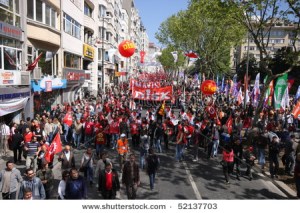
may day rally in istanbul's taksim square

Let us, we who have no nation – antinationals, postnationals, aliens, refugees, immigrants, undocumented workers, development refugees – sing the strains of the Internationale. Let us recall the days when the poetry of the International truly belonged to the ‘wretched of the earth’, the time when the Internationale was not yet taken over and made into the official anthem of nations, parties and governments. The long winter of party-state-nation appropriations of the voices of struggle, that set in more than a century ago, and once again imprisoned them, may be nearing its end.

Continue reading In Memory of the Unknown Worker, this May Day

A Few Lessons on Marxism and Politics

“At a certain point in their historical lives, social classes become detached from their traditional parties. In other words, the traditional parties in that particular organizational form, with the particular men who constitute, represent and lead them, are no longer recognized by their class (or fraction of a class) as its expression” – Antonio Gramsci, Prison Noteboooks, International Publishers, New York, 1971, p. 210. Emphasis added)

This is how Gramsci, sitting inside Mussolini’s fascist prison, began his now celebrated discussion of the ‘crisis of hegemony’. I cite this here apropos of the discussion that has gone on some of the previous posts by Monobina Gupta, Sankar Ray and myself on the CPM/Left in West Bengal, in the course of which, I have been accused of ‘coming out’ as a supporter of the Trinamool Congress, which some have also termed as a fascist or even ‘super-fascist’ organization! Clearly, these gentlemen neither know the history of fascism nor indeed of Marxism. Fed on pamphlets of a certain marxist catechism, they have learnt only one thing: the division of the world into two camps where ostensibly, battle lines are permanently drawn between parties that apparently have a ‘mandate from heaven’ of bearing a particular class character, either bourgeois or working class. I hope none of those who have learnt their ‘dialectics’ or their ‘historical materialism’ from marxism-made-easy pamphlets of Emile Burns, Maurice Cornforth and Stalin will jump to pronounce Gramsci a postmodernist who denies this supposed ‘class essence’ of parties . (I am told though that these too are passe now; ‘cadres’ these days are not meant to read beyond party resolutions and ‘theoretical’ essays of Prabhat Patnaik, whose own world has stopped with Michal Kalecki).

Continue reading A Few Lessons on Marxism and Politics

वामपंथ, माकपा और जनवादी क्रांति बकौल प्रभात पटनायक

[This post is a response to Prabhat Patnaik’s article ‘Why the Left Matters’ which appeared in the Indian Express on 17 March. A version has appeared in two parts in Jansatta]

पांच राज्यों में विधान सभा चुनाव हो रहे हैं. इनमें से दो, बंगाल और केरल वाममोर्चा शासित प्रदेश हैं. केरल में तो भारत के अन्य राज्यों की तरह  चुनावों के परिणामस्वरूप सरकारें बदलती रही हैं , बंगाल ने पिछले  चौंतीस  साल से वाम मोर्चे के अलावा किसी और सरकार का तजुर्बा करना ज़रूरी नहीं समझा है. इसे अक्सर बंगाल की जनता की राजनीतिक परिपक्वता के तौर पर व्याख्यायित किया गया है. बौद्धिक जगत में साम्यवादी विचार की वैधता के लिए भी जनता द्वारा दिए गए इस स्थायित्व का इस्तेमाल वैसे ही किया जाता रहा है जैसे कभी सोवियत संघ और अन्य पूर्वी युरोपीय देशों या अभी भी चीन में  साम्यवादी दल के  सत्ता के अबाधित रहने से उसे प्राप्त था.  बल्कि कई बार इसे अन्य  राज्यों की जनता के राजनीतिक दृष्टि से पिछ्ड़े होने के प्रमाण के रूप में भी पेश किया जाता रहा है . इस बार स्थिति कुछ बदली हुई लग रही है. अगर बंगाल में अनेक स्तरों के स्थानीय निकायों के चुनाव कुछ इशारा कर रहे हैं तो वह सत्ता परिवर्तन का है.

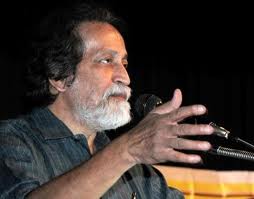
Prabhat Patnaik, leading CPI-M aligned intellectual

संसदीय प्रणाली पर आधारित लोकतांत्रिक व्यवस्था में इस प्रकार का परिवर्तन जीवन का नियम माना जाता है, बल्कि इस अस्थिरता में ही उसकी जीवंतता का स्रोत भी देखा जा सकता है. लेकिन बंगाल की जनता द्वारा मत-परिवर्तन की संभावना एक विशेष बौद्धिक संवर्ग के लिए चिंता का विषय बन गई है. प्रख्यात अर्थशास्त्री प्रभात पटनायक ने कुछ पहले इस संकेत की असाधारणता की ओर ध्यान दिलाते हुए एक टिप्पणी लिखी है. बल्कि यह जनता और विशेषकर भारत के शिक्षित समुदाय से एक अपील ही है – भारत की लोकतांत्रिक क्रांति की रक्षा की अपील. उनके कहने का सार यह है कि भारत की सतत वर्धमान लोकतांत्रिक क्रांति पर प्रतिक्रांतिकारी शक्तियों के बादल मंडरा रहे हैं और इस बार यह खतरा वास्तविक और आसन्न है. इस खतरे का सामना करने के लिए प्रभात आवश्यक मानते हैं कि वामपंथ को चुनाव में प्रतिकूल परिणाम न झेलना पड़ॆ.  उनके अनुसार वामपंथ को कोई भी चुनावी धक्का दरअसल लोकतांत्रिक क्रांति के लिए मरणांतक आघात साबित हो सकता है.

Continue reading वामपंथ, माकपा और जनवादी क्रांति बकौल प्रभात पटनायक

Did You Say ‘US Imperialism’, Prakash Karat? Sankar Ray

Guest post by SANKAR RAY

The CPI(M) general secretary Prakash Karat and the Left Front chairman Biman Bose deserve thanks for referring to the WikiLeaks revelation about the US enthusiasm in seeing a change of guard at the Writers’ Buildings, the seat of the Government of West Bengal.

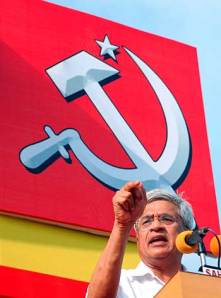
Prakash Karat, CPM general secretary
Prakash Karat, CPM general secretary, courtesy rediff.com

Quoting the cable no 230353 10/20/2009, Mr Karat conveyed the gist of it as follows: “Since the May 2009 parliamentary elections elevated West Bengal’s regional party, All India Trinamool Congress, from obscurity to the second largest constituent party in the United Progressive Alliance, its leader, Mamata Banerjee, has conscientiously sought to re-brand herself as West Bengal’s Chief Minister-in-Waiting. She is using the considerable administrative resources at her disposal as Railway’s Minister, political resources as leader of the state opposition party, and personal resources to initiate this transformation. Supporters and critics acknowledge the new image, but question whether it is indeed a new product, or simply new packaging. Backed by a large parliamentary constituency and allied with the ruling Congress party, Banerjee’s Trinamool is well placed to win the 2011 state assembly elections if she can continue along her current path of self-restraint and avoid making any mistakes along the way.” For details, the reader has to visit http://pragoti.org, even though it’s unabashedly pro-CPI(M).

The CPI(M) supremo observed that the AITC brass “is very much within private outreach. I’m in no position unfortunately to investigate and tell you what they are doing to fulfill this general direction they’ve given in the cable”.

Continue reading Did You Say ‘US Imperialism’, Prakash Karat? Sankar Ray

The ‘Whore of Babylon’ – Or, Misogyny, Sexism, CPM Style

It has to be seen and heard to be believed! Former Arambagh CPM(M) MP Anil Basu , addressing an election rally in his home turf likened Mamata Banerjee to a ‘whore of Sonagachi’, who is now getting rich clients from the US to give money for her election campaign! I draw attention to this with the greatest of respect for the women  he is referring to, sex workers who work hard to make a living. When Basu refers to them, however, it nothing but a statement of  misogynist contempt for women in public and reveals, once again the mindset of the Left leadership that rules West Bengal.

Some extracts from today’s Indian Express report:

 “Addressing a rally yesterday, Basu made references to Sonagachi — Kolkata’s red-light area. “Where is she getting the money from?” he asked. “From which bhatar (Bengali derogatory slang for a woman’s “illicit male partner”) did she get Rs 24 crore to fund the Trinamool Congress’s poll expenses?”

Saying that prostitutes in Sonagachi “do not even look at smaller clients” when they get a “big client”, Basu said now that the Trinamool has got a “big client” — the USA — to fund its poll expenses, it is not interested in the “smaller clients” from Chennai, Andhra Pradesh and other places in the country.”

Continue reading The ‘Whore of Babylon’ – Or, Misogyny, Sexism, CPM Style

The Paradoxical Figure of Mamata: Monobina Gupta

Guest post by MONOBINA GUPTA

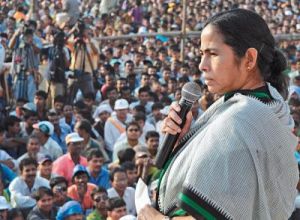
With the coming assembly elections, West Bengal seems to be poised on the edge of a historic upheaval that will, in all probability, enter the collective memory of its people, much like the momentous 1977 elections. The most palpable moment of this churning will manifest in what looks like an unbelievable denouement – that of the thirty-four year old monolithic rule of the Left Front. Equally stunning might be the image of Mamata Banerjee, bringing the red fortress down – a politician, almost bludgeoned to death by CPI-M cadres on 16th August 1990, now transformed into the emblematic face of this extraordinary hour. The 2011 polls may be billed as the great unraveling of West Bengal, its politics and culture – but also, I think, of gender relations. Banerjee is on the verge of acquiring a unique status, becoming the first woman head of a state well known for its misogynist culture, notwithstanding many claims to the contrary.

mamata banerjee
Mamata Banerjee. Courtesy The Hindu, Arunangsu Roy Chowdhury

An important aspect of Banerjee’s ascendancy may be lost if we fail to locate her persona within this grid of power and gender relations; if we do not contextualize her in Bengal’s thriving culture of male chauvinism. The association of West Bengal and its ruling Marxists with the autonomy and radicalization of women – who are supposedly respected in Bengal unlike in other parts of the country – is a well preserved myth. Bengal respects its women, but only if they belong to the hallowed league of ‘Mothers and Sisters’. Like elsewhere, ‘deviant’ women have little place in the land of the Renaissance.

Continue reading The Paradoxical Figure of Mamata: Monobina Gupta

Why so serious?: Anuj Bhuwania

Guest post by ANUJ BHUWANIA

Cellphone videos of the celebrations at India Gate after India won the semi-final against Pakistan


So cricket is the opiate of the Indian masses, and India’s left-liberals (henceforth LLs) can’t deal with it. Or with popular cinema or religion, for that matter. All of which are things that these oh-so-serious people can’t quite seem to fathom. The only cinema you should enjoy are art house/multiplex films with the right ‘social message’, the only religion you can profess is Sufism and the only cricket you are allowed to enjoy is West Indies winning a test match, because CLR James has apparently said it’s ‘empowering’ or  ‘anti-imperialist’ or some such. These trivialities – cinema, religion, cricket – are just there to distract people from the really important issues. We should all only obsess about ‘important’ topics like nuclear energy, the 2G spectrum scam or the UID. Continue reading Why so serious?: Anuj Bhuwania

Corruption, CPI(M) and Neoliberalism: Sankar Ray

Guest post by SANKAR RAY

Prasenjit Bose, chief of research cell, central committee of CPI(M) deserves kudos for his article Corruption and Forbearance under Neoliberalism, published in the journal of The Centre for Policy Analysis, and reproduced in pragoti.org. However, corruption is not an exclusive phenomenon under the capitalist system. Socialist countries – I mean the social orders encouraged by the Third International – were also afflicted by corruption, not to speak of People’s Republic of China (both in Mao and post-Mao years). Even the CPI(M)-led governments in Kerala and West Bengal never waged a principled war against corruption.  Hence Bose’s inference that “the state under the neoliberal regime has increasingly become a vehicle for capital accumulation and also a site for primitive accumulation, by the established corporate players as well as new entrants to the big business club” – is only half the truth. Continue reading Corruption, CPI(M) and Neoliberalism: Sankar Ray

Reflections on Sudipta Kaviraj’s ‘Marxism in Translation’

[The following is a revised version of some comments made during a discussion with Sudipta Kaviraj at the Centre for the Study of Developing Socoeties, Delhi on 21 October 2010. Kaviraj made a presentation based on a recent essay of his ‘Marxism in Translation: Critical Reflections on Indian Political Thought’ (published in Political Judgement: Essays in Honour of John Dunn, Eds Raymond Geuss and Richard Bourke) to which some of us responded. AN]

It is interesting to revisit, with Sudipta Kaviraj, the field of ‘Indian Marxism’. It is an abandoned field, a piece of haunted land where no living beings go – at least not in their senses. What is more, it is a field that ‘Indian Marxists’ themselves are afraid of revisiting. It is their past – the land of the dead, of unfulfilled ancestral spirits, where the ghosts of yesteryears hang like betaal from every tree. The terror of this forbidden territory has redoubled, after the collapse of socialism. It is as if some deep secrets of the past lie buried there which they would rather not bring back to life, for fear of what might be revealed to them of their own selves. It is strange but true that Marxists who swear by history are perhaps as afraid of it as anybody else.

Read the full post in Critical Encounters.

Hypocrisy beneath hammer-and-sickle sign: Sankar Ray

Guest post by SANKAR RAY

Sankar Ray is a veteran journalist based in Kolkata

[This article presents the sordid tale of land acquisitions for the New Rajarhat Township and the involvement of important CPI(M) personnel in this game. One of them, the key protagonist of the story below, was mentioned by Pranab Mukherjee in parliament yesterday, taunting the CPI(M) over its claims to be a crusader against corruption, arousing the ire of its MPs. – AN]

Calling it a ‘shocking experience”, after a visiting a segment of oustees in the Narmada Valley in mid- August 2002,  Sarla Maheswari, then CPI(M) member of Rajya Sabha member told the media – as if her heart bled, and with revolutionary conscience ablaze:  “How can a development project create a disaster in the lives of the most downtrodden tribal people and also thousands of farmers of a huge area? How can it ravage their lives without any protest by mainstream political parties?  Truth indeed is stranger than fiction as the same fire-eating  ‘communist MP’s demagoguery is now in a hot soup as I-T sleuths raided  at  her residence, as a sequel to  detection of an unaccounted sum of Rs 31 crores and 26 benami companies, belonging to the Canopy Group whose chairman is her husband Arun Maheswari. And the CPI (M) brass at the Muzaffar Ahmed Bhavan, Bengal CPI(M)’s state headquarters keep up their recalcitrance, not even demanding a ‘show cause’ of the cash-rich ‘comrade’ . Former MP and CPI(M) CC member Mohd Selim, a spokesman of state party leadership too, ruled out any punitive step until specific indictment by the I-T department, leave alone criticizing the shady land transactions in the controversial New Town project at Rajarhat fully with the knowledge of ‘comrade Sarla Maheswari’  and her family.

Continue reading Hypocrisy beneath hammer-and-sickle sign: Sankar Ray

Un-Indianizing Kerala: How to defend K K Shahina

Like the unseasonal and tenebrous rain clouds that are hovering over Thiruvananthapuram in what should be a sunny, light-mist-adorned January, a pall of gloom, of impending danger, hangs around my everyday life in Kerala. This is not a general feeling. It is however shared by many of us who write and speak critically about the powers that be. The space to speak and write thus has been shrinking for a while now, but now there is a sense of dangerously teetering on the edge: the Indian state seems to be upon us, and with a vengeance. Continue reading Un-Indianizing Kerala: How to defend K K Shahina

Maoist dilemmas in Nepal

Exactly four years after a peace accord the end of Nepal’s civil war, the Unified Communist Party of Nepal (Maoist) is going through a deep existential crisis. This was most starkly reflected in the separate political documents presented by chairman Pushpa Kamal Dahal ‘Prachanda’, senior vice-chairman Mohan Vaidya ‘Kiran’, and another vice-chairman and ideologue Dr Baburam Bhattarai at an extended party meeting in Palungtar of Gorkha district last week. Almost 6,000 delegates – including 1200 Maoist combatants from UN-monitored cantonments – reviewed the party’s achievements and failures after entering the peace process, and discussed the future ‘political line’ the party should adopt. Continue reading Maoist dilemmas in Nepal

“Nobody Can Stop The Revolution”

Over the weekend, a number of journalists received the following statement from Ganapathy; General Secretary of the Communist Party of India (Maoist). In the text, Ganapathy clarifies the Maoist stance on a broad range of topics – particularly Kashmir, the Commonwealth Games, the Ayodhya Verdict, Mamta Bannerjee in Bengal, Obama and the North East.

However, the fact that the questions are posed by an obviously sympathetic “interviewer” and our inability to send any follow-up questions means that, I personally, treat this as a policy document rather than an “interview”. To get a quick newsy sum-up, you could read my report for The Hindu.

I felt it would be interesting for our readers to go through this text to get a sense of “What Maoists Want”.  As a reporter, I am only too aware of how Maoist politics is severely under-reported as opposed to their military tactics.

As neither the Maoists, nor Mr Ganapathy are currently in a position to defend their views on Kafila; I have disabled comments on this post. Afzal’s acerbic (and spot on) comment has changed my mind. Have allowed comments on this piece.Hopefully, this document shall serve as a reference point for further discussions on the Maoist movement.

Continue reading “Nobody Can Stop The Revolution”

Greed-Kerala Express, Anyone?

The panchayat elections in Kerala are over and the dust has settled in the battle-field. In the past weeks, I have been repeatedly asked, why aren’t you writing something on the elections? Well, I told them, I have many failings but I do not suffer from Schadenfreude.

Continue reading Greed-Kerala Express, Anyone?