Category Archives: Media politics

Aseem Trivedi and the guardians of good taste

There’s a time for everything. When a cartoonist is being arrested for his cartoons, for cartoons that caused no harm, incited no violence, killed no people, then do you discuss his art or his incarceration? Continue reading Aseem Trivedi and the guardians of good taste

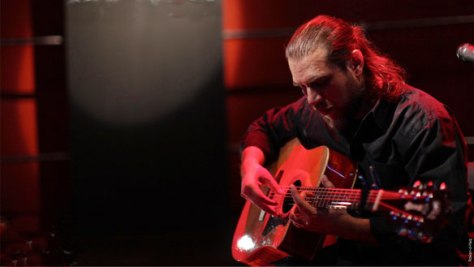
Coke Studio Pakistan – At a crossroads: Nandini Krishnan

Guest post by NANDINI KRISHNAN

Rohail Hyatt, producer of Coke Studio Pakistan

Khabaram raseedah…imshab
Khabaram raseedah imshab kih nigaar khaahi aamad

The words are beautiful; the voices that sing them mellifluous. And yet, I find that instead of being overwhelmed as I usually am by the qawwali of Fareed Ayaz and Abu Muhammad, enraptured by the transcendental waves of their music, parts of my consciousness are held down, niggled. Perhaps it’s the constant drumming and strumming, perhaps it’s the psychedelic sound waves zipping across giant screens, perhaps it’s the acoustics that throw back bits of the singers’ strains at them. But the Coke Studio version of Khabaram Raseedah doesn’t affect me the way even scratchy recordings of live, open-air concerts do. Continue reading Coke Studio Pakistan – At a crossroads: Nandini Krishnan

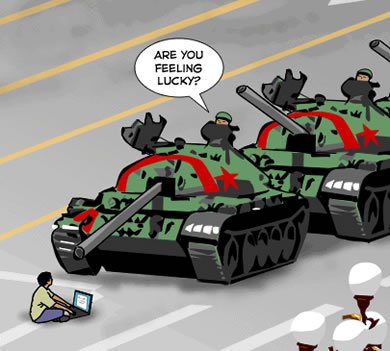
Why is the Indian media building a case for internet censorship rather than against it?

Hundreds of webpages now stand blocked in India, the government has openly been appealing to internet companies to pre- or post-screen content and remove what the government wants it to remove. One Google Transparency Report after another has been revealing how the number one target of the government is criticism of politicians and government. Just imagine what would the Indian media’s response to such censorship have been like had it been hundreds of books or articles we were talking about? Instead of asking Facebook to ‘pre-screen’ our posts, had Kapil Sibal been asking for someone to pre-screen articles in the newspapers, would it not be like the Emergency?

Okay, point taken. Let us not trivialise the Emergency, which entailed jailing of dissidents and forced sterilisation and so on. But still, there’s so much internet censorship in India now that it is surprising that instead of outrage you find the Indian media actually building the case for censorship. What about hate speech, they ask. What about the trolls, Why is there so much abuse on the internet? Continue reading Why is the Indian media building a case for internet censorship rather than against it?

Borderline madness: Sajan Venniyoor


Guest post by SAJAN VENNIYOOR

Now that government agencies in India — some half a dozen of them working with the exceptional coordination we have come to expect from government agencies — have blocked Facebook accounts, Twitter feeds and YouTube videos supposedly originating in Pakistan, perhaps we could contemplate other trans-border electronic transgressions committed by our neighbours.

In August 2011, The Times of India reported that Punjab border farmers still tune into Pak FM radio stations. According to villagers on the fringes of Ferozepur, the limited range of India’s “national radio” broadcasts and the absence of any local FM station have made radio services from Pakistan the most popular source of entertainment in border areas.

About the same time last year, the Indian government had become alarmed by the popularity of Nepal’s FM radio channels in Bihar along the Indo-Nepal border. According to various sources, some half a dozen Nepal FM radio stations are broadcasting programmes – “anti-India advertisements and vulgar songs”, according to one outraged newspaper report – into Bihar, especially Madhepura, Supaul, Madhubani, Kishanganj, Araria, Sheohar, Saharsa, Muzaffarpur, and East and West Champaran districts.  Continue reading Borderline madness: Sajan Venniyoor

Full text: The Indian government’s recent orders to Internet Service Providers to block websites, webpages and Twitter accounts

Joji Thomas Philip has put out these documents in The Economic Times.

18 August:

19 August: Continue reading Full text: The Indian government’s recent orders to Internet Service Providers to block websites, webpages and Twitter accounts

How Delhi paper ‘Sahafat’ fell for fake images of violence in Burma

Yousuf Saeed wrote in Kafila on 13 August how fake images of violence against Muslim Rohingyas in Burma – images that were in fact, of, say, earthquake victims. In his post he mentioned how even some Urdu papers in India were fooled by the images,which provoked violent protests in Mumbai,and recently, Lucknow.

Now, CM Naim describes in detail how Sahafat, an Urdu newspaper published from Delhi, fell for these fake images. Naim translates large parts of two charged-up articles in Sahafat, one of which calls for the boycott of Buddhists in Delhi. One article was published on 10 August and one on 16 August. As Naim says, it’s time for the Press Council of India to take note. One excerpt: Continue reading How Delhi paper ‘Sahafat’ fell for fake images of violence in Burma

Of Shopfloors and Newsrooms: Faiz Ullah

Guest Post by FAIZ ULLAH

It’s that time of the year. Newsrooms of television news broadcasters are buzzing. Human Resource (HR) professionals may choose to see it as the culmination of a significant process called performance appraisal, but for young news producers and journalists – a decidedly young species – it’s time to see that overdue promotion or promised increment in remuneration. Sometime during the beginning of last financial year these young professionals must have set up their ‘specific and measurable’ KRAs, or Key Result Areas, by using formulaic proformas sent to them by the HR department. This year, a few months ago they would’ve again got a mail from the HR department asking them to revisit those excel sheets with their line supervisors and have their performances graded on the scale of 1 – 10 or some such. Every story filed, every source cultivated, every special ‘half-hour’ show done must reflect on this document. ‘Domain expertise and knowledge’, ‘integrity’, ‘self-discipline’ and ‘adaptability’ are some of the ‘competencies’ against which the supervisors are required to assess the performance of their subordinates additionally. What don’t find mention on these appraisal forms are day to day frustrations that are part and parcel of a news professional’s job and anxieties that permeate his/her larger lifeworld.

Continue reading Of Shopfloors and Newsrooms: Faiz Ullah

Creating Happiness – Rijul Kochhar

Guest post by RIJUL KOCHHAR


It is a minute and a half long, and from the moment you see it, you will know that there is something sinister about it—a scenario of forced forgetfulness. It is displacement incarnate, and what is it doing, this aesthetic of obscenity? Is this retribution or charity, or retribution through charity, the developmental discourse of murderous sustainability through erasure? You will be puzzled and worried, harried and then it will make you sleep again in pious numbness, for isn’t the world—its deep blue sky and crystal fluid and cleansing sunlight, and bright flowery faces, its innocent time—just so beautiful! You will find that you cannot respond to it, physically, humanly, for it is not receptive to the organic. It cannot be mediated. It is a ghoul, perched to haunt and hypnotize us out of the memory of its past terrors. You remember, lenore, and wasn’t it to be nevermore? It is an electrical transmission and nothing more, or is it? It is a triumph of pre-postmodern, oily chic, so cloaked in ancient blood, that the blood has caked and turned black and fallen off, revealing the identical colour of the master’s heart, now you see it, now you don’t. The laceration has been hidden by the three-day apoptosis—the extra-cellular matrix, the forgetful memory’s collagen. But you will need to dig outward and inward from here, and very deep. It is there on my screen, this light of blood-lust, “Vedanta: Creating Happiness”, and every time a new or repeated tale from half way across the world is beamed, news every quarter of an hour, this monstrosity accompanies those facts like some leech feeding on reality. You remember Sontag, and isn’t she who had her way with those words: “Now there is a master scenario available to everyone. The color is black, the material is leather, the seduction is beauty, the justification is honesty, the aim is ecstasy, the fantasy is death.”

Continue reading Creating Happiness – Rijul Kochhar

Anonymous, India and the Blackhat Spectacle: Oxblood Ruffin

Guest post by OXBLOOD RUFFIN

If there be time to expose through discussion the falsehood and fallacies, to avert the evil by the process of education, the remedy to be applied is more speech, not enforced silence.
— Justice Louis D. Brandeis, Whitney v. California

Any discussion of Anonymous is problematic. One is never sure which Anonymous is being referenced: the meme, the group as a whole, or an individual operation. And the press doesn’t appear to know or care. It has gone into a rapturous fap over the loose knit collective, declaring them, inter alia, the most influential group in the world, terrorists, and – wait for it – very dangerous hackers. This last descriptor is particularly amusing. There are, in fact, so few real hackers within Anonymous that they could petition the U.N. as an endangered species.
Continue reading Anonymous, India and the Blackhat Spectacle: Oxblood Ruffin

कॉरपोरेट और मीडिया का नया खेल: विनीत कुमार

आदित्य बिड़ला समूह ने इंडिया टुडे, बिजनेस टुडे जैसी पत्रिकाएं प्रकाशित करने वाली कंपनी लिविंग मीडिया इंडिया के साढ़े सत्ताईस फीसद शेयर खरीद लिए हैं। इसकी बदौलत टीवी टुडे नेटवर्क, जिसका 57.46 फीसद लिविंग मीडिया के पास था और उस पर मालिकाना हक अरुण पुरी का ही है, अब उसमें भी आदित्य बिड़ला समूह का व्यावसायिक दखल हो गया है।

Continue reading कॉरपोरेट और मीडिया का नया खेल: विनीत कुमार

“The more they censor the internet the bigger we become” – An interview of Anonymous India

In which I interview “Anonymous India” who have organised a massive protest against internet censorship across 11 Indian cities on 9 June.

Some say such attacks (hacking and defacement of Web sites) could be used by the political class to actually strengthen their argument in favour of control and regulation of the Internet. What do you say to that?

Anamikanon: People on the ground are vulnerable to people with a lot of power and no problems misusing it. Anonymous can’t be found to defame, threaten, suppress, stall…. wrong means? Ok. Worth it.

Netcak3: I say the more they censor the Internet, the bigger we become. We strive in users from across the world. Pro tip: Once an idea has been made, you cannot kill it.

Anamikanon: In my view, these are the means that can be safely used without risking life, limb, careers, reputations, family…

Gummy: Defacing is like posting a nill which is illegal and can be removed. Like people post their advertisement bill (poster) at the back of buses and other public places.

Anamikanon: Except we post it in inside their drawing rooms! [Read the full interview.]

Net Loss: Sajan Venniyoor

Guest post by SAJAN VENNIYOOR

Image via dailygalaxy.com

Net: noun, verb.

1. a contrivance of strong thread or cord worked into an open, meshed fabric, for catching fish, birds, or  other animals
2. anything serving to catch or ensnare

The other day, in a Parliamentary debate on Internet Rules 2011, the leader of the Opposition in the Rajya Sabha said something so absurd that for a moment I thought he had joined the government. “You can control print and electronic media, but not internet,” he said, only removing his foot from his mouth to add, “If internet had been in existence, Emergency would have been a fiasco.”

Actually, if the Emergency had been in existence, the Internet would have been a fiasco. Continue reading Net Loss: Sajan Venniyoor

Meet Ashok Kumar the John Doe of India; or The Pirate Autobiography of an Unknown Indian

The internet has been abuzz with  news of all the major ISPs in India blocking popular websites including piratebay, vimeo, dailymotion and pastebin etc. This is pursuant to a Chennai high court order available here and there are a number of unanswered questions about the validity of the blocking of the websites including whether the DOT were entitled to ask for a blocking of the site on the basis of the orders, how the ISPs chose these particular websites since the order itself does not mention any particular website. This is not to mention the larger question of how the last ten years has seen the dubious rise of John Doe orders as preemptive measure against copyright infringement.

For those unfamiliar with John Doe orders, they are ex parte injunctions ordered against unknown persons. Just to put this in context, ex parte injunctions are not the easiest things to obtain since they are based on the denial of  another person’s right to be heard. So even for cases of violence against women getting an ex parte restraining order is not easy. In contrast the last ten years we have seen the ease with which one can obtain these orders for copyright infringement cases. Continue reading Meet Ashok Kumar the John Doe of India; or The Pirate Autobiography of an Unknown Indian

The Great Indian Media Hoax Of Self-Regulation: Ruchi Gupta

Guest post by RUCHI GUPTA

[This post was initially published in the Times of India and removed from their site soon thereafter.]

With a comfortable gap of time after the revelations of paid news, private treaties and the Radia tapes, the media is once again on the offensive to guard its independence. The trigger this time is a private member’s bill, the Print and Electronic Media Standards and Regulation Bill, 2012. The proposed legislation has been widely and energetically panned by the industry, with the Congress subsequently distancing itself from the Bill. The Bill is not available in the public domain; however based on news reports, some provisions could perhaps lend themselves to state censorship. While the merits of the Bill are debatable, what is striking is the complete lack of self-consciousness with which the media termed the attempt as an attack on democracy, without addressing its own corruption and its deleterious impact on democracy. Continue reading The Great Indian Media Hoax Of Self-Regulation: Ruchi Gupta

When Laughter becomes a laughing matter: Statement by CSSSC Faculty Members on the Cartoon Controversy

Going by the ruckus surrounding cartoons these days, by the angry, at times violent, reactions of elected lawmakers against any kind of caricature of prominent personalities, it seems ‘laughter’ itself has become a laughing matter in contemporary India. And, this indeed is puzzling. The emerging trend of automatically equating lampooning with character assassination, of treating every expression of joviality targeting persons deputed by people to run the republic as being fundamentally slanderous and libelous, cannot but result in undermining the nation’s democratic charter.

Those who now readily question the public right to parody celebrities or icons are also guilty of forgetting that India has a long tradition of producing social and political commentaries in the form of hilarious visuals and words. The lack of sense of humour of persons at the helm of power today is so profound now that we may very soon lapse into a state of amnesia in relation to the deeply admired and dearly loved cartoonists, such as, Gaganendranath Tagore, R. K. Laxman, K. Shankara Pillai (better known as Shankar), Attupurathu Mathew Abraham (known popularly as Abu Abraham), O. V. Vijayan, Mario de Miranda (better known as Mario).

It is on behalf of the ‘little men’, from whose perspectives the celebrated cartoonists dared to make light heavy-going matters, that we condemn the somber Indian politicians’ and their lathi-wielding goons’ zeal to persecute persons committed to the cause of irony, irreverence and critical humour in public life.

Tapati Guha-Thakurta

Sibaji Bandyopadhyay                                                                     Lakshmi Subramanian

Indraneel Dasgupta                                                                        Sugata Marjit

Manabi Majumdar                                                                           Jyotsna Jalan

Dwaipayan Bhattacharyya                                                          Prachi Deshpande

PranabKumar Das                                                                           Priya Sangameswaran

Rosinka Chaudhuri                                                                        Anirban Das

Saibal Kar                                                                                           Somnath Ghosal

Bodhisattva Kar                                                                               Partha Chatterjee

Centre for Studies in Social Sciences, Calcutta (CSSSC)

May 14, 2012

“Ideal Journalists” and a Woman’s Right to Dignity: Aswathy Senan

Guest post by ASWATHY SENAN

[The astoundingly misogynist representation of Aswathy Senan’s appointment as the Liaison Officer in Calicut University by the Deshabhimani newspaper was discussed earlier on Kafila in a guest post by APARNA ESWARAN]

Just as issues of gender and ethical journalism have been raised with regard to the Deshabhimani report on 30.04.2012 by C. Prajosh Kumar, a legal and ethical concern bothers any interested reader, who is beginning to feel involved. The reporter while correcting himself as a response to my letter stated it thus: “For a post that was advertised on 21-12-11, a bio-data was sent more than a month back, and a recommendation by VC was made on it: it is this irregularity in the procedure that the report tried to bring forth. And thus, the reporter has done the duty of an ideal journalist.” Continue reading “Ideal Journalists” and a Woman’s Right to Dignity: Aswathy Senan

Facts and Fiction – Creative Journalism and Real Consequences: Aparna Eswaran

Guest post by APARNA ESWARAN

Increasingly, a section of young unmarried Malayali women are choosing to leave the comforts and shackles of their homes in Kerala, to live independently in alien cities in an unapologetic pursuit of their particular dreams. The patriarchal society of Kerala negotiates this category of women with a strange ambivalence, and the Malayalam media tackles her in two convenient ways.  Continue reading Facts and Fiction – Creative Journalism and Real Consequences: Aparna Eswaran

14 farmers committed suicide and the Times of India said no one died

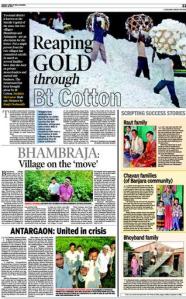
The Times of India did not hear of any dead people because Monsanto paid for the taxi from the city to the village for its reporter. Or is that all that Monsanto paid for? P Sainath in The Hindu:

The 2008 full-page panegyric in the TOI on Monsanto’s Bt Cotton rose from the dead soon after the government failed to introduce the Biotech Regulatory Authority of India (BRAI) Bill in Parliament in August 2011. The failure to table the Bill — crucial to the future profits of the agri-biotech industry — sparked frenzied lobbying to have it brought in soon. The full-page, titled Reaping Gold through Bt Cotton on August 28 was followed by a flurry of advertisements from Mahyco-Monsanto Biotech (India) Ltd., in the TOI (and some other papers), starting the very next day. These appeared on August 29, 30, 31, September 1 and 3. The Bill finally wasn’t introduced either in the monsoon or winter session — though listed for business in both — with Parliament bogged down in other issues. Somebody did reap gold, though, with newsprint if not with Bt Cotton. [Full story]

Why do people read the Times of India when we know it tells us lies that corporations pay it to tell us?

Where do the defenders of the free market disappear when stuff like this comes out?

Dil Se Nahin Dimaag Se Dekho – Thoughts on Satyamev Jayate Episode 1: Shohini Ghosh

Guest post by SHOHINI GHOSH

The first episode of Aamir Khan’s much publicized TV show Satyamev Jayate telecast on May 6, 2012 dealt with “Female Foeticide”. The following is a reflection of the show’s line of reasoning. Since only one out of 13 episodes has been telecast, what follows should not be taken as a judgement on the series but a response to the first episode. For reasons that I will explain later, I will use the term Sex-Selective Abortions (hereafter SSA) instead of `Female Foeticide’.

Continue reading Dil Se Nahin Dimaag Se Dekho – Thoughts on Satyamev Jayate Episode 1: Shohini Ghosh

Unpacking India’s Internet Censorship Debate

Recent debates on Internet censorship in India have focused to the allegedly free-for-all nature of the internet. Those of us who have argued against internet censorship have been somewhat misrepresented as arguing for absolute freedom whereby the reasonable restrictions laid down in Article 19 (A) of the Constitution of India don’t apply. Nothing could be farther than the truth.

It has been said that the internet can be used to incite violence, particularly inter-communal violence, and there needs to be a mechanism to prevent that. Communications minister Kapil Sibal wants internet giants to “self-regulate” for this reason, denying that he wants to censor political dissent on the internet. Following on the heels of his expression of such concern in December 2011, Mufti Aijaz Arshad Qasmi and journalist Vinay Rai filed cases against various internet companies for similar material that is religiously offensive.It needs to be pointed out, however, that the cases filed by Qasmi and Rai are under the Indian Penal Code and do not even invoke the Information Technology Act. So if the Indian Penal Code can be used against religiously offensive material why do we need any new mechanism to “regulate” or even “self-regulate” the internet? Continue reading Unpacking India’s Internet Censorship Debate

An Unrecorded Festival – Pictures from Parliament Street: Siddhi Bhandari

April 14 was Ambedkar’s birth anniversary. There is no single pan-India political icon, certainly not Gandhi, whose birth and death anniversaries are celebrated as public festivals, by the public, in the way the Ambedkar’s is. Some newspapers on 15 April typically had photos of the top leaders of the country paying homage to Ambedkar but that’s about all. When historians turn these pages they will not find, in the first drafts of history, any reports about how people celebrated Ambedkar’s birthday like a festival. They will not find a record of the singing and dancing, of drums and plays, of Dalit housing socities and employees’ unions holding celebrations bang under the nose of the Indian Parliament at Parliament Street as much as in Dalit bastis is villages across India. Such is the public ignorance of this celebration at Parliament Street in Delhi that most Delhites enjoying a free holiday don’t even know about it. Parliament street is where SIDDHI BHANDARI took these photos in 2010.

This slideshow requires JavaScript.