Category Archives: Metropolis

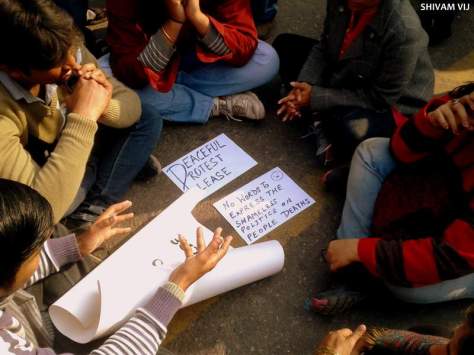
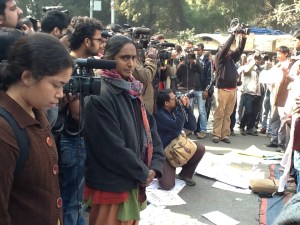
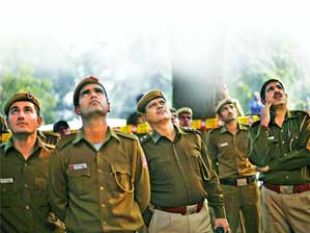
Peaceful Protest Against Afzal Guru’s Execution at Jantar Mantar Broken Up by Right Wing Goons and Delhi Police
This slideshow requires JavaScript.

A small group of citizens, mainly young people from different universities in Delhi, and people associated with civil rights groups and initiatives, had gathered at Jantar Mantar in New Delhi this afternoon at 1:00 pm to express their protest against the execution by hanging of Afzal Guru at 8:00 am this morning in Tihar Prison.

The protest was dignified and entirely peaceful. It was interrupted suddenly when a large mob gathered and began heckling the protestors. I was present there, and I clearly heard this mob of young men hurl, unprintable abuses at the men and women who were peacefully protesting against the execution of Afzal Guru. Some of them wore saffron scarves that clearly identified them as being the storm troopers of the far right. They repeatedly chanted violent and incendiary slogans which included the following – “shoot them all”, “kill the traitors”. These alternated with patriotic chants. I have never seen a more nakedly bloodthirsty exhibition of the far right wing version of Indian nationalism on the streets of Delhi. The mob made threatening gestures and advanced towards the line of protestors. Continue reading Peaceful Protest Against Afzal Guru’s Execution at Jantar Mantar Broken Up by Right Wing Goons and Delhi Police
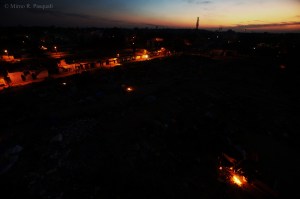
Photographs from Ejipura Demolition : Mirno R. Pasquali

Mirno Pasquali  is a photographer who has been documenting the EWS evictions in Ejipura Bangalore. Gautam Bhan has written about the evictions here

I spent the past few days photographing in the Ejipura slum which has been the focus of many activists working here in Bangalore. This has been my first attempt at documenting these types of issues, and being a foreigner has made it particularly interesting. I hope to have done so in a way that is fair, unbiased and ultimately insightful.

A number of activist have referred me to this forum as an intellectual space to post stories, issues and ultimately begin a dialogue about a number of different topics. I am happy to have found a place to place these photographs, and I hope doing so will aid to this goal.

Please feel free to use them for any publication, write up or other purposes. I only ask for acknowledgement and the passing along of my contact information.

mirno.pasquali@gmail.com

http://indiathough.blogspot.com

Mobile (+91) 8197862434

Jan 23 morning 060

Continue reading Photographs from Ejipura Demolition : Mirno R. Pasquali

Seven Propositions and One Challenge from Ejipura

The recent eviction of over 1500 Economically Weaker Section (EWS) households from Ejipura in Bangalore (see here, here and here) to make way for a high-end mixed-use development (with some EWS housing for “original residents”) is just one a series of millennial evictions that have scarred the landscape of Indian cities and yet another instigated by an order of a High Court. Below are seven quick propositions on how to understand these evictions, how to respond in the immediate and near-term.

Continue reading Seven Propositions and One Challenge from Ejipura

Letting Go of Fear: Tenzing Choesang

Guest post by TENZING CHOESANG

Nine years ago, on a hot summer day, I was sitting in the New Delhi railway station waiting for a train to Dharamsala where I had planned to do my summer internship in a human rights organisation. There, I met a person who used to live in the same locality as I did when I was a child. He asked me where I was headed and I excitedly told him about the summer internship I was going for. He gave me a sympathetic look and said in Nepali “God, what all, daughters have to do these days”. I was taken aback by his statement but I knew where it was coming from. I come from Sikkim, a beautiful state in the foothills of the Himalayas. Students from Sikkim generally come to Delhi for graduation and after completing their higher studies most of them return back. After their return, they either start their own businesses or get into comfortable government jobs and live with their parents. This is how things work there. So, I think he felt bad for me since he thought that I was being made to “face the big bad world” when I could have gone back home happily. I didn’t agree to his logic then and have not till date. Continue reading Letting Go of Fear: Tenzing Choesang

From Delhi to Djakarta, Protests Against Sexual Violence Across Borders: Bonojit Husain

Guest post by BONOJIT HUSAIN

20130115-211244.jpg

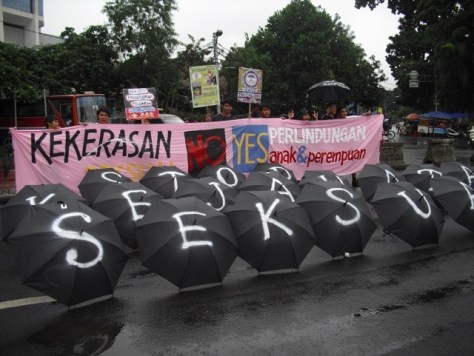
(Photographs courtesy: Pipit Apriani who is a Jakarta based activist and a blogger)

Protests against sexual violence are spreading across Asia. Last week demonstrations against rape and sexual violence were held in Nepal, Bangladesh, Pakistan and Sri Lanka.

Inspired by the protests held in Delhi for last three weeks, hundreds of university students and activists march on the streets of Jakarta few hundred meters away from the Presidential Palace for a world free of sexual violence. The call for the protest march was given by a coalition of University Students’ Unions and civil society organizations in response to the death of RI, a 11-year-old girl, who died last week after suffering severe vaginal and rectal injuries due to repeated sexual assaults. Continue reading From Delhi to Djakarta, Protests Against Sexual Violence Across Borders: Bonojit Husain

Stalking, Delhi Police and Memory – Another Encounter: Kavita Krishnan

Guest Post by Kavita Krishnan

I have been wanting to post about an experience with Delhi police since yesterday, but haven’t found the time yet… Here goes.

Some days ago, (early this month if I recall rightly), I got a call from a woman worker living in Usmanpur near Seelampur. She got my number through the son of one of our Trade Union comrades, who is a friend of her brother’s. She said she was being stalked by a man who made calls to her thretening an acid attack. She has 3 children and was concerned for their safety too. She told me she was scared to complain to the police, and asked for advice. I was reluctant to advice a police complaint without her being fully ready, knowing that it might not yield satisfactory results. So I suggested we meet and talk things over before deciding.

But soon after, she called again: feeling buoyed by a sense of hope arising from the ongoing movement, she had gone to the police station – alone – and written out a complaint, giving the stalker’s mobile number, the number of his bike, and offering to share recordings she had made on her phone of the threat calls. She said, though, that the police had not given her any proof of having received or recorded her complaint (in spite of her asking).

Continue reading Stalking, Delhi Police and Memory – Another Encounter: Kavita Krishnan

Some thoughts on rape, sexual violence and protest – responding to responses: Devika Narayan

Guest Post by Devika Narayan

Rarely does a city experience the sort of upheaval that Delhi is witnessing.  Everyone is talking about it. Everyone has an opinion. It is impossible to walk down the street without overhearing snatches of conversation. Issues that usually find brief mention in some obscure corner of the newspaper are now being subject to analysis by every passer-by. A rickshaw driver refuses to take any money when he realises I am on my way to a protest. I remember the old man at a photocopy shop who had looked up and asked no one in particular: do you think she will die? The receptionist at the doctor’s clinic is distraught, providing waiting patients her explanation for the recent events. Men huddled around tiny fires littered across the foggy city carp on about the state of politics, the police and the government. Everyone is invested in this moment of reckoning.

An opportunity, in the most brutal manner, has been thrust upon us to challenge, critique and reconstruct unjust social relations. This is an opportunity to pledge our commitment to a vision of a gender just society. Unless we assert in powerful ways that women are autonomous beings and equal citizens it will not end. Continue reading Some thoughts on rape, sexual violence and protest – responding to responses: Devika Narayan

Freedom in Three Acts: @Koinon3a

Guest post by @KOINON3A

New Friends Colony Park, 1996.

There’s a funny telepathy between people running or walking in opposite directions along a narrow jogging track. You both move to one side to avoid bumping into the other, only to find that the other person has moved in exactly the same direction you have. We exchanged half smiles at this long before we actually collided. As we approached each other, I smiled more widely as an acknowledgment of having managed to get it right and avoid each other.

His pockmarked face broke into a smile too. And in the moment he passed right by me, he reached out and grabbed my left breast hard and then moved on. Something I couldn’t have planned or thought about happened; I snapped like a brittle twig, swung around and went after him. His back was turned to me and he didn’t expect this. I hit him in the middle of his back with my fist, my keychain around my fingers giving him an additional gouge. He whirled around, surprised, the mouth now a quivering O, and went for my chest again.

Continue reading Freedom in Three Acts: @Koinon3a

The epiphanic moment of the lathi charge

At the Khan Market Metro station

The girl wasn’t aware that the Udyog Bhavan Metro station in central Delhi had been shut down. In the Metro going to Gurgaon, she needed to get down at Udyog Bhavan. Her friend was waiting in a car outside the station. She waited at the door. The train stopped too, but the gates didn’t open. The PA system — the annoying PA system of the Delhi Metro that never stops saying something or the other — – fell silent. The station was deserted. Not a soul in sight.

The girl asked fellow passengers — all of us men around her — which would be the nearest station that would be open. All the options were far off. Ramakrishna Ashram station on one end, for instance, was four kms. away. “Now what?” the girl asked her friend on the phone in a tone that blamed him, in a way only lovers can. “Now what?” she kept repeating. Continue reading The epiphanic moment of the lathi charge

The things you learn at a protest: Aakshi Magazine

Guest post by AAKSHI MAGAZINE

She was sitting among a group of young men and women at Jantar Mantar, shouting “Hang those bastards.” When the slogan lost its effectiveness, it turned to “We want Justice,” “Inquilab Zindabad,” and then “Bharat Mata ki Jai”. Borrowed and heard slogans, but they came from a very real place. “I work in Saket but live in Dwarka.” That is a long distance to travel especially at night. She nodded. “I don’t like it when my parents tell me to come home early just because other people are at fault,” she said anger rising in her voice. She didn’t know any of the people in the group she was sitting with. “We just met here. I had come with a friend who I can’t locate at the moment.” Continue reading The things you learn at a protest: Aakshi Magazine

Notes from a Night Walk in Delhi University

[ B&W pictures, courtesy Chandan Gomes. Colour pictures and cell phone video footage, courtesy, Bonojit Husain, New Socialist Initiative ]

Dear young women and men of Delhi,

I am writing to you again because I have been listening to you. This is a strange time, when everybody is talking, and everybody is listening, and the unknown citizen, who could have been any one of you, has transformed us all.

I was with you last night, from five thirty in the evening to around nine at night, while we walked together from the Vishwavidyalaya (University) Metro Station to Vijay Nagar, Kamla Nagar and the North Campus of Delhi University. There were around twelve hundred of you. Several of you held candles. You made yourselves into a moving blur of light. As the shopkeepers of Vijay Nagar, as the rent collecting aunties of paying guest accommodations, as the men and boys and girls and women on the streets and in the verandahs looked at you in wonder, you looked back at them, many of you smiled and waved. I could see some people in the crowd lip-synch with your Hallabols.

[ video of the night march near Delhi University ]

Continue reading Notes from a Night Walk in Delhi University

Desires of planning and the planning of Desires: Vignettes of a Rape Culture and Beyond: Rijul Kochhar

Guest post by text by RIJUL KOCHHAR photos by CHANDAN GOMES

Each person, withdrawn into himself, behaves as though he is a stranger to the destiny of all the others. His children and his good friends constitute for him the whole of the human species. As for his transactions with his fellow citizens, he may mix among them, but he sees them not; he touches them, but does not feel them; he exists only in himself and for himself alone. And if on these terms there remains in his mind a sense of family, there no longer remains a sense of society.

~Alexis de Toqueville (Epigraph to Richard Sennett, The Fall of Public Man)

Friends! You drank some darkness

and became visible

~Tomas Tranströmer (“Elegy”)

An hour is what it took for a band of six males to show a woman, a paramedic, ‘her place’ in contemporary Delhi. Often, in our pathological public places, it takes a mere moment. This case is different because it compels us to think through the limits of brutality of the living; it compels us to confront the limits of our capacity to inflict violence. But the night of December 16, 2012 also confronts us with the kind of cities we are building and the kind of places we want to inhabit. It is a different, by no means less important, matter that this woman—from whatever one has gathered these past weeks through the periodic medical bulletins—has battled to compel us to confront all of this and more, for the pain of her body and the brutality of an experience that she had survived for two weeks, serves a specular role—through it, we bear witness to ourselves, or so one hopes.

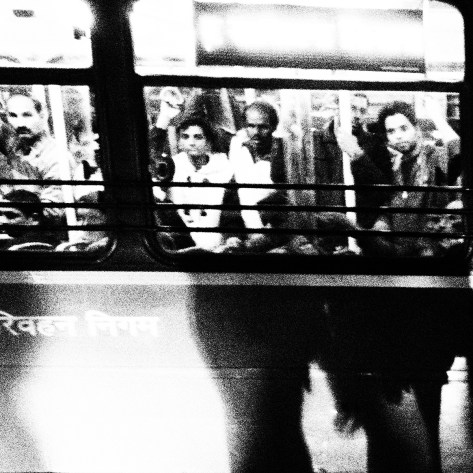
Passengers in a DTC bus try and catch a glimpse of the candle light vigil organised outside Safdarjung Hospital. Thousands of commuters became witness to today’s meet – some got down from their buses to join the vigil. Some joined their hands when their gaze fell on the bed of candles. An old woman took out her hair clip that was shaped like a flower and threw it towards us.

Continue reading Desires of planning and the planning of Desires: Vignettes of a Rape Culture and Beyond: Rijul Kochhar

Evening at Jantar Mantar.

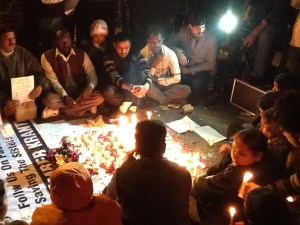
Candles at,Jantar Mantar
The Wake
The Wake
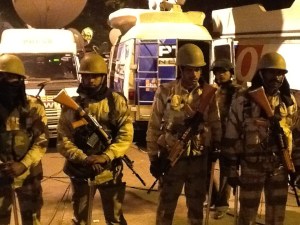
Armed, Cold, Bored
Armed, Cold, Bored

We must resist the cunning of judicial reform: Pratiksha Baxi

Guest Post by PRATIKSHA BAXI

The death of the 23 year old woman following the brutal gangrape rape and assault on a moving bus on 16 December 2012 at a hospital in Singapore early this morning leaves all of us in states of deep mourning. This is a political death. Rape and murder of women is political violence against all women, whether or not, the political class recognises and accepts this. In the course of the last two weeks, many body blows have been endured. We felt a body blow after the political death of the 17-year-old gangrape victim in Patiala who took her life after she was humiliated and pressurised to compromise. The numbing list of such political violence continues.

We have seen the emergence of many kinds of publics. There have been many speeches and writing against the emergence of a retributive public, where the cry for death penalty or castration became a vocabulary of protest, also especially since the media initially focussed largely on this demand. Yet in the last few days there has been a perceptible shift from the focus on forming a retributive public moving towards a passionately reasoned and informed public on what the government needs to do to be accountable to rape survivors, and indeed, to all of us who reject the rape cultures in India.
Continue reading We must resist the cunning of judicial reform: Pratiksha Baxi

Remembering the 23 Year Old Who Brought Delhi Together

Sucheta Dey (AISA) and Kavita Krishnan (AIPWA) just before they spoke at the condolence meeting

This morning, Delhi woke up to the news that the 23 year old Paramedic that the city had taken to its heart had breathed her last at around two in the morning at the Mount Elizabeth Hospital in Singapore. From early morning, sms messages, phone calls and facebook and twitter posts and updates, informed the city about a condolence meeting scheduled for 11 am in the morning at Jantar Mantar. I was there by 11, and realized that a lot of people were having problems getting there because a shameless administration had decided to shut down entry and exits on to reportedly ten stations of the Delhi Metro. Buses were also being diverted. Despite this, a sizable crowd had gathered by around noon. Two minutes silence was observed. Sucheta Dey (AISA, JNU) and Kavita Krishnan (AIPWA) spoke briefly.

Both emphasized the need for a peaceful, dignified gathering to pay respects to the brave fighting spirit of the deceased woman. Kavita Krishnan spoke about the need to combat patriarchy everywhere, in the family, at home, in the workplace, in colleges, schools and universitities. And called for an to end the culture of impunity that lets men think that they can get away with rape and sexual violence. Continue reading Remembering the 23 Year Old Who Brought Delhi Together

This is to clarify a small misunderstanding: Anusha Rizvi

Guest post by ANUSHA RIZVI

To,
Ms. Shiela Dixit, Chief Minister Delhi NCR
Mr. Sushil Kumar Shinde, Home Minister, India
Mr. Tejendar Khanna, Lt. Governor, Delhi NCR

This is to clarify a small misunderstanding. I know a part of the protests made you believe that women in Delhi are asking to take policemen away from their VIP duties and put them on Delhi streets. This is incorrect. Many of the protestors are too young to understand

Ma’am and Sirs, the roads are unsafe enough. All Delhi women know – when you see a Delhi policeman, you run. This is what our mothers taught us. This is what we teach our children. I sincerely request you to increase VIP duties for all cops in the Delhi National Capital Region. Please don’t waste your time and energy transferring or suspending any of these gentlemen. All you have to do is ensure no cops are given non-VIP duties. Continue reading This is to clarify a small misunderstanding: Anusha Rizvi

A City’s Pride

This Sunday, Delhi walks in its fifth annual queer pride parade. Each year at this time the question arises again: why a pride parade? Transgender, lesbian, gay, bisexual, hijra, kothi, and intersex people still have too many answers to give. While a decision on the appeals against the 2009 Naz judgment still remains pending, stories of continuing violence on the bodies of those deemed different do not wait for the Supreme Court. Queer people continue to have no legal protections against discrimination in the workplace; to be forcibly dragged to psychologists; to be forced to lie, cheat and conceal their lives; to be victims of familial, domestic and public violence and to feel, in so many ways both in their own minds and in the eyes of many others, like lesser citizens.

What this past year has reminded us is that they are not alone. The fundamental pillars of what enables this violence – fear, prejudice, intolerance – seem to have dug themselves deeper into our cities just as the institutions and democratic safeguards meant to combat them seem to have floundered. The ranks of urban residents who have experienced that deeply queer moment of exclusion and otherness – whether or not it speaks the particular idiom of sexuality – have grown. This year, as people once again take to the streets, they must do so not just for themselves but for the cities they inhabit and, increasingly, must protect.

Continue reading A City’s Pride

New Delhi: A heritage zone at 80!

In 1988 Lutyen’s Delhi, was declared a heritage zone by prohibiting building activity within the 26 square kilometre area out of the 43 Sq. Km. area that falls within the civic control of New Delhi Municipal Committee (NDMC). A move has now been initiated to get the entire area declared a World Heritage site.

The very logic of an area being declared a Heritage Zone should preclude any interference with the layout and design of the entire zone. Non-interference also means that, future building and development activity, if at all permitted, has to conform to the original parameters of design, materials, fittings and fixtures used, building techniques, landscaping and the kinds of trees planted in the heritage zone.

Even before the 1988 freeze on construction, there was a master plan for Delhi and it clearly identified the Lutyen’s Bungalow Zone as an area where high rises were not to be permitted.

The actual violations began when this rule was selectively relaxed beginning with permission given in the mid 70s to construct the high rise Sagar Apartments on Tilak Marg. High rises like Asha Deep and Dakshineshwar on Hailey Road followed shortly thereafter. Continue reading New Delhi: A heritage zone at 80!

दिल्ली बनाम बम्बई

भारत के दो महानगरों राष्ट्रिय राजधानी दिल्ली और बम्बई को यूनेस्को द्वारा विश्व धरोहर की सूची में नामांकित करने की तैयारियां चल रही हैं, कुछ मित्रों ने दिल्ली या बम्बई की बहस शुरू कर दी है जो वास्तव में पूर्णत: अनर्गल बात है.

में दिल्ली बनाम बम्बई के पचड़े में पड़ने के बजाये ये सवाल पूछना चाहता हूँ के ऐसा क्यों है के 65,436,552 की कुल आबादी और 6,74,800 वर्ग किलोमीटर के कुल क्षेत्रफल वाले फ्रांस में 35 स्थान, नगर, इमारतें प्राकृतिक स्थल आदि ऐसे हैं जो विश्व धरोहर की सूची में शामिल किये गए हैं मगर इस सूची में भारत का नाम केवल 29 बार ही आता है.

जो सवाल पूछना ज़रूरी है वो यह के सिर्फ दिल्ली या/और बम्बई ही क्यों? जोधपुर, जयपुर, अजमेर, इंदौर, उज्जैन, भोपाल, बनारस, इलाहबाद, लखनऊ, पटना, वैशाली, हैदराबाद, विदिशा कालिंजर, मदुरै, कांचीपुरम कलकत्ता और मद्रास क्यों नहीं ?, आप ने नोट किया होगा के बम्बई कलकत्ता और मद्रास के नए नाम में इस्तेमाल नहीं कर रहा हूँ और दिल्ली को भी देहली नहीं लिखा है. यह जान बूझ कर किया जा रहा है दरअसल विरासत कहीं अतीत में जड़ हो गयी कोई चीज़ नहीं है और इसलिए नाम बदलने की समस्त परियोजनाएं विरासत से छेड़ छाड करने की निन्दनीय प्रवर्ति का ही हिस्सा हैं. Continue reading दिल्ली बनाम बम्बई

GPS and receipts will not stop Delhi’s auto-wallahs from overcharging: Simon Harding

Guest post by SIMON HARDING

Last week, the Delhi High Court gave the go-ahead for the compulsory installation of GPS systems and printers in the capital’s auto-rickshaws by dismissing petitions against the policy from auto unions (download judgement .pdf here). The GPS kits are supposed to allow the Transport Department to track the movement of Delhi’s autos. The printer will provide the passenger with a fare-receipt, which will show the distance travelled and the amount paid. The policy will eliminate over-charging and will provide “secure and transparent travel” to the capital, claims The Hindu.

Sadly, the installation of GPS systems will do little to address the problem of over-charging. On the contrary, it may actually exacerbate it. Continue reading GPS and receipts will not stop Delhi’s auto-wallahs from overcharging: Simon Harding

Can we save the last natural forest in the vicinity of Delhi?

The road that leads to Faridabad from Gurgaon used to be a sleepy little one before it was expanded into a four lane expressway. The local villagers for some reason call it the ‘Relaynce’ (Reliance) Road, I am not writing this piece to speculate on their reasons, but because I want to take you off this road.

Get to Andheria Mod and ask for directions to the Gurgaon-Faridabad Road. Once on this road be on the lookout for the Gwal Pahari Campus of TERI (Tata Energy Research Institute). It would appear to your left, keep driving. A little while later if another structure looms into view, this time to your right and if simultaneously your senses are assailed by the stench of garbage you should feel assured that you have successfully stuck to the right path. Whoever said that the search for the divine is fraught with great challenges was not joking.

Why the search for the divine, because that is where I am leading you. Continue reading Can we save the last natural forest in the vicinity of Delhi?