Category Archives: Mirror Worlds

Shahid in Srinagar: Arif Ayaz Parrey

Guest post by ARIF AYAZ PARREY
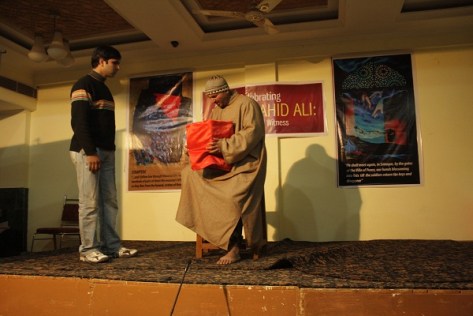
Photo by Muhabit-ul-Haq / TheKashmirWalla.com

I must go back briefly to a place I have loved
to tell you those you will efface I have loved [i]

Exactly ten years after he left us, Aga Shahid Ali returned to his Kashmir. A couple of days earlier, many parts of the valley were blessed with the season’s first snowfall, signalling an end to Harud, the autumn season in Kashmir, and ushering in Wande, the winter. The sky over Srinagar was overcast too, as it has been for the past few days, maybe because this year Moharram has been particularly demanding, with mourners not being allowed to mourn because “the processions might be used by separatists to whip up anti-India sentiments”. The reason for the ban is announced from the same bureaucratic offices which, during the summer, employ the entire state machinery to ensure that people from the plains can climb up the mountains into a cave where Amarnath wants to spend some private time with Parvati so that he can explain to her the mysteries of immortality (Which must include, one would like to presume, the secrets of the longevity of a fragile mountain ecology.) Some like to define this variance in state policy and practice as “secularism”. The connection between the tyranny of Karbala and the present-day Kashmir is firmly established, once again. Continue reading Shahid in Srinagar: Arif Ayaz Parrey

Harvard does the right thing: drops Subramanian Swamy

The Harvard Crimson reports:

Faculty members chose to remove two summer economics courses at the Summer School taught by Subramanian Swamy, a controversial Indian political figure. Over the summer, Swamy published an op-ed that advocated for the destruction of hundreds of Indian mosques and the disenfranchisement of non-Hindus in India.

Chief Information Officer for the University Anne H. Margulies concluded the meeting by updating faculty on the newly-created Harvard University Information Technology system and its future vision, which included greater collaboration with the library and further digital pedagogy. [Link]

Although DNA never apologised for publishing “How to wipe out Islamic terror,” Swamy’s hate-filled column, (and Kapil Sibal thinks Facebook will cause riots), Harvard University has done the right thing. Continue reading Harvard does the right thing: drops Subramanian Swamy

Hindi and Urdu: Sa’adat Hasan Manto

This is MUHAMMAD UMAR MEMON‘s translation of an article by SA’ADAT HASAN MANTO. The translation first appeared in The Annual of Urdu Studies.
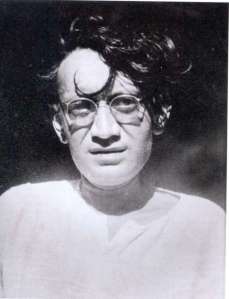
The Hindi-Urdu dispute has been raging for some time now. Maulvi Abdul Haq Sahib, Dr Tara Singh and Mahatma Gandhi know what there is to know about this dispute. For me, though, it has so far remained incomprehensible. Try as hard as I might, I just haven’t been able to understand. Why are Hindus wasting their time supporting Hindi, and why are Muslims so beside themselves over their preservation of Urdu? A language is not made, it makes itself. And no amount of human effort can ever kill a language. When I tried to write something about this current hot issue, I ended up with the following long conversation:

Munshi Narain Parshad:  Iqbal Sahib, are you going to drink this soda water?

Mirza Muhammad Iqbal: Yes, I am.

Munshi: Why dont you drink lemon?

Iqbal: No particular reason. I just like soda water. At our house, everyone likes to drink it.

Munshi: In other words, you hate lemon. Continue reading Hindi and Urdu: Sa’adat Hasan Manto

The need to influence the trajectory of one’s own life: Ruchi Gupta

Guest post by RUCHI GUPTA

The Arab Spring demonstrations in Tunisia, Egypt, Libya, Bahrain, Yemen, Syria, Jordan, Morocco were hailed in much of the democratic world. However the Occupy Wall Street protests, which till date have spread to 100 cities in the United States and 1500 globally have met with mixed response.

The Arab people are fighting for democracy, and thus their resistance must be respected and supported. But the OWS folks, proudly leaderless and having framed no concrete demands are vulnerable to all manner of criticism, even from those expected to be supportive. Bill Keller, the former editor of arguably one of the most influential newspapers in the world, the ostensibly liberal, New York Times derides,  “the Occupiers have been pandered to (“Love your energy!”); patronized (“Here, I’ve drafted you a list of demands …”); co-opted by unions, celebrities and activists for various causes; demonized by the right; arrested and tear-gassed in some cities; and taken lightly by the likes of me”.

However the uprisings in the Arab nations, the OWS demonstrations and even the wave of anti-corruption protests that swept India this year are all ultimately an expression of people’s resistance to disenfranchisement. Whether it’s those fighting for democracy or those who find themselves powerless in face of a system that’s been hijacked by the illegitimate nexus between the financial and political elite (the metaphorical 1%), the underlying sentiment is a demand for fair play and the right of self-determination. Continue reading The need to influence the trajectory of one’s own life: Ruchi Gupta

Pakistan 2012 – We Must Learn from History: Raza Rumi

Guest post by RAZA RUMI

Iskander Mirza, Pakistan’s President between 1956 and ’58, is remarked to have said that democracy was ‘unsuited’ to the genius of the Pakistani people. Decades later, similar questions about democratic form of governance are being raised in Pakistan. Take any TV show, read the multitude of op-eds, or more worryingly, check what the youth have to say on Facebook or Twitter. The parameters of debate remain the same.

The urban Pakistani’s disdain for the ‘illiterate’, ‘rural’ politicians and their ability to rule the country is a long-running theme. More importantly, the duality of civil-military rule has generated a peculiar discourse: the weak and corrupt ‘civilians’ compromise national security as opposed to authoritarian regimes which guard ‘ideological’ and geographical borders of the country. Continue reading Pakistan 2012 – We Must Learn from History: Raza Rumi

Pundit Manto’s First Letter to Pundit Nehru

This is M. ASADUDDIN‘s translation of a letter written by SA’ADAT HASAN MANTO to Jawaharlal Nehru in 1954. This translation first appeared in The Annual of Urdu Studies (volume 11, 1996).

Pundit-ji, assalamu alaikum!

This is the first letter I’m sending you. By the grace of God you’re considered very handsome by the Americans. Well, my features are not exactly bad either. If I go to America, perhaps I’ll be accorded the same status. But you’re the Prime Minister of India, and I’m the famed story writer of Pakistan. Quite a deep gulf separating us! However, what is common between us is that we are both Kashmiris. You’re a Nehru, I’m a Manto. To be a Kashmiri is to be handsome, and to be handsome … I don’t know. Continue reading Pundit Manto’s First Letter to Pundit Nehru

Apples and Oranges in Egypt’s Historic Election: Alia Allana

This guest post by ALIA ALLANA, a despatch for Kafila from Cairo, is the eleventh in a series of ground reports from the Arab Spring. Photos by Alia Allana

This slideshow requires JavaScript.

“Votes and rocks: just two ways to get heard,” said Salma.

Continue reading Apples and Oranges in Egypt’s Historic Election: Alia Allana

Egypt, Revolution 2.0: Alia Allana reports from Tahrir Square

This guest post by ALIA ALLANA is a despatch from Cairo for Kafila, the ninth in a series of ground reports from the Arab Spring. Photographs by Alia Allana

This slideshow requires JavaScript.

The police lobbed another tear gas canister and soon the feeling of suffocation would take over. But he didn’t move, instead he stood in the center; he continued to wave the Egyptian flag. The sound of rubber bullets being fired drowned under the sound of the drum. The drum was the harbinger of doom: when it was sounded by protestors, when the cacophony cut through the air, the message was simple – run, run as fast as you can because the police would begin their attack, again.

Continue reading Egypt, Revolution 2.0: Alia Allana reports from Tahrir Square

Arrested Development – a comparative study of Delhi’s schools and prisons: Sajan Venniyoor

Guest post by SAJAN VENNIYOOR

“Schools are prisons,” sang the Sex Pistols. “Another brick in the wall,” raged Pink Floyd, “Teacher, leave them kids alone!” Schools and prisons have been so frequently equated in the popular imagination that it has become a cliché almost never held up to scrutiny. But even a cursory study of Delhi’s schools and prisons belies the comparison.

Sure, Delhi’s schools and prisons are both dreadfully overcrowded. Delhi’s jails, built for 6250 prisoners, house 10500 on an average.  We cannot say with any statistical certainly just how overcrowded our schools are, as the Dept. of Education has no idea how many schools it runs or the actual number of teachers and students therein.

But in almost every major indicator of human development, the penal system far outperforms the public school system in Delhi. Continue reading Arrested Development – a comparative study of Delhi’s schools and prisons: Sajan Venniyoor

Trading with the Enemy: Raza Rumi

Guest post by RAZA RUMI

Reports suggest that Pakistan has decided, in principle, to grant the Most Favoured Nation (MFN) status to India. Much progress has taken place since the earlier announcement and several parleys between the officials suggest that trade relations may finally ‘normalise’. India already conferred MFN status to Pakistan in 1996. India and Pakistan have no formal trade agreement. Until now Pakistan maintained a Positive List of importable items from India consisting of 1075 items.

Most Favoured Nation: Under the WTO agreements, countries cannot normally discriminate between their trading partners. Grant someone a special favour (such as a lower customs duty rate for one of their products) and you have to do the same for all other WTO members. This principle is known as most-favoured-nation (MFN) treatment. It is so important that it is the first article of the General Agreement on Tariffs and Trade (GATT), which governs trade in goods. MFN is also a priority in the General Agreement on Trade in Services (GATS). Continue reading Trading with the Enemy: Raza Rumi

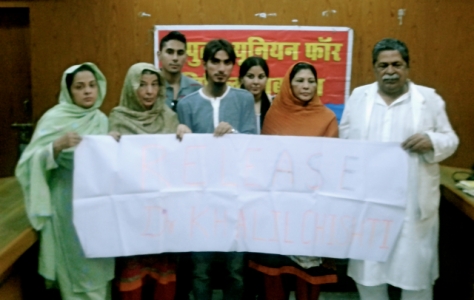
Dr Khaleel Chishty’s family in Ajmer to appeal for his release: Kavita Srivastava

This press release comes from KAVITA SRIVASTAVA of the People’s Union for Civil Liberties. It was released after a press conference in Ajmer on Friday, 18 November 2011

  • Family appeals to Governor Shivraj Patil to sign the mercy petition of Dr. Khalil Chishty pardoning him at the earliest
  • Government of Rajasthan grants perrmission to the family to meet Dr. Chishty in Jail

Govt must do more to protect minorities: Human Rights Commission of Pakistan

This press release was put out by the HUMAN RIGHTS COMMISSION OF PAKISTAN, Lahore, on 9 November 2011

The brazen murder of three brothers from the Hindu community in Shikarpur district on Eid day demonstrates that the perpetrators believe they can get away with murder simply because the victims are non-Muslim, the Human Rights Commission of Pakistan (HRCP) has said.

In a statement issued on Wednesday the Commission said: “HRCP is shocked at the brazen murder of the three Hindu citizens in Shikarpur and shares the sense of outrage of the Hindu community, not least because of the utter failure of the police to prevent the killings or arrest the killers even though threats of violence had been brought to their notice. Continue reading Govt must do more to protect minorities: Human Rights Commission of Pakistan

A Rickshaw Ride in Kolkata: Waled Aadnan

Guest post by WALED AADNAN

“Amar naam Chatterjee!” My name is Chatterjee! sounds like a proclamation from a fiery leader of the masses at a public rally, but it came from a rickshaw wallah plying his trade in the dusty bylanes of North Calcutta and addressed to no one in particular.

As I sat on his rickshaw, the frail old man launched into an indignant tirade against the ruling political party, whom he branded as a group of turncoats, insisting vehemently and repeatedly to nothing but the evening breeze that he had always been a Congressman.

Yes, he defended, petrol prices have been rising, but surely the bosses in Delhi would admit to that! What is the point of protesting about that in an insignificant meeting of rickshaw wallahs’ union? His tone of uncompromising understanding of world affairs drew me to listen to him, rather than plug in my earphones and switch off the world. Continue reading A Rickshaw Ride in Kolkata: Waled Aadnan

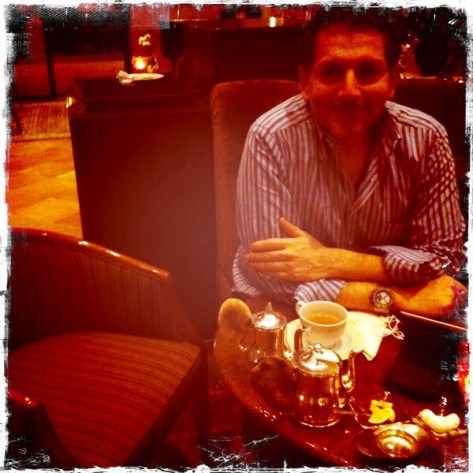
Adib Shishakly – The Rebel in the Hotel Room: Alia Allana

This guest post by ALIA ALLANA, a despatch from Istanbul, is the seventh in Kafila series of ground reports from the Arab Spring. Photos by Alia Allana unless otherwise mentioned

Adib Shishakly’s rebellion starts with a small pin on his blue blazer.

Embellishing the the blue of his jacket, clipped on to the left collar is a flag of Syria not seen since the days following the French mandate. Today the flag flies in the besieged areas of Homs, Hama and Dera’a where the protestors have posed Bashar al Assad’s regime with it’s biggest challenge to date. It’s this very flag, with its three golden stars that was outlawed by the Ba’ath Party, by strong man Hafez al Assad.

Continue reading Adib Shishakly – The Rebel in the Hotel Room: Alia Allana

Kathmandu to Peshawar

Himal Southasian editor Kanak Mani Dixit and his wife Shanta Dixit, an educator, are driving from Kathmandu to Peshawar, via Lucknow, Delhi and Lahore, to raise money for Nepal’s only Spinal Injury Rehabiliation Centre, which he started after Kanak’s own miraculous recovery from a spinal injury. The journey was flagged off yesterday by Nepal President Ram Baran Yadav. Do join them!

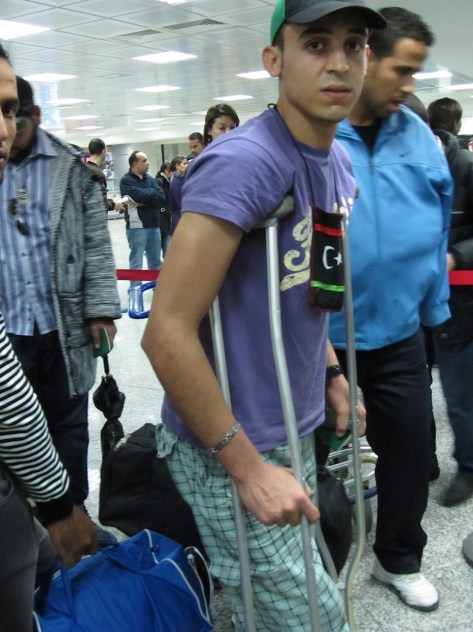
‘Who isn’t a Shabaab these days?’: Alia Allana reports from the Tunisia-Libya border

This guest post by ALIA ALLANA is part of a Kafila series of despatches from the Arab Spring

When does a boy become a shabaab?

Literally, in Arabic, shabaab means young men. Before the fever of the Arab Spring raged in the minds of the youth, back when boys used to gather in squares aimlessly, girls eyeing them would call them shabaab.

But that was then; before the political architecture of the Arab world was reconstructed.

Today the shabaab are the disenchanted youth, the angry boys of Benghazi with deathly toys devoid of opportunity, angry at their condition, aware of the world through the Internet and their mobiles, acting out their rebellion. Today the shabaab, the rebels of Libya, want what they think is theirs: the right to self-determination, a say in politics and freedom.

Continue reading ‘Who isn’t a Shabaab these days?’: Alia Allana reports from the Tunisia-Libya border

A temple in Peshawar reopens for the first time since 1947: Shabbir Imam

Guest post by SHABBIR IMAM from Peshawar, Pakistan. Video and photos by Shabbir Imam

[youtube:http://www.youtube.com/watch?v=qnZJClQNI_c%5D

During Sikh rule in Peshawar, the Gor Khatri area of Peshawar was declared Governor House, so the Gorakh Nath temple here was abondened and Hindu families shifted to a close by residential compound called Christian Colony. Then during the British Raj, the government provided residential quarters to a Hindu family to look after the temple. Continue reading A temple in Peshawar reopens for the first time since 1947: Shabbir Imam

What ails Pakistan?

Op-eds. Yes.

Bad things only happen so that columnists may write Op-eds about them. Before the advent of newspapers there were no terrorists, no sectarian divide, nothing was on the brink, nobody was at a crossroads; the insidious Op-ed writers have invented all these things to scare us under our beds, like parents who tell their children ghost stories because they don’t want them wandering around in the dark lest they flip the light switch at an inappropriate time. [Read the full post by Haseeb Asif]

From Kafila archives:

A prologue to memory: Arif Ayaz Parrey

Guest post by ARIF AYAZ PARREY

Over the corner shop at the busy crossing near home hangs a white board on which the words ‘Muzaffar Pan-House’ are painted in bright red. On the right side of the words, an artistic rendition of the side-view of Muzaffar’s face can be seen. His left hand is also painted in, holding a cigarette. The grey smoke emanating from the cigarette does not vanish before it touches the top of the board.
Continue reading A prologue to memory: Arif Ayaz Parrey

Understanding the Nepali Revolution: Baburam Bhattarai

(Nepal’s Prime Minister, Dr BABURAM BHATTARAI, visited India in his first bilateral trip since taking office, in the third week of October. Bhattarai spoke at the Jawaharlal University, Delhi, where he had earned his PhD from the Centre for Study of Regional Development, about the political evolution in Nepal, particularly after the 1990 and 2006 movements as seen through the prism of the Unified Communist Party of Nepal (Maoist).

Before beginning his substantive speech, he declared, “I am what I am because of JNU,” amidst thundering applause and cries of Lal Salaam.

The full text of the speech, provided to Kafila by his office, is being posted below for the record.)  Continue reading Understanding the Nepali Revolution: Baburam Bhattarai

Bhutan’s cautious tryst with democracy

Bhutan’s shift to plural politics remains carefully calibrated, but the emergence of a relatively free press and democratic institutions are important achievements. An account from Thimpu

Political changes in Bhutan over the past five years — the introduction of a ‘democratic constitution,’ the retreat by the fourth King and the coronation of his son, elections to Parliament which now has both a ruling and an opposition party, and governance being the prerogative of the elected government — have triggered two opposite reactions generally. One school has hailed the vision of the Bhutanese monarchy and its act of ‘renunciation,’ and has declared the ‘democracy story’ to be a success. Many others dismiss the transition as being a ‘farce,’ claiming that the King still calls the shots and that Bhutan remains a tight autocracy. Continue reading Bhutan’s cautious tryst with democracy