Category Archives: Movements

Your rapists and ours

Two interesting articles:

Emer O’Toole in the Guardian CiF:

There’s something uncomfortably neocolonial about the way the Delhi gang-rape and subsequent death of the woman now known as Damini is being handled in the UK and US media. While India’s civil and political spheres are alight with protest and demands for changes to the country’s culture of sexual violence, commentators here are using the event to simultaneously demonise Indian society, lionise our own, and minimise the enormity of western rape culture. [Full article]

And Ananth Krishnan in The Hindu:

The rape case was one of the most discussed topics in Chinese microblogs over the past week, prompting thousands of posts and comments. By Sunday, however, the authorities appeared to move to limit the debate: on Monday, a search for the topic triggered a message on Sina Weibo – a popular Twitter-equivalent used by more than 300 million people – saying the results could not be displayed according to regulations. The message is usually seen as an indicator of a topic being censored by the authorities. [Full article]


The things you learn at a protest: Aakshi Magazine

Guest post by AAKSHI MAGAZINE

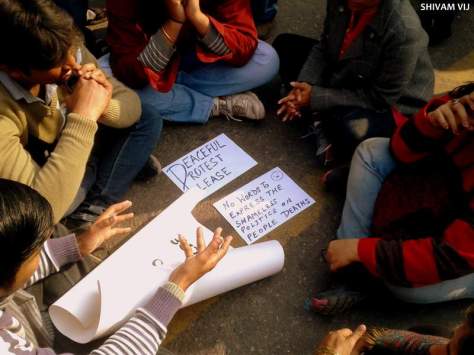
She was sitting among a group of young men and women at Jantar Mantar, shouting “Hang those bastards.” When the slogan lost its effectiveness, it turned to “We want Justice,” “Inquilab Zindabad,” and then “Bharat Mata ki Jai”. Borrowed and heard slogans, but they came from a very real place. “I work in Saket but live in Dwarka.” That is a long distance to travel especially at night. She nodded. “I don’t like it when my parents tell me to come home early just because other people are at fault,” she said anger rising in her voice. She didn’t know any of the people in the group she was sitting with. “We just met here. I had come with a friend who I can’t locate at the moment.” Continue reading The things you learn at a protest: Aakshi Magazine

Naye Saal Mein Azaadi – Freedom from Fear in the New Year

[ Click to play above Youtube video of young women and men, led by Com.Lokesh (‘Lucky’) of Stree Mukti Sangathan (Women’s Liberation Organization) articulate their desires on the ‘Take Back the Night’ night walk and street party from Anupam PVR Complex to the road outside Select City Walk in Saket, New Delhi on the night of the last night of 2012 and into the early hours of 2013. ]

Delhi took back the night as we moved into the new year. Took it back from fear, from patriarchy, from misogyny and a stupid state. They said it loud and clear. This is what I remember, roughly in this order. Continue reading Naye Saal Mein Azaadi – Freedom from Fear in the New Year

Notes from a Night Walk in Delhi University

[ B&W pictures, courtesy Chandan Gomes. Colour pictures and cell phone video footage, courtesy, Bonojit Husain, New Socialist Initiative ]

Dear young women and men of Delhi,

I am writing to you again because I have been listening to you. This is a strange time, when everybody is talking, and everybody is listening, and the unknown citizen, who could have been any one of you, has transformed us all.

I was with you last night, from five thirty in the evening to around nine at night, while we walked together from the Vishwavidyalaya (University) Metro Station to Vijay Nagar, Kamla Nagar and the North Campus of Delhi University. There were around twelve hundred of you. Several of you held candles. You made yourselves into a moving blur of light. As the shopkeepers of Vijay Nagar, as the rent collecting aunties of paying guest accommodations, as the men and boys and girls and women on the streets and in the verandahs looked at you in wonder, you looked back at them, many of you smiled and waved. I could see some people in the crowd lip-synch with your Hallabols.

[ video of the night march near Delhi University ]

Continue reading Notes from a Night Walk in Delhi University

In Memory of The Unknown Citizen

We may never know her name. But not every memory needs a name or a pile of stone. Her memorial need not claim space on a city street, or square, or on the river-front. Let the well-known Leader and the Unknown Soldier have their real estate, but for the Unknown Citizen, let us not fire gun salutes, fly flags at half-mast or build portals and pedestals. And let us not for even a moment imagine that instituting police measures against the people the Prime Minister calls ‘foot-loose migrants’ will mean anything remotely resembling justice.

We can think about what the contours of enduring justice can be without being hangmen. Only safe cities, safe towns and safe villages, and freedom for all men and women will mean justice. Justice does not come from the gallows. It springs from a freedom from fear, and the gallows only perpetuate fear. Hangmen will turn the bullies who rape into the cowards who will automatically murder so that there may not be a trace of their rape. It will make fathers who rape their daughters into fathers who rape and murder their daughters. Capital punishment will lead to less, not more convictions for rape and heinous sexual violence. That can never lead us to justice. Continue reading In Memory of The Unknown Citizen

Evening at Jantar Mantar.

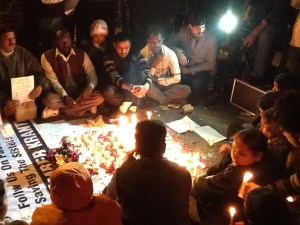
Candles at,Jantar Mantar
The Wake
The Wake
Armed, Cold, Bored
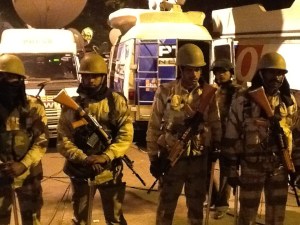
Armed, Cold, Bored

For Anonymous: Nilanjana Roy

Guest post by NILANJANA ROY

Photo: Ruchir Joshi
Photo: Ruchir Joshi

That girl, the one without the name. The one just like us. The one whose battered body stood for all the anonymous women in this country whose rapes and deaths are a footnote in the left-hand column of the newspaper.

Sometimes, when we talk about the history of women in India, we speak in shorthand. The Mathura rape case. The Vishaka guidelines. The Bhanwari Devi case, the Suryanelli affair, the Soni Sori allegations, the business at Kunan Pushpora. Each of these, the names of women and places, mapping a geography of pain; unspeakable damage inflicted on women’s bodies, on the map of India, where you can, if you want, create a constantly updating map of violence against women. Continue reading For Anonymous: Nilanjana Roy

Hope

Some images from Jantar Mantar today.

This slideshow requires JavaScript.

Remembering the 23 Year Old Who Brought Delhi Together

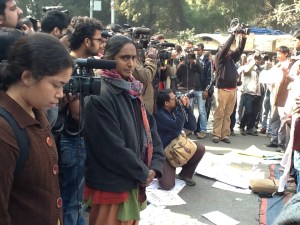
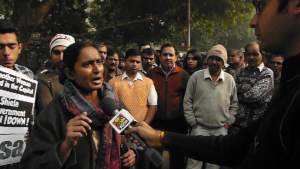
Sucheta Dey (AISA) and Kavita Krishnan (AIPWA) just before they spoke at the condolence meeting

This morning, Delhi woke up to the news that the 23 year old Paramedic that the city had taken to its heart had breathed her last at around two in the morning at the Mount Elizabeth Hospital in Singapore. From early morning, sms messages, phone calls and facebook and twitter posts and updates, informed the city about a condolence meeting scheduled for 11 am in the morning at Jantar Mantar. I was there by 11, and realized that a lot of people were having problems getting there because a shameless administration had decided to shut down entry and exits on to reportedly ten stations of the Delhi Metro. Buses were also being diverted. Despite this, a sizable crowd had gathered by around noon. Two minutes silence was observed. Sucheta Dey (AISA, JNU) and Kavita Krishnan (AIPWA) spoke briefly.

Both emphasized the need for a peaceful, dignified gathering to pay respects to the brave fighting spirit of the deceased woman. Kavita Krishnan spoke about the need to combat patriarchy everywhere, in the family, at home, in the workplace, in colleges, schools and universitities. And called for an to end the culture of impunity that lets men think that they can get away with rape and sexual violence. Continue reading Remembering the 23 Year Old Who Brought Delhi Together

Men against Sexual Violence, Men for Gender Justice

Statement by Men for Gender Justice, Bangalore

Public Protest on December 30th


Men against Sexual Violence, Men for Gender Justice

As men, we are ashamed over the continuing domination of men over women!!

Women and men are Equal. Men should understand and accept this!!

Men should become responsible, humane and non-violent!!

As protesters are pouring into the streets all across the country and demanding justice for the recent brutal gang-rape of a 23 year old woman in Delhi, we as men who stand for justice and equality are ashamed, as a large section of men in our country are committing abuses against women – rape, sexual harassment, domestic violence, economic and legal discrimination.

Continue reading Men against Sexual Violence, Men for Gender Justice

An ‘I Witness’ Account of Delhi Police and RAF Violence at India Gate on 23 December: Sangeeta Das

Guest post by SANGEETA DAS

[The Delhi Police has begun systematically lying about what has been happening in the past few days. We have seen spin doctoring around the unfortunate death of Constable Subhash Tomar. There has been efforts to plant generalized and unsubstantiated rumours about the presence of ‘terrorists’ amongst the crowds at India Gate. We have even seen the Chief Minister of Delhi, Shiela Dikshit and a sub divisional magistrate complain about the Delhi Police trying to interfere and influence that process of the recording of testimonies. Here is an important account by an eyewitness, Sangeeta Das, about the way the police behaved on the evening of the 23rd of December. Please note the kind of language that she says policemen were using. Can we trust the city to be safe in their hands.]

I am appalled at the lop-sided relay of events and incomplete images being telecast by some of the NEWS channels on TV, regarding the incident that happened at India Gate yesterday (this is an account of what happened on 23rd of December) at around 5:30 PM.

I was there. We were all on the other side of India Gate towards the Dhyan Chand Stadium.

I think I need to paint the correct picture for the nation. Except for CNN IBN and NEWS X, most other channels are not showing the peaceful gathering. Thus it gives out the wrong message to the nation, to the politicians, to other women that there was violence. Continue reading An ‘I Witness’ Account of Delhi Police and RAF Violence at India Gate on 23 December: Sangeeta Das

Rape is allowed because most people don’t know what it is: Anonymous

Guest post by ANONYMOUS

Rape is allowed because most people don’t know what it is.

To say that victims understand it is assuming too much. The immediate affect will be a deep, invisible wound. After years of counselling it will still hurt and terrorise. All the strength in the world, at the individual and existential levels, will fall short. Very often the crime will remain unreported. Rather than empowering women, the legal system will manage so few convictions that it will itself be the greatest perpetrator.

The perpetrators, as in the actual rapists, know as much or as little as the victims. They will go unarrested, unnoticed, unashamed, and this will fuel their psychopathy. They may or may not realise that rape is not about sex but power.

Continue reading Rape is allowed because most people don’t know what it is: Anonymous

How the God of Death Changed His Mind: Images from the Protest Against Rape at Jantar Mantar

Kavita Krishnan, AIPWA speaking at Jantar Mantar
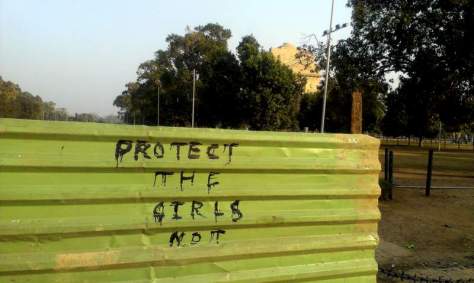
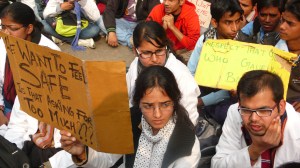
Wanting Safety
Wanting Safety

Protests against sexual violence continued for the third day in Delhi. The venue had shifted from the India Gate-Rajpath environs to Jantar Mantar. Despite the fact that the government had closed metro stops in central New Delhi (from Rajiv Chowk to Khan Market) so that Vladimir Putin was spared the embarrassment of having to encounter protestors against rape, even as he sold gas and guns, a motley crowd of mostly young women and men were able to make their way to Jantar Mantar. Here are a few images and vignettes from this afternoon. Continue reading How the God of Death Changed His Mind: Images from the Protest Against Rape at Jantar Mantar

A Day at Raisina Hill: Nilanjana Roy

Guest post by NILANJANA ROY

“We want justice! We want justice!”

I went to the protests at Raisina Hill expecting very little. Despite the anger over the recent, brutal gang-rape of a 23-year-old by a group of six men, who also beat up her male friend, protests over women’s violence in the Capital have been relatively small.

But the crowds walking up the Hill, towards the government offices of North and South Block, from India Gate are unusual. It’s a young crowd—students, young men and women in their twenties, a smattering of slightly older women there to show their solidarity, and it’s a large crowd, about a thousand strong at the Hill itself. There are two small knots representing student’s politicial organisations, but otherwise, many of the people here today are drawn together only by their anger. Continue reading A Day at Raisina Hill: Nilanjana Roy

*hit still happens

“Approximately 13000 trains run daily out of which 9000 are Passenger trains and 13 million passengers traveling every day. As per Nanda report the railways have cited several reasons for the delay, including prohibitive costs, with one estimate pegging the amount required for bio-toilets at Rs.1,600 crore. Continue reading *hit still happens

Mowgli meets the Maoists: Satya Sagar

Guest post by SATYA SAGAR

Hello folks! I need your help and hence this appeal to all of you!

I have been a journalist for a long time but never managed to write a full book on my own all these days. One reputed publisher has now approached me to write a book about the Maoists and I am very excited about it. The publisher thinks that the Maoists are a very ‘sexy’ topic and I should write about them because as a veteran journalist I am qualified to write on anything under the sun.

Let me give you some background. Basically publishers have figured out there seems to be lots of money in printing anything penned by an Indian writer. Novels, plays, travelogues, diaries, memoirs, collections of old essays, homework notes from school, whatever- because the entire world is willing to read anything written by Indians. It seems people around the planet had assumed all these decadesthat Indians were completely illiterate and now that has been finally proven untrue they want to read EVERYTHING they write. Continue reading Mowgli meets the Maoists: Satya Sagar

Dreamum Wakeupum, HRD Ministry!

Monobina Gupta, who writes on Kafila had a piece in Times of India recently on the ravages of restructuring at Delhi University. While researching this piece Gupta sent me and several others a list of questions about the reforms. I reproduce below her questions and my answers in full. If you’re convinced by what follows, please sign this petition.

  1. How has the academic culture/ environment changed over the last five years? Has it been a slow process of attrition or sudden negativity with Kapil Sibal getting more and more aggressive?

Interestingly, strictly speaking, we’ve seen not so much attrition as an acceleration of initiatives in the purely quantitative sense accompanied by academic chaos and a disturbing decline in intellectual input. It’s possible that we now have a greater variety of courses on paper, more research projects and more published papers by faculty, but the quality of each of these has to be questioned in the light of the pressure under which they are being produced. Intellectual activity, whether anybody likes it or not, cannot be compared to most other types of output or production. It requires a very different administration, temporality (like any creative activity) and support. It needs to be largely self-directed and self-motivated, with a few broad parameters set by authority. There can consensus on standards, but these need to be set by the academic community in a public and transparent way. They cannot be set by bureaucrats and administrators and enforced by the gun. What Sibal’s regime did, consciously or unwittingly, was to define the entire teaching class as enemies, at the administrative level. The effect was that Delhi University’s VC found it in himself to bypass established democratic and consultative procedures and ram through the proposed changes. Every time teachers asked that established norms be respected and we be consulted through due process or if we suggested that intellectual and scholarly processes take time, the administration stonewalled us and threw us out of the reform process. Under Sibal, decades of collegiate functioning was torn apart, and every fight got ugly. Suddenly, ‘debate’ and ‘democratic consultation’ became dirty words. It is to be expected that a change in the higher education policy of a country as massive as India would generate passionate debate. Since this debate was not taking place in the national media, we teachers should have been considered the most valuable interlocutors, but we were stunned by the speed and ferocity of the reform process, and the criminalisation of our right to dissent and ask questions. Who has decided what the time frame for reforms is, and why aren’t we involved in this decision? Ultimately, the administration might wish that we didn’t exist as the troublesome, questioning human element in the teaching learning process, but unfortunately this is not going to happen unless they invent androids!

  1. Can you outline the main points of difference in the way the education is perceived by the ministry/ policymakers and those who actually do the teaching?

Continue reading Dreamum Wakeupum, HRD Ministry!

Imagining Post-Zionist Futures – Israeli Apartheid and Palestinian Resistance III

This post is the third of a series based on a visit by Nivedita Menon and myself to Palestine in mid-September 2012. The first two are Nakba and Sumoud and Waiting for the Third Intifada.

It was the 18th of September, our third evening in Ramallah. We were at the Ramallah Cultural Palace to listen to Palestinian youth bands perform. The place was teeming with people, mostly young, in their twenties and thirties. The hall was packed, the atmosphere so electric that even if Magid had not been there to explain, there was no  way we could have missed the excitement and the anger that the songs evoked in the  audience. Interestingly, not all the songs were about Zionist oppression and the travails of everyday life in occupied Palestine.  When a song critical of the PA (Palestinian Authority) began, the hall went up in spontaneous applause, endorsing the  sarcastic lyrics directed at PA that has lately been involved in carrying out repression on its own population.

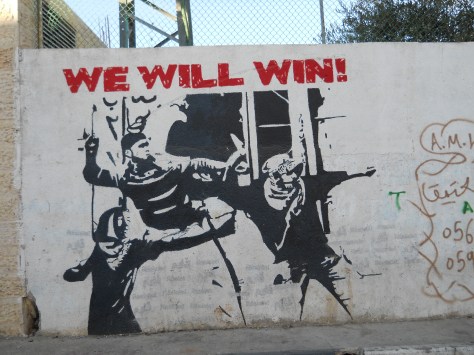
Liberation Graffitti on Wall in Ayda camp, Photos AN/NM

The complexity of the current phase of the movement arises from the fact that now, the new forces of Palestinian liberation are arrayed, not merely against Israeli occupation but also against this entity called PA and the Oslo Accords that put in place the political arrangements that mark the division of territories today. An arrangement that was supposed to be merely an interim one lasting but a few years, until the question of Palestinian statehood could be settled, has become a quasi-permanent one that is seen to threaten the longer-term goal itself.

Continue reading Imagining Post-Zionist Futures – Israeli Apartheid and Palestinian Resistance III

“We may weep but we will stay”: Women resist evictions in Palestine: Kalyani Menon Sen

Guest post by KALYANI MENON SEN

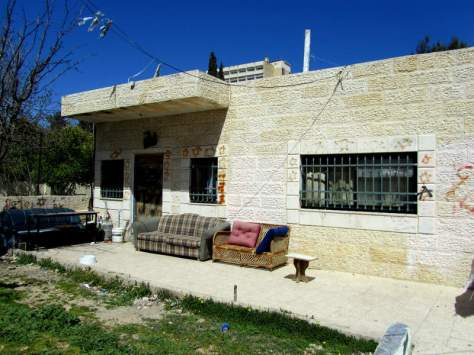
Umm Nabil’s settler-occupied house is painted with Israeli symbols. (Photo: Aruna Rao)

Umm Nabil al Kurd is 82 years old. She is tiny and frail – her hands tremble as she takes the mike. But her voice is steady as she describes how she lost her home.

“We came to Jerusalem from Haifa as refugees in 1948” she says. “The Jordanians allotted us our house. We have lived there for 60 years – my children were born there. It was small and broken when we moved in – we extended it and improved it as our family grew. We planted a garden. When my son got married and the grandchildren came, we built a separate unit for him at the back of the main house. We built with our own money, with our own hands. Then, two years ago, the Israelis came with the police and told us to leave. They said the house was theirs. They pushed me to the ground, called me filthy names, turned their dogs on me. They threw out our furniture and moved into the house. We went to court but the judge said we were occupying the house illegally – he told us to pay 100,000 shekels as rent for the years that we had lived in the house. We had to pay – my husband would have been imprisoned if we did not. We are still fighting the case – the next hearing is in July but I don’t know if we will ever get the house back.” Continue reading “We may weep but we will stay”: Women resist evictions in Palestine: Kalyani Menon Sen

Maruti Suzuki Workers Union Release – Dharna and Strike on 7th and 8th November

Onwards to the Dharna and Hunger Strike of 7th and 8th November !!

The Maruti Suzuki Workers Union (MSWU: Reg. no. 1923) has decided to hold a protest dharna in the form of a two-day hunger strike on 7th and 8th November 2012. Our family members, relatives and well-wishers and organizations have staged regular protests across Haryana and given memorandum to all the ministers in the state but to no avail. We were not allowed to unite and express our side of the story and our indignation atbeing falsely implicated in the unfortunate incident of 18th July 2012.

Continue reading Maruti Suzuki Workers Union Release – Dharna and Strike on 7th and 8th November

Petition – End the Scourge of Manual Scavenging

This statement is based on a Seminar attended by representatives of Safai Karamchari Andolan, Republic Trade Union of India, Centre of Indian Trade Unions, Tamil Nadu Untouchability Eradication Front; Advocates, Doctors and Health Activists; Faculty and Students of MIDS, IIT-M, New College, ACJ, MSE, Madras University among others. The discussion was one among many incidents happening across the country to support the struggle for abolishing manual scavenging and rehabilitation of manual scavengers.

Others who would wish to endorse this statement may please use the link attached along with this post (from change.org) to sign it.  http://www.change.org/en-IN/petitions/end-the-scourge-of-manual-scavenging-now.

More than a million people (mostly Dalit women and children) in India are still being ordained by the caste-ridden social order to clean the refuse of society with their bare hands. They are systemically forced to sell their labour-power, at a minimal price, to perform this inhuman task – what is termed as “Manual Scavenging”. People from particular Dalit communities, cutting across region and religion, are vulnerable to early death due to fatal infections, disease and exposure to toxic gases that manual scavenging entails. Further, age old casteism, continues to stigmatize and humiliate manual scavengers suppressing them to the status of “lesser humans”. Continue reading Petition – End the Scourge of Manual Scavenging