Category Archives: Movements

A Report from the Protests: Kavya Murthy

Guest post by KAVYA MURTHY.

In the middle of the day a few days ago, a group of around ten people held hands and blocked the traffic on the road opposite the police headquarters at ITO, Delhi, protesting and calling for the removal of the Police Commissioner after a young, young child  had been raped and the police had done nothing, not file an FIR, nor act.

In this instance, it was not only the brutality of the act that had shaken us up. A young child, five years of age, raped by neighbours, bad enough to hold one’s head in shame – yes. There was outrage. But there was also outrage that a police officer had tried to bribe the family of the girl – with two thousand rupees – to avoid filing an FIR. Then, to add insult to injury, a young woman protester slapped repeatedly by an impatient policeman, an Assistant Commissioner of Police no less, when she tried to get inside the hospital where the child was in a critical condition.

Why were we there, that afternoon outside the Delhi Police Headquarters? What had prompted people to gather at the AIIMS metro station the day the child was shifted there for care, what was being said, who was being addressed? Was it  a silent vigil, in hope that this little child does not meet the same fate as the 23 year old woman gang raped just a few months ago? Was it also to say,  this is not the first time it is happening after that fateful day on December 16, 2012? 363 rapes already in just around the NCR the last few months, and here we are again, not exactly happy to be standing outside in outrage thinking of a little girl with bottles in her vagina and terrible infections. Continue reading A Report from the Protests: Kavya Murthy

बंगलादेशी जनउभार और भारत की मुर्दाशान्ति: किशोर झा

Kishore Jha is a development professional and is working in the field of children’s rights for the last two decades. This piece was originally published on the NSI blog.

सन २०११ में भ्रष्टाचार के खिलाफ अन्ना आन्दोलन में उमड़े हजारों लोगों की तस्वीरें आज भी ज़ेहन में ताज़ा है। उन तस्वीरों को टी वी और अख़बारों में इतनी बार देखा था कि चाहें तो भी नहीं भुला सकते। लोग अपने-अपने घरों से निकल कर अन्ना के समर्थन में इक्कठे हो रहे थे और गली मोहल्लों में लोग भ्रष्टाचार के खिलाफ नारे लगा रहे थे। इंडिया गेट से अख़बारों और न्यूज़ चैनलों तक पहुँचते पहुँचते सैकडों समर्थकों की ये तादात हजारों और हजारों की संख्या लाखों में पहुँच जाती थी। तमाम समाचार पत्र इसे दूसरे स्वतंत्रता आन्दोलन की संज्ञा दे रहे थे और टी वी देखने वालों को लग रहा था कि हिंदुस्तान किसी बड़े बदलाव की दहलीज़ पर खड़ा है और जल्द ही सूरत बदलने वाली है। घरों में सोयी आवाम अचानक जाग गयी थी और राजनीति को अछूत समझने वाला मध्यम वर्ग राजनैतिक रणनीति का ताना बाना बुन रहा था। यहाँ मैं आंदोलन के राजनितिक चरित्र की बात नहीं कर रहा बल्कि ये याद करने की कोशिश कर रहा हूँ कि उस आंदोलन को उसके चरम तक पहुचाने वाला मीडिया अपने पड़ोस बांग्लादेश में उठ रहे जन सैलाब के जानिब इतना उदासीन क्यों है और कुछ ही महीने पहले बढ़ी आवाम की राजनैतिक चेतना आज कहाँ है? Continue reading बंगलादेशी जनउभार और भारत की मुर्दाशान्ति: किशोर झा

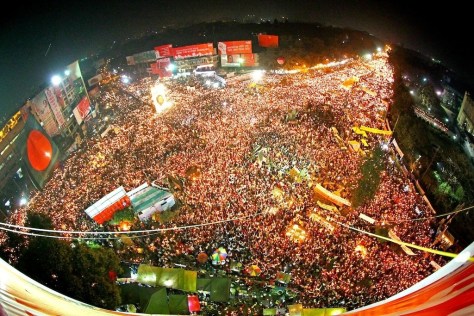
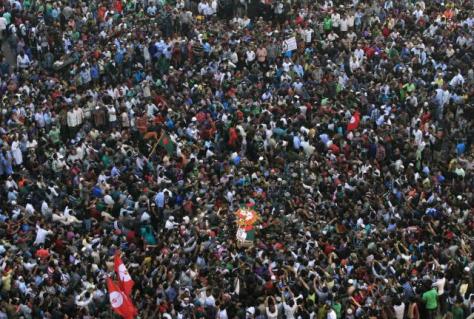
Gonojagoron march in Dhaka April 6, 2013

Images courtesy KALYANI MENON-SEN

1365252284-hefajat-program-attack-revealed-at-press-conference_1935474


1365426178-strike-in-dhaka-called-by-hefajateislam_1941888

In Delhi for Dhaka: A solidarity vigil for Shahbagh

The New Socialist Initiative (NSI), Jamia Teachers’ Solidarity Association (JTSA), Nishant, Anhad, Krantikari Lok Adhikar Sangathan and the Stree Mukti Sangathan have put out this statement in advance of the demonstration tomorrow (9 April) 2 pm before the Bangladesh High Commission in Delhi.

The neighbouring country of Bangladesh is going through a new churning. Hundreds and thousands of people have hit the streets of Dhaka, demanding strict punitive action against ‘war criminals’ and their organisations, who forty-two years ago—at the time of the liberation struggle/war of the then East Pakistan (now Bangladesh)—colluded with the Pakistan army and committed untold acts of atrocities on the general public.

Basically, there are two main demands of the protesters: war criminals should be strictly punished and organisations like the Jamat-e-Islami, Bangladesh, should be banned and all commercial and other kinds of establishments run by it should be proscribed. Continue reading In Delhi for Dhaka: A solidarity vigil for Shahbagh

What a time to be in Dhaka! Kalyani Menon-Sen

This is a guest post by KALYANI MENON-SEN

I am in Dhaka right now.

Being here at this moment, in Shahbagh (Projonmo Chottor, as it is now called) and on the streets with activists from the Gonojagoron Mancha – young people, academics, veterans of the liberation movement, singers, artists, writers, professionals and thousands of ordinary people – is a unique and inspiring experience.

Battle for the soul of Bangladesh – Rally in February against the killing of Rajab Haider, the blogger who was a key figure in the protests against Islamists

The similarities and differences with the Delhi mobilisation are striking. Continue reading What a time to be in Dhaka! Kalyani Menon-Sen

Of imagined solidarities and real fears – The politics of the Sri Lankan Tamil cause in Tamil Nadu: Anonymous

This is a guest post by ANONYMOUS:  When elephants fight it is the grass that suffers, so goes an old Kenyan proverb. In the maelstrom of political hysteria unleashed by Jayalalitha and Karunanidhi ostensibly in aid of Sri Lankan Tamils, democracy, truth and solidarity have been the biggest casualties. Over the past few months, Tamil Nadu has witnessed attacks on Sri Lankan Buddhist monks and Christian pilgrims, and the government sanctioned blockade of Sri Lankan schoolchildren and sportspersons.

The latest salvo from Chennai regarding Sri Lanka is the Tamil Nadu assembly resolution calling upon India to press for a United Nations Security Council mandated referendum amongst Tamils living in Sri Lanka as well as Tamils of Sri Lankan origin in other countries on the question of carving out an independent Tamil Eelam in Sri Lanka. This is in addition to demands to declare Sri Lanka a ‘hostile state’, impose some form of sanctions etc. Continue reading Of imagined solidarities and real fears – The politics of the Sri Lankan Tamil cause in Tamil Nadu: Anonymous

Haryana Police and Administration Repress Ongoing Maruti Workers’ Struggle: MSWU

Guest Post by Maruti Suzuki Workers Union, Provisional Working Committee

Third Day of our Fast Unto Death – Police and Administration Gearing up for Further Repression of Our Struggle!

Friends,

Today is the third day of our fast unto death that began on 28th March. However it seems that the state is adamant on responding to our peaceful movement with increased violence and use of brute force. Today, when the local people of nearby villages and our family members came to lend their support to us at the site of the hunger strike, they were greeted by an increased number of policemen. When we tried to meet Haryana Industrial Minister Randeep Surjewala – we have been sitting outside whose residence for the last 6 days braving rains and the cold – he flatly refused to meet us. When the family members surrounded him demanding our rights then a large number of police men appeared at the site and the minister left the place using the police to disperse the people. Now there are 2 police vans stationed here and the small shopkeepers and tea stall owners in the area are being threatened by the administration to withdraw their support from our movement. When the administration realized that we are not going to abandon our struggle because of their threats then they put pressure on the owner of the plot where we are sitting and tried to use him force to us out.
Continue reading Haryana Police and Administration Repress Ongoing Maruti Workers’ Struggle: MSWU

Letter from Jail: Maruti Suzuki Workers Union

Guest Post by MARUTI SUZUKI WORKERS UNION
(Reg. No. 1923, IMT Manesar)

Appeal from Jail
Stand in Solidarity with us for Justice

We are workers of Maruti Suzuki, who are behind bars since 18.07.2012 as part of a conspiracy, and without any just investigation. 147 of us are inside Gurgaon Central Jail. Since July, 2500 permanent and contract workers have been terminated from our jobs. In these past more than 8 months, we have sent our appeal to almost all administrative officials and elected representatives, including Chief Minister Haryana and the Prime Minister of India. But neither have our appeals been heard nor have we been granted bail.

Continue reading Letter from Jail: Maruti Suzuki Workers Union

“Politics Pulls at Me” – The Palestinian Youth Movement: Sunaina Maira

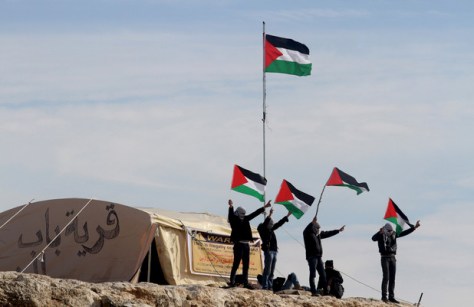
bab-al-shams

The establishment of Bab Al Shams, a direct action against Israel’s settlement enterprise. (Photo credit: Issam Rimawi / APA images)

SUNAINA MAIRA writes in muftah.org 

The eruption of resistance villages is an extension of popular struggles in which young Palestinians have been actively involved since March 15, 2011. During Palestine’s so-called Arab Spring, a series of protests organized by youth erupted in Ramallah and in other sites across the West Bank, as well as in Gaza and within the 1948 borders of Israel among the “’48 Palestinians.”

Inspired partly by the Arab revolutions and in solidarity with the Palestinian prisoners, this new “youth movement” is but one phase in ongoing resistance against Israeli occupation, colonialism, and apartheid. Nevertheless, as the second anniversary of the Palestinian youth movement approaches, it is important to reflect on a phenomenon that largely remains in the shadows of much more dramatic revolts in North Africa, and the more difficult struggle, in a sense, that Palestinian activists have been waging for democracy as well as national liberation.

Read the full article

Responding to a debate on the Kudankulam struggle against nuclear energy

Taking the debate on nuclear energy forward (after the wonderful review of MV Ramana’s book by Nityanand Jayaraman), here’s an exchange between Rahul Siddharthan and Madhumita Dutta in The Hindu in September 2012, Siddharthan advocating nuclear power, Dutta pointing to its utter indefensibility.

nuke-protest_350_091412024253

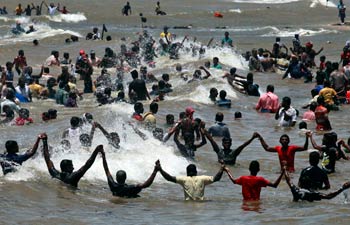
Jal satyagraha at Kudankulam in September 2012

Dutta says, in her response to Siddharthans initial article:

In the case of Kudankulam, the fisherfolk have been…asking to see the disaster management plan which, till date, remains a secret, even under the Right to Information Act. Given the inherent uncertainties of natural disasters, questions about preparedness to mitigate impact of calamities such as tsunami waves of higher magnitude are being asked. Continue reading Responding to a debate on the Kudankulam struggle against nuclear energy

चे का चेहरा: ओम थानवी

ओम थानवी का यह लेख जनसत्ता अखबार में 23 सितंबर 2007 को प्रकाशित हुआ था। ओम थानवी जनसत्ता के संपादक हैं।

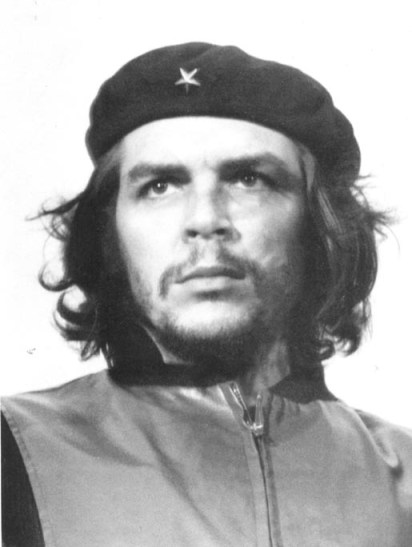
che-gu-22

वह तस्वीर चे ने खुद कभी नहीं देखी। उस तस्वीर से उसके छविकार ने कभी एक पैसा नहीं कमाया। मगर दुनिया के हर कोने में आज वह छवि मौजूद है। विद्रोह और क्रांति के एक सशक्त प्रतीक के रूप में। ‘टाइम’ पत्रिका द्वारा चे गेवारा को पिछली सदी की सौ हस्तियों में शरीक करने से बहुत पहले वह छवि दुनिया में सबसे ज्यादा छपी तस्वीर घोषित हो गई थी। Continue reading चे का चेहरा: ओम थानवी

Dhinkia and Govindpur Mothers go Naked to Protest against Forcible Land Acquisition for POSCO: Minati Dash

Guest post by MINATI DASH

On 7th March 2013, at least two mothers of Dhinkia and Govindpur (Patna village in this panchayat) villages in Jagatsinghpur went naked before the paramilitary station in Mangalpada near Govindpur village. In a rally led by mothers, hundreds of women and children went to the temporary paramilitary station that has more than 5 platoons of forces at the moment. While taking off their clothes, they constantly shouted, ‘why have you come here?, what do you want to see?’.

What must be the extent of desperation and provocation that our mothers decide to become naked before outside men?  In such a site (Eastern Odisha), where women bodies are constructed dominantly as private objects to hide, what does it mean to dare to bare? It is important to read this shocking act as an act of mediation of their political voices. It is in a desperate bid to express their furore, frustration & anger over intrusive presence of police & paramilitary in the area that they bared their bodies to shame them.

But shockingly, instead of recoiling with shame in response to such an act, the paramilitary chose to strike physically. They did not spare even these protesting women and brutally lathicharged them. Continue reading Dhinkia and Govindpur Mothers go Naked to Protest against Forcible Land Acquisition for POSCO: Minati Dash

Crude Questions about Crude Bombs: Biju Mathew

This is a guest post by BIJU MATHEW

Tarun Mandal, Narahari Sahu and Manas Jena are dead, blown up by what the media has described as a “crude” bomb. All bombs are crude. They kill. They are meant to destroy flesh and bone. They are aimed at sucking out life. Lakshman Mandal battles for his life in a Cuttack hospital. He knows how crude a bomb is. Hopefully he will live to tell the tale of its crudeness.

This is a partisan piece. But it aims to produce balance. Almost all media reports so far have had a strong spin that the three – Narahari, Tarun and Manas – were killed while making a crude bomb. So says Mr. Satyabrata Bhoi, Jagatsinghpur SP. Nobody has bothered to ask him any further questions. It’s quite understandable. Asking any more questions might make the entire spin untenable. For instance, they could have asked: why is it that something illegal, such as crude bomb making, was being done out in the open and not within the confines of a house? Especially given that for the last month, the police have been constantly in and out of the village? Especially because there are at least a few dozen pro-POSCO folks in the village? Why would three leaders of an oppositional movement sit outside on the porch of a house that is fully identified with POSCO Pratirodh Sangran Samiti (PPSS) and make bombs – openly, for all to see – at 6.30 PM when there is enough light for anybody to see them? Isn’t crude bomb making normally confined to the indoors? How many incidents do we know of where crude bomb making was happening outside in broad daylight? Isn’t the RSS, the most famous outfit that makes crude bombs and occasionally manages to blow up its own, always known to make its bombs indoors? Continue reading Crude Questions about Crude Bombs: Biju Mathew

Why I need feminism

Here’s wishing all men and women across borders and boundaries, in New Delhi and New Haven, Ranchi and Russia, Dublin and Damascus, Srinagar and Sri Lanka, Bhutan and the Bermudas, a very happy International Women’s Day. These images are from the ‘I Need Feminism’ Campaign at the Lahore University of Management Sciences

This slideshow requires JavaScript.

Mayhem in March: Sameer Bhat

Guest post by SAMEER BHAT: The completeness of night’s silence is absolute in Kashmir. Earlier today another boy was put six feet under. Killed in cold blood in Baramulla by the Indian army. Apparently a small crowd was protesting against the hanging of Afzal Guru and driven by pure emotion, pelted a passing army truck with stones. Since Kashmiri blood costs next to nothing, the armymen quickly got down, cocked their machine guns and sprayed the protesting kids with bullets, instantly killing a kid – Tahir — in his 20s. Nothing much. His friends, too shocked to react, smeared his blood on their faces. Grown-ups wept. The army later issued a statement that they didn’t shoot the boy. Period. Continue reading Mayhem in March: Sameer Bhat

Shahbagh: The Forest of Symbols: Naeem Mohaiemen

This is a guest post by NAEEM MOHAIEMEN

Shahbagh_SyedLatifHossain
© Syed Latif Hossain

There is a particular way of lensing mass movements, when we are observing from within immediate tactics. In a fast moving situation, with opponents and allies squared off, the first thing to shrink is the space for internal critique. Professor Azfar Hussain uses the term “critical solidarity” for his approach to Shahbagh. A critique that seeks to help the movement, but also a critique some are not ready to hear yet.

For the last sixteen days, Bangladesh has been in an intense new political phase. The ground has shifted and been recast by the scale of the Shahbagh movement. The flash point was the sentencing of the “Butcher of Mirpur” (a war criminal who collaborated with the Pakistan army in 1971). But, by now, the demands have expanded to a call for a ban on the main Islamist party Jamaat-e-Islami, or even Islamist politics altogether. Older leftist thinkers like Badruddin Umar are daring to ask questions of the hallowed place of “state religion” in the constitution. Younger bloggers are urging all to make it clear that the movement is about war criminals, not religion. But of course, with war criminals conflated with the Jamaat-e-Islami, and that party eager to present themselves as standing for “Islam,” category errors will happen. Continue reading Shahbagh: The Forest of Symbols: Naeem Mohaiemen

People’s Watch Over Parliament: Bekhauf Azadi Campaign

20130220-235633.jpg

  • Protestors at the ‘Freedom Parade’ Rally of the Bekhauf Azadi Campaign, New Delhi, 26 January, 2013

Guest Post by Bekhauf Azadi (Freedom Without Fear) Campaign.

People’s Watch Over Parliament: February 21, 1st Day of the Budget Session, Jantar Mantar
Gather in large numbers – 12 PM onwards at Jantar Mantar, New Delhi.
Are Our Lawmakers Ready to Listen to the Voice of the Movement Against Sexual Violence?

Continue reading People’s Watch Over Parliament: Bekhauf Azadi Campaign

All India Protest Day in Support of Maruti Suzuki Workers: MSWU

Guest post by MARUTI SUZUKI WORKERS UNION (Provisonal Working Committee)

[This is a statement issued by the MSWU – Provisional Working Committee on the All India Protest Day held on the 5th of February in many cities and industrial areas in Solidarity with the workers of the Maruti Suzuki Factory in Manesar, Gurgaon, Haryana. Predictably this important statement and report was not carried by the mainstream media.]

MSWU, Registration No. 1923, IMT Manesar, Gurgaon, Date: 5 February 2013

Today, 5th February 2013, the great response to our appeal to all trade unions, workers, democratic organizations and progressive forces to hold an ALL-INDIA PROTEST DAY in solidarity with our struggle, against the continued exploitation, repression and injustice by the Maruti Suzuki company and Haryana Government, has further strengthened our resolve. 147 of our fellow workers are arrested and have not got bail for last 7 months, 66 more have non-bailable arrest warrants against them, 546 permanent and 1800 contract workers terminated from our jobs have not been reinstated, and we continue to face continued police repression, anti-worker administration and a state which has nakedly sided with the company-management. Even thus we are determined to carry forward our struggle to release all jailed workers, reinstate all terminated workers, impartial probe into the 18 July incident, implementation of labour laws and abolition of contract worker system.

Continue reading All India Protest Day in Support of Maruti Suzuki Workers: MSWU

Theories of Oppression and another Dialogue of Cultures: Ashis Nandy

This is the text of the Ambedkar Memorial lecture delivered by ASHIS NANDY at the India International Centre on 14 April 2012, under the auspices of Ambedkar University, Delhi.

It was published in Economic and Political Weekly, July 28, 2010

Every generation likes to believe that it is living in momentous times, witnessing the death of one world and the birth of another, negotiating what pre-war Bengali writers used to grandly call yugasandhikshana, the moment when two epochs meet. This generation of Indians too believes that it is seeing such changes and even participating in them. Perhaps they are. However, I shall argue here that, along with transitions in society and politics to which they like to stand witness, there are transitions in cultures of knowledge and states of awareness of which they may be gloriously innocent. And they perhaps try to protect that innocence. The categories we deploy to construe our world images are parts of our innermost self and to disown them is to disown parts of ourselves and jeopardise our self-esteem. Even when we struggle to shed these categories, they survive like phantom limbs do in some amputees. Or perhaps they survive the way one of Freud’s three universal fantasies, the one about immortality, does. When you imagine yourself dead, you are still there, fully alive, looking at yourself as dead. Continue reading Theories of Oppression and another Dialogue of Cultures: Ashis Nandy

The Official Emergency Continues – The Ordinance on Sexual Assault: Pratiksha Baxi

Guest post by PRATIKSHA BAXI

The reform of rape law, which was not a priority for more than two decades, seems more like a 20-20 match now. The spectacle of judicial reform has all the elements of cinematic imagination built into it—violence, voyeurism, repression, tears, scandal, redemption and betrayal. We are all consumers and participants of this judicial spectacle. We veer between manic hope and dark despair as we are left conjecturing how this theatre of judicial reform will enact equality and dignity for survivors of sexual assault. The latest twist in the tale is the introduction of an ordinance, following the Justice Verma Committee (JVC) report.

Continue reading The Official Emergency Continues – The Ordinance on Sexual Assault: Pratiksha Baxi

Why the Govt’s Ordnance is Fraud & Mockery of the Justice Verma Committe Recommendations: Bekhauf Azaadi Campaign

Guest post by BEKHAUF AZAADI CAMPAIGN

The UPA Govt, in a Cabinet meeting held on 1 February, has introduced an ordinance that it claims will address the most urgent concerns on sexual violence. In fact, the Government has been completely reluctant to acknowledge and implement the Justice Verma Committee recommendations: the PM refused to accept it from Justuce Verma, the Ministry of Home Affairs removed it from their website, the Govt never adopted any transparent process of discussion to decide the way forward on implementing the recommendations, rather they said Justice Verma ‘exceeded his brief’. Now, they claim that their ordinance has ‘implemented’ the Justice Verma recommendations. Is this true?

The fact is that the Government’s ordinance is a mockery of the letter and spirit of the Justice Verma recommendations. Why? Let us take a closer look.

Continue reading Why the Govt’s Ordnance is Fraud & Mockery of the Justice Verma Committe Recommendations: Bekhauf Azaadi Campaign