And how can Bihar, which they say has been witness to a glorious past, be an exception. Of course nobody could have imagined that ‘surprise of surprises’ or (should I call) ‘mother of all surprises’ would be reserved for the Bihar police. In fact it was one life time experience for all of them there where they found how ‘Rs 50,000 can balloon into Rs 1.14 crore’.
The central character in the still unfolding drama is Giriraj Singh, a RSS activist since his childhood days, and a senior leader in the state, who has already carved out a name for himself nationally for his controversial statements. People would remember how he proposed to Modi opponents to go to Pakistan during election campaign or how he eulogized Brahmeshwar Singh, leader of Ranveer Sena, the private army of landlords which had been allegedly responsible for hundreds of killings of innocents as ‘true Gandhian of our times’ when the dreaded figure was killed in a gang war. As an aside it needs be mentioned here that Giriraj Singh was one of the first in the state who had vouched for Mr Narendra Modi’s PM candidature also. Continue reading The ‘Patriots’ of Our Times !→
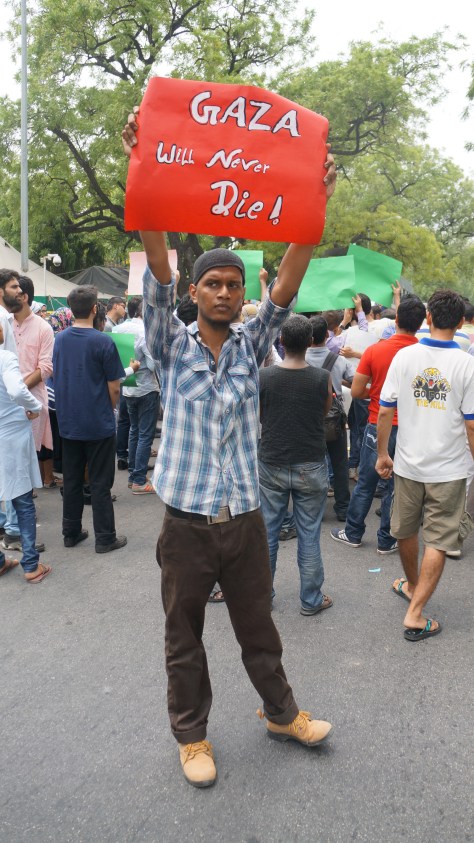
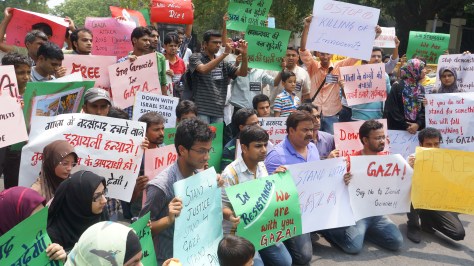
Protests against the situation in Gaza have been held in Delhi yesterday, (Sunday, 13th July, and today, 14th July, in the morning). Yesterday, on Sunday morning, there was a peaceful protest in front of the Israeli Embassy – this came out of a call for protest by individuals. Yesterday, about a hundred odd people, including many young people, had gathered. I was present at this gathering. Some people made statements condemning the Israeli state’s aggression against the Palestinian people. The Delhi Police was present, but did not try to disrupt or disturb the protest. The protest happened right in front of the Israeli Embassy gates on Aurungzeb Road.
Protestor in front of the Israeli Embassy in Delhi on Sunday, 13th July 2014Protestors with Signs against Israeli State’s Aggression on Gaza, in front of the Israeli Embassy in New Delhi, 13th July, 2014
The following is a report from the indefatigable Prof David Shulman, who teaches at the Hebrew University of Jerusalem. Prof Shulman works on the history of religion in South India and poetry and poetics in Tamil, Telegu and Sanskrit. David Shulman writes as protests inside Israel increase, as do right-wing attacks on the protestors. This report has been circulated by Prof Louise Bethlehem of the Hebrew University of Jerusalem.
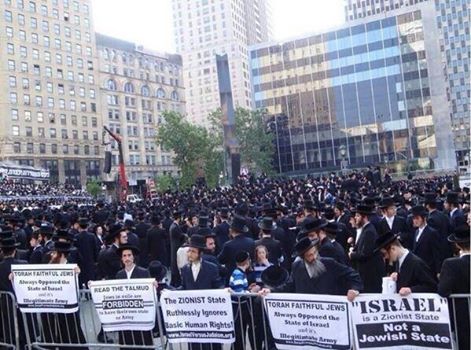
Jews demonstrate in New York Against Bombings
July 12, 2014 Umm al-Ara’is, Susya, Bi’r al-‘Id, Ma’asara
Business as usual in the South Hebron hills. There’s a war on in Gaza, but that too is business as usual, the meaningless biannual ritual in which both sides gleefully smash one another before reverting to the status quo ante. The Israeli media are drowning us in words, a vast and raucous flood, and the government is putting out its familiar, mendacious statements; perhaps in recent days only Abu Mazen has spoken the truth. The only solution, he said, is a political one, and Netanyahu is no partner. Meanwhile, rockets are flying, the Air Force is bombing, children are dying, soldiers are doing what soldiers mostly do, that is, wait around, and in South Hebron the land-grab proceeds apace, as always. Nothing, it seems, can stop that.
But wait a minute, some things have changed. Since the horrible murder of three Israeli teenagers, followed by the equally abominable revenge killing of the Palestinian boy from Shuafat, Israel has witnessed a wave of racist hatred on a scale perhaps not known before. Part of it has to do with the near-infinite opportunities of the internet: tens of thousands of virulent hate messages sent by ordinary Israelis have clogged the major sites; thousands of them call openly for revenge. I remember a time somewhat like this one, in the summer and autumn of 1982, the days of the first Lebanon War; the nadir came when a hate-filled nationalist threw a grenade into a Peace Now demonstration, killing my student, Emil Grunzweig. Some of the internet sites these days have called for the execution of leftists. Perhaps most striking of all is the utter shamelessness of this wave. Probably people used to have these same feelings but were not so ready, or eager, to state them in public. Decades of demagoguery and xenophobic incitement by the right, including, famously, by Netanyahu himself, have had an effect. The sluices are open. Continue reading Scholar David Shulman on the Gaza Bombings→
A short fragment of video, fifty seven seconds long, taken from behind a window in a building in the Gaza Strip which was aired last night on Al Jazeera television brought home (once again) the sheer horror of the Israeli Defence Forces’ (IDF) brutal, ongoing offensive against the people of Palestine with devastating clarity.
In a recent piece, entitled The Modi Wave, I analyzed the orientations of the Modi campaign, and argued that crucial to Modi’s repackaging was his ‘sovereignty effect’. In this case, entirely a property of the media narratives that pitched Narendra Modi as someone from outside history, he was offered as an intervention into national history. I have suggested that this was a masterstroke to the extent that the subject within history has a compromised agency. The continuities – of forces, events, rationales and time as a whole – blunt the provenance of the outsider. In order for the subject to act upon history, he must stand entirely outside it. In this way, he cannot be accessed from within historical time. Modi not only offered a historical narrative of an unending Congress rule, infested with corruption, appeasement and misrule, but also that of him observing this lingering malady from outside the fence. His story of his own rise goes from being a tea-seller to the Chief Minister of Gujarat, from a not-yet to a fully sovereign. He is never a deputy, never a peg within the system; he suffers till his agency is still being shaped, and appears as already the incumbent. This fundamental separation from the substance of historical progression is needed to project oneself as unsullied, unlike those defiled by the their political existence within history.
What is it about Narendra Modi that makes people suspend disbelief? Ashutosh Varshney in his Modi’s Ambivalence, Indian Express, June 28, actually considers it possible that the new Prime Minister has a chance of going down as “one of the greatest leaders of independent India”. Surely anyone qualifying for such a status must be acceptable to the majority of Indians? Last we heard, the magic of Modi had left almost two-thirds of the electorate untouched, not to forget the fact that he doesn’t exactly inspire respect among our largest minority.
Varshney makes some bewildering assertions in his evaluation of Modi’s first month as PM. From a “novel policy language for poverty alleviation” to a new acceptance of Mahatma Gandhi as the Father of the Nation, to his RSS-defying portfolio distribution, Varshney sees signs of a new Modi, quite different from the man cursed forever with the burden of Gujarat 2002.
पिछला एक हफ्ता भारत के शैक्षणिक समुदाय के लिए, खासकर उनके लिए जो किसी न किसी रूप में दिल्ली विश्वविद्यालय और विश्वविद्यालय अनुदान आयोग से जुड़े रहे हैं, सामूहिक शर्म का समय रहा है. यह अकल्पनीय स्थिति है कि आयोग एक सार्वजनिक नोटिस जारी करके किसी विश्वविद्यालय के पाठ्यक्रम में दाखिले की प्रक्रिया के बारे में निर्देश जारी करे. आयोग ने दिल्ली विश्वविद्यालय के स्नातक पाठ्यक्रम में दाखिले के सिलसिले में अभ्यर्थियों को कहा है कि वे विश्वविद्यालय द्वारा विज्ञापित चार वर्षीय स्नातक पाठ्यक्रम में प्रवेश न लें. उसने विश्वविद्यालय प्रशासन को फौरन यह पाठ्यक्रम वापस लेने और 2013 के पहले के पाठ्यक्रम को बहाल करने का आदेश दिया है. उसने विश्वविद्यालय के सभी कॉलेजों को भी सीधे चेतावनी दी है कि उसका आदेश न मानने की सूरत में उन्हें अनुदान बंद किया जा सकता है. किसी विश्वविद्यालय को नज़रअंदाज कर उसकी इकाई से उससे सीधे बात करना अंतरसांस्थानिक व्यवहार के सारे स्वीकृत कायदों का उल्लंघन है. व्यावहारिक रूप से यह दिल्ली विश्वविद्यालय का अधिग्रहण है.यह भारत के विश्वविद्यालयीय शिक्षा के इतिहास में असाधारण घटना है और सांस्थानिक स्वायत्ता के संदर्भ में इसके अभिप्राय गंभीर हैं. Continue reading स्वायत्तता की फिक्र किसे है? अपूर्वानंद, सतीश देशपांडे→
What unites anti-homophobia campaigners, defenders of the poor’s right to clean water, university student collectives, women rights’ groups and academics under a premature summer sun in New Delhi on the 30th of March earlier this year? It is the unacceptable means employed by the Indian state in response to armed rebellions in North east India and the threat to civilian life that it has precipitated. The contagion of a military approach to a largely political problem was promulgated as an ordinance in 1958 under the presidency of Dr Rajendra Prasad to help quell the Naga movement and was developed into the Armed Forces Special Powers Act (Assam and Nagaland) later in the same year. The Armed Forces Special Powers Act (from here on AFSPA) persists in violating human rights in Kashmir and North east India despite its incompatibility with national and international human rights declarations. Over the years this Act has been sanctified in the inner sanctum of India’s centralised quasi-military administration. The government has been extremely guarded in its approach to growing popular demands for annulling this Act. The civil leadership’s reluctance to temper with the ritualized provisions of this Act has raised the disquieting question of who runs the country.
On 30th March central Delhi woke up to a motley group of protestors unified by a concern for violation of human rights under AFSPA. [Photo credit: V Arun Kumar].
The following is the text of the PUCL petition to NHRC in the case of Teesta Setalvad, Javed Anand and the Citizens for Justice and Peace
PEOPLE’S UNION FOR CIVIL LIBERTIES
270-A, Patpar Ganj, Opposite Anand Lok Apartments, Mayur Vihar I, Delhi 110 091 Phone 2275 0014 PP FAX 4215 1459 Founder: Jayaprakash Narayan; Founding President: V M Tarkunde President: Prof. Prabhakar Sinha; General Secretary: Dr. V. Suresh
SUB.: SEEKING AN INDEPENDENT REVIEW AND INTERVENTION IN RESPECT OF CONTINUING PERSECUTION AND PROSECUTION OF HUMAN RIGHTS DEFENDERS, TEESTA SETALVAD AND JAVED ANAND OF CITIZENS FOR JUSTICE AND PEACE AND OTHERS
The Intelligence Bureau has, as we know prepared a document, updating it from the time of the UPA regime (which had reportedly started the dossier) indicating large scale foreign funding for subversive anti-development activities. Such as claiming that you have a greater right to your own lands and to your livelihood than monstrous profit-making private companies. Or raising ecological arguments that might stand in the way of the profits to be made by private corporations and the corrupt state elite, from mining, big dams, multi-lane highways and so on.
The IB report, signed by IB joint director Safi A Rizvi — alleges that the “areas of action” of the foreign-funded NGOs include anti-nuclear, anti-coal and anti-Genetically Modified Organisms protests. Apart from stalling mega industrial projects including those floated by POSCO and Vedanta, these NGOs have also been working to the detriment of mining, dam and oil drilling projects in north-eastern India, it adds.
Imagine – working against the interests of POSCO and Vedanta! Is there no end to the depraved anti-nationalism of these NGOs!
These folks must have made millions of dollars
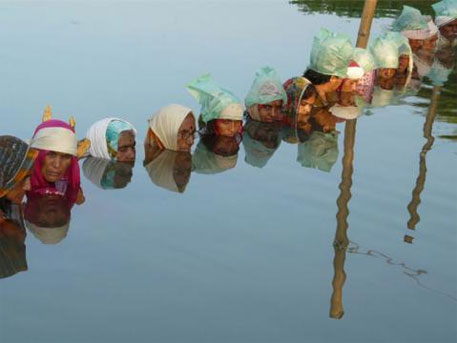
In 2012, people affected by the Omkareshwar and Indira Sagar dams protested the raising of dam storage levels by staying in neck-deep water for over a fortnight (Photo: Narmada Bachao Andolan).
The average observer of Indian politics – being like me, not as sharp as the IB – might be a little befuddled by this apparently anachronistic allergy of two successive governments and its intelligence gathering organization, towards foreign funding, in an era in which the slightest slowing down of the pace of handing over the nation’s resources to multi-national corporations, is termed as “policy paralysis”, and attacked as detrimental to the health of the mythical “Sensex”. Older readers might remember that the inspiring slogan of the legendary Jaspal Bhatti’s Feel Good party was Sensex ooncha rahe hamara.
This post is just to help you figure out then, when it is Okay to applaud foreign funding and when it is not – because otherwise you might post something on your FaceBook page that attacks foreign funding when it is actually Okay – and then how stupid and anti-national you’ll look. Continue reading When Are Foreign Funds Okay? A Guide for the Perplexed→
Meanwhile, with Shiv Visvanathan entering the debate, flogging the long dead secularist horse, sections of the liberal and left intelligentsia seem to have gone into a tizzy. Shiv’s argument merely restates in 2014 what political analysts like Ashis Nandy had been saying at least since the mid-1980s and it does so without its nuance. The long and short of this argument is that secularism is the creed of a deracinated English-speaking, West-oriented elite which cares little about the beliefs and ways of thinking and being of the majority of their compatriots. (See also Visvanathan’s piece in Economic and Political Weekly, May 31, 2014, on ‘Narendra Modi’s Symbolic War’)
Somewhere between the two poles of the fast-dwindling tribe of the Leftist gung-ho secularist and the breast-beating liberal, the possibility of a serious debate dies a quiet death. The 1980s-1990s debate on secularism had raised all the important questions about secularism and its problematic practice that Shiv Visvanathan’s piece raises but which, it seems bypassed a whole generation of Leftists who either still seem to find it scandalous to relate to religion or are suddenly discovering their alienation or worse, the virtues of religiosity. Needless to say, such a rediscovery, in the face of political adversity is not likely to be anything more than instrumental use of religion.
So now the gloves are off. For the BJP, that is, whose victory in these elections gives India not only its most right-wing government, but, more to the point, a prime minister to the right of his party – more laissez faire, openly contemptuous of minorities, authoritarian in style. What the party, and Narendra Modi, will make of its – and his – comprehensive victory will soon be apparent, but the omens are far from good. Working in a coalition and under the supposedly moderate leadership of Atal Behari Vajpayee, the BJP between 1998 and 2004 achieved quite a lot – not just in the cultural wars that are its forte, but also in terms of putting economic “reform” on steroids. Now that it is being advised by that distinguished dispenser of received opinion and tireless self promoter, Dr Jagdish Bhagwati – an economist whose ignorance of history and the methods through which economic development was actually achieved in almost every successful industrial economy from Great Britain in the 16th and 17th centuries to South Korea in the 20th (cue: protectionism and lots of effective government intervention) is stupendous even by the low standards of the discipline – all bets are off. Continue reading Looking back – and forward – from Modi’s election: Shashank Kela→
As journalists, academics and other pundits scramble to make sense of the just concluded elections to the Indian parliament, one can discern a few broad strands of opinion. One group – lets call them the Optimists – point to India’s almost seven-decades long experiment with electoral democracy and aver that we have the institutional strength and resilience in civil society to keep Prime Minister Narendra Modi and his Bharatiya Janata Party confined to a moderate middle that will be, ultimately, not very different from other regimes (single-party or coalition) that have ruled from Delhi. Prominent voices among the Optimists are Ashutosh Varshney, Ram Guha and Pratap Bhanu Mehta.
A second group – lets call them the Alarmists- see the BJP’s clear parliamentary majority (albeit arising from a mere 31% of the popular vote) as inaugurating an era of unapologetic Hindu majoritarianism that could severely strain and irreparably damage the plural fabric of Indian society. They are especially concerned about the fate of the Muslim minority and regard the 2002 pogrom in Gujarat as a foretaste of things to come. The Alarmists range across activists like the late Asghar Ali Engineer, politicos like Mani Shankar Aiyar and intellectuals such as Akeel Bilgrami. Continue reading A Chronicle of an Event Foretold? Sankaran Krishna→
This is a guest post by Saumya Uma and Arvind Narrain
Among the miniscule tribe of human rights lawyers, even one loss is irreplaceable. We felt that way when we lost K. Balagopal in 2009, K.G. Kannabiran in 2010 and most recently when, Mukul Sinha passed away on 12 May 2013. Each of these figures were giants in the world of human rights activism who struggled for an idea of India which all too often remained an ideal and a vision, sometimes far from reality. Regardless of how distant the vision of a real and functioning democracy, founded on the ideals of social and economic justice was, these three figures never lost heart, always communicating a spirit of hope about the future based on concrete and grounded work in the present. Continue reading Honouring Mukul Sinha: The Struggle of Memory Against Forgetting: Saumya Uma and Arvind Narrain→
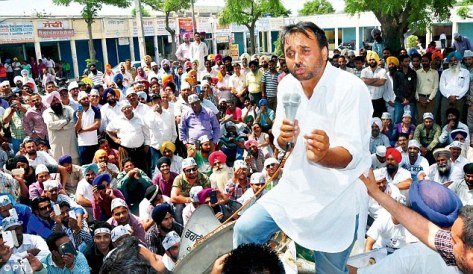
Bhagwant Singh Mann, now AAP MP from Sangrur, on the campaign trail
The Indian general election of 2014 will firstly be remembered for the signal self-destruction and implosion of independent India’s three-quarters-of-a-century-old ruling dynasty and its political arm, the Congress Party. Whether the unexpected series of victories by the fledgling Aam Aadmi Party (AAP) in Panjab will be remembered as an interesting anomaly, or as a galvanizing moment of genuine political change, remains to be seen. But just how a party that only a few months ago was essentially unknown on the national political scene, short on funding, and with virtually no organizational infrastructure, managed to secure 25% of the popular vote and four of thirteen Lok Sabha seats in Panjab (with a narrow miss on a fifth seat) is a tale that needs to be told. Although the newly demarcated role of the AAP as the gadfly and moral conscience of the political scene has been important to its success from a national perspective, it was the intersection of a new political ideology with a particular historical juncture that enabled the AAP to emerge as a giant-killer in Panjab where it met with frustrating disappointment in every other Parliamentary election that it contested elsewhere in India.
The AAP’s success in Panjab comes almost exactly thirty years after the devastating events of 1984, including Operation Bluestar (the Indian army’s full out assault on one of the holiest of Sikh shrines, Harmandir Sahib, and the adjacent Akaal Takht, one of the seats of Sikh temporal power), the subsequent assassination of then Prime Minister Indira Gandhi, and in its aftermath, the Congress Party-orchestrated retaliatory massacres of thousands of Sikhs in New Delhi. The timing of the AAP’s success in Panjab precisely three decades after 1984 is by no means coincidental, but rather is closely tied to the unfolding history of Panjab in the post-1984 period. The momentous events of 1984 were followed by the tumultuous period of 1984-1992 in Panjab. Continue reading History and Idealism in the Aam Aadmi Party’s 2014 Victories in Panjab: Puninder Singh→
As May turns into June the quiet loneliness of war-torn Jaffna lies before me. For how much longer, years or decades into the future, will I look back into the past? And who will help me reflect on that past?
Some, fifty years ago, the tragedy of Biafra unfolded. I grew up hearing about the legacy of Biafra. During the early years of Tamil militancy, my father and a few other Tamil intellectuals of his generation warned that we may end up like Biafra. That many intellectuals perished in the struggle for Biafra I knew, but what they did I did not know back then.
It is over the last year, that I returned to Biafra, through the powerful novel of Chimamanda Adichie, Half of a Yellow Sun. A novel sometimes helps us think about questions we find difficult to ask. Adichie made me think about how long it takes for us to grasp the suffering that comes with a devastating war. Indeed, Adichie writes about Biafra some forty years after. From Adichie, I moved to Chinua Achebe’s There Was a Country: A Personal History of Biafra. What struck me most about Achebe’s memoir, is that almost fifty years later, he is still struggling to come to terms with what Biafra meant to him, shackled by lingering nationalist sentiment. It takes a life time or even more to deal with the past in places like Biafra and Lanka.
There is something awfully nostalgic about May 16. The election results brought with them a sense of melancholy-laden déjà vu. For the queers and allies on the political Left, the sinking feeling that May 16 brought with it, was reminiscent of yet another day, December 11, 2013; the day the Indian Supreme Court reversed the decision of the Delhi High Court decriminalizing homosexuality in India. It was once again criminal to be gay in India; once again the legal State apparatus had rendered queer bodies vulnerable to violence, from the State and from the political Right. There was a sense of desperation and disheartening injustice; what avenues remained to be sought when the country’s highest courts had us disappointed?
The Rashtriya Swayamsevak Sangh (RSS) and the Bharatiya Janata Party (BJP) had vehemently welcomed the Supreme Court judgment then, but our incoming Prime Minister, Narendra Modi, remained silent. It was perhaps too trivial an issue for him to address; when were rights anyway a matter of importance for him? If the indigenous people and forest dwellers of Gujarat could make the Indian mass media listen to them, they would tell us the story of Gujarat’s abysmal performance in settling land claims and distributing title deeds. Rights, especially of the fragments, are a roadblock for the Modi-style Development machine.
This article offers a preliminary analysis of what the Modi phenomenon means in terms of BJP’s sweeping win on 16 May. It makes four propositions.
First, we stop seeing it as an individual phenomenon centered on the personality of Modi even as his votaries as well as some critics tend to view it that way.
Second, the Modi phenomenon is triumph of a massive ideological movement at the center of which stands the Rashtriya Swayamsewak Sangh, RSS. Sharply distinguishing between the BJP and the RSS is a naivety; the RSS’ influence goes far beyond as numerous politicians under its influence have gone to the non-RSS parties in the same way as politicians from the non-RSS parties have joined the RSS-BJP collective.
Third, the BJP victory is neither due to development nor due to anti-corruption but due to Hindutva dressed as development so that both were rendered synonymous. The BJP victory, I contend, is an outcome of a violent mobilization against “the other”, Muslims.
Fourth, BJP’s victory is not the triumph of democracy but its subversion. Charting a different genealogy of demokratiain Greek, I argue how it is pseudo democracy.
It may not be an exaggeration to say that what has just transpired is nothing short of a peaceful counter-revolution. Counter-revolution, not because there was an imminent threat of revolution that has been put down, but because the big bourgeoisie has finally put an end to the challenge from mass struggles that corporate interests had been facing. Struggles around land acquisition, the pressures for environmental clearance that held-up corporate projects, social welfare programmes that came in the way of the most unbridled pursuit of profit, and subsidies that supposedly introduced market distortions – all these had been greatly troubling the corporate sector and their ideologues. A campaign was built up, gradually over the past few years, to install a strong leader with a solid majority, who would give the bourgeoisie a free hand. And it must be admitted today that most of us failed to see where and how that threat was building up. We failed to see that for at least three, perhaps four years, the idea of the ‘Gujarat model’ was being put in place as a shorthand for an unrestrained play to private big capital.
Even when we realized that Modi was being pushed seriously, our eyes were still fixed on the older question of Modi’s culpability or otherwise in the 2002 carnage in Gujarat. The dream of the Gujarat model was sold over the years in many different ways, among precisely those sections whose support the Left (in its broadest sense) would have liked to enlist. The UPA government, of course, left no stone unturned in alienating itself from its popular support. Thus while important social welfare programmes, formulated under pressure from popular and social movements lagged behind in implementation, the neoliberal axis of Manmohan Singh, Chidambaram and Montek Singh Ahluwalia pushed relentlessly on matters like abolishing subsidy on cooking gas and direct cash transfers. The UPA government’s experience, in fact, showed that you cannot be all things to all people; that the interests of the big bourgeoisie and those of common people stand in irreconcilable contradiction. The balancing act cannot really go on for very long. Continue reading Beyond the Elections – Need for a Vibrant and Credible Left→
Shazia Ilmi’s exit marks a real blow for AAP supporters. Her frequent TV appearances as AAP spokesperson made her out to be an articulate, confident woman who didn’t need to assert her religious identity to prove a point, which is a rare thing in today’s politics. Her participation in the Anna andolan was as much a pointer to its inclusive nature as it was to the emergence of a new kind of Muslim in public life: one who had no hesitation plunging into a mass movement which had strong nationalist overtones, was avowedly against the political system and had little to do with minority concerns.
When Shazia almost won from Delhi’s R K Puram constituency, it suddenly came home – for the first time in years, a Muslim candidate had been fielded from a Hindu-dominated constituency, and the Hindus had voted for her. In Mumbai, a Muslim political activist who’s friendly with every political party, has for long told Shiv Sena leaders that the moment they field a Muslim from any of their strongholds, he would join them. “The ability to take the other community along, that’s the test of a secular politician,’’ a senior Congress Muslim in Nanded told me, rueing the fact that Muslims who could do this were ignored by his leader Ashok Chavan (one of the two Congressmen to win in the state this time). Continue reading Shazia Ilmi – Why Her Exit is Such a Blow: Jyoti Punwani→
The Bharatiya Janata Party secured about 19% votes in the general elections of 2009 to win 116 seats in the Parliament. With this most impressive conversion ratio, they had more or less exhausted their possibilities in their ‘safe’ states like Gujarat, Madhya Pradesh, Chhattisgarh, Jharkhand, Karnataka, and the like. They were still 157 seats away from a simple majority in the Loksabha. Even assuming the impressive conversion ratio, they needed at least 26% more of the vote share, that is 45% in all, to form a government.
When the elections for 2014 were announced, it was hard to see where the BJP would get these additional votes from. Moreover, unlike the NDA of 1999-2004, they had rather modest support from other parties with most of the big parties like AIADMK, TMC, JDU, BJD, and the like staying away. Hence, even if we factor in some rise in number of seats in ‘safe’ states, plus handsome gains in Rajasthan, Maharashtra etc., their ability to reach anywhere near the 272+ mark looked rather dim.