Category Archives: Politics

The Political Parties of Pakistan: Saim Saeed

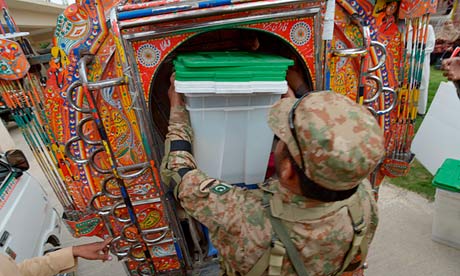
A Pakistani soldier loads ballot boxes into a van in Rawalpindi. Authorities hope the app, combined with a fully revised voter list and an unprecedented level of public scrutiny, will help ensure the election will be the cleanest ever. Photograph: Farooq Naeem/AFP/Getty Images

Guest post by SAIM SAEED: Democracy in South Asia is its own animal, and has little resemblance with its counterparts in the United States and elsewhere. Gone are any kind of faultlines between liberals and conservatives, ideologies and the like; “Social Democrats” means little, and Greens, Communists and Freedom, even less.

A widely held view is that political parties in Pakistan (and India) are based on ethnic lines. And there is good reason to believe that view. The PML-N, run by Punjabis, controls northern Punjab. The PPP, run by Sindhis, controls Sindh and parts of Southern Punjab. The ANP, run by Pushtuns, controls the Pushtun-dominated Khyber Pukhtunkhwa province in the North-West, and represents a few Pashtun-heavy neighborhoods in Karachi. Smaller parties run similarly. The MQM, a party founded as a Muhajir – immigrant – party, runs Karachi, the city with the largest Muhajir constituency. The BNP, founded as a Baloch pro-independence party is the most popular party in Balochistan. At various points, parties have tried to fashion themselves nationally, reflecting their larger ambitions. PPP’s official rhetoric talks of a national narrative. The MQM, originally short for Muhajir Quami Movement – National Immigrant Movement – changed to become the Muttahida Quami Movement (without any change to its initials), Muttahida meaning United. These changes have been cosmetic, however, and each party’s constituency remains more or less the same.

This view, however, is incomplete.

Continue reading The Political Parties of Pakistan: Saim Saeed

Naya Pakistan, an old fable: Ayesha Siddiqa

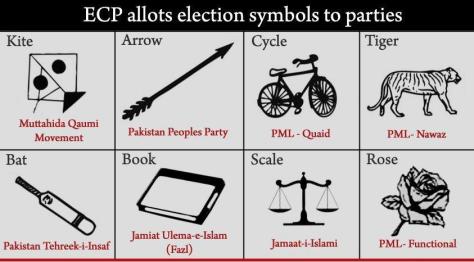
pakvotes-election-symbols

Guest post by AYESHA SIDDIQA: The renowned television anchor Quatrina Hosain was in tears. A day after the incident of her being sexually assaulted at a Pakistan Tehreek-e-Insaaf (PTI) jalsa by party workers in Wah Cantonement, she talked about how the bruises may heal but not her emotional scars. She was covering election rallies and got invited by a PTI candidate Mohammad Sarwar to his rally in Wah. It was a sudden plan so no one could have conspired to misbehave. This is important to note, as  many PTI workers have subsequently tried to blame the incident on Pakistan Muslim League (Nawaz)’s workers. However, when confronted with facts, PTI workers tried to hide behind the argument that women should not provoke people by coming out and mixing with them. Continue reading Naya Pakistan, an old fable: Ayesha Siddiqa

Partha Chatterjee on Subaltern Studies, Marxism and Vivek Chibber

At the recent Historical Materialism conference held in Delhi from April 3-5, a panel was organized with great fanfare – an official panel by the HM editors – around Vivek Chibber’s new book Postcolonial Theory and the Spectre of Capital. This panel was billed to be a decisive refutation of Subaltern Studies and Postcolonial theory, not only by the chief  theorists and organizers of Historical Materialism but by many other Indians – most of whom in any case have little more than a religious faith in ‘Marxism’ and understand little of Marxism and its history.  There was glee all around and one came across the hurried announcement of a Centre for Marxist Studies that was to host further events around this book against the demon that Chibber had apparently slain. After all, Chibber  was backed by the likes of Slavoj Zizek, Robert Brenner and Noam Chomsky, all of whom  had  endorsed his book as the death knell to  Subaltern Studies and Postcolonial theory. The glee was to be short-lived.

On April 28, at the New York conference of Historical Materialism, the organizers made the mistake of inviting Partha Chatterjee (a representative of a spent force, already buried at the Delhi HM Conference!) to debate the new star on their horizon. The meticulous demolition of Chibber that followed, embarrassed even his most ardent supporters, who had hoped to see the redoubtable Partha vanquished in person. And Chhibber, let our marxist brethren note, is reduced to finally accepting that he is more inclined towards contract  theory than towards Marxism!

Partha, whose years of meticulous engagement with Marxism can hardly be taken on cavalierly by any upstart on the horizon, calmly tore Chibber’s claims to shreds. Many supporters of Chibber’s book have, in social media, glumly  described the 28 April event as a great setback to their cause…

Here is Partha in debate…

Food Security Bill – MPs clueless: Ankita Aggarwal

This is guest post by ANKITA AGGARWAL: Last week a group of about fifteen of us (students who have been working on the right to food in various capacities) met Members of Parliament to discuss the amended National Food Security Bill and how it can be improved. We knocked on the doors of more than a hundred MPs, but managed to meet only about twenty of them. Most of the MPs were away from Delhi, in their constituencies or elsewhere, and a few were “too busy” or “too tired” to meet us.

Our overall experience was quite disappointing. Most MPs were quite clueless about the Bill. But instead of using our visit as an opportunity to inform themselves about the Bill and its shortcomings, most of them preferred to indulge in rhetoric, making statements like “we will raise your demands in the Parliament” or “it’s shameful that there is hunger in the country even so many years after independence”. A few MPs talked to us at length about issues ranging from the demand for Telangana to the impossibly high cut-offs in colleges, but not about how the Bill can be salvaged. Some MPs were of the opinion that there was no scope for discussion of the Bill in Parliament, and that it was pointless to discuss it with us. Continue reading Food Security Bill – MPs clueless: Ankita Aggarwal

Of Angry Young Students and Education in India – A Response to Thane Richard: Aritra Chatterjee

This is a guest post by ARITRA CHATTERJEE: In his response to the article by some students of St. Stephen’s College, Thane Richard has raised a set of questions about the college, about the students participating in the present movement, about education in India and students’ voice in shaping education. He is critical about what he calls the lack of quality education, of a system where education is primarily about rote learning and conformity to structures of authority; in such a situation the promise of a good liberal arts education remains a mere promise and students migrate to the West in search of it. He also rues the lack of students’ voice in the education system, rhetorically asking, “Do students have any right?” He welcomes the students’ fight against the oppressive regime at St. Stephen’s College but views it as a movement that is too little too late and even that in “the wrong direction”. I shall respond to his views at two levels – at the level of education in the country as a whole, and that of the present movement at St. Stephen’s College. Continue reading Of Angry Young Students and Education in India – A Response to Thane Richard: Aritra Chatterjee

Let us declare that a state of war exists

“Let us declare that the state of war does exist and shall exist so long as the Indian toiling masses and the natural resources are being exploited by a handful of parasites.” Those are not the words of a member of the Central Committee of the Communist Party of India (Maoist), though the film has that too. These words are of Bhagat Singh, revolutionary freedom fighter who has today been appropriated by everybody for their own purposes.

The most remarkable thing about Sanjay Kak’s new film Red Ant Dream is Punjab. Occupying more than a third of the film, its use of the revolutionary sentiment in today’s Punjab takes forward the debate on the Maoist and other resistance movements in India. Instead of getting into the debates around the Maoist movement in central India, the film makes for a powerful document of the how and why the revolutionary ideal lives in India 2013. Continue reading Let us declare that a state of war exists

Academic Excellence and St. Stephen’s College: A response by Thane Richard

This is a guest post by THANE RICHARD

I recently read an article in Kafila – more like an angry, reflective rant – written by some students from St. Stephen’s College in Delhi.  To quickly summarize, the piece criticized the draconian views of the Principal of St. Stephen’s College regarding curfews on women’s dormitories and his stymying of his students’ democratic ideals of discussion, protest, and open criticism.  More broadly, though, the article’s writers seemed to be speaking about the larger stagnant institution of Indian higher education, overseen by a class of rigid administrators represented by this sexist and bigoted Principal, as described by the students.  The students’ frustration was palpable in the text and their story felt to me like a perfect example of what happens when an unstoppable force meets an immovable object.  Except Indian students are not an unstoppable force.  Not even close. Continue reading Academic Excellence and St. Stephen’s College: A response by Thane Richard

Spin Doctors, Propagandists and the Modi Make-over

Elsewhere on Kafila, we have published a 7000 word long response by Madhu Kishwar to Zahir Janmohamad’s open letter to her which appeared on 15 January, followed by Zahir Janmohamad’s response. Perhaps a few things need to be stated here clearly with respect to her ‘response’. It seems to me to violate every tenet of reasoned debate and argument and is replete with name calling and stereo-typing of not just the secularist ‘other’ [who is her real other, not the Muslim] but even of the adversary she is arguing with. So if Zahir is a  Muslim, he has to be X, Y, Z and has to be believing in A, B, C. Everything starts and ends in bad faith. But then that is what distinguishes Madhu Kishwar from others. She is in her element especially in relation to those whom she disagrees with. With her there can be no disagreement – you have to be sneered and jeered at, irrespective of whether you are a Medha Patkar or an Aruna Roy. I suppose these are matters of personal style and I shall not dwell on them further.

Let me rather, turn to some of the more substantive issues raised in Madhu’s response. Zahir has answered most of them but it seems to me that a couple of vital questions still remain. Even here, though, a caveat is necessary. I have great admiration for Madhu Kishwar’s battle in defense of the rikshaw pullers in Delhi and have often said so openly to her as well as others. However, I do know that it is possible to talk to her when only we agree, which is very rare. On matters that we disagree about, I have decided that I do not want to enter into any kind of an argument with her. In any case, large parts of her ‘response’ are like Modi’s PR handouts, served to us without any sense of critical examination. Therefore, what follows below is not my reply to her but my reactions to a set of allegations she has raised about whosoever is opposed to Narendra Modi – all lumped together in a breathtaking move of reductio ad absurdum, first as secularists , who are reduced to Leftists/ NGO activists and finally to Congress-supporters (because, she says in her Modinama1, the Congress has been equally responsible for all the riots till date). I therefore, lay my cards on the table at the outset: I am an inveterate Modi-hater (and a Congress-hater as well, if that makes sense to anyone in her dichotomized universe) and Kafila is a forum with a certain, if very broad, politics that, at the minimum rules out being pro-Modi. Continue reading Spin Doctors, Propagandists and the Modi Make-over

Lethal Lottery: A study on death penalty in India, 1950-2006

Melbourne Academics in Solidarity with UPenn Professors

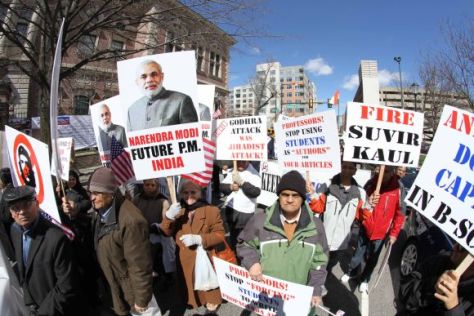
Statement from Melbourne Academics in Solidarity with Ania Loomba, Suvir Kaul, Toorjo Ghosh and others at the University of Pennsylvania.

24wharton1

The statement follows the brief background to the issue below:

Ashley L Cohen in The Daily Pennsylvanian

In the pages of The Daily Pennsylvanian and elsewhere, supporters of Narendra Modi have framed the issue of Modi’s disinvitation from the Wharton India Economic Forum as one of free speech. The framing is a clever one. Narendra Modi is a rather unsavory figure, and he is difficult to defend on any other terms. Continue reading Melbourne Academics in Solidarity with UPenn Professors

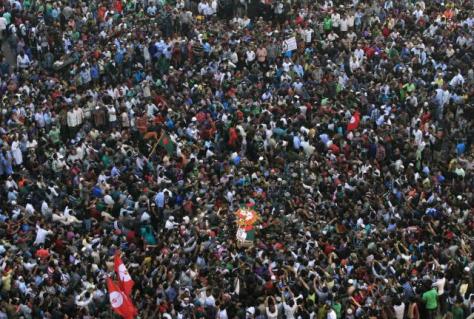
Gonojagoron march in Dhaka April 6, 2013

Images courtesy KALYANI MENON-SEN

1365252284-hefajat-program-attack-revealed-at-press-conference_1935474


1365426178-strike-in-dhaka-called-by-hefajateislam_1941888

In Delhi for Dhaka: A solidarity vigil for Shahbagh

The New Socialist Initiative (NSI), Jamia Teachers’ Solidarity Association (JTSA), Nishant, Anhad, Krantikari Lok Adhikar Sangathan and the Stree Mukti Sangathan have put out this statement in advance of the demonstration tomorrow (9 April) 2 pm before the Bangladesh High Commission in Delhi.

The neighbouring country of Bangladesh is going through a new churning. Hundreds and thousands of people have hit the streets of Dhaka, demanding strict punitive action against ‘war criminals’ and their organisations, who forty-two years ago—at the time of the liberation struggle/war of the then East Pakistan (now Bangladesh)—colluded with the Pakistan army and committed untold acts of atrocities on the general public.

Basically, there are two main demands of the protesters: war criminals should be strictly punished and organisations like the Jamat-e-Islami, Bangladesh, should be banned and all commercial and other kinds of establishments run by it should be proscribed. Continue reading In Delhi for Dhaka: A solidarity vigil for Shahbagh

What a time to be in Dhaka! Kalyani Menon-Sen

This is a guest post by KALYANI MENON-SEN

I am in Dhaka right now.

Being here at this moment, in Shahbagh (Projonmo Chottor, as it is now called) and on the streets with activists from the Gonojagoron Mancha – young people, academics, veterans of the liberation movement, singers, artists, writers, professionals and thousands of ordinary people – is a unique and inspiring experience.

Battle for the soul of Bangladesh – Rally in February against the killing of Rajab Haider, the blogger who was a key figure in the protests against Islamists

The similarities and differences with the Delhi mobilisation are striking. Continue reading What a time to be in Dhaka! Kalyani Menon-Sen

Nuclear Energy – Reassurances Don’t Guarantee Safety: M V Ramana

This is a guest post by M V RAMANA 

On 23 March 2013, NDTV featured one of its Walk the Talk features with Shekhar Gupta interviewing Yukiya Amano, the Director General of the International Atomic Energy Agency (IAEA). This was reproduced a few days later in the Indian Express. Coming shortly after the second anniversary of the multiple accidents at Fukushima, the purpose of the interview is made clear by Gupta late in the interview when he says:

…some of us who support the idea of [expanding] nuclear power [in India] need more reassurance from people like you.

And Amano does oblige by asserting,

with more caution, with further measures, I am very confident that nuclear power is much safer than before.

To those already supportive of more nuclear reactors, the interview is likely to have been successful in offering them the assurance that they need, not so much for themselves, but to silence those skeptical of the expansion. But if one reads the interview more carefully, it is clear that the assurance is not really a guarantee that no catastrophic accidents will happen. Continue reading Nuclear Energy – Reassurances Don’t Guarantee Safety: M V Ramana

Making Mockery of Panchayati Elections : Shivnarayan Rajpurohit

This is a guest post by SHIVNARAYAN RAJPUROHIT : A school teacher in Rayapuram village of Mehabubnagar district (Andhra Pradesh) summed up the sentiment of the village: “Without a sarpanch [an elected village-chief], this village is like a rudderless ship. The implementation of government schemes has gone from bad to worse. The government has appointed special officers, who hardly have any bonding with villagers in each panchayat.” Recently, the state government of Andhra Pradesh (AP) decided to conduct the panchayati elections in April-May 2013, which have been overdue since July-August 2011. What were the reasons for this postponement? Continue reading Making Mockery of Panchayati Elections : Shivnarayan Rajpurohit

Of imagined solidarities and real fears – The politics of the Sri Lankan Tamil cause in Tamil Nadu: Anonymous

This is a guest post by ANONYMOUS:  When elephants fight it is the grass that suffers, so goes an old Kenyan proverb. In the maelstrom of political hysteria unleashed by Jayalalitha and Karunanidhi ostensibly in aid of Sri Lankan Tamils, democracy, truth and solidarity have been the biggest casualties. Over the past few months, Tamil Nadu has witnessed attacks on Sri Lankan Buddhist monks and Christian pilgrims, and the government sanctioned blockade of Sri Lankan schoolchildren and sportspersons.

The latest salvo from Chennai regarding Sri Lanka is the Tamil Nadu assembly resolution calling upon India to press for a United Nations Security Council mandated referendum amongst Tamils living in Sri Lanka as well as Tamils of Sri Lankan origin in other countries on the question of carving out an independent Tamil Eelam in Sri Lanka. This is in addition to demands to declare Sri Lanka a ‘hostile state’, impose some form of sanctions etc. Continue reading Of imagined solidarities and real fears – The politics of the Sri Lankan Tamil cause in Tamil Nadu: Anonymous

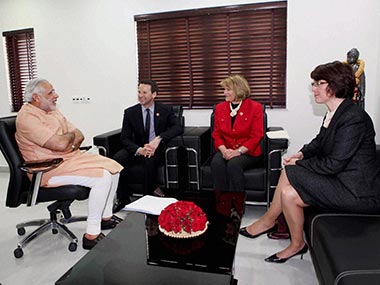
On Narendra Modi’s strange bedfellows in Washington DC: Zahir Janmohamed

Guest post by ZAHIR JANMOHAMED

PTI photo
PTI photo

The headline on Zee News at 5:09pm today read: “America opens its gates for ‘very dynamic’ Narendra Modi.”

The Business Standard in an article posted a few minutes earlier, at 4:57pm, wrote: “After UK, now US softens stand on Modi.”
Indeed three members of the US Congress, along with a few US business leaders, did meet with the Gujarat Chief Minister today in Gujarat. But should we infer any shift in US policy towards Narendra Modi?

In short, no.
Continue reading On Narendra Modi’s strange bedfellows in Washington DC: Zahir Janmohamed

“Politics Pulls at Me” – The Palestinian Youth Movement: Sunaina Maira

bab-al-shams

The establishment of Bab Al Shams, a direct action against Israel’s settlement enterprise. (Photo credit: Issam Rimawi / APA images)

SUNAINA MAIRA writes in muftah.org 

The eruption of resistance villages is an extension of popular struggles in which young Palestinians have been actively involved since March 15, 2011. During Palestine’s so-called Arab Spring, a series of protests organized by youth erupted in Ramallah and in other sites across the West Bank, as well as in Gaza and within the 1948 borders of Israel among the “’48 Palestinians.”

Inspired partly by the Arab revolutions and in solidarity with the Palestinian prisoners, this new “youth movement” is but one phase in ongoing resistance against Israeli occupation, colonialism, and apartheid. Nevertheless, as the second anniversary of the Palestinian youth movement approaches, it is important to reflect on a phenomenon that largely remains in the shadows of much more dramatic revolts in North Africa, and the more difficult struggle, in a sense, that Palestinian activists have been waging for democracy as well as national liberation.

Read the full article

Appeal from Tamil Civil Society to the International Community on Sri Lanka

This appeal was published in groundviews.org and has been sent to us by V. Geetha. We are publishing it here to give a different view from the kind of view that dominates now. Even though the appeal was made before the voting took place in the UN Human Rights Council, it is nevertheless an important view.

This appeal, signed by civil society activists who live and work in the North and East of Sri Lanka, seeks to state our position with regard to the resolution on Sri Lanka to be tabled at the 22nd sessions of the UN Human Rights Council. We understand that the resolution will seek to provide more time to the Government of Sri Lanka to implement the recommendations contained in the Lessons Learnt and Reconciliation Commission and that it will fall short of calling for an international independent investigation to hold to account those responsible for the Crime of Genocide, War Crimes and Crimes Against Humanity. If this resolution would contain only the above and no further, in our opinion, it would be truly unfortunate. Read the full statement here.

Understanding the Empty Promises of Nuclear Energy: Nityanand Jayaraman

This is a review by NITYANAND JAYARAMAN of M.V. Ramana’s book The Power of Promise: Examining Nuclear Energy in India (Penguin/Viking).

Narayanasamy’s monthly promises of power from the Koodankulam nuclear plant may be something of a joke in Tamil Nadu. But the periodic promises served a function. They kept one section of Tamil Nadu hopeful that commissioning Koodankulam will solve the state’s power crisis, and therefore resentful of the agitators who were seen to be putting their own lives, livelihoods and safety over the needs of the state.

In late 2012  Penguin published the first solo book by Princeton University-based physicist M.V. Ramana. The book is titled The Power of Promise: Examining Nuclear Energy in India.

downloadRamana’s commentary is witty, articulate and rich with anecdotes. He makes a solid case for his central thesis – that delivering on the promises of power or security were never the actual goal of India’s nuclear program, and probably never will be. Rather, promises are the engines that power the program, he argues. By holding out the twin ideals of unlimited electricity and infallible security in the form of a credible nuclear deterrent, India’s nuclear establishment has carved for itself an enviable position. It is answerable to no one but the Prime Minister, and can spend billions over decades with nothing to show for the expense.

Continue reading Understanding the Empty Promises of Nuclear Energy: Nityanand Jayaraman

Women – rights-bearers, economic assets, or stranded starfish? Uma Narayan

This is a review by UMA NARAYAN of the book Half the sky: Turning Oppression into Opportunity for Women Worldwide by Nicholas D. Kristof and Shirley WuDunn (2010). This review was first published in Perspectives on Politics, Vol. 8, No. 1, March 2010.

Why are we republishing a three year old review? The book has since then become a “movement” with celebrity advocates and a Facebook game that was launched this year. While being widely celebrated across the media in the US, it is also being sharply attacked for its “your women are oppressed, but ours are awesome” rhetoric. 

8065751089_c4fd818f4e

Asks Sayantani Dasgupta in her blog post from which the image above is taken:

For example, would Kristof, a middle-aged male reporter, so blithely ask a 14-year-old U.S. rape survivor to describe her experiences in front of cameras, her family, and other onlookers? Continue reading Women – rights-bearers, economic assets, or stranded starfish? Uma Narayan