Category Archives: Politics

In Delhi for Dhaka: A solidarity vigil for Shahbagh

The New Socialist Initiative (NSI), Jamia Teachers’ Solidarity Association (JTSA), Nishant, Anhad, Krantikari Lok Adhikar Sangathan and the Stree Mukti Sangathan have put out this statement in advance of the demonstration tomorrow (9 April) 2 pm before the Bangladesh High Commission in Delhi.

The neighbouring country of Bangladesh is going through a new churning. Hundreds and thousands of people have hit the streets of Dhaka, demanding strict punitive action against ‘war criminals’ and their organisations, who forty-two years ago—at the time of the liberation struggle/war of the then East Pakistan (now Bangladesh)—colluded with the Pakistan army and committed untold acts of atrocities on the general public.

Basically, there are two main demands of the protesters: war criminals should be strictly punished and organisations like the Jamat-e-Islami, Bangladesh, should be banned and all commercial and other kinds of establishments run by it should be proscribed. Continue reading In Delhi for Dhaka: A solidarity vigil for Shahbagh

What a time to be in Dhaka! Kalyani Menon-Sen

This is a guest post by KALYANI MENON-SEN

I am in Dhaka right now.

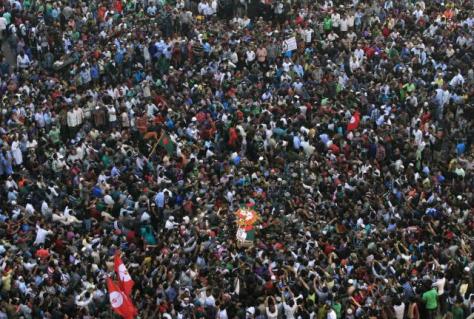
Being here at this moment, in Shahbagh (Projonmo Chottor, as it is now called) and on the streets with activists from the Gonojagoron Mancha – young people, academics, veterans of the liberation movement, singers, artists, writers, professionals and thousands of ordinary people – is a unique and inspiring experience.

Battle for the soul of Bangladesh – Rally in February against the killing of Rajab Haider, the blogger who was a key figure in the protests against Islamists

The similarities and differences with the Delhi mobilisation are striking. Continue reading What a time to be in Dhaka! Kalyani Menon-Sen

Nuclear Energy – Reassurances Don’t Guarantee Safety: M V Ramana

This is a guest post by M V RAMANA 

On 23 March 2013, NDTV featured one of its Walk the Talk features with Shekhar Gupta interviewing Yukiya Amano, the Director General of the International Atomic Energy Agency (IAEA). This was reproduced a few days later in the Indian Express. Coming shortly after the second anniversary of the multiple accidents at Fukushima, the purpose of the interview is made clear by Gupta late in the interview when he says:

…some of us who support the idea of [expanding] nuclear power [in India] need more reassurance from people like you.

And Amano does oblige by asserting,

with more caution, with further measures, I am very confident that nuclear power is much safer than before.

To those already supportive of more nuclear reactors, the interview is likely to have been successful in offering them the assurance that they need, not so much for themselves, but to silence those skeptical of the expansion. But if one reads the interview more carefully, it is clear that the assurance is not really a guarantee that no catastrophic accidents will happen. Continue reading Nuclear Energy – Reassurances Don’t Guarantee Safety: M V Ramana

Making Mockery of Panchayati Elections : Shivnarayan Rajpurohit

This is a guest post by SHIVNARAYAN RAJPUROHIT : A school teacher in Rayapuram village of Mehabubnagar district (Andhra Pradesh) summed up the sentiment of the village: “Without a sarpanch [an elected village-chief], this village is like a rudderless ship. The implementation of government schemes has gone from bad to worse. The government has appointed special officers, who hardly have any bonding with villagers in each panchayat.” Recently, the state government of Andhra Pradesh (AP) decided to conduct the panchayati elections in April-May 2013, which have been overdue since July-August 2011. What were the reasons for this postponement? Continue reading Making Mockery of Panchayati Elections : Shivnarayan Rajpurohit

Of imagined solidarities and real fears – The politics of the Sri Lankan Tamil cause in Tamil Nadu: Anonymous

This is a guest post by ANONYMOUS:  When elephants fight it is the grass that suffers, so goes an old Kenyan proverb. In the maelstrom of political hysteria unleashed by Jayalalitha and Karunanidhi ostensibly in aid of Sri Lankan Tamils, democracy, truth and solidarity have been the biggest casualties. Over the past few months, Tamil Nadu has witnessed attacks on Sri Lankan Buddhist monks and Christian pilgrims, and the government sanctioned blockade of Sri Lankan schoolchildren and sportspersons.

The latest salvo from Chennai regarding Sri Lanka is the Tamil Nadu assembly resolution calling upon India to press for a United Nations Security Council mandated referendum amongst Tamils living in Sri Lanka as well as Tamils of Sri Lankan origin in other countries on the question of carving out an independent Tamil Eelam in Sri Lanka. This is in addition to demands to declare Sri Lanka a ‘hostile state’, impose some form of sanctions etc. Continue reading Of imagined solidarities and real fears – The politics of the Sri Lankan Tamil cause in Tamil Nadu: Anonymous

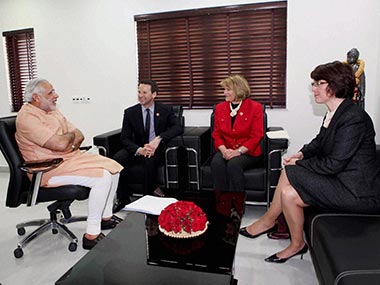
On Narendra Modi’s strange bedfellows in Washington DC: Zahir Janmohamed

Guest post by ZAHIR JANMOHAMED

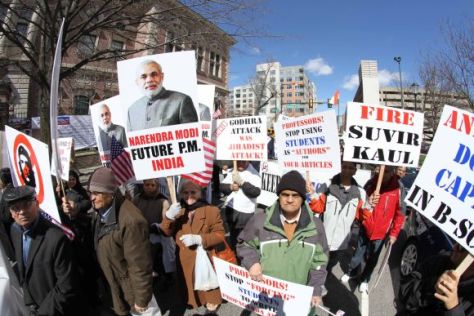
PTI photo
PTI photo

The headline on Zee News at 5:09pm today read: “America opens its gates for ‘very dynamic’ Narendra Modi.”

The Business Standard in an article posted a few minutes earlier, at 4:57pm, wrote: “After UK, now US softens stand on Modi.”
Indeed three members of the US Congress, along with a few US business leaders, did meet with the Gujarat Chief Minister today in Gujarat. But should we infer any shift in US policy towards Narendra Modi?

In short, no.
Continue reading On Narendra Modi’s strange bedfellows in Washington DC: Zahir Janmohamed

“Politics Pulls at Me” – The Palestinian Youth Movement: Sunaina Maira

bab-al-shams

The establishment of Bab Al Shams, a direct action against Israel’s settlement enterprise. (Photo credit: Issam Rimawi / APA images)

SUNAINA MAIRA writes in muftah.org 

The eruption of resistance villages is an extension of popular struggles in which young Palestinians have been actively involved since March 15, 2011. During Palestine’s so-called Arab Spring, a series of protests organized by youth erupted in Ramallah and in other sites across the West Bank, as well as in Gaza and within the 1948 borders of Israel among the “’48 Palestinians.”

Inspired partly by the Arab revolutions and in solidarity with the Palestinian prisoners, this new “youth movement” is but one phase in ongoing resistance against Israeli occupation, colonialism, and apartheid. Nevertheless, as the second anniversary of the Palestinian youth movement approaches, it is important to reflect on a phenomenon that largely remains in the shadows of much more dramatic revolts in North Africa, and the more difficult struggle, in a sense, that Palestinian activists have been waging for democracy as well as national liberation.

Read the full article

Appeal from Tamil Civil Society to the International Community on Sri Lanka

This appeal was published in groundviews.org and has been sent to us by V. Geetha. We are publishing it here to give a different view from the kind of view that dominates now. Even though the appeal was made before the voting took place in the UN Human Rights Council, it is nevertheless an important view.

This appeal, signed by civil society activists who live and work in the North and East of Sri Lanka, seeks to state our position with regard to the resolution on Sri Lanka to be tabled at the 22nd sessions of the UN Human Rights Council. We understand that the resolution will seek to provide more time to the Government of Sri Lanka to implement the recommendations contained in the Lessons Learnt and Reconciliation Commission and that it will fall short of calling for an international independent investigation to hold to account those responsible for the Crime of Genocide, War Crimes and Crimes Against Humanity. If this resolution would contain only the above and no further, in our opinion, it would be truly unfortunate. Read the full statement here.

Understanding the Empty Promises of Nuclear Energy: Nityanand Jayaraman

This is a review by NITYANAND JAYARAMAN of M.V. Ramana’s book The Power of Promise: Examining Nuclear Energy in India (Penguin/Viking).

Narayanasamy’s monthly promises of power from the Koodankulam nuclear plant may be something of a joke in Tamil Nadu. But the periodic promises served a function. They kept one section of Tamil Nadu hopeful that commissioning Koodankulam will solve the state’s power crisis, and therefore resentful of the agitators who were seen to be putting their own lives, livelihoods and safety over the needs of the state.

In late 2012  Penguin published the first solo book by Princeton University-based physicist M.V. Ramana. The book is titled The Power of Promise: Examining Nuclear Energy in India.

downloadRamana’s commentary is witty, articulate and rich with anecdotes. He makes a solid case for his central thesis – that delivering on the promises of power or security were never the actual goal of India’s nuclear program, and probably never will be. Rather, promises are the engines that power the program, he argues. By holding out the twin ideals of unlimited electricity and infallible security in the form of a credible nuclear deterrent, India’s nuclear establishment has carved for itself an enviable position. It is answerable to no one but the Prime Minister, and can spend billions over decades with nothing to show for the expense.

Continue reading Understanding the Empty Promises of Nuclear Energy: Nityanand Jayaraman

Women – rights-bearers, economic assets, or stranded starfish? Uma Narayan

This is a review by UMA NARAYAN of the book Half the sky: Turning Oppression into Opportunity for Women Worldwide by Nicholas D. Kristof and Shirley WuDunn (2010). This review was first published in Perspectives on Politics, Vol. 8, No. 1, March 2010.

Why are we republishing a three year old review? The book has since then become a “movement” with celebrity advocates and a Facebook game that was launched this year. While being widely celebrated across the media in the US, it is also being sharply attacked for its “your women are oppressed, but ours are awesome” rhetoric. 

8065751089_c4fd818f4e

Asks Sayantani Dasgupta in her blog post from which the image above is taken:

For example, would Kristof, a middle-aged male reporter, so blithely ask a 14-year-old U.S. rape survivor to describe her experiences in front of cameras, her family, and other onlookers? Continue reading Women – rights-bearers, economic assets, or stranded starfish? Uma Narayan

No Time for Grieving – Or Why We Should Talk Some More About Kai Po Che: Debashree Mukherjee

Guest post by DEBASHREE MUKHERJEE

Okay, so the popular consensus is that Kai Po Che is a good film. Everyone agrees that it’s well shot and edited, the relatively unknown heroes are excellent, and the narrative is taut and emotionally resonant. It is competent and follows all the right cues worthy of a buddy movie about growing up and testing loyalties. But the film is hardly an event. It has been seized upon as a significant cinematic landmark for its depiction of the Gujarat pogrom of 2002. It might be worth our while to get some perspective here.

Today I will look at some other questions about our collective liberal attitude to this film, and what it indicates about our memory of select incidents of mass violence in this country. The main question to ponder is whether there is something dangerous about a historically-contextualized cultural product that can be coopted by a range of political perspectives? Is there something objectionable about a film (and the emotions it generates) which is deliberately toothless in the face of power? Over the last few weeks we have witnessed a range of informed cultural commentators  protest that critics of the film are making much to-do about what is in fact the first “realistic” and engaging Bollywood depiction of the Gujarat massacre. This post rejects that opinion and appeals for responsible film criticism and an alert, active mode of spectatorship.

Continue reading No Time for Grieving – Or Why We Should Talk Some More About Kai Po Che: Debashree Mukherjee

Pot calling the dynasty black: Ajaz Ashraf

gandhi-family

AJAZ ASHRAF writes: It is time we examined the society we have created before we invoke the rather trite argument of dynastic rule to stridently criticise the Gandhis and the Congress. No doubt, dynasty is antithetical to democratic politics. Yet, it is also true that dynastic succession is the norm outside the Indian political realm as well. Its sheer pervasiveness explains why people dismiss outright the hypocritical media outcry against dynastic succession to routinely vote pater familias to power, in state as well at the Centre. Continue reading Pot calling the dynasty black: Ajaz Ashraf

Should Narendra Modi be India’s next Prime Minister?

MODI-HITLER

Sheela Bhatt writes: Continue reading Should Narendra Modi be India’s next Prime Minister?

The Irony of Iconhood – The life and times of Bhanwari Devi: Laxmi Murthy

08MN_DEVI_1389073f

Bhanwari Devi (right) with her daughter Rameshwari, in Mangalore 

This is a guest post by LAXMI MURTHY: “Only justice can fill my belly, not awards,” says Bhanwari Devi in response to a question from the audience about whether or not she had been recognised by international awards. She was speaking at a meeting organised by the Alternative Law Forum, Bangalore. The previous day, along with other leaders, Bhanwari had roused a massive rally in Mangalore with her fiery calls for solidarity and action against violence against women. The Mangalore March 8th program itself was phenomenal, from all accounts The unprecedented coalition of women’s and progressive groups (almost a hundred groups) to raise a voice against the saffronization of Karnataka’s coastal belt and increasing attacks on women, has been the outcome of dedicated work by the Forum Against Atrocities on Women (the Mahila Dourjnya Virodi Vedike, Karnataka). With delicious irony, Bhanwari, Urmila Pawar and other invited activists were accommodated at “Morning Mist’, the homestay that was ransacked by right-wing goons who broke up a private celebration there last June. That none of the events, which saw the mobilization of more than 5000 women, made it to even the Bangalore editions of the dailies (can’t even dream of the national media bothering!) is a matter of dismay, but won’t go into that right now. Continue reading The Irony of Iconhood – The life and times of Bhanwari Devi: Laxmi Murthy

Gender Just, Gender Sensitive, NOT Gender Neutral Rape Laws

images

Statement by feminist and queer groups and individuals:

The report of the Parliamentary Standing Committee on the 2012 Criminal Law (Amendment) Bill as well as the 2013 Criminal Law (Amendment) Ordinance not only violates the letter and spirit of the Justice Verma Committee (JVC) recommendations but endangers and deepens women’s vulnerability in this country.

Representatives of women’s groups, democratic and human rights groups and activists are alarmed about major lacunae in current legislative protection to women, upheld by the Standing Committee report, and we insist on the following:

The Accused Must Be Male.

One pernicious provision of the Ordinance 2013, upheld by the Committee report, is blanket gender neutrality of the perpetrator of sexual harassment, assault and rape. Put simply: unlike in existing law where the accused is male, the Committee recommendations if enacted into a proposed new Bill, will make it possible for women to be charged with these offences. This is wholly unacceptable for the following reasons: Continue reading Gender Just, Gender Sensitive, NOT Gender Neutral Rape Laws

Spew venom and enjoy life: Who scripted Mr Varun Gandhi’s release?

Image

“This is not a hand (Congress symbol), it is the power of the lotus (BJP symbol). It will cut the head of… Jai Shri Ram,” a PTI report quoted Varun Gandhi (29) as telling an election meeting in Pilibhit, his attack directed at the Muslims. At another meeting, the PTI report said, he said: “If anyone raises a finger towards Hindus or if someone thinks that Hindus are weak and leaderless, if someone thinks that these leaders lick our boots for votes, if anyone raises a finger towards Hindus, then I swear on Gita that I will cut that hand.”

(Varun Gandhi’s hate-Muslim speech makes his BJP squirm; Express News Service: Lucknow, Tue Mar 17 2009)

 Mr Varun Gandhi, BJP M.P. was all smiles when he emerged from the courts which had acquitted him in the second hate speech case. Expressing confidence in the Indian Constitution and India’s Legal System he said ‘truth has prevailed’. Only a few days ago another court in UP had acquitted him of the first hate speech case. It may be added that when extracts of the speeches he had allegedly delivered during election campaign in 2009 had appeared in a section of the press, the then Mayawati government had promptly filed cases against him and ordered his arrest and had to spend some time behind bars before bail was ultimately granted to him then. Continue reading Spew venom and enjoy life: Who scripted Mr Varun Gandhi’s release?

Mayhem in March: Sameer Bhat

Guest post by SAMEER BHAT: The completeness of night’s silence is absolute in Kashmir. Earlier today another boy was put six feet under. Killed in cold blood in Baramulla by the Indian army. Apparently a small crowd was protesting against the hanging of Afzal Guru and driven by pure emotion, pelted a passing army truck with stones. Since Kashmiri blood costs next to nothing, the armymen quickly got down, cocked their machine guns and sprayed the protesting kids with bullets, instantly killing a kid – Tahir — in his 20s. Nothing much. His friends, too shocked to react, smeared his blood on their faces. Grown-ups wept. The army later issued a statement that they didn’t shoot the boy. Period. Continue reading Mayhem in March: Sameer Bhat

Indian Land Grab in Africa: Sputnik Kilambi

images

This is a guest post by SPUTNIK KILAMBIThe rise of China and India in Africa has important implications for the continent’s development. While the two Asian giants provide a much needed alternative to the old and until now sole paradigm of dependence on the West, both countries are accused of being part of the global land grabbing club. Many African governments are complicit in this whole sale plunder of their land, which the FAO has compared to the ‘wild west’.  India’s role in the land take-over underway in Africa raises serious questions about the direction of south-south relations.

Just before the 2010 World Cup of soccer in South Africa, the Indian food and beverages giant Parle Agro ran an ad campaign to promote its new lemon drink LMN. One spot showed a couple of Bushmen digging in the sand for water when their stick breaks. Suddenly, they see a tap and wrench it off.

Fortunately, the Advertising Standards Council of India forced the company to make changes because the spot was racist and made fun of water scarcity, an acute problem in Africa and India.

The Parle ad is an apt metaphor for growing fears in Africa about India’s seemingly insatiable demand for the continent’s land and water. Water scarcity at home and global fears of a looming water and food crisis are among the reasons India has joined the club of land predators.

India now ranks third in the amount of land grabbed from other countries. It is, says environmental journalist Darrel De Monte, “the irony of a former British colony turning into a neo-coloniser”.  Continue reading Indian Land Grab in Africa: Sputnik Kilambi

The Great Right-Wing Convergence – Towards 2014: Ruchi Gupta

Guest post by RUCHI GUPTA

For those of us, whom the well organized Right on the internet describes as “sickular”, the prospect of Modi as Prime Minister is unthinkable. Congress is then a reflexive default – not a party of choice. Its secular credentials too are tarnished with 1984, but its communal capitulations are opportunistic (and thus contained) unlike the BJP with its official Hindutva party plank. Moreover with all its corruption and contradictions, the Congress has always had a strong left-liberal strand, providing some space for engagement to further progressive agenda, enacting for instance the landmark Right to Information Act, NREGA and FRA. However faced with a Rahul Gandhi versus Modi contest – the former a reluctant prince leading a dithering party, the latter the decisive machismo king of no-nonsense governance – it appears that Congress has decided to move so far to the Right that 2014 looks set to become a Modi versus ‘sickular’ Modi contest.

Continue reading The Great Right-Wing Convergence – Towards 2014: Ruchi Gupta

तार्किकता, भावुकता और फासिज्म

 28 फरवरी को याद करने पर अब कहा जाने लगा है कि यह नकारात्मक स्मृति है और इंसानी फितरत के मुताबिक़ हमें आगे बढ़ना  चाहिए. हिन्दुओं को, खासकर गुजराती हिन्दुओं, यह नागवार गुजरता है कि उन्हें  बार-बार 28 फरवरी , 2002 की याद दिलाई जाए. आखिर गुजरात में 2002 के बाद पूरा अमन है और वह विकास के मार्ग पर एक दृढसंकल्प मुख्यमंत्री के नेतृत्व में संकल्पपूर्वक बढ़ा जा रहा है और वहां के मुसलमान भी अब कुछ और बात करना चाहते हैं.

दरअसल भुलाने और आगे बढ़ जाने की शुरुआत 2002 में ही हो गई थी. 28 फ़रवरी से राज्य-संरक्षण में शुरू हुए मुसलमानों के कत्लेआम ने भारत के उद्योगपतियों के एक हिस्से को भी झकझोर दिया था. लेकिन कुछ समय बाद ही पूंजीवाद के तर्क ने मानवीयता की कमजोरी पर विजय पा ली और उन्होने नाराज़ मुख्यमंत्री से क्षमायाचना करके गुजरात की प्रगति में उन्हें हिस्सा लेने की इजाजत माँग ली  थी. सार्वजनिक रूप से उन्हें गांधी और पटेल से तुलनीय बताया जाना अब अटपटा भी नहीं लगता, बल्कि उलट कर कहा जा सकता है कि गांधी और पटेल में  ऐसे कई गुण नहीं थे जो गुजरात के ह्रदय-सम्राट में पाए जाते हैं , इसलिए यह तुलना वस्तुतः इन दोनों के प्रति पक्षपात है. पूंजीवाद के मूल अंतर्राष्ट्रीय चरित्र ने अंततः युरोपियन यूनियन को अपनी मानवीय हिचक को किनारे करके गुजराती यथार्थ को कबूल करते हुए कारोबारी नज़रिया अपनाने को प्रेरित किया. यह संभव नहीं था कि आर्थिक निवेश के ठोस आकर्षक आमंत्रण को   न्याय के अमूर्त आग्रह  के चलते ठुकरा दिया जाए. Continue reading तार्किकता, भावुकता और फासिज्म

The Hyderabad blast investigations are doomed to fail: JTSA

This release was put out today by the JAMIA TEACHERS’ SOLIDARITY ASSOCIATION

hyderabad-blasts-probe-feb2

In a grotesque replay of every investigation that follows a bomb blast, prejudice, misinformation and media blitz rules the direction of Dilsukh Nagar bombings investigation too.  The same suspects and shadowy organizations are being paraded as executors of the Hyderabad bombings.

But should we be surprised? A day after the Home Minister’s humiliating capitulation to the RSS-BJP, virtually giving them and their affiliates a clean chit, the message to the investigating agencies must have been crystal clear.  When the Home Minister himself discards the bulk of allegations and material pointing to the existence of Hindutva groups in planning and executing terror attacks, should we really expect the investigating agencies, whose past record inspires hardly any confidence, to sincerely pursue all possible angles and leads? This, when Messrs Aseemanand and company are being tried for the 2007 bombing of the Mecca Masjid.  By asserting that Hyderabad bombing may have been a reaction to the execution of Kasab and Afzal Guru, the Home Minister himself foreclosed any possibility of unbiased investigation. Continue reading The Hyderabad blast investigations are doomed to fail: JTSA