Category Archives: Politics
“Being South African, it felt like walking into another apartheid ambush”
The Three Wise Men blocked by Israel’s Apartheid Wall
A delegation of South African Christian Church leaders has just returned from a one-week solidarity visit to the holy cities of Bethlehem and Jerusalem in Palestine-Israel. On their return, they released this joint statement [extracts]:
“Being South African, it felt like walking into another apartheid ambush. We witnessed violations of international law on so many levels – the multiple Israeli house demolitions, the discriminatory Israeli legal system, the daily intimidation of Palestinians by the Israeli Defence Forces, the Israeli Apartheid Wall and its associated regime of restrictions on movement and access for Palestinians, the imprisonment of a large percentage of Palestinians (including children), the ongoing confiscation of Palestinian water and land, the closure of previously bustling Palestinian streets and businesses, separate pavements for Israelis and Palestinians…”
Continue reading “Being South African, it felt like walking into another apartheid ambush”
Appeal to Dalit Groups for Solidarity with Laxmipet Dalit Victims: Hyderabad Political Economy Group
Statement issued by the HYDERABAD POLITICAL ECONOMY GROUP, received via RAVICHANDRAN BATHRAN
It is necessary for all of us to look beyond whatever we do. The killing of Laxmipet Dalits on 12th June 2012 and subsequent events indicate that divided houses of Andhra Pradesh Dalit Mahasabha must re-examine the nature of political divisions that have long since afflicted it leading to numerous splinter dalit groups and the formation of two major groups, the Mala Mahanadu demanding status-quo and the Madiga Dandora claiming for categorisation in reservation policy. There are three major issues emerging over the last six months after Laxmipet events unfolded which is why we appeal to both political groups of Dalits to show support and solidarity with each other.
First, time has now come for these Dalit organisations to realise how their persistent bickering has divided them and has weakened their struggle for justice. The Dalit organisations, especially the Mala Mahanadu and the Madiga Dandora, must realise that a full-fledged reservation system in Laxmipet, ensuring representation of Dalits in administration and politics, have failed to protect Dalits from atrocities committed by dominant castes over land issues. Continue reading Appeal to Dalit Groups for Solidarity with Laxmipet Dalit Victims: Hyderabad Political Economy Group
Mowgli meets the Maoists: Satya Sagar
Guest post by SATYA SAGAR
Hello folks! I need your help and hence this appeal to all of you!
I have been a journalist for a long time but never managed to write a full book on my own all these days. One reputed publisher has now approached me to write a book about the Maoists and I am very excited about it. The publisher thinks that the Maoists are a very ‘sexy’ topic and I should write about them because as a veteran journalist I am qualified to write on anything under the sun.
Let me give you some background. Basically publishers have figured out there seems to be lots of money in printing anything penned by an Indian writer. Novels, plays, travelogues, diaries, memoirs, collections of old essays, homework notes from school, whatever- because the entire world is willing to read anything written by Indians. It seems people around the planet had assumed all these decadesthat Indians were completely illiterate and now that has been finally proven untrue they want to read EVERYTHING they write. Continue reading Mowgli meets the Maoists: Satya Sagar
Finding Women among “Common Men”: Aradhana Sharma
Guest post by ARADHANA SHARMA
I have often wondered about the place of women in all the current talk about the aam aadmi. Is she included in this expansive and apparently un-gendered discourse that claims to represent every ordinary citizen? Who speaks for her and how? And what does this tell us about the gendered, dare I say patriarchal, nature of the contemporary discourse on democratic transformation?
Congress’ claims on the political symbol aside, the aam aadmi’s recent resurgence has much to do with Anna Hazare and Arvind Kejriwal. Be it the mobilizations around the RTI Act or Lokpal Bill, the Gandhian cap or Kejriwal’s new party, the aam aadmi’s durdasha and a fight for his rights are front and center in political debate today. The largely male leadership of ongoing agitations for governance reform and their critics rarely talk about women or gender concerns specifically. They assume, it seems, that women are automatically included under the common man category and therefore are spoken for each time the figure of the ordinary citizen is invoked.
So imagine my surprise, when, during an NDTV show titled “The Kejriwal School of Politics,” gender issues within governance were raised directly, if fleetingly. Continue reading Finding Women among “Common Men”: Aradhana Sharma
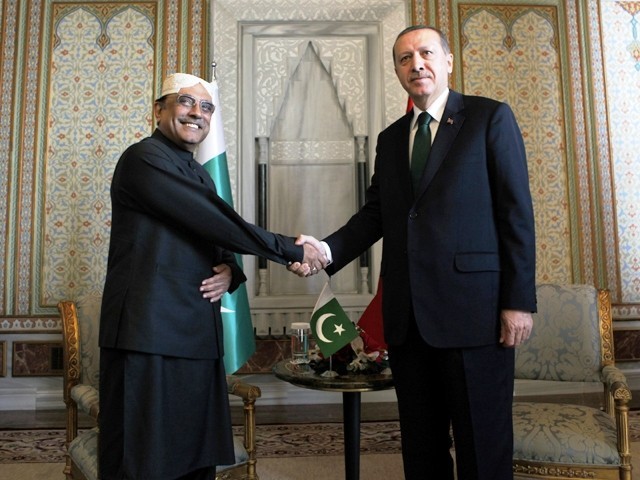
Why Pakistan Loves Turkey: Saim Saeed
Guest post by SAIM SAEED

Everybody loves Turkey. It’s where Pakistani families go for holidays, where students now go for education, where laborers go for work, where clerics go for counsel, and where both civilian and military officials and dignitaries go to find inspiration. Due to Turkey’s momentous economic and political rise, especially in the last decade, it is being held up to the rest of the Muslim world as a country worth emulating, and experts from everywhere have been referring to the “Turkish model” – an Islamic democracy with a robust economy – as the blueprint for a strong and stable (and still Muslim) country. Continue reading Why Pakistan Loves Turkey: Saim Saeed
Kurdistan, a Forgotten Nation of 40 Million People: Kamal Chomani
Guest Post by KAMAL CHOMANI
It has been for about 13 months I am living in Bangalore, India. I am here to study masters. India to me, as it is, is incredible. I feel as if I am at home. People here are friendly. My teachers and colleagues are just great. I have to confess that for a student that is his first time to leave his home for such a long time, certainly, will face many difficulties, but no difficulties have hurt me as much as a question of Indian people ‘where are you from?’
I am from Iraq, but Iraq is not my country. I cannot speak Arabic which is the official language the country. Luckily three more Iraqi people are with me who have helped me to manage my Arabic. My culture is different from Arabs. I don’t want to look like a nationalist, because I am telling the truth. I am a Kurd! My mother tongue is Kurdish. My homeland is Kurdistan.
So, who are the Kurds?

Kurds are the original inhabitants of Middle East. They are the biggest stateless nation around the world that they are still struggling for freedom and independence. They have been forgotten by the world.
Yes, Kurds are a forgotten nation of 40 million populations. In India, few people know who Kurds are. I am really surprised when some Indians ‘love’ Saddam Hussein, the former Iraqi president. Saddam has killed more than 300,000 Kurds. He used poisoned gas against Kurds and killed 5000 Kurds in only one hour in Halabja, which is known as Hiroshima and Nagasaki’s sister! He mass murdered more than 182,000 Kurds in Anfal (Genocide) operations. The Anfal case is going to be an international case. Sweden Parliament has just decided to recognize it as a genocide act against humanity. In UK, Kurdish people have started a huge campaign to make pressures on UK parliament to recognize as Genocide. Continue reading Kurdistan, a Forgotten Nation of 40 Million People: Kamal Chomani
Sex, Lies and God’s Promise: Response to a Diatribe
An article titled “In Defence Of Israel” is being circulated to media-persons in India by the Spokesman of the Embassy Of Israel in Delhi. This article, published in Open magazine, was written by Jonas Moses Lustiger (a student based in Paris, who has earlier lived in India). The article names me specifically, and refers to mine and Aditya Nigam’s posts on Palestine in Kafila, but I was not interested in engaging with Lustiger’s largely ill-informed, propagandist and misrepresenting rant. But now that it appears we are responding directly to the Israeli state, I feel perhaps I should put some things on record.
(Our three posts on Kafila are Nakba and Sumoud, Living the Occupation and Imagining Post-Zionist Futures)
Let me begin by stating my complete agreement with Lustiger on three of his key statements in the Open article.
First:
It is true that Israel’s current government is one of the worst it has known and most of its citizens have lost hope for peace. It is also true that Israeli society is turning more racist, intolerant and ignorant of the suffering and existence of their immediate neighbours—Palestinians. Of course, the Palestinian people have been denied many rights and have been living under precarious conditions since Israel’s 1967 occupation of the West Bank and Gaza. True, they have been repeat victims of unjustifiable violence and a large proportion of Israeli politicians deny their claim to an independent land, even as Israel threatens the viability of a Palestinian state by wielding tools of colonisation.
Pretty much sums up our three posts on Kafila – what’s not to agree?
Second: Continue reading Sex, Lies and God’s Promise: Response to a Diatribe
‘Media ka self-regulation ka drama expose ho jayega’
Madhu Trehan’s fascinating interview of Ravish Kumar:
Reminds me of Trehan’s interview of the more rebellious Punya Prasoon Vajpayee:
विश्वविद्यालय के विचार का अंत : अपूर्वानंद
दिल्ली विश्वविद्यालय प्रशासन और अध्यापक वर्ग के लिए यह समान रूप से चिंता का विषय होना चाहिए कि मानव संसाधन और विकास मंत्री को प्रशासन को यह सलाह देने की ज़रूरत पड़ी कि परिसर में किसी भी प्रकार का अकादमिक परिवर्तन पर्याप्त और वास्तविक विचार-विमर्श और संवाद के जरिए ही लाया जाना चाहिए और यह कि दिल्ली विश्वविद्यालय शिक्षक संघ अध्यापाकों द्वारा चुनी हुई वैधानिक संस्था है . इसका अर्थ यह है कि विश्वविद्यालय परिसर में संवाद टूट गया है. शिक्षक संघ से कई मामलों में जगह असहमत अध्यापकों का भी ऐसा महसूस करना क्या उनकी अतिरंजित प्रतिक्रिया है ?
संवाद की आरंभिक शर्त यह है कि शामिल पक्ष एक-दूसरे के स्वतंत्र मत के अधिकार को स्वीकार करें और उसका सम्मान करें. लेकिन यदि विश्वविद्यालय प्रशासन के किसी प्रस्ताव पर विचार के लिए विभागीय बैठक के पहले अध्यक्ष को यह निर्देश प्राप्त हो कि वह प्रस्ताव के पक्ष , विपक्ष में मत देने वाले अध्यापकों के ही नहीं , उनके नाम भी भेजें जो मत नहीं देना चाहते तो सन्देश स्पष्ट है. प्रशासन के प्रस्ताव से अलग मत रखने वाले संदिग्धों की सूची में डाल दिए जाएंगे. इसका तात्पर्य यही हो सकता है कि विश्वविद्यालय अपने अध्यापक की व्यक्तिमत्ता को स्वीकार करने को तैयार नहीं. लेकिन विश्वविद्यालय की तो खूबी यही है कि वह मुझे अकेले एक व्यक्ति के रूप में खड़े रहने का साहस देता है. इसका अर्थ यह है कि मैं अपनी इस व्यक्तिमत्ता के साहस के साथ अपनी सामूहिकता का चुनाव करने की स्वतन्त्रता अर्जित करता हूँ. इसके साथ यह जोड़ना भी ज़रूरी है कि विश्वविद्यालय एक ऐसा परिसर है जहां ‘अलोकप्रिय’ और ‘अनुपयोगी’ विचारों को पनपने और पल्लवित होने की अनुकूल जलवायु प्राप्त होती है. इसके लिए अनिवार्य हो उठता है प्रभुत्वशाली और स्वीकृत विचारों का विरोध.विरोध या असहमति इस प्रकार विश्वविद्यालय का अस्तित्व-तर्क है. इसीलिए विश्वविद्यालय अनुशासन और दंड के विधान से बंधे नहीं होते.
We are fine in Gaza. How about you?

Palestinians carry the bodies of members of the al-Dalo family during their funeral in Gaza City. Reuters
Listen to the Palestinian singer and writer—Khaled El-Hibr sing these words on Jadaliyya:
We are fine in Gaza
How about you?
We are fine under attack
How about you?
Our martyrs are under the rubbles
Our children now living in the tents
And they ask about you
We are fine in Gaza
How about you?
Gaza Solidarity actions in Delhi and Lucknow

Lucknow Monday, November 19, 2012

Delhi, November 19, 2012

Photographs of Delhi demonstration by Benny Kuruvilla. For more pictures, click here.
Worldwide protests as Israel attacks Gaza
List of world-wide protests from Bethlehem to Quebec, November 14-17, 2012

Child wounded in Israeli air strike on November 14th
[From The Electronic Intifada]
Yesterday Israel ended an effective truce with armed groups in Gaza, and carried out the extrajudicial execution of Ahmed al-Jabari, the commander of the military wing of Hamas.
Israeli attacks today killed at least seven people including two young girls in Gaza.
Aside from the fact that it almost always violates truces and ceasefires, seeking escalation where instead there could be calm, what motives might Israel have?
Israel’s “Minister of Home Front Defense” [Avi Dichter] says Gaza must be “reformatted” as if it were a computer hard drive, just like Israel did in the West Bank in 2002 during a series of massacres it called “Operation Defensive Shield.”
Israel’s Ynet reported in Hebrew that Dichter
said in a closed meeting, in the course of his visit in the south under the escalation, that “there is no other choice, Israel must carry out a formatting action in Gaza, actually format the system and clean it out, the way we did in Judea & Samaria during Operation Defensive Shield.”
Protest in London over Israeli airstrikes in Gaza in 2009

Imagining Post-Zionist Futures – Israeli Apartheid and Palestinian Resistance III
This post is the third of a series based on a visit by Nivedita Menon and myself to Palestine in mid-September 2012. The first two are Nakba and Sumoud and Waiting for the Third Intifada.
It was the 18th of September, our third evening in Ramallah. We were at the Ramallah Cultural Palace to listen to Palestinian youth bands perform. The place was teeming with people, mostly young, in their twenties and thirties. The hall was packed, the atmosphere so electric that even if Magid had not been there to explain, there was no way we could have missed the excitement and the anger that the songs evoked in the audience. Interestingly, not all the songs were about Zionist oppression and the travails of everyday life in occupied Palestine. When a song critical of the PA (Palestinian Authority) began, the hall went up in spontaneous applause, endorsing the sarcastic lyrics directed at PA that has lately been involved in carrying out repression on its own population.

The complexity of the current phase of the movement arises from the fact that now, the new forces of Palestinian liberation are arrayed, not merely against Israeli occupation but also against this entity called PA and the Oslo Accords that put in place the political arrangements that mark the division of territories today. An arrangement that was supposed to be merely an interim one lasting but a few years, until the question of Palestinian statehood could be settled, has become a quasi-permanent one that is seen to threaten the longer-term goal itself.
Continue reading Imagining Post-Zionist Futures – Israeli Apartheid and Palestinian Resistance III
भदरसा के जलने में प्रशासन की अहम भूमिका: रिहाई मंच
This release in Hindi about recent communal violence in the Bhadarsa area of Faizabad district of Uttar Pradesh comes to us from the RIHAI MANCH. Please help us translate this into English by translating just one paragraph in the comments

- Jannatunisa
फैजाबाद, 9 नवम्बर 2012। रिहाई मंच के जांचदल ने दशहरा के दौरान हुयी साम्प्रदायिक हिंसा से प्रभावित भदरसा गांव का दौरा किया। जांच दल ने पाया कि भदरसा में हुयी हिंसा पूरी तरह सुनियोजित थी जिसे साम्प्रदायिक तत्वों और प्रशासन की मिलीभगत से अंजाम दिया गया जिसमें मीडिया की भूमिका भी संदिग्ध थी। जांच दल ने यह भी पाया कि प्रशासन की तरफ से आगजनी से पीडित परिवारों से घटना के साक्ष्य जबरन मिटवाए जा रहे हैं जबकि पीडि़तों को न तो उचित मुआवजा मिला है और ना ही एफआईआर दर्ज किये गये हैं। जांच दल ने प्रेस काउंसिल द्वारा गठित शीतला सिंह जांच आयोग से भी भदरसा जाने की मांग की है। Continue reading भदरसा के जलने में प्रशासन की अहम भूमिका: रिहाई मंच
“We may weep but we will stay”: Women resist evictions in Palestine: Kalyani Menon Sen
Guest post by KALYANI MENON SEN

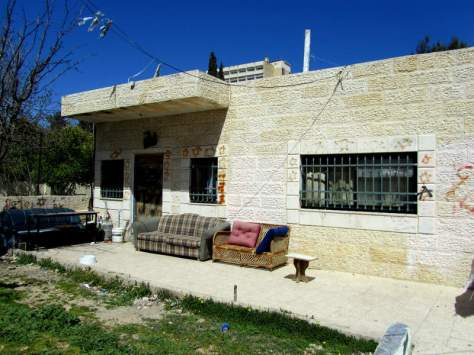
- Umm Nabil’s settler-occupied house is painted with Israeli symbols. (Photo: Aruna Rao)
Umm Nabil al Kurd is 82 years old. She is tiny and frail – her hands tremble as she takes the mike. But her voice is steady as she describes how she lost her home.
“We came to Jerusalem from Haifa as refugees in 1948” she says. “The Jordanians allotted us our house. We have lived there for 60 years – my children were born there. It was small and broken when we moved in – we extended it and improved it as our family grew. We planted a garden. When my son got married and the grandchildren came, we built a separate unit for him at the back of the main house. We built with our own money, with our own hands. Then, two years ago, the Israelis came with the police and told us to leave. They said the house was theirs. They pushed me to the ground, called me filthy names, turned their dogs on me. They threw out our furniture and moved into the house. We went to court but the judge said we were occupying the house illegally – he told us to pay 100,000 shekels as rent for the years that we had lived in the house. We had to pay – my husband would have been imprisoned if we did not. We are still fighting the case – the next hearing is in July but I don’t know if we will ever get the house back.” Continue reading “We may weep but we will stay”: Women resist evictions in Palestine: Kalyani Menon Sen
Israeli Apartheid and Palestinian Resistance II – Living the Occupation
Planning to visit Palestine? Good news, Indian citizens don’t need a visa to enter Palestine. One small thing though. Palestine is occupied, and you cannot enter Palestine except through Israeli border control. The occupied Palestinian territories (OPT) have no control over their external borders.

Entry to Ayda refugee camp in the West Bank, established in 1950. The key is the symbol of the Right of Return of Palestinians. (Photo AN/NM)
Whether you fly in through Ben Gurion airport in Tel Aviv, or enter by road from Jordan or Egypt – it’s an Israeli visa that is required – there is no such thing as a visa to Palestine. Indeed, from the point of view of the occupying state, there is no Palestine, only Palestinian Territories – that is, West Bank and Gaza, the two green bits in the fourth map reproduced in the previous post. (There are also no Palestinians, according to Israeli state classifications – there are Israelis and there are bureaucratically differentiated Arabs, as we’ll see below). Continue reading Israeli Apartheid and Palestinian Resistance II – Living the Occupation
Friends of Palestine Respond to InCACBI Call to Boycott the Cameri in Delhi
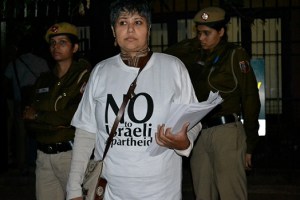
On Sunday evening, November 4th, about 60 friends of Palestine — theatre persons, writers, artists, film makers, academics, students and activists — gathered outside Delhi’s Siri Fort auditorium, the venue for the Israeli state-sponsored performance by The Cameri Theatre. Their form of protest was an unusual one. All of them wore T shirts which said, in bold black letters on white, No to Israeli Apartheid. There were no slogans or placards. Instead, they stood around the entrance, distributing leaflets and talking to theatre goers about the boycott. A few theatre goers actually responded and did not go in. A couple even joined the protest. One woman, who took a T shirt to wear inside, found a different form of discrimination being practiced in the auditorium; the Israeli theatre goers were let in, but the Indians had to wait. She read the leaflet in her hand, came out to join the protestors. Read more
लोकतंत्र के ईश से दूर होते नीतीश : मनीष शांडिल्य
नीतीश कुमार और मीडिया दोनों एक-दूसरे को बहुत प्रिय हैं. (यहां मीडिया से तात्पर्य मुख्यतः बिहार के मुख्यधारा के बड़े अखबारों से है.) नीतीश कुमार बतौर मुख्यमंत्री मुख्यधारा की मडिया पर बिहार का खजाना लुटाते हैं और बदले में मीडिया अपना युगधर्म भूलकर उनकी झूठी-सच्ची तारीफ में लगा रहता है, उनके पक्ष में तर्क-कुतर्क गढ़ता है, अखबार संदर्भ-बेसंदर्भ उनकी बड़ी-बड़ी तसवीरें छापते हैं. वैसे नीतीश कुमार और मीडिया के बीच के मधुर रिश्ते की और भी दूसरी बड़ी वजहें भी हैं, लेकिन उनकी चर्चा फिर कभी. फिलहाल इस रिश्ते का जिक्र इस कारण क्योंकि पिछले दिनों नीतीश अखबारों के पहले पन्नों पर दिखाई तो दे रहे थे, मगर कुछ दूसरे अंदाज में उनकी तस्वीरें छप रही थीं.
मामला कुछ यूं था. बिहार को विशेष राज्य दिलवाने की मांग (या कहें जिद) के लिए जन-समर्थन जुटाने जब इस बार नीतीश कुमार बिहार भर की ’अधिकार-यात्रा’ पर निकले तो जनता-जर्नादन को अपने अधिकारों की भी याद आ गई. (लिखत-पढ़त में यह उनकी सरकारी यात्रा नहीं थी!) मिथिलांचल इलाके से इस यात्रा के दौरान आम लोगों, खासकर नियोजित शिक्षकों ने अपने मांगों के समर्थन में नीतीश कुमार का ध्यान खींचना शुरू किया. गौरतलब है कि इस मंहगाई में नौकरी करते हुए भी मात्र छह-सात हजार मासिक पाने वाले ‘सरकारी’ शिक्षकांे को बिहार में कई महीनों से वेतन तक नहीं मिल रहा था. अब जनता का तो अपना तरीका होता है (कहीं-कहीं बहकावे में भी आ जाती है, कहीं-कहीं जनता की भीड़ में शरारती तत्व भी घुस जाते हैं), वह कहीं काला झंडा लहराने लगी तो कहीं मंच की ओर चप्पल दिखाने-उछालने लगी. उपेक्षा और परेशानियों से उपजे लोगों के आक्रोश ने खगड़िया जिले में रौद्र रूप धारण कर लिया. और खगड़िया के बाद ही नीतीश कुमार अखबारों में उस अंदाज में दिखाई देने लगे, जिस बदले रूप का ऊपर जिक्र है.
Continue reading लोकतंत्र के ईश से दूर होते नीतीश : मनीष शांडिल्य
Israeli Apartheid and Palestinian Resistance I – Nakba and Sumoud
[In September 2012, Aditya Nigam and I had the incredible good fortune to visit Palestine. This post is the first of a series in which we reflect on our experience and what we learnt there. We stayed in Ramallah, visited and interacted with colleagues at Birzeit University and spoke at a conference organized by Muwatin, a research institute based in Ramallah. We met a large number of inspiring people who pushed the frontiers of our minds, and we came away humbled and moved by the dignity of a people living through the brutal occupation of their lands by the Zionist state of Israel, with limitless courage and sense of humour intact.
Deepest gratitude to Rema Hammami of Birzeit who drove us around Jerusalem, and whose inimitable commentary gave us a live historical sense of her country.
Words are inadequate to thank our friends Magid Shihade and Sunaina Maira, whose passionate love of Palestine and determination to help us make the most of our brief stay there, expanded our horizons continually.]
On the 15th of May 1948, the state of Israel was born, dispossessing Palestinians who had lived on that land for centuries. Fleeing terror and genocide in Europe, and anti-semitism globally, Jews from all over the world poured into Palestine.
Why Palestine? Why was Palestine given to the Jews as their home? And whose property was Palestine, that it could be given away? Why were people who had never done any harm to the Jewish people made to pay the price for European anti-semitism? It was Germany and Italy and Poland that had in fact, run concentration camps; it was any number of other countries of Europe that could boast of centuries-old histories of violent anti-semitism. Why were not parts of these countries carved out to make a country for the people they had wronged?

Maps showing the gradual obliteration of Palestine by Israel
Continue reading Israeli Apartheid and Palestinian Resistance I – Nakba and Sumoud
Boycott Zionazi Apartheid at Delhi International Arts Festival!
[Posted below is a statement by artistes, writers and the Indian Campaign for the Academic and Cultural Boycott of Israel. The statement is self-explanatory. However, as we shall be explaining in a series of posts on Kafila soon, Zionism in Israel has perfected the most hated techniques of their own twentieth century tormentors, the Nazis, against the people of Palestine. Worse still, it has given these techniques a veneer of ‘normalcy’ – and every ‘cultural exchange’ with Israel only helps further normalize this most despicable form of colonial occupation. ‘Settlements’, in this game of occupation, become the mode of annexing more and more of the Palestinian territory through settling of civilian Jewish populations in what still remains of Palestinian areas. – AN]
Call to boycott The Cameri Theatre at the Delhi International Arts Festival 2012
The organizers of the Delhi International Arts Festival (DIAF) — the Prasiddha Foundation, the Hindustan Times and the Indian Council of Cultural Relations (ICCR) — have invited The Cameri Theatre from Israel to perform at Siri Fort on November 4th as part of the Festival’s celebration of “the spirit of Delhi”.
The Cameri Theatre serves as an official propaganda tool for the State of Israel — a state that occupies Palestinian lands and practises apartheid policies on the Palestinian people. The Cameri theatre is complicit in the Israeli Occupation of Palestine because it chooses to perform in the illegal settlement of Ariel. Ariel is one of the largest settlements in the occupied West Bank, located on expropriated agricultural Palestinian land. The construction of Israeli settlements on occupied Palestinian land violates international law, and amounts to a war crime.

Illegal Ariel contaminates Palestinian water and agricultural lands. Illegal Ariel is surrounded by walls and fences, and closely guarded by soldiers and armed security personnel. A theatrical performance in this illegal settlement is, by definition, a performance to an exclusively Israeli audience. Palestinians living even in the nearest village are physically excluded from attending. By performing in such circumstances, the Cameri profits from and legitimizes Israel’s illegal colonization policies, and becomes an accomplice to these crimes.
Continue reading Boycott Zionazi Apartheid at Delhi International Arts Festival!