Category Archives: Politics

Shahbagh: The Forest of Symbols: Naeem Mohaiemen

This is a guest post by NAEEM MOHAIEMEN

Shahbagh_SyedLatifHossain
© Syed Latif Hossain

There is a particular way of lensing mass movements, when we are observing from within immediate tactics. In a fast moving situation, with opponents and allies squared off, the first thing to shrink is the space for internal critique. Professor Azfar Hussain uses the term “critical solidarity” for his approach to Shahbagh. A critique that seeks to help the movement, but also a critique some are not ready to hear yet.

For the last sixteen days, Bangladesh has been in an intense new political phase. The ground has shifted and been recast by the scale of the Shahbagh movement. The flash point was the sentencing of the “Butcher of Mirpur” (a war criminal who collaborated with the Pakistan army in 1971). But, by now, the demands have expanded to a call for a ban on the main Islamist party Jamaat-e-Islami, or even Islamist politics altogether. Older leftist thinkers like Badruddin Umar are daring to ask questions of the hallowed place of “state religion” in the constitution. Younger bloggers are urging all to make it clear that the movement is about war criminals, not religion. But of course, with war criminals conflated with the Jamaat-e-Islami, and that party eager to present themselves as standing for “Islam,” category errors will happen. Continue reading Shahbagh: The Forest of Symbols: Naeem Mohaiemen

Dalit and Adivasi Women Warriors Question Caste and Gender Oppression: Sujatha Surepally

Posted at Round Table India

SUJATA SUREPALLY shares her impressions from the first National Dalit and Adivasi Women’s Congress held on February 15-16, 2013, at Tata Institute of Social Sciences, Mumbai.

We live in nature! We die in Nature! It’s our life, if you occupy our land where should we go and how do we live? Whose land is this?

dayamani

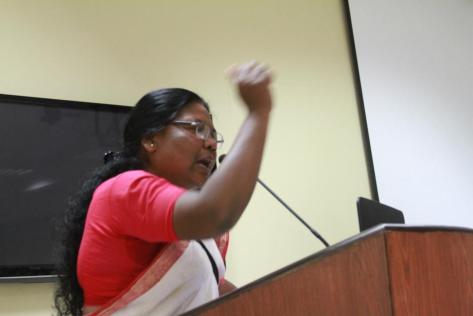
The hall is echoing with the furious voice of Dayamani Barla, veteran Adivasi activist from Jharkhand. She is trying to unite people against mining in Jharkhand, around 108 mining companies are waiting to destroy Adivasi life in the name of mining, first they come for coal, next they say power houses, it continues, we are pushed out and out further. How do we live without our land? Spectacular speech for an hour, pin drop silence all around, everyone is identifying with her pain and agony. At the end of it, what is she is trying to convey?

Humko Jeene Do! Let us live our own life! If this is called development, we care a damn about it!  Blanket statement. [Continue reading]

Talk Hindutva, Sell Narcotics?

Curbing Freedom of Press: The Karnataka Way

ImageA 10-member group allegedly assaulted a staff member of Kannada daily Karavali Ale at Kulai here on Wednesday night.According to B.V. Seetaram, director and chairman of Chitra Publications, which publishes the paper, Harish Putran (36), office assistant, was attacked when he was waiting near Vishnumurthy temple to catch a bus back home.He was hit with iron rods and wickets and chased by the attackers, Mr. Seetaram said. Mr. Putran managed to save himself by hiding behind a shop.

Mr. Seetaram suspected the involvement of a rightwing group in the attack. He said Karavali Ale published a report on Wednesday alleging the rightwing group’s involvement in the sale of narcotics in the city. Copies of the newspaper were burnt and some vendors were threatened against selling the Wednesday’s edition, he said.Mr. Putran has been admitted to a private hospital. A complaint has been filed with the Surathkal police.

(Karavali Ale employee attacked : Staff Correspondent, The Hindu – Mangalore, February 7, 2013)

It has been a ‘happening’ week. Celebrations around one billion rising held in different parts of the world.Soni Sori acquitted in four cases. Dr Sunilam and two of his associates getting bail from Jabalpur high court after spending three months in Bhopal jail. More than two hundred intellectuals, activists writing to President of India about the manner in which Afzal Guru was hanged.  Interestingly in the melee of news certain troubling developments in south of Vindhyas have not got enough attention they deserve. And they concern the curbing of media by majoritarian elements with due connivance of the people in power. Continue reading Talk Hindutva, Sell Narcotics?

Who’s afraid of the Karachi Literature Festival?: Ayesha Siddiqa

Guest post by AYESHA SIDDIQA

Photo via Dawn.com

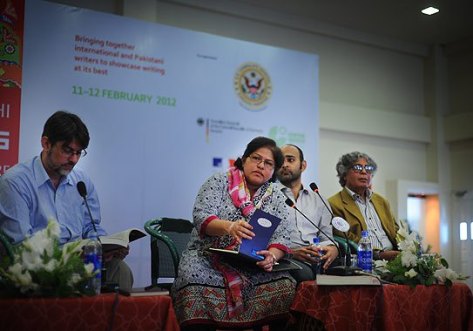
Here we are seemingly in an age of intellectual freedom, burgeoning media industry and literature festivals. There are numerous festivals held all over South Asia celebrating books new and old, bringing people together for exchange of ideas. But these festivals seem to be wrapped in their own politics. In some cases, certain cliques that want to encourage a peculiar perspective dominate the show. I understood this through my interaction with the Karachi Literature Festival. Continue reading Who’s afraid of the Karachi Literature Festival?: Ayesha Siddiqa

Secret hanging a major setback: Human Rights Watch on the execution of Afzal Guru

Statement put out on February 9 by HUMAN RIGHTS WATCH

(New York) –The hanging in New Delhi of Mohammad Afzal Guru makes it more urgent for India to reinstate its previous informal moratorium on executions as a step towards abolishing the death penalty, Human Rights Watch said today. Azfal Guru, executed on February 9, 2013, was convicted for his role in the attack on the Indian parliament in 2001.

In November 2012, India ended its eight-year unofficial moratorium on executions when it hanged Ajmal Kasab, convicted for his role in the 2008 Mumbai attacks. Continue reading Secret hanging a major setback: Human Rights Watch on the execution of Afzal Guru

We remember Gujarat 2002. And we know you’re lying about development.

Gujarat Riots-Sanjiv Bhatt Arrest-Tehelka

Don’t tell us stories about development, Narendra Modi. Your Vibrant Gujarat and claims of development are shameless hollow lies, and even if they were true, it would still be an unethical and blood-stained development.

But they are lies, Modi, lies.

Here’s a report by Pranjal Sharma in Business World that sees through the working of your  aggressive PR machinery:

The Centre for Monitoring Indian Economy (CMIE) recently examined the investment statistics flaunted by the Gujarat.  The Vibrant Gujarat investment summit held by the chief minister has been projected to have earned billions of dollars of fresh investment into India. But a closer look at the figures reveals a different story. Only a small percentage of projects announced in Vibrant  Gujarat (VG) summits in 2009 and 2011 have actually moved on the ground. The details of many grand projects are missing… Continue reading We remember Gujarat 2002. And we know you’re lying about development.

Theories of Oppression and another Dialogue of Cultures: Ashis Nandy

This is the text of the Ambedkar Memorial lecture delivered by ASHIS NANDY at the India International Centre on 14 April 2012, under the auspices of Ambedkar University, Delhi.

It was published in Economic and Political Weekly, July 28, 2010

Every generation likes to believe that it is living in momentous times, witnessing the death of one world and the birth of another, negotiating what pre-war Bengali writers used to grandly call yugasandhikshana, the moment when two epochs meet. This generation of Indians too believes that it is seeing such changes and even participating in them. Perhaps they are. However, I shall argue here that, along with transitions in society and politics to which they like to stand witness, there are transitions in cultures of knowledge and states of awareness of which they may be gloriously innocent. And they perhaps try to protect that innocence. The categories we deploy to construe our world images are parts of our innermost self and to disown them is to disown parts of ourselves and jeopardise our self-esteem. Even when we struggle to shed these categories, they survive like phantom limbs do in some amputees. Or perhaps they survive the way one of Freud’s three universal fantasies, the one about immortality, does. When you imagine yourself dead, you are still there, fully alive, looking at yourself as dead. Continue reading Theories of Oppression and another Dialogue of Cultures: Ashis Nandy

Why the Govt’s Ordnance is Fraud & Mockery of the Justice Verma Committe Recommendations: Bekhauf Azaadi Campaign

Guest post by BEKHAUF AZAADI CAMPAIGN

The UPA Govt, in a Cabinet meeting held on 1 February, has introduced an ordinance that it claims will address the most urgent concerns on sexual violence. In fact, the Government has been completely reluctant to acknowledge and implement the Justice Verma Committee recommendations: the PM refused to accept it from Justuce Verma, the Ministry of Home Affairs removed it from their website, the Govt never adopted any transparent process of discussion to decide the way forward on implementing the recommendations, rather they said Justice Verma ‘exceeded his brief’. Now, they claim that their ordinance has ‘implemented’ the Justice Verma recommendations. Is this true?

The fact is that the Government’s ordinance is a mockery of the letter and spirit of the Justice Verma recommendations. Why? Let us take a closer look.

Continue reading Why the Govt’s Ordnance is Fraud & Mockery of the Justice Verma Committe Recommendations: Bekhauf Azaadi Campaign

Is Prof Nandy a Holy Cow?: K Satyanarayana

We are posting below an interview of Dr K SATYANARAYANA on the issues arising out of the ‘Ashis Nandy case’. The interview was conducted by DALIT CAMERA and sent to us by RAVICHANDRAN

The interview raises some important issues that call for a reasoned public debate and we welcome this opportunity provided by this interview.

Ashis Nandy, Media and the Work of Acceleration: Anirban Gupta Nigam

Guest post by ANIRBAN GUPTA NIGAM

The hornet’s nest stirred by Ashis Nandy’s comments at the Jaipur Literature Festival might – hopefully – be dying down, but certain questions raised by the occurrences on the 26th probably require a little reflection on everyone’s part.

In the corporate and social media blitz, a lot of the details have been forgotten, excised and overlooked. Till yesterday it was not clear what his entire speech consisted of. The most quoted line from his talk at the festival is: “it is a fact that most of the corrupt come from the OBC, the Scheduled Castes and now increasingly the STs and as long as it is the case, the Indian republic will survive.” None of those attacking Nandy for being casteist or spewing hate-speech have in fact even attempted to explain the latter part of the quote: “as long as it is the case, the Indian republic will survive.” How is that a casteist statement? More importantly, media reproductions of his statement have excised a crucial disclaimer he himself gives at the beginning: “It will be an undignified, even vulgar statement, but it is a fact that most of the corrupt come from the OBC, the Scheduled Castes and now increasingly the STs and as long as it is the case, the Indian republic will survive.” Continue reading Ashis Nandy, Media and the Work of Acceleration: Anirban Gupta Nigam

Of Complicity and Contamination in the Neoliberal Academy: Oishik Sircar

Guest post by OISHIK SIRCAR

Many years back as a naïve leftist graduate student in Toronto I discovered the meanings of complicity and contamination through a most ordinary event. As someone who believed that no artistic work should ever have restricted access because of copyright, I bought an online software programme that could break copy protected DVDs. I would get film DVDs from the university library and use the software to copy them onto my hard drive. In the one year that I spent there, I copied over 1000 films. Over the years I have distributed many of these films to my students and friends, and have made extensive use of them in my teaching and workshops.

By the time I was nearing the end of my stay in Toronto, I wanted to figure out whether the software would work in India – so that I can continue my copyright breaking enterprise. I was delighted to find out that it would, as long as I paid to extend the software’s use for another year. And at the time of making this payment, to my utter surprise, I saw that this software was copyrighted. The fact that a copyright breaking software could itself have a copyright was bizarrely enlightening. The software was a tool to rip through the oppressive regimes of copyright, and in doing so it also sought recognition from that very language of privatizing innovation. It got me thinking whether we could ever espouse and practice a politics that is not a constant negotiation between complicity and contamination. Whether a search for a politics of purity is both foolish and counterproductive? My naïveté has been gradually undone through events that I have observed and experienced since then. While I can treat this as a process of acquiring wisdom, it is nevertheless a disturbing wisdom to possess. It has also left a feeling of yearning for utopia in this world of cruel contradictions.

After returning from Toronto, I shook off my naïveté with such force that I ended up with a job at a university funded by one of India’s largest steel companies whose operations have wreaked havoc in the lives of adivasi populations in several parts of India. Continue reading Of Complicity and Contamination in the Neoliberal Academy: Oishik Sircar

Free Naveen Soorinje

This is a public statement; names of signatories given at the end.

As editors and senior journalists representing a cross-section of the print, television and online media, we wish to bring to your notice a matter of serious professional concern for the journalist fraternity.

Naveen Soorinje, a district reporter with the Kannada channel Kasturi Newz 24, was arrested by the Karnataka police on 7 November 2012 for the role he played in covering the 28 July 2012 attack by Hindutva vigilantes on innocent boys and girls who were celebrating a birthday at a homestay in Mangalore. In the two months that Naveen Soorinje has been in judicial custody in Mangalore, his mental and physical health has deteriorated drastically. He was recently discharged from the jail ward of the district hospital after suffering a bout of chickenpox. Continue reading Free Naveen Soorinje

PUCL Rajasthan condemns FIR against Ashis Nandy

This release was put out by the Rajasthan unit of the PEOPLE’S UNION FOR CIVIL LIBERTIES on 26 January

PUCL condemns the FIR lodged under sec. 506 IPC, criminal intimidation and 3-1(10) of prevention of atrocities against SC,ST 1989 against Prof. Ashis Nandy for his statements in a discussion at the Jaipur Literature Festival 2013 and the protest demanding his arrest.

From the reports we have received, he was not exhorting hate and not being casteist and was only making an academic point which means that nobody is free from corruption.

Proceeding criminally against him and arresting him is restricting academic freedom and academic debate. Now that he has apologised and regretted  what he has said the matter should be closed.

Prem Krishan Sharma, President
Kavita Srivastav, General Secretary

See also: Most of the corrupt come from SC/ST, OBCs: Ashis Nandy
Below: Video report from CNN-IBN and ABP TV video of Nandy’s press conference Continue reading PUCL Rajasthan condemns FIR against Ashis Nandy

Who is afraid of Tipu Sultan?

Ravi said the state government is not ready to name the university after Tipu Sultan. If they are going to set up a non-religious university then the name should be non-controversial…. Like British, Tipu is also a foreigner for us and we will not accept his name.

CT Ravi, higher education minister, Karnataka, Jan 25, 2013, 16:38 IST , DNA)

The fast changing political developments in Karnataka has rather overshadowed the manner in which Tipu Sultan- who died fighting the Britishers at Srirangapatna (4 th May 1799) – is being denigrated by people owing allegiance to Sangh Parivar. The latest in series happens to be the higher education minister of Karnataka Mr C T Ravi, who claimed that for them ‘Tipu is also a foreigner’ like the British.

The immediate context of this Tipu bashing is the decision by the central ministry of minority affairs to set up ‘Tipu Sultan University’ at Srirangapatna. Continue reading Who is afraid of Tipu Sultan?

‘भारतीय विचारधारा’: मिथक से यथार्थ की ओर

[An edited version of this review of Perry Anderson’s ‘Indian Ideology‘ (Three Essays Collective, October 2012) appeared in January edition of Samayantar]

the-indian-ideologyअपनी किताब‘ द जर्मन आइडिओलोजी’ (रचनाकाल 1845-46) मार्क्स एवं एंगेल्स इतिहास की अपने भौतिकवादी व्याख्या का निरूपण करते है। किताब की शुरूआत 19 वीं सदी के शुरूआत में जर्मनी के दार्शनिक जगत पर हावी हेगेल की आदर्शवादी परम्परा एवं उसके प्रस्तोताओं की तीखी आलोचना से होती है जिसमें यह दोनों युवा इन्कलाबी चेतना एवं अमूर्त विचारों पर फोकस करनेवाले और सामाजिक यथार्थ के उससे निःसृत होने की उनकी समझदारी पर जोरदार हमला बोलते हैं। इस ऐतिहासिक रचना से नामसादृश्य रखनेवाली पेरी एण्डरसन (थ्री एसेज़, 2012) की किताब ‘द इण्डियन आइडिओलोजी’ का फ़लक भले ही दर्शन नहीं है, मगर अपने वक्त़ के अग्रणी विचारकों द्वारा भारतीय राज्य एवं समाज की विवेचना की आलोचना के मामले में वह उतनी ही निर्मम दिखती है।

आज की तारीख में भारतीय राज्य एक स्थिर राजनीतिक जनतंत्र, एक सद्भावपूर्ण क्षेत्रीय एकता और एक सुसंगत धार्मिक पक्षपातविहीनता के मूल्यों को स्थापित करने का दावा करता है। उपनिवेशवादी गुलामी से लगभग एक ही समय मुक्त तीसरी दुनिया के तमाम अन्य मुल्कों की तुलना में – जहाँ अधिनायकवादी ताकतों ने लोकतांत्रिक प्रक्रियाओं एवं संस्थाओं को मज़बूत नहीं होने नहीं दिया है – विगत साठ साल से अधिक समय से यहां जारी संसदीय जनतंत्र के प्रयोग को लेकर वह आत्ममुग्ध भी दिखता है। इतना ही नहीं अक्सर यह भी देखने में आता है कि भारतीय समाज की विभिन्न गैरबराबरियों, जाति-जेण्डर-नस्ल आदि पर आधारित तमाम सोपानक्रमों के विभिन्न आलोचक भी भारतीय राज्य की  इस आत्मप्रस्तुति/आत्मप्रशंसा से सहमत हुए दिखते हैं। मगर यह बेचैन करने वाला सवाल नहीं पूछा जाता कि भारतीय राज्य के तमाम दावों एवं वास्तविक हकीकत के बीच कितना तारतम्य है ? अगर दावों एवं हकीकत के बीच अन्तराल दिखता है तो उसे हम परिस्थिति की नियति कह सकते हैं या उसकी जड़ें शासकों के आचरण में ढूंढ सकते हैं। Continue reading ‘भारतीय विचारधारा’: मिथक से यथार्थ की ओर

Learning gender, learning caste: two reflections

We received two brief submissions separately sent by two women, reflecting on incidents in their childhood or youth that returned to haunt them more recently. Rethinking, reworking their own sense of self, they present before us questions both timely and urgent.

AYSHWARIA SEKHER looks back on her ignorance of caste, PRANETA JHA revisits a childhood game that taught her about sexual violence.

AYSHWARIA SEKHER

I was seventeen, and an undergraduate when I met this friend at hostel.  She was from a southern district of Tamilnadu almost near Kanyakumari. I was always amused by her southern dialect and teased her immensely, for it was very different from what I was used to speaking, being a northerner. She lived next door at hostel, so we got into conversations every time we bumped into each other. One evening she was sweeping her room and cleaning it.  I stopped by to see the way she swept so I could bully her.  As I observed I did realise that she was so much better than me at it and did it with ease. As we got talking, she revealed that she always did it at her home, and it was not a task for her.

Ignorantly I enquired why they did not have a help at home, which according to me was something that every household possessed. She looked at me, and brushed aside the question plainly, saying simply that they just didn’t have any help. I pestered with the question giving her no space. She stopped sweeping and rested her hand against the wall and said that people would not come to her house to work. I was amazed at why people would not go to a home for work.  So my cross questions persisted and she had no choice but to answer.

Continue reading Learning gender, learning caste: two reflections

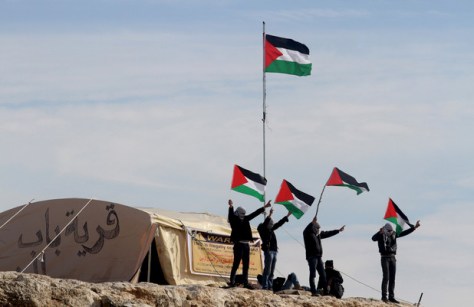
Israeli repression at The Gate of the Sun

Bab-AlShams

On January 11, 2013, 250 men and women from across Palestine established a new Palestinian village named “Bab Al shams” (Gate of the Sun).

They declared:

We, the sons and daughters of Palestine from all throughout the land, announce the establishment of Bab Alshams Village (Gate of the Sun). We the people, without permits from the occupation, without permission from anyone, sit here today because this is our land and it is our right to inhabit it.

A few months ago the Israeli government announced its intention to build about 4000 settlement housing units in the area Israel refers to as E1. E1 block is an area of about 13 square km that falls on confiscated Palestinian land East of Jerusalem between Ma’ale Adumim settlement, which lies on occupied West Bank Palestinian land, and Jerusalem. We will not remain silent as settlement expansion and confiscation of our land continues. Therefore we hereby establish the village of Bab Alshams to proclaim our faith in direct action and popular resistance. We declare that the village will stand steadfast until the owners of this land will get their right to build on their land.

Continue reading Israeli repression at The Gate of the Sun

Harassment by Times Now: Statement by Shabnam Hashmi

[The following is a public statement issued by Shabnam Hashmi regarding her harassment by Times Now. The report is truly alarming and shows the extent to which this form of ‘media vigilantism’ – Arnab Goswami/ Times Now style can go. It is of course, another matter that when confronted by a Raj Thakre, the same macho anchor can turn into a small and helpless mouse. We are reproducing this statement in public interest.] 

I was in Gujarat for over six months and returned to Delhi two weeks ago. While in Gujarat I was asked to appear on different television channels constantly. On one such talk show on Times Now I felt that I was especially being pushed into a corner and it was an absolutely unbalanced panel, I told the Times Now guest coordinator that I will not come on the channel any longer. It continued for about a week or so. Then a representative came from Mumbai and met me in Gujarat office and ensured that it will not happen in future and requested me to come for the Talk Shows.

I agreed and went again whenever I was called.

On December 28, 2012 I released a public statement in Delhi regarding the Gujarat Verdict 2012 and resigned from various UPA committees that I was part of. On the same day I was invited to Times Now and I found the same attitude of being highly aggressive towards me.

January 2, 2013, I filed a police complaint against Mr Akbaruddin Owaisi in Parliament Street Police Station against the hate speech which he made in Andhra Pradesh. I was called on Times Now and met the same uncivilized and aggressive behavior.
Continue reading Harassment by Times Now: Statement by Shabnam Hashmi

Some thoughts on rape, sexual violence and protest – responding to responses: Devika Narayan

Guest Post by Devika Narayan

Rarely does a city experience the sort of upheaval that Delhi is witnessing.  Everyone is talking about it. Everyone has an opinion. It is impossible to walk down the street without overhearing snatches of conversation. Issues that usually find brief mention in some obscure corner of the newspaper are now being subject to analysis by every passer-by. A rickshaw driver refuses to take any money when he realises I am on my way to a protest. I remember the old man at a photocopy shop who had looked up and asked no one in particular: do you think she will die? The receptionist at the doctor’s clinic is distraught, providing waiting patients her explanation for the recent events. Men huddled around tiny fires littered across the foggy city carp on about the state of politics, the police and the government. Everyone is invested in this moment of reckoning.

An opportunity, in the most brutal manner, has been thrust upon us to challenge, critique and reconstruct unjust social relations. This is an opportunity to pledge our commitment to a vision of a gender just society. Unless we assert in powerful ways that women are autonomous beings and equal citizens it will not end. Continue reading Some thoughts on rape, sexual violence and protest – responding to responses: Devika Narayan

Now that Owaisi is in jail, how about Praveen Togadia?: Mahtab Alam

Guest post by MAHTAB ALAM

Akbaruddin Owaisi, an MLA of Andhra Pradesh Legislative Assembly, who belongs to a Hyderabad-based political party All India Majlis-e-Ittihad al-Muslimin, better known as MIM, and its floor leader in the Assembly made an inflammatory speech against Hindus on 24 December 2012 at a public meeting in Adilabad District. The speech attracted widespread condemnation by Muslim activists, rightly so, apart from left, liberal individuals and organizations. Dr. Zafarul Islam Khan, President, All India Muslim Majlis e Mushawarat (AIMMM), an umbrella body of prominent Indian Muslim organizations termed it ‘a hate and rash speech’ arguing, ‘words that should never have been uttered by a responsible person, let alone a political leader, were used’.

Shabnam Hashmi, a prominent social activist and who has been relentlessly working on the issue of minority rights registered an FIR in Delhi against Owaisi stating, ‘the whole speech is highly objectionable, inflammatory and against the values of our constitution, democracy and secular values’. Similarly, FIRs were also registered in the State invoking section 295 A (for deliberate and malicious acts intended to outrage religious feelings) and 153 A (promoting enmity between different groups) of Indian Penal Code (IPC). Owaisi was arrested finally arrested on Tuesday (8th January) and sent to 14-day judicial custody. Continue reading Now that Owaisi is in jail, how about Praveen Togadia?: Mahtab Alam

The muezzin’s last call at Babri Masjid: Krishna Jha and Dhirendra K Jha

This guest post by KRISHNA JHA and DHIRENDRA K JHA is an excerpt from their book, Ayodhya: The Dark Night, about the original Ayodhya conspiracy of 22 December 1949

Published December 2011 by HarperCollins India;Rs 499; Pages 232
Published December 2011 by HarperCollins India; Rs 499; Pages 232

The sound of a thud reverberated through the medieval precincts of the Babri Masjid like that of a powerful drum and jolted Muhammad Ismael, the muezzin, out of his deep slumber. He sat up, confused and scared, since the course of events outside the mosque for the last couple of weeks had not been very reassuring. For a few moments, the muezzin waited, standing still in a dark corner of the mosque, studying the shadows the way a child stares at the box-front illustration of a jigsaw puzzle before trying to join the pieces together. Continue reading The muezzin’s last call at Babri Masjid: Krishna Jha and Dhirendra K Jha