
These are happy days in which everyone in Kerala wants too settle the land dispute at Chengara. A happy consensus between the Left and the Right seems to be growing there, after the Congress leader of the Opposition, Oommen Chandy, decided to take on Godfathership of the land struggle. The very language of the struggle had changed – interestingly, from ‘we are landless squatters’ to ‘we are settlers’! Now, it is well-known in Kerala that these terms have had different sorts of political associations – ‘squatter’ with the Left, and ‘settler’ with (largely) the Right. Indeed, this was inevitable perhaps, given the fact that the New Left didn’t look very keen on ‘squatters’. However, it is clear that neither dalit or tribal organisations are going to be part of the negotiations towards the final package –today’s newspapers report that prominent tribal and dalit leaders have protested against the state’s reluctance to negotiate with them. It would be very convenient for both the Left and the Right to delegitimize – indeed criminalize – tribal and dalit organizations. And what luck that precisely that boon has been granted to them by the sudden eruption of a ‘lower-caste terrorist group’ (according to the police), the ‘Dalit Human Rights Movement’!
Category Archives: Politics
Teacher-Veacher, Union-Shunion…Kya Bakwaas Hai Yaar?
(To translate for non-Hindi speakers, “teachers…unions…what nonsense is this, my friend?)
Terrible translation, but you get the gist. Those who have spent any time in Delhi University will immediately recognise the picture I paint now…imagine a long-haired, loose-jeaned youth of about twenty, casually lounging against a wall, sipping a banta (lemon soda) and occasionally scanning the horizon for that pretty girl from his business studies class…his friends will agree, “teacher-veacher union-shunion, kya bakwas hai yaar?” These are serious students lets assume, with dreams of MBAs post-graduation and eight-figure salaries. One of them might then say, “Mittal sir, he is the best, yaar; he never goes on strike, and his notes got us first divisions.”
I mean lets face it; as stereotypes of the teaching profession immortalised on screen we have the hot teacher (Main Hoon Na, and millions of others – usually involves a seemingly prim woman suddenly taking her glasses off, and shaking her bun open in slow motion), the radical teacher who inspires his students to question the system (Dead Poet’s Society), the truly inspiring teacher who turns students’ lives around (To Sir With Love) and the cool teacher, who is the students’ best friend (too many to recount). But the teacher who is an employee, joins a union and goes on strike?? Continue reading Teacher-Veacher, Union-Shunion…Kya Bakwaas Hai Yaar?
The End or Future of Capitalism and Ending Obama’s War
Last night I heard a public conversation between the Marxist Geographer David Harvey and Alexander Cockburn the editor of CounterPunch and columnist with The Nation. The conversation titled, ‘The End or Future of Capitalism’ was hosted by The Center for Place, Culture & Politics. Cockburn opened the conversation by speaking about the lack of vision in the Left. Harvey argued that the capitalist system was facing tremendous stress and that a different path of economic development had to be envisioned. Harvey continued on the end of capitalism as one needing analysis in terms of how this crisis arose with the problem of accumulation and realization of surplus, and poses the question of what is to be done? Central to Harvey’s argument is that the mounting stress seen at the centre of the capitalist system in the last three decades is the culmination of the inability to sustain the two and a half percent compounded accumulation that has been a characteristic of global capital over the last couple hundred years. That the capitalist system is unable to find productive investments for the two and a half percent accumulation rate leading to repetitious and aggravating crises in the unproductive bubbles in financial assets.
I stood in line when the floor was open, but much to my disappointment the moderator had brought the conversation to an end before I could ask my question, and so I am going to ask it here. Both Harvey and Cockburn talked about the urgency of the moment and the need for provocative questions from the Left. But what is the more urgent question to ask at this moment? Is it the end or future of capitalism? Or is it the end or future of the American Empire? The two may well be related and even two sides of the same coin, but the question for me is influenced by the urgency of the situation in our region; the war in Afghanistan and Pakistan. The relatedness of the two questions also leads me to ask what would be the consequence of the tremendous stress at the centre of the capitalist system on the wars fought at the periphery of Empire? And in turn, what is the impact of the tremendous stress of the wars on the periphery for the hegemonic centre of the capitalist system?
Continue reading The End or Future of Capitalism and Ending Obama’s War
Divide in higher education in India: Vrijendra
This guest post has been sent to us by VRIJENDRA, who teaches at a college affiliated to Bombay University
I
Of late, higher education in India has been in the news for many reasons. The new HRD Minister Kapil Sibal has been busy drafting new bills and formulating new policies to give a big push to higher education and to open up the higher education sector to foreign universities and their affiliates. In this scenario, two issues have been the major focus:
(a) The need to improve the enrolment ratio from the present, dismal ratio of about 10 percent – that is, only 10 percent of eligible young students enrol in colleges in India – to about 15/20 per cent in the next decade to catch up with the rest of the world in some ways. (Though the official enrolment ratio in India is about 11 per cent, if we go by how many of these students are really learning anything in reasonably well–equipped colleges, my guess is that the ratio will be down to alarmingly low level of about 5 per cent.) For example, in the US and Europe, the enrolment ratio is more than 60 percent. Even in China, our favourite competitor these days, the ratio is about 19 percent.
(b) The need to urgently improve the quality of higher education in the country to make it more competitive globally and to emerge ‘global knowledge hub’ in the near future.
However, any meaningful discussion on these two issues has to recognize two alarming features of higher education system in the country.
Continue reading Divide in higher education in India: Vrijendra
On Austerity
In the 1990s, when I first understood economics, austerity was a word that scared me. It represented a paradigm that I associated with the story of Zambia in the late 1980s. Zambia had one of the more functional public health systems in Africa in the late 70s and early 80s. It then became IMF’s test case for user fees in health care and the rest of the story is familiar one of user fees, loss of access and a systemic worsening of care in an already incredibly poor country. “Austerity” was [and is] in economics of a certain tune, not about economy class travel and eliminating excess photocopying. It was about tightening state expenditure, usually to pay off large scale debts. It was part of Structural Adjustment and the attack on “big” African government, part of the shock transitions of Eastern Europe.
In one of its shades, then, austerity is the slow dismantling of the welfare state. It is not the stance — as the UPA would have you believe — that one takes in some notion of deference to the reality of poverty, it is the cause of some of that poverty in the first place. Every time one government or any other calls for “austerity drives” of any kind, the shadow of this austerity still haunts them. The austerity that causes poverty is also rooted within these calls, though more quietly.
Company Secretary to Replace Inspector
New Delhi: While the Manmohan Singh government’s Left-free second innings is expected to usher in changes to India’s archaic labour laws, the labour ministry is working on a quick-fix solution to help drop the country’s notorious ‘inspector raj’ tag.
If all goes to plan, India Inc would no longer have to deal with labour inspectors turning up at their premises to check compliance with 43 central and myriad state labour legislations. Instead, firms can submit a certificate from a company secretary that validates their compliance with the numerous employment laws.
( The Indian Express, Vikas Dhoot, Posted: Wednesday, Aug 05, 2009 at 0137 hrs IST)
Prime Minister Manmohan Singh led government’s ‘left free second innings’ seems to be taking the battle against ‘archaic labour laws’ full steam ahead. The outgoing Union Labour Secretary, Ms Sudha Pillai, some time back shared with the media about the draft which is being prepared in the labour ministry to this effect.
The proposal, which would be shortly submitted in the form of a cabinet note, seeks to ‘permit company secretaries to file compliance reports for labour laws, just like they give compliance reports for other laws.’ As of now the role of the company secretary is limited to certifying the said firm’s compliance with various statues, which includes the companies act, 1956 and also the listing agreement with stock exchanges and the issue of compliance with labour laws is handled by the labour inspectors.
Continue reading Company Secretary to Replace Inspector
And this song is dedicated to Buddhababu
“CM Buddhadeb back, denies quit rumours”
sar par paaon rakh kar bhaago
sar par paaon rakh kar bhaago
katne waala patta hai
suno ji ye kalkatta hai
hurr..
Magistrate Tamang, a hero: Vasudha Nagaraj
By VASUDHA NAGARAJ via FeministsIndia List
You can download here the report by Magistrate Tamang.
I cannot resist but recount this account of exemplary courage and commitment of a Magistrate working in the Metropolitan Courts of Ahmedabad. He is none other than Magistrate Tamang who has been in the news for the past few days.
Brief facts: We all know about the encounter of Ishrat Jehan and three others in the outskirts of the city of Ahmedabad which took place in June, 2004. Soon after the encounter there were enquiries by human rights groups which declared that it was a cold blooded killing and not an encounter. To counter the demands the Crime Branch ordered a Magistrate to enquire into the matter. It has been reported that no Magistrate was willing to stick his neck into this issue. Finally on 12 August, 2009 the Chief Metropolitan Magistrate (CMM) ordered Magistrate Tamang to conduct the inquiry. The latter was supposed to conduct this inquiry under S 176 CrPC. This is the section of law in which a Magistrate is empowered to hold an inquiry into the cause of death whenever a person dies while in police custody or when it is a death in doubtful circumstances. Generally, under this section of law, Magistrates record dying declarations of women who are dying and lying in the hospitals.
Ultra Violet:A feminist blog
I came across this blog a couple of months ago, and have been wanting to bring it to the attention of kafila-readers who may not have visited it yet. Always something interesting and provocative going on there.
Its self-definition:
Ultra Violet is a place for Indian feminists.
It’s a place for sharing stories and views and questions. It’s a place for exploration, opinion and information (not necessarily in the order). It’s a place where we can come together to understand what other feminists around the country–or around the world–are saying…
Ultra Violet does not represent any school, wave, organization, institution or categorization. We do not belong in a box. We do not huddle together in a tank. We do not fly in formation like a flock of geese. We are all free people, approaching feminism from different locations, backgrounds and personalities…
Reading Land and Reform in Pakistan
A number of activists from the South Asia Solidarity Initiative (SASI) in New York have initiated a reading group on South Asia. The notes below are the first in a series of commentaries following reading discussions that some members of the reading group hope to post on Kafila. This is an attempt to broaden the discussions and in the process make it a productive dialogue to understand developments in the region and deepen our solidarity.
Reading Land and Reform in Pakistan
— Svati Shah, Prachi Patankar and Ahilan Kadirgamar
“…any strategy to stem the tide of Taliban-Al Qaida led militancy cannot ignore the issue of land rights…. Any reforms that revalue and formally recognize the local management of common property resources, therefore, will elevate the authority of tribal leaders over religious clerics or TAQ militants.”
Haris Gazdar, ‘The Fourth Round, And Why They Fight On: An Essay on the History of Land and Reform in Pakistan’
Given the escalation of a multifaceted war in Pakistan, and given our own commitment to a peace with justice in South Asia, we have started reading and discussing issues of importance in Pakistan and South Asia more broadly. This inquiry is informed by the alarming and rapidly changing situation in Pakistan, and by an interest in interrogating the category ‘South Asia’ itself. While all are agreed that the term ‘South Asia’ is indispensable, we wonder how ‘South Asia’ could be used to describe more than a region or a set of places outlined by shared borders. We wonder how we can move beyond the limitations of finding historical unity in South Asia primarily through the lens of British colonialism? We wonder how we could describe the political unities and potential solidarities of ‘South Asia’ in this moment? We find it particularly helpful to approach these questions by seeing common issues in the region relating to labour, land and the role of the state in societies in South Asia. At the same time, we want to move away from the received notions of South Asia, whether they be the statist conceptions of SAARC, South Asia as seen by the US State Department or, for that matter, as a region defined by area studies.
Saffron Blunderland – Can the Saffrons bounce back?
The BJP would bounce back in the near future much on the lines of a Shav (dead body) metamorphosing into Lord Shiva.
Mohan Bhagwat, RSS Supremo talking to media in Delhi
There are rare moments in the trajectory of a modern democracy where one is witness to the apparent implosion, albeit in a slow motion, of a political party. Today, the right-wing Bharatiya Janata Party (BJP), the principal opposition party in India, which was yearning to reach the citadels of power just a few months back, presents such a spectacle. With two consecutive defeats, in the 2004 and 2009 parliamentary elections, followed by the factional bloodletting which is now reaching its pinnacle, the ‘Party With a Difference’, as it used to describe itself, presents a pale shadow of its earlier self. It is a sign of the tremendous crisis faced by the party that for the first time in its 29-year old history, the top leadership of its parent organisation, the Rashtriya Swayamsevak Sangh (RSS), recently had to intervene to put the house in order. Apart from newly-appointed RSS supremo Mohan Bhagwat, a number of other senior leaders literally landed in the capital to hold consultations with the top brass of the BJP to find a solution to its seemingly intractable problems. The latest news is that BJP President Rajnath Singh and leader of the opposition L K Advani have been ‘persuaded’ to relinquish their posts. A search is on for possible successors.
Continue reading Saffron Blunderland – Can the Saffrons bounce back?
बेलगाम हिंसा और मानवाधिकार आंदोलन का ज़मीर
1 सितंबर:31 अगस्त की रात पुरुलिया की अयोध्या पहाडियों में नौदुली गाँव में तीस हथियारबंद लोग घुसे , गांववालों को घर से न निकलने का हुक्म पुकार कर सुनाया, फिर वे लतिका हेम्ब्रम के घर में घुसे जहां वह अपने पति गोपाल के साथ सोई थी. राइफल के कुन्दों से लतिका को पीटते हुए उन्होने धमकी दी कि उसे उन्होंने एक साल पहले ही सी.पी.एम. छोड देने को कहा था पर उसने अब तक यह किया नहीं और अगर वह अभी भई यह नहीं करती तो वे उसे जान से मार डालेंगे. लतिका स्त्री है, ग्राम पंचायत की प्रमुख है, पर उसकी उसके पति के साथ जम कर पिटाई की गई. हवा में गोलियां दागते हुए वे दस किलोमीटर दूर एक दूसरे गांव जितिंग्लहर पहुंचे और देबिप्रसाद के घर पहुंचे. देबीप्रसाद के मां-बाप इनके पैरों पर गिर पडे और अपने बेटे के प्राणों की भीख मंगने लगे. पर उसे ठोकर मार कर जगाया गया और छाती में दो गोलियां मारी गईं. देबी प्रसाद की मौत हो गई. देबीप्रसाद सी.पी.एम. का सदस्य था.
Continue reading बेलगाम हिंसा और मानवाधिकार आंदोलन का ज़मीर
Jailing Journalists: Pradeep Jeganathan
This is a guest post by PRADEEP JEGANATHAN from Colombo.
The sentencing of J.S. Tissainayagam is deeply distressing.
While I’m neither a attorney, nor conversant with the details of the evidence presented by the prosecution, nor the text of the judgment delivered — and so can not comment on those areas, it seems clear that this judgment and sentence was only possible given the Prevention of Terrorism Act, of 1979. Two features stand out, given the PTA– the narrow bounds allowed for freedom of expression, on certain themes, and the admissibility of a ‘confession’ as ‘evidence,’ which is not allowable under the penal code. Taken together they make for a curtailing of freedom which is telling. There is an appeal pending, I understand, and there may be a possibility of a pardon, if that process is exhausted to no avail.
Notes from a Metro (Pun Unintentionally Intentional)
Enter Delhi: The boy was about 13, perhaps less. He was riding a bike which was about three times his size. He swerved between the vehicles on the road at Karol Bagh, very much in the wrong in terms of which side of the road he ought to be on, and therefore also in terms of the traffic rules and regulations. But he could not care. I looked at him and wondered,
Dilli dilwalon ki hai – Delhi is a city of the large-hearted, of the daring, the bold and the courageous.
A few days later, one of the auto drivers remarked to me during a journey,
Kehte hai dilli dilwalon ki hoti hai. Lekin yeh jhoot hai. Sabhi log yahan paise ke peeche pade rehte hai aur har koi aapko lootne ki koshish karna chahta hai – It is a saying that Delhi is a city of the large-hearted. But this is false. Everyone here is behind money, and each person is out to loot/cheat you.
Continue reading Notes from a Metro (Pun Unintentionally Intentional)
Anand Jon wants to be tried in India – I would too, if I were him
Fashion designer Anand Jon has been sentenced by a Los Angeles court to 59 years in prison for violent sexual assault on seven young women, some of them under-age. His defence tried to move for a mistrial on the grounds that one of the jurors had contacted Jon’s sister during the trial, but a new trial was not granted by the judge. The concerned juror delivered a “guilty” verdict along with the other 11 jurors in the case.
A month ago, his sister Sanjana had pleaded with the Indian government to extradite him as he would not get a fair trial in the US, being Indian. She claimed then, and did so again after the verdict on September 1, that Jon is a victim of racist discrimination.
Would Anand Jon have been acquitted of such charges in an Indian court? Almost certainly, yes. In a justice system in which alleged rapists are routinely acquitted for “lack of evidence” and proven rapists given a reduced sentence because of their youth and the promising life ahead of them, Sanjana is right to insist that he be tried in an Indian court. In an Indian court, the testimony of women who had willingly gone to his home on the promise of jobs in the fashion business, and then claimed they were raped, would be dismissed out of hand. Especially if the women are white. Gratuitous references to “western women” and their supposed attitudes to sex, pepper judgements and statements by officials on rape in India.
Continue reading Anand Jon wants to be tried in India – I would too, if I were him
Remembering Rajani and Re-Reading The Broken Palmyrah
I am posting below a much longer version of an article that is published in Himal Southasian. The Broken Palmyrah is out of print, but the entire book is on the UTHR(J) website.
Remembering Rajani and Re-Reading The Broken Palmyrah
September this year many will remember Rajani Thiranagama, a feminist, an activist, a Marxist, a scholar, a doctor and a teacher assassinated twenty years ago on September 21st, 1989. Among the reasons for her assassinations was the publication of that profoundly grounded work, The Broken Palmyrah, which she co-authored with three other academics from the Jaffna University. While we commemorate the life and work of Rajani at a time when the war has come to an end, in many ways the Palmyrah is still broken. It is in this context that I return to that inspiring work, which has much to teach us, in particular for those of us belonging to the younger generations of activists after Rajani. Inspiring, for despite the worst cruelties of war, it carried a message of hope, an analysis of possible ways forward and faith in the resilience of ordinary people. Continue reading Remembering Rajani and Re-Reading The Broken Palmyrah
A People’s Uprising Destroyed by The Maoists: Santosh Rana
[This is a guest post by SANTOSH RANA, one of the legendary leaders of the Naxalite revolt in 1967. Rana lead one of the important CPI(ML) groups that is active in the Jharkhand region. Here he writes of the Lalgarh and the Maoists. The post was written sometime ago. It gives a more nuanced picture of the different strands and phases of the movement, including the PCPA phase.]
Lalgarh lies in Jhargram sub-division of West Medinipur district of West Bengal. It is part of the Paschimanchal (western zone) of the state and is an extension of Chhotanagpur plateau. With its laterite soil of low water-retention capacity and Sal-Mahua forests, the area differs from the Bengal plains both geographically and culturally. It is indeed a part of the Jharkhand cultural region. Nearly 30 percent of the population are Scheduled Tribes (ST), 20 percent Scheduled Castes (SC) and the rest are communities like Kudmi-Mahatos, Telis, Kumbhars, Bagals, Rajus, Tamblis, Khandaits and others. The Kudmi-Mahatos are the biggest among the rest, who had been treated as ST till 1935 when they were de-scheduled. The Mahatos, Bagals and some other communities are actually semi-tribals who have been partly Sanskritised but still retain their tribal characteristics; now they are treated as Other Backward Classes (OBC). There are other OBC communities like Kumbhar, Tanti, Teli and others. But in West Bengal, benefits for OBCs started not only late but also unenthusiastically. Even today, there is very little reservation – only 7 percent, and that too in the government jobs only – given to the OBCs here. The OBCs are not given any reservation in higher education. The SC communities living in the region ( Bagdi, Dom, Jele, Mal and Bauri etc) are so backward that they are unable to get government or semi-government jobs through reservation. The tribals constitute 30 percent of the population Jhargram sub-division, but in local jobs, they are given only 6 percent reservations – the stipulated quota for the STs at the state level.
Continue reading A People’s Uprising Destroyed by The Maoists: Santosh Rana
The Ghost of Jinnah, Advani and Jaswant Singh
[That the BJP expelled Jaswant Singh for writing a book on Jinnah is hardly surprising, even if it represents really the most rotten part of contemporary India’s political culture from the Right to the Left: intolerance of intellectual differences. What is intriguing is that Jaswant Singh wrote the bookknowing well that this would be the end of his political career; even LK Advani could not survive his praise of Jinnah and even though he came back, he remains a pale shadow of his former self. So Jaswant never really had a chance. I have not yet read the book but have tried to follow those who have. While a more detailed analysis will have to wait, I am posting a piece I had written sometime ago as part of a larger academic paper which deals with Advani’s Jinnah episode and the seductions of secularism. – AN ]
Advani Meets the Ghost of Jinnah
On 5 June 2005, Bharatiya Janata Party leader and former Deputy Prime Minister, Lal Krishna Advani unleashed a storm within his party and its allied organizations of the Hindu Right. On that day, speaking at a function organized by the Karachi Council on Foreign Relations, Economic Affairs and Law (KCFREAL), Advani referred to Mohammed Ali Jinnah’s speech in the Pakistan Constituent Assembly on 11 August 1947 and described it as ‘a classic exposition of a Secular State’ and Jinnah as a genuine secularist (Advani 2005). In this speech, sections of which Advani read out at length, Jinnah, the founder of the ‘Islamic state of Pakistan’ had said: ‘You are free, you are free to go to your temples. You are free to go to your mosques or any other places of worship in this State of Pakistan. You may belong to any religion or caste or creed; that has nothing to do with the business of the State…You will find that in the course of time Hindus will cease to be Hindus and Muslims would cease to be Muslims, not in the religious sense, because that is the personal faith of each individual, but in the political sense as citizens of the State’ (Jinnah 2005).
On the previous day, Advani had already fired his first salvo. He had visited the Qaid-e-Azam mausoleum where he made the following entry in the visitor’s book: ‘There are many people who leave an inerasable stamp on history. There are very few who actually create history. Qaid-e-Azam Mohammed Ali Jinnah was one such rare individual.’ And further, recalling Sarojini Naidu, underlined: ‘Sarojini Naidu, a leading luminary of India’s freedom struggle, described him as an ambassador of Hindu Muslim unity. His address to the Constituent Assembly of Pakistan on August 11, 1947, is really a classic, a forceful espousal of a secular state…’ (Sarwar 2005, Kapoor 2005). If there was any doubt in anybody’s mind that this was not just a polite entry in a visitor’s book, made in a formalistic way, Advani hastened to clear it in the speech that followed the next day.
Continue reading The Ghost of Jinnah, Advani and Jaswant Singh
Go, Fly A Kite !
Dear all,
Here is the slightly longer, original version of a text by me on ‘Kite Flying’ (among other things) that appeared in the latest issue of Outlook, to mark the 15th of August. The version published in Outlook is titledFreedom on A String.
Apologies for cross posting on Reader List.
best
Shuddha
————————-
Go, Fly a Kite !
There is almost nothing about rituals of statehood that appeals to me. The speeches leave me cold and patriotic anthems are the worst, most ponderous form of music ever performed or invented. As for the pomp and circumstance of parades and other solemn but pathetic attempts at grandeur – they only repeat their lessons in how distant the apparatus of the state actually is from the lives of citizens. Continue reading Go, Fly A Kite !
Of Bhoomiputra and Housing
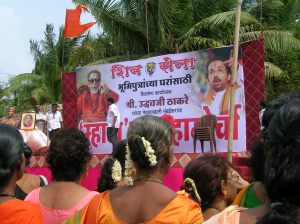 I was moving around Mumbai city on that weekend, mainly in the western suburbs. Several posters and banners were put up all over, announcing a call to a mass rally by Shiv Sena chief Uddhav Thackeray. Thackeray’s clarion call for that meeting was: “Housing for the bhoomiputra“. Bhoomiputra literally means son of the land. On an overt reading of the poster and slogan, one could conclude that the Sena is back to its advocacy of the sons of the soil theory which originally raised it to prominence in the 1960s. But when I attended the rally and noticed the people who attended it, I asked myself, so who exactly is this son of the soil that the Sena is talking about? Is it the Marathi manoos, the local underdog who the Sena argues has no social and economic space in his/her own city? If it is truly the Marathi manoos, then how do I interpret the presence of North Indian women, Bohra muslim women, perhaps even Dalit women, and many other women who I tried to mark but could not classify as either Hindu or Christian or any other particular else. Hmmm …. Continue reading Of Bhoomiputra and Housing
Teachers and Academics Against 377
University teachers, researchers and academics from all over India issued a strong statement in support of the recent Delhi High Court judgement decriminalizing consensual sex among adults and challenged the legitimacy of “religious leaders” to speak for the whole of society.
180 signatories from institutions and universities in Allahabad, Calicut, Peechi, Punalur, Thiruvananthapuram, Kottayam, Sonipat, Goa, Jammu, Nanded, Mumbai, Pune, Pondicherry, Kolkata, Ahmedabad, Baroda, Chennai, Chandigarh, Delhi, Bangalore, Hyderabad, Guwahati and Shillong endorsed a statement that said:
 KAFILA - COLLECTIVE EXPLORATIONS SINCE 2006