Category Archives: Politics

वाम के खिलाफ अवाम: ईश्वर दोस्त

This is a guest post by ISHWAR DOST. Ishwar is a Left activist and journalist. He works with Jansatta.

एक वक़्त था जब नंदीग्राम माकपा के बर्ताव से अचंभे और सदमे में था। आज पूरे बंगाल में बुरी तरह खारिज कर दिए जाने पर माकपा की यही स्थिति है। कभी नंदीग्राम पीड़ित के रूप में उभरा था, आज माकपा और उसके साथ और पीछे खड़ी पार्टियों की पीड़ा समझी जा सकती है। नंदीग्राम और सिंगूर के एक स्थानीय घटना बन कर रह जाने की माकपाई उम्मीद अचानक खत्म हो गई। नतीजे बताते हैं कि नंदीग्राम की पीड़ा के साथ बंगाल के देहात ने ही नहीं, शहर कोलकाता ने भी साझा किया है। किसानों के साथ हुए हिंसक सलूक से कोलकाता के बुद्धिजीवी ही नहीं, आम लोग भी हिल गए थे।

नंदीग्राम अब माकपा की पीड़ा और छटपटाहट को समझ सके, इसमें शायद काफी देर हो गई है। ऐसा कभी हो सके, इसके लिए माकपा और उसके पीछे चलने वाली पार्टियों को सारे अहंकार छोड़ कर एक पुरानी पीढ़ी के किसी कम्युनिस्ट की तरह नंदीग्राम तक सिर झुकाए आना होगा। सत्ता और सफलता का अहंकार पीड़ा को समझने और उससे जुड़ने की क्षमता नष्ट कर देता है। इस अहंकार ने कम्युनिस्टों की एक वक्त की नैतिक, ईमानदार और जज्बाती होने की पहचान को कमजोर कर दिया है। Continue reading वाम के खिलाफ अवाम: ईश्वर दोस्त

Making Sense of the Ravi Dasis: Surinder S. Jodhka

The recent attack on the head of Dera Sachkhand Ballan in one of their gurudwaras in Vienna and the ensuing shoot-out between Dalit and non-Dalit Sikhs, spilling over in India into angry street demonstrations in Jalandhar by followers of Dera Sachkhand and other Dalit bodies, forces us to confront the question of caste in contemporary Punjab. We asked SURINDER S. JODHKA, sociologist and Director, Institute of Dalit Studies, who works in this area, to give us a background note.

The Dera Sachkhand Ballan is one of the most important Guru Ravi Das Deras in Punjab today. Ravi Das was a 15th century saint of the Chamar caste whose message is constructed by his contemporary followers in a modern language that foregrounds questions of caste oppression and the  fight against the prevailing structures of authority and the Brahmanical moral order.  In his piece here, Surinder gives us a historical background to the emergence of this movement, and brings us to the point of the 1990s, when the “diasporic energy” of Ravi Dasis who had emigrated to the UK and Europe, gave a boost to the movement both at home as well as in the diaspora, where Ravi Dasis had found things to be no different. In the alien context, with no systemic justification for caste ideology, the Punjabi Dalits did not expect to be reminded of their “low” status in the caste hierarchy, says Surinder, but facing systematic discrimination from wealthy Jat Sikhs, were forced to set up their own autonomous organizations and their own gurudwaras. Continue reading Making Sense of the Ravi Dasis: Surinder S. Jodhka

CSDS data on caste voting patterns in UP LS ’09 elections

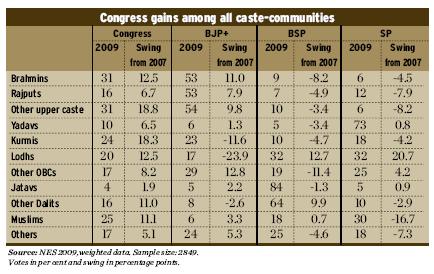
csdsdataupls09In my post a few days ago I had mentioned a survey who source I could not reveal, except that the BSP is looking at these figures. Truth be told, I don’t know who conducted that survey. But, to back the conclusions, I had a little more than just that survey. Continue reading CSDS data on caste voting patterns in UP LS ’09 elections

The Future

Tarun Tejpal to Sonia Gandhi:

And yes, as I bid you speed and strength, with the extra god by your side, may I make a final plea. You have given us of yourself, and of your son. Now will you kindly also give unto us your luminous daughter.

YOURS EXPECTANTLY,
TARUN

[Link]

When Buddha Did Not Smile: Monobina Gupta

This is a guest post by MONOBINA GUPTA

Buddhadeb with Tata building as backdrop, courtesy Calcuttans.com
Buddhadeb with a laterally inverted Tata as backdrop, courtesy Calcuttans.com

As the true magnitude of the West Bengal election results sank in, a sulking Buddhadeb responded, stonewalling the media as if to say that had it not been for them the Party would have romped home victorious! Here is a conversation reported in The Telegraph (May 18,2009). The reporters in Writer’s Building asked the Chief Minister:

Is it true that you have offered to resign?

No reply.

Will you step down as chief minister owning moral responsibility for the party’s debacle?

No reply.

Why didn’t you go to Delhi to attend the CPM politburo meeting?

No reply.

Silence has rarely been so eloquent in the corridors of Writers’ Buildings as when a grim-faced Buddhadeb Bhattacharjee walked out at 1.30 pm for lunch at home.
Faced with a volley of questions whether he had offered to resign, the Bengal chief minister left without replying. The Telegraph had reported that the chief minister had offered to resign but CPM boss Prakash Karat had been trying to make him change his mind.

This is not the first time Bhattacharjee has faced tricky questions but he usually deflects them by saying “I don’t reply to questions flung at me from the corridors’’.
But this afternoon, he opted for silence.

Continue reading When Buddha Did Not Smile: Monobina Gupta

UP’s Dalits Remind Mayawati: Democracy is a Beautiful

Party Vote-share Seats
BSP 27.42% 20
SP 23.26% 23
Congress 18.25% 21
BJP 17.5%
10

The higher you fly, the harder you crash. Kumari Mayawati has just learnt this lesson, and is finally giving her ever-expanding fleet of air-crafts some rest. There was clear evidence before the results were out that Dalits were not going to the polling booths to vote; if they did they wouldn’t be able to press any button other than the elephant. Dalit activists in UP had been telling me this for some time now. There were rumours that the UP police has also informed the administration of this trend. Continue reading UP’s Dalits Remind Mayawati: Democracy is a Beautiful

‘Either we finish what we started, or get finished’

The most dangerous and worrying feature in the last two weeks is the resurgence of visceral anti-Maoist politics.

The line between the liberals and right wing has suddenly blurred and they are united in their hatred of the former rebels. The Kathmandu middle class, a part of which gave the benefit of doubt to the Maoists in the polls, had to cough up concessions under Baburam Bhattarai’s fiscal regime. With the recent video revelations, they have veered away even further. The urban lower middle class suffered during eight months of misgovernance with price rise, and collapse of services and is hoping the next government may provide some relief.

The army establishment has reasserted itself and is actively hatching plans to undermine Maoists. Most of the press, with ownership and editorial staff affiliated to ‘mainstream’ parties’, is toeing the NC-UML line. And erstwhile sympathisers in the Indian establishment are now sick of what they see as Maoist duplicity – the recent rediscovery of the ‘nationalist’ rhetoric has put them off further. Continue reading ‘Either we finish what we started, or get finished’

Vaikom Viswan and Little Bo-Peep

If I weren’t aware of Kerala’s more vibrant political past,I’d have died laughing this elections. The election campaign in Kerala was impossibly funny. Just to give you an example  — in Thiruvananthapuram, in the middle of the campaign, we were treated to the spectacle of all the three major contenders — of the CPI, the Congress, and BJP — don the costume of the chivalrous knight — indeed, pushing and shoving each other quite unchivalrously– determined to rescue the damsel in distress. However, there was no damsel waiting to be rescued! Continue reading Vaikom Viswan and Little Bo-Peep

People of the Vaish Community Honouring Shri JP Aggarwal…

"jai prakash aggarwal ko vaish samaj ke logo ne sammanit kiya"
"Jai Prakash Aggarwal ko vaish samaj ke logo ne sammanit kiya."

The photograph above has been sent to me, in my capacity as a journalist, by the PR company hired by Jai Prakash Aggarwal. He was the Congress candidate from the North East Delhi seat, a replacement for Jagdish Tytler. Aggarwal is also the president of the Delhi unit of the Indian National Congress party, that has returned to power with a less encumbering coalition than the one it ran for five years. JP Aggarwal was a reluctant replacement: he was also a Rajya Sabha MP and feared he might lose to the BJP, which would be a great embarrassment for him as the president of the Delhi Pradesh Congress Committee. But the Congress insisted they wanted a ‘baniya’ for the seat. Happily for him, he has won, and this press release is about how the Vaish community has honoured him. Continue reading People of the Vaish Community Honouring Shri JP Aggarwal…

The Commissar in his Labyrinth

Prakash Karat, Gen Sec, CPI(M), photo courtesy The Hindu

Look carefully at this grey, arrogant and humourless face: The face of the Commissar, who on 22 July went into Lenin-in-October 1917 mode, predicting an uprising in the country if the Indo-US Nuclear Deal was pushed through. However much one might have sympathized with the man and his party on this issue, there was something strange and inexplicable in the game he started playing at that point. At least publicly, that seemed to have been the beginning. For those who have known him and his ways from closer quarters, know him to be an utterly vindictive man with a blood-curdinlingly cold and calculating mind. Ruthless inside the party, he was now playing out this same game outside. His stance on Somnath Chatterjee (and let there be no mistake, it was entirely his), leading to the latter’s expulsion, was just an instance of his style. This time he made a serious error. Continue reading The Commissar in his Labyrinth

How to be TV-free on election results day

Avoid the pundits on the nauseating news channels, keep your peace of mind, cut the noise and save your aspirin bills. Watch the results live tomorrow morning 8 am onwards on http://eciresults.nic.in/


जारी है ‘जनपक्षीय हिंसा’ का तान्डव

खबर मिली है कि छत्तीसगढ़ में माओवादी हमले में ग्यारह से ज़्यादा पुलिस के जवान मारे गए हैं. इस महीने ऐसी हत्याओं की संख्या पचास से अधिक हो गयी है. इसके साथ ही बंगाल के चुनाव में हिंसा के समाचार किसी भी दूसरे राज्य से अधिक मिले हैं. बंगाल की हिंसा में  संसदीय राजनीति में भाग लेने वाले एक मार्क्सवादी दल के सदस्य शामिल हैं.संसदीय राजनीति को  भटकाव बताने वाले और उसे रणनीतिक रूप से इस्तेमाल करने वाले, दोनों तरह के मार्क्सवादी या माओवादी दलों को हिंसा के अपने इस्तेमाल के जायज़ होने में कोई  शक नहीं है.दोहराव का खतरा उठाते हुए नंदीग्राम और सिंगुर में सीपीएम की हिंसा के पक्ष में उसके बुद्धिजीवियों के तर्कों को याद कर लेना  उचित होगा.इन तर्कों में एक तर्क रक्षात्मक हिंसा का था. इस बार चुनाव में अपने पक्ष में न होने के लिए सीपीएम ने नंदीग्राम में हत्याएं कीं और तृणमूल कांग्रेस के कार्यकर्ताओं ने सीपीएम के समर्थकों को  मारा.बंगाल के पिछले एक साल के अखबार को उठा कर देख लें, हिंसा उस समाज के स्वभाव को परिभाषित करती जान पड़ती है.
Continue reading जारी है ‘जनपक्षीय हिंसा’ का तान्डव

Naagbanton, Binayak Sen and Kampala Declaration

Patrick Barigbalo Naagbanton is a well-known human rights activist. Born in Rivers State, Nigeria, he trained as a journalist before working as a trade unionist at the Port Harcourt factory of the Union Dicon Salt PLC, where he was elected chairman of the workers union, Maritime Workers Union of Nigeria (MWUN). He was eventually fired for campaigning for improvement in working conditions. Naagbanton recruited many workers to join human rights/pro-democracy groups like the Civil Liberties Organisation (CLO), Campaign for Democracy (CD), and Committee for the Defence of Human Rights (CDHR). Naagbanton served as a board member of Civil Liberties Organisation (CLO), representing the Niger Delta region of Nigeria. He also worked with the Environmental Rights Action (ERA) and Friends of the Earth Nigeria (FOEN), documenting, researching and campaigning against human rights and environmental degradation in Nigeria. In recognition of his role in promoting and defending victims of rights abuse in Nigeria, Naagbanton received the Indianapolis University Human Rights Award in 2001; and in 2002, the Rivers State branch of the CLO conferred on him the Saro-Wiwa Award for human and environmental rights defender.
Continue reading Naagbanton, Binayak Sen and Kampala Declaration

‘Our’ Violence Versus ‘Their’ Violence

The first three phases of the 200 Lok Sabha elections have passed off peacefully. When we say peacefully, we do not take into account the killings of poll officials and police personnel involved in election related work by the Maoists. The Maoists gave a poll boycott call in areas where they thought they are strong but were not heeded by the people. Even many tribals of Lalgadh in Bengal decided to risk their lives to exercise their hard earned right to vote defying the Maoist boycott call. Unable to convince the masses, the Maoists have resorted to the old strategy of ambushing poll parties and burning and demolishing of public properties to register their presence. Jharkhand, Chhattisgarh, Orissa, Maharashtra, Bihar and Bengal have been witness to violence by armed groups of Maoists. Interestingly, we have not seen any statement by them owning up to these acts. Continue reading ‘Our’ Violence Versus ‘Their’ Violence

Sri Lanka: A Tragedy Foretold – Rohini Hensman

guest post by ROHINI HENSMAN

Once a forest fire is raging, putting it out is difficult, and an enormous amount of destruction is inevitable. The same is true of the war in Sri Lanka. Even over the past fifteen years, there were several chances to prevent this tragedy, but only a tiny minority of those who are now grieving over the dead and injured were arguing then that a failure to take these chances would lead to a bloodbath. Continue reading Sri Lanka: A Tragedy Foretold – Rohini Hensman

Barter – is that what they’re calling it now?

It’s a world on the downturn out there.

And new and creative ways of handling the situation emerge. Imagine a journalist accepting some old jeans (in very good condition), some rice, atta and vegetables (and also sugar)  from the newspaper proprietor in exchange for her reporting. Meanwhile, an ad agency employee  opts for day-old newspapers and fruits for every successful slogan he coins.

Impossible?

Continue reading Barter – is that what they’re calling it now?

Buffalo Soldier

“Come in,” says Munisa, “it’s such a large house you’ll be surprised.” The room isn’t big enough for a single person, and Munisa, a widow at 30, shares it with six children and her mother-in-law. She’s trying to turn the courtyard into a room even though she knows the impending monsoons will was away the mud thatch: “At least the summer will pass.” She works as farm labour, earning Rs 35 a day, and can’t make use of NREGA because the chronic pain in her legs won’t let her do hard labour.

Two years ago, an NGO did a survey in the village and found her to be the poorest. They gifted her a cow. “It gave milk because I fed her. And then, six months ago, she died.” But Munisa is not ungrateful: she will still vote for the candidate who runs the NGO that gifted her the cow. So will her neighbours who didn’t get anything: “Here’s someone who has at least proven her concern for the poor,” says one. Read More…

Anatomy of a prejudice

The BSP’s politics may trouble the popular conception of Indianness, among English speaking middle classes, who understand India as one whole, where the ‘Indian’ identity dominates and the rest, which reflect real India (inequality and conflicts) are hushed up. On the other hand, the BSP’s politics reiterates that India is a country of various minorities (castes, religions, regions) who may be victimised by fellow Indians in different contexts. Emphasising the BSP or Mayawati’s Dalitness ignores the complexity of caste society and associated politics. Kanshiram in the past and Mayawati now raise issues of caste not to sustain inequality but to challenge them. What Mayawati and BSP’s growth represents is the deepening of democracy in India. [Suryakant Waghmore]

What next in Nepal?

Prime Minister Pushpa Kamal Dahal ‘Prachanda’s resignation on Monday afternoon once again reveals how the Unified Communist Party of Nepal (Maoist) is different from any other ‘mainstream’ party that inhabits the Nepali political landscape. Most observers, including this writer, fail in assessing the Maoists correctly because we end up using the same categories, attribute the same motivations, and expect similar tactics from them as from other political actors.

The PM’s resignation came after a two week long political thriller leading up to the executive’s decision to dismiss Army chief General Katawal and appoint General Kul Bahadur Khadka in his place. Continue reading What next in Nepal?

Ajmer Blasts: Revisiting Hindutva Terror

It has been more than one and half years that the great Sufi shrine of Khwaja Moinuddin Chishti based in Ajmer, Rajasthan, which is equally revered by the Hindus and Muslims, reached headlines for unforeseen reasons. On 11 th October 2007 it witnessed a bomb blast which saw deaths of two innocents and injuries to many. In fact it was for the first time in its few centuries old history that blood of innocents lied splattered in those areas where thousands and thousands of people use to gather daily to offer their prayers.
As was the routine procedure then – when Hindutva terror had not reached headlines – a few fanatic Islamist groups were blamed for this ignoble incident. There were interrogations, arrests, quite a few people were illegally detained supposedly to extract their confession for this act. Media was not to be left behind, it had juicy stories about the plans and the execution of this inhuman and barbaric act, and definite clues about its real ‘masterminds’ remote controlling from across the border. Witch-hunting of the community went on for a while. And as usually happens in such case(s), after some initial hullabaloo Ajmer blasts were relegated to the inner pages of newspapers in one small corner. People also lost interest. Perhaps they had more exciting news awaiting them. Continue reading Ajmer Blasts: Revisiting Hindutva Terror

Another sort of touch

The British queen placed a royal hand around the American First Lady’s waist, who graciously reciprocated, and a million words and images were launched in the world media on that historical moment.

How come we never got to see  this other Touching Moment in London involving another Obama? Thanks to Dilip Simeon, who was sent this by a friend, I received this picture of what happened when Barack Hussein was entering 10, Downing Street on April 1, 2009.

There he is, a British police officer joyously breaching protocol while ushering a black American president into the British corridors of power. As the caption in the forwarded message said – “the two brothers couldn’t resist the historic moment!”

(Reuters/Toby Melville)

That’s it for now, folks.