Category Archives: Scams

The Triumph of the Will(ie): Prasannarajan Anoints Modi in the Open

The televised coronation (or should I say Rajyabhishek) of Narendrabhai Damodardas Modi has featured a supremely photogenic set (the Dasashwamedh Ghat in Benaras), a chorus line of calisthenic priests lining the riverfront of the Ganga with blazing torches, a script (being written, even as the epic is being canned, in every television studio and editorial office) talented producers and art directors, an army of happy-clappy extras, and even its own battalion of masked stunt doubles.

Modi at Dasashwamedh Ghat, Varanasi/Benaras on 17 May 2014. Courtesy, Amar Ujala website.
Amit Shah, Rajnath Singh and Narendra Modi,  at Dasashwamedh Ghat, Varanasi/Benaras on 17 May 2014. Courtesy, Amar Ujala website.

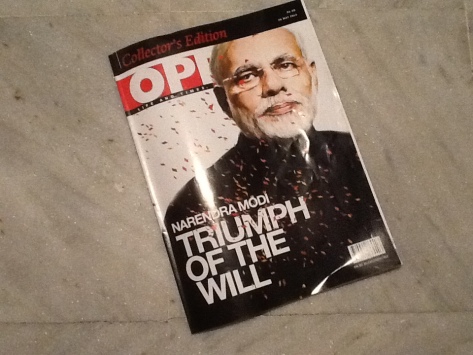
Like any good bollywood blockbuster, it cannot but be a homage to an extant cinematic classic. S. Prasannarajan, editor of the Open Magazine has even told us what that classic is. On the cover of Open, beneath a pensive, tight lipped and determined Narendrabhai looking out at the magazine’s reader through a shower of rose petals and rimless Bulgari glasses, four words spell out in bold capitals the film’s name – ‘TRIUMPH OF THE WILL’. Dejavu, anyone?

'Triumph Of the Will' Open Magazine, May 26, 2014
”Triumph Of the Will’ Open Magazine – ‘Collectors’ Issue’, May 2014

Continue reading The Triumph of the Will(ie): Prasannarajan Anoints Modi in the Open

Why the Law may still Catch Up with Amit Shah: Warisha Farasat

Guest Post by WARISHA FARASAT 

Amit Shah seems to be on a roll this election season. First, he escaped any punishment after delivering one of the most disturbing hate speeches made during the 2014 election campaign. After the Muzaffarnagar riots, attempts were made by political parties to capitalize on the suffering of the locals, and provoke certain communities to vote for them. And when Amit Shah was censured by the Election Commission for indulging in objectionable speeches during the election campaign in Uttar Pradesh, BJP Primeminsterial candidate Narendra Modi came to the defence of his most loyal lieutenant. Clearly, Amit Shah’s statement was made with the intention of polarizing the voters in a politically surcharged environment in Uttar Pradesh and amounted to hate speech. However, the Election Commission soon did a u-turn, diluted its own stand, withdrew the ban against Shah and allowed him to go ahead with his campaign. The withdrawal of ban against Amit Shah ignoring the drastic implications of his hate speech during the campaign was alarming.

And now, the CBI has not named Shah as an accused in the Ishrat Jehan fake encounter case stating that there is no ‘prosecutable evidence’ available against him. But Shah and his supporters should not think that this so-called ‘clean chit’ absolves him of all criminal responsibility for indulging in fake encounters in Gujarat. If we believe the CBI in the Ishrat Jehan case when they claim that there is no prosecutable evidence against Shah, consequently, we also need to trust their investigations in atleast two other fake encounters, namely the Sohrabuddin Shiekh and the Tulsiram Prajapati cases where the CBI have named Shah as an accused. Shah is presently being tried in these cases and is able to campaign during these elections only because he is out on bail.

Continue reading Why the Law may still Catch Up with Amit Shah: Warisha Farasat

The curious case of Reliance Industries Ltd’s gravity defying stock price – Or, how you should learn to stop worrying about gas prices and buy RIL stock now: Vineeth Sukrithan

This is a guest post by VINEETH SUKRITHAN

The stark contrast between RIL’s latest march quarter performance and the almost- three-year highs that its stock price is perched on top, merits a deeper analysis. On April 18th, 2014, RIL released its quarterly data showing disappointing results that were entirely in line with industry expectations. Petrochemical business revenues fell 3.7%, while oil and gas turnover dropped 18.2% q-o-q. Net profit growth in its January-March quarter (Q4FY14) was at Rs 5,631 crore – only 0.7 per cent higher than Rs 5,589 crore it earned a year ago. The petrochemicals business’s Ebit was lower than in the December quarter and the company’s outstanding debt over shot its cash and equivalents. (Rs 89,968 crore against cash, and equivalents of Rs 88,190 crore.)

Yet, for a company that has always been known to be reticent about taking on high levels of debt, RIL has gone on what can only be called a remarkable splurge in capital expenditure. Its capital expenditure during the year was the highest ever. The company reported net addition to fixed assets of Rs 35,210 crore in FY14. In FY09, when the company commissioned its second refinery and K-G basin gas production, its capex was only Rs 24,907 crore. So, on all accounts, RIL’s actions and stock price seem counter to the predicaments of its current financial health, which begs the question, where does Reliance derive this level of confidence in its future profitability to be willing to take on tremendous amounts of debt?

Continue reading The curious case of Reliance Industries Ltd’s gravity defying stock price – Or, how you should learn to stop worrying about gas prices and buy RIL stock now: Vineeth Sukrithan

Universal Adult Francise? A Reality Check: Reena Gupta

Guest Post by REENA GUPTA

When polling began on the morning of April 10, our team coordinating the Aam Aadmi Party campaign in Bawal was expecting to respond to complaints of money and alcohol distribution. During the jan sabhas throughout the area, Yogendra Yadav, the AAP candidate for the constituency, had made it amply clear that, “na toh hum shraab bechenge, nah hum bikne denge.” We had spent days training booth volunteers who would be available to assist voters with information and monitor elections throughout the 200 odd villages in Bawal. Our mobile teams would document any violations of the electoral code and lodge complaints with the requisite authorities. Having campaigned in the Delhi elections for AAP, I knew firsthand that the secrecy of the ballot gave people the chance to rise above external pressures and inducements. After the hard yards of campaigning, voting day seemed set to be relaxing and I occupied myself with preparations for lunch for the numerous volunteers who were streaming in and out of our office.

Bawal is less than 100 kms from Delhi and is one of 9 legislative constituencies that comprise the Gurgaon Parliamentary constituency. In fact, Bawal falls within the National Capital Region and has been proclaimed as soon joining the constellation of Delhi’s satellite towns. There are already hi-tech factories strewn along the Delhi-Ajmer Highway and then there’s the buzz about the upcoming Delhi-Mumbai Industrial Corridor. Of course, the symptoms of lop-sided development are visible right behind the façade of big industrial complexes. With one quick turn off the highway, the roads fall apart and you are welcomed to villages with virtually non-existent education and public health infrastructure. However, I realized the extent of the distance between Bawal and Delhi only after our phones started ringing on the morning of 10th April and we set out to see for ourselves the manner in which citizens are allowed to exercise their electoral rights, in the world’s largest democracy.

Continue reading Universal Adult Francise? A Reality Check: Reena Gupta

A Corruption Scandal in Turkey: Tamer Söyler

Guest post by TAMER SӦYLER 

A corruption Scandal in Turkey first broke on December, 17th last year. Under instructions by the public prosecutor Celal Kara, the financial police took into custody several suspects comprising famous businessmen (Ali Agaoğlu and Reza Zarrab), family members of three ministers from the cabinet (sons of ministers Muammer Güler, Zafer Çaglayan and Erdoğan Bayraktar) and high level bureaucrats. Main suspects were immediately arrested by the court.
Prime Minister Erdoğan declared that this was a fabricated investigation to humiliate his government on the eve of coming elections. The Prime Minister accused Fethullah Gülen, the founder of the Gülen Movement, living in a self-imposed exile in the US for the last 15 years, for placing a plot to overthrow his government.

Continue reading A Corruption Scandal in Turkey: Tamer Söyler

Naked Bias Threatens Media’s Credibility – A Statement by Some Mediapersons

An Appeal to Indian Journalist Fraternity by a Group of Media persons, released in Chandigarh, 16 March, 2014

In a terse comment, Aam Aadami Party leader Arvind Kejriwal said that a part of the media, particularly some TV channels “sold itself to Bharatiya Janta Party (BJP) and is indulging in running a propaganda spree in favor of BJP’s Prime Ministerial candidate, Narendra Modi”. As has happened earlier in many cases relating to deprived and unprivileged sections of the Indian society, that section of media took an undue offence to the comment that was completely out of proportion, and it launched a virulent campaign against AAP. This section of media is peeved at Arvind Kerjriwal’s remarks that if his party came to power, a punitive action would be taken against those media outlets which have been biased in their news coverage and suppressed the anti Modi news stories projecting his false claim to an ‘unparalleled development of Gujarat’.

During his field tour to Gujarat, Kejriwal started taking on Modi , attempting to expose the chinks in ‘Gujarat Vikas’, which according to him, is a ‘hollow projection’ made with ‘active support’ of a section of media. In what could be called an overreaction, a naked anti-Kejriwal slant became a routine affair in the coverage of some media outlets. It is not difficult to smell from the reports and debates of these media outlets that their journalists (by order from above or own their own) have shamelessly started walking in the footsteps of Hitler’s notorious spin doctor Joseph Goebbels, who also did a stint in journalism. Continue reading Naked Bias Threatens Media’s Credibility – A Statement by Some Mediapersons

Time For a Code of Conduct for Media

Let us make no mistake, the Big Media in India does not merely report; it is a player in Indian politics in general and elections in particular.

Now that the debate is out in public it is time to insist on a code of conduct for the media as well. After Arvind Kejriwal’s recent allegations against four television channels that have been blown out of proportion and misrepresented, there has been an uproar. A burst of righteous anger, not only from those accused by Kejriwal of having been bought out by a particular party, but also by professional bodies like the News Broadcasters Association (NBA), the Editor’s Guild, the Broadcast Editors Association (BEA) and other senior journalists.

The NBA, which is a private association, threatened to black out Kejriwal and AAP news and then went on to assert its objectivity and fairness against the “unsubstantiated and unverified allegations” against the news channels.

The BEA said in its statement:

“BEA condemns Arvind Kejriwal’s irresponsible statement on media. BEA believes that electronic media is discharging its responsibility in a fair and objective manner. It is wrong to say that TV channels are pursuing a biased agenda in favour of any person or party. BEA believes that such statements are a conspiracy to dilute the credibility of media. We have strong faith in the self regulatory institutions that electronic media has developed…”

Let us concede for the sake of argument that Arvind Kejriwal went overboard and his statement about ‘jailing mediapersons’ was uncalled for. But does the claim of the BEA, NBA and other bodies really stand up to scrutiny? Is the electronic media really dïscharging its  responsibility in a fair and objective manner”? What precisely, may we ask, are the “self regulatory institutions that electronic media has developed” and what have they done by way of reigning in the Indian media that have sunk to new lows in recent years with “paid news”and “advertorials” – not to mention private treaties with big corporations ? We ask the BEA and the NBA and 0ther defenders of the media, is this the ethical behavior they talk of? Is this self-regulation? Maybe Kejriwal’s allegations are “unsubstantiated” in the sense that there is no “proof”, but there is little doubt from the instructions that journalists have been receiving from their bosses, that a lot more than mere reporting is at stake. And just for the record, the the Chairman of one of media houses accused by Kejriwal, Subhash Chandra of Zee News, is currently facing a case of extortion – using his channel’s news-gathering for blackmail. We would love to hear how this qualifies as ‘fair and objective’in the eyes of the BEA and other luminaries. Continue reading Time For a Code of Conduct for Media

Modi and Godhra – Review of Manoj Mitta’s ‘The Fiction of Fact-finding’: Monobina Gupta

MONOBINA GUPTA reviews The Fiction of The Fact-finding: Modi and Godhra by Manoj Mitta, Harper Collins India, 2014

My most embarrassing moment during my recent Eastern UP trip was hearing RSS and BJP men sing praises of the media. “Aap log Modiji ka bahut madat kar rahen hain” (You all in media are really helping Modiji), they said warmly, throwing cheerful smiles all around. “Sometime ago, you were giving Arvind Kejriwal too much of coverage. Now you have brought the focus back on Modiji,” was the discomfiting refrain in these upbeat quarters.

I squirmed beneath my fake smile and grumbled to myself: this was a stiff penalty to pay for covering these fraught general elections. I would rather these men complain about why we in the media were still so troubled about Narendra Modi’s role in the 2002 Gujarat riots; why were we still persisting with our questioning the process of investigation, particularly the role of the Special Investigation Team (SIT), that led to Modi’s exoneration in the charge of complicity in the 2002 pogrom.

But that’s not how political discourse in the run up to the 2014 elections is shaping up. Skeptics holding the judiciary to be fallible are blasted for daring to express doubts about the ‘hallowed’ courts; those not rushing in to embrace Modi’s acquittal as manifestation of the truth and nothing but the truth are regularly shouted down on television talk shows. Dissidence is drowned out in the noisy din raised by Modi drum-beaters. Continue reading Modi and Godhra – Review of Manoj Mitta’s ‘The Fiction of Fact-finding’: Monobina Gupta

Crimes of Unreason: Danish Sheikh

A post on the cowardly judgment of the Supreme Court by DANISH SHEIKH. I term it a cowardly decision because if it had said that we are homophobic then it would at least have been admirable for its honesty if not for its belief. It instead chooses to mask its homophobia with crimes of unreason

Now you’re legal – Now you’re not!

With the ease of a particularly sadistic magic trick, a 98 page document has sent millions of LGBT individuals time-warping back into pre-2009 criminality. If there were any constitutional justifications for this act, they are not to be found lurking in the pages of this shockingly poorly reasoned decision. The Supreme Court has taken a chainsaw to one of the most beloved court decisions of our time, and surgically extracted everything that made it such an important verdict. Besides, of course, that little side business of equal-moral-citizenship granting. A broader walkthrough the shoddiness of the judgment can be found  here, (http://kafila.org/2013/12/12/we-dissent-siddharth-narrain/) I’m presently looking at some of the more egregious of its violations. Continue reading Crimes of Unreason: Danish Sheikh

Tehelka, Jhatka and now Tamasha:Satya Sagar

Guest post by Satya Sagar

Eight years ago I remember listening to Tarun Tejpal in Bangalore as he held forth on how the news media could change the world for the better. It was a gathering of journalism students from Catholic institutions around the country and Tejpal was impressive in his defense of media freedoms.

He was passionate, charismatic, extremely articulate and as Chief Editor of Tehelka- with some of the best stories of Indian journalism behind them- very credible too. After his speech Tejpal left in a hurry, like a star priest dashing off to his next flaming sermon and fawning audience. Continue reading Tehelka, Jhatka and now Tamasha:Satya Sagar

Deceit at the Hospital of Truth: Surendra Panchal

Guest Post by Surendra Panchal

Sanitation Hospital Workers Strike at a Delhi Hospital over Non-Payment of Minimum Wages

Sanitation workers of the Satyavadi Raja Harishchandra Hospital (The Truthful King Harishchandra Hospital), Narela in Outer Delhi have started an indefinite dharna today, to protest their unjust dismissal when they asked to be paid the statutory minimum wage for unskilled work declared by the Delhi Government, Rs 7254 per month.

Continue reading Deceit at the Hospital of Truth: Surendra Panchal

The buck should not stop with Meena Kumari

Let us recount some facts to understand the circumstances that led to the death of 23 children at a primary school at Gandaman, Chapra . First, some micro-facts :

  • The primary school struck by the  tragedy  is  a NAV SRJIT VIDYALAYA, a  newly created school. In fact, it is a break away from an earlier existing middle school   in the village.
  • This school, if you care to call it by this name, is a single room structure  with a floor full of potholes.
  • There is neither a kitchen nor a   facility to store the raw food-items in the school.
  • There is no source of clean drinking water in the school. There is a hand pump there but you get hard water from it.
  • Meena Kumari was NOT the headmistress of the school . She was only the teacher –in-charge of the school.
  • The school has two women teachers including Meena Kumari. The other one was on maternity leave  at the time of the incident. Meena Kumari was the only teacher left to look after more than 60 children, from class one to five who study there , a duty which includes teaching, supervising Mid-Day Meal (MDM) and other administrative duties. Continue reading The buck should not stop with Meena Kumari

Boyalagudem’s Search for Water: Rajendran Narayanan

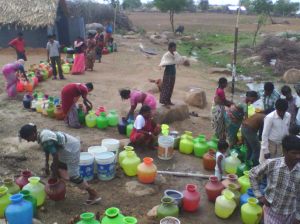
Guest post by RAJENDRAN NARAYANAN. Boyalagudem – The name sounds like one of those nondescript railway stations in south India that an express train whizzes by in utter condescension of its portly status. Except that in this case it is much worse. There are no railway tracks in a 50 kilometre radius of this village, tucked away in a corner of Mahabubnagar district in Andhra Pradesh. The landscape here is various hues of brown with not even a pretension of greenery anywhere, barring a few adamant shrubs as if standing up for their fraternity.

A not so covetous claim to fame of this region is its proneness to drought. People here spend each year in the hope that weather cannot play a prank every year. Prayers are offered each year in the second week of June to please the rain gods so that the chosen gods can have mercy this time around. But, the gods in turn haven’t been too pleased with the prayers so offered for the past few years.

Boyalagudem's scramble for water
Boyalagudem’s scramble for water

To cut to the chase, water is scarce in this region and so is electricity. Most villages in this part of the district have a central water pump connected to a storage tank that gets water when the State takes pity and provides electricity. Thus, no electricity implies no water. Electricity comes and goes at random times of the day and consequently there is no fixed schedule regarding the availability of water. Some desperate villager wakes up at 4 AM and rushes to the water pump in the hope of getting water. Another sleepy villager  walking out to take a leak at that hour observes an active man with four colourful pots running to get water and rushes back to his house to join the early riser in the daily water fetching ritual. News of water availability spreads and within 30 minutes one can see majority of the villagers, from 6 year olds to70 year olds, wiping their sleep off their face, walking, running or cycling, each with four to six bright colourful plastic pots to the solitary water pump. Multicoloured fluorescent pots form a long and winding queue to usher in the day. The chaotic queue naturally lends itself to quarrels and verbal skirmishes about who came first and why somebody has come with eight pots to hoard water.

Continue reading Boyalagudem’s Search for Water: Rajendran Narayanan

Welcome the Two-Year Under Undergraduate Programme at Delhi University

Harish Kumar Trivedi’s article on the proposed four-year undergraduate programme at Delhi University, “Is Delhi University Dying?” (TOI May 29th 2013), for all its rhetorical flourishes, makes in fact a single point – the need for change. He is not alone in this belief; who could possibly be against reform? Who would want to stick their necks out in these breathless times and say, “Stop, why so fast?”

Many, many right-thinking people, actually, as the absolute barrage of criticism against the FYUP has shown. From the ordinary undergraduate teacher to academic and executive councils, committees of courses, and internationally renowned scholars, writers and academics. Now, there can be two responses to the range and variety of criticism that has been expressed. One would be to engage with it, based on the reasonable assumption that so many people involved with a profession cannot be entirely wrong. The other response is of the kind Professor Trivedi makes – to make an a priori argument for “change”. I say a priori because in fact there is only one, short paragraph in the article that discusses the possible advantages of the new system. One, that the new system ends the distinction between pass and honours courses. Two, that even if students exit after two years, they will still earn a “university qualification”. Three, it allows college teachers to frame a course in the fourth year.

Continue reading Welcome the Two-Year Under Undergraduate Programme at Delhi University

Rushed Reforms in Delhi University: Akshita Nagpal

Guest post by AKSHITA NAGPAL

It was only in 2012 that we got a subtle whiff of the broth brewing in the minds of the bosses of Delhi University. While this isn’t the first time that authorities have attracted opposition from everyone on the other side of the ideological fence, the repercussions of the present push for hasty implementation of the Four Year Undergraduate Programme(FYUP) might be much more damning. Refuting change is not what the displeased body of teachers and students mean to convey. The opposition is against the hasty implementation and lack of insight sharing on the workings of the new system. Keeping up with the absurd pace of implementation, procedural requisites as pivotal as UGC approval have been done away with! Continue reading Rushed Reforms in Delhi University: Akshita Nagpal

Of Gandhi and a Godfatherly Copyright Offer: Shamnad Basheer and Lawrence Liang

In an op-ed in the Hindu, we highlighted an egregious copyright law-suit slapped against Delhi University and its photocopier by leading foreign publishers. The IFFRO (International Federation of Reproduction Rights Organisation) and its partner organisations which collect moneys on behalf of publishers issued a response to this piece, expectantly touting the virtues of acquiring a copyright license from them.

Unfortunately, owing to space constraints, we could only offer a pithy rebuttal to their response in the Hindu.

Below is a more elaborate version of our rebuttal.

(For those who came in late, here is a short jingly version of what this law suit is really about)

For those interested in tracking the case, see updates on SpicyIP

An Irrefusable Offer:

In their response, the IFRRO and its counterparts once again offer the option of a tantalizingly cheap copyright license, repeatedly stressing the “reasonableness” of their offer.

Continue reading Of Gandhi and a Godfatherly Copyright Offer: Shamnad Basheer and Lawrence Liang

Of Education and Democracy in India: Preeti Chauhan

This is a guest post by Preeti Chauhan Now that the cat is out of the bag and the four year undergraduate programme(FYUP) is being criticized and thereby being discussed threadbare by some of the leading scholars of the country, one needs to also think of its relationship with the current state of democracy in India. The manner in which FYUP is being pushed through crushes the very idea of a university and with it the ideals and ideas of democracy.

Even if one assumes and believes that the “Academic Congress” held last year in the University gave a go ahead to change the existing three year undergraduate programme to FYUP and frame courses accordingly, then also the way the University administration has functioned goes against the very values that the University of Delhi or for that matter any university is supposed to promote. Continue reading Of Education and Democracy in India: Preeti Chauhan

Dismiss the Delhi Police Commissioner

It is surreal watching leaders from Sushil Kumar Shinde to Sushma Swaraj make tough statements, one after another, on television. Statements about taking strong measures, the latter even demanding, as is her wont, death sentence to rapists. I felt like asking, do you even realize what the people are angry about? Do you even know what is at issue here? Who will you hang? Case after case, even after December 16, it is being revealed, suffers from the same problem: the refusal of the police to even register a case! What is the meaning of this high histrionics then, when you do not even have a culprit to punish? I am not even raising the question of the ethics of death penalty because that is a redundant question at the moment. Except for the raving right wingers who – like Sushma Swaraj and Shinde – have to make some song and dance about the issue merely for effect, no one else really believes that at the moment there is any issue other than the criminality of Delhi Police. Continue reading Dismiss the Delhi Police Commissioner

The Bastar Land Grab: An Interview with Sudha Bharadwaj

This intervew with SUDHA BHARADWAJ of Chhattisgarh Mukti Morcha was conducted by JUSTIN PODUR in Raipur on 5 March 2013

JP: As a lawyer and an activist, how do you see the relationship between legal work and activism?

SB: I see myself primarily as a trade unionist. I joined the union movement over twenty years ago, and it was the union that made me a lawyer. They felt that workers needed a good lawyer in their fight with the corporations. Our union is one of contract workers and has been striving to overcome divisions in the working class. Here, workers have a close connection with the peasants. So, we believe that working with the peasants is part of unionism.

When I got to the High Court, I found that all the people’s organizations were in a similar situation. The laws that give you rights are poorly implemented. When you fight, the status quo has many legal weapons, launches malicious litigation, etc. So we have a group of lawyers now (Janhit), and we work on group legal aid, not individual legal aid. The idea is that if you help a group, that can bring about some kind of change, create some space. I’ve also gotten involved with the People’s Union for Civil Liberties (PUCL), for which I am the General Secretary in Chhattisgarh. Continue reading The Bastar Land Grab: An Interview with Sudha Bharadwaj

Mining in Goa and Odisha and the CPI, Then and Now: Hartman de Souza

Guest post by HARTMAN DE SOUZA. The article was written a few days before April 12, the CPI’s day of solidarity with Odisha mine workers.

When the Goa State Committee of the erstwhile Communist Party of India (CPI) and its national secretary, our very own Comrade Christopher Fonseca, tells you that April 12th will be observed all over India as a day of solidarity with the Adivasi people of Odisha struggling for seven years to save more than 4000 acres of their ancestral lands from falling to mining conglomerates as rapacious as their Goan counterparts, ageing leftists in the village bar are not too sure whether they should laugh or just weep.

Perhaps one needs to paint the larger picture to highlight the irony that lurks in the shadows.

There was a time it needs to be said, when the CPI ran a long, hard and lonely battle in Goa, led by Comrade George Vaz who it is hard to believe was once Comrade Fonseca’s mentor. He was a short, somewhat portly, soft-spoken, widely-travelled man fluent in at least four languages. Not many Goans would know that Comrade Vaz ran a free kitchen in his home at Assenora open to anyone in need of a simple, nourishing meal, or that some of us who now want to weep in our glasses have eaten there several times…

Continue reading Mining in Goa and Odisha and the CPI, Then and Now: Hartman de Souza

Illegal Antiquities: Vishes Kothari

Guest post by VISHES KOTHARI

As a collector of Indian antiquities wanting to set up an antiquities dealership in the future, I had heard of the wholesale illegal export of Indian art treasures and antiquities out of India- sometimes through newspaper reports, but mostly through word of mouth. This summer I decided to explore this market further. Nothing could really have prepared me for what I was to see over the course of the next month spent between Delhi and Rajasthan.

Contrary to my imagination of the Delhi businesses operating in a very shady and dubious manner out of musty, hidden godowns in obscure corners of Old Delhi, and run by people with barely any idea of what they were handling, what I found instead was that almost all these businesses were located in localities which epitomize mainstream “cosmopolitan Delhi” and run by extremely wealthy upper middle class families. Connaught Place, Greater Kailash, Green Park, Sunder Nagar- these were just some of the places where I was able to locate an open sale of antiquities- happening not through dodgy godowns or via clandestine networks- but instead conducted out of posh showrooms and sold openly to anyone who cared to buy.

Continue reading Illegal Antiquities: Vishes Kothari