Category Archives: Technology

How India made it easy for everyone to play internet censor: A primer from SFLC.in

This FAQ has been put out by the Delhi-based SFLC.in

The Central Government notified the Information Technology (Intermediaries Guidelines) Rules, 2011 in April, 2011.  The rules which seek to control the intermediaries end up controlling the actions of users. As these rules attempt to cover a wide range of activities through a duplicate, complicated structure, neither the industry nor the end users are able to understand the boundaries of their rights and duties.

This FAQ aims at making these rules easy to understand and at sensitising the beneficiaries to the problems that the rules raise.

Who are intermediaries? Continue reading How India made it easy for everyone to play internet censor: A primer from SFLC.in
Library.nu R.I.P

Amongst the competing visions of heaven offered by the various prophets and saints, my favourite remains the one conjured by St. Alberto Manguel. For him, heaven is a place where you can read all the books that you did not finish. It would be difficult for me – proud member of the tribe of bibliophiles- to imagine a better idea of paradise than this. I would even hazard a bet that many of you fellow tribe members would probably imagine yourself in this other world (with enough time) curled up in a  comfortable sofa, opening a copy of Joyce’s Ulysses for the 28th time – saying finally this time.

But even within the order of the saints, one must respect the subtle rules of hierarchy and pecking order, and by that count St. Manguel would have to make way for the highest ordained of them all- the blind seer who saw everything- Jorge Luis Borges, who had much earlier been granted a vision of paradise and he declared that it was shaped like a library.

Continue reading Library.nu R.I.P

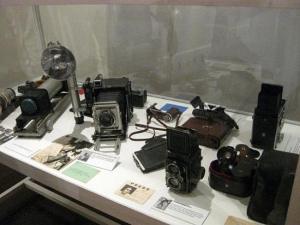
Tribute to Homai Vyarawalla, India’s first woman photojournalist

Homai Vyarawalla passed away at the age of 98 yesterday. We reproduce here the curator’s note written by cinematographer SABEENA GADIHOKE, biographer and friend of the legend, on the occasion of her staging a retrospective of Vyarawalla’s work at the National Gallery of Modern Art in 2011.

Having worked for thirty three years of her life Homai Vyarawalla gave it all up one day. Why did she give up photography?

Often meant for a fleeting glimpse in the newspaper, press photographs become visual archives of the future. Homai Vyarawalla’s photographs chronicling the defining moments of India’s Independence have acquired an iconic status and are now integral to a Nationalist version of history. According to this version, some people led and others followed. As important people dominated photographs, ordinary citizens or `the masses’ frequently found themselves relegated to the margins. Sometimes, they would be `cropped’ from the frame to accommodate more prominent figures.

Continue reading Tribute to Homai Vyarawalla, India’s first woman photojournalist

Invisible Censorship – How India Censors Without Being Seen: Pranesh Prakash

Guest post by PRANESH PRAKASH

The Indian government wants to censor the Internet without being seen to be censoring the Internet. This article by Pranesh Prakash shows how the government has been able to achieve this through the Information Technology Act and the Intermediary Guidelines Rules it passed in April 2011. It now wants methods of censorship that leave even fewer traces, which is why Mr. Kapil Sibal, Union Minister for Communications and Information Technology talks of Internet ‘self-regulation’, and has brought about an amendment of the Copyright Act that requires instant removal of content.

Power of the Internet and Freedom of Expression
The Internet, as anyone who has ever experienced the wonder of going online would know, is a very different communications platform from any that has existed before. It is the one medium where anybody can directly share their thoughts with billions of other people in an instant. People who would never have any chance of being published in a newspaper now have the opportunity to have a blog and provide their thoughts to the world. This also means that thoughts that many newspapers would decide not to publish can be published online since the Web does not, and more importantly cannot, have any editors to filter content. For many dictatorships, the right of people to freely express their thoughts is something that must be heavily regulated. Unfortunately, we are now faced with the situation where some democratic countries are also trying to do so by censoring the Internet. Continue reading Invisible Censorship – How India Censors Without Being Seen: Pranesh Prakash

High theory, Low ‘Kolaveri Di’: Why I am a Fan of this Flop Song: AS Ajith Kumar

Guest post by AS AJITH KUMAR

YouTube’s search results for the `Kolaveri di ’ song are amazing. It is hard to pick the `original’ from the plethora of `kolaveri di ’ songs -the `reply cover version’, kids version by Naveen Nigam, the damn version, and many more. I was very excited to find this possibility-a song has initiated a dialogue, and that too a musical engagement. This I think are the new possibilities that the new media has brought into the field of music. Here  is not the two- way process that we are familiar with, between the music and the listener, but a number of activities in multiple tracks.

The ‘listener’ is more visible  now, and has more powers. He/she shares, likes, comments, makes his/her own videos and broadcasts them by herself/himself. I am not trying to jump into a sort of technological determinism, but approaching the shifts in the music field – in the making, listening, broadcasting and sharing of music. I would say that it is within this context that we have to reflect on the popularity of the `kolaveri di ’ song.

Continue reading High theory, Low ‘Kolaveri Di’: Why I am a Fan of this Flop Song: AS Ajith Kumar

When Openness is Unfreedom (alternatively, when data is unfreedom) – Part II

This is the second post in the series that I began in October. I want to thank Rasagy Sharma for prompting me to put down the second post in this series.

This evening, Rasagy raised a question on twitter about whether the effort of a developer to make the database of the Indian railways downloadable is ‘official’ or not? As Rasagy later explained, the downloadable database is a list of trains, stations and the railway timetable. This list has has been made available in various downloadable formats (such as .csv, .pdf, etc) to encourage developers/interested persons to make web/mobile based applications. Rasagy’s question was more in the nature of checking the legality of  the act of putting this information/database on another website when it is explicitly copyright of the Indian Railways (as declared on their website). He argued that cities such as New York and some countries across the world have made this information ‘open’, meaning available to the ‘public’. Hence, it is unreasonable for this government entity i.e., the Indian railways, to be ‘closed’ about reuse of this information by private entities and individuals.

Continue reading When Openness is Unfreedom (alternatively, when data is unfreedom) – Part II

The Biometricwallah

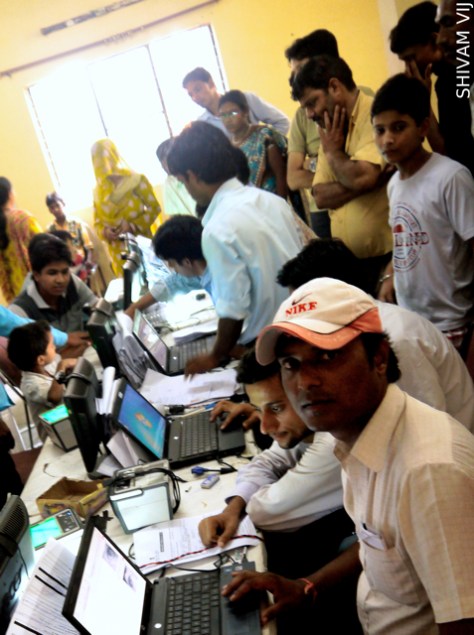
Contrary to what his name suggests, Bechu Lal Yadav, 29, isn’t a seller of goods. He is a recordist of identity. He is amongst a new breed of technical professionals that have come up overnight – the Biometricwallahs.  Continue reading The Biometricwallah

A Critical Primer on India’s UID: Simi Chacko and Pratiksha Khanduri

This guest post by SIMI CHACKO and PRATIKSHA KHANDURI is the full text of a booklet released in August 2011. A .pdf version of the booklet (41 pages, 304 KB) can be downloaded here.

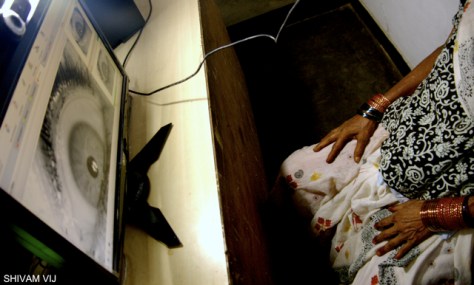
A citizen gets her iris scanned for a UID 'Aadhar' card in Delhi.

Introduction

A. UID: The Basics

B. The Enrolment Process

C. Benefits of UID

D. Concerns: Biometrics, Privacy, Data security, Surveillance

Continue reading A Critical Primer on India’s UID: Simi Chacko and Pratiksha Khanduri

Speed and Control at Manesar: Why is the Maruti-Suzuki Management Keeping Workers Out of Its Factory

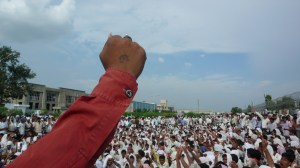
Protest Meeting at Maruti-Suzuki Factory, Manesar, September 01, 2011

Manesar is an emerging industrial hub roughly fifty kilometers from Delhi. Factories rise along the co-ordinates of a neat grid, overshadowed by the rocky Aravallis. The world is made here – cars, bikes, semiconductors, automotive parts, electronics, telecommunications equipment. Manesar has a little bit of everything. Even a bomb data analysis centre and a brain research lab and a military school and a heritage hotel. On a Maruti Swift, speeding down National Highway 8 towards Jaipur, you could make it to Manesar from Delhi, through Gurgaon, in less than an hour. Maruti’s ads are all about speed and control. Speed and control will cruise you to Manesar.

Continue reading Speed and Control at Manesar: Why is the Maruti-Suzuki Management Keeping Workers Out of Its Factory

A fax about Anna: Dilip D’Souza

Guest post by DILIP D’SOUZA

Of course everyone has their own take on the movement that’s got us all talking. It raises passions, it polarizes, it shakes the powerful, on and on. I have immense admiration for what Anna Hazare has achieved: the outrage against corruption where we had indifference before, the outlet for such outrage, the renewed hope where we had cynicism before, the way his movement has shamed brazen politicians and forced an entire government to listen.

Yet the movement sometimes reminds me, of all things, of fax machines. Continue reading A fax about Anna: Dilip D’Souza

Mediation, Middle Grounds and Meddling – The Medley of Middlemen

[Dedicated to Sankarshan Mukhopadhyay on account of “receiving ends”]

Couple of weeks ago, I was attempting to rent out the apartment that my mother and I own in an urban sprawl in South Bangalore. Among others, a broker – referring to himself as a ‘property consultant’ – approached me with a client. I met the client and conducted some negotiations. Eventually, however, I rented the apartment to persons who had approached me before the broker and his client saw our place. I politely refused the broker’s client. The broker contacted me soon thereafter and began issuing threats for not renting the place to his client. He threatened that it would be dangerous for me to spoil my business with him. Initially, I was also nervous and upset because I was unsure if the broker had an office in the neighbourhood and whether he was powerful enough to spread false rumours about our property which could potentially devalue the property and/or spoil my relations with the new tenants who had just come in. He then came to the apartment complex where the flat is situated and created a small ruckus. Finally, failing on all counts, he threatened to lodge a false police complaint against me for allegedly taking a deposit from his client without issuing a receipt. The broker’s threats turned out to be empty and damp squib as him. He never showed up after that dramatic afternoon of back-and-forth(s). Continue reading Mediation, Middle Grounds and Meddling – The Medley of Middlemen

The Power of Crowdsourcing

हिरोशिमा से फ़ुकुशिमा: अनिल मिश्र

Guest post by ANIL MISHRA

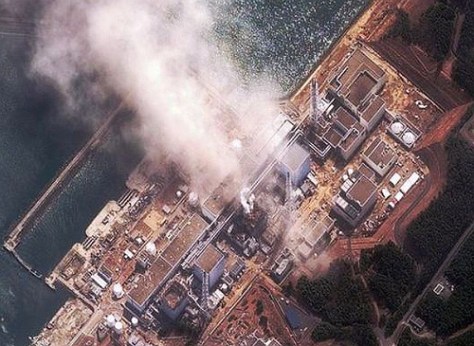
पिछले सप्ताह जापान में सुनामी के साथ आए भूकंप ने समूची दुनिया को दहला कर रख दिया है. इस विभीषिका से होने वाले नुक़सानों का वास्तविक आकलन, एड़ी चोटी के प्रयासों के बावजूद, अभी तक नहीं हो पाया है. सब कुछ धरती के नीचे दफ़्न हो जाने की सैकड़ों ख़बरें अभी तक आ रही हैं. रही सही कसर  परमाणु संयंत्रों में विस्फ़ोट के बाद विकिरण के ख़तरे ने पूरी कर दी है जिसके असर कई कई सालों और पीढ़ियों तक मारक होते हैं.

People evacuated from a nursing home
Fukushima - evacuated people

जापान के प्रधानमंत्री नाओतो कान के बयान कि ’दूसरे विश्वयुद्ध के बाद यह उनके देश में सबसे भयानक तबाही है, और कुछ मायनों में उससे भी ज़्यादा विनाशकारी’, के कई पहलू हैं. इसे प्राकृतिक आपदा में नष्ट हो चुके एक देश द्वारा महज वैश्विक मानवीय सहायता और सहानुभूति की अपील की तरह देखना पर्याप्त नहीं होगा. प्रधानमंत्री का बयान परमाणु ऊर्जा के ख़तरनाक पहलुओं की भी एक स्वीकारोक्ति है. मानवतावादी संकटों से निपटना निश्चित ही एक अहम और तात्कालिक चुनौती है. लेकिन परमाणु संयंत्रों में विस्फ़ोट और विकिरण के जो खतरे पैदा हो रहे हैं उनसे निपटना आने वाले दिनों में बेहद कठिन होगा. साथ ही, ऊर्जा के लिए परमाणु ईंधन को प्रोत्साहन देने वाले अन्य देशों की योजनाओं के लिए इससे कई महत्वपूर्ण सबक़ मिले हैं.
Continue reading हिरोशिमा से फ़ुकुशिमा: अनिल मिश्र

Praful Bidwai on Lessons for India from Fukushima

Excerpts from a recent article by Praful Bidwai, journalist, social science researcher and activist on issues of human rights, the environment, global justice and peace.

The crisis holds a number of lessons for India as it embarks on a massive nuclear power expansion programme, which will double and then further triple India’s nuclear power capacity.

First, nuclear power generation is inherently hazardous. It is the only form of energy production that can lead to a catastrophic accident with long-time health damage and environmental contamination. Human error or a natural calamity can trigger a catastrophe—but only because reactors are themselves vulnerable.

Reactors are high-pressure high-temperature systems in which a high-energy fission chain-reaction is only just controlled. Nuclear reactors are both systemically complex, and internally, tightly coupled. A fault or malfunction in one sub-system gets quickly transmitted to others and gets magnified till the whole system goes into crisis mode.

Continue reading Praful Bidwai on Lessons for India from Fukushima

How is Savita Bhabhi a Threat to India’s National Security?

“Ask the Home Ministry, because this is a security issue.”
That is what India’s Minister for Communications and Information Technology said recently when asked about the lack of transparency in the blocking of websites in India.

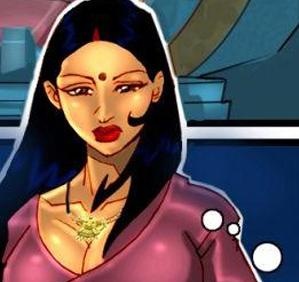
Now, one of the websites blocked in India is Savita Bhabhi, as also several mirror websites of the same. Savita Bhabhi, as you doubtless know, was a soft-porn web comic. All I want to ask Kapil Sibal is: How is Savita Bhabhi a threat to India’s national security? Wait, I have another question: Continue reading How is Savita Bhabhi a Threat to India’s National Security?

The Day India Will Shut Down the Internet

Sounds alarmist? Perhaps. But under the IT Amnedment Act of 2008, the Government of India gave itself the power to do so. The Economic Times reports: Continue reading The Day India Will Shut Down the Internet

Here’s what India’s Communications and IT Minister thinks about online freedom

Kapil Sibal said the following at a conference on social media in Delhi recently:

We’ve seen the power of the medium in the last six months or so seeking to perform a transformational role, but in the absence of a balance… this is really the danger of sites like these. What happens in the process is that all kinds of opinion get both elicited and taken forward, without the necessary wherewithal, and there’s a great danger, because this, I believe, is a part of freedom of speech. Continue reading Here’s what India’s Communications and IT Minister thinks about online freedom

On the fuzziness of Personal Identity: UIDAI and the national identity card of India: Taha Mehmood

Guest post by TAHA MEHMOOD

I – The spread of Identity cards in Southasia:

An identity card virus seems to be spreading across south-Asia. The pathogen emerged long ago in 1971, when Pakistan established a paper based personal identity system. !971 was also the year when Pakistan was engaged with India in a military conflict which led to the creation of Bangladesh. In 1972, a year later, the Department of Registrations of Persons located at Colombo, Sri Lanka, was entrusted with the responsibility of issuing a national identity to citizens who were over sixteen years of age. In 1972 the name of the island was changed from Ceylon to Sri Lanka and Tamil Tiger leader Velupillai Prabhakaran formed the Tamil New Tigers (TNT), which later became LTTE or Liberation Tigers of Tamil Eelam. The state of Sri Lanka was at war with LTTE for the next three decades. Nothing new happened on the national identity card front for the next two decades. Continue reading On the fuzziness of Personal Identity: UIDAI and the national identity card of India: Taha Mehmood

Going Viral: Cyberspace’s subtle fevers

Source: neuromancer.org

Over the last few weeks, I have been reading a fair bit on and around the whole idea of cyber-security, the ‘militarization of the internet’, the idea of military viruses and other William Gibson-esque stuff.

For those of us who read (and loved) Neuromancer – Gibson’s cyber punk novel set in a futuristic Chiba City, Japan – recent developments of the outer-fringes of the internet seem eerily like the world that Henry Dorset Case inhabits.

This post is primarily intended to serve no higher purpose than share a bunch of articles that I think are brilliant and should be read by everyone.  If you are looking for themes – I would suggest contemplating the idea of disruptive technology in an increasingly networked world.

Last week, I had posted a link to a story on how the Predator drones used by the CIA might be running on “hack” versions of their aiming software. It reminded of a WSJ article I had read about drones, more than a year ago.

Militants in Iraq have used $26 off-the-shelf software to intercept live video feeds from U.S. Predator drones, potentially providing them with information they need to evade or monitor U.S. military operations.

Continue reading Going Viral: Cyberspace’s subtle fevers

Aim for the Insurgent…

Source: historycommons.org

… and you just might hit the wedding party. A fascinating intellectual property rights dispute offers up a possible reason for the number of civilians killed by American drone strikes.

To quote from the article from The Register:

The dispute surrounds a location analysis software package – “Geospatial” – developed by a small company called Intelligent Integration Systems (IISi), which like Netezza is based in Massachusetts. IISi alleges that Netezza misled the CIA by saying that it could deliver the software on its new hardware, to a tight deadline. Continue reading Aim for the Insurgent…

Murder, not accident

“At the airport and blah =_= Only thing to look forward to is the rain.” That was Harshi’s last tweet. She was travelling to Mangalore to attend a wedding. She might have been able to enjoy the rain had it not been for the negligence of the negligence of the guardians of civil aviation in India. The crash, then, must be called murder, not accident.

This was no accident, but the direct result of deliberate failure of officials at the highest level in the Director General of Civil Aviation, Airports Authority of India, Ministry of Civil Aviation and the Government of Karnataka for allowing this 2nd runway to be built in criminal negligence of applicable norms and standards. Such a strong charge is being made as the likelihood of this kind of a crash (the worst case scenario) was predicted. A series of Public Interest Litigations were fought by the undersigned to stop the construction of this 2nd runway in Mangalore airport on grounds that the design simply did not conform to the most basic national and international standards of airport design. The PILs also highlighted that the airport does not conform with the most minimum safeguards for emergency situations – particularly during landings and takeoffs, and could not have emergency approach roads within a kilometre on all sides of the airport as required. [Environment Support Group]