Category Archives: Theory

Nehru, Ambedkar and Challenge of Majoritarianism

Image result for nehru ambedkar

( Photo courtesy : The hoot)

(To be published in the special issue of ‘Janata’)


The spectacle of what is called religion, or at any rate organised religion, in India and elsewhere, has filled me with horror and I have frequently condemned it and wished to make a clean sweep of it. Almost always it seemed to stand for blind belief and reaction, dogma and bigotry, superstition, exploitation and the preservation of vested interests.

– Toward Freedom: The Autobiography of Jawaharlal Nehru (1936), pp. 240–241.

If Hindu Raj does become a fact, it will no doubt, be the greatest calamity for this country. No matter what the Hindus say, Hinduism is a menace to liberty, equality and fraternity. On that account it is incompatible with democracy. Hindu Raj must be prevented at any cost.

– Ambedkar, ‘Pakistan or Partition of India’, p. 358.

Introduction

India’s slow ushering into a majoritarian democracy is a matter of concern for every such individual who still believes in pluralism, democracy, equality and a clear separation of religion and politics. The way people are being hounded for raising dissenting opinions, for eating food of their choice or entering into relationships of their own liking or celebrating festivals according to their own faith is unprecedented. The situation has reached such extremes that one can even be publicly lynched for belonging to one of the minority religions or for engaging in an activity which is considered to be ‘suspicious’ by the majority community.

No doubt there is no direct harm to the basic structure of the Constitution, its formal structure remains intact, de jure India does remain a democracy as well as a republic, but de facto democracy has slowly metamorphosed into majoritarianism and the sine qua non of a republic—that its citizens are supreme—is being watered down fast. It does not need underlining that this process has received tremendous boost with the ascent of Hindutva supremacist forces at the centrestage of Indian politics. Continue reading Nehru, Ambedkar and Challenge of Majoritarianism
‘Revolution against Das Kapital’ and the ‘Lonely Hour of the Economy’

This is a modified version of the article that was published earlier in The Wire

(T)he economic dialectic is never active in the pure state; in History, these instances, the superstructures etc – are never seen to step respectfully aside when their work is done or, when the Time comes, as his pure phenomena, to scatter before His Majesty the Economy as he strides along the royal road of the Dialectic. From the first moment to the last, the lonely hour of the ‘last instance’ never comes. – Louis Althusser, For Marx, London: Verso 1979, p. 113

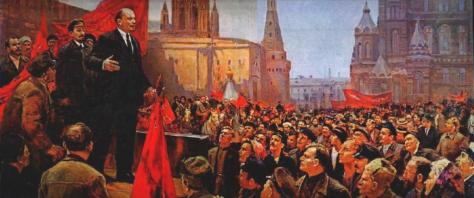
The event known to the world as the ‘October’ revolution in Russia – or simply as the ‘Russian revolution’ – took place on 7-8 November, a hundred years ago. But then why call it the October revolution? Thereby hangs a tale – the tale of modernity, myth-making and of a new imagination of Time.

The moment of revolution, image courtesy libcom.org

As a matter of fact, the Revolution occurred on 25-26 October, according to the Julian calendar (so called because it had been promulgated by Julius Caesar), which Russia, along with a large part of the Western world, followed at that time. It was only in January 1918 that the Soviet government decreed the shift to the Gregorian calendar. The reason was that Russia should join ‘all cultured nations in counting time’, as a decree cited by historian Mark Steinberg put it. Accordingly, the first anniversary of the revolution was celebrated on 7 November 1918 throughout the Soviet Union.

What is interesting here is not so much the shift but the reason assigned for it – joining other ‘cultured nations’ of the world, which in the language of the early twentieth century meant only one thing – the modern West, which had long been setting the norm for everything desirable. Ways of ‘counting time’ too had to be aligned with Europe, lest one be considered insufficiently modern. Spatially, the Czarist Russian empire straddled both Europe and Asia, which had already, in the new reckoning of Time, been cast as ‘advanced’ and ‘backward’ respectively. The desire to become modern and join the ‘cultured nations’ was to run through the history of the revolution and its consolidation into the new Stalinist state. This desire was to be manifested in its deep distrust of the peasantry and rural life on the one hand, and in the frenetic drive to ‘catch up’ with Western Europe. As Stalin would say, he wanted to accomplish in a couple of decades what Europe had in a few centuries, compressing time, as it were, into one dizzying experience for entire society. The continuing ‘past’ had to be annihilated.

Continue reading ‘Revolution against Das Kapital’ and the ‘Lonely Hour of the Economy’

When Charlatans Become Ideologues – The Real ‘Prisoners of the Binary’

Present day Hindus are probably the strongest opponents of Marxism. They are horrified at its doctrine of class-struggle. But they forget that India has been not merely the land of class struggle but she has been the land of class wars. – B. R. Ambedkar, Philosophy of Hinduism.

I often find myself in a bind over whether or not to respond to supposed RSS ideologues, given that they simply trade in lies and hatred with the supreme arrogance of ignorance. One such is the upcoming star on the RSS horizon, a gentleman called Rakesh Sinha, who like the rest of his pack (led by the supreme leader) is currently engaged in a cheap attack on the outgoing Vice-President, Hamid Ansari. His piece in the Indian Express today (linked above) is an  instance of a combination of all these things. So, why should one bother about such a character? Why take him and his discourse seriously? Well, someone had better respond because, because, for one thing they are in power, and are going to teach generations of students that valorous ‘Hindus’ like Maharana Pratap won all the wars, though by some magic, ‘Muslims’ continued to rule for about 8 centuries! For another, there are enough gullible types who really think these people ‘have a point of view’, which should be debated.

As we have repeatedly seen, their ‘having a point of view’ has nothing to do with debate. It is to be enforced by gangs of gorakshaks, anti-romeo squads, hoodlums deciding what will or will not be taught in universities and schools, what will be written, how people should dress and love – and when nothing works, ‘win’ a ‘debate’ like Arun Jaitley claimed they did, by simply arresting the opponents and slapping sedition charges on them. Given this, I do not really address, in person, the ideologue, Rakesh Sinha, who has now made it a fine art to pick up some phrases from the toolkit of what is understood as ‘postmodernism’ by many. Wasn’t it postmodernism, one can  hear them say, that said all viewpoints are equally valid and ‘everything goes’? Wasn’t it postmodernism that challenged the hegemony of Western thought, its logocentrism, its Rationalism (with a capital R) from within that very tradition? Wasn’t it postmodernism again, that by decentering West’s logocentrism, actually gave these RSS-type creatures the gumption to claim that their utterly unsubstantiated viewpoint about the past too was as valid as that of historians who struggled with evidence, painstakingly putting together texts, artefacts and procedures of dating in order to produce a plausible account of the past?

Continue reading When Charlatans Become Ideologues – The Real ‘Prisoners of the Binary’

Mathematics, Decolonization and Censorship: C. K. Raju

Guest post by C.K.RAJU
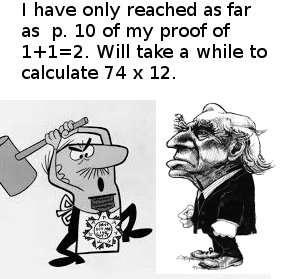
Did you find math difficult in school? Does your child? If so, what is the solution: change the teacher or change the child? Blaming the teacher or the child for math difficulties is a common but unsound explanation. Thus, problems with teachers or students should equally affect all subjects, not only math.The right solution is to change math. That seems impossible. People naively believe that math is universal. In fact, the math taught today, from middle school onward, is called formal math; it began only in the 20th c. with David Hilbert and Bertrand Russell. It differs from the normal math which people earlier did for thousands of years, across the world, and still do in kindergarten.Formal math adds enormously to the difficulty of math but nothing to its practical value. The practical value of math comes from efficient techniques of calculation, used in normal math, not prolix formal proofs. For example, the proof of 1+1=2 took Whitehead and Russell 368 pages of dense symbolism in their Principia. That proof is a liability in a grocer’s shop. In contrast, normal math is easy. One apple and one apple make two apples as most people learn in kindergarten. So should we switch back to normal math at all levels?

Russell

Continue reading Mathematics, Decolonization and Censorship: C. K. Raju

The Elephant in the Room – Silence on Class Issues in Indian Politics : Sanjay Kumar

Guest Post by SANJAY KUMAR

Ramesh has been working as a daily wager in a Government of India office in Delhi for ten years. He is one of the army of peons, office assistants, security guards, gardeners, and cleaning staff which government offices, city municipalities, hospitals, schools and colleges of the metropolis employ regularly. He is a graduate, but gets the wage of an unskilled worker. He is among the fortunate ones who at least get government mandated minimum wage. Most private employers in the city violate the minimum wage act; either they pay less than the mandated amount, or make daily wagers work more than eight hours without any overtime.

Ramesh was pleasantly surprised this April when he noted a more than 30% increase in his wages. His daily wage that stood at Rs 360/ earlier was now Rs 513/. This was due to a Government of Delhi notification issued on 3rd March, 2017. The news was covered in the inner pages of some newspapers. Most TV news channels ignored it. Hence, it is not surprising that employees like Ramesh who are not associated with any organsiation of workers were not aware of this increase. Continue reading The Elephant in the Room – Silence on Class Issues in Indian Politics : Sanjay Kumar

Karl Marx in the Times of Climate Change

The Communist Manifesto had, as its object, the proclamation of the inevitable impending dissolution of modern bourgeois property. But in Russia we find, face-to-face with the rapidly flowering capitalist swindle and bourgeois property, just beginning to develop, more than half the land owned in common by the peasants. Now the question is: can the Russian obshchina, though greatly undermined, yet a form of primeval common ownership of land, pass directly to the higher form of Communist common ownership? Or, on the contrary, must it first pass through the same process of dissolution such as constitutes the historical evolution of the West?

The only answer to that possible today is this: If the Russian Revolution becomes the signal for a proletarian revolution in the West, so that both complement each other, the present Russian common ownership of land may serve as the starting point for a communist development. [Marx and Engels, ‘Preface’ to the 1882 Russian Edition of The Communist Manifesto; all emphasis added]

The above passage, jointly signed by Marx and Engels, appears at the end of the 1882 ‘Preface’ to the Russian edition of The Communist Manifesto. It also appears, towards the end of a decade-long engagement with the Russian social formation and the social formation of many Eastern societies like India’s. The detailed notes, excerpts and commentaries compiled by Marx, published later as The Ethnological Notebooks of Karl Marx, belong precisely to the end of this period, the years 1880-1882. Marx passed away the following year, in 1983. Continue reading Karl Marx in the Times of Climate Change

New Politics of Our Times and Post-Capitalist Futures

An earlier version of this essay was published in Outlook magazine

“The young students are not interested in establishing that neoliberalism works – they’re trying to understand where markets fail and what to do about it, with an understanding that the failures are pervasive. That’s true of both micro and macroeconomics. I wouldn’t say it’s everywhere, but I’d say that it’s dominant.
“In policymaking circles I think it’s the same thing. Of course, there are people, say on the right in the United States who don’t recognise this. But even many of the people on the right would say markets don’t work very well, but their problem is governments are unable to correct it.”
Stiglitz went on to argue that one of the central tenets of the neoliberal ideology – the idea that markets function best when left alone and that an unregulated market is the best way to increase economic growth – has now been pretty much disproved. Read the full report by Will Martin here

One often hears over-zealous warriors of neoliberalism say of Leftists that they live in a time- warp; that the world has long changed and that the disappearance of state-socialism has finally proved that all their beliefs were little more than pipe-dreams. They talk as though history came to an end with the collapse of actually existing socialisms and the global ascendance of neoliberalism in the early 1990s. As though all thought came to an end; as if the distilled essence of everything that could ever be thought, or need be thought, was already encapsulated in the neoliberal dogma.

Continue reading New Politics of Our Times and Post-Capitalist Futures

Individuality and a Liberal Error – A Response to Pratap Mehta: Huzaifa Omair Siddiqi

Guest post by HUZAIFA OMAIR SIDDIQI

It has often been broadcast that we live in a post-truth age. In fact we live in an age better envisioned as one of post-certainty, where everything and every fact is liable to be pronounced uncertain and doubtful. The problem with the mainstream liberal discourse is its inability to catch up to the inevitable demise of certainty in the political sphere. What was most certain, according to Descartes, was the being of one’s own ego. In this age of post-certainty, this is the last certainty which the liberal discourse still seems to stick to, in the name of ‘individual rights’, without ever understanding the real essence of the question of individuality.

Muhammad Iqbal was the public intellectual of the last century who made this question of individuality his very own guiding question. This guiding question, how does individuation happen, was part of his desire to formulate his basic question, how does the community of individuals come into being? Pratap Bhanu Mehta, in his opinion piece in The Indian Express has sought to diagnose the tragedy of Iqbal as one which in its sacrifice of the rights of the individual, attempted to pursue the consolidation of the truly spiritual community. Mehta, one of India’s finest public intellectuals, cannot be questioned within this paradigm of liberal thinking.

Continue reading Individuality and a Liberal Error – A Response to Pratap Mehta: Huzaifa Omair Siddiqi

Rain and Revulsion: Prasanta Chakravarty

This is a GUEST POST by Prasanta Chakravarty

“Slime is the agony of water.”

~ Jean Paul Sartre, Being and Nothingness


The Birth of Revulsion – Pranabendu Dasgupta

No certainty where each would go —
Suddenly the descent of a cloudburst, rain.
We stood, each where we were,
And stared at one another.
It is not good to be so close
“Revulsion is born” – someone had said

“Revulsion, revulsion, revulsion.”
Then, lighting a cigarette, some man
Muttered abuse at another next to him.
Like an abstract painting, spiralling like a gyre,
In a wee space
We slowly fragmented, dispersed.
Had it not rained, though,
We would have stepped out together.
Perhaps to the cinema, tasting a woman’s
Half-exposed breast with the eye,
Then laughing out loud,
We could head for the maidan!
Someone maybe would sing; someone
Would say, “I am alive”.

But it rained.

(Krittibas, Sharad Sankhya,  1386)

 ঘৃণার জন্ম

প্রনবেন্দু দাশগুপ্ত

কোথায় কে যাবে ঠিক নেই —
হঠাৎ দুদ্দাড় ক ‘রে বৃষ্টি নেমে এলো।
যেখানে ছিলাম, ঠিক সেইখানে থেকে
আমরা পরস্পরের দিকে তাকিয়ে রইলাম।

এত কাছাকাছি থাকা খুব ভালো নয়।
” ঘৃণার জন্ম হয় ” –কে যেন বললো
” ঘৃণা, ঘৃণা, ঘৃণা। ”
তারপর সিগ্রেট ধরিয়ে, আরো একজন
খুব ফিশফিশ ক ‘রে
পাশের লোককে গাল দিলো।
বিমূর্ত ছবির মতো তালগোল পাকিয়ে পাকিয়ে
ছোট্ট জায়গা জূড়ে
আমরা ক্রমশ ভেঙে, ছড়িয়ে পড়লাম।

বৃষ্টি না নামলে কিন্তু
আমরা একসঙ্গে বেরিয়ে পড়তাম।
হয়তো সিনেমা গিয়ে,রমণীর আধ -খোলা স্তন
চোখ দিয়ে চেখে
তারপর, হো হো ক ‘রে হেসে
ময়দানের দিক যাওয়া যেতো !
কেউ হয়তো গান গাইতো ; কেউ হয়তো
বলতো “বেঁচে আছি “।

কিন্তু বৃষ্টি নেমেছিলো।।

(কৃত্তিবাস, শারদ সংখ্যা ১৩৮৬)

Continue reading Rain and Revulsion: Prasanta Chakravarty

On the Ongoing Debate in CPI(M): Dheeresh Saini

Guest Post by DHEERESH SAINI

“In India today, neither has fascism been established, nor are the conditions present — in political, economic and class terms — for a fascist regime to be established. There is no crisis that threatens a collapse of the capitalist system; the ruling classes of India face no threat to their class rule. No section of the ruling class is currently working for the overthrow of the bourgeois parliamentary system. What the ruling classes seek to do is to use forms of authoritarianism to serve their class interests,”

-Prakash Karat

When CPI(M) was under the stewardship of now deceased, voluntarily or forcefully retired leaders, young leaders-workers would say that when young leaders (who were actually middle aged then) like Prakash Karat and Sitaram Yechury take over, the party would zoom on to its real revolutionary track. Karat was always considered more principled and genuine between the two. Yechury has now succeeded Karat as the topmost leader. Meanwhile, the situation of the party that prided itself in waging nationwide struggle against the fascist forces went from bad to worse in West Bengal considered as its fort. In the present scenario, any party considered as progressive or secular, would be bound to face such situation. But it is disappointing to see CPI(M) hog the headlines, in such tough times, on account of constant tussle between its two stars considered most resplendent. Continue reading On the Ongoing Debate in CPI(M): Dheeresh Saini

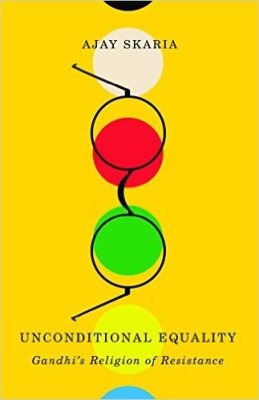
Gandhi – A Religion of the Question: Ajay Skaria

[The following is the ‘Preface’ to AJAY SKARIA’s recent book, Unconditional Equality: Gandhi’s Religion of Resistance by Ajay Skaria. The preface raises interesting questions not only about Gandhi’s politics but also about the idea/s of secularism and religion in what we might call a postsecular world – a world that is, where the naive and uninterrogated binary between the two terms is constantly put into question. Also of interest to readers might be the attempt made by the author to read Gandhi’s writings as a long and ongoing struggle to articulate or ‘understand’ his own politics – a politics that Skaria claims is as much premised on equality among humans as it is on the equality of all being/s.]

Unconditional Equality by Ajay Skaria

Somewhere in the early 2000s, while preparing to teach Mohandas Karamchand Gandhi’s English translation of Hind Swaraj to my undergraduate class, a passage about history in the text intrigued me. Since I happened to have the Gujarati version of that text at hand, I consulted it. The divergence is striking. The Gujarati text criticizes “history” (the English word occurs in the Gujarati text) and contrasts  it to itihaas [usually translated as “history”]. The English text criticizes “history,” but in it there is no equivalent for itihaas; the contrast between history and itihaas is thus obscured. The gap between the Gujarati and English texts, I have since come to realize, is symptomatic of Gandhi’s struggles to think his politics. What this politics involves is by no means clear to him; perhaps he writes so prolifically and indefatigably (his collected works run to ninety-eight volumes in English) precisely in order to try and understand his own politics. This politics becomes even more intriguing when we attend not only to Gandhi as an author or “intending subject,” but to his writing.[1] By dwelling in and on the gaps (between Gujarati and English and also within each of these languages) in his writing, this book tries to draw out his politics.

For me, writing this book has been difficult also because of another gap—that between Gandhi’s insistence that there can be “no politics without religion” and the secular inheritance that I have, as far as I know, no desire to abandon. Gandhi repeatedly describes satyagraha (his most famous neologism, which he coins initially as a translation of “passive resistance”) as his “dharma” or “religion,” even as the religion that stays in all religions.[2] Symptomatic of my difficulty with this religious politics was my inability for long to even recognize it. When Vinay Lal first asked me in 2007 to write an essay on Gandhi’s religion for a volume he was planning on political Hinduism, I protested that I was not interested in this aspect of Gandhi. But with his characteristic persistence, Vinay did not accept my protests, and I ended up writing that essay, which became a precursor of this book.

In the process, my own understanding of dharma and religion as “concepts” has been transformed.[3]

Continue reading Gandhi – A Religion of the Question: Ajay Skaria

Reading Foucault in Mahendragarh

history_of_sexuality2c_french_edition2c_volume_one

In March this year in a rural hamlet 3 hours by train from New Delhi, the local edition of Hari Bhoomi carried an unusual piece of news: Central University of Haryana (CUH) at Mahendragarh, had filed a police complaint against a Facebook page.

The story was short on specifics, but an email to the university registrar, Ram Dutt, elicited a reply:

“Yes, University has filed a complaint against the CUH Media page (anonymously administered unlawfully using acronym of the University) to trace the identity of the page. As the University is Autonomous Body and has the right to continuous vigil to maintain the reputation of the University on the Internet World …”

What was this page, “anonymously administered”, that had the administration so upset? Who were these students “unlawfully using the acronym of the university” to besmirch the university’s reputation “on the Internet World”?

At first glance, the CUH Media page was just like the millions of pages on Facebook visited by a small band of followers – at last count it had just 174 “Likes” – who trolled each other. But a closer look at the posts, the comments they attracted, and their ripples offline, since the page was started in September 2015, suggested the gradual emergence of a spiky student politics in one of India’s newest central universities. Read More


Rebellion as Contagion

IMG_2231

Perhaps this is the infection, the gangrene, that Justice Pratibha Rani fears: a slogan, chanted in the streets of Srinagar as a matter of routine, finds an opening at a university campus in New Delhi. Freed from the usual suspects, unmoored from the routine skirmishes, deaths, and encounters, along the Line of Control, the slogan floats through a university corridor – distracting rows of disciplined students from their academic pursuits.

A slogan’s explosive power, it seems, is not just about what is shouted – but rather where it appears, and who takes up the call. This realisation offers us an opportunity, long sought, to think through this troubling question of “Freedom of Expression.” Read the rest of this piece here

A Review of Purifying the Land of the Pure – Pakistan’s Religious Minorities : Guest Post by Karthik Venkatesh

Guest Post by Karthik Venkatesh

Pakistan was created as a homeland for the sub-continent’s Muslims and yet, even before it had formally taken birth, its founder in a famous speech delivered on August 11, 1947 stated his intention to establish a secular nation where religion would be relegated to the private sphere and the public discourse would be given to pressing development issues. Jinnah’s first cabinet consisted of an Ahmadi (considered by orthodox Muslims as a heretical sect), Sir Zafarullah Khan and Jogendranath Manadal, a Hindu from East Pakistan. Jinnah himself was a Shia while the majority of Pakistan’s Muslims were Sunnis. Roughly one-quarter of Pakistan was non-Muslim at the time of independence and secularism seemed a realistic option. Also, Jinnah’s actions appeared to imply that it would actually be practised. But events proved otherwise.

During Jinnah’s time itself, as Ispahani adeptly documents, an unhealthy nexus had begun to develop between politicians and extremist religious groups. His death in 1948 merely served to accentuate this process. In March 1949, PM Liaquat Ali Khan moved the Objectives Resolution in the Constituent Assembly which set the tone for the Islamisation of Pakistan. Continue reading A Review of Purifying the Land of the Pure – Pakistan’s Religious Minorities : Guest Post by Karthik Venkatesh

“A Glorious Thing Made Up Of Stardust:” What Pat Parker & Rohith Vemula Ask Us to Consider Lata Mani

This is a guest post by LATA MANI

The first thing you do is to forget that I’m black
Second, you must never forget that I’m black

Pat Parker (1978)

In these opening lines of her poem, For the White Person Who Wants to Know How to be My Friend, Pat Parker names a paradox at the heart of challenging socially produced difference. Parker is speaking not to diversity in nature, nor to the diversity of nature. Not to the variations of appearance – size, shade, height, foliage, texture; or mode of expression – hoot, howl, accent, gesture, cultural practices. Her lines address a uniquely human phenomenon: prejudice. They speak to the poignant difficulty of challenging a spurious and malevolent construction of racial difference in a society still in the grip of its miasma.

I have recalled Parker’s lines many times in the days of sorrow, tumult and righteous rage that have followed Rohith Vemula’s suicide. “Rohith Vemula’s suicide.” I am holding off from saying “Dalit scholar Rohith Vemula’s suicide.” Or, as is now being said with good reason, “Dalit scholar Rohith Vemula’s institutional murder.” I defer by a couple of sentences a description of him that refers to the caste into which he was born; to honour if only symbolically his anguish that the contingent facts of his birth had indelibly defined his life.

Continue reading “A Glorious Thing Made Up Of Stardust:” What Pat Parker & Rohith Vemula Ask Us to Consider Lata Mani

The Terror That Is Man: Shaj Mohan

Guest post by SHAJ MOHAN

Manifold is the un-homely, yet nothing is more un-homely than man — Sophocles

The middle of the previous century is understood to be the termination of all kinds of containments of man, having witnessed the worst containment in the Camp[i]. This termination resulted from a crisis that is both philosophical and political: what is the de-termination of man such that he is not the contained? A summary of this scenario is found in a trivial understanding of Foucault’s statements concerning “the end of man” (The Order of Things) and Derrida’s deconstruction of the notion of the “the end” in his essay “Ends of Man” (Margins of Philosophy). As a result of the exigencies of the philosophical and the political, the concept of the state located itself, in the occidental domain, away from the containers. The State would no longer claim to be the clergy and the sovereign of containers such as race and religion. Instead, the State demanded only the right to primary containment—first Indian and then Muslim, first British then White, first Spanish then Basque. The list, the differences, the classification and the management of all the other containers—religion, caste, language, race, public, private—were left up to the new clerics, the new academic disciplines and the NGOs. If all containers were opened up then everything should have flooded out and mixed to form a substance of a new world of people; rather, a substantiality for the in-terminable formation of people. This new people-substance should have dissolved the traces of all the containers, the way science-fiction often imagines the future to be. It should have left for us tales which are the negative of memories, that is, taboos, or myths. For example, the tales that we received about incest from the ancients, the tales of cannibalism in fairy tales, the tales of the world’s resistance to Nazism. Continue reading The Terror That Is Man: Shaj Mohan

गांधी से नफरत, गोडसे से प्यार

 देश विभाजन के काफी पहले ही गांधीजी को मारने की साजिश रची गई थी।

( Photo by Mondadori Portfolio via Getty Images,  Courtesy – blogs.timesofindia.indiatimes.com

हिन्दू महासभा ने 15 नवंबर को बलिदान दिवस मनाने का फैसला किया है। इस दिन महात्मा गांधी के हत्यारे नाथूराम गोडसे को फांसी हुई थी। पिछले साल हिन्दू महासभा ने देश भर में नाथूराम गोडसे के मंदिरों का निर्माण करने का ऐलान किया था। काफी हो-हल्ला मचने के बाद यह अभियान रुक गया। इस बार केंद्र सरकार हिन्दू महासभा के प्रति क्या रुख अख्तियार करती है, यह देखना दिलचस्प रहेगा। महात्मा गांधी की हत्या को लेकर एक बात अक्सर कही जाती है कि नाथूराम गोडसे गांधीजी से नाराज था, क्योंकि गांधीजी ने देश का बंटवारा होने दिया और वह पाकिस्तान को पचपन करोड़ रुपये देने की बात किया करते थे।                                                                                                                                              

दरअसल इन दो तथ्यों की आड़ में उस लंबी साजिश पर पर्दा डाला जाता है जो हिन्दूवादी संगठनों ने रची थी। सचाई यह है कि गांधीजी को मारने की कोशिशें विभाजन के काफी पहले से शुरू हो गई थीं। आखिरी ‘सफल’ कोशिश के पहले उन पर चार बार हमले के प्रयास किए गए। चुन्नी भाई वैद्य जैसे सर्वोदयी के मुताबिक हिन्दूवादी संगठनों ने कुल छह बार उन्हें मारने की कोशिश की, जब न पाकिस्तान अस्तित्व में था और न ही पचपन करोड़ का मसला आया था। पिछले दिनों गांधीजी की हत्या पर ‘बियॉन्ड डाउट: ए डॉशियर ऑन गांधीज असेसिनेशन’ नाम से लेखों का संकलन (संपादन: तीस्ता सीतलवाड) प्रकाशित हुआ है, जो इस मामले की कई पर्ते खोलता है। Continue reading गांधी से नफरत, गोडसे से प्यार

The Indian Unconscious : Ravi Sinha

Guest Post by Ravi Sinha

There is yet another head on the political platter of the world’s largest democracy. This head is not metaphorical. It does not signify a disgraced leader or a government that has fallen. It is a literal head dripping with literal blood – battered with bricks that supported a leg-less bed. The bed belonged to one Muhammad Akhlaq who lived in a village called Basehara in Dadri, Uttar Pradesh, not too far from the national capital of India. The head too belonged to him.

It has been only a few days but this latest episode in the long-running Indian serial is already well-known to the world. On a late September night it was announced over the loudspeakers of the village temple that there was going to be beef on Akhlaq’s dinner plate. A mob hundreds-strong – some say thousands – gathered within no time. It attacked the family killing Akhlaq on the spot and badly injuring his son, Danish.

In the meantime, meat-loafs confiscated from the family fridge have been sent for forensic examination. The system of justice must check whether it actually was beef, although, as one commentator points out, “…mere possession of beef isn’t illegal in Uttar Pradesh.”[1] Shedding helpful light on feebly lit corners of the Hindu moral universe, a prominent Hindutva ideologue wrote in a national daily, “Lynching a person merely on suspicion is absolutely wrong, the antithesis of all that India stands for and all that Hinduism preaches.”[2] The lynch-mob should have waited till the forensic reports came.

A few suspects have been apprehended for the murder. This has made the village livid with anger. There are protestations that those arrested are innocent. Journalists have been attacked for making such a big thing out of a small matter and bringing a bad name to the village. Cameras have been broken and OB vans damaged. There is a pertinacious wall of angry women guarding the village against any further intrusion by outsiders who can neither understand the village mind nor the Indian culture.

It is not easy to understand the collective mind of an Indian village. Even learned anthropologists are of little help. Their ethnographic techniques of studying a form of life from its internal standpoint are particularly susceptible to the rationalizations of a complex cultural species. If anyone has a chance, it would, perhaps, be a villager who has stepped out – an Archimedean Point created out of the same cultural universe. Ravish Kumar, by now a near iconic journalist and anchor of a prominent Hindi news channel, stood out for this very reason.[3] His eyes could see the natural rhythm and the instinctual response of an Indian village in the immediate aftermath of a collective crime. Nearly everyone had disappeared from the village. Whoever could be found claimed that he was miles away at the time of the incident. The lynch-mob had materialized instantaneously out of thin air. It had as quickly melted away after the job was done. Everyone has now returned to defend the honor of the village and strategize about how to deal with the unwarranted intrusions of modernity including that of the law. Continue reading The Indian Unconscious : Ravi Sinha

Periyar – Brahminism’s Nightmare: Satya Sagar

Guest Post By  SATYA SAGAR

Trust Markandeya Katju to rush in where angels fear to tread – casually disparaging the legacy of E.V.Ramaswamy Naicker or ‘Periyar’, founder of the Dravidian movement and arguably one of the greatest social reformers in modern India.

 According to former Justice Katju, in a recent post on his Facebook page, “Periyar ( E.V. Ramaswamy) was objectively a British agent, who preached caste hatred, particularly against Brahmins”

It is perhaps a fitting tribute to the revolutionary character of Periyar that, four decades after his death, he is still reviled by upper-caste Hindus of India,of both the Establishment and ‘anti-Establishment’ variety. And Markandeya Katju is not the only ‘secular, progressive’ intellectual  in this country to have such contempt for or very little knowledge of Periyar and his work. Continue reading Periyar – Brahminism’s Nightmare: Satya Sagar

Frontline’s Calculus of Caste: C. K. Raju

Guest post by C. K. RAJU

[Frontline carried a historically ill-informed article on Indian calculus which also had mathematical and casteist errors. When the errors were pointed out, the magazine ignored it, contrary to journalistic ethics. Here is Prof Raju’s response to that article.]

Frontline (23 Jan 2015) published an excessively ill-informed article by Biman Nath on “Calculus & India”. The article suppressed the existence of my 500 page tome on Cultural Foundations of Mathematics: the Nature of Mathematical Proof and the Transmission of Calculus from India to Europe in the 16th c. (Pearson Longman, 2007). This suppression was deliberate, for Nath and Frontline ignored it even after it was pointed out to them. They also refused to correct serious mathematical and casteist errors in the article. That is contrary to journalistic ethics. To understand my response, some background is needed.

According to my above book and various related articles, the calculus developed in India and was transmitted to Europe. The second part of the story is lesser known. As often happens with imported knowledge, calculus was misunderstood in Europe. Later that inferior misunderstanding was given back to India through colonial education, and continues to be taught to this day just by declaring it as “superior”. That claim of superiority was never cross-checked to see if it is any different from the other flimsy claims of superiority earlier made by the West, for centuries, for example the racist claim that white-skinned people are “superior”. Continue reading Frontline’s Calculus of Caste: C. K. Raju

An Interview on the Continuing Relevance of Marx

The following is an interview with PRADIP BAKSI, an independent Marx scholar based in Kolkata. He has translated and edited some of the notes and manuscripts of Karl Marx on mathematics and on the history of land relations in India. He has also written on Marx’s study of some of the natural sciences and technologies of his time. The interview was conducted by SANKAR RAY, a senior journalist based in Kolkata.

Sankar Ray [SR]: What are your views on the relevance of Marx for India today, in the context of the financial crisis continuing since 2008, a certain renewal of interest in Marx’s Capital and, of late in Piketty’s Capital for the 21st Century?

Pradip Baksi [PB]: Despite the echo of the title of Marx’s famous book in the title of Piketty’s bestseller, the latter is an exercise within one of the currently fashionable strands of Marx-innocent political economy. In contrast Marx’s Capital is a part of an unfinished and incomplete program of critique of political economy, proposing a continuous reconstruction of it as a science.

While marshalling a very large and interesting dataset on growing inequality within contemporary capitalism, Piketty proposes to make that inequality bearable through taxation within future capitalism, and thereby holds a brief for that very capitalism. Marx, it is true, left his critique of political economy incomplete and unfinished, but he never held any brief for capitalism.

The ongoing financial crisis has triggered some interest in these two books in some quarters. This financial crisis and this interest may or may not last long. I do not wish to speculate about that. The questions of relevance or otherwise of Marx for India, and for the rest of the world, however, are questions of a different order. Continue reading An Interview on the Continuing Relevance of Marx