Category Archives: Violence/Conflict

The Anatomy of a Disappearance: Shehla Rashid

Guest Post by Shehla Rashid. Videos by Haider Saif and Samim Asgor Ali

Students Gathering in a Vigil for Najeeb Ahmed at JNU


Think of the person closest to you, and the place that they hold in your daily life, the bittersweet memories that they create each day in your life, the daily fights and the moments of affection. At times, you fight and simply want to go away from one another, seeking a temporary calm from each other’s absence. You resolve never to call him/her again, or to speak to her/him anymore. However, by the time dusk falls, you realise the emptiness of your time without them, and you make a phone call, speaking reservedly, trying not to sound desperate or sappy. You tell them that you are coming home, and ask whether you need them to get anything- as if that were the reason for the phone call. This person could be you sister, your partner, or your best friend. Continue reading The Anatomy of a Disappearance: Shehla Rashid

End repression in Kashmir: A call from civil society

We, the undersigned, are dismayed over the ongoing crisis in Kashmir. We have watched in horror and shock the repetitive cycle of state aggression leading to violence, deteriorating state of civil liberties, violation of fundamental rights and ever escalating loss of human life and dignity in Kashmir. In the last 115 days, we have lost over 100 lives in Kashmir. More than 15,000 civilians have been injured, out of which 4500 persons have suffered grievous injuries due to pellet-guns, 4664 have been injured by bullets. Over 8000 people have been arrested out of which 434 people have been detained under the Public Safety Act (toll as on October 30, 2016).

The immediate response of the Indian state to the recent uprising in Kashmir was the imposition of curfew, which is continuing till date. A media gag where newspaper offices have been raided, copies confiscated and editors threatened with dire consequences, accompanied it. Journalists reporting the situation have been attacked, intimidated and threatened with violence by those supposedly responsible for protecting them. Most recently the government banned the publication of Kashmir Reader, a daily newspaper published from Srinagar.

Continue reading End repression in Kashmir: A call from civil society

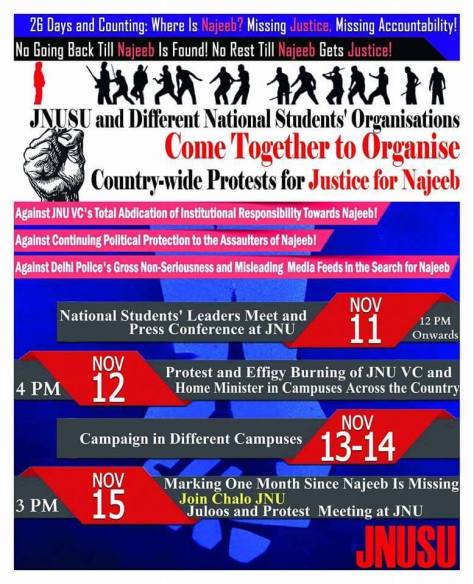
2 Weeks No #JusticeForNajeeb – A Few Thoughts on Yesterday’s March and the Way Forward: Shehla Rashid

Guest Post by Shehla Rashid.

Video and Photo Inputs from Naushad MK, Samim Asgor Ali and Amit Kumar

[ This post was written shortly after JNU students gathered in front of Vasant Vihar Police Station to articulate their concern and anger at the lax attitude taken so far by the Delhi Police and other concerned authorities in relation to the disappearance of Najeeb Ahmed almost two weeks ago. In this text, (originally uploaded as a note on Facebook and then sent to us to be posted at Kafila) Shehla Rashid, thinks aloud about what has happened so far and looks ahead at the possible way forward for the students of JNU and their supporters to focus on making sure that Najeeb Ahmed, wherever he is, returns safe and sound to the JNU campus. We hope that it will be widely read, and discussed to evolve strategies for the evolving future of the campaign to give justice to Najeeb. Kafila]

Shehla Rashid and Others Being Confronted by Delhi Police at the Vasant Vihar Chakka Jam on Oc. 26, 2016


First of all, I’d like to express my gratitude to all the students who joined the Chakka Jam at Vasant Vihar police station, where the ACP refused to even accept the paper with our demands and, instead, ordered a lathi-charge on us. Students marched as one and stayed together till the end, despite all differences, for one goal- justice for Najeeb, and his safe return to campus life. I salute this spirit of JNU students. Having said that, I must say that we need to do more. Students need to come out in even greater numbers, as the attack on us is of immense magnitude.

Continue reading 2 Weeks No #JusticeForNajeeb – A Few Thoughts on Yesterday’s March and the Way Forward: Shehla Rashid

An Appeal by JNU Teachers on the Disappearance of Najeeb Ahmed

We, the undersigned teachers of JNU, are deeply concerned about the continued absence of Najeeb Ahmad, a student of M.Sc. Biotechnology, who was last reported as seen  on JNU campus on 15 October 2016. We express our deepest sympathy and solidarity with Najeeb’s mother, sisters and extended family, and share in their anxiety and despair at the fact that even after ten days of Najeeb’s disappearance, neither the police not the JNU authorities have been able to provide any credible leads to his whereabouts; indeed, both have failed to even keep the JNU community informed of the progress of the search operations.

The JNUTA has repeatedly requested the VC to issue a personal appeal assuring Najeeb complete security and due process and to immediately set up a channel for the dissemination of this information, but to our dismay, the JNU administration has taken no concrete steps in this direction.The very least the JNU administration can do at this juncture is to issue a press release detailing all the steps it has taken thus far in facilitating the search for Najeeb, including its own efforts as well as its communications to the police and other authorities, and thereafter issue daily bulletins on the developments in the search. This willingness to share information with the JNU community and particularly Najeeb’s distraught and anxious mother and family, is absolutely imperative, both as a measure of enforcing accountability as well as to prevent the circulation of unfounded rumours. Continue reading An Appeal by JNU Teachers on the Disappearance of Najeeb Ahmed

Resist the Draconian and Undemocratic Ban Order on the Kashmir Reader Newspaper: Junaid Nabi Bazaz

Guest Post by Junaid Nabi Bazaz. Photos by Abid Bhat and from Kashmir Reader Online

kashmir-reader-ban-759


In a move unprecedented in the last three decades in the strife torn Kashmir valley, the Jammu and Kashmir government published an order in early October that stated that Kashmir Reader (KR), a vocal newspaper with circulation of less than10000 copies, contained material and content ‘which tends to incite violence and disturb public peace and tranquility.’ This was then used as a justification for placing a ban on the publication of KR. Today, on the 25th of October, Journalists assembled in Srinagar to protest this arbitrary ban.

Continue reading Resist the Draconian and Undemocratic Ban Order on the Kashmir Reader Newspaper: Junaid Nabi Bazaz

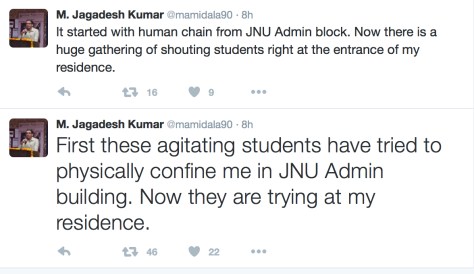
The Twitter Gherao of Mamidala90 on the 10th Day of Najeeb Ahmed’s Disappearance from JNU: Shehla Rashid

Guest Post by Shehla Rashid

[ Between the 9th and 1oth day of the disappearance of Najeeb Ahmed from the JNU campus, the JNU Vice Chancellor, Mamidala Jagadesh Kumar decided to salvage his reputation on twitter, even as he squandered it on the grounds of the campus of the university he presides over. And so he let forth a volley of tweets, while sitting inside his office and his residence, even as he refused to meet or listen to the JNU students who have grown increasingly concerned and anxious at the university administrations callous laxity about the fate of Najeeb Ahmed, the missing students.

While students marched down the campus, forming a human chain that culminated at the gates of the VC’s residence near the university’s east gate, Mamidala90 (the handle with which the VC distinguishes himself in twitsville) began getting extremely active. While the students were peacefully assembled at the gates of the VC’s residence, very much not in ‘gherao’ or ‘blockade’ mode, Mamidala90 whined about being ‘blockaded’.

A Sample of Mamidala90's tweets while students gathered peacefully outside his residence. Is this what it felt like to hear Nero fiddle while Rome burnt?
A Sample of Mamidala90’s tweets while students gathered peacefully outside his residence. Is this what it felt like to hear Nero fiddle while Rome burnt?

Continue reading The Twitter Gherao of Mamidala90 on the 10th Day of Najeeb Ahmed’s Disappearance from JNU: Shehla Rashid

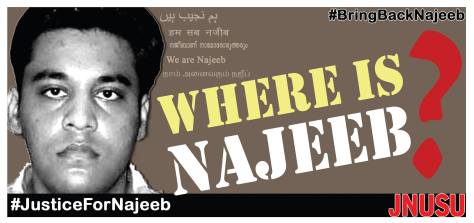
Bring Back Najeeb Ahmed to JNU: A Call to Resist Terror in Universities

14615765_679911288839993_8711625822412574391_o-1

It is now more than a week since Najeeb Ahmed, an MSc (first year) student of Biotechnology at Jawaharlal Nehru University, Delhi has been reported missing, after an altercation with members of the RSS affiliated ABVP student organization, which reportedly left him injured and severely traumatized.

Continue reading Bring Back Najeeb Ahmed to JNU: A Call to Resist Terror in Universities

Killings in Kaziranga, Dantewada Hazaribagh – ‘National Interest’, ‘Internal Security’ and ‘Development’: Kamal Nayan Choubey

Guest post by KAMAL NAYAN CHOUBEY

In the last few weeks there were at least three gruesome incidents of killing of tribals or forest dwelling persons in different parts of the country. In the first incident two persons from Muslim community were killed in police firing near Kaziranga National Park (KNP) of Assam on 19 September 2016. These people were peacefully protesting against their eviction drive carried out by local administration, which was implementing the judgment of Gauhati High Court related to evictions. In the second incident two young boys were killed by police in the Bastar area of the Chhattisgarh, and following the long tradition of all such killings, the police claimed that they were Maoists. The third incident occurred on the 1st October in the Hazaribagh, Jharkhand where the police used its brutal power and killed four persons in an open firing. These people were peacefully protesting against land acquisition for a Thermal Power Plant, which would cause their displacement. It is should be asked that why the State used its brutal power against one of the most marginalized sections of the society? Was firing on these unarmed and, at least in two cases, peacefully protesting tribal and forest dwelling people necessary? Could it be claimed by the State authorities that they fulfilled all constitutional obligations in the context of the demands of these people, in other words, could it be claimed by authorities that their demands were absurd and unconstitutional? Or would it be more correct to underline that tribals represent the marginal voices of the Indian nation-state, and mainstream notions of ‘national interest’, ‘internal security’ and ‘development’ have meager or no space for their claims or rights?

Continue reading Killings in Kaziranga, Dantewada Hazaribagh – ‘National Interest’, ‘Internal Security’ and ‘Development’: Kamal Nayan Choubey

Indian and Pakistani citizens speak out against war

article-sbhlockykc-1452406888

Images from #ProfilesforPeace (Scroll.in)

This petition will be delivered to:

  • Prime Minister Of India Narendra Modi
  • Prime Minister of Pakistan Nawaz Sharif

We, the people of India and Pakistan, stand in solidarity with each other to speak out against war in any form because, in war, we are all losers regardless of who might appear to win.

We hope that the elected representatives of both countries will exercise restraint, and act with wisdom, in the interests of lasting peace in our region, which alone can ensure economic progress and political stability.

We urge our leaders to come up with creative diplomatic solutions instead of engaging in a violent display of military might that threatens to destroy precious human life and natural resources.

We are determined to end the hostility that has festered between our nations since 1947, so that we can collectively work on the challenges that our common to us: climate change, terrorism, and widespread social injustice.

We want India and Pakistan to make a joint commitment to promote a culture of peace and non-violence, in keeping with the United Nations Sustainable Development Goals, and our vision for a better future for the young people of this planet.

Women Of The World Stand With Sharmila – Repeal AFSPA Now!

Statement from Stand With Irom Sharmila campaign

sharmila_20151105

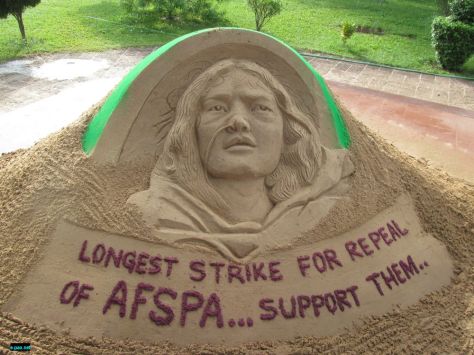
Sand Sculpture at Cuttack, Orissa by artist Himanshu Shekhar Parida, in solidarity with Irom Sharmila’s struggle for repeal of AFSPA,  to mark 15 years of completion of  her hunger protest in 2015. (Image courtesy E-Pao)

“My struggle will continue until AFSPA is struck down” said Irom Sharmila Chanu, the poet and activist from Manipur whose 16-year long hunger strike against the Armed Forces Special Powers Act has made her a global symbol of non-violent resistance. Sharmila was speaking at a press conference organised on October 1, 2016 by the “Stand With Irom Sharmila: Repeal AFSPA” Campaign, a global campaign endorsed by nearly 1000 women – from pioneers of global women’s movements to grassroot activists who have dedicated their lives to the struggle for women’s rights and freedoms.

The Armed Forces Special Powers Act (AFSPA) is a colonial law first promulgated by the British rulers of India in 1942 to try and quell the freedom struggle. It has been continuously operative in several north-eastern states, including Sharmila’s home state of Manipur since 1958. It was also imposed in Jammu and Kashmir in 1990. Under this law, armed forces and other security forces in “disturbed areas” have the license to shoot to kill anyone on suspicion; make arrests without warrants; enter and search any home or establishment; detain and question anyone. Armed forces personnel and security forces have complete immunity for actions taken under this law, and their prosecution requires prior sanction of the government, under Section 6 of the AFSPA. RTI information has disclosed that Sanction for prosecution of armed forces even for egregious human rights violation has never been granted. Nor is the government’s decision on declaring an area “disturbed” subject to judicial review.
Continue reading Women Of The World Stand With Sharmila – Repeal AFSPA Now!

Ae Shareef Insanon – Sahir Ludhianvi Talks to Those Who Are Still Sane in India and Pakistan

Ae Shareef Insanon

(Sahir Ludhianvi)

khoon apna ho ya paraya ho,
nasl-e-adam ka khoon hai aakhir;

jang mashriq mein ho ya maghrib mein,
aman-e-alam ka khoon hai aakhir.

jang to khud hi ek maslaa hai,
jang kyaa maslon ka hal degi;

aag aur khoon aaj bakhshegi,
bhookh aur ehtiyaaj kal degi.

bartaree ke saboot ki khatir,
khoon bahana hi kya zaroori hai?

ghar ki tareeqiyan mitane ko,
ghar jalana hi kya zaroori hai?

Bomb gharon par giren ke sarhad par,
Rooh-e-taameer zakhm khati hai;

Khet apne jalein ke auron ke,
Zeest faaqon mein tilmilati hai.

Tank aage badhe ke peeche hate,
Kokh dharti ki baanjh hoti hai;

Fateh ka jashn ho ke haar ka soug,
Zindagi maiyaton pe roti hai.

Isliye ae shareef insanon,
jang taltee rahe to behtar hai;

aap aur ham sabhi ke aangan mein,
shama jalti rahe to behtar hai.


اے شريف انسانو !
(ساحر لدھيانوي)

خون اپنا ہو يا پرايا ہو
نسلِ آدم کا خون ہے آخر
جنگ مشرق ميں ہو کہ مغرب ميں
امنِ عالم کا خون ہے آخر
بم گھروں پر گريں کہ سرحد پر
روح تعمير زخم کھاتی ہے
کھيت اپنے جليں کہ اوروں کے
زيست فاقوں سے تلملاتی ہے
ٹينک آگے بڑھيں، کہ پيچھے ہٹيں
کوکھ دھرتی کی بانجھ ہوتی ہے
فتح کا جشن ہو کہ ہار کا سوگ
زندگی ميتوں پر روتی ہے
جنگ تو خود ہی ايک مسئلہ ہے
جنگ کيا مسئلوں کا حل دے گی
آگ اور خون آج بخشے گی
بھوک اور احتياج کل دے گی
اس ليے اے شريف انسانو !
جنگ ٹلتی رہے تو بہتر ہے
آپ اور ہم سبھی کے آنگن ميں
شمع جلتی رہے تو بہتر ہے
برتری کے ثبوت کی خاطر
خوں بہانا ہی کيا ضروری ہے
گھر کی تاريکياں مٹانے کو
گھر جلانا ہی کيا ضروری ہے
جنگ کے اور بھی تو ميدان ہيں
صرف ميدانِ کشت و خوں ہی نہيں
حاصلِ زندگی خِرد بھی ہے
حاصلِ زندگی جنوں ہی نہيں
آؤ اس تيرہ بخت دنيا ميں
فکر کی روشنی کو عام کريں
امن کو جن سے تقويت پہنچے
ايسی جنگوں کا اہتمام کريں
جنگ، وحشت سے، بربريت سے
امن، تہذيب و ارتقاء کے ليے
جنگ، مرگ آفريں سياست سے
امن، انسان کی بقاء کے لیے
جنگ، افلاس اور غلامی سے
امن، بہتر نظام کي خاطر
جنگ بھٹکي ہوئي قيادت سے
امن، بےبس عوام کي خاطر
جنگ، سرمائے کے تسلط سے
امن، جمہور کي خوشي کے ليے
جنگ، جنگوں کے فلسفے کے خلاف
امن، پُرامن زندگي کے ليے‘


A Fast That Ended in Hunger- Thoughts on Irom Sharmila and Hunger Strikes: Anirban Bhattacharya

Guest Post by Anirban Bhattacharya

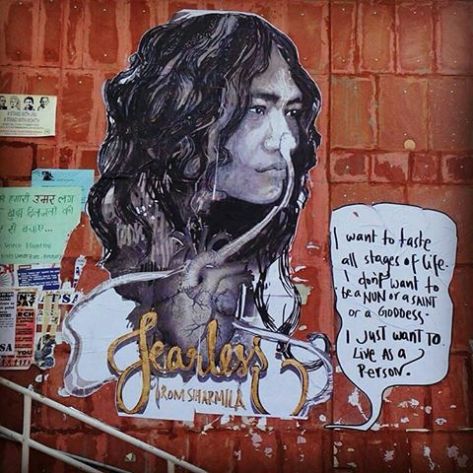
Iram Sharmila Mural at ‘Freedom Square’ JNU. Art by Shijo Suleman and the Fearless Collective. Photograph by Rebecca John. Image, courtesy, ‘The Great Walls of India’ blog on Graffiti and Wall Art

We may have differences in our political approach as to the way and means of the struggle, but what must be stated at the outset is the fact that Irom Sharmila has certainly been an icon of resistance and inspiration in the struggle against AFSPA.

Her 16 year long hunger strike has been a grim reminder of the crimes against the Manipuri people – rape, torture, fake encounters and massacres – committed by the armed forces with impunity under such draconian Acts like AFSPA. But her abrupt decision to end her fast accompanied with her willingness to contest elections in the upcoming assembly elections have met with a mixture of shock, scepticism, disappointment, puzzlement and even anger amongst her people in Manipur and even her close associates. There also seems to be a resentment against her being in a relationship and her plan to marry. Such scrutiny/dragging of her personal life are, however, quite deplorable. But overall, the disappointment with the decision of Irom to quit fasting and contest elections is so strong that, after breaking her fast in the hospital, when she tried to go to a local activist’s shelter, the locals disapproved. She had to seek temporary shelter in an ISKCON temple along with her police guards and then was shifted to a police station and finally she was forced to retreat to the same hospital that housed her for last 16 years. Now, this is telling. But what does it tell? The answer to this question would take us away from criticisms about any particular individual, but to the evaluation of the very method of struggle that she had been a part of, its scope, effectivity and limitations.

Continue reading A Fast That Ended in Hunger- Thoughts on Irom Sharmila and Hunger Strikes: Anirban Bhattacharya

Kashmir Issue – A Brief Report on Solidarity Actions in Punjab: Jagmohan Singh

Guest Post by JAGMOHAN SINGH

Clear Message from the Revolutionary Democratic Movement in Punjab

We Firmly Stand with the People of Kashmir

Once again, Kashmir is boiling with rage. The pent-up anger of the people of Kashmir against their brutal oppression by the Indian security forces has erupted in powerful massive protests in the form of gatherings, demonstrations and skirmishes and clashes with these forces, in which more than 75 people have been killed, many blinded and more than thousand injured so far. It is more than 60 days now since the cold-blooded killing of Hizbul commander Burhan Wani by the security forces on 8th of July. Yet the anger of the people is finding no let-up. Brave Kashmiris are valiantly fighting against the atrocities and brutalities of the security forces. They are coming out on the roads time and again, in large numbers, caring little for the restrictions, curfews and even firings. They deserve our salute.

The just and righteous struggle of the people of Kashmir has gained support from variety of sections of the people world over. In India too, the reports of such solidarity actions supporting the Kashmiri people are pouring in. In Punjab also some such actions have taken place. The solidarity activity in Punjab, scattered over a wide area and taking different forms such as conventions, public meetings, demonstrations and other forms of mass-propaganda, was chiefly organized by the communist revolutionary, revolutionary democratic and other pro-people forces active in the state. Almost all the sections of society such as peasants, workers, employees, intellectuals, students and youth participated in these solidarity actions; especially the leading sections and front rank activists and fighters of the revolutionary democratic movement of the state participated in considerable numbers and with a marked conviction.

Continue reading Kashmir Issue – A Brief Report on Solidarity Actions in Punjab: Jagmohan Singh

Statement in Support of Khurram Parvez from Groups and Individuals in Karnataka

Over the past 70 days, there have been over 84 deaths, hundreds have lost their eyesight to pellet wounds and thousands have been injured in Kashmir. As news reports of the death of 11 year old Nasir Shafi, son of Muhammad Shafi, a resident of New Theed Harwan in Srinagar emerge, we also hear about Showkat Ahmed Misger, a person with mental disabilities from Safa Kadal who was admitted in hospital in a critical condition with pellet wounds. Though the people of Chandpora were told by the police that Nasir Shafi was mauled by a bear, pictures of his body with pellet wounds and torture marks stand in contradiction to this official version of events. The violence unleashed by the armed forces continue unabated in Kashmir inspite of extensive social media outrage and mass protests in  Indian cities like Patna, Kolkatta, Chennai, Bangalore, Delhi etc.

Continue reading Statement in Support of Khurram Parvez from Groups and Individuals in Karnataka

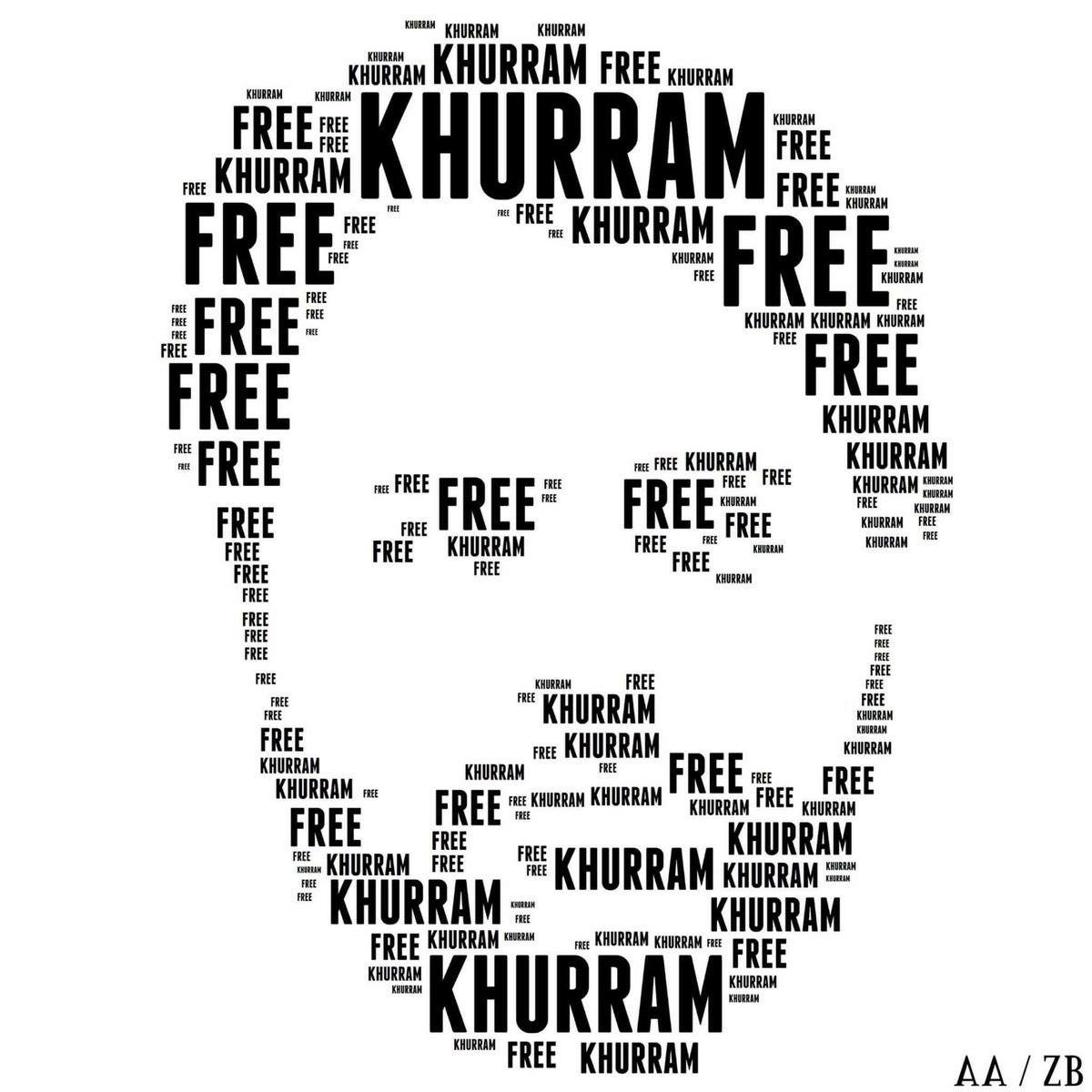
Free Khurram Parvez – An Open Letter to Civil Society: JKCCS

Guest Post by Jammu and Kashmir Coalition for Civil Society on behalf of the signatories of the statement in support of Khurram Parvez

14355569_670864076420404_7479719579066415935_n
Khurram Parve, Image, courtesy JKCCS

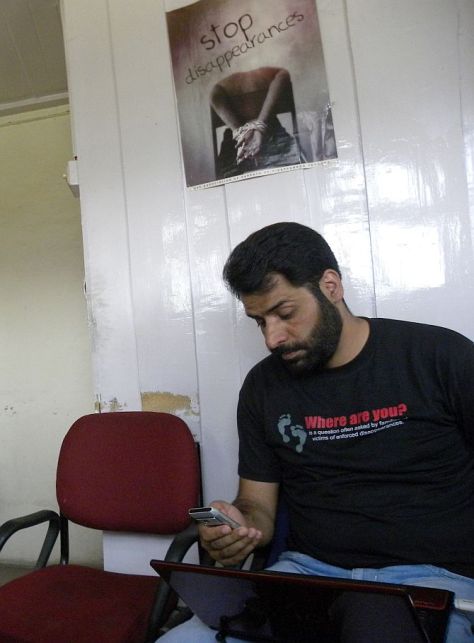
We, the undersigned, call for the immediate release of Khurram Parvez, a distinguished and courageous human rights defender, and write in support of the enclosed statements issued by Advocate Parvez Imroz

As we write this, Khurram Parvez has been remanded to preventive custody in a sub-jail in the highly militarized Kupwara District of Kashmir. He is expected to be produced before the court on 21 September 2016.

An executive magistrate in Srinagar issued the order against Khurram Parvez, invoking Sections 107 and 151 of the Code of Criminal Procedure (CrPC) (pertaining to detention for breach of peace and design to commit a cognizable offence).

The actions against Mr. Parvez are symptomatic of the escalated repression in Kashmir by institutions of state since July 8.

We note with horror that since July 2016, over 80 persons have been killed, over 11,000 persons have been injured, over 1,000 persons have been arrested and over 100 ambulances have been attacked. For 70 days now, curfew has been imposed in various parts of Kashmir. Continue reading Free Khurram Parvez – An Open Letter to Civil Society: JKCCS

State Violence against Peaceful Assemblies in Kashmir: JKCCS

Guest Post by Jammu & Kashmir Coalition for Civil Society (JKCCS)

Over the last week – August 29 to 5 September, of uninterrupted curfew in Kashmir, the government’s unbridled use of force on peaceful public meetings/rallies, which are either funeral processions of the civilians killed by government forces or peaceful political rallies where people demand their right to self determination, across Kashmir valley has resulted in injuries to 1215+ people, many of whom are injured by pellets shot guns. The violence used by government forces against un-armed peaceful rallies deflates its claims that its forces only resort to violence when they are pelted with stones. Contrary to government claims, the use of force against the peaceful demonstrators acts as a provocation to people and youth in particular who then retaliate by stone throwing on Indian forces. The sheer number of peaceful pro-freedom rallies held in the last week alone symbolizes the nature of the current anti-India uprising which has seen lakhs of Kashmiris on streets to voice their demand for right to self-determination. Such attacks are against the internationally, and domestically, recognized fundamental rights of peoples to peaceful assembly and association, and freedom of opinion and expression, including India’s obligation under the ICCPR. Continue reading State Violence against Peaceful Assemblies in Kashmir: JKCCS

Kashmir Scholars Action Group Letter to the UN High Commission for Human Rights on the Situation in Jammu&Kashmir: KSAG

Guest Post by Kashmir Scholars Action Group

To Mr. Zeid Ra’ad Al Hussein

UN High Commissioner for Human Rights

Re: Urgent action needed to end state violence in Indian-controlled Kashmir

We are writing to you to express our concern about the situation in Indian-controlled Kashmir where the already subjected population is currently living in a state of siege due to the massive violence unleashed by the Indian forces. We appreciate your decision to create a fact-finding mission and deplore the refusal of the Indian government to allow access to UN human rights monitors (1). In the absence of such a mission, we feel it incumbent upon civil society groups to provide regular updates on the situation.

We, the Kashmir Scholars Action Group, are an interdisciplinary group of scholars of various nationalities engaged in research on the region of Kashmir. Our research on Kashmir, its history, its consequences for the region and beyond, and its possible resolution, delves into the implications for an internationally mediated political solution, and is of relevance to policy makers. Based on our long and active engagement with civil society groups in Indian-controlled Kashmir, we have undertaken to document and communicate the situation on ground since the Indian state’s violence against civilians has continued to mount from July 7th, 2016 onwards. Each of us has written about Kashmiri history, society and politics; and we are particularly concerned about the present conditions of violence. We write to you now as part of our urgent efforts to check the brutality of the state’s response to Kashmiris, scores of whom have mobilized in support of their demand for azadi (freedom). Even as we will go on to list some of the details of the humanitarian crisis, we wish to make clear that we are calling not only for the resumption of basic civil services, the rule of law, and the restoration of human rights in Kashmir, but, most importantly, for an internationally mediated political solution for this ongoing crisis. Continue reading Kashmir Scholars Action Group Letter to the UN High Commission for Human Rights on the Situation in Jammu&Kashmir: KSAG

Ambedkar University faculty statement on violence against marginalized communities

Ambedkar University Delhi Faculty Association (AUDFA) expresses serious concern and outrage about the growing spiral of violence against various marginalized communities across the country. In the last one month two states particularly have witnessed violence and protests in an extensive scale.

AUDFA condemns the continued violence against people in the Kashmir valley, where the death toll is continuously rising. The violence in Kashmir this time saw a familiar pattern as before, an (encounter) killing, a funeral where rage is vented through slogans and indiscriminate and abominable violence as a response. Kashmir valley remained under a complete blackout with all modes of communication and transport blocked and curfew imposed for several days. AUDFA urges that immediate efforts towards demilitarization of Kashmir valley must be initiated and steps must be taken towards preventing the killing and injury of civilians.

AUDFA also strongly protests against the brutal beating, flogging stripping and parading of seven dalit men in Una taluka of Gujarat. As protests against this violence, at least twelve dalit men attempted suicide. Massive protests by dalits are evidence towards the failure of the justice system which has not been able to provide redress against the high rates of caste atrocity in Gujarat. AUDFA believes that action needs to be taken against vigilante gauraksha groups (who were the perpetrators of the violence) under the SC/ST (Prevention of Atrocities) Act.

Continuous violence and discrimination against Muslims and the dalits goes against the moral fabric of the Constitution and as a faculty association AUDFA expresses its anxiety over the growing everyday intolerance among and polarisation of the people in this country. We express our solidarity with protests against such ongoing violence.

Gopalji Pradhan                   Rukmini Sen                         Arindam Banerjee

Secretary                                President                               Treasurer


In Chhattisgarh, a slow and determined CBI cover-up

Whose Terror, Whose Powerlessness? Milind Wani


Guest post by MILIND WANI

On January 7 a car bomb at a Libyan police camp in the town of Zilten killed 60 people and wounded 200 more.  On January 11, bombs in three cities in Iraq, including Baghdad, killed over 130 people. On January 16, ISIS forces attacked the Syrian town of Deir ez-Zor, killing Syrian army members as well as women and children. Death toll estimates range between 130 and 300 people.  On February 1, a suicide bomber detonated a vest outside Afghanistan’s national police headquarters in Kabul, killing 20 and injuring 29. On February 8, ISIS executed approximately 300 activists, police, and military personnel in Mosul, Iraq. On February 21, ISIS detonated car bombs in two Syrian towns heavily populated with Shi’ite Muslims, killing between 140 and 270 people, and wounding over 300 more. In March this year, a car bomb detonated in a busy public square killed at least 37 people in the Turkish capital of Ankara. The same month, on a street filled with shops and cafes in Istanbul, Turkey’s largest city, a suicide bomber killed five people. On March 27, seventy-two people, including 29 children, were killed in a suicide bombing at the largest public park in Lahore, Pakistan. In May Baghdad attacks, at least 69 to 90 were killed in suicide attacks and car bombings in Iraq capital. On June 28, a trio of suicide bombings at an airport in Istanbul killed 45 and injured 200 more. On 3rd July 2016, coordinated bomb attacks were carried out in Baghdad, resulting in mass civilian casualties. A few minutes after midnight local time, a suicide truck bombing in the district of Karrada killed more than 300 people and injured hundreds more. This list is not exhaustive.

In the above backdrop of terror attacks in middle east by the ISIS or groups associated with it, that Pratap Bhanu Mehta should be impelled to write a passionate piece only after the horrendous truck rampage which left 84 dead in Nice says much about how even the most sympathetic of commentators have become party to selective amnesia. But if that was his only sin, one could just put it down to the times we live in where even the most informed ones are not free of ideological biases. However there is much that can be considered as problematic, either in terms of his analysis or the solutions he proposes or the stand he takes and would want us to take. Continue reading Whose Terror, Whose Powerlessness? Milind Wani

Not Pakistan, but Modi has pushed Kashmir on the Brink : Ashok Swain

This is a guest post by ASHOK SWAIN

Since the death of a young and charismatic separatist named Burhan Wani, Kashmir has erupted into violence and chaos. Weeks of violent protests in the Valley have resulted in the deaths of at least 50 people and over 5,000 injuries. Kashmir is not new to violent protests and civilian deaths, but this time the intensity of the protest and the passion of the protesters is unprecedented. Continue reading Not Pakistan, but Modi has pushed Kashmir on the Brink : Ashok Swain