Category Archives: Violence/Conflict

Open Letter to the Prime Minister of India: Simar Singh

Guest Post by SIMAR SINGH

Honourable Prime Minister of India,

I am fifteen years old, and I’m not an anti-nationalist, but I believe that having an opinion that differs from that of the state isn’t a crime.

I’m not an anti-nationalist, but I believe that physical and verbal abuse by lawyers against the accused in a courtroom in the presence of the police is a defamation of our legal system and violation of the Right to Fair Trial as stated in the Article 10 of the Universal Declaration of Human Rights.

I’m not an anti-nationalist, but I believe that verbal harassment of an accused on National Television in the name of Media Trial is unjustified. I don’t know journalism or media better than those running the news provision system of our country but what I do know is that each journalist or media personnel or any human being for the matter of fact is subjected to converse or debate with another human being with a certain decency and a sense of respect towards other’s opinion. Defamation of an accused by a journalist by labelling him/her as an anti-nationalist and calling them a shame to the nation is a violation of the article 41 of the Norms of Journalism Conduct published by the Press Council of India in 2010 and a threat to one’s dignity and public image. Continue reading Open Letter to the Prime Minister of India: Simar Singh

Encounters With the State and Other Comedies: Asmit Pathare

This is a guest post by ASMIT PATHARE

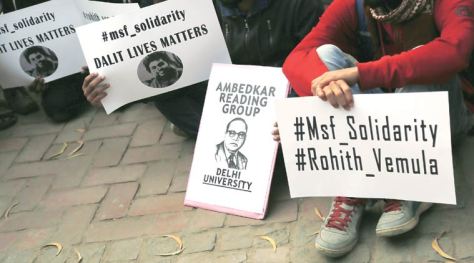
In response to JNUSU’s call for observing 2nd March as International Day of Protest and to demand justice for Rohith Vemula and the release of the then three arrested students, numerous organisations decided to gather outside Dadar station (E) and carry out a peaceful protest. Among them were All India Students’ Association (AISA), All India Students’ Federation (AISF), Students’ Federation of India (SFI), Democratic Youth Federation of India (DYFI), All India Youth Federation (AIYF), University Committee for Democracy and Equality (UCDE) and others. The protest was supposed to begin at 5pm. Continue reading Encounters With the State and Other Comedies: Asmit Pathare

St Louis Universities Stand With JNU: A Statement


Kanhaiya Kumar, the president of the Jawaharlal Nehru University Student Union (JNUSU) in New Delhi, India, was arrested on Feb 10 on charges of sedition and criminal conspiracy. Kanhaiya was present at a meeting on the evening of Feb 9, where incendiary slogans were allegedly raised. Seven other students were also charged. Mr. Kumar is not accused of raising the slogans; indeed the identity of the person(s) who raised the slogans remains a mystery. Charging a student leader for sedition for another’s mere sloganeering is prima facie absurd. Further, the assault of Mr. Kumar, other students and faculty, and even journalists, in court premises by lawyers and others sympathetic to the government, do not inspire confidence in a fair judicial process. Continue reading St Louis Universities Stand With JNU: A Statement

Who were the masked slogan shouting men at JNU? Does the Delhi Police know?

Police plan Big-Brother cameras for JNU, we have learnt. A senior police official told The Telegraph that this measure would help in identifying

students who often raise anti-national slogans and stage protests. It will also help us in preventing clashes among students belonging to different ideologies – the Left, the far-Left and the ABVP.

Remember, dear citizens, the police were actually present at the event at JNU on February 9th. We will return to this point, but they don’t really need CCTV surveillance, they are physically present on JNU campus in civilian clothes, and with JNU ID.

This,  also recollect, is the very same police force that stood by while a mob attacked JNU students and faculty and assaulted Kanhaiya at Patiala House; the same police who cannot arrest the man who publicly, with name and phone number, offered a reward for killing Kanhaiya – they “booked him for defacing property”, and will “analyse the poster carefully” before deciding whether other provisions of the IPC apply.

When all the evidence is available – the name, picture and phone number of a man who issues a death threat, he cannot be booked for anything more serious than the actual pasting of the poster on walls, because “the posters have to be analysed”.

Violence unfolds before their very eyes, and the Delhi Police cannot act.

These guys need CCTV surveillance?

This entirely compliant police force, now acting as the private army of the BJP, is concerned about preventing clashes in JNU, which has never ever had violent clashes, when it cannot carry out the normal functions of a police force anywhere else in the city.

So what will a CCTV system establish that the Delhi Police don’t already know?

Consider the following facts, and do come to your own conclusions. We have. Continue reading Who were the masked slogan shouting men at JNU? Does the Delhi Police know?

Another patriotic song to counter ‘Mere desh ki dharti’

Justice Pratibha Rani began her bail order on Kanhaiya Kumar with the patriotic song “Mere desh ki dharti”, an upbeat celebration of the beautiful land that yields gold and pearls. Her judgement was emotional about the soldiers who give their lives so that the rest of us can be safe.

Here is another sort of patriotic song from another Hindi film, which Justice Pratibha Rani might connect to. This haunting song about the futility of war also goes out to all those who say it is insulting to the armed forces to raise our voices against widespread militarization of the Indian subcontinent.

The refrain of the song is – “Ask the departing solider, where do you go?” It talks about death and destruction, of weeping women and hungry children. The poet is Makhdoom Mohiuddin (a communist and a Muslim – anti-national on two counts). Whose wars do these men fight?

Would we all be safer, including our soldiers, if the elites of neighbouring countries and a global military industrial complex did not have immense stakes in keeping tensions running high?

Submission Before Inquiry Commission by Concerned Teachers and Scientists, Univ of Hyderabad

Submission by Concerned Teachers and Academics before the Roopanwal Judicial Commission at Hyderabad

 (The Roopanwal Commission came to Hyderabad on 23-25th February to enquire into the facts and circumstances leading to the suicide of Dalit research scholar Rohith Vemula. The mandate of the Commission was to review the functioning of existing grievance redressal mechanisms in the university. Concerned with the absence of in-house redressal mechanisms for marginalized students, a joint submission was made by 88 concerned teachers drawn from the state and central universities in Hyderabad. The Submission sought for a rigorous implementation of the 2012 UGC Regulation as well as the setting up a Special Commission to review the major punishments passed by Universities in the case of marginalized students.) 

The suicide of Dalit research scholar Rohith Vemula in Hyderabad Central University has brought to the fore the issue of caste discrimination in higher educational institutions. We believe that the suicide is only the tip of the iceberg of many problems that students from Dalit and other marginalized groups are experiencing. University administrations have generally attributed these deaths to personal psychology instead of initiating broad systemic and attitudinal reforms to prevent such suicides.

In 2012, in the wake of series of suicides by marginalized students in higher educational institutions, the University Grants Commission formulated two Regulations to ensure social equity and set in place grievance redressal mechanisms.  In 2013, Andhra Pradesh High Court took suomoto notice of the student suicides in Andhra Pradesh in PIL No 106/2013 and issued several directives to the Universities to prevent the recurrence of suicides. However, neither the UGC Regulations of 2012 nor the Court directives have been implemented by the Universities.   Continue reading Submission Before Inquiry Commission by Concerned Teachers and Scientists, Univ of Hyderabad

Intolerance Tracker – A Community Curated Visual Storytelling Platform: Siddharth Peter de Souza and Saba Sharma

Guest post by SIDDHARTH PETER DE SOUZA and SABA SHARMA

In a world where breaking news cycles drive our imagination and interaction with events and incidents around us, it often becomes difficult to not to have a fragmented idea of trends because they evolve and develop so rapidly. Does this volume of information necessarily imply that we become unable to view similar types of stories because they are portrayed as isolated, anomalous and disconnected? Is this also because it is much more comfortable to forget, rather than remember and reflect on an accumulation of incidents that maybe unpleasant, inglorious and inconvenient. Amartya Sen recently stated that “The problem is not that Indians have turned intolerant. In fact to the contrary we have been much too tolerant of intolerance”. Is our numbness because we are overwhelmed by these incidents or because we perceive them to be isolated without an underlying systemic pattern?

Intolerance Tracker is a visual story telling and crowd-mapping platform that seeks to engage with some of these issues. The idea of using a map is because it provides a compelling medium through which information can be consolidated, and presented across temporal and spatial boundaries.

It aims to utilize the power of the community to identify, report and map instances of intolerance across South Asia, and organically create and curate a visual storytelling database. This initiative is primarily led by students at the University of Cambridge, and has been set up on an entirely voluntary basis by people who are passionate and committed to the cause of documenting intolerance across the region. Continue reading Intolerance Tracker – A Community Curated Visual Storytelling Platform: Siddharth Peter de Souza and Saba Sharma

Consolidated Solidarity Statements in Support of JNU

JNU Solidarity Poster

Kafila posted a set of solidarity statements recently in support of the students, faculty and autonomy of JNU. We are posting another set, received from the following organisations:

  1. First-Decade JNU Graduates and Other Graduates – 548 signatories.
  2. Faculty, Staff and Students at the Indian Institute of Management, Bangalore.
  3. California Students and Faculty. California, U.S.
  4. Current Fellows of the Jawaharlal Nehru Institute of Advanced Study, JNU, Delhi.
  5. Colorado College, Colorado, U.S.
  6. Faculty at DePaul University, Chicago, U.S.
  7. Faculty, Students and Staff, Brown University, Rhode Island School of Design (RISD) and University of Rhode Island, Providence, U.S.
  8. McGill and Concordia Universities, Canada.
  9. Canadian Academics from Various Universities.

Please click on Read More below for the statements and signatories:

Continue reading Consolidated Solidarity Statements in Support of JNU

Jat Quota Stir and Violence in Haryana: Satendra Kumar

This is a guest post by SATENDRA KUMAR


jaat-protest--_647_022016112612
IMAGE COURTESY: INDIA TODAY

There is an uncanny academic public silence over the Jat quota stir and the unjustified violence enacted during the stir in Haryana. The scale of violence and destruction is such that it competes for the worst instance of caste violence in Haryana’s post-Independence history. So far 30 people have lost their lives while over 200 people were injured in the nine-day violent Jat agitation demanding job quotas in Haryana. There is anger, fear and helplessness among those who lost their kin, homes, businesses and properties.At least 10 Haryana districts were severely affected by the violence. After such a huge loss, as if it was a routine, matter the Union Home Minister announced that a committee led by M Venkaiah Naidu will examine the demand by Jats for reservation in central government jobs.

In Haryana, the BJP’s government in the state has promised to bring a Bill granting OBC status to Jats in the upcoming assembly session. The Jats’ demand for reservations in the central OBC list is not new. Since 1995, Jats in Haryana have been demanding an OBC (Other Backward Class) status, which will help them secure the 27 per cent reservation in government jobs. Earlier in 1997, the Jats in Haryana, Uttar Pradesh and Madhya Pradesh had demanded themselves to be included in the central OBC list. It was rejected by the National Commission for Backward Classes. Subsequently UPA government’s decision to include Jats from 9 states in the OBC list was also rejected by the Supreme Court in March 2015. Despite all this, political parties such as Congress and BJP continue promising quota to Jats during election campaigns. These promises have encouraged the Jats to organize and agitate for quotas. However, their agitations for reservations have not been so violent. That is why the most pressing and important question that needs analyses is why has the current agitation by Jats been so violent? Perhaps three factors will help us to understand this severe violence and loss of property worth crores of rupees.

Continue reading Jat Quota Stir and Violence in Haryana: Satendra Kumar

Statement by JNU Faculty on Bar Council of India Report on Patiala House events of February 15 and 17, 2016.

In a shockingly partisan statement that blatantly misrepresents events, the Bar Council of India has issued a report that justifies the well documented attacks by a mob of lawyers on JNU students, teachers and media at Patiala House Courts over two days (February 15 and 17, 2016) as ‘a reaction to the incidents, which are grave in nature and very dangerous for the country’. BCI Joint Secretary Ashok Kumar Pandey claimed that a large number of JNU teachers and students and others had arrived at the court in three to four buses and raised slogans and used ‘provocative words’. This led to the untoward incident in which ‘both the sides took part,’ said the report, adding that ‘any true citizen or a lawyer of India’ was supposed to react strongly to the ‘anti-India’ slogans.

We, the undersigned faculty members of Jawaharlal Nehru University, wish to set the record straight. Nine of us reached Patiala House Court No 4 between 1 and 1.15 pm on 15th February 2016 to attend the hearing on Kanhaiya Kumar’s bail plea. The sole objective of our presence there was that when Kanhaiya Kumar was produced he would see the faces of his teachers in the courtroom. At that time, a few students and other teachers of JNU, and some members of CPI, the parent organization of Kanhaiya’s student group, were already waiting silently outside, similarly wanting him to see friendly and familiar faces when he was produced. There were about 15 to 20 of them, hardly enough to fill 4 cars, let alone one bus.

Continue reading Statement by JNU Faculty on Bar Council of India Report on Patiala House events of February 15 and 17, 2016.

Chalo Dilli! Report on 23 Feb Protest March for Rohith Vemula: Saagar Tewari

This is a guest post by SAAGAR TEWARI

Rohith Protest 3

rohith-vemula-protest 4
IMAGES COURTESY: INDIAN EXPRESS

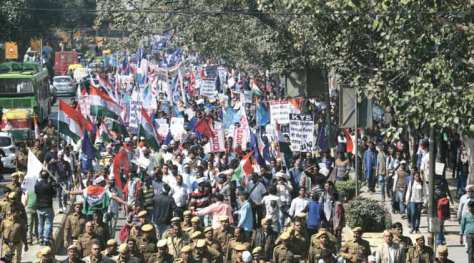
The call for a protest rally by the Joint Action Committee for Social Justice, constituted in the aftermath of Hyderabad Central University research student Rohith Vemula’s suicide galvanised large number of students and activists on 23rd February. On a bright sunny day, thousands descended on the streets of central Delhi marching from Ambedkar Bhawan to Jantar Mantar. The attendance was perhaps lower and the organization less cohesive than the JNU protest rally of 18th February. However, it trumped its predecessor in terms of attracting a far-wider political cross-section of the voices openly choosing to dissent against the current ruling establishment. The protestors proudly displayed anti-Brahmanism banners, flags, badges (featuring excerpts of Rohith’s suicide note) and even a radical inversion of Modi-style masks (featuring Rohith Vemula’s smiling face) thereby signaling that the same youth-brigade which was instrumental in BJP’s rise to political power in 2014 has started turning against it.

Continue reading Chalo Dilli! Report on 23 Feb Protest March for Rohith Vemula: Saagar Tewari

Confront the Rupa Subramanyas Within : A Note to a Nair-born Friend

Dear Kaviraj,

Just saw your post condemning The Telegraph’s representation of Smriti Irani as ‘Aunty’. I understand your indignation, though I am curious to know why few people like us stand up and protest when the people who supporte her, the sanghis, throw vile abuse at dissenters and feminists, label them prostitutes, and threaten them regularly with rape and disfigurement. My daughter was recently threatened in Delhi and warned not to behave like a ‘JNU randi’; senior women teachers from JNU were showered with similar abuse, shoved, groped, and hit at the Patiala House, and many of them have received direct and indirect threats. JNU women have been portrayed in the most despicable terms recently, before which Telegraphs’s characterisation of Irani as ‘Aunty’ is tame indeed even if unacceptable.

Continue reading Confront the Rupa Subramanyas Within : A Note to a Nair-born Friend

A Close Look at Certain Words Allegedly Shouted Recently in JNU and Their Impact on Our National Intelligence: Soumyabrata Choudhury

This is a guest post by Soumyabrata Choudhury

Polonius: “What is it you read, my lord?”

Hamlet in New Delhi, 2016: “India, Pakistan, security, sovereignty, nation, anti-national…words, words, words”

According to Sigmund Freud, when we dream, and when we suffer psychotic delusions, we treat words as pictures and things. A word’s meaning, in these conditions, becomes the shape of the word and its appearance is the same as feeling its physical impact, its blow. We cannot grasp anymore that a word refers to an object or idea outside in the world or that it can be used as a metaphor or an indirect analogy and image. We cannot even receive the rhetorical communication of words intended to persuade, exhort, transgress or insult. In each of these communications intended by an addresser we already feel physically, viscerally and as a consequence, mentally under the assault of the words of the addresser as if they are blows.

So in response we don’t persuade, exhort, transgress or insult back but instead, we curse (the upper limit of lucid  discourse in this state), punch, grab the addresser  by the throat, pull a knife or gun if we have any of these articles in our possession – or we cringe, weep, hold our heads in our hands and rock to and fro. Now it is very unlikely that in a real psychotic condition, we are able to invoke a particular law or clause of law in our favor, complain to the police and come up with a fluent image of language as justification for our actions. “We had no choice but to do what we did because the other(s) insulted our Mother India”. In a real psychotic condition, it is more likely we will be the ones to be taken away. Continue reading A Close Look at Certain Words Allegedly Shouted Recently in JNU and Their Impact on Our National Intelligence: Soumyabrata Choudhury

Apologise to the Nation, All of You.

You, who shout your nationalism from the rooftops; you whose blood runs hot for “Mother India”; you who turn red with rage when contradicted; you who set agendas like patriarchs drunk on father-right; you who refuse to let another speak, you! who don a suit every night on television to disguise your cheap tricks; you who abuse your guests if they happen to be young, powerless and honest; you who bloat on adrenaline while your viewers turn to idiotic jelly; you who abuse the highest offices of this land; you who give a bad name to khaki; you who wear lawyers’ robes to beat students and teachers; you who are protected by your political masters; you who strike deals in the privacy of your offices, chambers and boardrooms; you who live by ratings and upvotes; you who tell lies so long you forget the truth; you who form bands of cowards hiding in plain sight; you who roam the streets showing your fist to all; you for whom a martyred soldier is more valuable than a living citizen; you who abuse the power that history gave you; you who mistake that accident of history for a moral right; you whose imagination of revenge always involves rape; you who have brought this country to the brink of civil war; you who speak in the name of the mythical motherland while the actual children of that land are hungry, thirsty and unemployed; you who claim this moment, this nation, this public, this history, this land. Apologise.

Apologise to those who work everyday to make this country decent; who work for too little, and for too long; those whose deaths become statistics in the great churning pots of state economists; those whose parents taught them to keep their heads down and quit an ugly fight; those who argue, debate, disagree without the urge to kill or maim their opponents; those who understand when an argument becomes too heated; those who pull back from the brink every time because they know that to be alive is not always to be right; those who reclaim the streets to protest when it’s hard, when it’s inconvenient, and when it’s dangerous, because it’s the only way to disagree; those who see that an eye for an eye makes the whole world blind; those who understand and accept this land in all its confounding conflict; those who risk death to expose the powerful and corrupt; those who have no choice but to join the army to feed their families; those who laugh when there is nothing left; those who write, think and reason, and take time over all three; those who appreciate the beauty of the stars on a still night; those who make love like it’s a gift and not a right; those whose parents live after they died because they were on the wrong side at the wrong time.

Above all, you deranged “nationalists”, apologise to three fellow citizens – one born in a caste that could only speak from the protection of death; another who is languishing in jail for no crime at all; and perhaps most of all, a third who is on the run from a police none of us ever trusted. Apologise. These young people are the future of this country, not you with your bloodlust. WE are the nation, and we demand an apology from you.

Statement of Solidarity with the JNU Community, from the Students and Faculty at Princeton University


We, the undersigned, condemn the undemocratic and unconstitutional actions of the BJP-ABVP-Delhi Police on the JNU campus. Continue reading Statement of Solidarity with the JNU Community, from the Students and Faculty at Princeton University

Statement in Support of Students and Faculty at JNU From Faculty and Affiliates of the American Uniersity of Beirut, Lebanon

February 23, 2016

We, the undersigned faculty, students, staff, and affiliates of the American University of Beirut are highly concerned over the recent repression of free speech and undue police and legal interventions at Jawaharlal Nehru University (JNU), New Delhi. Continue reading Statement in Support of Students and Faculty at JNU From Faculty and Affiliates of the American Uniersity of Beirut, Lebanon

Statement on Behalf of Facultyand Students of O.P Jindal Global University in Solidarity With JNU


We, the undersigned Faculty and Students from the O.P Jindal Global University (JGU) in our individual capacity, condemn the police crackdown in Jawaharlal Nehru University- Delhi(JNU) and the apathy towards JNU demonstrated by State actors through their coercive actions. Continue reading Statement on Behalf of Facultyand Students of O.P Jindal Global University in Solidarity With JNU

Statement of Solidarity FromFaculty and Graduate Students at the University of Hawai’i, Manoa Against Police Ation on JNU Campus


To: Prof. M. Jagadesh Kumar

Vice Chancellor

Jawaharlal Nehru University

New Delhi-110 067, India

Continue reading Statement of Solidarity FromFaculty and Graduate Students at the University of Hawai’i, Manoa Against Police Ation on JNU Campus

Communication Students, Practitioners, and Professors in Solidarity with Kanhaiya Kumar, Umar Khalid, Anirban Bhattacharya, Rama Naga, Ashutosh Kumar, and Anant Prakash Narayan and Jawaharlal Nehru University


 We, students, professors, and practitioners of Communication and Media, condemn the recent attacks by the Indian state on students and faculty at Jawaharlal Nehru University (JNU) campus. Given the spurious nature of the claims mostly circulated through traditional and social media, we demand an immediate end to all police action on campus, a withdrawal of charges against the President of JNU Students’ Union, Kanhaiya Kumar, and JNU students Umar Khalid, Anirban Bhattacharya, Rama Naga, Ashutosh Kumar, and Anant Prakash Narayan, as well as an engaged effort to return peace and a climate of open debate to the university. We are troubled by the climate of authoritarianism being actively promoted by the Indian government in educational institutions and the concerted effort by the government to silence critical conversations. We are also disturbed by the attack on journalists by lawyers and goons close to the structures of power. Continue reading Communication Students, Practitioners, and Professors in Solidarity with Kanhaiya Kumar, Umar Khalid, Anirban Bhattacharya, Rama Naga, Ashutosh Kumar, and Anant Prakash Narayan and Jawaharlal Nehru University

The India I Came Back To: Namrata Sharma

This is a guest post by NAMRATA SHARMA


I will start this piece with a painful but short flashback tirade about myself. I moved back to New Delhi in 2014, after six long years in New York and Singapore. My decision to move back to the motherland was predominantly attributed to issues that a twenty-something grapples with when he or she is away from home and family. However, familial ties and emotional reasons aside, there was one factor which deeply resonated with me and was the driving force behind my decision to move back. This factor was – the liberty to express my thoughts and views on a topic, any topic, in an indulgent and lenient space, which, by virtue of being an Indian citizen, was guaranteed to me in India and not in other places. In India, this liberty transcended predictable spaces like classrooms, newsrooms and sophisticated editorial pages of the morning newspaper and was very organically present in the form of arm-chair political banter amongst friends and political conversations with family over dinner. Continue reading The India I Came Back To: Namrata Sharma

A Solidarity Poem for JNU from the Incarcerated Community of Philadelphia

A solidarity poem for Kanhaiya and the JNU protestors from the Center for Carceral Communities (a collective of current and previously incarcerated people and advocates in Philadelphia, housed at the University of Pennsylvania, USA).


we are with you kanhaiya

reaching out from our barred windows

all 2.5 million of US

we cross borders and seas

to smuggle in

wirecutters and metalfiles

and circuitbreakers

hidden deep

in these words and

outraged tears

we are with you

as you dance on this

multiheaded serpent

this global picture-in-picture-in-picture

of progress-in-democracy-in-prison-in-silence-in-fear

with you

shoulder to shoulder

as you scream over and over

abvpISobamaISbushISmodi

hand-in-hand with you

dear kanhaiya

as you christen

this revolution

with blood and urine

spilt in these corridors

of power

slick with the froth

of hindutva

with you always

as you stare down

this justice

turned

slippery and slick

and cold

until it is just / ice

Signed:


mouth

Alison Neff (Director, CCC)

Toorjo Ghose (Associate Professor, SP2, UPenn)

35 members of the CCC collective (who need to remain anonymous)

on behalf of

2.5 million who are currently incarcerated in the U.S. (who are forced to remain anonymous)