War and the Lightness of Being Adivasi – Security camps and villages in Bijapur, Chhattisgarh: PUDR

Report produced by PEOPLE’S UNION FOR DEMOCRATIC RIGHTS

Between December 26th and 31st 2014, a PUDR fact-finding team visited 9 villages of Bijapur district, Chhattisgarh to ascertain reports of arrests, intimidation and harassment, including sexual abuse by security forces who are stationed there to fight the Maoists. Predominantly Adivasi villages, the residents of Basaguda, Kottaguda, Pusbaka, Lingagiri, Rajpeta, Timmapur, Kottagudem, Korsaguda and Sarkeguda, narrated the daily acts of violence and violations committed by armed personnel residing in security camps. Apart from documenting the continuance of ‘area domination’ by the security forces, the report draws particular attention to:

  1. The large number of ‘permanent warrants’ issued against the populace, of which a significant number is declared as ‘absconders’. A rough estimate indicates that as many as 15-35,000 people live under the threat and fear of these warrants in Bijapur alone.
  2. The lawless conduct of the armed personnel and Special Police Officers (SPOs) who routinely raid, beat, loot, detain and compel the Adivasi villagers to perform ‘begar’ (free labour) at the security camps. Instances of sexual torture were also noted.
  3. The impossibility of lodging FIRs against the security forces as against the rising number of arrests of villagers who languish in jails. Continue reading War and the Lightness of Being Adivasi – Security camps and villages in Bijapur, Chhattisgarh: PUDR

Peace, bread and politics of AAP: Satya Sagar

Guest post by SATYA SAGAR

Among the epithets, most frequently hurled at Arvind Kejriwal by the BJP, in the run up to the Delhi assembly elections, were ‘anarchist’, closely followed by ‘urban naxal’. What is it about AAP that threatens the Sangh Parivar to a point of exhibiting such great hysteria and anxiety?

AAP, despite some novelties, is after all a very mainstream political formation, operating completely within the ambit of the Indian Constitution and no pretensions of turning the system upside down?Is there something deeper happening here?

One possibility is of course that, in its name-calling, the BJP presumed the average Delhi voter would run scared, straight into the waiting arms of Papa Modi[1]. In that case then, it was obviously a complete misreading of the public mood of anger and defiance against established national parties. Continue reading Peace, bread and politics of AAP: Satya Sagar

Halting the Demolition Derby

My piece (linked to and pasted as text below) in The Indian Express today, takes stock of AAP’s order to halt evictions and the possibilities it opens up to intervene into Delhi’s housing inequalities. I link it here in order to place it together with one additional frame that is necessary to the argument in the piece.

The counter to eviction is also a second object: a 25 sq m flat that is increasingly the primary choice of our housing policies to replace self-built house. This is seen as progress, an easily legible move from kuccha to pucca, from basti to flat. Complexes of these flats – often built in the thousands with a characteristic green stripe of the National Urban Renewal Mission (JNNURM) at the bottom – have begun to emerge across Indian cities. Many more are on their way.

Who doesn’t want such a housing unit? It turns out, in fact, many people. Occupancy rates of units built in the first decade of JNNURM are as low as 30%. Why do families leave? Well, because life on very low incomes isn’t possible far from work, schools and transit. New housing units need land – far more land than the dense, self-built bastis ­– which means they are most often, especially in the bigger cities, peripheral. Far precisely from work, schools, and transit.

It isn’t just the distance. Housing decisions by the income poor are not made on the basis of the quality of a flat but on the ability to integrate housing with work by using homes as workspaces and living near jobs. This is why bastis are built where and how they are. Even if the new units weren’t peripheral, they remain a form unsuited to these multiple lives of housing: they can’t be incrementally changed and moulded into godowns, warehouses, tailor shops, or restaurants, or grow with families. They are houses, not housing. Moving beyond evictions will also need re-imagining the 25 sq m unit.

Link to the main piece here.  Text after the break.
Continue reading Halting the Demolition Derby

AAP Victory and Some Tools for Popular Self-Government: Sagar Dhara

Guest post by SAGAR DHARA

The Aam Admi Party (AAP) has won a spectacular victory in the Delhi assembly elections and will form a government shortly. The party’s manifesto 2015 (http://www.aamaadmiparty.org/AAP-Manifesto-2015.pdf) promises to do many things—some positive, e.g., passing a Swaraj Bill and some that are not so positive, e.g., setting up pithead power plants to supply power to Delhi. Here are a few practical suggestions that may help AAP and its supporters to strengthen people’s participation in grasroot self-governance.

Participatory budgeting

AAP’s proposed Swaraj Bill is aimed at strengthening grassroot self-governance in Delhi mohallas and community neighbourhoods. Mohalla committees are designed to deal with local issues. However, they can also be used as platforms for Delhi’s polity to participate in decisions that that affect all of Delhi through a process called participatory budgeting.

Participatory budgeting first began in 1990 in the Brazilian city of Porto Alegre.  In the first quarter of every year, communities hold open house meetings every week to discuss and vote on the city’s budget and spending priorities for their neighbourhood.  Later, city-wide public plenaries pass a budget that is binding on the city council.  The results speak for themselves.  Within seven years of starting participatory budgeting, household access to piped water and sewers doubled to touch 95%.  Roads, particularly in slums, increased five-fold.  Schools quadrupled, health and education budgets trebled.  Tax evasion fell as people saw their money at work.  People used computer kiosks to feed communicate suggestions to the city council’s website.

Participatory budgeting is now being done in 1,500 towns around the world—Europe, South America, Canada, India—Pune, Bengaluru, Mysore and Hiware Bazar in Maharashtra. Twenty five years ago, Hiware Bazar was like any other drought-prone village in Marathwada.  Today its income has increased twenty-fold and poverty has all but disappeared. Continue reading AAP Victory and Some Tools for Popular Self-Government: Sagar Dhara

धर्म की आड़ में महिला अस्मिता पर प्रहार: जीत सिंह सनवाल

Guest post by JEET SINGH SANWAL

उन्नाव (उ.प्र.) से भारतीय जनता पार्टी के सांसद साक्षी महाराज ने पिछले माह हिन्दू धर्मावलम्बी महिलाओं को चार-चार बच्चे पैदा करने की सलाह देकर हिन्दुत्ववादी संगठनों की वर्षों पुरानी ख्वाहिश को मानो एक जीवनदान दे दिया। इस बयान के बाद तमाम हिन्दुत्ववादी संगठनों ने धर्म की दुहाई देते हुए महिलाओं को ज्यादा से ज्यादा बच्चे पैदा करने की सलाह देने के लिए मोर्चा संभाल लिया। कुछ लोगों ने तो आठ और कुछ ने दस-दस बच्चों को पैदा करने तक का आह्वान कर दिया। कई वर्षों से विश्व हिन्दू परिषद इस विषय को मुद्दा बनाये हुए है लेकिन साधारण जनमानस ने उसे कोई महत्व नहीं दिया। भाजपा के नेताओं द्वारा इस तिरस्कृत मुद्दे को उछालने के बाद इस तरह के तमाम संगठनों ने इसे हाथों-हाथ लेते हुए एक व्यापक मुद्दा बनाने का प्रयास किया।

महत्वपूर्ण बात यह है कि वी.एच.पी. से संबंधित साध्वियों को यदि छोड़ दें तो महिलाओं से संबंधित इस मुद्दे पर यह बहस पुरुषों ने शुरू की है। महिलाओं को संबोधित करने वाले ये बयान महिलाओं पर अधिकार जमाने वाले पुरूष मानसिकता का प्रतिरूप है, जिसमें महिलाओं की स्वतंत्रता, इच्छा, अधिकार, समानता व आत्मसम्मान की कोई जगह नहीं है।

इस मुद्दे की जमीनी सच्चाई तो यह है कि ऐसे  बयानों के बावजूद भारतीय महिलाओं ने प्रजनन दर को कम रखने को प्राथमिकता दी है। जनसंख्या निदेशालय के आंकड़ों के अनुसार भारत की कुल प्रजनन दर जो 1971 में 5.2 थी वह घटकर 2013 में 2.3 हो गई। धार्मिक भावनाओं केा भड़का कर इन महिला विरोधी बयानों को तूल देने की इस प्रक्रिया में चिंता इस बात की है कि इसमें धर्म के ठेकेदारों के साथ-साथ सत्ता पक्ष से जुड़े राजनेताओं ने भी मोर्चा संभाला हुआ है। छिट-पुट विरोधों के अलावा प्रगतिशील मंचों से इस तरह के बयानों की कोई खास आलोचना न होने से भी इन संगठनों व लोगों के हौसले बढे  हैं।  Continue reading धर्म की आड़ में महिला अस्मिता पर प्रहार: जीत सिंह सनवाल

A Chance for Social Change Like Never Before: Shankar Gopalakrishnan

Guest post by SHANKAR GOPALAKRISHNAN

For those who don’t like Modi-Sangh politics, February 10th was a day of joy. When this note was drafted a month ago, the provisional title was “This is No Time for Despair.” But last Tuesday has not only dented Modi’s invincible image – it has also dented the sense of being besieged. Since May 2014, almost every progressive force in the country has been on the defensive. The AAP’s politics and the popular tsunami that drove it to power have shattered this gloom.

But the key question at this point – is the eventual defeat of the NDA in an election the only goal? I argue that here that that is just the beginning. The end of this period – which, notwithstanding February 10th, is obviously some time away – will offer a space that has not existed in Indian politics in decades. Whether that space gets used or not will depend on how the struggle develops in the interim period.

The potential of this period is rooted in three basic flaws that the current ruling coalition (between big business and the Sangh) suffers from. First, its key forces are fundamentally myopic and delusionary in character. Second, it is internally contradictory – the two pillars of this formation will undercut each other in organisational (not just political or rhetorical) terms. Finally, it embodies a peculiar combination of organisational strength and political weakness. Continue reading A Chance for Social Change Like Never Before: Shankar Gopalakrishnan

Mumbai’s Docklands – Cutting the Cake: Hussain Indorewala

Guest Post by HUSSAIN INDOREWALA

In the early 1970s, a conservative government in the UK set up a study group for the London Docklands. Its report, which focused primarily on exploiting the commercial potential of the docklands, was torn up and thrown out by local community groups and the local boroughs. Later, in 1974, a strategic-planning authority called the Docklands Joint Committee (DJC) was set up to plan the area. This committee included, along with central and local government representatives, the Port of London Authority and trade unions; it was also associated with the Docklands Forum, which was a group that represented various sections of the public, including “militant community groups.”[i] The DJC along with the Docklands Forum adopted a radically new approach to planning: it instituted a bottom-up process, working with communities entailing a “delicate, even tentative, negotiated style of planning.” The planner was now the “servant of the public” and the “large-scale, top-down, professionally oriented planning” was replaced with its opposite.[ii] Significantly, the DJC came up with a comprehensive plan – the London Docklands Strategic Plan of 1976 – that was based on the preservation of manufacturing, creation of social housing, and social programs for residents of the area. So progressive it seemed, that it never got realised. In 1979, Margaret Thatcher became Prime Minister of the UK, drowning any little hope that remained.

Continue reading Mumbai’s Docklands – Cutting the Cake: Hussain Indorewala

Rohtak Gang Rape Reveals the Attitudinal Differences Disabled Face in India: Rupande Mehta

Guest Post by RUPANDE MEHTA

By now it is all beginning to sound very familiar: A woman gang raped, her vital organs missing, stones and blades found in her stomach, other objects found in her anus and vagina and the doctor conducting the post mortem stating it was the most horrific case of his life. This case, however, has one additional parameter – the woman raped and killed was mentally challenged and being treated for her condition at the Post Graduate Institute of Medical Sciences (PGIMS) in Rohtak, Haryana.

There is conflicting information on the mental condition of the woman raped and killed. While some reports state she was suffering mental retardation, others state her as condition as being psychiatric. Never mind that mental retardation is untreatable but the contradiction in reporting highlights a fact we all know – how widely misunderstood mental illness really is.

Mental illness is the most undertreated of all diseases around the world. There is an unspoken stigma around it and most sufferers usually do not want to talk about their “condition.” We have a difficult time grasping its severity and hence victims usually quietly suffer on their own until the situation often gets very serious. Many famous people have suffered mental illness and it has taken many of them years to come out and acknowledge their suffering. Few of them have fallen to their disease, the most notable recent case being that of Robin Williams who suffered from extreme depression. Other personalities who suffered mental illness include: Winston Churchill, the Prime Minister of UK, Buzz Aldrin, the second man on the moon, Beethoven, musical genius, Diana, Princess of Wales who suffered from bulimia, an eating disorder, and depression. Mental illness is the most unrecognized and, perhaps, one of the most damning diseases.

Continue reading Rohtak Gang Rape Reveals the Attitudinal Differences Disabled Face in India: Rupande Mehta

Are Jibran Nasir and his friends Game Changers in today’s Pakistan? Fawzia Naqvi

Guest Post by FAWZIA NAQVI

One cold Karachi Night

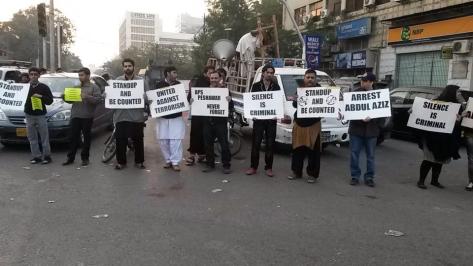
On the night of February 1st, Jibran Nasir Pakistan’s leading activist and a handful of peaceful protesters sat on a road in Karachi near the Sindh Chief Minister’s house for more than 24 hours, demanding the arrest of terrorists responsible for the January 30th Shikarpur attack which killed 65 Shias during Friday prayers, and demanding action against banned sectarian organizations. There were only 20 protesters, their average age 25, outnumbered it seemed by riot police with water cannon and batons at the ready.

Protest in Karachi against Terrorism and Secterian Violence

Continue reading Are Jibran Nasir and his friends Game Changers in today’s Pakistan? Fawzia Naqvi

AAP Victory and the Challenges of a New Politics

Let me say it once again, the AAP victory cannot be understood outside the post-ideological moment. I have argued earlier on Kafila (here and here), that one of the key features of AAP was its post-ideological character – one that moved relentlessly beyond many verities of 20th century ideologies and binaries like state versus market, or religious/communal versus secular and so forth. To reiterate, this formation represents the spirit of the moment that is itself post-ideological.

At Ramlila maidan, courtesy New Indian Express

But it is also time perhaps, to underline that post-ideological does not mean post-political. At least, not any longer. There is no doubt that a politics of AAP is gradually and clearly coming into view – but it is a politics whose edifice is being built from the bottom up. It does not derive from any settled ideological blueprint that comes ready-made – a blueprint around which a politics is then sought to be constructed. That was the project of all 20th century ideologies, which had already divided the world into neat camps and made the divisions into permanent battle lines. Ideologies became repositories of Truth – universal and unchanging, taking away from politics the very contingency and fluidity that defines it. Ideology, in other words, was fundamentally anti-political. In parenthesis, it may be relevant to point out that that is why, perhaps, Marx himself celebrated the Paris Commune by underlining that the workers “had no ideals to realize, no blueprints to which the world must conform”; they merely had to set free the new forces that were challenging the old order. Socialism in the 19th century was not yet an ideology in that sense. Continue reading AAP Victory and the Challenges of a New Politics

Shuddhikaran of Hindu Mahasabha by Lovers of Love in Delhi

Well, they tried, and more power to them.

shuddhikaran of that hate-filled, divisive, toxic organization (and others of the Hindutva brigade) would have considerably reduced pollution in the only vasudha we have, which is our kutumb, but the attempt was foiled by a compliant Delhi Police. However, Parliament Street Police Station was very shuddh indeed by the end of the day, its noxious atmosphere cleansed by the cosmic vibrations of music, dance and “marriages” among all sorts of human beings.

IMG_20150214_152622113_HDR

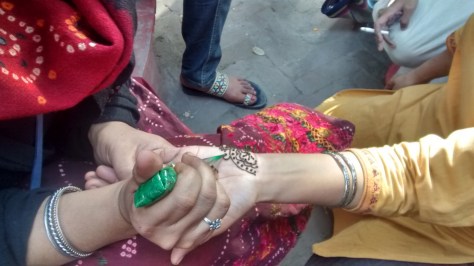
Mehndi ceremony inside parliament Street Police Station

Image courtesy feminisminindia.com

This hilarious subversion of the idea of marriage, with which Hindu Mahasabha threatened lovers, is in fact a deeply political gesture against the institution of patriarchal, heterosexual marriage with all its violent hierarchies of age and gender, in which disobedient women and younger people are in the custody, much like prisoners in jail, of the patriarchs of the family, which include compliant women. There are no honour killings – these are custodial deaths, when families violently separate couples who chose to marry outside their caste or religious community, often killing one or both of them.

Continue reading Shuddhikaran of Hindu Mahasabha by Lovers of Love in Delhi

BJP and Sangh spokespersons reveal real reason for witch hunt against Teesta Setalvad and Javed Anand

[LINK TO SOLIDARITY STATEMENT BELOW]

If you saw the programme on IBN7 last night, vilifying Teesta Setalvad and Javed Anand, with BJP spokesperson Sambit Patra and Sangh spokesperson Rakesh Sinha at their asabhya virulent best, shouting down and intimidating mild Sandeep Pandey and shouting continuously throughout whatever feisty Priyanka Chaturvedi (Congress spokesperson) had to say (which was hard-hitting and unanswerable), you would know what the case against the two activists is really about.

B9qSg1BCcAQUC_b

Of course, the charges against them are of corruption and embezzling of funds collected for Gujarat riot victims, but when Priyanka Chaturvedi pointed out that the case against them is dubious because Gujarat police and judiciary are not exactly exemplars of probity, given the assiduous stalking carried out by the Gujarat police on behalf of Modi’s man, of a young woman (whose family was paid off/ intimidated in classic Hindutva style, ending in the woman claiming gratitude for being stalked) they had no answer. (She could have added the blatant miscarriages of justice in cases of fake encounters and the Ishrat Jahan killing.) Continue reading BJP and Sangh spokespersons reveal real reason for witch hunt against Teesta Setalvad and Javed Anand

Vandalism – The Perfect Solution To Communalism! Nandini Rao

Guest Post by  NANDINI RAO

Thank you, unknown-vandals-out-there.

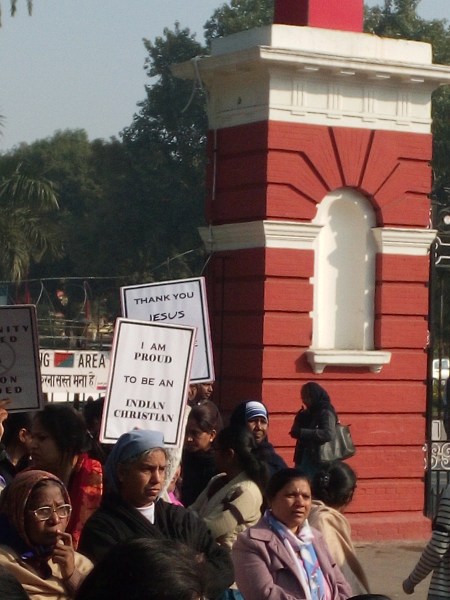
For burning church altars to ashes; for desecrating sacred objects inside houses of worship, for tossing carcasses inside religious places; for converting, de-converting, un-converting or re-converting (as the case may be); for stealing objects from churches that are more valuable to their parishioners for their emotional significance rather than monetary value. For making people ask in hushed tones when and where the next attack is going to take place and what form it will take. For making the pastor conduct midnight mass on Christmas eve outside the church in Delhi, with the faithful offering their prayers in the freezing winter night, simply because they did not have a church to go to.

But most of all, thank you for frightening communities who follow different religions and worship different gods. As for those who do not believe in god or religion, thank you for making them worried about how the social fabric of this country is being pulled apart, thread by thread, through political machinations.

IMG_20150205_094537

Because by doing all of the above, the unknown vandals (they are, needless to say, not criminals, just harmless “vandals”) have made people stop in their tracks and think. They have made communities question law enforcement agencies that brush aside fears and doubts and try to minimise the crimes taking place in their houses of worship. They are compelling them to discuss and debate about forced versus consensual conversions to religions of one’s choice. They are making people of all communities and religions realise how they are being pitted against each other and used as pawns in devious political games. They understand that, in the bargain, it is the poor and the marginalised living on daily wages who are being exploited in the worst possible way. People are realising the importance of their vote and of the very real impact they can make and the change they can bring about, with the single act of pressing a button.

Vandalism has made people come together to hold meetings and consultations to chart out a course to resolve the crises. It has made them stand outside their churches on pavements and on roads, demanding justice and accountability from a state and administration that does not seem to be heeding their voices.

And most important of all, vandalism is teaching us (more than political speeches and advertisements) how one needs to keep on asserting till our voices are heard that we are all citizens in a secular, socialist and democratic republic. That as believers and non-believers, we may worship (or not worship) in varied ways and learn from the teachings of one holy book (or a multitude of books and philosophies), but as citizens, our Holy Book is only the Constitution of India and what it has defined for us, as Indians.

Continue reading Vandalism – The Perfect Solution To Communalism! Nandini Rao

Shahid Lives, Shahids Never Die

Tafawut ast mun-I-shunidam-I-man-o-to, Tu bastan-dar, o, man fatahe-bab me shunidam

(What you and I hear are different : you hear the sound of closing doors, but I of doors that open)

– A Persian couplet that Maulana Abul Kalam Azad choose to use while addressing a gathering of Muslim Youth at the Aligarh Muslim University in 1949.

I

It was the mid of 2008 when I first heard about Shahid Azmi.

Friend/journalist Ajit Sahi had written a series of articles in ‘Tehelka’ about the fraudulence of the police in framing innocent Muslim men, which had caused enough consternation among the chattering classes. As Ajit had revealed Shahid had played an important role in making the story happen. Apart from facilitating meeting with victims of system, he had himself provided many facts relevant to the story.

And the name kept cropping in. I read an interview of Shahid where he discussed the challenges faced by lawyers like him who dared to take up inconvenient cases which at times put the police people on the defensive. I was still not aware of the many twists and turns in his life – his spending prime years of his youth behind bars as an innocent victim of TADA – or his classes at the prestigious TISS (Tata Institute of Social Sciences) where he use to enthuse students in magical ways. Continue reading Shahid Lives, Shahids Never Die

A Daughter’s Plea For A Better Way to Die: Gowri Parameswaran

This is a guest post by Gowri Parameswaran on behalf of her mother Sulochana

“Life changes in the instant, the ordinary instant” wrote Joan Didion in her book The Year of Magical Thinking. Didion wrote about her attempts to cope with her husband’s death and her reference was to the moment of his passing. I had picked up the book in JFK and had completed it by the time I reached Chennai. I needed the sustenance that the book seemed to offer; I was coming to see and take care of my mother (Amma we called her) who had been admitted to the hospital with decompensated lungs for the third time in two months. Her heart was too sluggish to pump her blood through the arteries and the fluid had backed up into her lungs; her lungs were decompensated. I remembered the ominous prognosis that one book on Heart Failure had spelled out about this turn of events in her health – that this was a seminal indication that the heart had reached the end of the road. She seemed so normal when I left her in October. The doctor had pronounced her heart healthy under the circumstances.

“Life changes in the instant,

The ordinary instant”. Continue reading A Daughter’s Plea For A Better Way to Die: Gowri Parameswaran

Open Letter to Hindu Mahasabha – we’ll be there on February 14th!

GET READY TO MARRY! 

To the National President, Akhil Bharat Hindu Mahasabha

Dear Chandra Prakash Ji,

It has come to our notice that  you and your self-appointed brigade of protectors of ‘Bharatiya Sanskriti’ have openly vowed to undertake a massive programme on the 14th of February where you promise to marry off anyone who openly expresses their love, whether on the streets or on Facebook. Since you have taken on this gigantic task of marrying so many people on a single day, we would like you to answer some questions that have ‘unnaturally’ crept into our heads as a result of ‘westernization’.

5d67984a9261b26c3a10a7214ddf55d3

Will you marry a boy to a boy he likes, or a girl to a girl?  Will you acknowledge their love for each other, repeal section 377? Or will you send them to jail or Baba Ramdev? Continue reading Open Letter to Hindu Mahasabha – we’ll be there on February 14th!

Fact-Finding Committee on Lay Offs at Tata Consultancy Services Releases Report

The following is the text of the report released by the Fact Finding Committee that investigated the issue of lay-offs at the Tata Consultancy Services. The committee, which released its report on 6 February in Chennai, consisted of the following members:

Fact finding committee press conf , Chennai

Mr. BRP. Bhaskar, Senior Journalist and Human Rights Activist, Thiruvananthapuram;

Dr. M.Vijayabaskar, Assistant Professor, MIDS, Chennai;

Adv. Bobby Kunhu, Legal Expert, Salem;

Ms. Chandrika Radhakrishnan, Software Professional and Labour Rights Activist, Chennai

Continue reading Fact-Finding Committee on Lay Offs at Tata Consultancy Services Releases Report

Adivasis in Assam – Extermination without a Camp: Suraj Gogoi and Prasenjit Biswas

Guest Post by SURAJ GOGOI AND PRASENJIT BISWAS

Repeated genocides in Assam and justification and rationalization of the same can be seen as the severest form of crime against humanity that one can imagine. It is the most reprehensible form of hatred that is committed and perpetually pushed under the carpet. Located in the foothills of Bhutan, the villages where 81 or so Adivasi persons were exterminated in the recent killings by the National Democratic Front of Bodoland (Songbijit faction) is no less than a genocide. Apparently the motive for such killing is attributed to Adivasi villagers helping the army and police in busting camps of Bodo militants. Seemingly they turn out to be the easy targets for insurgent firepower.

The adivasis, therefore, remain in a state of being exterminated. If camps mark the predicament of a modern fragmented society, one might say that the Adivasis are permanently thrown into shelters and camps as internally displaced. An estimated 2.75 lakh people of Adivasi origin are settled in about 250 camps across Udalguri and Chirang. They are decamped before the act of being camped and by the very act of remaining in the state of being camped they are rightless and defenseless. Herein we find a sense of perennial othering which subverts any democratic attempt to empower them with right and dignity. They are othered in a state of displacement and pushed form their settlements to an uncertain destiny. This continual displacement completes the fate of marginality. The process marks an inner othering of the marginalized that actualizes fragmentation of mainstream social identities of Assam. Continue reading Adivasis in Assam – Extermination without a Camp: Suraj Gogoi and Prasenjit Biswas

Modiji suniye, jo Dilli ka mood hai, vohi desh ka mood hai!

10983414_921021707917116_5374565183841541049_n

Image courtesy Kumar Sundaram

My elections days, 2015: Sivamohan Sumathy

Guest Post by SIVAMOHAN SUMATHY

campaigning, exciting, tense, nervous, delirium-invested, holding training sessions on the verendah for the immediate neighbouhood, as nobody but appa had voted in any previous presidential election, strangely agreeing with appa on politics for once, passing on all the wild gossip about the mr family, nightmare riddled pre election nights, sleeplessness, inducing drinking, exhilarating, liberating, cautionary, educating vasuki’s children about the elections ( they are keenly interested), near addiction to fb and quarellling with totally unknown friends on it, while another plethora of unknown persons writing in to befriend me, baila sessions, holding candle lit vigils for assassinated journalists, being connected to the universe on election night through thiru, who was on every tweet, every note, every social bleep, planning, writing, tasking for the future, doubts, setting off crackers, taking to singing, questions, pondering profound political questions on the nature of the state, reforms or revolution, gramsci’s historic bloc, not stopping at paradigm shift as most liberal commentators have done with this over used and abused term, not bothering with muslim bashing in europe over charlie whatever, in fact, just a wee bit short of visionary.

no paradigm shift,
no revolution, it is toward …….

they cut the jak tree down in our backyard,
the day after elections.
the parrots displaced again.

An Election of Hope Versus Fear

Yes it’s a simplistic dichotomy, but there is really no better way to describe the current Delhi elections. On the one hand, a little ragtag army of Davids behind “Mufflerman”, as his faithful supporters affectionately call him, a person in baggy sweater and sneakers, one you wouldn’t look at twice if you passed him on the road.

Mufflerman Business Standard

  Kejriwal

On the other hand, a massively funded, aggressively confident Goliath, openly backed by the corporate bodies and full-page ads, riding a  national “Wave” higher than most Tsunamis, topped by the 56-inch chest of “Modiman”, even if recently modestly covered by a 12-lakh rupee vest.

56-inch Modi78c0d4d3-be9e-4afb-b034-1247529df720wallpaper1

On the one hand, a fearful and awed media establishment donating PR for free to the seemingly invincible King of Gujarat, and on the other, an aam aadmi, a volunteer-cadre run campaign and a palpable vibe of trust and openness on the ground. I know I know, some will say it’s all ‘perception management’ and PR, but barring the googly of the 2 crores party donation thrown at the opportune moment, if Mufflerman’s party was any cleaner, it could have given Lalita ji’s Surf a run for its money. Whatever the result on the 10th (and there is reason to be hawk-eyed about the possibility of tampering as Nivedita Menon’s post has urged), how does anybody not get what a miracle this alone is, in a political economy with a black economy of a size that is higher than the GDPs of most smaller countries? Perhaps this is in fact about hope and fear after all, however clichéd that sounds.

Continue reading An Election of Hope Versus Fear

DISSENT, DEBATE, CREATE