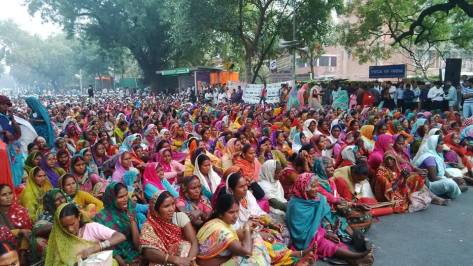
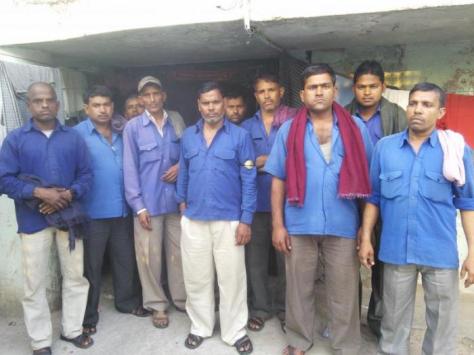
We Need You More Than Ever Today – A Tribute to Mukul Sinha: Harsh Mander

Guest post by HARSH MANDER

Two events altered his life forever. The first was when he witnessed a supervisor disrespectfully berating and kick a junior employee, which transformed a young apolitical physicist, who was passionately devoted to fundamental scientific research, into a tireless trade-unionist. The second – seeing his beloved adopted city Ahmedabad burn with tumultuous hate violence for many weeks in 2002 – thrust him into the heart of many battles against state power malevolently exercised against people of minority faiths. When Mukul Sinha succumbed to a particularly deadly stream of cancer in the summer of 2014, just weeks before Narendra Modi was swept to power, the country lost one if its bravest, most forthright voices for justice.

Raised in the railway enclave of the small district town of Bilaspur in Chhattisgarh where his father served, the young man had clearly worked out his chosen career as a scientist. After graduating in physics from IIT Kanpur, his elected life pathway seemed neatly laid out for him when, in 1973, he was accepted for his doctoral studies in plasma physics in the prestigious Physical Research Laboratory (PRL) in Ahmedabad. Founded in 1947 by the legendary Vikram Sarabhai, this apex space research institute undertakes fundamental research in physics, space and atmospheric sciences, astronomy, solar physics and planetary geo-sciences. This was where India’s first space satellite was born. It was a cloistered intellectual world, separated it seemed by light years from the turbulent life of fighting injustice which Mukul was to ultimately choose. Continue reading We Need You More Than Ever Today – A Tribute to Mukul Sinha: Harsh Mander

Nation’s Honour, ‘IBIs’ and the Dimapur lynching : Bonojit Hussain

Guest Post by BONOJIT HUSSAIN

naga

Photo courtesy: ABPLive

On 5th of March a mob of few thousands stormed the Dimapur central jail and after having dragged jail inmate Syed Sarif Uddin Khan, brutally lynched him while a gleeful lot clicked photographs of the lynching with mobile phone cameras.

Since the night of 5th March photographs of the brutalized dead body and a video of the lynching has gone viral on social media and activists across the country has rightfully condemned this horrific act of mob lynching. But most activists are under the impression that the outrage and subsequent lynching was because a Sumi Naga woman was allegedly raped by Syed Sarif Uddin Khan on the night of 23rd February. But one needs to understand that the outrage and the lynching of Khan wasn’t primarily about rape of a woman, it was more about how an outsider, more so a ‘lowly’ IBI (a very popular acronym for Illegal Bangladeshi Immigrant), has violated  the Naga nation’s honour reposited in the bodies of its women by raping one of its ‘daughters’. Continue reading Nation’s Honour, ‘IBIs’ and the Dimapur lynching : Bonojit Hussain

Paying tribute to Meera Kosambi: Uma Chakravarty

kosambiobit

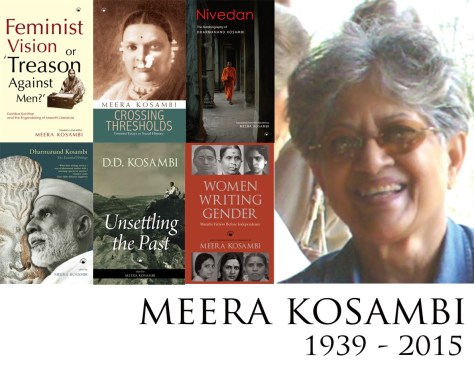
Image courtesy Permanent Black

Meera Kosambi, best known for her scholarship on Pandita Ramabai, passed away at the end of February. Uma Chakravarty, feminist historian, writes on FeministsIndia about the work of Meeratai, as she sternly admonished me to address her, when I casually called her Meera! I met her only once, a few years ago, and was enthralled through the lovely Maharashtrian dinner she had prepared, by her personal warmth and sharp intellect. ‘I dont like these Western ways of addressing older people’, she had said, ‘We have such lovely words of respect and affection, why not use them?’

Meeratai, you will live through your work. Salaam.

And here is Uma Chakravarty: 

Many years ago, before Meera Kosambi began to write on women in 19th Century Western India, a region that I wrote on in my work on Pandita Ramabai, the only Kosambi on my intellectual horizon was D.D. Kosambi, her father, who towered over the history writing scene.

So it was not surprising that when I first met her sometime in the 1990s, a lot of our conversation was about her father and also about her grandfather Dharmanand Kosambi because of my interest in Buddhism. Belonging to such an illustrious family it would have been difficult to carve a distinctive space for herself as Meera Kosambi certainly did.

Read the rest of this tribute here.

Indian feminists, ‘India’s daughter’, and sexual violence: The issues at stake*

International-women-s-day

Today, on International Women’s Day I am proud to acknowledge the deeply contested terrain that we call feminism in India, in which no claim goes unchallenged, no issue is undisputed (and some might say, no good deed goes unpunished!) In which over the decades, every stand and every understanding on practically every issue, has been painfully rethought and reformulated in the face of intense questioning from newer claims and voices.

In the clamour of feminist responses both to Leslee Udwin’s documentary ‘India’s Daughter’, as well  as to the Indian state’s crackdown on it, some themes have emerged that reflect profound fault lines in our (feminist) understanding – not so much of sexual violence itself – but of what to do about it; how to act upon the knowledge of widespread misogyny and pervasive masculinist violence; how to acknowledge that sexual violence cannot be understood except as refracted through prisms of caste, class, Indian state militarism and… a list that will inevitably end in ‘etc’ regardless of how long it is; and in this particular case, above all, what sorts of representations of sex and sexual violence will further our ethical ambitions, and what others will undo decades of work.

In what follows, I will try to uncover some of these themes, on the explicit understanding that I do not claim to have resolved any of the debates, nor even to have highlighted all of them. This is a partial, personal attempt to make sense of the recurring ideas in a tumult of intelligent, concerned and strongly articulated opinions, in the course of which I will of course, make my own views explicit too.

First, perhaps I should state immediately that I saw ‘India’s Daughter’ and liked it very much. This is just to get it out of the way, because my opinion on the film is irrelevant to my belief that freedom of speech and expression ought to be a value that feminists defend at all costs. I did not hold such a strong view on freedom of expression in an earlier decade, but I do now, at the beginning of the 21st century, when it has become increasingly clear that the silencing of uncomfortable voices, even unto murder, has become the preferred mode of snuffing out debate globally.

Continue reading Indian feminists, ‘India’s daughter’, and sexual violence: The issues at stake*

Bread and Roses in Kerala today – the Kalyan Sarees Women Workers’ Struggle, and an Appeal on Women’s Day-Eve: Malavika Narayan

This is a Guest post by MALAVIKA NARAYAN

Drive through any road in Kerala, one sees enormous showrooms of silks and jewellery, glittering with all the riches they contain.

Who says that the Kerala model of development is slow on growth and only high on human indicators? The most literate ‘progressive’ state is evidently doing well enough in business and investment too it would seem. We are also an expanding consumer market now, willing to finally shed some of that humility and simplicity once perceived to be characteristic of us. We have what claims to be Asia’s biggest mall, and other international chains setting shop here. In Maveli’s land, there really appear to be no poor or oppressed who would destroy this image of perfection. Continue reading Bread and Roses in Kerala today – the Kalyan Sarees Women Workers’ Struggle, and an Appeal on Women’s Day-Eve: Malavika Narayan

Reading the Power Struggle in AAP

There is no way of discussing the ongoing crisis in AAP without being blunt and frank. The terrain of politics is, after all, a brutal and treacherous one. So let me put it without mincing words. The ongoing crisis in AAP is not just about ‘differences of opinion’ or ‘toleration of dissent’ but a power struggle. And before squeamish liberal stomachs start churning, let me also add – power struggles are not always only about power in and of itself. Sometimes they are, but quite often they have to do with alternative visions, imaginations and of course, contrary interests. It is only likely that every serious political party or organization will, if it has any life in it, be faced with a struggle over any or all of these matters, for what is politics if not about steering the party/ movement in the direction one understands to be the best course. And these alternative visions, imaginations, policies and interests are inseparable from the position of individual personalities involved. Individual ambitions are pretty much the stuff of politics and it is unrealistic to expect to see a politics without all of this. The will to power is not exactly a self-effacing virtue.

For this reason, factions and platforms are inevitable in all political formations and it is best to recognize them as legitimate entities and have open public debate, on matters at stake. These cannot be matters of concern to only a small group of leaders in the National Executive and Political Affairs Committee (in AAP’s case) or in Politburos and Central Committees (in the case of communist parties). So, if collective deliberations are important in the apex committees, they would do well to be preceded by a public debate among different tendencies within the organization. At one level, this means moving away from the party-form itself to the form of a platform or coalition, where the different groupings and ideological currents are honestly and openly recognized, as are the personal inclinations and angularities of each individual leader.

This longish preface should make it very clear that my concerns here have nothing to do with the usual liberal platitudes about ‘amicably and democratically’ resolving ‘difference of opinion’. A political movement or party is not an academic seminar. Every such struggle, in the final analysis, is a power struggle – so is the current one in AAP. And there can be no doubt that both sides in this conflict are deeply involved in it. Decoding the stakes in the absence of a clear public debate, apart from selective leaks in the press, is not an easy task. But it does not involve rocket science either. One can read the signs, one can read between the lines of the narratives from both sides that have emerged, howsoever partially, in the media. What follows below, though, is a reading quite different from the ones inundating the media about intolerance of dissent. Continue reading Reading the Power Struggle in AAP

We are all Mukto-Mona

 ‘Our aim is to build a society which will not be bound by the dictates of arbitrary authority, comfortable superstition, stifling tradition, or suffocating orthodoxy but would rather be based on reason, compassion, humanity, equality and science’.

– Avijit Roy

 “Dr Dabholkar who was fighting against superstition was assasinated because he was a rationalist. All such people who have embarked upon a path of reason and rationalism, propagated these ideas, had to make tremendous sacrifices. Dr Dabholkar was not the first and would not be the last person who sacrificed himself on the altar of rationalism. This unending struggle between rationalism and irrationalism is going on since ages and it is for you to decide whether it needs change or not.”

– Comrade Pansare

Words, ideas scare fundoos rather fundamentalists of every kind, colour and stripe.

The mere possibility that a free mind can question, challenge and ultimately upturn the ‘ultimate truth’ the faithful  have received through their ‘holy books’ rather unnerves them and they react in the only way they are familiar with. Resort to machetes to take on ideas or use meat cleavers to deal with unchained minds, quoting sanction from the same ‘books of wisdom’. Continue reading We are all Mukto-Mona

The only New York we see: Juhi Tyagi and Karn Kowshik

Guest Post by JUHI TYAGI AND KARN KOWSHIK

When most tourists visit New York City, what they see is the New York that you see on TV – Times Square, Carnegie Hall, a Broadway Show and maybe a visit to the Legendary Soup Nazi. Our view of the City, though, was vastly different. As one of the authors visited New York for the first time, in the wake of cop killings of young black men in Ferguson, Staten Island and East NY, what we saw was the transformation of neighbourhoods into armed police camps, and a city torn by sharp racial divide.

Maybe our experience of New York was coloured by where we lived and spent most of our time. A tiny apartment on the same street as the 79th Precinct in Brooklyn; not far from where two NYPD officers were shot dead by a mentally unstable man in December 2014. In many of these neighbourhoods, the first piece of advice you got wasn’t about the coolest neighbourhood bar. It was: “On the streets, don’t run, don’t make sudden movements. If a cop stops you, keep your hands out of your pockets and don’t talk back. You don’t want to get shot.”

Continue reading The only New York we see: Juhi Tyagi and Karn Kowshik

That Elusive Thing with Feathers – After the Killing of Avijit Roy: Abdul Bari

Guest Post by ABDUL BARI

Avijit Roy was brutally murdered in Dhaka a few days ago. His wife, after heroically trying to shield his person with her own body, now lies in an ICU bed, fighting for her life.  I was an infrequent visitor to his website, Muktomona. Visiting it was like running your tongue over that tooth you’re missing, or reflexively checking whether you had your keys with you in the morning. Its presence was a reminder that, no matter how circumscribed, the nation-state of Bangladesh still had men and women who liked to think unconventional thoughts; give expression to unpopular ideas; endeavored to stand, as it is, in the very edge of what the societal limit of what could be expressed, and then take another firm step, not back, but forward. Continue reading That Elusive Thing with Feathers – After the Killing of Avijit Roy: Abdul Bari

Condemn Communal Violence in Kozhikode Village: Concerned Citizens

We  strongly condemn the unprecedented communal violence at the end of January 2015, in Tuneri, Vellur and Kodanjeri villages, Nadapuram in Kozhikode, Kerala, in which more than a hundred Muslim families and homes were singled out, attacked, and crores worth of property destroyed. We are utterly horrified and outraged that violence of this extent has received scant attention from the media — electronic, print or even social.

On 22 January 2015, a local murder was instantly transformed into a communal conflict. Shibin Bhaskaran, a 19-year-old DYFI activist, resident of Vellur, a village dominated by the Communist Party of India (Marxist) — CPI(M) — was stabbed to death by an Indian Union Muslim League (IUML) activist Teyyampadi Ismayil. Ismayil, who openly claimed responsibility for the murder on that very night, is known to have criminal antecedents and was once jailed for six months in accordance with the Kerala Anti-Social Activities (Prevention) Act, 34/2007. The aftermath of this cold-blooded murder, a personal settling of scores between two individuals, was instantly communalised, and in a manner that is reminiscent of communal violence in other parts of the country, especially in Muzaffarnagar 2013.

Read more at   : http://www.epw.in/letters/communal-violence-kozhikode-village.html 

G Arunima, P K Yasser Arafath, K Satchidanandan, Kavita Krishnan, Jairus Banaji, G Haragopal, Shabnam Hashmi, J Devika, Trupti Shah, Jyotirmay Sharma, Upinder Singh, B Rajeevan, C R Neelakandan, Kumkum Roy,
A K Ramakrishnan, Ajay Gudavarthi and others

The Land Ordinance (now Bill) is Bringing Back the Colonial Legacy: NAPM

Statement from National Alliance of People’s Movements

The Real Battle is between Farmers and Land Grabbing Corporates and BJP, not between Bharat and Pakistan!

16633316162_2fcb9a5538_n

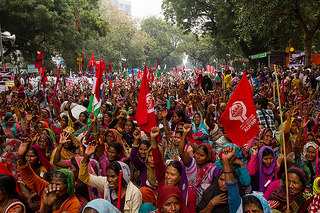
Protest Against Land Ordinance, February 2015 Delhi

Image courtesy Joe Athialy

Forcible land acquisition has always been an issue of life and death for millions of people in India, not only farmers but also agricultural laborers and fish workers. With the Land Ordinance it has become a political hot potato. More than 350 people’s organizations gathered at Parliament Street on February 24th, with 25,000 people from Gujarat to Orissa to Assam, and from Himachal Pradesh to Tamil Nadu and Kerala. This show of strength has forced the political parties to take a stand on the issue, leading to heated debates and discussion on the floor of the Parliament. The Ordinance, now Bill, reflects the anti-farmer and anti-poor move of un-democratically amending the 2013 Act on Land Acquisition and Rehabilitation, killing its very spirit and purpose.

The Ordinance brought in by the NDA government just after the Winter session of the Parliament came to an end was an obvious imposition on the country’s common people, of the colonial legacy of a perverted vision of development through an unjust and undemocratic modus operandi. The Ordinance is an attempt to open up the land that is the life support, source of livelihood and shelter for India’s toiling masses, to wealthy investors, including big corporations and builders. Its intention is to forcibly divert India’s agricultural land at the cost of food security, giving a free hand with no ceiling to the private companies as well as private entities i.e. private trusts and expensive profit-making educational and health institutions. The intention is to benefit private interests in the name of public interest.
Continue reading The Land Ordinance (now Bill) is Bringing Back the Colonial Legacy: NAPM

India’s Obsession with Elitism is Leading it to Ignore the Marginalized: Rupande Mehta

Guest post by RUPANDE MEHTA

Chances are you have heard about Sureshbhai Patel, a 57 year old man, beaten and left temporarily paralyzed by Alabama police. His only crime: while he was out for a walk, a neighbor reported a ‘suspicious’ and ‘skinny black guy’ in the neighborhood causing him extreme distress and nervousness to leave his wife alone at home.

Several elements of this case bring back the ghosts of Trayvon Martin and Eric Garner, two black lives taken away by police brutality – despite being unarmed, Sureshbhai was subjected to “extreme force” and suspected not because he was Indian but because he resembled a black guy – but also bring to the forefront the enormous emotional and financial support generated not only from Indians but also Americans who rallied behind Sureshbhai and the injustice meted out to him. In a matter of six days, donations worth $190,000 were garnered to help the Patel family with medical bills. The incident also provoked Alabama’s governor to apologize for police’s use of “excessive force” and to initiate an investigation by the Alabama Law Enforcement Agency, along with the one being conducted by the FBI. Continue reading India’s Obsession with Elitism is Leading it to Ignore the Marginalized: Rupande Mehta

Reading Between the Lines – A Critique of the UAPA: Avani Chokshi

Guest post by AVANI CHOKSHI

It seems ludicrous that in a civilised democratic society like India, a citizen may be practically abducted by police, charged with perfunctory offences and incarcerated without bail on mere suspicion for an indefinite period of time.  But this is indeed the situation in present-day India, with duly passed legislation sanctioning the inhumane state of affairs.

The validity of unjust or immoral laws has long been debated, with two major schools of thought emerging- the positivist school and the naturalist school. The positivist school does not recognise any correlation between the legal system of a society and notions of what ought to be justice. The positivist framework mandates that the law is that ordained by the valid legislator, whereas the naturalist school of thought envisages some rights to be inherent by virtue of humanity of a person. Thus, an unjust law, as per the school of naturalist thought, would be no law at all; positivistic thought, on the other hand, would posit such law to be valid by virtue only of being ascribed to the law-making process. The Hart- Fuller debate  devolved around the law made by Hitler; with Hart contending that laws passed using proper procedure would always be valid and Fuller maintaining that no unjust rule could ever be law. India allows “procedure established by law ” to deprive people of their Fundamental Rights; a state of affairs which reflects positivistic thought in the founders of India. India’s judiciary has slowly moved from this strictly positivist setting to a more naturalistic and liberal interpretation  of the term. This shift has placed India closer to the guarantee of “due process of law” in the United States of America. Continue reading Reading Between the Lines – A Critique of the UAPA: Avani Chokshi

A poem for Rafida Ahmed Banna – Avijit Roy’s Partner: Irfanur Rahman Rafin

Guest Post by Irfanur Rahman Rafin, translated from Bengali

[ Kafila normally does not carry poetry. But sometimes we make an exception, and we are making one in the case of this tribute by Irfanul Rahman Rafin, dedicated to Rafida Ahmed Banna, Bangladeshi blogger and partner of Avijit Roy, the Bangladeshi-American writer and blogger who was attacked and killed by Islamist thugs while the couple were on their way back from the Dhaka Book Fair. Roy wrote regularly on the Bangla blog Mukto Mona, and had written several books about religious belief, doubt, homosexuality and other issues. He had recieved death threats from Islamist groups in Bangladesh in the recent past. Roy is not the only blogger, writer and intellectual to have been attacked in this way. Last year, Ahmed Rajib Haider, another blogger opposed to Islamic fundamentalism, was hacked to death in February by a gang of Islamist thugs.

Hundreds of people have come out in protest against the killing of Avijit Roy in Dhaka. The killings of Avijit Roy and Rajib Haider mirror the assasinations of Narendra Dabholkar, and only recently, of Govind Pansare, in India by Hindu Fundamentalist thugs. ]

Avijit Roy and Rafida Ahmed Banya
Avijit Roy and Rafida Ahmed Banna

Sister Banna, listen
by Irfanur Rahman Rafin (translated from Bengali)

I don’t have the words to beg forgiveness
But something still has to be said
So I whisper in your ear sister Banna
Seven brothers still stand by Parul

I know some will say it was atheism
I will say he was child of my mother
We will see if they or Nazrul was right
Those who claim divinity to take life

Do not believe their prophecies
Those who play games with corpses
The war began with bullets and fire
Bringing white shrouds to each home

In this land nobody’s life has value
I know blood flows equally for all
But sister Banna listen to these words
Even the hardest heart cries out today

February 28, 2015

বন্যাদি তুমি শোনো

ক্ষমা চাইবার ভাষা নেই আজ কোনো
কিছু একটা তো বলতেই হয় তাই
কানে কানে বলি বন্যাদি তুমি শোনো
বোন পারুলের পাশে জেগে সাত ভাই

জানি কেউ কেউ বলবে সে নাস্তিক
আমি বলে দেবো সন্তান মোর মা’র
দ্যাখা যাবে তারা নাকি নজরুল ঠিক
খুন করে যারা নিয়ে নেয় দায়ভার

তুমি বিশ্বাস করো না ওদের বাণী
লাশ নিয়ে যারা পাশা খেলে অগোচরে
বুলেট আর আগুন নিয়ে যেই হানাহানি
সফেদ কাফন নিয়ে আসে ঘরে ঘরে

জীবনের দাম এই দেশে কারো নেই
কোনো রক্তই বেশি লাল নয় জানি
তবু বন্যাদি তুমি শোনো আজ এই
দেশে পাষাণেরও চোখ জুড়ে আছে পানি

ফেব্রুয়ারি ২৮, ২০১৫

Widespread Protests in Dhaka Against Avijit Roy’s Killing by Muslim Extremists

Killing of Avijit Roy, image courtesy Sudin Chattopadhyay
Standing up to the killing of Avijit Roy, image courtesy Sudin Chattopadhyay


Soon after this brutal killing of the Bangladeshi-American atheist blogger, protests have begun across Dhaka. We extend our support to the struggle against the dangerous forces of religion-inspired extremism. See more detailed report in Al Jazeera here and The Guardian here.

B'desh protests against killing
B’desh protests against killing, image courtesy The Guardian

हम सब पानसरे


अभी पिछले साल की बात है जब जनवरी के मध्य में महाराष्ट्र के कोल्हापुर में ‘डा दाभोलकर की हत्या और तर्कशीलता/विवेकवाद’ विषय पर बोलते हुए कामरेड गोविन्द पानसरे, ने एक अहम बात कही थी कि अंधश्रद्धा के खिलाफ संघर्षरत रहे डा दाभोलकर की हत्या इसी वजह से हुई क्योंकि वह विवेकवादी थे। उनका कहना था कि

‘ऐसे सभी लोग जिन्होंने तर्कशीलता का रास्ता अपनाया, उसका प्रचार किया, उन तमाम लोगों को कुर्बानी देनी पड़ी है। तर्कशीलता की बलिवेदी पर अपने आप को न्यौछावर करनेवाले डा दाभोलकर न पहले शख्स हैं और न आखरी। तर्कशीलता और तर्कशीलता विरोध का यह संघर्ष आदिम काल से चल रहा है और उसमें बदल करना है या नहीं इसके बारे में आप को फैसला लेना होगा।’

निश्चित ही उस वक्त़ किसे यह गुमान हो सकता था कि महज एक साल के अन्दर शहीदों की इस गौरवशाली परम्परा में उनका नाम भी जुड़ जाएगा।

20 फरवरी 2015 को मुंबई के ब्रीच कैण्डी अस्पताल में कम्युनिस्ट पार्टी के इस वरिष्ठ नेता ने अपनी अन्तिम सांस ली। 16 फरवरी को सुबह जब वह अपनी पत्नी उमा के साथ सुबह टहलते हुए लौट रहे थे, तब मोटरसाइकिल सवार युवकों ने उन पर गोलियां चलायी थी। अपनी लम्बी जिन्दगी लेखन से लेकर आन्दोलन, संगठन निर्माण से लेकर रचनात्मक काम आदि तमाम मोर्चों पर एक साथ सन्नद्ध रहा यह सेनानी, चार दिन जिन्दगी और मौत से संघर्ष कर, यह जंग हार गया। इसे विचित्र संयोग कहा जा सकता है कि डा दाभोलकर की मौत और उनकी मौत के तरीके में भी एक समानता थी, मोटरसाइकिल पर सवार युवकों ने दोनों पर तभी गोलियां चलायी गयीं जब वह सुबह टहल कर लौट रहे थे। Continue reading हम सब पानसरे

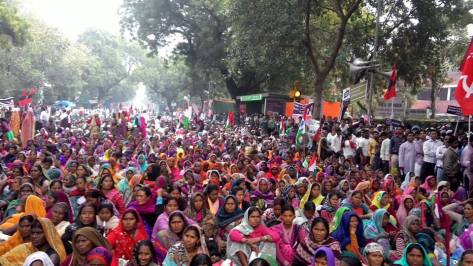
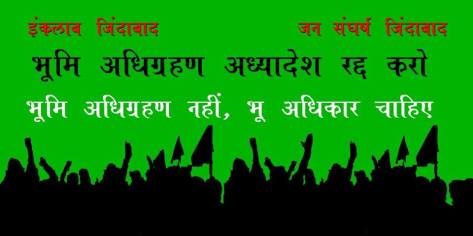
Massive protests against Land Acquisition Ordinance at Jantar Mantar

For updates on the protest, visit Abki Baar Humara Adhikar

11017480_669849169804507_5254527374248079527_n


poster


women

Images courtesy Abki Baar Humara Adhikar

Innocence Interrupted: Arshie Qureshi

Guest post by ARSHIE QURESHI

For a child born in Kashmir, the chances of living a normal life and even survival vary greatly from one region to another. Suppose you are born in the seemingly volatile stretch of Downtown. You may well turn out to be someone whose pictures are flashed on social media as the epitome of bravery, someone whose demise is imminent, and someone ready to wear the ‘Shaheed’ label. I arrived at this place at 4:30 on a cold evening. The room was crowded by women sitting with only one recognizable face; Shehzaad’s mother, Rubeena Akhter. Nobody spoke. The air smelled like rain. After a short while, a tall man in a brown-checkered pheran appeared. Leaning on the walls, he helped himself to one corner of the dimly lit but spacious room. He did not want himself to be identified as a ‘victim of conflict’.

For Shehzaad, life had been altogether different before. He had spent happy summers with his family in the town where violence, as it existed, had never appeared to him naked. By now, he is 23. He has become larger and properly bearded. The one thing which you can’t miss about Shehzaad is that he has giant brown eyes like a dairy cow. That’s what prompts my most idiotic lines of inquiry. Could someone who looks like that really pelt stones on streets? Idiotic, I know. “Do I have to tell you how I was supposed to have been killed that day?” he says, sounding like a gull. I hear a slow whimpering strangled with ache. This soon changes into full-throated babbling—a cascade of terrible, terrified pleading wails as he continued naming those who had been killed during the 2010 agitations.

Continue reading Innocence Interrupted: Arshie Qureshi

Bus Porters’ Petition for Aadhaar – A Political Analysis: Tarangini Sriraman

Guest post by TARANGINI SRIRAMAN

IMG_20140407_180321

Porters at ISBT  (Image courtesy DNA)

Barely six years into its introduction, the Aadhaar project, otherwise known as the Unique Identification (UID) project has been studied and critiqued extensively – its promises to strengthen welfare delivery, curb corruption, exorcise ghost beneficiaries from government databases, initiate financial inclusion and enhance intra-governmental coordination have been enthusiastically received in certain corporate and technocratic circles and skeptically, if not scathingly viewed in other academic and journalistic quarters. The liberties this far-advanced project has taken with individuals’ privacy and its failure to acquire a statutory basis (even as enrollment drives continue unabated) have justly attracted severe censure. And until recently, the surreptitiously mandatory nature of the project – where welfare entitlements were linked to the possession of numbers – was cause for alarm. The Supreme Court judgment in 2013 challenging this mandatory linkage between Aadhaar and subsidies/entitlements may have slowed down processes of the number’s proliferation as an exclusive proof.

However, since the new government at the Centre took over, newer uses and linkages are being imagined. How indispensable the Aadhaar will be to such schemes and entitlements only time can tell: cases in point the Jan Dhan Yojana (JDY) and the linkage of the Aadhaar with the passport. As new linkages appear in place of the old, the new government is urging all of us to walk boldly into the embrace of biometric identification that will, to a certain extent, at least, pervade public transactions (for some) and their very socio-economic chances of welfare support (for most others).  It was against this conceptual and empirical backdrop (so competently elucidated by the various scholars, lawyers and journalists following this project) that I decided, as part of my work on a larger book project, to speak with a migrant community in Delhi about their Aadhaar-related experiences – did they wish to get these numbers, if so why?

For these purposes, I picked a community of bus coolies or porters in North Delhi most of whom were migrants from different parts of the country and who stayed in a makeshift residence on the premises of the bus terminal. Continue reading Bus Porters’ Petition for Aadhaar – A Political Analysis: Tarangini Sriraman

The Genealogy of the Secular Discourse of Bangladesh – A Second Reading to Bangladesh History: Mubashar Hasan

Guest Post by MUBASHAR HASAN

Even though, according to a series of Gallup and Pew Research polls, Bangladeshi society is now perhaps most illiberal in its history of existence, most informed readers know that a strong secular discourse led by a group of academics, creative writers and artists still continues to flourish and resisting the illiberalism to be the main discourse of the country.

After the independence, the 1972 constitution of the country have endorsed secularism, socialism and democracy as key founding principles among others. However, it is unclear to me as a Bangladeshi who is in his thirties whether these principles were propounded within the constitution with mass support or influential elite intellectuals who were close to the power-base asserted these values because they had the luxury to construct Bangladesh in paper the way they wanted to. May be the latter is true. If secularism was a value held close to the hearts of Bangladeshi masses, it does not make sense now why there is a huge mass support-base for the center-right party Bangladesh Nationalist Party (BNP) or the growing shift to Islam by the ruling Awami League (AL).

In this article, I want to revisit the role of a group of intellectuals who were instrumental in shaping a secular discourse for Bangladesh when Bangladesh was known as the East Pakistan. I call my approach as a second reading to Bangladesh history simply because I haven’t come across any narratives that looks into the thought process of the key constructors of secular discourse in Bangladesh. In this lieu, I shall try to point out to the motivational forces of key actors behind the secular discourse of Bangladesh.  Continue reading The Genealogy of the Secular Discourse of Bangladesh – A Second Reading to Bangladesh History: Mubashar Hasan

Zehn ki Loot – The Plunder of Reason in a Times Now TV Studio: Kavita Krishnan

Guest Post by Kavita Krishnan

“Phool shaakhon pe khilne lagey” tum kaho,
“Jaam rindon ko milne lagey” tum kaho,
“Chaak seenon kay silne lagey” tum kaho,
Iss khule jhooth ko,
Zehn ki loot ko,
Main nahin maanta,
Main nahin jaanta

“Branches are abloom with flowers” you say!

“The thirsty have got to drink” you say!

“Wounds of the heart are being sewn” you say!

This open lie…

A plunder of reason…

I shall not accept!

I shall not recognise!

(Habeeb Jalib, translated by Ghazala Jamil)

In Shakespeare’s Taming of the Shrew, Petrucchio declares the noontime sun to be the moon: “I say it is the moon,” to test his wife’s loyalty and obedience. As long as she stands by her reason and asserts “I know it is the sun”, she continues to be a ‘shrew’. Only when she consents to ‘zehn ki loot’ (plunder of reason), when she agrees to subordinate her own reason to the whim and diktat of her husband, and deny the self-evident truth, does she achieve approval as a suitable wife.

We, the people of India, are being similarly tamed of our ‘shrewish’ behaviour, with propaganda and public shaming in TV studios accomplishing the ‘zehn ki loot’. It is a process that seeks to bully us into declaring that the sun is the moon, that night is day, that ‘khula jhooth’ (open lie) is in fact the only truth. Refuse to part with your reason, and you are chastised for ‘bad behaviour’.

I would like to revisit the #GovtVsNGO News Hour show on Times Now, on 17th February, as a particularly glaring instance (Activism or Anti-nationalism, Parts 1 and 2 )

The topic of the show was the Government of India’s decision to deplane a Greenpeace activist Priya Pillai from a London-bound flight, because she was planning to depose before British MPs about the violation of India’s forest rights laws by a British mining company, Essar, in Mahan in Madhya Pradesh.

Continue reading Zehn ki Loot – The Plunder of Reason in a Times Now TV Studio: Kavita Krishnan

DISSENT, DEBATE, CREATE