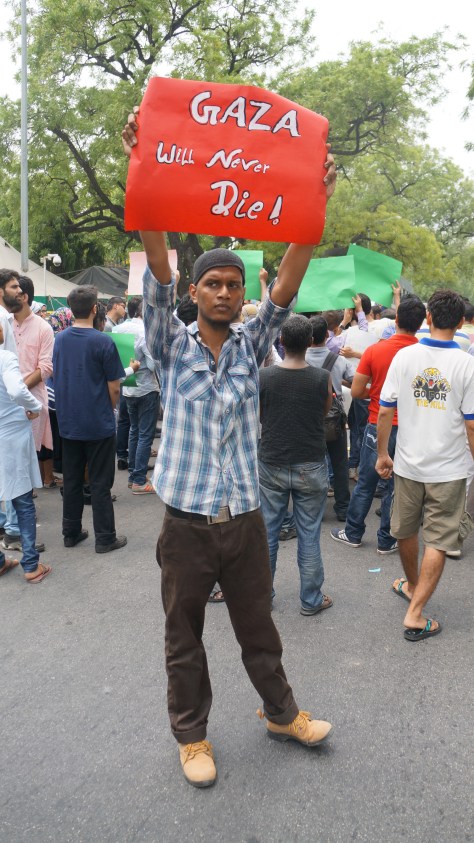
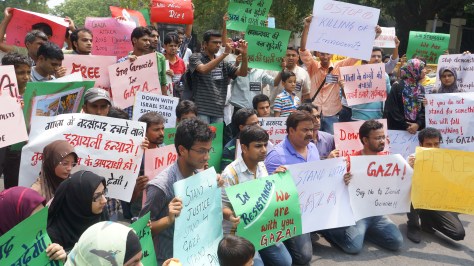
Protests against the situation in Gaza have been held in Delhi yesterday, (Sunday, 13th July, and today, 14th July, in the morning). Yesterday, on Sunday morning, there was a peaceful protest in front of the Israeli Embassy – this came out of a call for protest by individuals. Yesterday, about a hundred odd people, including many young people, had gathered. I was present at this gathering. Some people made statements condemning the Israeli state’s aggression against the Palestinian people. The Delhi Police was present, but did not try to disrupt or disturb the protest. The protest happened right in front of the Israeli Embassy gates on Aurungzeb Road.
Protestor in front of the Israeli Embassy in Delhi on Sunday, 13th July 2014Protestors with Signs against Israeli State’s Aggression on Gaza, in front of the Israeli Embassy in New Delhi, 13th July, 2014
This article has appeared in the June issue of Terrascape
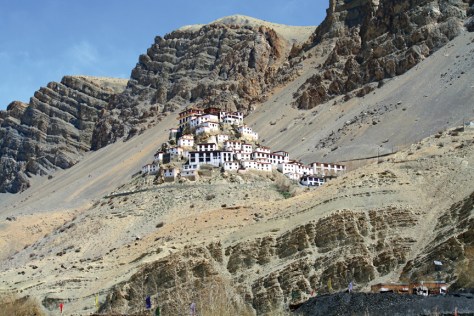
Travelling with a knowledgeable guide makes a trip worth it. And if the guide is someone like Chhering, you’ll cherish the trip all your life.
Kee Monastery, Spiti
Broadly speaking there are two kinds of human beings, the inquisitive and the conformist. It is the inquisitive kinds who try new things; experiment, ask questions, make most discoveries, travel to unchartered territories and constantly venture into terrain, geographic and cephalic, where angels fear to tread. The conformist does none of the above. They travel only the well-trodden path, visit places where the food, the hotel, the weather, in fact nothing whatsoever has the potential of throwing up a surprise.
The world cannot exist without either. The inquisitive opens up the world, both physically and in terms of ideas, while the conformist fashions new territories – geographical and cerebral – habitable and familiar for others and prepares the ground for the next generation of the inquisitive to venture beyond what has by then become familiar.
It is a fact that I am not one of those who can be included among the ‘inquisitive’, not in the sense in which I use the term here. It is equally true that I do not want to belong to the category that I have chosen to describe as the ‘conformist’. Why I do not want to be placed in the second category will be revealed once you go through this episode placed below. Your perusal of the same would perhaps justify my reluctance to be counted among the second category. Continue reading Chhering – A Guiding Star→
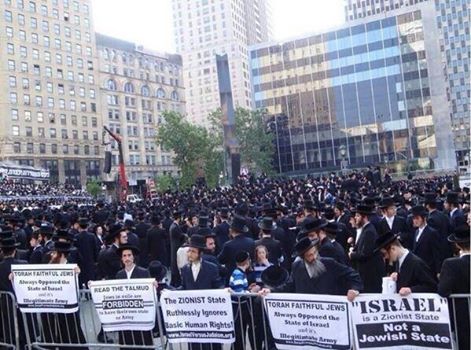
The following is a report from the indefatigable Prof David Shulman, who teaches at the Hebrew University of Jerusalem. Prof Shulman works on the history of religion in South India and poetry and poetics in Tamil, Telegu and Sanskrit. David Shulman writes as protests inside Israel increase, as do right-wing attacks on the protestors. This report has been circulated by Prof Louise Bethlehem of the Hebrew University of Jerusalem.
Jews demonstrate in New York Against Bombings
July 12, 2014 Umm al-Ara’is, Susya, Bi’r al-‘Id, Ma’asara
Business as usual in the South Hebron hills. There’s a war on in Gaza, but that too is business as usual, the meaningless biannual ritual in which both sides gleefully smash one another before reverting to the status quo ante. The Israeli media are drowning us in words, a vast and raucous flood, and the government is putting out its familiar, mendacious statements; perhaps in recent days only Abu Mazen has spoken the truth. The only solution, he said, is a political one, and Netanyahu is no partner. Meanwhile, rockets are flying, the Air Force is bombing, children are dying, soldiers are doing what soldiers mostly do, that is, wait around, and in South Hebron the land-grab proceeds apace, as always. Nothing, it seems, can stop that.
But wait a minute, some things have changed. Since the horrible murder of three Israeli teenagers, followed by the equally abominable revenge killing of the Palestinian boy from Shuafat, Israel has witnessed a wave of racist hatred on a scale perhaps not known before. Part of it has to do with the near-infinite opportunities of the internet: tens of thousands of virulent hate messages sent by ordinary Israelis have clogged the major sites; thousands of them call openly for revenge. I remember a time somewhat like this one, in the summer and autumn of 1982, the days of the first Lebanon War; the nadir came when a hate-filled nationalist threw a grenade into a Peace Now demonstration, killing my student, Emil Grunzweig. Some of the internet sites these days have called for the execution of leftists. Perhaps most striking of all is the utter shamelessness of this wave. Probably people used to have these same feelings but were not so ready, or eager, to state them in public. Decades of demagoguery and xenophobic incitement by the right, including, famously, by Netanyahu himself, have had an effect. The sluices are open. Continue reading Scholar David Shulman on the Gaza Bombings→
In May this year the investment banking powerhouse Goldman Sachs released a report that predicted Brazil would win the FIFA world cup. The prediction relied on statistical modelling and used tools like “Regression Analysis”, “Poisson Distribution”, “Stochastic model” and “Monte Carlo Simulation”. In other words, the methodology is incomprehensible to anyone except those with an advanced degree in Statistics or Econometrics. In hindsight, the prediction looks silly, given the 7-1 score line in the semi-final match between Germany and Brazil. However, the report is a perfect example of the failures of modern economics, particularly the financial voodoo economics pushed by the likes of Goldman Sachs.
When “The World Cup and Economics 2014” was released on May 27 it gained a lot of press publicity globally. The report predicted that Spain would reach the semi-final stage and lose to Argentina, which would lose to Brazil in the final. Goldman’s research division analyzed reams of data, including about 14,000 matches since 1960, national teams’ Elo rankings, average goals scored per team, home country and home continent advantage. To be sure, the report states that the predictions are just “probabilities” of teams advancing. Still the report states, “The most striking aspect of our model is how heavily it favours Brazil to win the World Cup”, and, “the extent of the Brazilian advantage in our model is nevertheless striking.” Continue reading How Goldman Sachs Got it Wrong on Football, The World Cup and Economics: Tushar Dhara→
‘कहीं रिहर्सल के लिए जगह दिला दो,’आफ़ताब ने कहा. हमारी मुलाकात लंबे अरसे बाद हो रही थी. मैं जानता था कि आफ़ताब इप्टा के साथ व्यस्त है. इधर कोई नाटक तैयार हो रहा है, यह खबर भी थी. लेकिन मालूम यह भी था कि इप्टा का अभ्यास पार्टी दफ़्तर में चलता रहा है.कई महीने पहले अजय भवन की सबसे ऊपरी मंजिल पर नगीन तनवीर के साथ एक बातचीत में हिस्सा लेने भी गया था.इसलिए मैंने पूछा,‘अजय भवन तो है ही!’ ‘निकाल दिया,’ आफ़ताब ने मुस्कराते हुए कहा, ‘….. का कहना है कि पार्टी का दफ्तर राजनीति जैसे गंभीर काम के लिए है, नाच-गाने की प्रैक्टिस के लिए नहीं.’ ‘औरों ने क्या कहा?’मेरी जिज्ञासा अबोध बालक जैसी थी क्योंकि उत्तर मुझे भी पता था.बहुत शोर होता है, तरह-तरह के लड़के-लड़कियाँ आते हैं जो देखने में ही भरोसे लायक नहीं जान पड़ते.वे नाचते-गाते हैं, एक ही संवाद को बार-बार बोलते जाते हैं. इससे दसियों बरस से पार्टी दफतर में बने मार्क्सवाद के इत्मीनान के माहौल में खलल पड़ता है. दूसरे कॉमरेड ने थोड़ी तसल्ली देने को कहा कि अभी वहाँ पार्टी क्लास चल रहा है. हो सकता है, उसमें डिस्टर्बेंस के चलते ही मना किया हो. मालूम हुआ कि पार्टी क्लास के सामने इप्टा को वह नाटक पेश करना है जो अभी वह तैयार कर रही है.हफ़्तों तक जो विचारधारात्मक बौद्धिक श्रम वे करेंगे, उसके बाद उन्हें विश्राम देने के लिए और उनका मनोरंजन करने के लिए शायद इप्टा के नाटक का इंतजाम किया गया हो!
अक्सर राजनीतिक दल अपने सम्मेलनों के अंत में गीत-संगीत या नाटक का आयोजन चाहते हैं. उनकी समझ है कि मुख्य काम तो वे कर चुके ,अब आनंद या विनोद की बारी है. शुभा मुद्गल ने इसी प्रवृत्ति से खीजकर मुझसे कहा था कि जब तक उनके संगीत की राजनीति को ‘एक्टिविस्ट’नहीं समझेंगे,वे उनके बुलावे पर आना पसंद नहीं करेंगी. Continue reading नचैया,गवैया और पढ़वैया→
A short fragment of video, fifty seven seconds long, taken from behind a window in a building in the Gaza Strip which was aired last night on Al Jazeera television brought home (once again) the sheer horror of the Israeli Defence Forces’ (IDF) brutal, ongoing offensive against the people of Palestine with devastating clarity.
One question I have faced umpteen times in my career as a Malayali feminist academic is the following: what is peculiar about patriarchy in Kerala? I have offered many answers to non-Malayalis but it is time now, I feel, to offer one which is non-technical makes unique sense to Malayalis. Why? Because the most conspicuous thing in Kerala’s contemporary cultural scene is the insecurity of the Malayali patriarchal-male, now bulging out like the paunches gifted to us by our recent prosperity. Like a feminist colleague once commented, patriarchy in Kerala is so ubiquitous, it is almost like air, all over the place. But a whole new generation of Malayali women have, mostly unwittingly,have caused it to condense into threatening dark clouds of male insecurity. What if the monsoon has been playing truant over my fair land, from these ominous clouds we now receive the copious showers of misogyny. Continue reading The Crisis of Devendran’s Father Muthu P.→
Suresh Soni, RSS’s point person with the BJP, who facilitated ‘anointment’ of fellow Pracharak as PM candidate last year and smoothly engineered the marginalisation of the senior Advani and proved his clout within the organisation, is in news these days albeit for wrong reasons.
News has come in that he along with his former supremo (the late) K S Sudarshan were also beneficiaries of the yet unfolding MPEB scam which has already claimed the head of a senior minister – another fellow Pracharak – in Shivraj Singh Chauhan’s cabinet. Laxmikant Sharma, the said minister, who earlier handled important portfolios like mining, culture, human resources had claimed at the time of his arrest that he has been made a sacrificial lamb and when time comes he would also ‘reveal the truth’. He allegedly facilitated appointment of Mihir, a personal assistant to the late Sudarshan, as a ‘Nap Taul Inspector’ at the behest of Suresh Soni. Continue reading Pearls of Wisdom of A RSS Leader – ‘Elections equivalent to Independence Struggle’→
POST-BUDGET UPDATE ADDED AT THE END OF THE POST (JULY 12, 2014)
Consider that an individual bought a house in 1992, made a few modifications, added a garden etc. and rented it out for the next 15 years. This would have brought the individual a steady stream of income over that 15 year period. In 2007, the individual decides to sell the house and it fetches a much larger sum than it was bought for (considering real estate prices went up quite a bit during 1992-2007). The income tax department sends a bill for 20% of the sale price. This is the long term capital gains tax and applies to both residents of India as well as non-residents.
Now consider this.
In 1992 the Hutchison Group of Hong Kong invested in the Indian mobile telecom industry through a joint venture later named Hutchison Essar Ltd or HEL. By 2006, Hutchison expanded its presence into 23 mobile telecom circles.
In 2007, the Hutchison Group’s 67% controlling interest in HEL was indirectly sold to Vodafone for an amount of USD 10.8 billion. This transaction occurred through Vodafone’s purchase of shares in a Cayman Islands (offshore) entity. It was a calculated attempt by Hutchison and Vodafone to avoid paying tax on capital gains. Continue reading Lobbying for a tax-free banana republic: Aditya Velivelli→
This response to Arun Shourie by DN JHA is the complete original, of which a shorter version was published in The Indian Express today.
Ruins of Nalanda University
I was amused to read ‘How History was Made up at Nalanda’ by Arun Shourie who has dished out to readers his ignorance masquerading as knowledge – reason enough to have pity on him and sympathy for his readers! Since he has referred to me by name and has charged me with fudging evidence to distort the historical narrative of the destruction of the ancient Nalandamahavihar, I consider it necessary to rebut his allegations and set the record straight instead of ignoring his balderdash.
My presentation at the Indian History Congress in 2006 (and not 2004 as stated by Shourie), to which he refers, was not devoted to the destruction of ancient Nalanda per se – his account misleads readers and pulls wool over their eyes. It was in fact focused on the antagonism between the Brahmins and Buddhists for which I drew on different kinds of evidence including myths and traditions. In this context I cited the tradition recorded in the 18th century Tibetan text, Pag-sam-jon-zang by Sumpa Khan-Po Yece Pal Jor,mentioned by B N S Yadava in his Society and Culture in Northern India in the Twelfth Century (p.346) with due acknowledgement, though in his pettiness, Shourie is quick to discover plagiarism on my part! I may add that “Hindu fanatics” are not my words but Yadav’s which is why they are in quotes. How sad that one has to point this out to a Magsaysay awardee journalist! Continue reading How History Was Unmade At Nalanda! D N Jha→
“You can fool some people some times but you can’t fool all the people all the time”
So goes one of the famous lines of Bob Marley’s song that draws upon statement by Lincoln. Perhaps the same can be said about the new BJP government because it seems that this time there will be nothing new left to be presented during the upcoming Union Budget. Most of the things to be presented by the Finance Minister have gradually been placed even before the actual budget could see the light of the day (on 10 July). In fact, the entire stretch since the Government took power can be termed as a long, extended budget session – a session in slow motion.
Just think about the policy decisions announced or showcased by the new Government so far—allowing 100% foreign direct investment (FDI) in defence sector (to boost technology transfer and employment growth, so to speak); reforming environmental clearance (to avoid discrepancies, end red-tapism and ensure transparency) by making the process online; raising import duties on sugar by more than double and extension of existing sugar export subsidy of Rs 3,300 per tonne (to help the sugar mills) till September besides raising the mandatory level for blending cane-based ethanol in petrol from 5% to 10%; allowing hike in price of non-subsidized cooking gas (LPG) by Rs 16.50 per cylinder (which is partly attributed to the crisis situation in Iraq); and raising train fares by 14.2% & freight rates by 6.5% in the month of June prior to the just-presented Rail Budget, among other things. Continue reading An Endless Budget Session, Even Before it Begins: Shambhu Ghatak→
In a recent piece, entitled The Modi Wave, I analyzed the orientations of the Modi campaign, and argued that crucial to Modi’s repackaging was his ‘sovereignty effect’. In this case, entirely a property of the media narratives that pitched Narendra Modi as someone from outside history, he was offered as an intervention into national history. I have suggested that this was a masterstroke to the extent that the subject within history has a compromised agency. The continuities – of forces, events, rationales and time as a whole – blunt the provenance of the outsider. In order for the subject to act upon history, he must stand entirely outside it. In this way, he cannot be accessed from within historical time. Modi not only offered a historical narrative of an unending Congress rule, infested with corruption, appeasement and misrule, but also that of him observing this lingering malady from outside the fence. His story of his own rise goes from being a tea-seller to the Chief Minister of Gujarat, from a not-yet to a fully sovereign. He is never a deputy, never a peg within the system; he suffers till his agency is still being shaped, and appears as already the incumbent. This fundamental separation from the substance of historical progression is needed to project oneself as unsullied, unlike those defiled by the their political existence within history.
A Fact Finding Report by a Women’s Collective on the Ethnic Riots in Aluthgama, Sri Lanka.
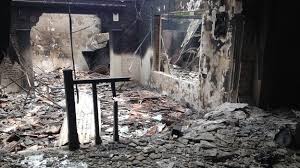
On the 15th of June 2014 ethnic riots took place in Aluthgama following a rally organized by the Bodu Bala Sena (BBS), a Buddhist fundamentalist organization. Even though the police and state officials had been informed of the potential of the rally to turn violent, no steps were taken to stop the same, instead a large number of police and Special Task Forces (STF) personnel were deployed in the area. In the aftermath of the violence that shocked the country, a women’s team visited Aluthgama and met with several survivors with the objective of documenting the events that took place. Below is their report. Considering the safety of the survivors their names, location and other identities are not recorded.
“Around 12 midnight on 15/06/2014 the Welipitiya Mosque administration made an announcement that a large group of thugs were coming to destroy the Mosque. Upon the announcement the men from the village brought their families, left the women inside the mosque for their safety, and stood outside the mosque to protect the mosque. Around 2000 persons arrived in a procession at that time chanting slogans saying ‘we will destroy the Dharga Town mosque’, ‘we will change Dharga Town into a Sinhala village’ and started pelting stones from all sides,” said a mother whose son was attacked in this incident. She stated that she has four sons, she has been separated from her husband since the birth of her youngest son, and has brought them up single handedly amidst various challenges. “My two unmarried sons aged 20 and 17 heard the announcement from the mosque and left to guard the mosque. A few minutes after they left home I heard gun shots and ran outside to look for my sons but I could not locate them. I ran back home and prayed for their safety. I could hear the firing of gun shots for about 2 hours. Continue reading Information on Aluthgama – Fact Finding by a Women’s Collective→
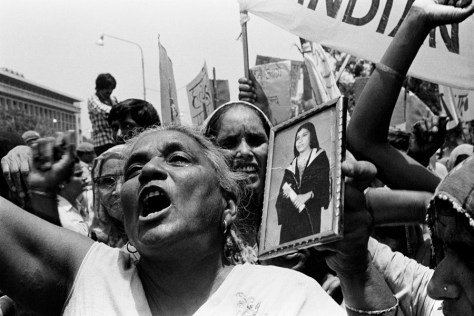
Sheba Chhachhi, artist, feminist and chronicler of feminist struggles, immortalized Satyaraniji and Shahjahan Apa in this image of an anti-dowry protest in 1981. Satyaraniji is in front, Shahjahan Apa on the right, behind her.
For those of us who came into the women’s movement in the 1980s in Delhi, the memory of Satyaraniji’s determined visage is a perennial source of energy and inspiration. In 1979, her daughter Kanchanbala, twenty years old and six months pregnant, was burnt to death following harassment for more dowry in her marital home. After her death, Satya Rani Chadha began a long battle for justice.
With the support of the parents of more than 25 other dowry death victims, Satyaraniji embarked on 21 years of sustained legal activism and court cases, which led to many landmark judgments and fundamental amendments in the criminal law. In 1987, Shakti Shalini, a Delhi-based organisation that helps and motivates other parents of dowry victims to fight this social menace, was formed jointly by Satyarani Chadha and Shahjehan Aapa.
On Friday, 13 June 2014, a well known Bollywood actress Preity Zinta lodged a criminal complaint against her former boyfriend and business associate Ness Wadia, with the Marine Drive Police Station, Mumbai. In this case, the actress brought about criminal charges against a powerful businessman under different sections of the Indian Penal Code (IPC). The criminal complaint, which forms the basis of the First Information Report (FIR), alleges a range of behaviour that amounts to different crimes under the IPC falling under specific sections categorised as ‘offences affecting the human body’ and offences dealing with ‘criminal intimidation, insult and annoyance’. The first offence of ‘assault or criminal force to woman with intent to outrage her modesty’ under Section 354 of the IPC is a cognizable non-bailable offence liable with imprisonment ranging from one to five years with or without fine. Section 504 of the IPC forms the basis of another offence dealing with breaching ‘public peace’ on account of intentional insult or provocation, is a bailable non-cognizable offence with a maximum punishment of two years in imprisonment with or without fine. Under Section 506 of the IPC, the businessman is accused of criminal intimidation with ‘threat’ that may deal with intention to cause ‘death or grievous hurt’ or ‘destruction of property’ or to ‘impute, unchastity to a woman’. This offence is liable with imprisonment for seven years and is non cognizable and bailable. Finally under Section 509 of the IPC, the businessman stands accused of a cognizable and bailable crime of insulting the ‘modesty’ of a woman based on ‘any word, sound or gesture’ and carries a term of imprisonment for three years with or without a fine.
What is it about Narendra Modi that makes people suspend disbelief? Ashutosh Varshney in his Modi’s Ambivalence, Indian Express, June 28, actually considers it possible that the new Prime Minister has a chance of going down as “one of the greatest leaders of independent India”. Surely anyone qualifying for such a status must be acceptable to the majority of Indians? Last we heard, the magic of Modi had left almost two-thirds of the electorate untouched, not to forget the fact that he doesn’t exactly inspire respect among our largest minority.
Varshney makes some bewildering assertions in his evaluation of Modi’s first month as PM. From a “novel policy language for poverty alleviation” to a new acceptance of Mahatma Gandhi as the Father of the Nation, to his RSS-defying portfolio distribution, Varshney sees signs of a new Modi, quite different from the man cursed forever with the burden of Gujarat 2002.
“We declare that Section 377 IPC, insofar it criminalises consensual sexual acts of adults in private, is violative of Articles 21, 14 and 15 of the Constitution.” Today marks 5 years of the Delhi High Court’s Naz Foundation v. Union of India judgment. Every year since the judgment came out, this has been a day marked by celebration. I remember this day in 2009 when the sheer novelty of the “decriminalized” tag reverberated through us in euphoric waves; the time in 2011 when we stood with flamboyant helium balloons in Bangalore’s Cubbon park, struggling with an untimely Bangalore drizzle; and then in 2013 in the same park, where the rain gave way to a too bright sun and lingering uncertainty about the fate of the judgment. It is now 2014 and we know its immediate fate. It has hit a bit of a, shall we say, roadbump.
One should look beyond these headlines to see what the new Government is up to under cover of the ‘honeymoon’ period.
Reuters reported on June 4 that the Modi Government will be allowing FDI in online retail or business to consumer (B2C) e-commerce during the upcoming budget session in July. FDI in e-commerce would mean foreign entities such as Ebay, Amazon and Walmart can start selling their inventories directly, and can have their own supply chains. No comment or analysis has been offered by the news media or the opposition parties so far. Neither was attention paid to the multiple instances of opposition from retailers body CAIT. Continue reading FDI in E-commerce – Under cover of the ‘honeymoon’ period: Aditya Velivelli→
This piece has appeared in the May issue of Terrascape
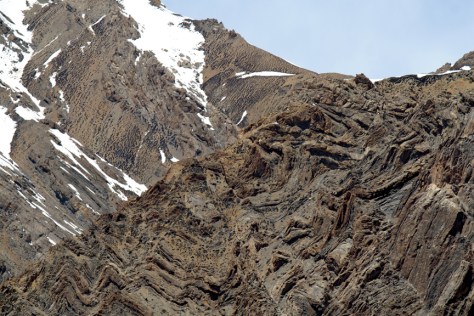
A quest for those mountains where a true seeker of truth can find solace and solitude – and a lesson in geology
I had grown up being told, as were most children who grew up in the times when I did, about great spiritual seekers, sanyasis, sufis and such like who had chosen to seek truth and to give up everything that tied them to the mundane concerns and attachments of this world. The stories of all these seekers of truth invariably ended with many of them finding what they sought in the mountains.
The mountains they visited were not the mundane, run-of-the-mill mountains, that ordinary mortals like us visit. They went in search of mountains that gave meaning to words like desolate, forsaken, remote, impassive, distant and words that created similar impressions. It was mountains such as these that the gods had chosen as their abodes, it were these that invited the seeker of truth within their folds. The seekers immersed themselves completely in the contemplation of the unknown and the unknowable, and emerged years later wiser and all-knowing.
As I and other children of my age grew up, we were drawn away from the spiritual and into the thick of the knowledge of the ‘this worldly’. We studied the secular sciences and gradually came to acquire a totally different understanding of the mountains.
While I would promptly concur with any sane person who thinks that this is the least of our worries, I have to return to a suspicion I expressed in an earlier post – at least one of the writers of blog posts attributed to ‘Narendra Modi’ is someone based in the USA who basically lifts American political idiom wholesale, regardless of its relevance to the Indian situation. The posts sound absurd, or should, to any reasonably aware person, but the Indian media seems to lack even one such person in its ranks. Hence the brain-dead way in which these blogs are reported, with much enthusiasm and empathy for the PM.
The first one I noticed was a blog post reported at the end of polling, in which ‘Narendra Modi’ said :
Lets place people over politics, hope over despair, healing over hurting, inclusion over exclusion and development over divisiveness. It is natural for the spirit of bipartisanship to get temporarily lost in the midst of an election campaign but now is the time to resurrect it.
We’ll come to those phrases I have emphasized in a minute, but first, the term ‘bipartisanship’ rang oddly in my ears. This is what bipartisan means:
representing, characterized by, or including members from two parties or factions
That’s the US party system, not India. For example, Reagan is said to have had a “bipartisan spirit”, reaching across the aisle to Democrats. Or take this essay ‘What is “bipartisanship” ‘? in The Economist in a section titled Democracy in America, which discusses this term in its specific context.
In India it would have to be multipartisan, for there are not just two parties. And there never has been a “spirit of multipartisanship” in Indian politics, where there are still real differences between parties, unlike the US, where the Republicans and the Democrats pretty much mirror each other. Continue reading Seriously, who writes Modi’s blogs?→


 KAFILA - COLLECTIVE EXPLORATIONS SINCE 2006