Smug patriarchal pronouncements about ‘dented and painted’ women and ‘rape in India and Bharat’ brought back to me an experience I faced in the classroom some years ago.
I teach English in grades 11 and 12 in a co-ed school in Delhi. That year I had this rather ‘difficult’ boy in class. I can’t remember now how the discussion really began. The discussion got to the point where students were talking about the amount of freedom available to girls and boys and why girls have far less ‘freedom’ than boys. It was somewhere at this point that this boy stood up (unlike the regular practice of standing to speak in the classroom, I insist students should sit and talk in my class) and stated with complete confidence that ‘if girls dress so provocatively boys can’t help themselves.’
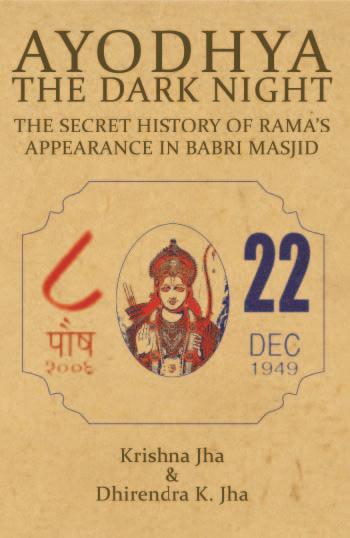
This guest post byKRISHNA JHAandDHIRENDRA K JHAis an excerpt from their book, Ayodhya: The Dark Night, about the original Ayodhya conspiracy of 22 December 1949
Published December 2011 by HarperCollins India; Rs 499; Pages 232
The sound of a thud reverberated through the medieval precincts of the Babri Masjid like that of a powerful drum and jolted Muhammad Ismael, the muezzin, out of his deep slumber. He sat up, confused and scared, since the course of events outside the mosque for the last couple of weeks had not been very reassuring. For a few moments, the muezzin waited, standing still in a dark corner of the mosque, studying the shadows the way a child stares at the box-front illustration of a jigsaw puzzle before trying to join the pieces together. Continue reading The muezzin’s last call at Babri Masjid: Krishna Jha and Dhirendra K Jha→
There’s a funny telepathy between people running or walking in opposite directions along a narrow jogging track. You both move to one side to avoid bumping into the other, only to find that the other person has moved in exactly the same direction you have. We exchanged half smiles at this long before we actually collided. As we approached each other, I smiled more widely as an acknowledgment of having managed to get it right and avoid each other.
His pockmarked face broke into a smile too. And in the moment he passed right by me, he reached out and grabbed my left breast hard and then moved on. Something I couldn’t have planned or thought about happened; I snapped like a brittle twig, swung around and went after him. His back was turned to me and he didn’t expect this. I hit him in the middle of his back with my fist, my keychain around my fingers giving him an additional gouge. He whirled around, surprised, the mouth now a quivering O, and went for my chest again.
In Memory of the Massacre in Sopore, Kashmir, by the 94th Battalion of the Border Security Force on January 6, 1993.
[YouTube Video – Compiled from various sources – including a report by Savyasachi Jain, now with NDTV, for Eyewitness – a VHS delivered video news magazine active in the early 1990s.]
There was sound of a huge bang that morning, like someone blowing up a cartful of dynamite. Just before the cockcrow. Most of the townspeople were asleep. The dawn prayers had thin attendance, mostly because it gets very cold in January. By nine o’clock a military patrol was out, doing rounds of the main marketplace. Suddenly gunmen emerged from a narrow alley and shot random bullets at the party before quickly disappearing in the maze that old Sopore is. Taken rather off guard, the security detail ran back to their barracks only to emerge again as Frankenstein’s monsters, spitting hell fire. In the next fifty odd minutes, they murdered fifty five people in cold blood. And burnt the town down. Continue reading January 6, 1993 – A Town Torched: Remembering the Sopore Massacre Twenty Years After: Sameer Bhat→
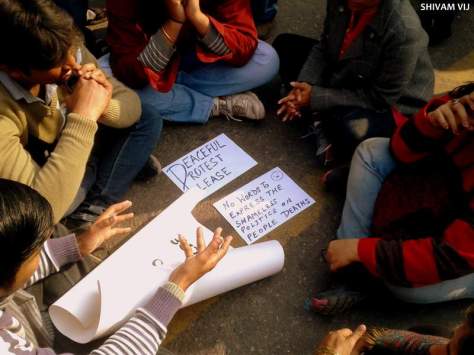
Another Report on the Gathering of the Night of 31st of December 2012/Ist January 2013 against Patriarchy in Delhi
It was 31st December 2012, city-Delhi, the same Delhi which has gained the infamy of being the Rape-Capital of a country called India, a nation whose ‘dignity’ has been maligned by the increasing cases of sexual assault on women. Around three hours before the clock struck the decisive moment of New Year, many of us gathered at the PVR Anupam complex in Saket to “take back the night”, back from the shackles of misogyny, sexual assault, patriarchy and above all from the banal and real fear of being subjected to crimes meted out by multifarious forms of male-supremacy and power. It was a night when ‘dented and painted’ females as well as males were showing that ‘denting and painting’ are not reasons that ‘invite’ rape or sexual assault and those ‘hormone driven gazes’. Continue reading Come Frolic with Me in the Streets of Delhi: Amrapali Basumatary→
Guest post byKAVITA, an activist with the Stree Mukti League
Translated from Hindi by Shuddhabrata Sengupta
It would be natural to expect that in the wake of the barbaric Delhi gang-rape of December 16 and subsequent popular upsurge of anger the police and the state machinery would betray a modicum of sensitivity and alertness. The reality is just the opposite of what you expect. We have heard this from many women in the past few days, and a few evenings ago, came face to face with this sad fact ourselves.
For the last few days, we (activists of the Stree Mukti League) have been going to different places in Delhi to hold meetings, demonstrations and to distribute leaflets against sexual violence. The leaflet has a contact phone number for the Stree Mukti League. Since the evening of the 1st of January this year a perverted male individual has been continuously ringing that number, abusing us, threatening us, using obscene and unprintable language. He even said ‘I know all you girls, and you cannot escape me. What I will do to you will terrify people…’, and several other things which cannot be repeated. Continue reading The Bitter Truth Regarding Delhi Police’s Womens’ Help-Line: Kavita→
In the last fortnight, we unlearned submission. On December 16, a 23 year old girl, just on the brink of leading a socio-economically independent life was raped in a moving bus at 9.30 at night.
We saw protests, we saw outraged masses. It is the first time in the history of this nation, when people were out on the streets on the issue of gender. For more than two weeks in a row. And it continues. Figures have been thrown at us: every 20 minutes a woman is raped in India, every third victim is a child, according to the National Crime Records Bureau.
At one of these protest sites, the car parking contractor informed me that they have slashed the parking charges from 30 bucks to 10 bucks in solidarity with the girl and her family. This may be dismissed as a ‘simplistic’ contribution by those who have been accusing these protests of being ‘middle class’. But we need to hit the core, to understand the wider repercussions of the Parking contractor’s this simple act. Continue reading Unlearning submission: Neha Dixit→
This song in memory of the unknown citizen is produced by Swaang, a Bombay based cultural group, whose members include actors, writers, music directors, musicians and producers “all in the grips of the market-driven Bombay film industry, but whose hearts continue to pull towards progressive politics!”
This brief has been put out by theJAMMU AND KASHMIR COALITION OF CIVIL SOCIETY
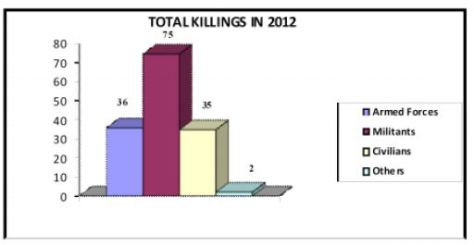
TOTAL KILLINGS
The year 2012 has just passed, and yet again like previous years, the government of Jammu and Kashmir has disgracefully claimed the year to be peaceful. This hyped peace is void of justice & peace and is packed with violence & injustice. In the year 2012 the people of Jammu and Kashmir in routine have witnessed unabated violence, human rights abuses, denial of civil and political rights, absence of mechanisms of justice, heightened militarization and surveillance. The figures of violent incidents suggest that 2012 as usual has been the year of loss, victimization, lies, mourning and pain for the people. Continue reading A review of human rights in Jammu & Kashmir in 2012: JKCCS→
Guest post by IRSHADUL HAQUE Translated from Hindi by Shuddhabrata Sengupta
Akbaruddin Owaisi, you are an enemy of Muslims. You are the kind of adversary who lurks like a snake in the grass, ready to strike at the person who cares for that patch. Your desire to provoke a confrontation between India’s 25 crore Muslims and 100 crore Hindus reminds us of Muhammad Ali Jinnah. This is why Javed Akhtar has gone to the extent of calling you ‘the greatest enemy of Muslims’. I know that I am not alone when I find myself agreeing with this view. Many other Indian Muslims will be in agreement with me. Continue reading Akbaruddin Owaisi – You are an Enemy of Muslims (and Hindus)→
Last week, I went to a bachelorette party. The party props were unbelievable to the point of being ridiculous—shot-glasses shaped like body parts, kinky trinkets, balloons in unmentionable shapes and sizes—and other items that would have made many women of another generation collapse in horror.
At the end of the party, everyone was slightly drunk and a good deal of time had been spent asking the bride-to-be embarrassing questions and cracking dirty jokes. I realized that our revelry had a close parallel in the cult classic “The Hangover”, a story of four men who go to Las Vegas to celebrate a very eventful bachelor’s party. Our party shared common themes from the script of the movie, including inebriation and the obsession with bodies, both perfect and imperfect. We missed the tiger and the stripper from the movie, but I am told that strippers are a very common feature in bachelorette parties in India.
The RSS supremo Mohan Bhagwat (or to call him out in the way he is referred to in the Sangh – Sarsanghchalak Param Pujya Shri Mohan-ji Bhagwat-ji) has now joined the pavilion of eminent Bharatiya moustachioed misogynists. In a breathtakingly revealing statement, he has told us that rapes happen in India, not in Bharat. What he means is that rape only occurs in urban areas where the influence of Paschatya Sanskriti (western culture) leads women astray into being raped by men unable to help or control themselves in the face of the assault of women, out and about, by day and night, defying Mohan Bhageat’s Sangh-mandated Lakshman Rekha.
When an upper-caste landlord in a village claims his ‘droit de seigneur’ (land-owner’s claim) with a Dalit woman, it is not rape, it is a yagya, a time honoured shastric ritual. When husbands persuade minor wives on their ‘suhaag raat’ with a few disciplinary measures that leave them with black eyes and sore limbs, it is not rape, it is the carrying out of an Upanishadic injunction. When swamijis, babajis, acharyas and prachaks have their way with ignorant and nabalik shishyas, it is not rape, it is the partaking of the naivedyam of a woman’s body. It is the realisation of a ‘pushp ki abhilasha’, even if the pushp gets pushed around a little bit in the process. Continue reading RSS Supremo Mohan Bhagwat’s Thoughts on Rape→
The curious Ways of Indian Democracy,from India Gate to the Slum Habitat
It has taken a horrific tragedy and a precious young life to stir the conscience of a nation. Or so one would like to believe! Reality may not still cater to our wishes. Our grand old civilization is also a culture of billion brutalities on its women and countless other victims. One can only hope that it changes for the better, even if a little, after what it has witnessed through the last fifteen days of the last year. Greater probability, however, is for such hopes to be belied yet again. It may take a lot more to lift the weight of an age-old way of life. After all, one would not have expected that rapes and molestations would be reported from across the country, and even from Delhi itself, right in the middle of anger, sorrow and protests that seemed to engulf the country. One would expect that the rapists and the criminals would lie low for a while till the situation returns to normal. Least of all would have one expected that women would be harassed, and one or two would even be molested, during those very protests that were taking place at the India Gate and Jantar Mantar. Continue reading Run with Gender, Hunt with Class: Prachee Sinha→
Protests against Sexual Violence continue in Delhi. Earlier this morning, there was a gathering to protest against the gruesome sexual violence committed on Soni Sori while in custody in Chhattisgarh under the supervision of Ankit Garg, Superintendent of Police, Dantewada. Ankit Garg was awarded with a presidential police medal on Republic Day (January 26) in 2012.
The year 2012 ended with a Kannada TV reporter, Naveen Soorinje, in jail for more than fifty days after the Karnataka High Court denied him bail. Mangalore-based Soorinje, was incarcerated from November 7, 2012 after police charged him under the UAPA and under the Indian Penal Code (IPC) for reporting on the raid on a homestay party by a Hindu fundamentalist group in July. Soorinje’s bail application was rejected on December 26.
The same month, a television journalist, Nanao Singh, was shot dead in a police firing in Manipur.
In 2012, India was a grim place for free speech. It recorded the death of five journalists. Another 38 were assaulted, harassed or threatened. There were 43 instances of curbs on the Internet, 14 instances of censorship in the film and music industry, and eight instances of censorship of content in the print medium. Continue reading Fettering the fourth estate: Free Speech in 2012→
The girl wasn’t aware that the Udyog Bhavan Metro station in central Delhi had been shut down. In the Metro going to Gurgaon, she needed to get down at Udyog Bhavan. Her friend was waiting in a car outside the station. She waited at the door. The train stopped too, but the gates didn’t open. The PA system — the annoying PA system of the Delhi Metro that never stops saying something or the other — fell silent. The station was deserted. Not a soul in sight.
The girl asked fellow passengers — all of us men around her — which would be the nearest station that would be open. All the options were far off. Ramakrishna Ashram station on one end, for instance, was four kms. away. “Now what?” the girl asked her friend on the phone in a tone that blamed him, in a way only lovers can. “Now what?” she kept repeating. Continue reading The epiphanic moment of the lathi charge→
There’s something uncomfortably neocolonial about the way the Delhi gang-rape and subsequent death of the woman now known as Damini is being handled in the UK and US media. While India’s civil and political spheres are alight with protest and demands for changes to the country’s culture of sexual violence, commentators here are using the event to simultaneously demonise Indian society, lionise our own, and minimise the enormity of western rape culture. [Full article]
And Ananth Krishnan in The Hindu:
The rape case was one of the most discussed topics in Chinese microblogs over the past week, prompting thousands of posts and comments. By Sunday, however, the authorities appeared to move to limit the debate: on Monday, a search for the topic triggered a message on Sina Weibo – a popular Twitter-equivalent used by more than 300 million people – saying the results could not be displayed according to regulations. The message is usually seen as an indicator of a topic being censored by the authorities. [Full article]
She was sitting among a group of young men and women at Jantar Mantar, shouting “Hang those bastards.” When the slogan lost its effectiveness, it turned to “We want Justice,” “Inquilab Zindabad,” and then “Bharat Mata ki Jai”. Borrowed and heard slogans, but they came from a very real place. “I work in Saket but live in Dwarka.” That is a long distance to travel especially at night. She nodded. “I don’t like it when my parents tell me to come home early just because other people are at fault,” she said anger rising in her voice. She didn’t know any of the people in the group she was sitting with. “We just met here. I had come with a friend who I can’t locate at the moment.” Continue reading The things you learn at a protest: Aakshi Magazine→
[ Click to play above Youtube video of young women and men, led by Com.Lokesh (‘Lucky’) of Stree Mukti Sangathan (Women’s Liberation Organization) articulate their desires on the ‘Take Back the Night’ night walk and street party from Anupam PVR Complex to the road outside Select City Walk in Saket, New Delhi on the night of the last night of 2012 and into the early hours of 2013. ]
[ B&W pictures, courtesy Chandan Gomes. Colour pictures and cell phone video footage, courtesy, Bonojit Husain, New Socialist Initiative ]
Dear young women and men of Delhi,
I am writing to you again because I have been listening to you. This is a strange time, when everybody is talking, and everybody is listening, and the unknown citizen, who could have been any one of you, has transformed us all.
I was with you last night, from five thirty in the evening to around nine at night, while we walked together from the Vishwavidyalaya (University) Metro Station to Vijay Nagar, Kamla Nagar and the North Campus of Delhi University. There were around twelve hundred of you. Several of you held candles. You made yourselves into a moving blur of light. As the shopkeepers of Vijay Nagar, as the rent collecting aunties of paying guest accommodations, as the men and boys and girls and women on the streets and in the verandahs looked at you in wonder, you looked back at them, many of you smiled and waved. I could see some people in the crowd lip-synch with your Hallabols.
[ video of the night march near Delhi University ]
Guest post by text byRIJUL KOCHHAR photos by CHANDAN GOMES
Each person, withdrawn into himself, behaves as though he is a stranger to the destiny of all the others. His children and his good friends constitute for him the whole of the human species. As for his transactions with his fellow citizens, he may mix among them, but he sees them not; he touches them, but does not feel them; he exists only in himself and for himself alone. And if on these terms there remains in his mind a sense of family, there no longer remains a sense of society.
~Alexis de Toqueville (Epigraph to Richard Sennett, The Fall of Public Man)
Friends! You drank some darkness
and became visible
~Tomas Tranströmer (“Elegy”)
An hour is what it took for a band of six males to show a woman, a paramedic, ‘her place’ in contemporary Delhi. Often, in our pathological public places, it takes a mere moment. This case is different because it compels us to think through the limits of brutality of the living; it compels us to confront the limits of our capacity to inflict violence. But the night of December 16, 2012 also confronts us with the kind of cities we are building and the kind of places we want to inhabit. It is a different, by no means less important, matter that this woman—from whatever one has gathered these past weeks through the periodic medical bulletins—has battled to compel us to confront all of this and more, for the pain of her body and the brutality of an experience that she had survived for two weeks, serves a specular role—through it, we bear witness to ourselves, or so one hopes.
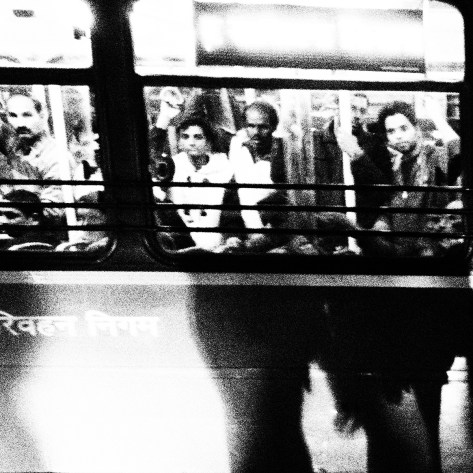
Passengers in a DTC bus try and catch a glimpse of the candle light vigil organised outside Safdarjung Hospital. Thousands of commuters became witness to today’s meet – some got down from their buses to join the vigil. Some joined their hands when their gaze fell on the bed of candles. An old woman took out her hair clip that was shaped like a flower and threw it towards us.

 KAFILA - COLLECTIVE EXPLORATIONS SINCE 2006