Solidarity for the Prisoners of Conscience in India – Statement in Support of Teesta, Sreekumar & other Human Rights Defenders in India

260 prominent human rights activists, intellectuals, journalists, artists and community leaders from all over the world strongly condemned the arrest of eminent human rights activist Teesta Setalvad and R.B. Sreekumar , Sanjiv Bhatt (already in prison for over 18 months) as well as journalist and fact checker Mohammed Zubair in India. The newly launched broad-based alliance, Solidarity for the Prisoners of Conscience in India, had appealed for this show of solidarity. 

Statement in Support of Teesta, Sreekumar & other Human Rights Defenders in India

We the undersigned, concerned citizens of the world, and representing various human rights organizations, condemn the arrest of veteran human rights leader, Teesta Setalvad and other Human Rights Defenders. These are Prisoners of Conscience in India, and all such prisoners must be freed.

June 25, 2022 marked the 47th anniversary of the dark era of an Emergency in India, when a government hijacked the whole edifice of the state. The ruling party and its leader treated the state as their personal estate. It was the imposition of a highly concentrated apparatus of power on a fundamentally free and federal society, and the turning over of this centralized apparatus for personal vengeance and pursuit of raw political power. It was one fell swoop overtaking the whole country, spreading a psychosis of fear and terror. Continue reading Solidarity for the Prisoners of Conscience in India – Statement in Support of Teesta, Sreekumar & other Human Rights Defenders in India

Letter to Chief Minister of Karnataka: Concerned citizens

Letter to CM of Karnataka by by a group of concerned citizens based in Karnataka

June 24, 2022

To Shri Basavaraj Bommai,  Chief Minister of Karnataka

Sub: Concerns about peace and harmony within Karnataka and the urgent need to restore the state to a “sarva janangada shantiya thota

Respected Chief Minister,

We have been trying to secure an appointment with you through your office for over a month. We wished to present this letter to you in person. Since we have not succeeded in our efforts, we have decided to issue it as an open letter since we believe that it concerns matters of public importance. We consider it our duty as citizens to bring our concerns and suggestions to your attention. We hope you and the government you head will take due note of it.

The letter follows:

We are a group of concerned citizens from different walks of life based in Karnataka who, like lakhs of fellow citizens, are deeply disturbed by recent developments in the state that threaten to destroy the peace, diversity and pluralism for which Kannada Naadu has long been known and admired. We believe it is our duty to bring our concerns and suggestions to your attention for corrective action. Continue reading Letter to Chief Minister of Karnataka: Concerned citizens

 The Role of Individuals in resisting the Majoritarian State – Aakar Patel

Eminent author and rights activist Aakar Patel will be delivering the 17 th lecture in the Democracy Dialogues Series, organised by New Socialist Initiative, at 6 PM (IST), Sunday, 3 rd July, 2022.

He will speak on ‘The role of individuals in resisting the majoritarian state’. You can also watch it live at facebook.com/newsocialistinitiative.nsi

About the Speaker :

Aakar Patel is a syndicated columnist, author and rights activist and is Chair, Amnesty International India

He has edited English and Gujarati newspapers. His translation of Saadat Hasan Manto’s Why I Write was published in 2014 ( Tranquebar). His study of majoritarianism in India ‘ Our Hindu Rashtra : What It Is. How We Got There came out in 2020 ( Westland) and his next book which seeks to explain data and facts on India’s performance under Narendra Modi, titled ‘Price of ‘The Modi Years‘ was published in 2021 ( Westland). His forthcoming book is on protest and participation by citizens

Abstract :

The role of individuals in resisting the majoritarian state.

India is going through a transformational period when many feel constitutional values have been undermined, an oligopoly has been handed control over large parts of the economy and the secular and pluralist basis of the nation are being eroded. 

What can the individual do in these circumstances? A talk on the ways of meaningful resistance

Letter to UP Administration: Women’s groups, democratic rights organisations and concerned citizens

Statement by women’s groups, democratic rights organizations and individuals

Shri Ajay Singh Bisht, The Chief Minister, UP

Shri Avnish Kumar Awasthi, Secretary, Home, UP

Dr Devendra Singh Chauhan, DGP, UP

Shri Ajay Kumar SSP, UP Police

We, the undersigned women’s organisations, democratic rights groups and individuals, write to you to strongly condemn the attempts of the Uttar Pradesh police to take into custody civil society activists who have been active in the anti-CAA struggle on the false and completely unsubstantiated claim that they were “masterminds” of the protests that happened in different parts of the country on June 9-10, 2022.

These protests were followed by police action in which several people have been injured. The police have unleashed bulldozers to demolish the homes of activists in a brazen and illegal manner. Police have filed cases against a number of people and sought to detain them and members of their families. Instead of compensating those whose houses have been unjustifiably demolished, your administration continues to take the same illegal path of throttling dissent. Continue reading Letter to UP Administration: Women’s groups, democratic rights organisations and concerned citizens

CCG Open Statement on the Sedition Provision in the Indian Penal Code

Statement by Constitutional Conduct Group

We are a group of former civil servants of the All India and Central Services who have worked with the Central and State Governments in the course of our careers. Our group has no affiliation with any political party, and we, as its members, believe in impartiality, neutrality and commitment to the Constitution of India.

On May 11, 2022, a chorus of appreciation greeted the Supreme Court’s interim orders on a batch of cases which had challenged the constitutionality of the sedition provision contained in Section 124A of the Indian Penal Code (IPC).  The Supreme Court’s order was an interim one, viz. to keep in abeyance this section and all related pending trials, appeals and proceedings until further orders.  While we would, like others, wish to applaud this decision of the Supreme Court, we feel that, at present, it deserves only a muted cheer.   Continue reading CCG Open Statement on the Sedition Provision in the Indian Penal Code

Why Google News Does Not Want To Talk Caste ?

The Google episode shows the right-wing vision of unity is exclusionary. But this vision is increasingly being challenged in the United States and beyond.

On 9 May 1916, a young BR Ambedkar presented a paper at Colombia University in the United States titled Castes in India: Their Mechanism, Genesis and Development. He referred to caste as a “local problem, but one capable of much wider mischief”. He wrote, “…if Hindus migrate to other regions on earth, Indian caste would become a world problem.”

More than a century later, as one of the biggest corporations, Google, battles allegations of caste discrimination in the United States, the predictive value of Ambedkar’s words is evident. Recently, Google News cancelled a scheduled talk by Thenmozhi Soundararajan, the founder and executive director of Equality Labs, after many Google employees (of Indian origin or Indians) opposed it. The discussion was supposed to mark Dalit Equality Month, celebrated every April to mark the month Ambedkar, the first law minister of independent India and its leading anti-caste activist, was born. Equality Labs is a leading non-profit group in the United States that advocates Dalit rights. According to its 2016 survey, a third of Hindu students in the United States reported experiencing caste discrimination.

Thenmozhi was subjected to an organised campaign led by a section of Google employees, who called her “Hindu-phobic” and “anti-Hindu”. The name-calling went on in emails her opponents sent to company bosses and documents they posted on a mailing list that thousands of Indian employees access.

( Read the full article here)

The Hindu deity as juristic person – A dangerous path, yet again: Rahul Govind

Guest post by RAHUL GOVIND

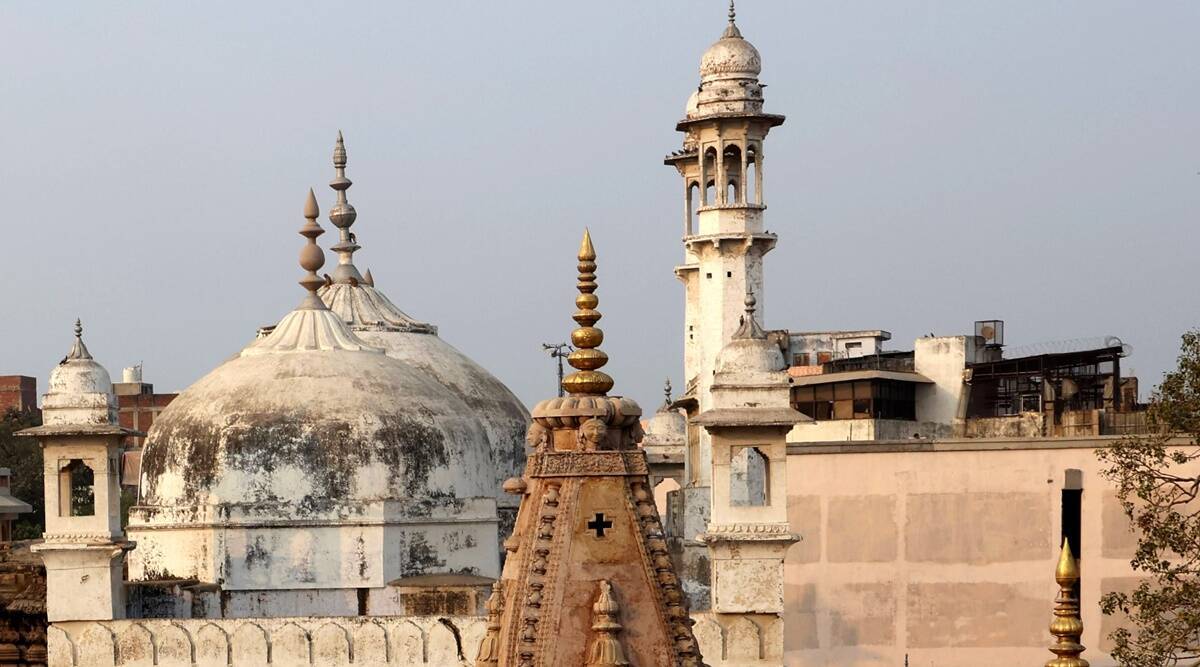
Gyan Vyapi Mosque and Kashi Vishwanath  Temple (Image courtesy Indian Express)

The present controversy over several religious sites threatens to tread yet again the path that led to the communal mobilization, riots and destruction of the Babri Masjid. The popular press also repeats several legal arguments without always analysing their import. In the present cases, just like in Ayodhya, a key point that we hear time and again is that when it comes to the Hindu deity’s property, such property is perpetual and therefore even if a temple was destroyed centuries ago, the legality of the Hindu deity’s property remains unimpeded, thereby becoming the basis of a reclamation. It is therefore important to understand the legal concept of the Hindu deity’s juristic personality. Continue reading The Hindu deity as juristic person – A dangerous path, yet again: Rahul Govind

No End to ‘Tamas’ ( Darkness) Around ?

One can imagine that if the plan to provoke riots before Eid in Ayodhya would have been successful, how it could have easily spilled over to the other parts of the country.

Image for representational purpose. Credit: Hindustan Times

It was the early 1970s when Bhisham Sahni, the legendary Hindi writer had penned the novel Tamas. It looks at the Hindu-Muslim riots in India in the backdrop of the Partition. Its central character is Nathu, who is Dalit and does the work of removing hides from dead animals. A local politician persuades Nathu to kill a pig; the act is later used to foment a riot in the city.

It has been more than 40 years since the novel was written, but it still resonates with today’s India as it throws light on the ‘fault lines’ of Indian society and shows the ease with which they can be weaponised.

A fortnight back, a similar attempt to provoke a riot was made in Ayodhya using a similar technique; however, prompt action by the district police averted a riot there.

( Read the full article here)

Academics and activists in solidarity with Dr Ravi Kant, Lucknow University

We, the undersigned academics and activists, express our deep concern regarding the public heckling, intimidation and abuse directed at Dr. Ravi Kant, Associate Professor of Hindi and well known Dalit intellectual, on the premises of Lucknow University by a mob allegedly comprising students of the university as well as outsiders. Highly divisive and incendiary slogans, which included threats to Dr Ravi Kant’s life, were raised, and the Dept of Hindi of the University was surrounded. Dr Ravi Kant was forced to take shelter in the University Proctor’s office for several hours. The ostensible reason for this protest were remarks that he made in a discussion in the well-known online channel Satya Hindi, about the Gyan Vapi Mosque in Varanasi, in which he cited a story about its origins narrated by Patabhi Sitaramaiya in his book ‘Feathers and Stones’. Dr Ravi Kant, while making this reference, was careful to emphasize that this narrative could only be called a ‘story’, as its author did not cite any source in support. Nevertheless, within less than twenty-four hours of these remarks, a maliciously edited extract of his comment was circulated online which, by the next morning, snowballed into a violent protest which has created a grave threat to Dr Ravi Kant’s safety.

Continue reading Academics and activists in solidarity with Dr Ravi Kant, Lucknow University

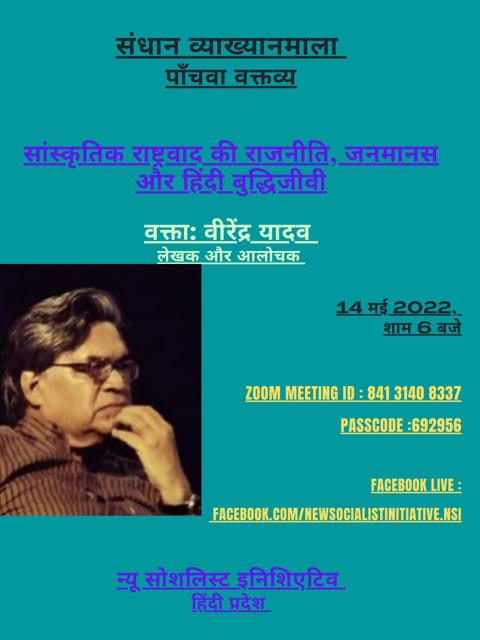
Politics of Cultural Nationalism, People’s Opinion and Hindi Intellectual : Virendra Yadav

Leading Writer and Critic Virendra Yadav will be delivering the fifth lecture in the ‘Sandhan Vyakhyanmala Series’ ( in Hindi) on Saturday,14 th May,  2022, at 6 PM (IST).

He will be speaking on ‘सांस्कृतिक राष्ट्रवाद की राजनीति , जनमानस और हिंदी बुद्धिजीवी’ ( Politics of Cultural Nationalism, People’s Opinion and Hindi Intellectual)

This online lecture would be held on zoom and will also be shared on facebook as well : :facebook.com/newsocialistinitiative.nsi

Join Zoom Meeting
https://us02web.zoom.us/j/84131408337?pwd=ZUp6eWg5WGdYVVY1ZkdzQ3ZzRnhoQT09

Meeting ID: 841 3140 8337
Passcode: 692956

Organised by :

NEW SOCIALIST INITIATIVE ( NSI) Hindi Pradesh

——–

संधान व्याख्यानमाला – पांचवा वक्तव्य

विषय : सांस्कृतिक राष्ट्रवाद की राजनीति , जनमानस और हिंदी बुद्धिजीवी 

वक्ता : अग्रणी लेखक एवं आलोचक वीरेंद्र यादव 

शनिवार, 14 मई , शाम 6 बजे 

सारांश :

1- ‘सांस्कृतिक राष्ट्रवाद’ मात्र एक राजनीतिक व्यूहरचना न होकर एक ऐसी अवधारणा है जिसकी गहरी जड़े पारम्परिक रूप से  हिंदू जनमानस में  मौजूद हैं।
2- 1857 से लेकर 1947 तक विस्तृत ‘स्वाधीनता’ विमर्श में इस हिन्दू मन की शिनाख्त की जा सकती है।
3- स्वाधीनता आंदोलन इस हिन्दू मन से मुठभेड़ की नीति न अपनाकर मौन सहकार की व्यावहारिकता की राह पर ही चला।
4- हिंदी क्षेत्र में तर्क, ज्ञान  व  वैज्ञानिक चिंतन की धारा भारतीय समाज की वास्तविकताओं में कम अवस्थित थीं, उनकी प्रेरणा के मूल में पश्चिमी आधुनिकता व वैश्विक प्रेरणा अधिक थी।
5- हिंदी क्षेत्र व समाज में ज़मीनी स्तर व हाशिये के समाज के बीच से जो तार्किक, अंधविश्वास विरोधी व विज्ञान सम्मत सुधारवादी प्रयास हुए उन्हें मुख्यधारा के चिंतन-विचार में शामिल नहीं किया गया।
6- ध्यान देने की बात है कथित ‘हिंदी नवजागरण’ विभेदकारी वर्ण-जातिगत सामाजिक संरचना की अनदेखी कर प्रभुत्ववादी मुहावरे में ही विमर्शकारी रहा।
7- संविधान सम्मत धर्मनिरपेक्ष आधुनिक भारत की परियोजना में    भारतीय समाज की धर्म व जाति की दरारों के जड़मूल से उच्छेदन को प्रभावी ढंग से शामिल नहीं किया जा सका।
8-सारी आधुनिकता के बावजूद हिंदी बुद्धिजीवियों का वृहत्तर संवर्ग वर्ण और वर्ग से मुक्त होकर   जनबुद्धिजीवी की भूमिका न अपना सका।
9- सामाजिक न्याय की अवधारणा का मन में स्वीकार भाव न होना, हिंदी बुद्धिजीवी की एक बड़ी बाधा है।
10- ‘सांस्कृतिक राष्ट्रवाद’ का प्रतिविमर्श रचने के हिंदी बुद्धिजीवी के उपकरण वही रहे जो हिंदू बुद्धिजीवियों के।
11- हिंदी बुद्धिजीवी के सवर्णवादी अवचेतन से उपजा दुचित्तापन ‘सांस्कृतिक राष्ट्रवाद’ का प्रतिविमर्श रचने में एक बड़ी बाधा है।

आयोजक : न्यू सोशलिस्ट इनिशिएटिव NSI  ( हिंदी प्रदेश)

STOP UNLAWFUL DEMOLITIONS IN DELHI: Women’s groups, other groups, and concerned citizens of Delhi

Letter of Deep Distress and Concern to
THE LG OF DELHI, CM OF DELHI, COMMISSIONER, MUNICIPAL CORPORATION OF DELHI

Stop Unlawful Demolitions in Delhi;
Compensate, Rehabilitate, Restore Livelihoods
of the Affected Immediately

We, the undersigned, wish to express our deep concern at the bulldozer-led demolitions carried out by various municipal corporations in Delhi. As is well known, the first round of demolitions was carried out by the North Delhi Municipal Corporation in Jahangirpuri resettlement colony on April 20, 2022, soon after the communal violence in the area just four days prior to that. The recent visits to and subsequent statement by the SDMC Mayor regarding areas earmarked for future demolition points to the real and present danger that the actions in Jahangirpuri and Kalyanpuri over the past week will be repeated in these areas that have already been named – Shaheen Bagh, Jasola, Sarita Vihar, Jaitpur and Madanpur Khadar.  It is deeply disturbing that demolitions in these areas have been put on hold only because the Delhi Police publicly asked for ten days’ notice in order to cooperate with the order. Massive presence of paramilitary forces in some of these areas as well as frequent processions of slogan shouting crowds led by BJP leaders are contributing to an overall climate of intimidation and terror.

It is appalling that the bulldozers hired by civic authorities are targeting temporary structures essential for livelihood such as handcarts and cycle carts, fruit stalls, gumtis, and wooden ‘shop’ tables. These structures are used all over the country by some of the poorest communities in the city – rickshaw pullers, fruit vendors, women running marginal and subsistence businesses, ragpickers, garbage sorters, vendors and hawkers. The brutality of the action to destroy the precious belongings of some of the poorest residents of the city is unprecedented in the history of Delhi. The affected are overwhelmingly unprotected informal economy workers who have already suffered sudden and severe destruction of their livelihoods during last two years of the coronavirus pandemic and lockdown.  Continue reading STOP UNLAWFUL DEMOLITIONS IN DELHI: Women’s groups, other groups, and concerned citizens of Delhi

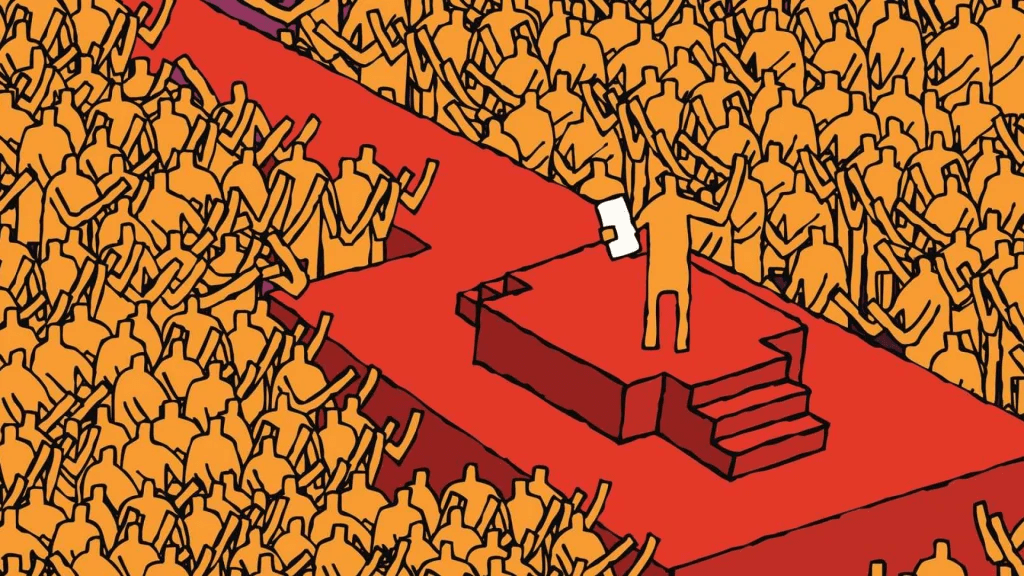
‘पृथ्वी के असंख्य घाव’  गिनता अकेला आदमी

Image courtesy -https://www.inc.com/


…..यह हमारी सोच की एक अनपहचानी सीमा है
नहीं समझते हम
कि अकेला आदमी जब सचमुच अकेला होता है
तो वह गिन रहा होता है
पृथ्वी के असंख्य घाव
और उनके विरेचन के लिए
कोई अभूतपूर्व लेप तैयार कर रहा होता है।
(अकेला आदमी – विमलेश त्रिपाठी)

कालजयी रचनाएं समय स्थान की सीमाओं को लांघ कर किस तरह आप को अपनी लगने लगती हैं, इसको बयां करना मुश्किल है।

हान्स क्रिश्चन एंडरसन (2 अप्रैल 1805- 4 अगस्त 1875) महान डैनिश लेखक – जिन्होंने नाटकों, यात्रा वृत्तांतों , उपन्यासों और कविताओं के रूप में प्रचुर लेखन किया – अपनी परिकथाओं के लिए दुनिया भर में जाने जाते हैं। उनकी परिकथाएं नौ खंडों में प्रकाशित हुई हैं और दुनिया की 125 जुबां में अनूदित भी हुई हैं।

उनकी एक ऐसी अदभुत रचना है ‘राजा के नए कपड़े’ – जिसे हम ‘निर्वस्त्र राजा’ के तौर पर अधिक जानते हैं।

जब जब किसी मुल्क में अधिनायकवाद की हवाएं चलने लगती हैं, और लोगों पर अधिनायक की अजेयता का जादू सर चढ़ कर बोलने लगता है और उसके खिलाफ बोलना भी कुफ्र में शुमार किया जाने लगता है, यह कहानी नए सिरेसे मौजूं हो जाती है।

विशाल जुलूस में निर्वस्त्र निकल पड़ा राजा, जो कथित तौर पर जादूई वस्त्र पहना है – जिन्हें देख कर अधिकतर लोग खूप गुणगान किए जा रहे हैं – और उसकी सच्चाई को बतानेवाले उस नन्हे बच्चे का रूपक आज भी मन को मोहित करता रहता है।

एक संवेदनशील, न्यायप्रिय व्यक्ति को अन्दर ही अन्दर ताकत देता रहता है।

ऐसी ही एक अन्य रचना है ‘Enemy of the People ’ (जनता का दुश्मन,1882 ) जिस नाटक की रचना नॉर्वे के महान नाटककार हेनरिक इब्सेन (20 मार्च 1928 –  23 मई 1906 )ने की थी। बताया जाता है कि शेक्सपीयर के बाद दुनिया भर में इन्हीं के नाटक आज भी खेले जाते हैं। नाटक का प्रमुख सन्देश यही है कि एक व्यक्ति, जो अकेला खड़ा रहता है, वह जनता की भीड़ से अधिक ‘‘सही’’ होता है। अपने दौर की उस धारणा को कि समुदाय/समाज बहुत महान संस्था है और जिस पर भरोसा किया जाना चाहिए उसी को वह चुनौती देता है।

(Read the complete article here)

How Did UP Decide : Identities, Interests and Politics – Prof Zoya Hasan

Prof Zoya Hasan, Professor Emerita, Jawaharlal Nehru University and Distinguished Faculty, Council for Social Development, New Delhi, will be delivering a Special lecture  in the Democracy Dialogues Series, organised by New Socialist Initiative, at 6 PM, (IST) Sunday, 24 th April, 2022.

She will be speaking on ‘‘How did UP Decide: Identities, Interests and Politics”

Join Zoom Meeting
https://us02web.zoom.us/j/81240964790?pwd=OEd1OU00ejA5d1ZxYWlMRzFaOGNkdz09

Meeting ID: 812 4096 4790
Passcode: 975399

Facebook Live on – http://fb.com/newsocialistinitiative.nsi

Abstract

How did UP Decide: Identities, Interests and Politics

Uttar Pradesh has just seen an intensely contested assembly election which resulted in a second straight victory for the Bharatiya Janata Party in this politically crucial state. This momentous outcome is the subject of intense debate among analysts and indeed the public at large. There was a premise this time, particularly in UP, that communal polarisation wasn’t working because of acute economic discontent which could trigger electoral change. However, the large-scale discontent over many economic issues, including jobs, did not translate into a decision to vote out the government. Many analysts have attributed BJP’s reelection to welfare measures and free rations to the poor during the lockdown. This cannot explain BJP’s persistent success which extends beyond this election. The welfarist argument ignores the compelling logic of long term communalism and the systematic construction of the Hindu vote in UP politics since the time of the Ramjanmabhoomi movement centered in UP and the communal campaigns in the last five years, its impact is reflected in the election results.This construction of the Hindu vote also trumped the caste-based politics of the regional Samajwadi Party and Bahujan Samaj Party through a mobilization of upper caste and  non-dominant backward and lower caste communities. Communal polarization and identity politics is the keystone of their strategy and the decisive factor driving electoral choices. 

Leftists who side with Russia are just not real leftists: Shilyn Shekhar

Guest Post by Shilyn Shekhar

The opinion that is shared here will certainly get hate from people who side with the rational side of politics but it must be addressed.

There are many mixed opinions about the Russian-Ukrainian conflict with people having many different opinions, it is this war that reveals to us the true reality of some who claim to be leftists.

The term for them is ‘Tankies’. This word originates from the 2nd half of the 20th century when the Soviet Union would crack down any uprisings in their eastern block. There was a large divide in the left at the time when the Soviet Union rolled tanks into Hungary and Czechoslovakia because they tried to break away from the oppressive Soviet Sphere of influence. Most leftists opposed this but there was still a group that was in favor of it, these are the original tankies.

The Soviet Union wasn’t socialist or communist at the time, it was an authoritarian fascist regime whether people agree or not and the ones that supported them were not real leftists because the ideology is based on rational thinking.

The modern day tankies are a very major reason leftism is seen as evil and irrational in the west because they give a wrong image to the people which makes them see leftism as authoritarianism.

The modern day tankie ideology can be summed up as this: “It’s because of America/CIA”. They see the west as monsters whose only intention is to cause suffering and hurt “their ideology”.

I will not try to defend the US because it remains a fact that they’ve done terrible things in the middle east, africa, latin america and many more examples. But blaming them for everything isn’t right and does not solve any problems.

To them, the US is such an exaggerated evil that even the most terrible actions by their opposition is justified.

If China bans forming independent workers’ unions then a tankie would say that they have to, those unions are surely controlled by the CIA.

Cuba throws political dissidents in jail? They’d reply that Cuba has to do it because those people are puppets of the US.

Continue reading Leftists who side with Russia are just not real leftists: Shilyn Shekhar

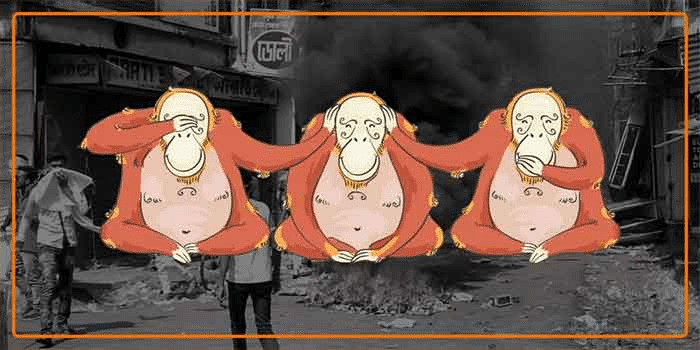
Silence of the Powerful

Why the Corporate Czars are Silent over increasing attacks on Social Fabric and rising Communalism 

Celebrity actors and players share an interesting commonality in this part of South Asia.

Their moral compass normally veers towards the ‘righteousness’ of the rich, powerful and the influential.

Lynching of innocent people on the streets for their faith, social and governmental hounding of lovers belonging to different communities, call for genocide of religious minorities from public forums and similar hate filled acts, nothing normally impinges on their conscience.

Corporate elites are qualitatively no different.

Occasionally, there are feeble voices of disagreements also.

What Kiran Mazumdar Shaw – founder of India’s largest biopharmaceutical company Biocon – did was exactly this only. She expressed her indignation about growing religious divide in the country and underlined how it would be detrimental to India’s global leadership in ITBT ( Information Technology and Bio Technology)

Definitely her statement which was couched in ‘economic terms’ was very mild, but it did not stop attacks by right-wing trolls.

( Read the full article here)

Part 2: A Ukrainian political scientist explains the War, Ukrainian nationhood, Maidan, NATO and neo-Nazis

Guest Post By Tushar Dhara

Tushar Dhara: Is it fair to say that Ukraine’s economic performance, especially GDP per capita, is less today than it was in 1991? I also noticed that some of the country’s macro-economic indicators like public and foreign debt, forex reserves and cost of borrowing were not very good in 2020, a period when lockdowns and the pandemic created global economic disruption. Could this have made the country more vulnerable?
Denys Pilash: It’s true that Ukraine’s economy was doing badly, and it was contending with Moldova for being the poorest country in Europe, in terms of income and GDP per capita. It was a continuation of a malign economic policy, the frame work of which was neo-liberalism, more privatization and marketization. Russia and Belarus were ever more neo-liberal than Ukraine in the case of labour legislation. Still, the intention of the Ukrainian ruling class was pretty clear. This led to a bad economic situation and meant that their logic led to a vicious circle of foreign loans and IMF loans, and the rollover of foreign debt. It was done by all Ukrainian governments, whether pro-Russia or pro-West. It was leading to a debt trap. It was one of the pretexts to the second Maidan protest. When Yanukovich was thinking about whether to borrow more from the West or from Russia – signing an agreement with the EU then backtracked and went back to Russia – it was all about finding the funds to fill the hole in the budget. They had no strategic vision about long term economic growth.

Continue reading Part 2: A Ukrainian political scientist explains the War, Ukrainian nationhood, Maidan, NATO and neo-Nazis

US, Russia and Ukraine – The Death Trap beyond the New Cold War: Vishwas Satgar

This article by VISHWAS SATGAR was earlier published in the Daily Maverick, South Africa, Satgar has written for Kafila on earlier occasions.

Vladimir Putin’s regime, unlike Franco, Mussolini or Hitler, has a formidable nuclear arsenal. In this context, the contemporary world stands on the brink, facing extinction either through nuclear holocaust emanating from battle fields in Ukraine or worsening the climate crisis, while in our everyday lives prices for food and fossil fuels are skyrocketing.

Precariousness, uncertainty and complex risk have become the lived reality of deep globalisation in which markets for finance, energy, food and production have been integrated.

The fragility of this global economy was exposed in the “great financial crisis” (circa 2007-2009) from which the world economy has not recovered, by the ongoing Covid-19 pandemic, and now by the Russian invasion of Ukraine. These realities cannot be understood through simple memes, propagandistic binaries or abstract security concepts.

The full article can be read here.

“Call It Invasion, an expression of Russian Imperialism.” Tushar Dhara in Conversation with Denys Pilash.

Guest Post by Tushar Dhara

Part 1: “The Russian invasion is a unilateral decision of the leadership which reflects the internal dynamics of Russian imperialism”: A Ukrainian political scientist explains the War, Ukrainian nationhood, Maidan, NATO and neo-Nazis.

In February Russian President Vladimir Putin claimed in a televised address that Ukraine is an illegitimate country that exists on a land that’s “historically” and “rightfully” Russian. Putin further claimed that a “genocide” was being perpetrated on “millions” of Russian supporters in the Donbas by Ukrainian far-right nationalists and neo-Nazis. Putin used this as an excuse to launch what he called “special military operations” in Ukraine, thus triggering the war.

One month into the Russian invasion, what is the situation in Ukraine? How does one understand the historicity of Ukraine’s nationhood, including its culture, language, status within the Soviet Union and its evolution since independence in 1991. How does one situate events like the maidan protests that rocked Ukrainian society, the role of far right formations like Azov and the aspirations of Ukrainians?

To understand these issues I spoke to Denys Pilash, a political scientist teaching at Kyiv National University. Pilash is on the editorial board of Commons magazine, a left of centre intellectual magazine. Pilash is currently in Transcarpathia in Western Ukraine, where he is helping deliver humanitarian aid. The interview is in two parts.      

Continue reading “Call It Invasion, an expression of Russian Imperialism.” Tushar Dhara in Conversation with Denys Pilash.

जीत भाजपा की नहीं निराशावाद की है : राजेंद्र चौधरी

Guest post by RAJINDER CHAUDHARY

इच्छा और आशा में अंतर होता है. विशेष तौर पर किसान आन्दोलन के आलोक में, बहुत से लोगों की तरह मैं भी चाहता था कि भाजपा हारे और मुझे इस की थोड़ी आशा भी थी परन्तु कोई विशेष आस नहीं थी. भाजपा की जीत मेरे लिए दुखदायी है परन्तु अनपेक्षित नहीं है. चुनाव परिणामों की समीक्षा के तौर पर बहुत कुछ लिखा-कहा गया है परन्तु एक महत्वपूर्ण पक्ष का ज़िक्र कम हुआ है. 

क्या उत्तरप्रदेश, जिस का कम से कम एक हिस्सा किसान आन्दोलन के सक्रिय केन्द्रों में शामिल था, में भाजपा की जीत से यह साबित हो जाता है कि भारतीय मतदाता हिन्दुत्ववादी हो गया है? ऐसा बिलकुल नहीं है. भाजपा को उतर प्रदेश में कुल पंजीकृत मतदाताओं के 25% ने ही वोट दिया है. भाजपा के वोट अनुपात में जिस बढ़ोतरी की चर्चा हो रही है वह असल में वोट डालने वालों में से भाजपा के पक्ष में वोट डालने वालों के अनुपात की  बढ़ोतरी है. ग़ैर-भाजपा वोटर के वोट ही न देने से और भाजपा वोटर के पहले की तरह वोट देने मात्र से भाजपा के समर्थन में बढ़ोतरी दिखाई देती है. वास्तविकता यह है कि 10 में से लगभग 4 पंजीकृत वोटर तो इतने निराश हैं कि वे वोट डालने ही नहीं गए (वोट न डालने वालों का एक छोटा हिस्सा निश्चित तौर पर ऐसा होगा जो किसी अन्य कारण जैसे शहर से बाहर होने के कारण या अन्य व्यस्तता के चलते वोट नहीं डाल पाया होगा परन्तु यह हिस्सा बहुत छोटा ही होने की संभावना है). 2017 में भी कुल पंजीकृत वोटरों में से भी लगभग इतने ही प्रतिशत वोटरों ने भाजपा के पक्ष में वोट डाला था. यानी बहुमत अभी भी हिन्दू वादी नहीं है, उत्तर प्रदेश में भी नहीं. 

Continue reading जीत भाजपा की नहीं निराशावाद की है : राजेंद्र चौधरी

Challenges to India’s Democracy : Prof Zoya Hasan

Prof Zoya Hasan, Professor Emerita, Jawaharlal Nehru University and Distinguished Faculty, Council for Social Development, New Delhi, will be delivering the 16 th lecture  in the Democracy Dialogues Series, organised by New Socialist Initiative, at 6 PM, (IST) Sunday, 27 th March, 2022.

She will be speaking on ‘Challenges to India’s Democracy

Prof Zoya Hasan has written and edited many books on state, political parties, ethnicity, gender and minorities in India and society in north India and has been a visiting Professor to the Universities of Zurich, Edinburgh and Maison des Sciences de L’Homme, Paris.

Her most recent publications include Forging Identities : Gender, Communities And The State In India ( edited) ,  Agitation to Legislation – Negotiating Equity and Justice in India ,   Congress after Indira: Policy, Power and Political Change (1984–2009), Politics of Inclusion: Castes, Minorities and Affirmative Action, (2009) and a collection of essays titled Democracy and the Crisis of Inequality

Abstract

Challenges to India’s Democracy

The 75th anniversary of Indian Independence is a landmark event in the history of our democracy. It is for this reason a significant moment to assess the state of India’s democracy. As the largest democracy in the non-western world, India is a success story. Its success, however, has primarily been recognized as an electoral democracy, with regular free and fair elections registering high voter participation, and also peaceful transfer of power. Elections certainly are a climactic moment of the democratic process but by no means the only important one. Politics between elections is central for understanding the challenges facing Indian democracy, and it is important, therefore, to contextualize democracy.

Three years since the Bhartiya Janata Party government was re-elected has seen the consolidation of the process begun in 2014 – the establishment of a Hindu state. This process has been facilitated by the combination of majoritarianism and authoritarianism which has resulted in democracy becoming thinner, not accidentally, but deliberately. This does raise certain questions about the relationship between Hindu nationalism and democracy which seems to weaken the idea of democracy moderated by institutions. 

This paper tries to make sense of these shifts through a thematic exploration of the trajectory of Indian democracy since 2014 focusing on three overlapping developments -the consolidation of a majoritarian brand of politics, the decline of independent institutions and the shrinking space for political dissent and protests -which has undermined democracy. Each of these issues distinct and significant in its own right when taken together constitutes a major risk to Indian democracy. However, public protests in the last few years have emerged as a major bulwark against authoritarian rule and the erosion of democratic dissent. For the Opposition it’s a moment of reckoning but there are signs of churning among the Opposition as well.

 मुसलमानों की उम्मीदों का मलबा:सालिक अहमद, अनुवाद: शुभेंद्र 

Guest Post by Salik Ahmad.

Originally published by The India Forum as The Shattering of The Muslim Hope in India(https://rb.gy/jfnxtz)

कुछ रोज पहले, एक शाम अपने दोस्त के साथ दिल्ली की भागदौड़ भरी जिंदगी से वक्त निकालकर, काई से काली पड़ चुकी अपनी छत पर बैठा, पीले आसमान के नीचे खड़े ठूँठे  रूख को देख रहा था। मेरा दोस्त, जो एक बड़ी मल्टीनेशनल कंपनी में काम करता है, अपने अनुभवों के बारे में बताते हुए कह रहा था कि कैसे उसका ऑफिस उसके लिए एक अजनबी जगह है।

 मेरे दोस्त कहता है, “वहाँ हर कोई मुसलमानों पर हो रहे अत्याचारों से कितना बेखबर है। मैं रोज लिंचिंग का नया वीडियो, नफरत उगलनेवाला भाषण, जनसंहार (Genocide)को उकसाने वाला कार्टून देखता हूँ लेकिन जब मैं ऑफिस जाता हूं तो वहां लोगों में चर्चा होती है, सबसे अच्छी सुशीज (Sushis) कहां मिलती है, और केक सबसे बेहतर कौन बनाता है। गुप्ता सांता का खेल चलता है और लोग अपनी तरक्की की योजनाएँ बनाने में मशगूल हैं। मैं ऑफिस को अचंभे के साथ देखता हूं और सोचता हूँ कि यह कैसी जगह है, या फिर मैं किसी दूसरे जमाने में आ गया हूँ।” 

Continue reading  मुसलमानों की उम्मीदों का मलबा:सालिक अहमद, अनुवाद: शुभेंद्र 

DISSENT, DEBATE, CREATE