Governing Kashmir: Critical Reflections on the Historical Present

Guest post by RICHARD SHAPIRO

The Indian state’s refrain to the people of Kashmir is as follows: Indian rule of Kashmir is legitimate because India is a secular democratic republic, organized by rule of law and constitutionally guaranteed human rights. As a democratic state, rule of law may be suspended for national security reasons to protect the state, and such action has been necessary in Kashmir because of cross-border terrorism and ‘separatist’ elements in Kashmir that includes armed militants. The suspension of democratic rights in Kashmir, India states, is necessary to protect India as a secular democratic republic. Elections are periodically held and touted as proof of democracy in India, but without a vibrant civil society ensuring social freedoms, electoral processes obfuscate the subjection of Srinagar to New Delhi and give Indian governance greater legitimacy than if the center took official control over the state of Jammu & Kashmir.

What is the logic of the Indian state to which Kashmiris are subjected? The people of Kashmir must be denied the rights guaranteed to citizens of India because every Kashmiri is considered a real or potential threat to India. Kashmiris are citizens of India who are denied the rights of citizens to protect the state as the guarantor of rights. Law and order demands the denial of democratic rights to the people of Kashmir. Freedom of assembly and movement, freedom of speech and expression, freedom of press, freedom of religion are the basic rights that make India a legitimate state, and it is precisely these rights that must be denied all Kashmiris because when Kashmiris exercise these rights it is considered evidence of the anti-national sentiment of Kashmiris. Continue reading Governing Kashmir: Critical Reflections on the Historical Present

A Twist in the Tale, Or, the New Copernican Revolution

Even as the rejection of Vedanta’s application to mine in Niyamgiri is being widely hailed as a victory for tribal rights, there is of course one set of very predictable voices, which has leapt in to start damage control for their corporate heroes. Thus one such cheerleader of Capital tells us that the ‘real twist’ in the script is that the ‘denial of bauxite mining in Niyamgiri’ can mean disaster for the future of a poor region and a poor state!

On the other hand, a statement by the Campaign for Survival and Dignity – a platform of tribal and forest dwellers’ organizations from all over the country has hailed the decision, arguing that: “The project’s main problem was that it violated the Forest Rights Act’s provisions requiring ‘recognition of habitat and community forest rights’ and the consent of the gram sabha prior to taking forest land. This sounds like technical legalisms. But the basic point is that, under the law, the Dongria Kondhs have the power to protect and manage their forests and lands. Simple, but unprecedented; it has never happened before.”

For our scribe however, the “really nuanced” stories of Niyamgiri are not those of the tribals and forest dwellers. They come from “the likes of Raju Sahu who came from Bihar to Kalahandi 10 years ago and runs four tea/food stalls on the state highway that links Lanjigarh – where Niyamgiri and the Vedanta factory are situated – to Bhawanipatna, the district HQ”.  Sahu apparently told our journalist-investigator that his business has more than trebled in the last four years since Vedanta started operations there. This is true for any big economic enterprise that gets set up – a large number of small businesses sprout up around it. There would be as many stories about poor people who benefited from the life that grew up around say, giant public sector units – the end of which is celebrated by these cheerleaders of Capital.  Will the perishing of those small businesses as a fall-out of the closure of PSU’s be accepted by our nuanced story-teller as a justification for the continuation of PSU’s? Never. For we know that there are always different standards for judging the merits of corporate marauders. You can tell even before you start reading a column by a Shekhar Gupta or a Tavleen Singh or a Saubhik Chakrabarti, what is coming – be it Niyamgiri, Bhopal and Union Carbide, the loot of the Commonwealth Games or the studied silence on matters relating to DIAL and GMR. And sometimes, just sometimes, we happen to know why…

Continue reading A Twist in the Tale, Or, the New Copernican Revolution

Socialism of the New Century: Sunil

Guest post by SUNIL

[Sunil is the national vice-president of Samajwadi Jan Parishad. This  article was written for a special issue of Janata weekly. The essay is an important statement from one of the leading activist-theorists of the socialist movement (i.e. non-Marxist socialism) which does not simply disavow the marxist legacy but engages with that experience as an essential component of socialist practice. AN]

The tussle between capitalism and socialism as alternative visions of human society is not yet over. It is like the old fable of the race between a hare and a tortoise. At times one seems to be the winner. At other times the other seems to be leading. Capitalism is like the hare of the story. It looks fast, impressive and dynamic but after some time it is tired and resting with its own contradictions. In the end, we know it is the tortoise of socialism which will prevail. But that end is yet to be arrived at.

Capitalism looked supreme and unchallengeable in the later decades of the past century. With the disintegration of USSR, reverting of China, Vietnam and many other communist countries to the path of capitalism, and downfall of social democracy in Europe, there was no challenge to capitalism. Thus ‘end of history’ was arrogantly announced. Market fundamentalism of Reagan and Thatcher varieties started ruling over the world. But soon many crises arrived. Ecological crisis with the dangers of climate change and global warming on the one hand, and the global financial crisis with the worst recession since the thirties on the other, shook the faith in the supremacy and immortality of capitalist civilization. Added to these were the growing crises of hunger, malnutrition, homelessness, violence and war. The number of hungry people in the world kept growing and crossed the figure of 100 cores in the first decade of the twenty first century i.e. every sixth person on the earth today remains underfed and starved. This is perhaps the biggest and the most glaring failure of capitalism. Even after more than two centuries of the industrial revolution and miraculous progress of science and technology, it is unable to fulfill even the most basic need of the humankind.

Continue reading Socialism of the New Century: Sunil

Godhra, arson, terrorism, stone-pelting, Dalits and Muslims, and other such issues in village Lehna

A fact-finding report released today by PUCL Uttar Pradesh

Fact Finding Report on the murder of MNREGA and labour activist Shri Hari Lal, Village Lehna, Block Manjhanpur, District Kaushambhi on 15.08.2010

A fact finding committee to investigate the incident was formed with the following: members

  1. Mr. S.R.Darapuri, Retired IPS, Vice President UP PUCL.
  2. Mrs. Arundhuti Dhuru, Consultant to Commissioner Right To Food Committee of Supreme Court.
  3. Mr. Ram Kumar, Vice President UP PUCL.
  4. Mr. Jawed Rasool, Dyanmic Action Group.
  5. Dr. Nisha Srivastav, Professor  (Deptt. of Economics ), Allahabad University .
  6. Mr. Rajni Kant Rai, HRLN, Allahabad .
  7. Mrs. Bindu Singh, Convener UP Right To Food Campaign .
  8. Mr. Sanjay Singh, convenor, Parmarth, Oriye, Jalaun

The committee visited the site of incident in village Lehna  on 21.08.10 .The fact finding committee met the family members of the late Hari Lal, other residents of the village, and workers and officials of Voice of People’s (VOP). The committee also met the district magistrate and spoke to the superintendent of police. The following facts about the incidents came to light through this enquiry:

Background to the Incident

The main issue behind this incident was of MNREGA and payment of labour wages. According to the available evidence, a pond was dug in the village by 250 labourers from the panchayat quota of MNREGA in April, May and June 2007. However, the gram pradhan, Tirath (Dhobi), did not pay the labourers full wages. The gram pradhan is a mere puppet in the hands of a former gram pradhan, Bassan, and his son Fateh and a criminal named Nakkan. Continue reading Godhra, arson, terrorism, stone-pelting, Dalits and Muslims, and other such issues in village Lehna

Why Kashmiris should speak to Indians, not India

On 28 May this year, the Economic Times, India’s leading business daily, carried a story titled, ‘Kashmir survey finds no majority for independence’. That is a curious headline. What is ‘no majority’? Either there is majority or there is not. Robert Bradnock conducted this survey for Chatham House, a leading British think-tank, Kashmir on both sides of the Line of Control. The survey was conducted in the autumn of 2009, and the copy mentioned that 44 percent in Azad Kashmir and 43 percent in Jammu & Kashmir favoured an independent Kashmiri nation state.

Similar was the reporting of the survey in other Indian papers. They omitted some details, though. They did not mention that the survey was conducted not just in Kashmir but also the Jammu and Ladakh regions. They did not mention that even after factoring in Jammu and Ladakh, the total support for India was 21 percent and for Pakistan 15 percent. So if there was a three-way poll, the whole region’s average figure of those supporting independence (43 percent) would win hands down. Most of the rest (14 percent) favoured making the LoC a permanent border, which means sealing the status quo, something India and Pakistan came very close to doing in 2007. This 14 percent comes only from Poonch (94 percent), Rajouri (100 percent) and Jammu (39 percent).

Further, they did not mention that in the district-wise results the greatest support for independence was in the Indian side of the Valley – an astounding 95 percent in Baramulla, 75 percent in Srinagar, 82 percent in Badgam, and 74 percent in Anantnag. Pulwama and Kupwara were not surveyed. The highest support for India was 80 percent in Kargil and 67 percent in Leh, 73 percent in Udhampur and 63 percent in Kathua. In Jammu district, it was 47 percent – ‘no majority’. In Azad Kashmir, 50 percent wanted to be with Pakistan.

Now read the ET headline again. ‘Kashmir survey finds no majority for independence’. The story does not tell us what they found a majority supporting. If we have to be polite, we can say that such manipulative reporting of a detailed survey amounts to the Indian media being in denial of the fact that Kashmiris don’t want to be with India. If we have to call a spade a spade, we can say that this amounts to telling us a lie. Read More

Murder of an activist

This report comes from KK ROY

MNREGA Fighter and leader of Voice of People (VOP) Hari Lal of District Kaushambi, U.P. has been killed in broad day light at 12.00 Noon in his village Lahna, Block Manjhanpur district Kaushambi on independence day, 15 August 2010 at the instance of the corrupt Gram Pradhan Tirath Lal by the contract killers. Thousands of members of the VOP and other organisation gathered in the village and made militant protest, burnt the houses of the killer. A heavy contingent of armed police lead by District Magistrate, Superintendent of Police, Circle Officers and SHOs of various police stations entered into the village and let loose the reign of terror over the villagers, women and children. Two FIRs has been lodged against the leaders and members of the VOP including the common villagers. The leader of VOP Parvez Rizvi has been named in both the FIRs. One FIR has been lodged u/s 307, 322, 334, 352, 147, 148, 149 IPC and 7 Criminal Amendment Act in which 5 persons have been named and the second FIR has been lodged u/s 353, 336, 506, 427, 352, 436, 392, 147, 148, 149 IPC and 7 Criminal Amendment Act. Both the FIRs have been lodged by police andin both the FIRs VOP leader Parvez Rizvi has been named. Continue reading Murder of an activist

Building, dead bodies and the emergency decree in Thailand

This is a guest post with photographs by ANON.

Sunday 1 August 2010

Activists and people in the red shirt movement organized the event Building, dead bodies and the emergency decree at the memorial “14 October 1973”, a memorial built to remember those who died fighting against the dictator on that date.  This event was organized to raise funds to help the victims and their families, affected by the Thai government crack down during the pro-democracy Red Shirt Political protests in April 2010 and May 2010. Continue reading Building, dead bodies and the emergency decree in Thailand

Naba Dutta of Nagarik Mancha Arrested Under False Charges

[Well known labour and human rights activist and one of the important functionaries of Nagarik Mancha, Naba Dutta was arrested by the West Bengal police in extremely strange circumstances, after he along with his colleagues was returning from a sit-in programme at the Block Development Officer’s office. The following is a press release issued by Kirity Roy of the Banglar Manabadhikar Suraksha Mancha (MASUM) and Programme Against Custodial Torture & Impunity (PACTI).]

Mr. Naba Dutta along with his 3 companions, Ms. Progna Paromita Dutta Roy Chowdhury, Mr. Gautam Ghosh and   Mr. Dipankar Mazumdar – all attached with Nagarik Mancha, a civil society organization mainly focused on environmental and labor issues –  proceeded for a preannounced programme of sit- in in front of the Block Development Officer’s office at Narayangarh block of West Midnapur. The programme was organized by Lodha Shabar Vumij Kalyan Smiti. Mr. Naba Datta and his companions started from Kolkata by a vehicle (Toyota – Qualis 2.4 D Model) with registration number WB-02M-8565. After reaching the place they peacefully completed the meeting and started for Kolkata by the said vehicle. The driver of the car Mr. Ashok Midhya and Mr. Joydeb Singh of Lodha Shabar Vumij Kalayan Samiti was also in the car with the abovementioned activists of Nagarik Mancha. While Mr. Naba Datta and his associates with the driver (names mentioned above) were on their way to Kolkata, one police vehicle intercepted them and asked to follow their vehicle without showing any reasons. When asked about the reason for such illegal act the police personnel who made the said persons captive replied as, ‘we are taking you at Narayangarh Police Station’. Mr. Naba Dutta’s car followed the police vehicle without making any further argument. All the police personnel who had taken the persons in hostage were not in police uniform but were using a police car while being in plain clothes. When the cars crossed the Narayangarh Police Station, Mr. Naba Dutta and his companions sensed some foul play and asked the police personnel about their actual motive and where they wanted to take them but the police personnel declined to give any answer and told the driver of Naba Datta’s car to follow their vehicle.

Continue reading Naba Dutta of Nagarik Mancha Arrested Under False Charges

POSCO Pratirodh Sangram Samiti to Jairam Ramesh

This is a press release issued last week by PPSS, pointing out the illegalities   being committed by the Orissa government and the Central Ministry of Environment and Forests in connection with the POSCO project.

POSCO PRATIRODH SANGRAM SAMITI

Dhinkia, Nuagaon, Gadkujang; Jagatsinghpur District, Orissa

11.08.2010

To:

Shri Jairam Ramesh

Minister of Environment and Forests

Paryavaran Bhavan

New Delhi

Sub: Regarding POSCO project – need for withdrawal of illegal final clearance; new Meena Gupta Committee clearly aimed at delaying matters Continue reading POSCO Pratirodh Sangram Samiti to Jairam Ramesh

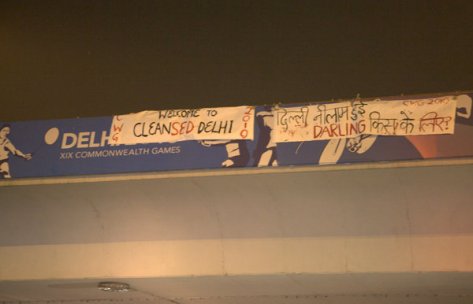
University Community for Democracy on relay hunger-strike against CWG evictions

We have had an earlier post on the University Community for Democracy which was formed in the wake of the arbitrary and authoritarian eviction of students from the hostels of Delhi University for the Commonwealth Games, but which raises wider questions about the “reckless logic by which the city is being re-made”.

This is their latest press release, followed by their letter to the National Commission for Women.

University Community for Democracy

PRESS RELEASE 10/08/10

The University Community for Democracy is initiating a RELAY HUNGER STRIKE FROM  9 AM TO 9 PM, 12TH AUGUST THURSDAY ONWARDS at the Arts Faculty Main gate, North Campus. Each day there will be five people (teachers, students and researchers) who will be on a hunger strike, as well as many others who will sit in solidarity.

The University Community for Democracy has been challenging a number of decisions taken by both Delhi University and the government with regard to the commonwealth games for over a month now. The Forum is deeply concerned by the gross violations of rights that the city has witnessed in the name of the Games and condemns the irresponsible manner in which Delhi is being prepared for this mega- event.

Continue reading University Community for Democracy on relay hunger-strike against CWG evictions

Creative Destructions

Part of a Series. See here.

In January of this year, I had taken a friend to Mumbai. One of the places we went to was Lower Parel – I wanted to show him what I could of the Mills. You could still see the Mills then, if not in the same form. The same compounds now housed small galleries and boutiques. There were advertisements for a ‘mills culture tour’, sold as something in between a bar hop and an art gallery cruise. I knew big clubs had opened here, as had malls. Phoenix Mills was Mumbai’s version of Delhi’s DLF Emporio – all the major global brands were there. Even here, however, I remember laughing and pointing out to him that some of Bombay’s stubborn egalitarianism remained. Armani was next to Addidas. Rohit Bal next to a paper store. Unlike in Delhi where no non-hyper-elite brand could get near DLF Emporio, in Bombay, even Armani couldn’t buy space away from Adiddas.

Continue reading Creative Destructions

What if man dies in the forest, and no one is around to see it?

Last week, the  Chhattisgarh police were caught in an extraordinary encounter in the forests of Dantewada. The encounter was interesting not just in the event itself, but also in the Police’s attempts to shape media perception during and long after the encounter.

On Kafila, we devote a considerable amount of our time trying to decode how the press covers particular events. Perhaps this post shall go some way in explaining why our morning papers look the way they do.

If the police are to believed, on August 4 this year, the Koya commandos were caught in a Maoist ambush, yet through brilliant rear-guard action emerged completely unscathed, along with the body of a “Maoist fighter”, a 12 bore shotgun and two IEDs to boot.

The “ambush” caught a lot of us in the press unawares: something had happened in the forest – but what? A series of strategic leaks had primed the media to expect “major losses” among the security forces – so when the police emerged from the jungle unscathed, everyone was expected to heave a collective sigh of relief.

However, for once, the Chhattisgarh based press was skeptical.

Continue reading What if man dies in the forest, and no one is around to see it?

Have I Joined the Popular Front?

In the past few weeks, I have been asked over and over again, not always in jest, if I had joined the Popular Front. I am not surprised. The police investigation around the violence against the college teacher at Muvattupuzha has broken all previous records in not only the violation of human and civil rights, but also in the silence of Kerala’s enlightened intellectuals. If I recall right, only Nandigram evoked such a dense and deliberate silence from them. No wonder, anyone who speaks up against the manner in which the police is being armed and authorized against ‘bad muslims’ is immediately dubbed a supporter of the Popular Front. But I am intrigued by this simple question, by which the entire history of that person’s engagement with discussions around religion and the state is erased. Continue reading Have I Joined the Popular Front?

Kashmir Comes to Jantar Mantar

A view of the crowd at Jantar Mantar - image taken on a cell phone camera

Last evening I went to Jantar Mantar after many years. It is a road I pass often, looking at the sad and melancholic little protests that line the kerb, whispering to an indifferent Capital the million mutinies of our banana plantation republic.

Last evening was different. There were perhaps four to five hundred people, many, but not all Kashmiri, men and women, who had gathered to protest against the wanton destruction of life in the Kashmir valley by the security apparatus of the Indian state in the last few weeks and months. 45 civilian deaths in 8 weeks signals a state losing its head. Especially when the deaths occur when the police and paramilitaries fire live bullets on unarmed or stone pelting mobs. When stones, or unarmed bodies are met with ammunition, you know that the state has no respect whatsoever for bare life. That this should happen in a state that calls itself a democracy should make all of us who are its citizens reflect on how hollow ‘democracy’ feels to the mother or friend of a young boy or girl who is felled by a ‘democratic’ bullet.

Continue reading Kashmir Comes to Jantar Mantar

Disability and the City Part III

Bed pan stories

“Yet in the different voice of women lies the truth of an ethic of care, the tie between relationship and responsibility, and the origins of aggression in the failure of connection.”- Carol Gilligan.

This piece will stray away from, but not abandon, the discussion about navigating public space with reduced mobility. This time let’s take a little peek into private spaces (ok, let me admit it now:  this sounds more fun than it is!J)

After the initial shock and pain of this injury has worn off,  the first thing that hit me is how dependant I am on others for the most basic things. The excretory system takes on a whole new dimension. Mundane things like shitting and pissing become a chore.  When loved ones stick a bed pan under you and clean you up after, one is forced to break personal boundaries with those people or realize that the boundaries don’t actually exist.

While admitted at the general ward at the AIIMS Trauma Centre, the class pyramid could be seen and felt. I was at the very top. But class wasn’t the only difference between me and the other patients. With one exception, almost everybody else I could see around me were men. All of these men were being taken care of by women, presumably their mothers or wives. While in the hospital, I had four friends, (two men, two women) taking turns as my primary caregivers. Every time the curtain was pulled shut so I could pee, any one of them could have come out to empty the bed pan. The four friends told me that the fellow patients and their attendants would joke with them when they were leaving saying ‘duty over??!!’. No one could figure us out: not the hospital employees, not the patients, and definitely not the other caregivers. Not only was there the eternal mystery of what relationships exist between these people and me, but also a mild scandal when men walk out with my bed pan.

Continue reading Disability and the City Part III

Pushing the Kashmiri to the wall, again

[An edited, shorter version of this article by me appeared last week in The Friday Times, Lahore.]

In the first week of June, I sat at a shopfront with a group of shopkeepers of Kalarus, a small town in Kupwara district in north Kashmir. In 1999, they collected money and bought land for a martyrs’ graveyard, one of many such in Kashmir. Whenever the Indian army killed militants trying to infiltrate from Pakistan to the Indian side of the Line of Control, they would hand over the bodies to the Kupwara police, who would give it to these people to bury after the autopsy.

“Look up at the mountain peak,” said one of them, “It is snow clad all twelve months. It is the LoC, 70 kms from here. Do you think anyone would cross that wearing the traditional Kashmiri Khan dress?” And yet, most of the hundred odd bodies in the graveyard had come wearing clothes unfit for snow. And, most of them had so many bullet marks on the face that they were unidentifiable. Continue reading Pushing the Kashmiri to the wall, again

Interim Report of the Independent Fact-finding Team on the Sompeta Firings on 14 July 2010

Interim Report of the Independent Fact-finding Team on the Sompeta Firings on 14 July 2010

The fact-find team (FFT), under the leadership of Justice P.K. Misra, former judge of the Orissa High Court, was an initiative of certain public-spirited individuals and organizations who were deeply concerned at the firing on the people protesting against the proposed thermal power plant by the Nagarjuna Construction Company (NCC) near Sompeta in Srikakulam district of Andhra Pradesh. The firing occurred on 14 July 2010 in which two persons died and five were injured by bullets (including a cameraman of TV-9 Telugu channel). In the events prior to the firing, about 300 people belonging to the neighbouring villages opposing the power plant and about 50-60 police personnel were injured.

During 24-25 July, the FFT visited Palasapuram, Lakkavaram, Isakalapalem and Ramaiahpatnam villages in Sompeta Mandal and talked to the local people who are resisting the proposed power plant to protect their life and livelihood. The Team met the District Collector, Mr. Srikanth (on the evening of 24 July), held discussions with the representatives and members of Sri Sri Sri Kanakadurga Taapi Mestri Sangam and Kalinga Vysya Sangam in Sompeta town, and visited the Government Community Hospital in Baruva Panchayat to meet some of the injured persons undergoing treatment. (Our effort to meet an injured police officer undergoing treatment in the Seven Hills Hospital in Vizag did not prove successful as he was discharged by the time we went there on the evening of 25 July).

Continue reading Interim Report of the Independent Fact-finding Team on the Sompeta Firings on 14 July 2010

Disability and the City Part II

Hobbling on the beach

I was born next to Elliot’s beach in Besant nagar in Chennai where I spent a large amount of my childhood and adolescence A small caveat about this area: Besant Nagar is considered one of the posh areas in Chennai. However, like many such places the combination of communities the class composition of this area is far more complex; large bungalows of film stars and the like co-exist with the Uroor slum. By co-exist of course, I don’t mean for a moment that they peacefully co-exist. They are next to one another (sort of) and there are many who are out there to change that. The slum has been destroyed by humans (more often) and natural disasters many a times. The latest being a bid by the government to build an elevated highway next to the ocean displacing the entire slum (again!). But that’s another story. (http://letsrob.org/home/)

The beach itself is an interesting space in my city, it is one of the few remaining public spaces that people can come and relax in without paying. But there are unsaid divisions within the beach. Having known this particular beach almost my whole life, I know that there are different unspoken, unmarked sections for the rich, the poor, the lovers, the lusters, the friends, the random teenagers who would have just met two minutes ago and aunty-uncle couples who have been married for time immemorial.  Of course, the way these boundaries are drawn and where you find yourself changes according to a variety of factors.

After a fascinating flight journey (which will be another piece in the series), my first outing in Chennai few days after I reached home was to my beloved beach. Continue reading Disability and the City Part II

What Went Wrong in Kashmir? Rekha Chowdhary

Guest post by REKHA CHOWDHARY

This article was also published in Kashmir Times
What went wrong in Kashmir? This is one pertinent question that needs to be addressed seriously before any corrective measures can be applied. Situation would certainly normalise after some time, but apparently ‘normal’ situation in case of Kashmir does not indicate anything. The vibrancy of ordinary life and the day-to-day routine followed for days and even months, takes only moments to break. Underneath the normalcy, the turbulence is ever present and can surface at any point of time. Every turbulent period however provides clues to the real problem, and one should hold on to these clues, if one really wants to do something about it.

So what do we see in the present turbulence? Firstly, though the crisis revolves around the stone-pelting youth, one can clearly say that the real problem is not that of the stone-pelters. Neither the theory of LeT being responsible for it, nor the issue of money being paid to stone pelters, nor the vested interests making the most of the situation explains the crisis.

Disability and the city Part I

I broke my leg three weeks ago. I cannot walk till end September. But I hope to get around the city a little bit during that time and I hope to record that experience. This I hope will be a multi-part series and here is the context:

I will be getting around either in a wheel chair or with my walker where I will be hobbling on one leg. Otherwise, my appearance right now is a bit ragged as my hair isn’t getting combed every day, primarily because I am lazy but I look like I am from a relatively well off family. And I look fair enough to be a Brahmin (a dark one) but can’t tell for sure immediately. Oh, and I am a woman. Visibly so.

Continue reading Disability and the city Part I

Pracharak as Terrorist – On the Bhasmasur of Hindutva Terror

I.

Hindu mythology with its plethora of gods and goddesses (which according to a conservative estimate numbers around 330 millions or 33 crores) has n number of stories supposedly to show the human face of the almighty. One such story talks of the creation of a demon called Bhasmasur by one of the gods himself. The said demon had the unique power of turning everything into ash if he could touch anybody’s head. The story goes that after ‘conquering’ the world the demon tries to attack his ‘creator god’ namely Shiva himself and then Lord Vishnu intervenes and manages to eliminate the demon itself.

Whatever might have been the significance of the story then, it bears striking resemblance to the plight of the RSS – the biggest fountainhead of Hindutva politics in the country – today. And this relates to the arrest of many of its senior wholetimers (called Pracharaks in its lexicon) for their role as masterminds, instigators or patrons of terrorist acts in the country and the ongoing questioning of many other senior leaders for their role in aiding and abetting such acts. Interestingly the parent organisation has till date not formally denied their role in all these acts and nor called it witchhunting as it did when investigations into the Malegaon bomb blast II (Sept 2008) were on and the likes of Sadhvi Pragya, Lt Col Purohit and others from the larger Hindutva family found themselves behind bars. In fact, this time it appears more cautious and according to a report it has even sent few of its leaders who supposedly played some role in these acts on a compulsory leave and has plans to send few more. (Bhaskar, 7 th July 2010).

Continue reading Pracharak as Terrorist – On the Bhasmasur of Hindutva Terror

DISSENT, DEBATE, CREATE