Courage Craft and Contention: Human Rights and the Judicial Imagination
On the 12th of June, the Alternative Law Forum (ALF) celebrated its tenth anniversary with a public lecture by Justice A P Shah and Prof. Upendra Baxi on the topic Courage Craft and Contention: Human Rights and the Judicial Imagination.
We are happy to share the transcript of the lectures.
Kashmir: The Hidden Occupation
Guest post by YASMIN QURESHI
Yasmin Qureshi grew up as a member of India’s Muslim minority before moving to the San Francisco Bay Area. She is a social justice activist who traveled to Palestine in 2007 and to Kashmir last year. This article is a reflection on her trip to Kashmir.
I wanted to go to Kashmir ever since I visited Palestine in 2007. There are many similarities in the nature of the occupation as well as the struggles, both being nearly 63 years old.
One difference is that while Israel is seen as an external occupying force in Palestine, the Kashmir issue is considered an “internal” matter or a conflict between Pakistan and India, and the voice of Kashmiris is often lost. As a result, there are fewer international organizations monitoring the region, and little information about the extent and impact of the occupation gets out.
A layoff from my company in August 2009 gave me the opportunity to visit the region, called “a paradise on earth” by Mughal emperor Shah Jahan. The unanimous message I heard as I traveled and spoke to journalists, taxi drivers, pony riders, waiters, students and teachers was that they want “azadi,” independence from the occupation by India. Continue reading Kashmir: The Hidden Occupation
In Search of the Postcapitalist Self
An issue of e-flux journal which may be of interest to many readers of Kafila.
No. 17: In Search of the Postcapitalist Self is guest-edited by Marion von Osten as her contribution to the 6th Berlin Biennale.
Summer 2010
Available online: e-flux journal no. 17: In Search of the Postcapitalist Self, guest-edited by Marion von Osten
A number of alternate, informal approaches to art and economy that arose in the Berlin of the 90s created a great deal of space and potential for rethinking relations between people, as well as possible roles for art in society. Today, however, much of this hope has since been obscured by the commercial activity and dysfunctional official art institutions most visible in the city’s art scene, and though many of the ways of living and working that were formulated in the 90s are still in practice today (not just in Berlin), many of their proponents acknowledge a feeling that the resistant, emancipatory capacities inherent to their project have since been foreclosed upon. Our interest in inviting Marion von Osten to guest-edit e-flux journal’s issue 17 had to do precisely with this widespread, prevailing sense of rapidly diminishing possibilities in the face of capitalist economy, and her extensive issue offers a broad and ambitious reformulation of how we might still rethink resistance and emancipation both within, and without capitalism—even at a time when alternate economies move ever nearer to everyday capitalist production, and vice-versa.
—Julieta Aranda, Brian Kuan Wood, Anton Vidokle Continue reading In Search of the Postcapitalist Self
Birthday Wishes from the Hindustan Times

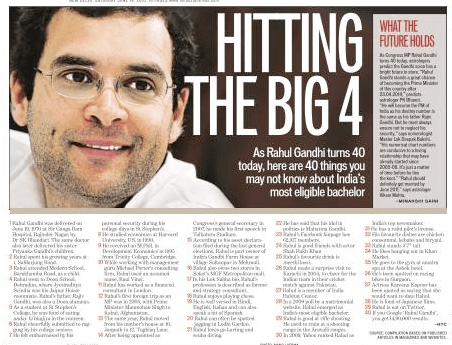
The Hindustan Times marked Rahul Gandhi’s fortieth birthday by tell us 40 things we “may” not know about “India’s most eligible bachelor”.
Nothing surprising about this. Why, don’t you remember how they told you 54 things about you didn’t know about Mayawati on Mayawati’s 54th birthday six months ago?
See also:
Why Hindol Sengupta Needn’t Fear Mayawati
Happy Ambedkar Jayanti
“Caste census will increase incidence of Japanese encephalitis”: Sociologist
Just four years ago, during “Mandal II”, everyone opposing the extension of OBC reservations to central educational institutions were saying we don’t even know how many OBCs there are. Now, when there is a proposal to count the OBCs, these voices are not to be heard. Just like “Mandal II”, a new term, “caste census” has been invented, as if the census already does not count the Scheduled Castes. The term “caste census” is used repeatedly in a way that suggests that a secular, progressive pro-development exercise is being sullied, polluted, by this monster of caste because of those uncouth cow belt politicians. Chee chee!
Obfuscation and intellectual dishonesty are in order. So, a lot of bullshit is being written about “caste census” to prevent us from knowing just how many of us are OBCs, to prevent the Other Backward Classes from entering the privileged spaces of the upper castes. This one takes the cake: Continue reading “Caste census will increase incidence of Japanese encephalitis”: Sociologist
The Desertification of Punjab and the Liability of Opinion Makers
In August last year, we had drawn attention to a piece by Indian Express editor Shekhar Gupta on the remarkable edit page piece he had penned on what he claimed was the ‘absence of drought’, in the Green Revolution region and provided his ‘explanation’ of why it had been possible. It had been possible, Gupta had opined, because all the great things had been accomplished in decades when the most retrograde environmental and jholawala movements in the history of mankind had not yet arrived on the scene. And with no evidence whatsoever and with nothing but his blind ideological faith, Gupta had even misled his readers that ‘underground aquifers were being constantly recharged’. This when just a few days ago, NASA satellite pictures had shown the extent of groundwater depletion in this region. Continue reading The Desertification of Punjab and the Liability of Opinion Makers
SMS booklets – guidelines for messaging addicts: Rafay Mahmood
[Sent to us by S. Akbar Zaidi, this article by RAFAY MAHMOOD was first published in The News of Pakistan. We are reproducing the this brilliantly funny report of the complete absence of boundaries between different forms (sms, print, internet) and the eclectic urge to take and assemble, to crack jokes, to create poetry – all in the service of the joy of life.]
“Tum Bijli, Pani or Train ko Rote ho Faraz / Is Mulk Mae Tau Toofan Bhi Time Per Nahin Aata”… This message was circulated all over the city when cyclone Phet proved to be an anti-climax for Karachiites by arriving late and then changing course before it hit the city’s coast. The brains behind this poetic gem is ‘Faraz’, who baptizes every new cell phone with one of his socially relevant yet romantic poetic masterpieces. He is a legend, the undisputed king created by messages being forwarded on cell phones.
The Short Messaging Service (SMS) plays a key role in our lives today and the SMS culture has not only redefined the identity of people like Faraz but has also spawned the creation of an SMS book industry. Continue reading SMS booklets – guidelines for messaging addicts: Rafay Mahmood
Social Profiling – Indian Style
“The Muslim is not wanted in the armed forces because he is always suspect – whether we want to admit it or not, most Indians consider Muslims a fifth column for Pakistan” [Vengeance! India after the assassination of Indira Gandhi (New Delhi, Norton, 1985), pp. 1995-96]
-George Fernandes
Amnesty International defines racial profiling as the targeting of individuals and groups by law enforcement officials, even partially, on the basis of race, ethnicity, national origin, or religion, except when there is trustworthy information, relevant to the locality and timeframe, that links persons belonging to one of the aforementioned groups to an identified criminal incident or scheme.
I
Is racial/social profiling practised in India? Continue reading Social Profiling – Indian Style
Mohamad Junaid: What Does the Chatham House Poll in Kashmir Tell Us?
Guest post by MOHAMAD JUNAID
The Chatham House poll conducted in the autumn of 2009 in Jammu, Ladakh, Kashmir and Azad Kashmir has revealed an interesting pattern of opinions held across these regions on issues ranging from the perception of major problems people face to effective solutions to the Kashmir issue and the best means to achieve them. Robert Bradnock, under whose supervision the poll was conducted, however presented the results somewhat shoddily leading to confusion over the real import of the opinion poll. This confusion has prompted media in India and Pakistan to portray the polls selectively or in a self-serving manner, largely reflecting their nationalist stances on the Kashmir question. The poll, in reality, points to some interesting developments in Kashmir and indicates a way toward an eventual, mutually agreeable solution.
Consistent with every other poll on the issue, Chatham House poll has shown again that an overwhelming number of people (74—95 percent) in Kashmir region demand independence. This figure comes as no surprise because the support for independence for Kashmir over accession to Pakistan has been steadily growing over the last 20 years. This feeling is more concretely reflected in the fact that most Kashmiris (more than 90 percent) support withdrawal of Indian troops from Kashmir, while a similar figure (around 80 percent) want Pakistan to withdraw its troops from Azad Kashmir. Along with demilitarization, there is a clear demand for de-weaponization (more than 80 percent) and an end to militant violence (around 90 percent) in the Kashmir region. The Line of Control in its present form is uniformly rejected in both Kashmir and Azad Kashmir. Continue reading Mohamad Junaid: What Does the Chatham House Poll in Kashmir Tell Us?
‘The Moral Obligation of Indian Civil and Political Society’: Rekha Chowdhary on Fake Encounters in Kashmir
Guest post by REKHA CHOWDHARY
With another incident of fake encounters in Kashmir, it is a moment of introspection for the political and civil society of India. For all those who are proud of Indian democracy, it is a moment to reflect as to how this democracy fares for the people in Kashmir. It is important to note that democracy does not remain limited to the electoral choices and the extent and intensity of competition in the formation of government – it also involves the political and civil rights of people. Even when democracy has been restored in Kashmir in its procedural form and is kicking in the form of intensely competitive politics, its substantive effect is missing. The right to life is the minimum that is provided by any democracy, the range of rights however goes much beyond this and involves the basic civil liberties as well. However, the way the hapless innocent persons were cruelly murdered in Nadihal in north Kashmir and declared as militants – it is the denial of the minimum. It is not only the murder of three people, it is also the murder of Indian democracy! Continue reading ‘The Moral Obligation of Indian Civil and Political Society’: Rekha Chowdhary on Fake Encounters in Kashmir
Women become targets; SPOs issue gag orders
Ever since Mukram hit the news, there has been a sure and steady attempt to cut-off access to the areas surrounding the Chintalnar Camp.
In the meantime, sources who helped me and a reporter from Tehelka access the villages are worried about their safety. SPOs in Chintalnar have reportedly threatened to “take action” against villagers who help the press.
The following is a recent article for The Hindu that has provoked some of the backlash against the press.
Mukram violence worsens; adivasi girls allege rape
A Public Service Announcement: Rukavat ke liye Khed Hai
Dear Readers,
There has been some consternation in the ranks regarding delays in comment moderation. If you do not see your comment up immediately, it is not because Central Committee has suddenly issued gag orders (we knew it!), we are becoming “un-democratic” (tyrants!), “authoritarian” (fascist bastards!), or coy (the dynamite of true revolutionaries is too much for our bourgeois souls). It is simply because all except one administrator are currently out of action.
Please have some sympathy for the lone Kafila elf, and desist from sending us 300 emails a day about Kafila’s sudden pact with the devil. Normal services will resume shortly :)
Notes on the Jaffna Economy
One of my friends in a discussion group in Colombo on ‘Democratising State and Society’ put forward the following challenge couple weeks ago. He said, a year after the end of the war, many of us who had been following the situation of the displaced people in the North, including the lack of freedom of movement and the militarization of the North have done little to engage the oppressive economic conditions of those affected by the war and now being resettled. That challenge was in the back of my mind as I visited Jaffna for ten days over the last two weeks. I tried to grasp what one could on a short visit. The following are very preliminary notes on the Jaffna economy, with a particular emphasis on agriculture and fisheries which ¬- despite technocratic and diasporic dreams of an information economy – continue to determine the economic life of the larger Jaffna population. These tentative notes I hope will stimulate some interest towards much needed research on the economy of the Jaffna District and the war affected Northern and Eastern Provinces. Continue reading Notes on the Jaffna Economy
Mukram slips into a vortex of violence

Don’t Treat us Like “Them”!
How inconsiderate of the Israeli spokesperson to club us, the self proclaimed largest democracy in the world and an atomic super power to boot, with the likes of failed states like Pakistan and with two others (Afghanistan and Iraq) that are currently being taught the basics of democracy by the marines of the most powerful democracy in the world.
How ungrateful of him, considering the fact we are buying so many weapons from his country, have signed so many MOUs with her, befriended her after betraying an entire people, who looked up to us because they thought that being founders and leaders of the Non Aligned movement we will stand with them .
We have done all this and more, in the weak -kneed statement protesting the attack on the freedom flotilla we did not even name the country that had perpetrated the crime
Despite all our most sincere efforts to accommodate them, this is how they treat us
Did the Israeli spokesperson think that we will not complain?
Did he really think that we will not seek to draw the attention of the comity of Nations and of Obama?
We will not be denied our democratic right to raise our voice of protest,
We will, with all the power at our command, appeal to world opinion and to the conscience of Benjamin Netanyahu and the entire Israeli cabinet not to club us with Pakistan, Afghanistan and Iraq.
We seek to inform Mr Yahu that we have no idea about the nature of his country’s relations with these three, what we do know is that we are friends of Israel. We have tried so hard to prove it to her and to her close ally the US, why does she not trust us. What more does she want from us? Why won’t she tell us?
Someone please help!
Beware Bigotry – Free Speech and the Zapiro Cartoons: Mahmood Mamdani
Text of talk on receiving an honorary doctorate at the University of Johannesburg, 25 May, 2010
MAHMOOD MAMDANI, Makerere University, Kampala, Uganda
This text was sent to us by Sujata Patel
It warms my heart to see these flowing gowns. I congratulate you on work accomplished! For over a millennium, these gowns have been a symbol of high learning from the Indian Ocean to the Atlantic. Should anyone ask you where they came from, tell them that the early universities of Europe – Oxford, Cambridge, le Sorbonne – borrowed them from the Islamic madressa of the Middle East. If they should seem incredulous, tell them that the gown did not come by itself: because medieval European scholars borrowed from the madressa much of the curriculum, from Greek philosophy to Iranian astronomy to Arab medicine and Indian mathematics, they had little difficulty in accepting this flowing gown, modeled after the dress of the desert nomad, as the symbol of high learning. Should they still express surprise, ask them to take a second look at the gowns of the ayatollahs in Iran and Iraq and elsewhere and they will see the resemblance. Education has no boundaries. Neither does it have an end. As the Waswahili in East Africa, which is where I come from, say: elimu haina muisho. Continue reading Beware Bigotry – Free Speech and the Zapiro Cartoons: Mahmood Mamdani
Holy Cow: Jyoti Rahman on Indophobia in Bangladesh
I am grateful to JYOTI RAHMAN, a Bangladesh-focused blogger, for contributing this guest post
Once upon a time, slaughter of cow was a major political issue in Bengal. There was a clause about it in the Bengal Pact — an agreement which, if implemented, could have avoided partition. And now, six decades after partition, there is a thriving trade in cows from India to Bangladesh. A recent LA Times article reports:
Continue reading Holy Cow: Jyoti Rahman on Indophobia in Bangladesh
Thailand – Two Elites and a Proletariat: Satya Sagar
A guest post by SATYA SAGAR
The two month long street protests in Bangkok by thousands of ‘red shirt’ opponents of the Abhisit Vejajiva government demanding fresh elections and the violence that followed has been described as the worst conflict Thailand has ever faced in its modern history. It left in its wake at least 88 dead, hundreds injured and close to US$2 billion worth of property destroyed, the toll being much worse in all aspects than previous political violence of October 1976 and May 1992.
Much of the loss of life and damage came in mid-May when the army brutally cracked down on the protestors using trained snipers and war weapons to take on street protestors armed mostly with slingshots, burning tyres and Molotov cocktails. Angry, retreating protestors in turn set fire to over two dozen buildings in Bangkok including Central World, the second largest shopping mall in South East Asia.
Continue reading Thailand – Two Elites and a Proletariat: Satya Sagar
Humanise First
There is dismay in some sections that the FIR lodged by the driver of the ill-fated Gyaneshwari Express does not name Maoists as the suspect perpetrators. Within hours of the derailment and death of the passengers, newspapers were already lamenting that the centre did not have guts to take on Maoists. Suggestions have been made that this is an extraordinary situation and vacuous talk of human rights should not be heeded. There is a familiar taunt being hurled at the UPA government for its unmanly response to the biggest threat to the internal security of the country. The principal opposition party, which otherwise very zealously guards the rights of the state and resents any interference by the centre in matters which fall under the state list, even in one of the most extra-ordinary moments of recent history , I am referring to the state sponsored massacre of Muslims in Gujarat , now feels that the nuanced division of the rights and duties of the state and centre is not something which should keep the centre from treating the Maoist threat as a national issue and going for an all out armed intervention against the enemy of the nation.