And that is why your neighbors don’t like you: Anurag Acharya

Guest post by ANURAG ACHARYA, student from Nepal at Jawaharlal Nehru University.

Peaceful coexistence among nations does not encompass coexistence between the exploiter and the exploited, the oppressor and the oppressed.

– Ernesto ‘Che’ Guevara

The 1800 km open border between India and Nepal has always been a matter of dispute between the two countries. While India has glorified the open border as its grace and gratitude towards a landlocked nation, Nepal has had to accept the miseries of sharing an open border with a bigger and powerful nation as a price for a trade transit. It goes without saying that whenever there has been a proposal or a debate within Nepal about the possibility of opening a trade route across the Himalayas to our north to tap the world’s largest market for Nepalese goods, it has attracted serious concerns from the South block. Bound by the unfair Indo-Nepal treaty of 1950 which prevents Nepal from independently conducting its international affairs and thwarts Nepal’s ambition to exploit the huge trade potential with China, an end to Nepal’s historical dependence on India has not materialized yet. While the treaty gives India a free hand to interfere in Nepal’s foreign affairs, citing its own domestic security, it has seriously impaired Nepal’s right to trade access, as a landlocked nation under the International Law. The treaty also stands in clear violation and entrenchment of a sovereign nation’s  right to conduct its external and internal affairs independently. However, weak diplomacy on Nepal’s part and unsympathetic attitude on the Indian side has ensured that Nepal stays dependent on India for all its exports and imports.

Continue reading And that is why your neighbors don’t like you: Anurag Acharya →
Historic Mandate, Historic Turning Point or More of the Same? Gail Omvedt on Elections 2009

Guest post by GAIL OMVEDT

The 2009 Lok Sabha elections in India were projected to be a historical turning point just as the 2008 Presidential elections in the U.S. were a turning point.  But the nature of that expected turning point was very different.

Five years ago, even two years before the elections, no one in the U.S. would have expected that a “Black” man with two Muslim names and one African name could have been elected President of the United States.  Yet it happened, and it happened not simply because Barack Husain Obama ran a brilliant campaign and is proving the most effective president in dealing with the economic and social crises besetting the world today, but also because of the racial transformation the U.S. has undergone in recent decades. Continue reading Historic Mandate, Historic Turning Point or More of the Same? Gail Omvedt on Elections 2009 →

Why the Delhi High Court judgement on IPC 377 does extend to the rest of India

While expanding the territorial jurisdiction of high courts in such cases, the SC took cognizance of the principle contained in Article 226(2), which empowers a high court to issue directions to entities located outside its territory. [Manoj Mitta]

The Day After the Judgement

So now that we have one group of criminals less to deal with, I have a proposal: Criminalize English TV news channels.

'Debate,' the Times Now way
‘Debate,’ the Times Now way

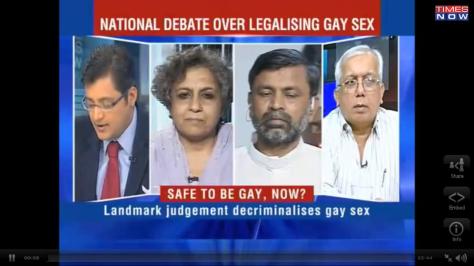
Watching Times Now yesterday after the Delhi High Court ruling on Section 377, I was overcome by a growing sense of bewilderment. I could hear Dominic Emmanuel (Director of the Delhi Archdiocese of the Roman Catholic Church) and Kamal Farooqui (Chairman of the Delhi Minorities Commission), saying quite cearly and more than once, to my surprise, that they welcome the decriminalization of homosexuality, that homosexuals should not be treated as if they were criminals. Okay, correct that – I could barely hear these statements over the insistent, aggressive and disruptive interruptions  of the anchor Arnab Goswami, who had obviously pre-set this “discussion” rigidly as a face-off between Reactionary Clerics/Minorities and Gay Rights Activists, while he himself was super hero, Anchorman. So each time they said “we welcome” etc.,  Anchorman would swoop in, bellowing, “So are you saying that they dont have rights, Sir, are you saying they should not have rights. Over to Anjali Gopalan (Naz) – Anjali, they say homosexuals should not have rights, what do you say?”

Continue reading The Day After the Judgement →

“The Magic of the Human Spirit and of a Nation’s Passion”: Three Queers for the Delhi High Court!

So – here we are folks, in a historic judgement this morning, Delhi High Court has read down Section 377 of the Indian Penal Code to exclude consensual sex among adults. Congratulations to the group of tireless activists who have helped to bring this about, and congratulations to all of us who count ourselves as part of the queer community. Continue reading “The Magic of the Human Spirit and of a Nation’s Passion”: Three Queers for the Delhi High Court! →

Hindu Rashtra in Delhi

(Protest by Hindutva organisations against construction of a mosque in Rohini Sector 16, Delhi…Prayer by the MUSLIMS not allowed by hindutva forces on 26.6.2009 and those who were coming for the  NAMAZ were beaten up and chased back. .. Hooligans marched in street to look out for muslims…Women also participated in large numbers..Timely intervention by the police..19 arrested……Appeal to maintain communal harmony by citizens groups.

According to reliable sources, a piece of land was alloted by the DDA to the ‘Dargah Islamiya Intezamiya Committee’ for a mosque in the area in North-West Delhi to cater to the longtime demand of the minority community. In fact people from Rohini have to either to go to Badli or Avantika, if they have to offer Namaz on anyday..

– Based on newspaper reports appearing in Rashtriya Sahara, Rojnama Sahara (27 th June 2009) and others) Continue reading Hindu Rashtra in Delhi →

When Pakistanis and Indians cheered for the same team

Continue reading When Pakistanis and Indians cheered for the same team →

A review of Anand Teltumbde’s “Khairlanji: A Strange and Bitter Crop”

Khairlanji: A Strange and Bitter Crop By Anand Teltumbde; Navayana, New Delhi, 2008, 214 pp.; Rs 190; ISBN 978-81-89059-15-6

Anand Teltumbde is a noted Bombay-based Dalit intellectual who also wears the hat of a business executive. He has written this book about the lynching of a Dalit family in a Maharashtra village in 2006 to ensure that the incident is not easily erased from memory. He quotes Milan Kundera: “The struggle against power is the struggle of memory against forgetting.” In other words, he sees this book as being a seminal work on the Khairlanji atrocity.

The book begins with Abel Meeropol’s song Strange Fruit, written in 1936 (and not 1939, as the book incorrectly states) about the lynching of two black youth. It is from this song that the book derives its sub-title, “A Strange and Bitter Crop,” which once again reinforces the book’s ambition. Billie Holiday’s rendition of Strange Fruit (in 1939) soon became an anthem for the anti-lynching movement in the US, but does Teltumbde’s book achieve its ambitious goal?

The book’s first chapter is a narration of the events of 29 September 2006, when Bhaiyyalal Bhotmange’s family was lynched to death. The atrocity is reduced in this narrative to a dry report, as if it were from the file of a district magistrate. Sample this: Continue reading A review of Anand Teltumbde’s “Khairlanji: A Strange and Bitter Crop” →

Iran: Inquilab Zindabad?

Once upon a time, only a hundred or so years ago, and earlier, Iranians were our neighbours. Many were friends, relatives – uncles, grandparents, ancestors, some were husbands, wives and lovers. And cities like Delhi, Lucknow, Murshidabad and Hyderabad spoke Persian better than they spoke English, or even Hindi. The distance from Tehran and Isfahan to Delhi, Lucknow and Lahore, or across the water from Bandar Abbas to Bombay or Karachi, in miles and in the imagination, seemed less than what we can even begin to understand today.

The Bengal renaissance had one of its points of origin in a Persian broadsheet called Mirat ul Akhbar published by Ram Mohan Roy in Calcutta. The first Iranian talking film and the last ‘Irani’ restaurant both have their origins in Bombay. The Sabk-e-Hindi, or the ‘Indian Style’ continued to adorn the more ornate fringes of Persian poetry in Iran. The miniatures painted in the ateliers of Delhi and Agra owed a great deal to the paints, brushes, colours and visions of visiting masters from Tabriz. The sitar and the sarod came from Iran, and stayed on. We shared jokes and stories, poets, prophets and pranksters, wine and spices, surnames (Kirmani, Rizvi, Mashadi, Yazdi) and clan histories, heresies and wisdom and a thousand other things that neighbours, friends, cousins and lovers share.

Continue reading Iran: Inquilab Zindabad? →

Corporates as Representatives

A few weeks before the national elections, www.SmartVote.in organized an open house where people could meet candidates contesting from various parliament assemblies in Bangalore and ask questions to them. Captain Gopinath was contesting from the prestigious Bangalore South constituency. He was one among the favourite candidates – honest, accountable and upright. Many questions were fielded to him during the open house ranging from what he would do about corruption to how he would improve the conditions in the city. One of the questions raised to him was how would he ensure that people’s opinions were reflected in the passage of important bills. To this, he replied that he would constitute a special committee comprising of people such as Mohandas Pai of Infosys and Kiran Mazumdar Shaw, among others, who he would consult on bills and legislation before casting his vote. He seemed to suggest that these persons’ opinions reflected those of the masses and hence, consultation would them would automatically imply obtaining views from the public. This both concerned and surprised me – how and why are corporates considered to be representing my opinion? Continue reading Corporates as Representatives →

“Two friends who have but one life”: Hope from the 19th century

I came across this delightful piece of information in the historian K P Padmanabha Menon’s History of Kerala (vol.3, AES reprint,2001, pp.498-500) which was written in the early 20th century. He quotes from “a paper published in the Madras Review (vol.2, p.250)”; we do not know which year this was published, but there is good reason to think that it was in the early 20th century. The paper is about a truly exciting institution – ‘marriage’ which produced not a heterosexual conjugal couple, but a same-sex  (male) couple bound by ‘friendship’! Continue reading “Two friends who have but one life”: Hope from the 19th century →

Gaon chodab nahin

Nandi’s divine wrath strikes BJP leader: Rukun Advani

This is a news flash from rainy Ranikhet, from RUKUN ADVANI of Permanent Black.

Balbir Punj owns a hotel called ‘Windsor Lodge’ on Ranikhet’s outskirts. (When it comes to personal money-making, BJP ideologues seem to have no problems naming their properties after the Queen of England.) Last week Punj came to his Lodge and went to the Kalika temple opposite the property. He did not notice a large bull there, but the bull noticed him: it charged straight for him and before Punj knew what was happening he had been thrown up in the air and gouged in the front. His arm is now in a sling. It being specially embarrassing for a BJP Hindu to be thus cast aside by a cow, Punj has been desperately downplaying his injuries. However, he asked Khanduri to immediately pen the bull, and the bull has been removed from the Kalika temple.

‘Only 35% Indians say freedom for Kashmir unacceptable’

Believe it or not, that is one of the findings of a new survey on Kashmir, conducted in both India and Pakistan.

And some more disbelief here:

A majority of Pakistanis say Pakistan’s government does not provide support to militant groups that conduct attacks against civilians in India, while a majority of Indians tend to believe it is providing support. Continue reading ‘Only 35% Indians say freedom for Kashmir unacceptable’ →

इतिहास से साक्षात्कार की घड़ी;

लालगढ़ मुक्त कराया जा रहा है. पिछले आठ महीने से जिस इलाके में पश्चिम बंगाल की मार्क्सवादी सरकार की पुलिस नही घुस पा रही थी , उस पर केन्द्र सरकार के सशस्त्र बल की सहायता से अब बंगाल की पुलिस धीरे–धीरे कब्जा कर रही है. केन्द्रीय गृह मंत्री पी. चिदंबरम ने कहा ज़रूर था कि यह कोई युद्ध नहीं हो रहा है क्योंकि कोई भी राज्य अपनी ही जनता से युद्ध नहीं करता लेकिन लालगढ़ में अभी चल रहे सैन्य अभियान की रिपोर्ट दे रहे पत्रकार लगातार यह बता रहे है कि वहां स्थिति किसी युद्ध क्षेत्र से कम नहीं है. गांव के गांव वीरान हो गए हैं.हजारों की तादाद में आदिवासी शरणार्थी शिविरों में पनाह ले रहे हैं. ध्यान देने की बात है कि ये शिविर भी राज्य सरकार नहीं चला रही है. पहले दो बडे शिविर तृणमूल कांग्रेस के द्वारा स्थापित किए गए. लालगढ़ की जनता के लिए शिविर स्थापित करने के बारे में बंगाल की सरकार अगर नहीं सोच पाई तो ताज्जुब नहीं क्योंकि उसके हिसाब से वह उसकी जनता नहीं है, वह तो शत्रु पक्ष की जनता है!दूसरे शब्दों में वह गलत जनता है. सही जनता वह है जो मार्क्सवादियों के साथ है.

लालगढ़ में पिछले आठ महीने से एक विलक्षण जन आंदोलन चल रहा था. बुद्धदेव भट्टाचार्य के काफिले पर हमले के बाद पुलिस ने जिस तरह लालगढ़ के आदिवासियों को प्रताड़ित किया, उसने साठ साल से भी ज़्यादा से असह्य गरीबी और अमानुषिक परिस्थितियों को झेल रही आदिवासी जनता के भीतर सुलग रही असंतोष की आग को भड़का दिया. लेकिन ध्यान दें, इन पिछड़े आदिवासियों ने कितनी राजनीतिक परिपक्वता का परिचय दिया! उन्होंने ‘पुलिस संत्रास विरोधी जनसाधारण समिति’ बनाई और लगभग हर संसदीय राजनीतिक दल से सहयोग मांगा. वह उन्हें मिला नहीं. लालगढ़ ने कहा , यहां हमारा अपमान करने वाली पुलिस और हमारी उपेक्षा करने वाले प्रशासन का स्वागत नहीं है. पुलिस और प्रशासन की उनके जीवन में अप्रासंगिकता का आलम यह है कि राज्य विहीन आठ महीनों में इस समिति ने ट्य़ूबवेल लगवाया जो बत्तीस साल के जनपक्षी वाम शासन में नहीं हो सका था, स्कूल चलाया, सड़क बनाई जो बत्तीस साल से नहीं थी और इस बीच अपराध की किसी घटना की कोई खबर नहीं मिली. एक तरह से यह जनता का स्वायत्त शासन था.
Continue reading इतिहास से साक्षात्कार की घड़ी; →

The Snub

[Part of  Series. Introduction: For Movement]

Tanger, Morroco, June 2009

Sometimes you just have to seek the travel moment. Yes, the best moments are unexpected, everyday, hidden. Sometimes though, the textbook travel guide moments, mass produced as they are, still work. Try this for a classic travel guide must-do: you drive down to the south of Spain, get to a ferry, put your car in the hold and cross the water in an hour long ride from Europe to Africa. West to.. well… not West. Continent to Continent. Universe to Universe. It’s a [good] travel writer’s worst nightmare and a travel publisher’s wet dream.

Continue reading The Snub →

On the Eve of Pride. Are We Going the Right Way: Akhil Katyal

This is a guest post by AKHIL KATYAL

Topicality is a homage one pays to the short-term memory that the new media both triggers and complains against in its customers. In the long-term of course, where trend is all important, the topical is only a category of the banal. But it is under the shelter of such a necessary topicality – the topical is always necessary – that I hope to sneak in a scandal.

Everyone is talking about the queer pride marches that are going to happen in four cities in India at the end of this month. Most liberal reportage is obviously supportive, if not triumphant. For these cities themselves, it is seen as a step into a liberal urban culture which tolerates, even enjoys difference. All the talk about the ‘gay community’ or ‘lgbt community’ that the Indian media – and the activists – have been dabbling in for at least a decade now, seems to be reaching its logical climax: the community is expressing itself. Every city seems to have its own pet lgbt community or at least aspires to.

Continue reading On the Eve of Pride. Are We Going the Right Way: Akhil Katyal →

Requiem for a Movement

Current media discussions about Lalgarh seem to miss out one crucial fact: Till less than a month ago, it was not a Maoist fortress, but a place where a fascinating experiment with a new kind of democratic politics was being undertaken. Maoists were certainly present, but they were constrained to go along with the mood inside Lalgarh, as earlier posts on Kafila have pointed out. This mood was certainly not one of forming ‘dalams’ or squads of roving Maoist guerillas. In fact, as People’s Committee Against Police Atrocities (PCPA) leader Chhatradhar Mahato told Times of India a couple of days ago, ‘if the state government had done even 10 percent of what we have done, the situation would have been very different.’ Continue reading Requiem for a Movement →

Inside Teheran – 03

Guest post by a friend via Monica Narula and the Sarai Reader list, with thanks.

June 15th/16th, 2009

I accidentally broke two glasses and a bowl. Yesterday, I was visiting a good friend of mine, K., who lives in the City Center, around the corner from Tehran University, between  Enghelab and Azadi Square. I was in the midst of kicking my legs up to stretch out onto the couch and my clumsy foot hit the edge of the small table nearby, knocking two glasses and a bowl onto the tile floor. My head was turned away when the accident happened, so the sound of so much glass breaking really took me and N., who had also come with me, by surprise.
Continue reading Inside Teheran – 03 →

Inside Teheran – 02

Guest posted by a friend via Monica Narula and the Sarai Reader list, with thanks. Apologies for formatting.

June 14th, 2009

8:45 PM

It‟s still less than ten days before the official beginning of summer. Although the weather may be warm and the blossoms are gone, it is, according to the position of the Earth in relation to the Sun, spring. Tehran Spring. A period of political liberalization under a Reformist government, backed by popular approval against the Soviet-backed Socialist system in Czechoslovakia in 1968 has come to be known as the Prague Spring. Infamous for the brutality of the Soviet and Warsaw Pact tanks rolling into the city of Prague eight months after President Alexander Dubcek loosened restrictions on speech, the media and travel, millions of demonstrators were crushed within seconds, although they remained peaceful the entire time. Czechoslovakia remained occupied by Soviet military forces until 1990, when the Socialist system collapsed. The Prague Spring may have not been successful from a populist, anti-authoritarian perspective, but it indicated a trend, rising in Europe and the world at the time, that unrest existed on many levels: cultural, economic, social, and, most importantly, ideological. The demonstrations in Prague temporarily shadowed the International Marxist movement, popular amongst intellectuals in Western Europe, as the USSR proved once again that the utopian yearning for revolution had seceded to authority hungry for control. During the early months of the Prague Spring, inspired by the Socialist reformist experiment in Czechoslovakia, students in Paris and other Western European cities set the university ablaze, workers went on strike, and the bureaucracy collapsed.

Continue reading Inside Teheran – 02 →

Inside Teheran – 01

From a friend via Monica Narula and the Sarai Reader List, with thanks.

June 13, 2009

9:05 PM

The satellite signal for BBC Farsi just turned off. I had spoken a few minutes earlier with my father and forgot where I was and that probably my phone call was being monitored. In fact, about 5 minutes into my phone conversation, I heard a faint click on the phone and my father‟s voice all of a sudden sounded very far away, muffled, as if he were on conference call. I was reminded by my friends in the other room that I should be a bit more prudent about what I say and how I say it – maybe it wasn‟t such a good idea to start off my conversation with “There‟s been a revolution”. We‟ve been camping out at home for the past 48 hours. Last night we were awake, in front of the television until 6AM. Slept in until noon and since then, we‟ve been on high alert, full of testosterone, exchanging our disappointment, confusion, worries, nervousness interspersed with information, hear say, opinions and the occasional, very necessary, joke. The house has turned into a news room, all of our computers open and
connected to the internet.

Continue reading Inside Teheran – 01 →

DISSENT, DEBATE, CREATE