End repression in Kashmir: A call from civil society

We, the undersigned, are dismayed over the ongoing crisis in Kashmir. We have watched in horror and shock the repetitive cycle of state aggression leading to violence, deteriorating state of civil liberties, violation of fundamental rights and ever escalating loss of human life and dignity in Kashmir. In the last 115 days, we have lost over 100 lives in Kashmir. More than 15,000 civilians have been injured, out of which 4500 persons have suffered grievous injuries due to pellet-guns, 4664 have been injured by bullets. Over 8000 people have been arrested out of which 434 people have been detained under the Public Safety Act (toll as on October 30, 2016).

The immediate response of the Indian state to the recent uprising in Kashmir was the imposition of curfew, which is continuing till date. A media gag where newspaper offices have been raided, copies confiscated and editors threatened with dire consequences, accompanied it. Journalists reporting the situation have been attacked, intimidated and threatened with violence by those supposedly responsible for protecting them. Most recently the government banned the publication of Kashmir Reader, a daily newspaper published from Srinagar.

Continue reading End repression in Kashmir: A call from civil society

भारत को पाकिस्तान बनने की राह पर धकेल रहे कट्टरपंथी

अठारह साल की एशम और उसकी बहन ईशा हर महीने दो बार मुल्तान जेल पहुंचती हैं, ताकि अपनी मां से मिल सकें। उनकी मां आसिया बीबी फिलवक्त पाकिस्तान के विवादास्पद ईशनिंदा कानून के तहत सजा-ए-मौत का इंतजार कर रही है। इस मामले में उसकी अंतिम अपील सुप्रीम कोर्ट के सामने है। ननकाना साहिब के लिए मशहूर पाकिस्तान के शेखपुरा जिले के इत्तनवाली गांव की रहने वाली आसिया बीबी (उम्र 50 वर्ष) पर ईशनिंदा के आरोप 2009 में लगे थे। एक खेत में काम करते हुए उसका झगड़ा साथ काम करने वाली मुस्लिम महिला से हो गया। झगड़ा इस बात पर हुआ कि आसिया को पानी लाने को कहा गया, तो मुस्लिम महिला ने आपत्ति जताई कि गैर मुस्लिम का छुआ पानी नहीं पिया जा सकता। झगड़े के बाद मुसलमान औरत स्थानीय मौलवी के पास पहुंची और बताया कि बीबी ने पैगंबर मोहम्मद को गाली दी। इसे ईशनिंदा का अपराध माना गया।

संवेदनशील मामला
पाकिस्तान में ईशनिंदा बहुत ही संवेदनशील मसला है, जिसके लिए मौत की सजा भी हो सकती है। आसिया बीबी को पुलिस ने गिरफ्तार कर लिया और उस पर मुकदमा चला। आसिया ने अदालत में कहा कि आपसी झगड़ा था, ईशनिंदा जैसी कोई बात ही नहीं थी, फिर भी 2010 में उसे मौत की सजा सुना दी गई। उसके समर्थन में बोलने वाले पंजाब प्रांत के तत्कालीन गवर्नर सलमान तासीर को उन्हीं के बॉडीगार्ड ने गोलियों से छलनी कर दिया। इस्लामाबाद में सरेआम गवर्नर की हत्या करने वाले मुमताज कादरी को मौत की सजा सुनाई गई और 2016 में उसकी सजा पर अमल भी हो चुका है। Continue reading भारत को पाकिस्तान बनने की राह पर धकेल रहे कट्टरपंथी

Anguish and Insurrection – Travelling with Shubha’s Poem: Prasanta Chakravarty

Guest post by PRASANTA CHAKRAVARTY

अतिमानवीय दुख

शुभा
________________

इतना दुख आंसुओं से नहीं उठाया जाता
वे हार गए कब के
चीख़ इसे और वीभत्स बनाती है
गुस्सा तो सिर्फ राख पैदा करता है

कुछ देर इसे ख़ामोशी ने उठाया
कभी उठाया कविता ने
विचार ने उठाया इसे
इसे उठाया दोस्तों ने
मिलकर गीत गाते हुए

कम्युनिस्ट पार्टियां बिखरीं
कितनी बार इसे उठाते हुए

इसे उठाने के लिए
कुछ और चाहिये
इन सबके साथ
उठाने का कोई नया ढब
इतिहास ने इसे उठाया कभी-कभी

अब इसकी चिन्दियां बिखरी हैं
इन्हें बच्चे उठा रहे हैं
यह पहुंच रहा है प्रकृति तक
तूफान और कन्दराएं
उठायेंगी इसका बोझ

अगर धरती इसे न उठा सकी
अन्तरिक्ष में नाचेंगी इसकी चिन्दियां

1.

SUPERHUMAN GRIEF

Shubha

Tears cannot bear such a burden of grief
They gave up a while ago
A scream makes it even more horrid
And anger gives birth only to ash

For a while silence bore it
Occasionally it was borne by poetry
Thought bore it
It was borne by friends
As they sang songs together

Communist parties scattered
so many times as they bore it

To be able to bear it
Something more is needed
along with all of these
a new way to bear it
History bore it on occasion

Now its scraps are scattered
Children are gathering them
It is now reaching nature
Storms and ravines
Will bear its weight
If the earth cannot bear it
Its scraps will dance in the cosmos

(Tr. Suvir Kaul)

* * *

2.

GRIEF WAY BEYOND HUMAN

Shubha

A grief that is way beyond human
Is too hard for tears to hold
Defeated, they dry up before long
Howling makes it only worse, more horrendous
Anger yields nothing but ash

Silence shouldered this grief for sometime
As did poetry
As did ideas now and then
As did comrades singing in unison
History has carried it too

Communist parties fell apart so often
Carrying this burden

Surely we need something different now
To carry it any farther

Grief is everywhere now
Little children are carrying its shredded pieces
It has overcome nature
Caves and storms will bear it

If the planet too fails to contain this grief
Its shreds will swirl and spread
Into empty space beyond

(Tr. Bhupinder Brar)

* * *

3.

SUPERHUMAN SORROW

Shubha

So much sorrow cannot be borne by tears
They gave up a while ago
A shriek makes it more grisly
And anger only births ash

For a while silence bore it
And sometimes poetry did
Thought carried it
And friends too
Singing along together

Communist parties disintegrated
so often while carrying it

Something more is needed
Some new bearing
with the rest to carry it
Now and then history lifted it

Now its bits lie scattered
Children are picking them up
Now it’s reaching into nature
Storms and caves will
bear its burden

If the earth is unable to bear it
The bits will dance in the cosmos

(Tr. Aishwarya Iyer)

* * *

4.

SUPERHUMAN GRIEF

Shubha

Tears can’t bear this much grief
They had been defeated long ago
A scream makes it more grotesque
Anger can only turn to ashes

For a time silence carried the burden
sometimes poetry tried it
Ideas bore it for a bit
And then the friends
singing together

Communist parties disintegrated
trying to carry it ahead

To bear it
one needs something else
A new way
Beyond the known ones
Occasionally history too tried its hand

Now it lies scattered
And children pick up the pieces

It now enters the nature itself
Storms & Caves
Shall lift its burden
If the earth can not bear it
Universe shall see the pieces dance

(Tr. Tarun Bharatiya )

5.

SUPERHUMAN GRIEF

Shubha

Tears cannot bear this burden
They have dried up long ago
A scream makes it bizarre
And anger can only produce so much ash

Silence bore it for some time
Sometimes poetry
Thought carried it
As did friends
singing in unison

Communist parties disintegrated
Umpteen times under its weight

Something else is needed
To lift it
A new way
Along with the familiar ones
History lifted it occasionally

It is scattered into tiny strips now
Kids are picking and carrying them
It is now reaching the nature itself
Storms and caves and ravines
Will bear it

If the earth couldn’t carry its weight
The strips will dance in outer space.

(Tr. Asad Zaidi)

––––

Five translations of a single poem, by five leading poets, activists, artists and/or literary scholars. A rare occasion in contemporary translation on the subcontinent. A special poem it is indeed. Every single one of these attentive readers seems to have been scorched by the primitive, enunciatory power of its pure voice. Every single translation extends the afterlife of the original and shows how Shubha has been able to successfully communicate the force of a guttural shriek into something coherent and universally felt. Continue reading Anguish and Insurrection – Travelling with Shubha’s Poem: Prasanta Chakravarty

The Importance of Being Makarand Paranjape: Anirban Bhattacharya

Guest Post by ANIRBAN BHATTACHARYA

A few days back, drawing from Oscar Wilde’s classic, Makarand Paranjape wrote a piece titled The importance of being Narendra Modi. He urged his readers to ensure a second term for Modi saying “If Narendra Modi gets a second term, he will certainly change India in a lasting and significant way.” That he is going to change India, and is doing so already is not that far from truth, but the question is which way is this change taking us. Given the track record of Modi Ji(o) so far, the change is surely going to be for the worse. But this piece is not on Modi Ji(o). This one is on the Makarand Paranjapes of the world. Yes, they are not one. They are in fact a particular breed not new in history, and they have a particular role. Specifically, we would evaluate this role of theirs in the light of a recent piece of his on the gherao of the JNU VC.

Some would say that the piece was on the issue of Najeeb. But no, it wasn’t. Najeeb, a new student pursuing M.Sc in Bio-Tech living in Mahi-Mandavi hostel was publicly assaulted by identified ABVP goons in front of students as well as wardens on the night of 14th October. He was showered with dire consequences of which too there are multiple witnesses including again the hostel wardens. A vicious communal slur-campaign was set in motion by the sanghis writing “Muslims are terrorists” within the hostel premises. Amidst all of this and in the given context Najeeb “disappeared” on 15th October from his hostel. He had called his mother last, who, as it appears, had reached Anand Vihar and was on her way to meet her son in distress. But, by the time she was here, Najeeb went “missing” mysteriously and is yet to be found. After five days of entreating an unresponsive university administration to be proactive in creating conditions for Najee’s safe return, JNU students undertook an all night vigil on the 19th of October.

Continue reading The Importance of Being Makarand Paranjape: Anirban Bhattacharya

Beyond pop nationalism – How neoliberalism affects the jawan: Ujithra Ponniah

Guest post by UJITHRA PONNIAH

‘7th Pay Commission: Modi government’s Diwali bonanza to armed forces! Indian soldiers to get 10% arrears’, on October 13, 2016 Zee News the current government’s pet broadcaster, tried to quell the rising disquiet within sections of the armed forces with the 7th pay commission recommendations[i]. The recommendations of the 7th pay commission headed by a retired Supreme Court judge, Justice Ashok Kumar Mathur came into effect from the January 1st, 2016. The three military chiefs in an uncharacteristic move since then have written repeated letters to the government, expressing their rising unhappiness within the ranks only to be swiftly turned down. The last on the matter from the defence minister Manohar Parrikar is a promise of referring the anomalies to a higher panel, a black hole where many concerns in the past have also been lost. Along with the current serving military chiefs, 10 ex-chiefs have also written to the Prime Minister, only to be met with the selective silence that many in the country are well familiar with[ii]. So what are the military’s concerns with the current pay commission?[iii] They can be swiftly summarized around three points though the issues run deeper: an increasing disparity between the military and the civilian central government employees both in terms of pay and hike (for example a hardship allowance for an IAS officer posted in the north east is more than a soldier in Siachen); a downsizing of the disability pension in the military; and the clubbing of the military service pay (MSP) of junior commissioned officers (who rise from within the ranks of the jawans) and the jawans[iv].

Continue reading Beyond pop nationalism – How neoliberalism affects the jawan: Ujithra Ponniah

2 Weeks No #JusticeForNajeeb – A Few Thoughts on Yesterday’s March and the Way Forward: Shehla Rashid

Guest Post by Shehla Rashid.

Video and Photo Inputs from Naushad MK, Samim Asgor Ali and Amit Kumar

[ This post was written shortly after JNU students gathered in front of Vasant Vihar Police Station to articulate their concern and anger at the lax attitude taken so far by the Delhi Police and other concerned authorities in relation to the disappearance of Najeeb Ahmed almost two weeks ago. In this text, (originally uploaded as a note on Facebook and then sent to us to be posted at Kafila) Shehla Rashid, thinks aloud about what has happened so far and looks ahead at the possible way forward for the students of JNU and their supporters to focus on making sure that Najeeb Ahmed, wherever he is, returns safe and sound to the JNU campus. We hope that it will be widely read, and discussed to evolve strategies for the evolving future of the campaign to give justice to Najeeb. Kafila]

Shehla Rashid and Others Being Confronted by Delhi Police at the Vasant Vihar Chakka Jam on Oc. 26, 2016


First of all, I’d like to express my gratitude to all the students who joined the Chakka Jam at Vasant Vihar police station, where the ACP refused to even accept the paper with our demands and, instead, ordered a lathi-charge on us. Students marched as one and stayed together till the end, despite all differences, for one goal- justice for Najeeb, and his safe return to campus life. I salute this spirit of JNU students. Having said that, I must say that we need to do more. Students need to come out in even greater numbers, as the attack on us is of immense magnitude.

Continue reading 2 Weeks No #JusticeForNajeeb – A Few Thoughts on Yesterday’s March and the Way Forward: Shehla Rashid

An Appeal by JNU Teachers on the Disappearance of Najeeb Ahmed

We, the undersigned teachers of JNU, are deeply concerned about the continued absence of Najeeb Ahmad, a student of M.Sc. Biotechnology, who was last reported as seen  on JNU campus on 15 October 2016. We express our deepest sympathy and solidarity with Najeeb’s mother, sisters and extended family, and share in their anxiety and despair at the fact that even after ten days of Najeeb’s disappearance, neither the police not the JNU authorities have been able to provide any credible leads to his whereabouts; indeed, both have failed to even keep the JNU community informed of the progress of the search operations.

The JNUTA has repeatedly requested the VC to issue a personal appeal assuring Najeeb complete security and due process and to immediately set up a channel for the dissemination of this information, but to our dismay, the JNU administration has taken no concrete steps in this direction.The very least the JNU administration can do at this juncture is to issue a press release detailing all the steps it has taken thus far in facilitating the search for Najeeb, including its own efforts as well as its communications to the police and other authorities, and thereafter issue daily bulletins on the developments in the search. This willingness to share information with the JNU community and particularly Najeeb’s distraught and anxious mother and family, is absolutely imperative, both as a measure of enforcing accountability as well as to prevent the circulation of unfounded rumours. Continue reading An Appeal by JNU Teachers on the Disappearance of Najeeb Ahmed

Requiem for the Undead: On Kerala’s Sixtieth Birthday

[The title is a tribute to Johnny Miranda’s exquisite Malayalam novel, Requiem for the Living (Jeevichirikkunnavarkku Vendiyulla Opees in Malayalam)

As Kerala’s sixtieth birthday – a year which was inevitably one of celebration for many Malayalis as the culmination of life, until the increasing life expectancy here rendered it redundant – approaches, evaluations on the health and well-being of the region (and not just the people, or individual Malayalis) are being offered. They do not bode well. There is a sense in which we feel that the magic that has somehow protected the region, placed a shining cloak around its shoulders once, has departed. This magic is none other than that which is captured by the term ‘Kerala Model’ – which, in our popular imagination, always exceeded being just social science shorthand for the complex array of historical factors that led to high social indicators in a society characterized by low economic growth once associated with us. The idea of the Kerala Model somehow represented the fairy godmother who had transformed Kerala from being the Cinderella in India, to a shining princess fit to be raised to the heights of the UN’s international development-circles in the 1970s. Continue reading Requiem for the Undead: On Kerala’s Sixtieth Birthday

Resist the Draconian and Undemocratic Ban Order on the Kashmir Reader Newspaper: Junaid Nabi Bazaz

Guest Post by Junaid Nabi Bazaz. Photos by Abid Bhat and from Kashmir Reader Online

kashmir-reader-ban-759


In a move unprecedented in the last three decades in the strife torn Kashmir valley, the Jammu and Kashmir government published an order in early October that stated that Kashmir Reader (KR), a vocal newspaper with circulation of less than10000 copies, contained material and content ‘which tends to incite violence and disturb public peace and tranquility.’ This was then used as a justification for placing a ban on the publication of KR. Today, on the 25th of October, Journalists assembled in Srinagar to protest this arbitrary ban.

Continue reading Resist the Draconian and Undemocratic Ban Order on the Kashmir Reader Newspaper: Junaid Nabi Bazaz

The Twitter Gherao of Mamidala90 on the 10th Day of Najeeb Ahmed’s Disappearance from JNU: Shehla Rashid

Guest Post by Shehla Rashid

[ Between the 9th and 1oth day of the disappearance of Najeeb Ahmed from the JNU campus, the JNU Vice Chancellor, Mamidala Jagadesh Kumar decided to salvage his reputation on twitter, even as he squandered it on the grounds of the campus of the university he presides over. And so he let forth a volley of tweets, while sitting inside his office and his residence, even as he refused to meet or listen to the JNU students who have grown increasingly concerned and anxious at the university administrations callous laxity about the fate of Najeeb Ahmed, the missing students.

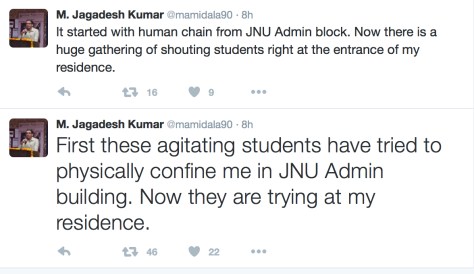
While students marched down the campus, forming a human chain that culminated at the gates of the VC’s residence near the university’s east gate, Mamidala90 (the handle with which the VC distinguishes himself in twitsville) began getting extremely active. While the students were peacefully assembled at the gates of the VC’s residence, very much not in ‘gherao’ or ‘blockade’ mode, Mamidala90 whined about being ‘blockaded’.

A Sample of Mamidala90's tweets while students gathered peacefully outside his residence. Is this what it felt like to hear Nero fiddle while Rome burnt?
A Sample of Mamidala90’s tweets while students gathered peacefully outside his residence. Is this what it felt like to hear Nero fiddle while Rome burnt?

Continue reading The Twitter Gherao of Mamidala90 on the 10th Day of Najeeb Ahmed’s Disappearance from JNU: Shehla Rashid

The RSS war on thought and ABVP as foot soldiers

Ever since the present Modi government came to power, there appears to have been a clear set of orders issued from the Rashtriya Swayamsevak Sangh (RSS) headquarters to its student organization, the Akhil Bharatiya Vidyarthi Parishad (ABVP), to go on the rampage in university campuses all over India. From getting specific parts of syllabuses changed under threat of violence, disrupting events by other student organizations on campuses, to forcing university administrations to intervene to curb freedom of expression, to filing police complaints against dissenters, they seem to have been acting according to a well rehearsed script, subverting democratic processes on campuses. After its recent electoral defeats in JNU and Hyderabad Central University (HCU), however, the ABVP’s role seems to have acquired an even more virulent feature. The game plan appears to be to provoke violence wherever possible so that rather than any kind of debate, however contentious, on issues such as nationalism, minority rights and caste injustice, what we are increasingly likely to see are violent standoffs between student groups, which have to be controlled by the police. These are often represented in the media as brawls between students, as if there were no ideology or political content involved, just two groups of students “clashing.” But of course, in each case ABVP is involved, and in some kinds of reporting it can even be made to appear that ABVP was somehow the victim.

This is the moment at which teachers need to finally accept that ABVP is not just another student organization. We have tended to take the position in our universities that we must not condemn or directly address ABVP, since we must not directly involve ourselves in student politics. Teachers must talk to administration, be publicly critical of its lapses, take all measures necessary to display and enact our solidarity with students under attack by this regime. While students take their own decisions on modes of struggle and so on, teachers see our role as supportive but with a critical distance.

However, now we may need to start thinking of ways in which we  recognize the organization of the ABVP as a serious threat to Indian democracy. I don’t mean individual students, who would also be in our class-rooms, and with whom it may still be possible to continue a conversation, and whose examinations we will continue to grade with utmost probity. as we have always done.

But the ABVP as an organization has a specific role to play, as storm-troopers in the project of Hindu nationalism, and we cannot afford any longer not to face up to this fact frontally.

Continue reading The RSS war on thought and ABVP as foot soldiers

Bring Back Najeeb Ahmed to JNU: A Call to Resist Terror in Universities

14615765_679911288839993_8711625822412574391_o-1

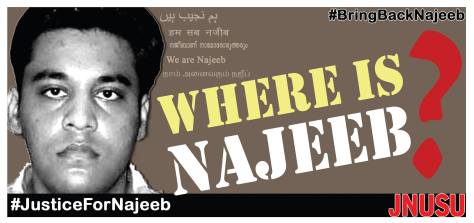
It is now more than a week since Najeeb Ahmed, an MSc (first year) student of Biotechnology at Jawaharlal Nehru University, Delhi has been reported missing, after an altercation with members of the RSS affiliated ABVP student organization, which reportedly left him injured and severely traumatized.

Continue reading Bring Back Najeeb Ahmed to JNU: A Call to Resist Terror in Universities

Academics’ Letter to the VC, Central University of Haryana Regarding the ‘Draupadi’ Affair

Following is the text of a letter to the Vice Chancellor, Central University of Haryana, sent by some academics protesting the attacks on Dr Snehsata Manav and Dr Manoj Kumar regarding the students’ production of the play ‘Draupadi’:
To the Vice Chancellor,
Central University of Haryana
Dear Vice Chancellor:
We write in support of Dr. Snehsata Manav and Dr. Manoj Kumar of the Department of English and Foreign Languages who have recently come under attack for their sponsorship of a student production on your campus of the play “Draupadi” based on a story by Mahasweta Devi who, as you know, is universally recognized as a towering figure in contemporary Indian literature. Her writings, translated into most Indian languages, have highlighted the struggles of oppressed and marginalized women and men. Her story “Draupadi”, whose dramatized version has been highly acclaimed and performed all over India, deals with the sensitive but enormously important question of the ethics of deploying the armed forces in dealing with civil disturbances within the country. This question, along with specific instances of rapes committed by army personnel in different parts of India, continues to be debated in the Indian public media and has engaged the attention of political leaders as well as the courts.
We strongly believe that it is both unjust and unwise to accuse intellectually responsible teachers of hurting the sentiments of some sections of opinion. The recent demise of Mahasweta Devi was a perfect occasion to engage university students in a serious discussion on why some of the greatest writers and artists of India have been concerned about the excesses of state violence carried out at the behest of those in power, no matter what their party or ideology.
We hope you will convey our views to those who have accused Dr. Manav and Dr. Kumar of being hurtful and unpatriotic. The university campus needs to be fostered as a place where difficult questions can be debated in a spirit of intellectual openness and without fear of censure.
Sincerely,
Gayatri Chakravorty Spivak, University Professor in the Humanities, Columbia University, New York
Akeel Bilgrami, Stanley Morgenbesser Professor of Philosophy, Columbia University, New York
Gauri Viswanathan, Professor of English and Comparative Literature, Columbia University, New York
Partha Chatterjee, Professor of anthropology, Columbia University, New York
Romila Thapar, Professor Emeritus in History, Jawaharlal Nehru University, New Delhi
Ramachandra Guha, author, Bengaluru

Continue reading Academics’ Letter to the VC, Central University of Haryana Regarding the ‘Draupadi’ Affair

Ezhuka Tamil – A Conversation about Democracy :Dharsha Jegatheeswaran and Gajen Mahendra

This is a guest post by DHARSHA JEGATHEESWARAN AND GAJEN MAHENDRA


On Saturday September 24, 2016, Ezhuka Tamil, organized by the Tamil People’s Council, became the largest rally to happen since the end of the war in the North-East of Sri Lanka. Over 10,000 people took to the streets to demand an end to ongoing human rights violations, particularly militarization and Sinhala-Buddhisization of the North-East,reiterate their demand for genuine accountability and justice and voice their expectations regarding the ongoing political processes. The political elite in Colombo and their supporters elsewhere have however chosen to read Ezhuka Tamil as an expression of ‘Tamil extremism’. This response requires us to critically interrogate the nature of democratic spaces in post-war Sri Lanka available to the numerically smaller communities and more largely what our understanding of democracy is. This is very necessary if we believe in the need for public participation in the constitutional and transitional justice process currently underway. Continue reading Ezhuka Tamil – A Conversation about Democracy :Dharsha Jegatheeswaran and Gajen Mahendra

Seven of Us – The Other Side of the Armed Forces: Sanjeev Kumar

Guest Post by SANJEEV KUMAR

Seven of us in my family including me, along with 90% of the young men from my village, have tried to join the army at least once in our lives. Here I am using the term ‘army’ to include all armed forces and paramilitary forces.

Three members of my family succeeded and are now in the army along with around a hundred others from my village. More than two-thirds of them gave bribes of 1-2 lakh rupees, either by selling land or using family savings, to join the army. There are others who were cheated by dalals.  Hardly any of them would claim that they joined the army to serve the nation; rather, they joined the army to bring some relief to their starving families. Most of them teased and molested girls while travelling ticketless in trains to army recruitment centres in different parts of the country. Most of them including my brother, took 7-12 lakh rupees as dowry for marriage. Hardly any one of them wants their children to be in the army in preference to other civilian jobs.

My father also tried once to join the Indian army in the early 1980s but my grandfather hid his joining letter from him because my grandfather believed farming was better for him and for the family. Whenever they quarrelled in the early 2000s, I always heard my father blaming his father for the poverty of the family, because he did not allow him to join the army. It was around the same time that I first heard of anyone giving a bribe to join the army. It was my own uncle who was barely 5 to 7 years older than me, who  sold his agricultural land to pay 1 lakh rupees to a dalal as bribe through his mamaji who was also in the army. I also heard of two young boys in my village who had earlier given around 40000 rupees as bribe to join Bihar Police but lost all their money to a  dishonest agent. It was courageous of my uncle to risk his money even though the news of how two other village boys were cheated was fresh in the air. He had the courage to do that because his secondary dalal was his own mamaji. He had the courage to do that also because he had no other alternatives.

Continue reading Seven of Us – The Other Side of the Armed Forces: Sanjeev Kumar

Communal goons and ‘Secular’ Police collude to deny Atheists Space in Vrindavan

It looks like the fringe has been active again, this time inVrindavan. A small gang of people from the Vishwa Hindu Parishad, Bajrang Dal and other groups disrupted a gathering of atheists on Friday, beating up attendees and causing general mayhem. This in itself has become so commonplace that it is no longer news. However, what should alarm us all is the way the police – which is under the ‘secular’ state government of Akhilesh Yadav – joined the disruptors. Instead of protecting the participants of the atheism conference by dispersing the small saffron gang, the police joined them and forced the event’s organiser to cancel the meeting. Unsatisfied with that, the police also insisted on the participants’ immediate departure from Vrindavan itself. Continue reading Communal goons and ‘Secular’ Police collude to deny Atheists Space in Vrindavan

Killings in Kaziranga, Dantewada Hazaribagh – ‘National Interest’, ‘Internal Security’ and ‘Development’: Kamal Nayan Choubey

Guest post by KAMAL NAYAN CHOUBEY

In the last few weeks there were at least three gruesome incidents of killing of tribals or forest dwelling persons in different parts of the country. In the first incident two persons from Muslim community were killed in police firing near Kaziranga National Park (KNP) of Assam on 19 September 2016. These people were peacefully protesting against their eviction drive carried out by local administration, which was implementing the judgment of Gauhati High Court related to evictions. In the second incident two young boys were killed by police in the Bastar area of the Chhattisgarh, and following the long tradition of all such killings, the police claimed that they were Maoists. The third incident occurred on the 1st October in the Hazaribagh, Jharkhand where the police used its brutal power and killed four persons in an open firing. These people were peacefully protesting against land acquisition for a Thermal Power Plant, which would cause their displacement. It is should be asked that why the State used its brutal power against one of the most marginalized sections of the society? Was firing on these unarmed and, at least in two cases, peacefully protesting tribal and forest dwelling people necessary? Could it be claimed by the State authorities that they fulfilled all constitutional obligations in the context of the demands of these people, in other words, could it be claimed by authorities that their demands were absurd and unconstitutional? Or would it be more correct to underline that tribals represent the marginal voices of the Indian nation-state, and mainstream notions of ‘national interest’, ‘internal security’ and ‘development’ have meager or no space for their claims or rights?

Continue reading Killings in Kaziranga, Dantewada Hazaribagh – ‘National Interest’, ‘Internal Security’ and ‘Development’: Kamal Nayan Choubey

Indian and Pakistani citizens speak out against war

article-sbhlockykc-1452406888

Images from #ProfilesforPeace (Scroll.in)

This petition will be delivered to:

  • Prime Minister Of India Narendra Modi
  • Prime Minister of Pakistan Nawaz Sharif

We, the people of India and Pakistan, stand in solidarity with each other to speak out against war in any form because, in war, we are all losers regardless of who might appear to win.

We hope that the elected representatives of both countries will exercise restraint, and act with wisdom, in the interests of lasting peace in our region, which alone can ensure economic progress and political stability.

We urge our leaders to come up with creative diplomatic solutions instead of engaging in a violent display of military might that threatens to destroy precious human life and natural resources.

We are determined to end the hostility that has festered between our nations since 1947, so that we can collectively work on the challenges that our common to us: climate change, terrorism, and widespread social injustice.

We want India and Pakistan to make a joint commitment to promote a culture of peace and non-violence, in keeping with the United Nations Sustainable Development Goals, and our vision for a better future for the young people of this planet.

दुर्गा दुर्मतिनाशिनी

षष्ठी की सुबह यह लिख रहा हूँ .  आज माँ भगवती के भक्तों की वर्ष भर की प्रतीक्षा पूरी होती है. माँ की प्रतिमा में आज प्राण-प्रतिष्ठा होगी. वे जीवंत हो उठेंगी. आज से चार दिन उनकी आराधना के दिन हैं. मैं रोज़ अपनी बहन को देखता हूँ, चंडी पाठ सुनते हुए. बचपन की माँ याद आ जाती है: दशहरा आते ही घर में धूप की एक सुगंध उठने लगती थी. तुरत नहाई माँ को दुर्गा की छवि के आगे आँख मूँदे हुए पाठ करते देखता था. उस छवि के आगे रक्त जवा या उड़हूल फूल के अर्पण को नहीं भूलता. शरद की वह गंध-छवि अब तक मन में बसी है.इस बार मालूम हुआ, अम्मी पाठ नहीं कर पा रही हैं .यह सुनकर मुझ जैसे ईश्वरसंदेही को भी कुछ लगेगा, सोचा नहीं था.

आरम्भ लेकिन षष्ठी से हो, ऐसा नहीं. बचपन से ही महालया की प्रतीक्षा व्यग्रता से होती थी. इस बार भूल ही गया. पिता ने, जो फेसबुक-संसार के सहज नागरिक हैं, महालया के दिन आगाह किया:

“देवी पक्ष के प्रारम्भ होने की सूचना हो गई है। देवघर में हमारी चेतना में यह बात रही है कि दुर्गापूजा के अवसर पर उमा एक साल बाद कैलास से अपने मायके चार दिनों के लिए आती हैँ। सप्तमी को उनका आगमन और दशमी को विदाई होती है। आगमनी गीत बेटी के लिए माँ की व्यथा की मार्मिक प्रस्तुति हैं। Continue reading दुर्गा दुर्मतिनाशिनी

Extra-Judicial Killings in Bijapur, Chhattisgarh: Women Against Sexual Violence and State Repression

Press release from WSS – Women Against Sexual Violence and State Repression – a nationwide platform of feminist activists and women’s organizations working to expose, challenge and resist sexual violence and its use as a tool of systemic repression.
Challenging State Impunity – A PIL on Extra-Judicial Killings in Bijapur, Chhattisgarh
Even as the Bastar police celebrate their “success” in having killed over a hundred alleged Naxalites this year, a Public Interest Litigation challenging the spate of encounters in Bijapur has been filed before the Chhattisgarh High Court in Bilaspur. The petitioners are two young women from Korcholi with extra-ordinary grit and determination –Suneeta Pottam (19 years old).and Munni Pottam (18 years old), who have been supported in this effort by a national women’s organization, the WSS (wssnet.org) as the third petitioner.

 The Petitioners, Suneeta Pottam and Munni Pottam, with a copy of their petition, in their lawyer’s office
The Petition

This petition highlights the extra-judicial executions of 6 people, which took place in the villages of Kadenar, Palnar, Korcholi and Andri in Bijapur district over the course of the last year. The police acknowledge only three of these incidents as encounters, and in each one of these, they providean almost identical story to the media –that these “encounters” occurred when combined teams of local police and paramilitary forces had gone out on combing operations after receiving “verified information” about the presence of Maoists in the area. In each one of these cases –  Kadernar, Palnar and Korcholi – the police claim that they first came under fire, forcing them to return fire – and it was only on searching the area in the aftermath that they stumbled onto the bodies of dead Maoists who had been killed in the exchange of fire. All of these dead Maoists, as per the police accounts, were found conveniently clad in uniforms and lying next to arms, spent ammunition and Maoist literature.
However, the villagers have something completely different to say.  Accompanying this petition are sworn affidavits of ten villagers who are family members of the deceased or eye witnesses of the incident, who challenge the police versions.  In Kadenar, the villagers talk about how a married couple, Tati Pande and Manoj Hapka, were forced out of their home in the evening at gunpoint, on the pretext of getting them “surrendered” in the Gangaloor police station. In Palnar, Seetu Hemla was dragged from the fields which he was ploughing, with his hands tied behind him, in full view of his young wife, mother and other villagers. In Korcholi, the womenfolk witnessed Sukku Kunjam of Itavar being shot point-blank, while he was visiting his relatives house in November 2015.

Continue reading Extra-Judicial Killings in Bijapur, Chhattisgarh: Women Against Sexual Violence and State Repression

International Scholars Condemn the Attack on Faculty and Students of Central University of Haryana

Over 70 UK and Europe-based scholars concerned with South Asia have written a letter to the Vice Chancellor of the Central University of Haryana. They have condemned the September 21, 2016 attack on a group of staff and students of CUH who were involved in putting together a performance based on the award-winning writer Mahasweta Devi’s acclaimed short story “Draupadi”. The attack and threats of charges of sedition against those involved in the performance were instigated by the BJP-affiliated student group ABVP as well as by the local press, which has falsely and maliciously spread the view that the play is anti-national and represented an attack on Indian soldiers. The letter appeals to the Vice Chancellor of CUH to protect the freedom of expression of the university’s staff and students, and to encourage the democratic exchange of ideas through means of debate and discussion.


Dear Vice-Chancellor Mahendra Pal Singh,

We, the undersigned, strongly condemn the attack on faculty members and students of the Department of English and Foreign Literatures at your university by members of the Akhil Bhartiya Vidyarthi Parishad (ABVP) for the performance of a play on 21 September 2016. The play was based on a short story by the eminent Bengali writer Mahasweta Devi. We understand that the staff and students involved in the performance had sought and received all necessary permissions for the event, which was organized to commemorate the literary achievements of Mahasweta Devi, the recipient of some of the most prestigious Indian and international awards.

We write to express our serious concern over this attack on the freedom of academic expression of the staff and students at your university. Mahasweta Devi’s story “Draupadi” was written in 1971 and represents her creative expression of the exploitation of India’s tribals.  It is regularly taught as part of course syllabi all over India and the world, including at the universities of some of the signatories to this letter. The claim by the ABVP and the local press that the play is an attack on Indian soldiers is manifestly fabricated. As one of the faculty members involved in the production, Dr Snehsata, has explained, students and teachers saw the programme as an academic and creative pursuit and their intention was certainly not to hurt the sentiments of soldiers as the ABVP has claimed: “In this event, I read the epilogue of the play recounting the data about atrocities on tribal people, especially sexual crimes against women by the Indian army. How ordinary soldiers are used by the state as a tool against its own people and how the body, especially the female body, becomes the site of revenge in the hands of Indian soldiers by the same state. All the teachers and students who were present there came up and congratulated us.”

Continue reading International Scholars Condemn the Attack on Faculty and Students of Central University of Haryana

DISSENT, DEBATE, CREATE