Resist the Draconian and Undemocratic Ban Order on the Kashmir Reader Newspaper: Junaid Nabi Bazaz

Guest Post by Junaid Nabi Bazaz. Photos by Abid Bhat and from Kashmir Reader Online

kashmir-reader-ban-759


In a move unprecedented in the last three decades in the strife torn Kashmir valley, the Jammu and Kashmir government published an order in early October that stated that Kashmir Reader (KR), a vocal newspaper with circulation of less than10000 copies, contained material and content ‘which tends to incite violence and disturb public peace and tranquility.’ This was then used as a justification for placing a ban on the publication of KR. Today, on the 25th of October, Journalists assembled in Srinagar to protest this arbitrary ban.

Continue reading Resist the Draconian and Undemocratic Ban Order on the Kashmir Reader Newspaper: Junaid Nabi Bazaz

The Twitter Gherao of Mamidala90 on the 10th Day of Najeeb Ahmed’s Disappearance from JNU: Shehla Rashid

Guest Post by Shehla Rashid

[ Between the 9th and 1oth day of the disappearance of Najeeb Ahmed from the JNU campus, the JNU Vice Chancellor, Mamidala Jagadesh Kumar decided to salvage his reputation on twitter, even as he squandered it on the grounds of the campus of the university he presides over. And so he let forth a volley of tweets, while sitting inside his office and his residence, even as he refused to meet or listen to the JNU students who have grown increasingly concerned and anxious at the university administrations callous laxity about the fate of Najeeb Ahmed, the missing students.

While students marched down the campus, forming a human chain that culminated at the gates of the VC’s residence near the university’s east gate, Mamidala90 (the handle with which the VC distinguishes himself in twitsville) began getting extremely active. While the students were peacefully assembled at the gates of the VC’s residence, very much not in ‘gherao’ or ‘blockade’ mode, Mamidala90 whined about being ‘blockaded’.

A Sample of Mamidala90's tweets while students gathered peacefully outside his residence. Is this what it felt like to hear Nero fiddle while Rome burnt?
A Sample of Mamidala90’s tweets while students gathered peacefully outside his residence. Is this what it felt like to hear Nero fiddle while Rome burnt?

Continue reading The Twitter Gherao of Mamidala90 on the 10th Day of Najeeb Ahmed’s Disappearance from JNU: Shehla Rashid

The RSS war on thought and ABVP as foot soldiers

Ever since the present Modi government came to power, there appears to have been a clear set of orders issued from the Rashtriya Swayamsevak Sangh (RSS) headquarters to its student organization, the Akhil Bharatiya Vidyarthi Parishad (ABVP), to go on the rampage in university campuses all over India. From getting specific parts of syllabuses changed under threat of violence, disrupting events by other student organizations on campuses, to forcing university administrations to intervene to curb freedom of expression, to filing police complaints against dissenters, they seem to have been acting according to a well rehearsed script, subverting democratic processes on campuses. After its recent electoral defeats in JNU and Hyderabad Central University (HCU), however, the ABVP’s role seems to have acquired an even more virulent feature. The game plan appears to be to provoke violence wherever possible so that rather than any kind of debate, however contentious, on issues such as nationalism, minority rights and caste injustice, what we are increasingly likely to see are violent standoffs between student groups, which have to be controlled by the police. These are often represented in the media as brawls between students, as if there were no ideology or political content involved, just two groups of students “clashing.” But of course, in each case ABVP is involved, and in some kinds of reporting it can even be made to appear that ABVP was somehow the victim.

This is the moment at which teachers need to finally accept that ABVP is not just another student organization. We have tended to take the position in our universities that we must not condemn or directly address ABVP, since we must not directly involve ourselves in student politics. Teachers must talk to administration, be publicly critical of its lapses, take all measures necessary to display and enact our solidarity with students under attack by this regime. While students take their own decisions on modes of struggle and so on, teachers see our role as supportive but with a critical distance.

However, now we may need to start thinking of ways in which we  recognize the organization of the ABVP as a serious threat to Indian democracy. I don’t mean individual students, who would also be in our class-rooms, and with whom it may still be possible to continue a conversation, and whose examinations we will continue to grade with utmost probity. as we have always done.

But the ABVP as an organization has a specific role to play, as storm-troopers in the project of Hindu nationalism, and we cannot afford any longer not to face up to this fact frontally.

Continue reading The RSS war on thought and ABVP as foot soldiers

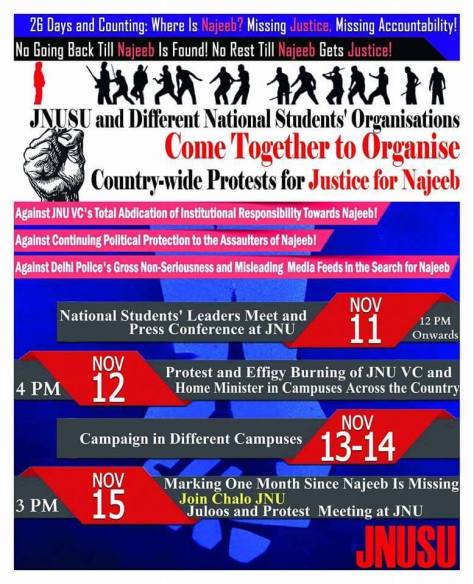
Bring Back Najeeb Ahmed to JNU: A Call to Resist Terror in Universities

14615765_679911288839993_8711625822412574391_o-1

It is now more than a week since Najeeb Ahmed, an MSc (first year) student of Biotechnology at Jawaharlal Nehru University, Delhi has been reported missing, after an altercation with members of the RSS affiliated ABVP student organization, which reportedly left him injured and severely traumatized.

Continue reading Bring Back Najeeb Ahmed to JNU: A Call to Resist Terror in Universities

Academics’ Letter to the VC, Central University of Haryana Regarding the ‘Draupadi’ Affair

Following is the text of a letter to the Vice Chancellor, Central University of Haryana, sent by some academics protesting the attacks on Dr Snehsata Manav and Dr Manoj Kumar regarding the students’ production of the play ‘Draupadi’:
To the Vice Chancellor,
Central University of Haryana
Dear Vice Chancellor:
We write in support of Dr. Snehsata Manav and Dr. Manoj Kumar of the Department of English and Foreign Languages who have recently come under attack for their sponsorship of a student production on your campus of the play “Draupadi” based on a story by Mahasweta Devi who, as you know, is universally recognized as a towering figure in contemporary Indian literature. Her writings, translated into most Indian languages, have highlighted the struggles of oppressed and marginalized women and men. Her story “Draupadi”, whose dramatized version has been highly acclaimed and performed all over India, deals with the sensitive but enormously important question of the ethics of deploying the armed forces in dealing with civil disturbances within the country. This question, along with specific instances of rapes committed by army personnel in different parts of India, continues to be debated in the Indian public media and has engaged the attention of political leaders as well as the courts.
We strongly believe that it is both unjust and unwise to accuse intellectually responsible teachers of hurting the sentiments of some sections of opinion. The recent demise of Mahasweta Devi was a perfect occasion to engage university students in a serious discussion on why some of the greatest writers and artists of India have been concerned about the excesses of state violence carried out at the behest of those in power, no matter what their party or ideology.
We hope you will convey our views to those who have accused Dr. Manav and Dr. Kumar of being hurtful and unpatriotic. The university campus needs to be fostered as a place where difficult questions can be debated in a spirit of intellectual openness and without fear of censure.
Sincerely,
Gayatri Chakravorty Spivak, University Professor in the Humanities, Columbia University, New York
Akeel Bilgrami, Stanley Morgenbesser Professor of Philosophy, Columbia University, New York
Gauri Viswanathan, Professor of English and Comparative Literature, Columbia University, New York
Partha Chatterjee, Professor of anthropology, Columbia University, New York
Romila Thapar, Professor Emeritus in History, Jawaharlal Nehru University, New Delhi
Ramachandra Guha, author, Bengaluru

Continue reading Academics’ Letter to the VC, Central University of Haryana Regarding the ‘Draupadi’ Affair

Ezhuka Tamil – A Conversation about Democracy :Dharsha Jegatheeswaran and Gajen Mahendra

This is a guest post by DHARSHA JEGATHEESWARAN AND GAJEN MAHENDRA


On Saturday September 24, 2016, Ezhuka Tamil, organized by the Tamil People’s Council, became the largest rally to happen since the end of the war in the North-East of Sri Lanka. Over 10,000 people took to the streets to demand an end to ongoing human rights violations, particularly militarization and Sinhala-Buddhisization of the North-East,reiterate their demand for genuine accountability and justice and voice their expectations regarding the ongoing political processes. The political elite in Colombo and their supporters elsewhere have however chosen to read Ezhuka Tamil as an expression of ‘Tamil extremism’. This response requires us to critically interrogate the nature of democratic spaces in post-war Sri Lanka available to the numerically smaller communities and more largely what our understanding of democracy is. This is very necessary if we believe in the need for public participation in the constitutional and transitional justice process currently underway. Continue reading Ezhuka Tamil – A Conversation about Democracy :Dharsha Jegatheeswaran and Gajen Mahendra

Seven of Us – The Other Side of the Armed Forces: Sanjeev Kumar

Guest Post by SANJEEV KUMAR

Seven of us in my family including me, along with 90% of the young men from my village, have tried to join the army at least once in our lives. Here I am using the term ‘army’ to include all armed forces and paramilitary forces.

Three members of my family succeeded and are now in the army along with around a hundred others from my village. More than two-thirds of them gave bribes of 1-2 lakh rupees, either by selling land or using family savings, to join the army. There are others who were cheated by dalals.  Hardly any of them would claim that they joined the army to serve the nation; rather, they joined the army to bring some relief to their starving families. Most of them teased and molested girls while travelling ticketless in trains to army recruitment centres in different parts of the country. Most of them including my brother, took 7-12 lakh rupees as dowry for marriage. Hardly any one of them wants their children to be in the army in preference to other civilian jobs.

My father also tried once to join the Indian army in the early 1980s but my grandfather hid his joining letter from him because my grandfather believed farming was better for him and for the family. Whenever they quarrelled in the early 2000s, I always heard my father blaming his father for the poverty of the family, because he did not allow him to join the army. It was around the same time that I first heard of anyone giving a bribe to join the army. It was my own uncle who was barely 5 to 7 years older than me, who  sold his agricultural land to pay 1 lakh rupees to a dalal as bribe through his mamaji who was also in the army. I also heard of two young boys in my village who had earlier given around 40000 rupees as bribe to join Bihar Police but lost all their money to a  dishonest agent. It was courageous of my uncle to risk his money even though the news of how two other village boys were cheated was fresh in the air. He had the courage to do that because his secondary dalal was his own mamaji. He had the courage to do that also because he had no other alternatives.

Continue reading Seven of Us – The Other Side of the Armed Forces: Sanjeev Kumar

Communal goons and ‘Secular’ Police collude to deny Atheists Space in Vrindavan

It looks like the fringe has been active again, this time inVrindavan. A small gang of people from the Vishwa Hindu Parishad, Bajrang Dal and other groups disrupted a gathering of atheists on Friday, beating up attendees and causing general mayhem. This in itself has become so commonplace that it is no longer news. However, what should alarm us all is the way the police – which is under the ‘secular’ state government of Akhilesh Yadav – joined the disruptors. Instead of protecting the participants of the atheism conference by dispersing the small saffron gang, the police joined them and forced the event’s organiser to cancel the meeting. Unsatisfied with that, the police also insisted on the participants’ immediate departure from Vrindavan itself. Continue reading Communal goons and ‘Secular’ Police collude to deny Atheists Space in Vrindavan

Killings in Kaziranga, Dantewada Hazaribagh – ‘National Interest’, ‘Internal Security’ and ‘Development’: Kamal Nayan Choubey

Guest post by KAMAL NAYAN CHOUBEY

In the last few weeks there were at least three gruesome incidents of killing of tribals or forest dwelling persons in different parts of the country. In the first incident two persons from Muslim community were killed in police firing near Kaziranga National Park (KNP) of Assam on 19 September 2016. These people were peacefully protesting against their eviction drive carried out by local administration, which was implementing the judgment of Gauhati High Court related to evictions. In the second incident two young boys were killed by police in the Bastar area of the Chhattisgarh, and following the long tradition of all such killings, the police claimed that they were Maoists. The third incident occurred on the 1st October in the Hazaribagh, Jharkhand where the police used its brutal power and killed four persons in an open firing. These people were peacefully protesting against land acquisition for a Thermal Power Plant, which would cause their displacement. It is should be asked that why the State used its brutal power against one of the most marginalized sections of the society? Was firing on these unarmed and, at least in two cases, peacefully protesting tribal and forest dwelling people necessary? Could it be claimed by the State authorities that they fulfilled all constitutional obligations in the context of the demands of these people, in other words, could it be claimed by authorities that their demands were absurd and unconstitutional? Or would it be more correct to underline that tribals represent the marginal voices of the Indian nation-state, and mainstream notions of ‘national interest’, ‘internal security’ and ‘development’ have meager or no space for their claims or rights?

Continue reading Killings in Kaziranga, Dantewada Hazaribagh – ‘National Interest’, ‘Internal Security’ and ‘Development’: Kamal Nayan Choubey

Indian and Pakistani citizens speak out against war

article-sbhlockykc-1452406888

Images from #ProfilesforPeace (Scroll.in)

This petition will be delivered to:

  • Prime Minister Of India Narendra Modi
  • Prime Minister of Pakistan Nawaz Sharif

We, the people of India and Pakistan, stand in solidarity with each other to speak out against war in any form because, in war, we are all losers regardless of who might appear to win.

We hope that the elected representatives of both countries will exercise restraint, and act with wisdom, in the interests of lasting peace in our region, which alone can ensure economic progress and political stability.

We urge our leaders to come up with creative diplomatic solutions instead of engaging in a violent display of military might that threatens to destroy precious human life and natural resources.

We are determined to end the hostility that has festered between our nations since 1947, so that we can collectively work on the challenges that our common to us: climate change, terrorism, and widespread social injustice.

We want India and Pakistan to make a joint commitment to promote a culture of peace and non-violence, in keeping with the United Nations Sustainable Development Goals, and our vision for a better future for the young people of this planet.

दुर्गा दुर्मतिनाशिनी

षष्ठी की सुबह यह लिख रहा हूँ .  आज माँ भगवती के भक्तों की वर्ष भर की प्रतीक्षा पूरी होती है. माँ की प्रतिमा में आज प्राण-प्रतिष्ठा होगी. वे जीवंत हो उठेंगी. आज से चार दिन उनकी आराधना के दिन हैं. मैं रोज़ अपनी बहन को देखता हूँ, चंडी पाठ सुनते हुए. बचपन की माँ याद आ जाती है: दशहरा आते ही घर में धूप की एक सुगंध उठने लगती थी. तुरत नहाई माँ को दुर्गा की छवि के आगे आँख मूँदे हुए पाठ करते देखता था. उस छवि के आगे रक्त जवा या उड़हूल फूल के अर्पण को नहीं भूलता. शरद की वह गंध-छवि अब तक मन में बसी है.इस बार मालूम हुआ, अम्मी पाठ नहीं कर पा रही हैं .यह सुनकर मुझ जैसे ईश्वरसंदेही को भी कुछ लगेगा, सोचा नहीं था.

आरम्भ लेकिन षष्ठी से हो, ऐसा नहीं. बचपन से ही महालया की प्रतीक्षा व्यग्रता से होती थी. इस बार भूल ही गया. पिता ने, जो फेसबुक-संसार के सहज नागरिक हैं, महालया के दिन आगाह किया:

“देवी पक्ष के प्रारम्भ होने की सूचना हो गई है। देवघर में हमारी चेतना में यह बात रही है कि दुर्गापूजा के अवसर पर उमा एक साल बाद कैलास से अपने मायके चार दिनों के लिए आती हैँ। सप्तमी को उनका आगमन और दशमी को विदाई होती है। आगमनी गीत बेटी के लिए माँ की व्यथा की मार्मिक प्रस्तुति हैं। Continue reading दुर्गा दुर्मतिनाशिनी

Extra-Judicial Killings in Bijapur, Chhattisgarh: Women Against Sexual Violence and State Repression

Press release from WSS – Women Against Sexual Violence and State Repression – a nationwide platform of feminist activists and women’s organizations working to expose, challenge and resist sexual violence and its use as a tool of systemic repression.
Challenging State Impunity – A PIL on Extra-Judicial Killings in Bijapur, Chhattisgarh
Even as the Bastar police celebrate their “success” in having killed over a hundred alleged Naxalites this year, a Public Interest Litigation challenging the spate of encounters in Bijapur has been filed before the Chhattisgarh High Court in Bilaspur. The petitioners are two young women from Korcholi with extra-ordinary grit and determination –Suneeta Pottam (19 years old).and Munni Pottam (18 years old), who have been supported in this effort by a national women’s organization, the WSS (wssnet.org) as the third petitioner.

 The Petitioners, Suneeta Pottam and Munni Pottam, with a copy of their petition, in their lawyer’s office
The Petition

This petition highlights the extra-judicial executions of 6 people, which took place in the villages of Kadenar, Palnar, Korcholi and Andri in Bijapur district over the course of the last year. The police acknowledge only three of these incidents as encounters, and in each one of these, they providean almost identical story to the media –that these “encounters” occurred when combined teams of local police and paramilitary forces had gone out on combing operations after receiving “verified information” about the presence of Maoists in the area. In each one of these cases –  Kadernar, Palnar and Korcholi – the police claim that they first came under fire, forcing them to return fire – and it was only on searching the area in the aftermath that they stumbled onto the bodies of dead Maoists who had been killed in the exchange of fire. All of these dead Maoists, as per the police accounts, were found conveniently clad in uniforms and lying next to arms, spent ammunition and Maoist literature.
However, the villagers have something completely different to say.  Accompanying this petition are sworn affidavits of ten villagers who are family members of the deceased or eye witnesses of the incident, who challenge the police versions.  In Kadenar, the villagers talk about how a married couple, Tati Pande and Manoj Hapka, were forced out of their home in the evening at gunpoint, on the pretext of getting them “surrendered” in the Gangaloor police station. In Palnar, Seetu Hemla was dragged from the fields which he was ploughing, with his hands tied behind him, in full view of his young wife, mother and other villagers. In Korcholi, the womenfolk witnessed Sukku Kunjam of Itavar being shot point-blank, while he was visiting his relatives house in November 2015.

Continue reading Extra-Judicial Killings in Bijapur, Chhattisgarh: Women Against Sexual Violence and State Repression

International Scholars Condemn the Attack on Faculty and Students of Central University of Haryana

Over 70 UK and Europe-based scholars concerned with South Asia have written a letter to the Vice Chancellor of the Central University of Haryana. They have condemned the September 21, 2016 attack on a group of staff and students of CUH who were involved in putting together a performance based on the award-winning writer Mahasweta Devi’s acclaimed short story “Draupadi”. The attack and threats of charges of sedition against those involved in the performance were instigated by the BJP-affiliated student group ABVP as well as by the local press, which has falsely and maliciously spread the view that the play is anti-national and represented an attack on Indian soldiers. The letter appeals to the Vice Chancellor of CUH to protect the freedom of expression of the university’s staff and students, and to encourage the democratic exchange of ideas through means of debate and discussion.


Dear Vice-Chancellor Mahendra Pal Singh,

We, the undersigned, strongly condemn the attack on faculty members and students of the Department of English and Foreign Literatures at your university by members of the Akhil Bhartiya Vidyarthi Parishad (ABVP) for the performance of a play on 21 September 2016. The play was based on a short story by the eminent Bengali writer Mahasweta Devi. We understand that the staff and students involved in the performance had sought and received all necessary permissions for the event, which was organized to commemorate the literary achievements of Mahasweta Devi, the recipient of some of the most prestigious Indian and international awards.

We write to express our serious concern over this attack on the freedom of academic expression of the staff and students at your university. Mahasweta Devi’s story “Draupadi” was written in 1971 and represents her creative expression of the exploitation of India’s tribals.  It is regularly taught as part of course syllabi all over India and the world, including at the universities of some of the signatories to this letter. The claim by the ABVP and the local press that the play is an attack on Indian soldiers is manifestly fabricated. As one of the faculty members involved in the production, Dr Snehsata, has explained, students and teachers saw the programme as an academic and creative pursuit and their intention was certainly not to hurt the sentiments of soldiers as the ABVP has claimed: “In this event, I read the epilogue of the play recounting the data about atrocities on tribal people, especially sexual crimes against women by the Indian army. How ordinary soldiers are used by the state as a tool against its own people and how the body, especially the female body, becomes the site of revenge in the hands of Indian soldiers by the same state. All the teachers and students who were present there came up and congratulated us.”

Continue reading International Scholars Condemn the Attack on Faculty and Students of Central University of Haryana

Academics VS Nationalist Militia

The story of Indian universities is generally written (and read) as a long lament. But we could also write it as a heroic ballad – or, to be more accurate, a narrative of individual courage and collective failure.

Universities are supposed to be places where we learn to put everything to the test. So the first thing we are taught is to have courage in the face of authority of all kinds. How are our universities doing on this front?

It could be said that the university leadership is failing the university and betraying its cause while a handful of teachers and students struggle to keep it alive. The most recent case is that of the Central University of Haryana. Here, the teachers of the Department of English are facing nationalist wrath manufactured though a series of deceptive acts by the Akhil Bharatiya Vidyarthi Parishad, the student arm of the Rashtriya Swayamsevak Sangh and the Bharatiya Janata Party. Continue reading Academics VS Nationalist Militia

मज़ाक मज़ाक में : किशोर

Guest Post by Kishore
(Summary: Article is about recent  racial comments on a  actress  and channel’s response to it.Now a days there is increasing trend of serving any thing in the name of comedy. This article raises questions on comedy. Is purpose of comedy is just to make us laugh or it has any social resposibility)
 पिछले दिनों तानिष्ता चटर्जी के रंग पर की गयी टिप्पणी के बाद वह एक मशहूर कॉमेडी शो को बीच में छोड़ कर चली गयी. बाद में उन्होंने इस टिप्पणी को नस्लवादी करार दिया. दूसरी तरफ इस चैनल ने इस आरोप को गलत बताते हुए कहा है वह तो बस “रोस्ट” ( एक तरह की खिंचाई) कर रहे थे और रोस्ट करना उनके शो में व्यंग करने करने का तरीका है . साथ में यह भी कहा कि उन्हें पहले ही बता दिया गया था कि उन्हें “ रोस्ट” किया जाएगा. किसी के रंग पर उलटे सीधे व्यंग करना कैसी  खिंचाई है इसका कोई स्पष्टीकरण नहीं दिया गया.
इसके बाद मुझे ध्यान आया कि पिछले कुछ सालों में टेलीविजन पर कॉमेडी शो की बाढ़ सी आ गयी है जो खुद ही कुछ कह कर खुद ही हँसते है. इन शो में किसी का मजाक उड़ाना कॉमेडी समझा जाता और इनमे किसी स्थिति से हास्य पैदा करने का सामर्थ् नहीं है. इन शो में कई बार किसी व्यक्ति या समूह को नीचा दिखा कर मजाक उड़ाया जाता है. अगर मैं कॉमेडी को एक विधा समझता हूँ या मैं उस समुदाय से सम्बन्ध रखता हूँ तो इस व्यंग पर मुझे हंसी नहीं आएगी.
वैसे मुझ जैसे अज्ञानियो को इन जैसे कॉमेडी शो से ज्यादा हंसी ए इस पर दिखाए जाने वाले होरर शो पर आती है जो डराने के मकसद से बनाये जाते हैं. खैर यह दीगर बात हएै पर एक बात तो तय है कि यह शो  बहुत लोकप्रिय हुए हैं और इनको देखने वालों की संख्या लाखो में है. भले ही तानिष्ता को उनके व्यंग करने के तरीके पर एतराज हो पर लोग इस अंदाज को बहुत पसंद कर रहे हैं.
मुझे उन लोगों की बात भी याद आई जो, जो मन में आये वह कह देते हैं और फिर कहते हैं इस बात को इतनी संजीदगी से लेने की क्या जरूरत है , यह तो महज एक मजाक था. इसी तरह किसी खास समुदाय और औरतो को लेकर बहुत से चुटकले चलते हैं जिनमें बहुत खराब खराब बातें होती है, और लोग हँसते भी है . आलोचना करने  पर इतना कह  कर बात टाल देते हैं कि यह चुटकला ही तो है. आखिर हम लोग कब कॉमेडी को संजीदगी से लेना शुरू करेंगे.
कॉमेडी का एक साधारण सा नियम तो समझ आता है कि कॉमेडी में जो हंसी का पात्र बनता है या बनती है उसे खुद भी अपनी उस स्थिति पर वैसे ही हंसी आनी चाहिए जैसे  की किसी और को आ रही है.  अर्थार्थ हंसी उसके रंग रूप , आकार या नैन नक्श से निरपेक्ष उस कलाकार के हाव भाव या उस परिस्थिति से आनी चाहिए. यह स्पष्ट है कि हंसी का कारण रंग रूप , आकार या नैन नक्श नहीं है.
दूसरी बात कि हंसी का कारण किसी समुदाय विशेष के प्रति पूर्वाग्रह नहीं होना चाहिए. हम यह कह कर मुक्त  नहीं हो सकते कि यह तो एक मजाक है. वास्तविकता यह है कि इस तरह के मजाक पूर्वाग्रहों को मजबूती देते हैं. यकीन ना हो तो अपने आसपास नजर दौड़ा कर देख लो. क्या इन पूर्वाग्रहों के सुदृढ़ होने मैं इस तरह के मजाक का हाथ नहीं है? क्या औरतों और पत्नियों के प्रति होने वाले मजाक ने समाज में उनकी स्थिति को प्रभावित नहीं किया ?
इन शो में से अधिकतर शो में कलाकार अपने हाव भाव और बातों से हंसाया जाता है. अब कोई पूछ सकता है कि हाव भाव या बातों से हंसाने में बुराई क्या है. सभी महान हास्य कलाकार बातों और हाव भाव से ही तो हंसाते थे या हैं. तो यह शो उन हास्य शो या फिल्मों से अलग कैसे हुए?
अंतर है कि किन बातों या किस हाव भाव से हंसाया जा रहा है. उस बात की विषय वस्तु  क्या है. कोई हाव भाव या बात फूहड़ या अश्लील  भी हो सकती है और सौम्य  भी. अब प्रश्न यह उठता है कि यह कौन तय करेगा कि यह विषय वस्तु फूहड़ या अश्लील है या सौम्य? हर समाज में फूहड़ या सौम्य होने के कुछ मानदंड होते हैं और कॉमेडी शो कि विषय वस्तु भी उसी से तय होगी. पर यह कहने में मुझे एक खतरा दिख रहा है? जिस तरह से किसी भी चीज को अश्लील या अनैतिक बता कर उस पर हमले हो रहे और कलाकारों की अभिव्यक्ति की स्वतंत्रता पर रोक लगाई जा रही  हैं उसमे इन शब्दों का प्रयोग बहुत संभल कर करना होगा.
मैं इस बात से आश्वस्त हूँ कि “ जाने भी दो यारों” नामक फिल्म में जो हास्य था वह उच्च कोटि का था और सौम्य था और जो मैं आजकल टी.वी. शो में देख रहा हूँ वह फूहड़ है. पर मैं यहाँ अपना तर्क गढ़ नहीं पा रहा कि क्या चीज “जाने भी दो यारों” को इन टी.वी. शो से अलग करती है. मेरा इस बात पे भी दृढ विशवास है  कि किसी के रंग रूप, नैन नक्श या किसी समुदाय के आधार मजाक उड़ाना गलत है . मैं पूरी तरह से इस शो के खिलाफ तानिष्ता का समर्थन करता हूँ.
बस मुझे बस इस बात पर संशय है कि किस आधार पर किसी बात को फूहड़ कहा जाएगा और किस आधार पर सौम्य?
(लेखक डेवलेपमेंट प्रोफेश्नल के रूप में  में कार्यरत हैं  और पिछले कई सालों से बाल अधिकारों के क्षेत्र में काम कर रहे हैं।)

Women Of The World Stand With Sharmila – Repeal AFSPA Now!

Statement from Stand With Irom Sharmila campaign

sharmila_20151105

Sand Sculpture at Cuttack, Orissa by artist Himanshu Shekhar Parida, in solidarity with Irom Sharmila’s struggle for repeal of AFSPA,  to mark 15 years of completion of  her hunger protest in 2015. (Image courtesy E-Pao)

“My struggle will continue until AFSPA is struck down” said Irom Sharmila Chanu, the poet and activist from Manipur whose 16-year long hunger strike against the Armed Forces Special Powers Act has made her a global symbol of non-violent resistance. Sharmila was speaking at a press conference organised on October 1, 2016 by the “Stand With Irom Sharmila: Repeal AFSPA” Campaign, a global campaign endorsed by nearly 1000 women – from pioneers of global women’s movements to grassroot activists who have dedicated their lives to the struggle for women’s rights and freedoms.

The Armed Forces Special Powers Act (AFSPA) is a colonial law first promulgated by the British rulers of India in 1942 to try and quell the freedom struggle. It has been continuously operative in several north-eastern states, including Sharmila’s home state of Manipur since 1958. It was also imposed in Jammu and Kashmir in 1990. Under this law, armed forces and other security forces in “disturbed areas” have the license to shoot to kill anyone on suspicion; make arrests without warrants; enter and search any home or establishment; detain and question anyone. Armed forces personnel and security forces have complete immunity for actions taken under this law, and their prosecution requires prior sanction of the government, under Section 6 of the AFSPA. RTI information has disclosed that Sanction for prosecution of armed forces even for egregious human rights violation has never been granted. Nor is the government’s decision on declaring an area “disturbed” subject to judicial review.
Continue reading Women Of The World Stand With Sharmila – Repeal AFSPA Now!

Ambedkar and the Environmental Tradition

The 125th birth anniversary of Ambedkar was celebrated in April 2016 all around, so much so that the United Nations, for the first time, observed this day with a focus on achieving Sustainable Development Goals (SDGs). As we know, the 17 goals along with 169 targets and 304 indicators, adopted in September 2015, aspire to transform our world by balancing the three dimensions of sustainable development: economic, social and environmental. The ‘plan of action for people, planet and prosperity’ has environment at its core, along with poverty and inequality: to ‘protect planet’, create ‘healthy environment’, and ensure equality, dignity and development ‘in harmony with nature’. And Ambedkar is found in this regard to be an apt and inspiring leader.

The world can see traces of Ambedkar’s vision in the SDGs and can find his views relevant for environmental sustainability, but not the Indian environmentalists! Indian environmental movements marginalize Ambedkar. From a historical past, environmental scholars have placed Gandhi at the apex of their inspiration. Recently, Nehru and Indira Gandhi too have been constructed through an ecological lens. However, Ambedkar’s engagement with the environmental question has been relatively unexplored, even when his thoughts and interventions on nature, village, land, agriculture, water, community, industry, technology and science are some of the enduring issues of India’s environmental and political traditions. In comparison with Gandhi, credited with having an intuitive critique of modern civilization, Ambedkar has often been criticized for his modernization vision, which it is argued, drew heavily on the west for inspiration (Nagaraj 2010: 56-7)

Continue reading Ambedkar and the Environmental Tradition

Press Club of India Elections 2016 – Prescription for a better soup: The Dissenters

[As the Press Club of India, Delhi, goes for its election today, with two left panels on offer, here is a note from THE DISSENTERS. We publish this as we think it raises some very important issues of larger importance.]

How to vote amidst false claims from Left, Right and Others

Journalism means expressing dissent and speaking truth to power. Alas! The Press Club Of India has lost this very essence. In the lust for power, all ethics and morality, even professional wisdom is being negotiated with in the current elections for PCI, New Delhi.

The recent move by one brave journalist to dissociate himself from his panel at the last moment exposes grave corruption embedded in the the moral sphere of scribes who have formed convenient rainbow coalitions, convenienty called panels, to grab the small power centre that operates from 1, Raisina Road, New Delhi. This election however was a farce from the very beginning. Let us take some time to read this before we go to vote on October 1st, 2016.

The outgoing panel was supposed to go out of office after completion of its one-year term and remain as a caretaker till the current elections. This never happened. There are many arguments for and against this immoral act but what has conspired in the meantime needs to be recalled.

The defining moment for this panel, named Nadeem panel after PCI outgoing Secretary-General, came in the Ali Javed episode. Let’s not forget that Ali Javed only booked the PCI hall  in his capacity as a member where the Kashmir-centric program was held and allegedly “anti-national” slogans were raised. Despite, this management committee involved Delhi Police instead of initiating a preliminary internal inquiry. A complaint was lodged in the midnight by PCI against Javed and others that led to prolonged harassment of this senior member who teaches in DU and is himself the General Secretary of Progressive Writers Association, the oldest organisation of writers in this country associated with the Communist Party of India (CPI).

A signature campaign was initiated against PCI’s move the very next day in favour of Javed that immediately tested the waters. The “official” panel (Gautam-Vinay panel) supported by outgoing GS Nadeem Kazmi is backed by so-called CPI-CPM affiliated journalists. These scribes not only refused to sign the petition rather disapproved of running any such campaign because “right-wing will benefit” from it. Later Javed was reinstated but when he arrived one fine evening in the club, he was forced to leave and even abused as “Pakistani agent” by some management committee members as well as others.  Continue reading Press Club of India Elections 2016 – Prescription for a better soup: The Dissenters

Ae Shareef Insanon – Sahir Ludhianvi Talks to Those Who Are Still Sane in India and Pakistan

Ae Shareef Insanon

(Sahir Ludhianvi)

khoon apna ho ya paraya ho,
nasl-e-adam ka khoon hai aakhir;

jang mashriq mein ho ya maghrib mein,
aman-e-alam ka khoon hai aakhir.

jang to khud hi ek maslaa hai,
jang kyaa maslon ka hal degi;

aag aur khoon aaj bakhshegi,
bhookh aur ehtiyaaj kal degi.

bartaree ke saboot ki khatir,
khoon bahana hi kya zaroori hai?

ghar ki tareeqiyan mitane ko,
ghar jalana hi kya zaroori hai?

Bomb gharon par giren ke sarhad par,
Rooh-e-taameer zakhm khati hai;

Khet apne jalein ke auron ke,
Zeest faaqon mein tilmilati hai.

Tank aage badhe ke peeche hate,
Kokh dharti ki baanjh hoti hai;

Fateh ka jashn ho ke haar ka soug,
Zindagi maiyaton pe roti hai.

Isliye ae shareef insanon,
jang taltee rahe to behtar hai;

aap aur ham sabhi ke aangan mein,
shama jalti rahe to behtar hai.


اے شريف انسانو !
(ساحر لدھيانوي)

خون اپنا ہو يا پرايا ہو
نسلِ آدم کا خون ہے آخر
جنگ مشرق ميں ہو کہ مغرب ميں
امنِ عالم کا خون ہے آخر
بم گھروں پر گريں کہ سرحد پر
روح تعمير زخم کھاتی ہے
کھيت اپنے جليں کہ اوروں کے
زيست فاقوں سے تلملاتی ہے
ٹينک آگے بڑھيں، کہ پيچھے ہٹيں
کوکھ دھرتی کی بانجھ ہوتی ہے
فتح کا جشن ہو کہ ہار کا سوگ
زندگی ميتوں پر روتی ہے
جنگ تو خود ہی ايک مسئلہ ہے
جنگ کيا مسئلوں کا حل دے گی
آگ اور خون آج بخشے گی
بھوک اور احتياج کل دے گی
اس ليے اے شريف انسانو !
جنگ ٹلتی رہے تو بہتر ہے
آپ اور ہم سبھی کے آنگن ميں
شمع جلتی رہے تو بہتر ہے
برتری کے ثبوت کی خاطر
خوں بہانا ہی کيا ضروری ہے
گھر کی تاريکياں مٹانے کو
گھر جلانا ہی کيا ضروری ہے
جنگ کے اور بھی تو ميدان ہيں
صرف ميدانِ کشت و خوں ہی نہيں
حاصلِ زندگی خِرد بھی ہے
حاصلِ زندگی جنوں ہی نہيں
آؤ اس تيرہ بخت دنيا ميں
فکر کی روشنی کو عام کريں
امن کو جن سے تقويت پہنچے
ايسی جنگوں کا اہتمام کريں
جنگ، وحشت سے، بربريت سے
امن، تہذيب و ارتقاء کے ليے
جنگ، مرگ آفريں سياست سے
امن، انسان کی بقاء کے لیے
جنگ، افلاس اور غلامی سے
امن، بہتر نظام کي خاطر
جنگ بھٹکي ہوئي قيادت سے
امن، بےبس عوام کي خاطر
جنگ، سرمائے کے تسلط سے
امن، جمہور کي خوشي کے ليے
جنگ، جنگوں کے فلسفے کے خلاف
امن، پُرامن زندگي کے ليے‘


Oppose the Communally Motivated Proposed Amendments to the Citizenship Act, 1955 : Delhi Action Committee for Assam

Guest Post by Delhi Action Committee for Assam

The proposed amendment to India’s Citizenship Act, 1955 has raised grave concern among democratic circles in Assam and in other parts of the country. The proposed amendment reads that “persons belonging to minority communities, namely, Hindus, Sikhs, Buddhists, Jains, Parsis and Christians from Afghanistan, Bangladesh and Pakistan, who have been exempted by the Central Government by or under clause (c) of sub-section (2) of section 3 of the Passport (Entry into India) Act, 1920 or from the application of the provisions of the Foreigners Act, 1946 or any order made thereunder, shall not be treated as illegal migrants for the purposes of this Act” and that for persons belonging to the aforementioned minority communities, “the aggregate period of residence or service of a Government in India as required under this clause shall be read as ‘not less than six years’ in place of ‘not less than eleven years’.” The proposed amendment which is being considered by a Joint Parliamentary Committee is indeed is a matter of grave concern for the whole of India. Government officials have claimed that the decision to grant Indian citizenship to the above mentioned discriminated religious communities in neighbouring countries is premised on ‘humanitarian grounds’. Notwithstanding this benevolent claim by the government, one needs to carefully place this proposed amendment in perspective.

The proposed amendment is premised on the religious persecution of non-Muslim minorities in neighbouring Muslim majority countries. While religious basis have ‘softly’ underlined India’s approaches to the issue of immigration since the Partition, what is alarming with the amendment proposed by the current government is its vehement attempt, in the garb of humanitarianism, to upturn the Constitution of India by slyly trying to introduce religious right-to-return. The current government displays zero or very little humanitarian concern for non-Hindu marginalised communities in the country and in neighbouring countries.

Unlike Israel, Korea (both South and North), and few other countries, Indian law and the Constitution till today doesn’t recognise any notion of ‘Right to return’. This is the first time, when a sort of religious ‘right to return’ – is being advocated by the law-makers. To reiterate, this runs contrary to the secular fabric of the Constitution.

Further apart from complicating the already vulnerable demographic cauldron of the state of Assam, the circumstances under which the amendment is sought to be carried out raise questions about the federal structure of the country. The proposed amendment overrides the Assam Accord of 1985 which sets the date of 24 March 1971 as the cut off date for categorisation of illegal foreign immigrants to Assam, irrespective of Muslims or Hindus. In 1986 the Citizenship Act was amended and Article 6A was inserted. Retrospectively Article 6A granted citizenship to all those who entered Assam on or before 24 March 1971. How many amendment to Citizenship Act is required? Ain’t the amendments made after the Assam Accord of 1985 not enough?

We strongly demand that the proposed amendment to the Citizenship Act 1955 be immediately withdrawn.

Join the Protest Demonstration Against Citizenship (Amendment) Bill, 2016, at 2 pm, 29th September, Jantar Mantar

A Fast That Ended in Hunger- Thoughts on Irom Sharmila and Hunger Strikes: Anirban Bhattacharya

Guest Post by Anirban Bhattacharya

Iram Sharmila Mural at ‘Freedom Square’ JNU. Art by Shijo Suleman and the Fearless Collective. Photograph by Rebecca John. Image, courtesy, ‘The Great Walls of India’ blog on Graffiti and Wall Art

We may have differences in our political approach as to the way and means of the struggle, but what must be stated at the outset is the fact that Irom Sharmila has certainly been an icon of resistance and inspiration in the struggle against AFSPA.

Her 16 year long hunger strike has been a grim reminder of the crimes against the Manipuri people – rape, torture, fake encounters and massacres – committed by the armed forces with impunity under such draconian Acts like AFSPA. But her abrupt decision to end her fast accompanied with her willingness to contest elections in the upcoming assembly elections have met with a mixture of shock, scepticism, disappointment, puzzlement and even anger amongst her people in Manipur and even her close associates. There also seems to be a resentment against her being in a relationship and her plan to marry. Such scrutiny/dragging of her personal life are, however, quite deplorable. But overall, the disappointment with the decision of Irom to quit fasting and contest elections is so strong that, after breaking her fast in the hospital, when she tried to go to a local activist’s shelter, the locals disapproved. She had to seek temporary shelter in an ISKCON temple along with her police guards and then was shifted to a police station and finally she was forced to retreat to the same hospital that housed her for last 16 years. Now, this is telling. But what does it tell? The answer to this question would take us away from criticisms about any particular individual, but to the evaluation of the very method of struggle that she had been a part of, its scope, effectivity and limitations.

Continue reading A Fast That Ended in Hunger- Thoughts on Irom Sharmila and Hunger Strikes: Anirban Bhattacharya

DISSENT, DEBATE, CREATE