
Ur-Fascism [Eternal Fascism] is still around us, sometimes in plainclothes. It would be much easier for us if there appeared on the world scene somebody saying, “I want to reopen Auschwitz, I want the Blackshirts to parade again in the Italian squares” Life is not that simple. Ur-Fascism can come back under the most innocent of disguises. Our duty is to uncover it and to point our finger at any of its new instances – everyday, in every part of the world.
-Umberto Eco
Introduction
Politics in this part of South Asia unfolds itself in very many ways. We have before us a spectrum of regimes ranging from electoral democracies at one end to countries which could be said to be unambiguously authoritarian at the other, and some others with varying mixes of electoral democratic and authoritarian features ‘packed in between.’ Since early 1980s we have also been witness to an emergence of right-wing populist parties and movements throughout a growing number of these countries. Appealing to public anxieties in the wake of rapid economic change, these movements have succeeded in mobilizing and exploiting popular resentments against immigrants, minorities, and the political establishment.
The eighty seven plus year journey of Rashtriya Swayamsevak Sangh (RSS) – loosely translated as ‘National Volunteer Corps’ – an organisation of Hindu males, working for Hindutva and which wants to usher into Hindu Rashtra can also be looked at in this context. Continue reading Communal Fascism in Action: Coopting the Dalits, Terrorising the Minorities


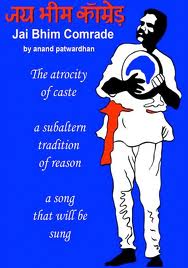 How many murdered Dalits does it take to wake up a nation? Ten? A thousand? A hundred thousand? We’re still counting, as Anand Patwardhan shows in his path-breaking film Jai Bhim Comrade (2011). Not only are we counting, but we’re counting cynically, calculating, dissembling, worried that we may accidentally dole out more than ‘they’ deserve. So we calibrate our sympathy, our policies and our justice mechanisms just so. So that the upper caste killers of Bhaiyyalal Bhotmange’s family get life imprisonment for parading Priyanka Bhotmange naked before killing her, her brother and other members of the family in Khairlanji village in Maharashtra, but the court finds no evidence that this may be a crime of hatred – a ‘caste atrocity’ as it is termed in India. Patwardhan’s film documents the twisted tale of Khairlanji briefly before moving to a Maratha rally in Mumbai, where pumped-up youths, high on testosterone and the bloody miracle of their upper caste birth are dancing on the streets, brandishing cardboard swords and demanding job reservations (the film effectively demolishes the myth that caste consciousness and caste mobilisation are only practised by the so-called ‘lower castes’). Asked on camera about the Khairlanji murders, one Maratha manoos suspends his cheering to offer an explanation. That girl’s character was so loose, he says, that the entire village decided to teach her a lesson.
 Under the scorching Sun
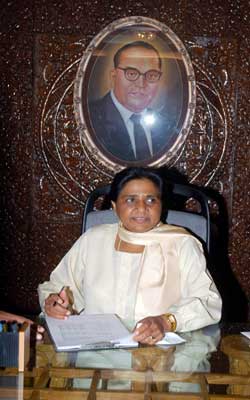 This guest post by RAM KUMAR is a review of five years of Mayawati’s administration in Uttar Pradesh. An English translation has appeared in Fountain Ink magazine,
  KAFILA - COLLECTIVE EXPLORATIONS SINCE 2006