Tag Archives: Delhi

Notes from a Metro (Pun Unintentionally Intentional)

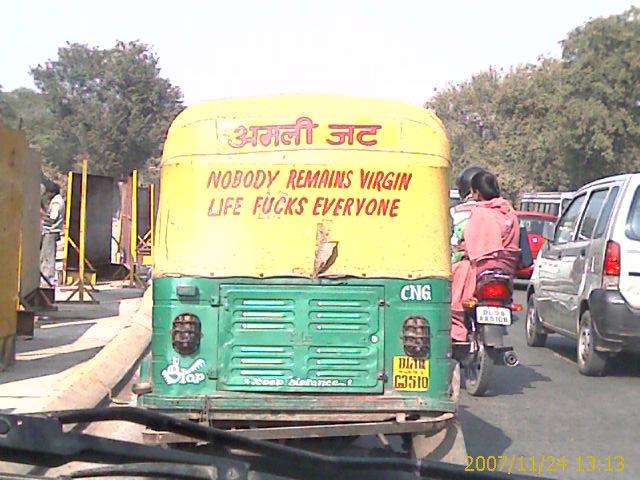
Enter Delhi: The boy was about 13, perhaps less. He was riding a bike which was about three times his size. He swerved between the vehicles on the road at Karol Bagh, very much in the wrong in terms of which side of the road he ought to be on, and therefore also in terms of the traffic rules and regulations. But he could not care. I looked at him and wondered,

Dilli dilwalon ki hai – Delhi is a city of the large-hearted, of the daring, the bold and the courageous.

A few days later, one of the auto drivers remarked to me during a journey,

Kehte hai dilli dilwalon ki hoti hai. Lekin yeh jhoot hai. Sabhi log yahan paise ke peeche pade rehte hai aur har koi aapko lootne ki koshish karna chahta hai – It is a saying that Delhi is a city of the large-hearted. But this is false. Everyone here is behind money, and each person is out to loot/cheat you.

Continue reading Notes from a Metro (Pun Unintentionally Intentional)
The Survey Unfolds

Guest post by SHVETA SARDA

lnjp1

Between 26 February, when it started and 6 March, yesterday, the survey of 220 houses has been completed in LNJP. There are roughly 1000 houses left to be covered. From the groundwork done end of last week by a group young women and men residents of LNJP, documents of many have been put in order, and the encounter with the survey teams this past week was much more confident. Continue reading The Survey Unfolds

The Survey Begins

Guest post by SHVETA SARDA

LNJP is an old settlement at the edge of old Delhi, opposite Turkhman Gate, beside the LNJP hospital, from which it gets its name. It began to be settled in the late ’60s, and is now home to about 12000 people. With the planned changes in the city ahead of the Commonwealth Games, LNJP, one of the oldest and last surviving settlements, has also now been earmarked for eviction and demolition.

The survey that precedes demolition has begun in LNJP. A survey is conducted by representatives from the Slum Department of the Municipal Corporation, to produce knowledge about the settlement to be demolished, in order to ascertain how many of its residents are eligible for resettlement. According to a Central Government order of 2000, all those who have lived in a settlement since before 1998 are eligible for resettlement; those who have lived there since before 1990 will be allotted plots of 18 sq m, and those who settled there between 1990 and 1998 will be alloted 12.5 sq m. Continue reading The Survey Begins

India’s fault lines, explored in a film about a Delhi thief – Trisha Gupta

Guest post by TRISHA GUPTA

Fifteen minutes into Dibakar Banerjee’s new film, a bunch of lower middle class Delhi boys are beating up a private school kid whose one refrain is a pleading “Jaan de bhai, extra class hai“. They don’t stop. But at one point, the gangly teenaged sardar pauses in his pummelling to make the padhaaku kid answer a crucial question, “Yeh greeting card mein likha kya hota hai?Continue reading India’s fault lines, explored in a film about a Delhi thief – Trisha Gupta

Phool Walon Ki Sair

Akbar Shah Saani (the second) ruled over a rapidly disintegrating empire between 1806 to 1837. It was during his time that the East India Company dispensed with even the fig leaf of ruling in the name of the Mughal Monarch and removed his name from the Persian texts that appeared on the coins struck by the company in the areas under their control.

Bahadur Shah Zafar who succeeded him was not Akbar Shah Saani’s choice as his successor, Akbar Shah was, in fact, under great pressure by one of his queens, Mumtaz Begum to declare her son Mirza Jahangir as the successor. Akbar Shah would have probably accepted this demand but Mirza Jahangir had fallen foul of the British and they will have none of this.

The Phool Walon Ki Sair or Sair-e-gul-Faroshan that is celebrated with much fanfare and official patronage had its beginning in a fracas between Mirza Jahangir and Sir Archibald Seton, the then British resident at Delhi. According to contemporary records of the event, Mirza Jahangir was extremely resentful of the manner in which the British threw their weight around the Red Fort and violated all customs and traditions. He was a strong man, moved around with a band of his followers and kept getting into arguments with the Goras. Continue reading Phool Walon Ki Sair

Buses, Bad Ideas and Bambi

Some say that if you give a man a long enough rope, he will eventually hang himself. Others say that when you’re in a hole; stop digging. Given the stubbornness of our friend from a 2.5 world country, chances are he will be one of the first to hang himself in a hole.  A truly horrible image that – but worry not fair readers; he can still be saved yet.

Scrolling through his latest rejoinder appears frighteningly like watching your neighbour’s child – in the other building across the road – assemble a shaky platform of poorly imagined arguments, test the strength of his rope of ignorance, throw it about his neck in an attempt to force his parents to say they are sorry for screaming at him and then, just as he is getting what he wants – HORROR. The platform is shaking, the legs are trembling, the noose is tightening, are his parents even watching? And then suddenly you can almost hear this crack that makes you want to scream STOP!!!

Continue reading Buses, Bad Ideas and Bambi

Some images do not disturb

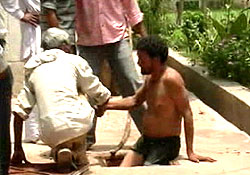
CBI-employed manhole workers in Noida

guest post by S. ANAND

There are times when our critical antennae do not perk up. We do not wish to decode certain signs because we are all implicated in them. Following the 14 September blasts in Delhi, suddenly the media found a new value in ragpickers, street vendors, auto drivers and others who live on the fringes of the city and are generally looked down upon by people who inhabit apartments, blogs, cars (and autos, I must add).

Suddenly, by 15 September, ragpicker Krishna was canonized as a ‘hero’ by the media, the police and the state (the Delhi government claims credit for saving some lives with its ‘eyes and ears’ policy). Yet, Times of India prefaced its report about Krishna thus: Continue reading Some images do not disturb

Cities, Cars and Buses: The Modern, the Ideological and the Urban

[This post is a response both to Aarti Sethi’s post on the BRT, as well as to Aman Sethi’s posts recently and this one earlier and as well as to some of the comments it generated.]

In 1970, Henri Lefebvre wrote: “the invasion of the automobile and the pressure of the automobile lobby have turned the car into a key object, parking into an obsession, traffic into a priority, harmful to urban and social life. The day is approaching when we will be forced to limit the rights and powers of the automobile. Naturally, this won’t be easy, and the fallout will be considerable” (The Urban Revolution, 19).

Talking about the BRT corridor in Delhi, its worth remembering many other urban clashes – Hausmann’s broad and open ways that opened up Paris in the mid 19th century, Robert Moses in New York, and Corbu’s (failed but still so real) plans for just about everywhere outside Europe. Hausmann’s boulevards were about a new kind of street for a new kind of urban formation: the boulevard was part of the birth of the industrial, capitalist city, the city of Baudelaire’s Paris and the “Eyes of the Poor” – the city of the current version of the modern that still shapes/haunts us today. Continue reading Cities, Cars and Buses: The Modern, the Ideological and the Urban

On dealing with fuss-tration

So for those of us who thought that frustrated, naive and aggressive car drivers are a caricature, Hey we at Kafila found one just for our readers.  He is loud, aggressive and fuss-trated as they come. Read on …

The wonderful thing about blogging, I am told, is that it allows everyone to publish their opinions.  At times however, forgive me for saying this, I wonder if everyone should.  My most recent reason for this harsh indictment of the blogging world, is based on this recent post titled “This is what the fuss is about (you twit)”. The title stems from a spot of witty wordplay on one of my recent posts.

The “you twit”, I might hasten to add, is not my addition. it is the author’s impression of my arguments.  While his post is reasonably, if somewhat naively, argued; his frequent abuse stems, perhaps, out of the need to get his blog read. Or maybe it is a style that is much appreciated by his readers.  I will however, thank him for his incisive – if somewhat excessively enthusiastic – critique of my work.

Continue reading On dealing with fuss-tration

Some Questions About the Delhi Encounter

By Shabnam Hashmi, Satya Sivaraman, Manisha Sethi, Tanweer Fazal, Arshad Alam, Pallavi Deka

First published on Countercurrents.

A team comprising activists, academicians and journalists visited the site of the police operation against alleged terrorists staying in an apartment in Jamia Nagar in the afternoon of 20.09.2008 (Saturday). Two alleged terrorists Atif and Sajid, along with Mohan Chand Sharma, an inspector of the Delhi Police’s Special Cell died in the operation while a third alleged terrorist was arrested. Continue reading Some Questions About the Delhi Encounter

Autos anyone?

After the recent – and fascinating – debate on autorickshaws that spanned three posts and several comments, I couldnt resist putting this up once it arrived in my mailbox.  Thank you Akshaya for sending it my way.

A Tangential Addition to the Great Auto Debate

I want to go off on a bit of a tangent here. Just to open a different discussion in the spirit of thinking, and muddling along together. It seems to me that one of the axis on which the debate has turned is on the question of desire and its representation. Who is the desiring subject, towards whom is this desire directed, who represents this desire in what way, what are the slippages therein, who has the right to speak about whom.

I was wondering if we can approach this from a slightly different angle by taking this question of desire beyond the individual subject (variously defined). And in fact nameless did gesture to this in one of her responses where she raised the question of the appropriation of what she termed subaltern practices by elite intellectuals where certain practices and forms, in this case autos, are made to stand in for certain values – in this case progressive, ‘left” etc – which says more about the locations of the intellectuals and their insensitivity to their own class-caste positions, in a move which is patronizing at best and exploitative at worst. I think inherent in this critique is the shadow of a kind of objectification of a certain experience, so that a symbol becomes alienated from the actual life practices in which it is located to circulate as some empty signifier, to be appropriately filled as per requirement.

Continue reading A Tangential Addition to the Great Auto Debate

Death of the Author(-ized)?

Or it is just another case of planning paranoia?

Although commonly understood to be a city of traders, Ravinder Singh Chowdhary*, is adamant that Delhi be understood as the abode of farmers.  Sitting adjacent to lush verdant fields of brinjal, rice, and spinach in the village Madapur Khadar in Delhi’s Badarpur Constituency, Chowdhary, explains how Delhi is paradoxically “a city of farmers.”  “From Kilokri and Kotla Mubarakpur in the South-East, to Karol Bagh in Delhi’s North-West, almost every new colony post-partition has been settled on farm land. Those settled by the Government were given water, electricity and drainage and became proper colonies; those settled by private individuals were denied these basic amenities and termed ‘illegal’ or ‘unauthorised’.”

In its most recent and controversial policy announcement, Delhi Government and the Union Ministry of Urban Development seem to take cognisance of Chowdhary’s understanding of the city’s settlements and have begun the process of issuing provisional regularisation certificates to about 1,500 unauthorised colonies that are mostly settled on agricultural land; a move that they claim will benefit approximately 40 lakh residents.
Continue reading Death of the Author(-ized)?

Pride, Prejudice and Politics

Reproduced from the Indian Express this morning. Of course, I wrote it entirely with Kafila in my heart, the Express just got it first :)

___________

A gay man is given two years of electroshock therapy in a major city hospital to “cure” him — the National Human Rights Commission refuses to file a complaint. A 2004 book on queer politics sees 34 contributors write under their full names, many for the first time. Lesbian women continue to commit suicide rather than be forcibly married. Large sections of the media openly support campaigns against Sec 377 — the 1861 law that criminalises “unnatural offences” — and widely carry an open letter written by Vikram Seth and Amartya Sen against the law. The law still stands over the head of the gay community, but the challenge to it in the Delhi High Court inches towards a verdict. Meanwhile, aravanis (as hijras are known in Tamil Nadu) win a landmark battle for the legal right to have government identification cards and passports issued under “E” as their gender. Continue reading Pride, Prejudice and Politics

So what was that fuss about?

Pleased with its professionally executed hatchet job on what is probably Delhi’s first real public transport endeavour that incorporates the needs of pedestrians and cyclists apart from bus users, the press seems to have forgotten the BRTS – moving on to search for other programmes to torpedo. But what was the BRTS fuss all about? Read on …

“’Experts’ order serial rape of Delhi Roads” screamed a particularly tasteless headline, in a national paper, of an article that claimed that the entire city shall be subjected to “gang-rape by greedy contractors with the benign blessings of rootless experts and supine babus.” In another widely published English newspaper, the editor in chief spoke out fearlessly against the “brutal enforcement of licence-quota raj on our roads”, denouncing what he saw as the “cynical and expensive exercise in enforcing a new kind of ideological socialism.” In another op-ed carried by the same paper, another piece spoke out against the “elitist” nature of the same project. “The masses want to drive,” noted columnist Saubhik Chakravarthy,” So reducing road space for private vehicles is ultimately elitist.” Judging by the vicious vendetta unleashed by the mainstream press, one would assume that the mild-mannered professors of the Indian Institute of Technology, Delhi, had committed a crime against the state, rather than have designed the latest addition to the city’s mass transit system.

Continue reading So what was that fuss about?

Counting Lights

This is a simple exercise in basic arithmetic that will help us reach some rather basic results, the results might be a little unexpected but simple arithmetic is known to have indulged in such pastimes on other occasions as well.

There are around 3000 Blue line buses that ply on the streets of Delhi, and aside from terrorising the general populace off the streets, sending around 150 citizens of Delhi to meet their respective makers they are also known to occasionally ferry passengers.

It is now public knowledge that most, if not all, these buses are owned, benami, by local politicians and, as the expression goes, their near and dear ones. The fact that these killers are allowed to hold an entire city of close to 14,000,000 to ransom is not entirely due to their being politically correctly related, though that helps, it is mostly because of a well organised system of preventing diligent government servants from the discharge of their duty.

The government servants being thus prevented are gentlemen who have promised to be “with us for us always” [the motto of Delhi Police, for the information of non-Delhi people] (I am personally extremely happy that they are being prevented from discharging their duties towards me). The fellows want so dearly to serve us but are systematically prevented by the drivers and owners (Ds & Os) of the aforementioned vehicles. What can the poor fellows do, every time they want to rise to our defence the Ds & Os or their representatives show them some magical papers and the potential do gooders freeze in mid stride!

Continue reading Counting Lights