Tag Archives: Democracy

‘Degrees’ of Democracy – Field Notes from a Central University in Bihar: Debaditya Bhattacharya

Guest post by DEBADITYA BHATTACHARYA

This piece has long been in the coming. Soon after the summer of student protests in India exposed the terror-apparatuses of the state and unleashed a new vocabulary of progressive political resistance, the students of a certain Central University of South Bihar (in Gaya) went on strike against the university administration in the early days of August. They however were not fighting to protect constitutional rights, because their daily encounters with the university had already come to rest on a structural suspension of many such rights. Like those of speech, of rational thought and scientific inquiry, of gender-equality, and of resisting what Vemula called the event of being reduced to one’s “immediate identity”. These students merely decided to fight for their right to a degree.

They had come together to demand statutory recognition for courses that they were enrolled in since 2013, but most sections of the national media at that time deemed the issue ‘sub-national’ enough to be granted space or audience. Reporters from the local print-media were – in what seems like accepted practice across public institutions in the country – barred entry into the university campus, and hearsay reports constituted the stuff of low-key news-briefs with little context or compassion. Those who attempted to organise public opinion by writing on social and alternative media spaces, were – in a classic division of interests that administrative bureaucracies are deft at provoking – urged by students themselves to withdraw. The reason was simple: each social media post or conversation around the issue was declaredly spied on by the university administration in order to ‘detect’ subterranean alliances and “outside support” (as if it were a terrorist conspiracy!), and students were individually targeted and intimidated for passing on internal ‘secrets’ to ‘outsiders’. I know of specific Facebook posts which had been taken print-outs of and convened surreptitious meetings over, where administrative heads and proctorial board members put their heads together to crush the germ of student dissent and ‘outsider’-mobilizations. The agitated students continued in their own ways, despite open threats of disciplinary action and reminders of exam-time tactics of penalisation. The Vice-Chancellor marched off to Delhi to strike bargains for an interim settlement-package with officials in the ministry, and returned to meet the striking protestors with as much of an assurance as threats of expulsion. Continue reading ‘Degrees’ of Democracy – Field Notes from a Central University in Bihar: Debaditya Bhattacharya
Kashmir’s Freedom is India’s Freedom: Hum Kya Chahte? Azadi

I do not think ordinary Indians support the brutality of army occupation in Kashmir. Despite what the Indian state says, and despite what the Indian army and CRPF are doing, I honestly do not believe that any ordinary Indian supports the torture of young men, the blinding of people attending a funeral, the rape of women, the killings and maiming and abuse and humiliation that are now a routinized fact of daily life in the Kashmir valley. To believe that ordinary Indians enjoy watching this spectacle of violence, that ordinary Indians take pleasure in the torture of children, would be to think India is now a country comprised of sadistic psychopaths. I honestly do not think ordinary Indians are psychopaths. I do think, however, that ordinary Indians, and I count myself amongst them, have somehow managed, till now, to keep some distance between what is happening in Kashmir and the idea of India as a whole. After all, India is a large and complex country, a huge and diverse society. Everything that happens in Kashmir, the brutality of the army and the security forces, cannot signify the whole truth of India we tell ourselves. It seems somehow unfair to us ordinary Indians that what happens in Kashmir reflects on us all.

But the time has come now to squarely face some hard truths about ourselves, and the dissimulations, psychological and social, by which we continue to live in this country and call ourselves ‘Indians’. Continue reading Kashmir’s Freedom is India’s Freedom: Hum Kya Chahte? Azadi

P.A.D.S. Statement on the killing of Prof MM Kalburgi – a sane voice against communalism and superstition

People’s Alliance for Democracy and Secularism (PADS)

Murder of another rational voice against communalism and superstition

The respected and loved Kannada scholar and writer MM Kalburgi was murdered by two unidentified men on August 30 at his home in Dharwad. The seventy seven year scholar was actively researching Vachanas literature of early Kannada and literature produced during the Adil Shahi period in Northern Karnataka. He was a source of wisdom for many students and scholars, and his killers gained access posing as students. He was also a vocal critic of religious superstitions and had been targeted by fundamentalists within his own Lingayat community and by Hindutva organisations. He had received many threats and his house had been attacked with stones and bottles. He was given police protection, which was withdrawn only days before his murder.

Professor Kalburgi’s cold-blooded murder has caused widespread shock and dismay in the literary and intellectual circles of Karnataka. Many protests involving ordinary citizens have been held in Bangalore and Dharwad. At least one Hindutva Bajrang dal activist has publicly welcomed the assassination, warned another rationalist of Karnataka, Prof KS Bhagwan of the same fate.

Prof Kalburgi’s killing comes after the murders of two other prominent critics of religious superstitions. Dr Narender Dabholkar was killed in 2013 in Pune. Trade Unionist and Communist Govind Pansare was killed in Kolhapur in February this year. There are uncanny similarities in the modus operandi of all three cases. It is likely that as in the earlier cases, the police will fail to solve Prof Kalburgi’s murder. Continue reading P.A.D.S. Statement on the killing of Prof MM Kalburgi – a sane voice against communalism and superstition

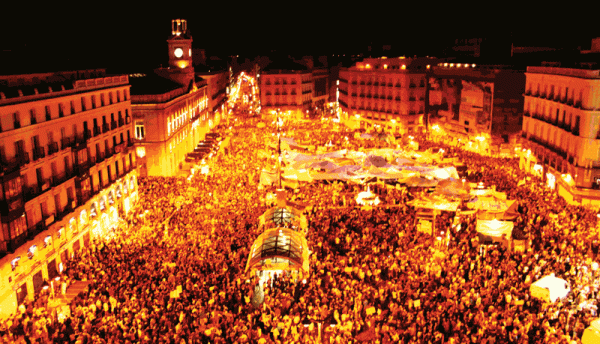
Whatever happened to 15-M Movement? Atharva Pandit

Guest post by ATHARVA PANDIT

[Against the background of Spain’s recent criminalizing of public protests and the first ever hologram demonstration (see Kafila post by Geeta Seshu) against it, this article revisits the major eruption in 2011, that eventually laid the ground for the emergence of a new political force in Spanish politics]

15M, image courtesy El Tecolote

Spain, seems to be a country that is still shaping itself. Somewhat like a nation that wants to come to terms with its past, unlike many other countries that have gone through a traumatic history and have finally emerged through the political passions – admittedly misdirected – of their distant past. Spain seems like it is yet to come to terms with a civil war that forged its legacy in millions of Spanish minds and the future generations of the country. The fascist forces that staged a coup, and consequently, went on to purge about 150,000 of its citizens in summary executions, far surpassed some of the worst dictatorships that the world has witnessed, including that of Pinochet’s in Chile and of Videla’s in Argentina.

Continue reading Whatever happened to 15-M Movement? Atharva Pandit

Land Acquisition and Delays Over Democracy: Shubham Jain, Sarangan Rajeshkumar, Dhruva Gandhi

Guest post by SHUBHAM JAIN, SARANGAN RAJESHKUMAR and DHRUVA GANDHI

The Right to Fair Compensation and Transparency in Land Acquisition, Resettlement and Rehabilitation Act, 2013 was passed with Objective to promote transparency and participative governance in the acquisition of land for industrialisation and urbanisation and to, thereby, ensure overall socio-economic development. In the pursuit of this objective, the law introduced mechanisms as Social Impact Assessment, Consent, and Rehabilitation et al.

This law, however, attracted widespread criticism from the industry on account of the supposedly time consuming barriers created for the acquisition of land. Accordingly, the Ordinance of 2015 was promulgated as a measure to hasten the process of Land Acquisition and to, thereby, contribute towards the economic development of the country. Unfortunately, most of the debate on this Ordinance has barely focussed on the problems it sought to address and, consequentially, there has been a dearth of an analysis of solutions proposed therein in the backdrop of these problems. Let us, therefore, contextualise the debate on the Ordinance and, then, examine the merits of the same. Continue reading Land Acquisition and Delays Over Democracy: Shubham Jain, Sarangan Rajeshkumar, Dhruva Gandhi

An Election of Hope Versus Fear

Yes it’s a simplistic dichotomy, but there is really no better way to describe the current Delhi elections. On the one hand, a little ragtag army of Davids behind “Mufflerman”, as his faithful supporters affectionately call him, a person in baggy sweater and sneakers, one you wouldn’t look at twice if you passed him on the road.

Mufflerman Business Standard

  Kejriwal

On the other hand, a massively funded, aggressively confident Goliath, openly backed by the corporate bodies and full-page ads, riding a  national “Wave” higher than most Tsunamis, topped by the 56-inch chest of “Modiman”, even if recently modestly covered by a 12-lakh rupee vest.

56-inch Modi78c0d4d3-be9e-4afb-b034-1247529df720wallpaper1

On the one hand, a fearful and awed media establishment donating PR for free to the seemingly invincible King of Gujarat, and on the other, an aam aadmi, a volunteer-cadre run campaign and a palpable vibe of trust and openness on the ground. I know I know, some will say it’s all ‘perception management’ and PR, but barring the googly of the 2 crores party donation thrown at the opportune moment, if Mufflerman’s party was any cleaner, it could have given Lalita ji’s Surf a run for its money. Whatever the result on the 10th (and there is reason to be hawk-eyed about the possibility of tampering as Nivedita Menon’s post has urged), how does anybody not get what a miracle this alone is, in a political economy with a black economy of a size that is higher than the GDPs of most smaller countries? Perhaps this is in fact about hope and fear after all, however clichéd that sounds.

Continue reading An Election of Hope Versus Fear

Feed The Poor, Go To Jail

image : Courtesy eideard.com

Whether serving food to the homeless is a crime?

Ask Arnold Arbott, known as Chef Arbott, a 90 year old man from Fort Lauderdale, Florida, who along-with two other members of a Church charity faces potential jail term for at least six months for the same ‘offence’. In fact his name finds prominent mention in the police records in the past week for breaking the new city ordinance which has come into effect recently which characterises his act as breach of law, according to reports.

Talking to a newsperson he said:

“These are the poorest of the poor. They have nothing. They don’t have a roof over their head. And who could turn them away?”

Continue reading Feed The Poor, Go To Jail

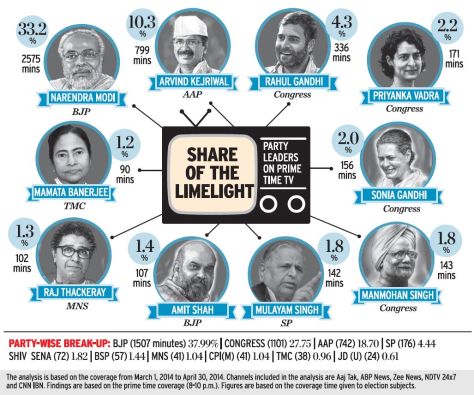
Democracy as Permanent Advertising – Indian Media and Elections : Irfan Ahmad

Guest post by IRFAN AHMAD

It was nothing short of a scandal. On 12 April, India TV, a Hindi channel, telecast 117-minute interview of the BJP Prime Ministerial candidate, Narendra Modi. Conducted by Rajat Sharma, it became, or was made, a mega hit. Tow days later, news director of Indian TV, Qamar Waheed Naqvi, resigned from his position alleging that the interview was ‘fixed’. Though Naqvi’s resignation was silenced in media, the fixed interview represents the dark and mutually constitutive relationships between media and politics.

Based on the analyses of select elections coverage by five television channels – India TV, NDTV, Aaj Tak, ANI, and IBN– I argue that:

  • The way journalists pose questions to their favorite politicians are often already answers;
  • In pursuing a storyline, journalists subordinate, even sacrifice, actual responses or events/facts to bolster their pre-determined narrative; and
  • Electoral polity like India is heading towards a designer democracy marked by permanent campaigning-cum-advertising.

In short, I caution against the use of widespread phrase: ‘media and politics’. It is more fitting to say: ‘media as politics’ or ‘politics as media’.

Share of prime time coverage, Image courtesy The Hindu

Modi’s ‘Fixed’ Interview: India TV Continue reading Democracy as Permanent Advertising – Indian Media and Elections : Irfan Ahmad

Some Reflections on the neutrality of political institutions and the project of making Modi more palatable: Moiz Tundawala

Guest Post by MOIZ TUNDAWALA

“ … . however good a Constitution may be, it is sure to turn out bad because those who are called to work it, happen to be a bad lot. However bad a Constitution may be, it may turn out to be good if those who are called to work it, happen to be a good lot. The working of a Constitution does not depend wholly upon the nature of the Constitution. The Constitution can provide only the organs of State such as the Legislature, the Executive and the Judiciary. The factors on which the working of those organs of the State depend are the people and the political parties they will set up as their instruments to carry out their wishes and their politics.”

[Dr. Bhimrao Amdedkar]

These observations of Babasaheb Ambedkar, made on the 25th of November, 1949, one day before the Constitution was finally adopted after three years worth of labour, should suffice for anyone who dismisses Modi skeptics as excessive scare mongers. As a second year law student in 2006-07, I couldn’t quite understand why our revered constitutional law teacher Prof. M.P. Singh would keep reiterating these sentiments in class, something which I thought was so axiomatic it did not need emphases. With only a few days left for the outcome of what is being called an election for the soul of India, I now realize the wisdom underlying those constant reminders, especially in a law school converted by the culture and priorities of its students into a factory churning out smart but unreflective products for the corporate sector. I think those of us who find Modi problematic, but would still vote him in for the lure of the promised economic miracle, while at the same time consoling ourselves with the talk of sufficiently robust political institutions capable of surviving any onslaught, must listen to Ambedkar carefully. The Constitution is an artefact, a human creation, constantly needing ‘good people’ at the helm to work it out. If nothing else, resistance to Modi’s rise to power is at least resistance against the enthronement of ‘bad people’, who deep down have only harboured contempt for the Constitution as a foreign document.

Continue reading Some Reflections on the neutrality of political institutions and the project of making Modi more palatable: Moiz Tundawala

A Temporary Respite from Ordinance Raj: Apurv Mishra

Guest post by APURV MISHRA

The Roman legalist Julius Paulus once said that, “One who contravenes the intention of a statute without disobeying its actual words, commits a fraud on it.” With the model code of conduct declared on Wednesday, the country was spared the possibility of a fresh round of ordinances that would have amounted to yet another fraud on the constitution by the UPA government. Believers in constitutionalism, for whom a constitutional impropriety is as disturbing as a blatantly unconstitutional act, can now breathe a temporary sigh of relief.

The phrase “fraud on the constitution” is not of my own making. It was used by the Supreme Court in a case that at once represents the best and worst of Indian polity. Between 1967 and 1981, the governor of Bihar promulgated an astonishing 256 ordinances which were kept alive for up to 14 years, including a fateful day on which 50 ordinances were passed at one go. The state assembly meanwhile, passed only 189 Acts in the same period. This was a brazen disregard for the basic structure of our constitution of which “separation of power” is an essential component- a simple and intuitive scheme where the legislature makes laws after careful deliberations and the executive branch of the government implements them.

It required two extraordinary individuals to put an end to this “complete nonsense”- Dr D C Wadhwa, who meticulously collected data on the systematic abuse of power by the Bihar government at grave personal cost and then-Chief Justice of India P N Bhagwati, who delivered an outstanding judgment (on the PIL filed by Dr Wadhwa ) which stated in no uncertain terms that the power to promulgate an ordinance is essentially an emergency power to be used to meet an extraordinary situation and “it cannot be allowed to be perverted to serve political ends.” Continue reading A Temporary Respite from Ordinance Raj: Apurv Mishra

Hidden in Plain Sight – Problems of Democracy Under Capitalism: Ravi Sinha

Talk delivered by RAVI SINHA at the International Seminar on “Democracy, Socialism, and the Visions for the 21st Century”, 7th to 10th March, 2014 Hyderabad, India

If one has to say something brief and short about a large and complex subject, which is also a much discussed topic, one always runs the risk of stating the obvious. But one may also chance upon the unexpected and the counter-intuitive. Problems of democracy under capitalism and under socialism have by now a ring of tiring familiarity around them, but they also contain surprises that are hidden in plain sight. While fixing my coordinates by recounting the obvious, my hope is to point towards aspects that may be counter-intuitive to the political common sense prevalent in much of the left and the social movements.

 Let me begin with the status of democracy under capitalism. Popular mind considers them complementary to each other. Ancients – whether in Greece or in India – were familiar with the concept of democracy and, at least in some famous examples, they are also supposed to have practiced it. But the large-scale acceptance and practice of democracy overlaps with the history of capitalism. In addition, the history of socialism of the twentieth century has been such that this association got further entrenched in the popular mind. I will come to the socialism question a little later. For now, let me stay with the relationship between democracy and capitalism.
If I were to say, then, that at the core of this relationship lies a tension that is fundamentally irresolvable, it would appear counter-intuitive to the popular common sense. On the other hand, it would appear obvious to a leftist. On both counts there are reasons to dig a little deeper. Truth is often counter-intuitive for the wrong reasons, but at times it is also obvious for the wrong reasons.

Crafting the Modi Mask – India Inc and the Big Media

AAP Rally in Gujarat. Courtesy Mukul Sinha

Two things stand out for their sublime quality in the current round of pre-election campaigning. First, the danger to Indian democracy has assumed unprecedented proportions, and there is a clear sense of desperation in the air. The threat emanates, you guessed right, from a group of anarchists who are poised to take over Indian democracy.  This is perhaps the dirtiest and most dangerous election that India has ever seen – what with the bunch of anarchists ‘fixing the media‘, ‘spreading anarchy‘, ‘hijacking democracy‘, ‘taking foreign funds‘ for their election campaign (while the others, the impeccable democrats of the BJP and the Congress have to make do with ‘local’ capitalists like  Mukesh Ambani). What’s more, these people are ‘political mercenaries‘,  urban Maoists in disguise and they want to wreck the neatly and painstakingly built edifice of our hallowed democracy. This widespread love of democracy is touching. For someone like me who has closely watched (and participated in) politics from the mid 1970s, the panic evident in the tone of those attacking AAP is as unprecedented as it is revealing. It is revealing of the fact that the political class is thrown into disarray by this new way of doing politics that AAP represents. In BJP’s case, in particular, one can discern complete befuddlement – neither its hope to reap the benefit of the mass anger against the Congress, nor its tried and tested polarizing communal vocabulary seem to have any meaning any more.

Thus, during the days of AAP rule in Delhi, the official BJP state executive resolution came up with this claim:

“Delhi is currently being ruled by a bunch of political mercenaries hired, supported and controlled by Congress party. The words and action of AAP leaders expose the fact that it is a Maoist outfit.”

Of course, the Maoists are “hired, supported and controlled by the Congress”!

Continue reading Crafting the Modi Mask – India Inc and the Big Media

Arvind Kejriwal, master-blaster

Arvind Kejriwal is the new Sachin Tendulkar. You throw him the most difficult googly and he sweeps it to add runs for his century. In 2011, he started a national anti-corruption movement with the specific aim of setting up an anti-corruption ombudsman called Lokpal. The movement’s public face and leader was Anna Hazare, a respected social leader, who like Gandhi, believes in fasting for politics. The critics said Anna is just a puppet and it’s Kejriwal’s movement, and that such sophistry showed Kejriwal (who takes oath as chief minister of Delhi tomorrow) had sinister motives.

Kejriwal’s critics said that fasting unto death was a blackmail strategy not suited to a democracy. Kejriwal can’t have a Lokpal just because he wants it. His popular support is just media hype. If he really wants a Lokpal, why doesn’t he form a political party and contest elections?

Kejriwal’s critics said he was supported by the RSS and the BJP, that he is a BJP stooge, that the Lokpal movement was a right-wing conspiracy to remove pristine, super-secular, people-loving, chosen-by-god Congress party from power. Continue reading Arvind Kejriwal, master-blaster

AAP’s Rise and Congress Rout – Some Obvious but Unconventional Questions: Sanjay Kumar

Guest post by SANJAY KUMAR

A Congress rout and the AAP success are the most obvious results of recent polls. Both are spectacular, in their own ways. Even BJP’s landslide victory in Rajasthan and Madhya Pradesh pales in comparison, for these two open up new possibilities.

Why a party whose legacy of anti-colonial struggle had lost sheen generations ago, whose top leadership is in the grip of a seemingly disinterested and incompetent dynasty, that lacks any organised cadre, coherent ideology, social base, and whose average leader appears more of a wheeler-dealer, and scamster, should continue to get close to thirty percent of votes from Indians even in worst of times, is a genuine mystery. That the Indian social analyses, barring a few exceptions, have tried little to unravel this mystery, is not only an indication of their intellectual limitations, but also of their ideological biases. The enduring success of Congress indicates seamier side of liberal democracy in general, which bourgeois social sciences try more to paper over than explore.

From voters’ perspective elections under liberal democracy are an exercise in choice, but not in freedom. When people vote, they are not acting as citizens shaping their social world, but as little men and women facing pre-existing structures of social power. The magic of elections under liberal democracy is precisely this. They offer a choice, the choice is not fake, its collective outcome is uncertain, yet the choice is already pre-determined in ways that by and large reproduce pre-existing power structures. That is why, exercising franchise is not necessarily a marker of democratic exercise, and leaders of fascist persuasion are often the loudest votaries of compulsory voting.  But that is not all. If elections were mere gears in a machine that simply revolved on and on, they would be quickly become a ritual, like those under state socialism in which the Party and leaders always got more than 95% approvals. Elections under liberal democracy in contrast provide flexible adjustment of state political functionaries to changing social conditions. They allow reflection of changes in public opinion, demography, gender politics, caste equations and balance of class forces, whose origins lie somewhere else, onto state politics. Punctuated adjustment with a time lag produces a sense of drama. Personae on stage appear as victors and losers, for voters there is enough stage space to allow their hope, vengeance or gratitude to play their part. For a time, and only for a time, the impersonal structure of state power becomes humanly palpable. Continue reading AAP’s Rise and Congress Rout – Some Obvious but Unconventional Questions: Sanjay Kumar

Katiyabaaz – the grid thief of Kanpur

Katiyabaaz Loha Singh in a still from the film

By SHIVAM VIJ: A new documentary film, Katiyabaaz, presents a problem that I’ve been struggling with. Although the film is set in Kanpur, it’s a problem that faces many parts of South Asia. The film-makers, Fahad Mustafa and Deepti Kakkar, obstinately refuse to offer possible solutions. With catchy lyrics and music, the film celebrates Kanpur, its people, and this messed-up system. It’s a snapshot of who we are. It’s when you think about the film that it disturbs you.

The film’s anti-hero is a thief — Loha Singh helps a lot of people steal electricity in Kanpur. He connects the illegal wire that is known in north India as katiya. Katiya is the sort of simple solution to life’s problems that South Asians feel very smart about. It’s an example of jugaad, the shortcut to problem solving that’s now integral to pop management theories. Continue reading Katiyabaaz – the grid thief of Kanpur

São Paulo: The City and its Protests: Teresa Caldeira

Guest post by TERESA CALDEIRA

In June 2013, a series of large demonstrations throughout Brazil have shaken up its main cities and political landscape.  They have also perplexed politicians and analysts alike, many of whom found themselves without solid references to interpret the novelty and oscillated between silence and old discourses.  It is always risky to interpret emerging processes. Minimally, we risk following secondary paths or, even worst, framing new events with the vocabulary made available by old interpretative models, exactly the ones that the new events are trying to displace. However, in order to reveal what is emerging it is necessary to risk, search for new hints, and follow signs already available.  Several references that can guide us to interpret the June events have been around for quite a while; others are new, but we can trace their lineage and contextualize them.

SP Batata 17 june
17th June, 2013

Continue reading São Paulo: The City and its Protests: Teresa Caldeira

India needs a third imagination

In a brilliant column in the The Indian Express, Pratap Bhanu Mehta (with whom I have much to disagree about reservations) calls the bluff of the “national” parties who want Indian voters to be wary of the ‘instability’ and impossibility of a third front coalition government. This argument, strangely posing itself in a nationalist tone, is unfortunately also bought by too many left-liberal intellectuals and activists who don’t want us to get out the non-choice of the BJP-Congress binary. Mehta writes:

Sometimes an ordered instability can be more productive than a comatose stability. It is said that a third front leadership is unlikely to have a national perspective. But the cringingly desperate way in which the leadership of the national parties have put their own survival above any principle makes you wonder what the charge of not having a national perspective is all about. The third front will make foreign policy hostage to regional interests. In a way, it already is. But the source of the problem is deeper. Even a supposedly national party like the BJP cannot get its act together on the enclaves agreement with Bangladesh. Why blame regional parties? The third front will be fiscally irresponsible. It is a risk, but no more than a risk with any political party. The Congress squandered the best of economic opportunities in a fiscally irresponsible way. It is something of an irony that the only Chidambaram budget described as a “dream budget” came under Deve Gowda. And many states have shown innovation in a kind of pro-business entrepreneurial capitalism and in social sector schemes. Many of the regional leaders who would make up the third front are autocrats. Indeed, many of them are. But that autocracy is more visible because the national parties can use the state structure in a very sophisticated way to further their ends. But they are articulate and engage with their constituents. In short, the constituents of the third front are as much India and Indian interests as anyone else. [Full article]

India needs a third imagination, and by constantly being told that it is not possible we are told not to imagine it. This is the argument of, as Mehta puts it, the ‘entrenched elites’, to save their privileges. The fear of the third front, of the ‘regional’, needs to be fought and defeated. We see this poverty of imagination thrown at us whether we’re talking of Nitish Kumar or Arvind Kejriwal or Mayawati by people who will do not think it necessary to subject the Congress and the BJP to similar scrutiny. This bias against the “regional” is remarkably shared amongst a lot of people across the ideological spectrum. Their bluff needs to be called.

Aadhar/UID is Against Equality and Democracy: Moiz Tundawala

Guest Post by Moiz Tundawala

After the suppression of the 1857 Mutiny and the British take over of Delhi, Mirza Ghalib was once asked by a military official whether he were Muslim or not. Ghalib is said to have quipped: “Only half Muslim; I drink wine but refrain from swine.” For me, this ripost evinces a flippant disdain for modern forms of rule which essentialize persons and groups purely based on certain attributes which are deemed definitive and prioritized over others. As far as Ghalib’s case was concerned, the idea may have been to find out based on his religious identity if at all he could pose problems for the newly established colonial regime. In later years, this policy, which African intellectual Mahmood Mamdani has recently termed ‘define and rule’, gradually became integral to governmental practices in most parts of the modern world; today, populations are ever so readily classified and enumerated based on empirically observable characteristics in order to make them amenable to effective government. The Aadhaar project of the Unique Identification Authority of India clearly falls within the gamut of such practices, marking a transition to modernity in a radical break from the past. So my reservations with it are just the same as those with any other modernity inspired programme wherein personal and collective identities are reduced to a somewhat arbitrarily determined bare essence which may have no real connection with lived experiences of fuzzy and contextually constructed identities.

Continue reading Aadhar/UID is Against Equality and Democracy: Moiz Tundawala

Kindly Deliver My Letter to the PM of India: Mahum Shabir

Guest Post by Mahum Shabir

Dear Mr. Prime Minister,

Maybe it is silly to think that the Prime Minister of the world’s largest democracy will listen to the sorrows of a young Kashmiri woman-you have a billion more people to worry about. Maybe your interest in this letter would be piqued if I began by telling you that we have something in common-an education from two of the world’s best universities, yours from Oxford, mine from Harvard. Maybe it shouldn’t take a reference to where one went to school to get attention on a serious ethical issue at the center of democratic governance in India but nothing else has worked so far. I hope jaan pehchaan will work its wonders this once too. Continue reading Kindly Deliver My Letter to the PM of India: Mahum Shabir

राष्ट्रवादी न्याय से करुणा की विदाई

“अगर हम ‘लोकतांत्रिक सरकारों के छिपे इरादों और गैरजवाबदेह खुफिया शक्ति संरचनाओं की जांच करने और उन पर सवाल उठाने से इनकार करते हैं तो हम लोकतंत्र और मानवता, दोनों को ही खो बैठते हैं.” पत्रकार जॉन पिल्जर का यह वाक्य आज हमारे लिए कितना प्रासंगिक हो उठा है! हमें नौ जनवरी को खुफिया तरीके से अफज़ल गुरु को दी गयी फांसी के अभिप्राय को समझना ही होगा. काम कठिन है क्योंकि इसे लाकर न सिर्फ़ प्रायः सभी संसदीय राजनीतिक दल एकमत हैं बल्कि आम तौर पर देश की जनता भी इसे देर से की गई सही कार्रवाई समझती है.

नौ जनवरी के दिन के वृहत्तर आशय छह दिसम्बर जैसी तारीख से कम गंभीर नहीं क्योंकि इस रोज़ भारतीय राज्य ने गांधी और टैगोर की विरासत का हक खो दिया है.अगर अब तक यह साबित नहीं था तो अब हो गया है कि भारत की ‘संसदीय लोकतांत्रिक राजनीति’ का मुहावरा उग्र और कठोर राष्ट्रवाद का है. और राजनीतिक दलों में इस भाषा में महारत हासिल करने की होड़ सी लग गयी है.

Continue reading राष्ट्रवादी न्याय से करुणा की विदाई

The (Ir)resistible Rise of Arvind Kejriwal – Enter The ‘Outsider’

The tide is clearly turning. You know this when former critics and lampooners start talking of him as a ‘game changer’; you know this when weather-cocks turn away from the corridors of power where once they had been ensconced. You know this when rats start deserting the sinking ship.

Suddenly, everybody is talking favourably about the man from the ‘outside’ who is refusing to respect any of the established protocols of protest and politics. More startling perhaps, is the fact that in the past two days we have had senior journalists and political analysts suddenly telling us that they had known all along that there was a ‘post 1980 contract’, a secret code of silence, that never would the dynasty be attacked – indeed never would any apsiring dynasty be attacked. Everybody knew, says Dipankar Gupta in the Times of India, that the issue came up one and a half years ago – and we all do know that. Robert Vadra’s doings had already  been known. A senior BJP leader is even reported to have told a senior journalist that his party had indeed been in possession of the very same documents that Arvind Kejriwal brandished at his press conference. But, this leader went to say, “after an intense discussion, the leadership decided not to rake up the issue in Parliament even after submitting a motion in each House asking for a discussion.” Everybody knew – the parties, their leaders, the media persons, political analysts. And yet, nobody spoke out. All of them colluded, in other words, in suppressing the issue. Politicians kept silent for an understandable reason – aspiring dynasties that they are, after all. But the others? Mediapersons? Any guesses?

As someone who has been trying to understand Indian politics over the decades, I have often wondered at what I have referred to as the ‘implosion of the political’ – that is to say, the destruction of politics in the formal political domain. What is called a noora kushti in Hindustani, had come to mark our parliamentary-political grammar. Farcical walk-outs after equally farcical fire-spouting rhetorical speeches in parliament, and a happy bonhomie away from the glare of the media – that was what our politics had been reduced to.

Continue reading The (Ir)resistible Rise of Arvind Kejriwal – Enter The ‘Outsider’