Tag Archives: JNU

Modi Govt. Stifles Dissent and Democratic Values – The real aim of the politics of ‘Desh-droh’ and ‘Gaddaar’ : NSI

Guest Post by New Socialist Initiative (NSI)

There is poison in the air. Loud abuses of ‘deshdrohi’, ‘gaddar’, ‘maaro maaro’ are rending the air. Angry men shouting these words have beaten up teachers and students of one of the best known universities in the country in the Patiala House Court of Delhi, barely three kilometers away from the seat of the national government. An elected MLA of the ruling party was part of the team of attackers. Women teachers of the university have publicly said that they were physically harassed by the mob, while the police looked the other way. This happened on 15th February. We can turn a day back.
The Home Minister of the country announced to the world that a protest by a handful of students at the Jawaharlal Nehru University was the handiwork of India’s ‘enemy number one’, Hafez Saeed of Lashkar-E-Taiba. The basis of his claim proved to be a fake tweet within hours. Three days before that, the elected president of JNU students union Mr Kanhaiya Kumar was arrested by Delhi police on charges of sedition, under the same clause of IPC which was used by the colonial rulers against Indian freedom fighters.

Continue reading Modi Govt. Stifles Dissent and Democratic Values – The real aim of the politics of ‘Desh-droh’ and ‘Gaddaar’ : NSI

Letter of solidarity from members of the faculty of IIT Bombay

[This statement is issued in our individual capacities, and does not represent the institution’s opinion]


We, the undersigned, members of the faculty at IIT Bombay, are deeply concerned with the recent events that have undermined the autonomy of institutions of higher education in this country. We believe that these institutions are spaces of critical thinking and expression. Matters of contention that might arise in the conduct of intellectual and social engagements need to be addressed democratically and rationally. These methods in turn should be within the purview of institutional procedures that are responsible and accountable.

The state cannot dictate on the many meanings of what it is to be ‘Indian’ or mandate the meaning of ‘nationalism’. Rather, the state should be the one that makes sure that multiple ways of imagining one’s relationship with the nation are allowed to flourish especially when it might contradict dominant ways of thinking. In this context, we condemn the overreach of the state in the recent incidents in a number of institutions and the attempts of the Hindu Right to stifle dissent and suppress differences.

Signatories:


Abhijit Majumder, Assistant Professor, Department of Chemical Engineering, IIT Bombay

Aftab Alam, Professor, Department of Physics, IIT Bombay

S. Akshay, Assistant Professor, Department of Computer Science and Engineering, IIT Bombay

Alka Hingorani, Associate Professor, Industrial Design Centre, IIT Bombay

Aliasgar Q. Contractor, Professor (retired), Department of Chemistry, IIT Bombay

Amitabh Bhattacharya, Assistant Professor, Department of Mechanical Engineering, IIT Bombay

Amitabha Nandi, Assistant Professor, Department of Physics, IIT Bombay

A. Sanyal, Professor, Department of Computer Science and Engineering, IIT Bombay.

UK Anandavardhanan, Associate Professor, Department of Mathematics, IIT Bombay

Anil Kottantharayil, Professor, Department of Electrical Engineering, IIT Bombay

Azizuddin Khan, Associate Professor, Department of Humanities and Social Sciences, IIT Bombay

A. Chatterjee, Professor, Department of Aerospace Engineering, IIT Bombay

Dayadeep Monder, Assistant Professor, Department of Energy Science and Engineering, IIT Bombay

Dibyendu Das, Professor, Department of Physics, IIT Bombay

Dipankar, TREELabs, IIT-Bombay

Douglas Allen, Professor of Philosophy, University of Maine, USA, and Visiting Chair Professor in Gandhian Philosophy, IIT Bombay

Kushal Deb, Professor, Department of Humanities and Social Sciences, IIT Bombay

Madhu N. Belur, Professor, Department of Electrical Engineering, IIT Bombay

Mukta Tripathy, Assistant Professor, Department of Chemical Engineering, IIT Bombay

Mithun Kumar Mitra, Assistant Professor, Department of Physics, IIT Bombay

N.C. Narayanan, Professor, CTARA, IIT Bombay

Om Damani, Associate Professor, Department of Computer Science and Engineering, IIT Bombay

D. Parthasarathy, Professor, Department of Humanities and Social Sciences, IIT Bombay

Paulomi Chakraborty, Assistant Professor, Department of Humanities and Social Sciences, IIT Bombay

Pradeepkumar P. I., Associate Professor, Department of Chemistry, IIT Bombay

Purushottam Kulkarni, Department of Computer Science and Engineering, IIT Bombay

Raghunath Chelakkot, Assistant Professor, Department of Physics, IIT Bombay

M S Raghunathan, Distinguished Guest Professor, Department of Mathematics, IIT Bombay

Priya Jadhav, Assistant Professor, Centre for Technology Alternatives for Rural Areas, IIT Bombay

Raja Mohanty, Professor, Industrial Design Centre, IIT Bombay

Ramesh Bairy T. S., Associate Professor, Department of Humanities and Social Sciences, IIT Bombay

Ratheesh Radhakrishnan, Associate Professor, Department of Humanities and Social Sciences, IIT Bombay

Ravi N. Banavar, Professor, Systems and Control Engineering, IIT Bombay

C. D. Sebastian, Associate Professor, Department of Humanities and Social Sciences, IIT Bombay

Sharmila Sreekumar, Associate Professor, Department of Humanities and Social Sciences, IIT Bombay

Shishir Kumar Jha, Shailesh J. Mehta School of Management, IIT Bombay

Shrikrishna G. Dani, Distinguished Guest Professor, Department of Mathematics, IIT Bombay

Siby K. George, Associate Professor, Department of Humanities and Social Sciences, IIT Bombay

Siddhartha Chaudhuri, Assistant Professor, Department of Computer Science and Engineering, IIT Bombay

Sriram Srinivasan, Adjunct Professor, Department of Computer Science and Engineering, IIT Bombay

Supratik Chakraborty, Professor, Department of Computer Science and Engineering, IIT Bombay

V. S. Borkar, Professor, Department of Electrical Engineering, IIT Bombay

Sudhir R. Ghorpade, Institute Chair Professor, Department of Mathematics, IIT Bombay

Harish K Pillai, Professor, Department of Electrical Engineering, IIT Bombay

V. Sarma, Department of Humanities and Social Sciences, IIT Bombay

Anurag Mehra, Professor, Department of Chemical Engineering, IIT Bombay

Ravi Raghunathan, Department of Mathematics, IIT Bombay

P Sunthar, Chemical Engineering, IIT Bombay

Siddhartha Ghosh, Department of Civil Engineering, IIT Bombay

Kishore Chatterjee, Department of Electrical Engineering, IIT Bombay

Naresh K. Chandiramani, Department of Civil Engineering, IIT Bombay

R. Chakrabarti, Assistant Professor, Department of Chemistry, IIT Bombay

Sushil K Mishra, Assistant Professor, Department of Mechanical Engineering, IIT Bombay

Anindya Datta, Professor, Department of Chemistry, Indian Institute of Technology Bombay

Arup Ranjan Bhattacharyya, Professor, Department of Metallurgical Engineering and Materials Science, IIT Bombay

Indradev S Samajdar, Professor Department of Metallurgical Engineering and Materials Science, IIT Bombay

Mrinmoyi Kulkarni, Department of Humanities and Social Sciences, IIT Bombay

Sachin C. Patwardhan, Professor, Department of Chemical Engineering, IIT Bombay

Stand With JNU – SUNY College, Colgate and Syracuse Universities for Academic Freedom in India

Guest Post by Students and Teachers of Syracuse University, Colgate University and SUNY College of Environmental Science and Forestry

We, the undersigned at Syracuse University, Colgate University, and SUNY College of Environmental Science and Forestry, are in solidarity with our comrades at Jawaharlal Nehru University (JNU), India against the ongoing anti-democratic actions by the Indian state. We demand an immediate end to the police action against students on campus, and withdrawal of all charges against Kanhaiya Kumar, President of the JNU Students’ Union. We further demand that the Central Government put an immediate end to its prejudiced persecution of student activists on campuses across the country.

We strongly believe that the charge of sedition against Kanhaiya Kumar follows spurious claims. This arrest is an excuse for the state to root out dissenting voices on JNU campus, a move towards converting educational institutions like JNU into an arm of the authoritarian state. Attempts of a similar nature have been witnessed recently at other Indian educational institutions such as Film and Television Institute of India (FTII) and Hyderabad University. The growing threat to academic freedom posed by the current political climate is transnational, and extends beyond India to other parts of the world–it is a threat we face here in the United States, too.

For any word or action to qualify as being “seditious” under Indian law, it has to directly issue a call to violence. This was not the nature of the protest held by a group of JNU students against the judiciary’s decision regarding Afzal Guru, who was convicted of an attack on the Indian parliament. The peaceful protest held on February 9 on campus was not unlike other protests convened at the university over the last several decades. Dissent is an essential part of a healthy democracy. We therefore strongly condemn the Indian government’s response to the students’ protests and demand that the state refrain from authoritarian behaviour. In this spirit, we urge the Vice Chancellor of JNU to protect members of the university community and safeguard their democratic rights. Continue reading Stand With JNU – SUNY College, Colgate and Syracuse Universities for Academic Freedom in India

A letter to Umar Khalid: Pallavi Paul

Guest Post by Pallavi Paul

Dear Umar,

My name is Pallavi Paul and like you I am a PhD student at JNU.

I write this letter to apologize to you. What thoughts must be crossing your mind and that of your family, friends and comrades- as bloodthirsty, jingoist goons are on a shameless head hunt for you and your friends. I apologize to you for the poverty of imagination of a state that brands you as anti-national, while continues to trample on the rights and bodies of those living within its borders from Pulwama to New Delhi to Hyderabad. I apologize to you that you find yourself in a society where to echo the feelings of thousands of Kashmiris, to think of yourself as first devoted to the idea of justice before any arbitrary construct of the nation, to be moved by suffering, to critique capital punishment – is considered an act of terrorism. In a beautiful post on Facebook your sister lovingly called you a “communist paagal”. I apologize to you that this current oppressive climate is too cramped for your magical madness. The imagination of a beautiful world which has place not only for sangh certified, brahminically privileged, self- affirming ‘Indian-ness’, but for everyone who has found themselves left outside of this fold- the landless, the stateless, those without the protections of caste, class, religion, gender or nation.

What a wonderful name you chose for the event on the 9th of February – Country Without A Post Office. After, one of Agha Shahid Ali’s most haunting works, which references a time in the 1990s when no letters were delivered to Kashmir. There was no way for people to talk to or hear one another. You chose to think about the punishment accorded to Afsal Guru, along with this history. Your efforts to create a conversation, a debate on what it means to take a human life, is today being branded as evidence of your anti-nationalism. I apologize to you for the amnesia and the fragile ego of this country, which is unable to revisit its history without a shred of doubt or criticality. Where the only way to serve the cause of the country is by mouthing its praises and letting it rot in its own status quo and not by bringing to it newer questions, possibilities and challenges.

Many television channels like Times Now, News X, Zee have been ruthless and vicious in trying to establish links between you and terrorist organizations like the Jaish- e- Mohammad. I am sorry that you are living in a country where your name makes it so easy for this connection to be made. While comrade Kanhaiya is still in Police Custody fighting the preposterous charge of sedition, even as I write this to you- he has at the very minimum the assurance that he will not be linked to an Islamist Terrorist Organization. You, dear Umar do not even have that. Even that you are a self proclaimed atheist is not guarantee against prejudiced links being made between the religion you were born into and your political beliefs. That you made a choice outside of religion and the various forms of violence that its fundamentalist interpretations throw up, has been drowned in the noise being whipped up by vigilante, self proclaimed ‘nationalists’.

Like every storm this too will pass. The arrogance of this regime will be its undoing. Today there is a report in the Hindu, where the Central Government has denied receiving any report linking you to terrorist outfits. It is being widely shared on social media with the hashtag #weareumarkhalid. We know that your social media account has been hacked , but be assured that many voices are also rising in your support. I do not know when or whether you will be able to read this letter, but I hope that whenever we meet we will be able to celebrate freedom, justice and the spirit of critique. The seasons will change and the breeze will blow more merrily.

Take care of yourself dear comrade, the struggle is on.

Lal Salaam!

Pallavi Paul is a filmmaker and a PhD candidate at the School of Arts and Aesthetics, Jawaharlal Nehru University.

Statement on behalf of the students, alumni and faculty of law schools against clamping down of university spaces

This is a statement signed by over 450 lawyers, law teachers and law students expressing their solidarity with JNU and Kanhaiya Kumar


We, the undersigned, as current students, alumni and professors of law universities, stand in strong opposition to the recent events which have unfolded at JNU, especially those involving the arrest of the JNUSU President, among other disproportionate measures. We strongly disapprove of the free reign given to the police to question, detain and arrest any student or faculty member for voicing their opinions.

We believe that university spaces are forums to discuss, question and debate fundamental political issues from different perspectives. University campuses are, and should be, spaces where people can peacefully voice their opinions, raise questions and disagree with each other on issues which concern us all as a part of the polity. The only way to uphold the ethics and values of safe spaces on university campuses, is to counter through dialogue and debate, not state backed violence. What a university campus cannot be is a site for stifling dissent and opinions with the threat of violence and a state backed misuse of the Indian Penal Code especially that of provisions such as sedition which were earlier used against many of our freedom fighters, those we eulogize as defenders of our “national” identity.

Continue reading Statement on behalf of the students, alumni and faculty of law schools against clamping down of university spaces

Break Down the Barriers: Reading Robin T, Bhimrao and the Nation State in JNU

Jai Bhim, Joy Guru, Lal Salaam

Two of the greatest, crazies, most beautiful minds produced by the Indian subcontinent in the Twentieth Century would have been arrested by the police and attacked by the RSS, as ‘Anti-Nationals’, perhaps rightly so, had they been alive today.After all, they never stopped being young.


The Young Ambedkar
The Young Ambedkar

One of them was tall, you know him – the big guy, with  glasses, always dressed to the nines, (no itchy khadi or scratchy khaki would do for him) .

995
The Young Tagore

The other had long hair and a beard, and even became a contemporary artist in his old age.

The cops, or thugs-in-law of the RSS might even have said “saala JNU ka lagta hai” (looks like this ***** is from JNU).

So, here they are – Bhimrao Ambedkar (Baba Saheb), and Rabindranath Tagore.

Once again, Jai Bhim, Joy Guru. And pass the ammunition.

Continue reading Break Down the Barriers: Reading Robin T, Bhimrao and the Nation State in JNU

Statement of Solidarity with Student Protests in India : Students of the University of Chicago

We, the undersigned, strongly condemn the arbitrary, unconstitutional, and anti-democratic actions of the BJP/RSS/ABVP/Delhi Police continuum at the Jawaharlal Nehru University (JNU) campus. We demand an immediate end to all police action on campus, a withdrawal of all frivolous charges against the President of JNU Students’ Union, Kanhaiya Kumar, and other students, as well as an end to the campaign of harassment and intimidation against students at the university. Continue reading Statement of Solidarity with Student Protests in India : Students of the University of Chicago

Fearless Minds and Heads Held High: To the CDS Student Community


Dear Friends

Ever since the Hindutva right-wing attacks on the country’s youthful citizens intensified – from the Kiss of Love protests to the attacks on politicized dalit youth on the campuses of IIT Madras and HCU, and now, against JNU – we have come together several times as a group to defend our right to critical thinking, action, and speech and protest against atrocities in the name of national interest and culture. We have come out not to defend our petty interests but in defense of the Indian Nation as we imagine it – differently from the right-wing – as belonging to  the communities of peasants, workers, students, artisans, dancers, singers, small traders, and thousands of other groups that contribute to the economy of this country, as the homeland of vast sections of underprivileged people denied humanity in the name of caste, class, culture, ethnicity and gender. Continue reading Fearless Minds and Heads Held High: To the CDS Student Community

SOLIDARITY STATEMENT BY JNU ALUMNI AND INTERNATIONAL ACADEMIC COMMUNITY

The statement below represents the concerns of JNU’s international alumni, and a wider global academic community of friends and comrades. The support demonstrated by the names below testifies that JNU is far more than a besieged university campus in India. JNU stands for a vital imagination of the space of the university – an imagination that embraces critical thinking, democratic dissent, student activism, and the plurality of political beliefs. It is this critical imagination that the current establishment seeks to destroy. And we know that this is not a problem for India alone. Similar attacks on critical dissent and university spaces are being attempted and resisted across the world.

If you would like to stand in solidarity with the students and faculty of JNU, and the ethos of university spaces everywhere, please mention your name and current institutional affiliation in the ‘Comments’ section. Also, in case you are a JNU alumnus, please mention the year you graduated. This list will be regularly updated.

****SOLIDARITY STATEMENT****

We, the undersigned, stand in solidarity with the students, faculty and staff of Jawaharlal Nehru University, New Delhi against the illegal ongoing police action since February 9, 2016. With them, we affirm the autonomy of the university as a non-militarized space for freedom of thought and expression. Accordingly, we condemn police presence on campus and the harassment of students on the basis of their political beliefs.

The charge of sedition, under the guise of which the police have been given a carte blanche to enter the JNU campus, to raid student hostels, arrest and detain students, including Kanhaiya Kumar, the current president of the JNU Students Union, is an alibi for the incursion of an authoritarian regime onto the university campus. Under Indian law sedition applies only to words and actions that directly issue a call to violence. The peaceful demonstration and gathering of citizens does not constitute criminal conduct. The police action on JNU campus is illegal under the constitution of India.

An open, tolerant, and democratic society is inextricably linked to critical thought and expression cultivated by universities in India and abroad. As teachers, students, and scholars across the world, we are watching with extreme concern the situation unfolding at JNU and refuse to remain silent as our colleagues (students, staff, and faculty) resist the illegal detention and autocratic suspension of students. We urge the Vice Chancellor of Jawaharlal Nehru University to protect members of the university community and safeguard their rights.


Dated/- 15 February 2016


  1. Asma Abbas, Bard College at Simon’s Rock
  2. Syed Shahid Abbas, Institute of Development Studies, Brighton, U.K.
  3. Gilbert Achcar, SOAS, University of London
  4. Katie Addleman, University of Toronto
  5. Barun Adhikary, JNU
  6. Aniket Aga, Yale University Continue reading SOLIDARITY STATEMENT BY JNU ALUMNI AND INTERNATIONAL ACADEMIC COMMUNITY

Spring Comes to JNU : Love, Laughter and Rage

A Small Fragment of the Human Chain in JNU, 14th February, 2016

February is a beautiful time of the year in Delhi. It inaugurates Basant, spring, the season for love. And it is made more beautiful by an incandescent, insurgent spirit, that spreads in the air like a loving contagion, especially around what the Hindu Right rehearses for months on end to spoil – the new found festival of Valentine’s Day.

Traditionally (or at least since as long ago as the late twentieth century CE), on Valentine’s Day, the loony Hindu right goes looking for lovers in the parks of Delhi and tries to ply its own line in the extortion trade. This time, they have been joined by some big guns. The Delhi police descended on some young people belonging to a theatre group who had stepped out to have tea during a poetry reading at the IGNCA on the grounds that they ‘looked like they were JNU students’. Meanwhile, their boss, the Honorable Union Home Minister Rajnath Singh (who deserves a Bharat Ratna all by himself for skills as a performance artist) regaled a press conference with a poker faced comic act –  his revelation of the Lashkar e Taiba’s links to the JNU protests on the basis of the discovery of a fake twitter handle. The fact that Rajnath Singh still has his job is because his boss Narendra Modi, our ‘dear leader’, is the chief architect of  the ‘Fake in India’ campaign.

Holy Cow
Holy Cow (courtesy, ‘Guess Who’)

One needs love, and laughter, plenty of laughter, to survive these times, and the antics of these men. Over the last two days, it is love, laughter, sorrow and rage, in equal proportion that have been most evident in the JNU campus in Delhi. Their signs were evident again, appropriately,  yesterday, on Valentine’s Day. A student population of thousands has been able to transform its rage at the capitulation of the recently appointed vice-chancellor and his cronies to the diktats of an incompetent home minister and his minions in the Delhi Police apparatus into a deep and abiding sense of good humoured solidarity. This is demonstrated by the support that they have readily offered Kanhaiya Kumar, the president of their students union, who is currently detained, facing ridiculous charges of sedition, and several other students, including some JNUSU office bearers, who the police are still reportedly hunting for. The hashtag #StandwithJNU has gone viral, spreading, connecting, bringing people together like the sudden awakening of spring after a cruel winter. What better way can there be of celebrating Valentine’s Day than to declare, en masse, a love for liberty, and for learning?

Continue reading Spring Comes to JNU : Love, Laughter and Rage

Who’s Afraid of JNU? Or, The Sedition That Wasn’t: Sania Hashmi

This is a guest post by SANIA HASHMI

JNU Sedition

Over the past couple of days, Zee News has been declaring to the world that Lance Naik Hanumanthappa died because he’d rather not breathe the same air as we at JNU do. That this statement is the worst possible trivialisation of a martyr’s death which is being exploited for petty sensationalism by our own version of the fourth estate is a separate issue, too nerve-wracking to be given precedence over the tragedy that unfolded in our campus yesterday with the arrest of our democratically-elected President Kanhaiya Kumar. A Zee News screen grab showed the word ‘Deshdrohi’ in 72-pt screeching yellow font pasted across Kanhaiya’s unsuspecting face. What was his fault? As an eyewitness from ground zero who was present at Sabarmati at the time of the protest, let me begin by answering the obvious questions that despite the numerous clarifications on part of the students and the JNUSU on social media and elsewhere are meeting deaf ears. It is interesting how despite being told that the Students Union and the student body in general had nothing to do with it and have in no uncertain terms condemned any alleged slogan against our country, the trolls are still putting decibels to shame with the very same questions. And no, I am not just talking about Nupur Sharma. So yes, let me begin by putting a few things on record in respect of Kanhaiya’s arrest. Did Kanhaiya organise the event? NO. Did he raise anti-India slogans? NO. Did he hail Pakistan? NO. Did he intervene to prevent ABVP-instigated violence in his capacity as the President? YES. Has he been vocal against the brahmanical tyranny of the RSS? YES. Has he been tirelessly fighting for the Rohith Vemulas of this world? YES. Has he been a torchbearer for students’ rights across the country? YES. Is this why you have arrested him? Is this your justice? If this struggle for a just society is anti-national in your eyes, we all plead guilty! If this is your witch-hunt for people who cannot conform to your ideological blinkers, we all plead guilty! If we must be party to the violent hooliganism of the ABVP in order to be called patriotic, rest assured, we all plead guilty!

WATCH KANHAIYA KUMAR’S SPEECH HOURS BEFORE HIS ARREST TO SEE WHAT THE GOVERNMENT OF INDIA CONSIDERS ANTI-NATIONAL. Clearly, Kumar’s fault was that he said in this speech that he doesn’t need the RSS’s certificate to be called a nationalist.

Continue reading Who’s Afraid of JNU? Or, The Sedition That Wasn’t: Sania Hashmi

Compilation of Resources on Sedition Law

Given that there is considerable debate on sedition right now, and how woefully off some of the reporting and comments on the ongoing JNU case has been, thought it may be useful to compile a set of existing resources to help anyone writing or commenting on the issue.
This is a compilation of resources on various facets of sedition law in India. I have provided a link with a very short summary of what the article/monographs say, and they contain very detailed historical and legal overviews,  highly recommended for anyone writing on sedition and looking for material.

Continue reading Compilation of Resources on Sedition Law

Statement by Educators, Intellectuals, Artists and Writers on Police Action in JNU

We, the undersigned, (educators, professors, intellectuals, writers and artists), are shocked by the appalling conduct of Delhi Police at Jawaharlal Nehru University in New Delhi yesterday. We also condemn the irresponsible sloganeering by some people at the fringes of a gathering on the JNU campus to mark the third anniversary of the execution of Afzal Guru. We believe that such calls to ‘war, until the destruction of India’ erode the gravity of any serious discussion on any political question, be it capital punishment, human rights or even the question of self-determination. Such conduct is shameful, regardless of who does it, and deserving of the sharpest criticism.

That said, the only way to counter such incidents, when they occur, is through a deepening of dialogue, not through police action. The police has no business to enter places of learning and harass students (including students who were clearly trying to defuse the situation and to take a stand against the irresponsible elements who gave the objectionable slogans) when there had been no breach of peace.

We condemn the arrest of Kanhaiyya Kumar, president of the Jawaharlal Nehru University Students Union on trumped up charges of sedition and demand that he be released immediately. Kanhaiyya’s public statements, which are widely available, clearly show that sedition is the last thing that you can charge him with. The University Authorities must take steps to ensure that the witch hunt that is ensuing against other students must also cease immediately. We demand that there be no more arrests of students. We are saddened by the new JNU Vice Chancellor’s readiness to submit to the diktats of the police, and we condemn the totally outrageous statements by the Union Home Minister Rajnath Singh, and the Minister for Human Resources Development Smriti Irani which virtually declare war on universities as spaces for dissent and debate.

We demand an unconditional withdrawal of police personnel from campuses, and reiterate our support and solidarity with the students, faculty and staff of JNU, and with students everywhere in India who are pursuing a courageous resistance against the ongoing assault on higher education unleashed by the BJP government.

Aditya Nigam, Professor, Centre for the Study of Developing Societies, Delhi

Ashis Nandy, Distinguished Fellow, Centre for the Study of Developing Societies, Delhi

Bharti Kher, Artist, Delhi

Debjani Sengupta, Associate Professor, Department of English, Indraprastha College, Delhi University

Gauri Gill, Artist, Delhi

Gayatri Sinha, Curator, Delhi

Geeta Kapur, Curator, Delhi

Iram Ghufran, Filmmaker, Delhi

Jeet Thayil, Poet, Delhi

K. Satchidanandan, Poet, Delhi

Karen Gabriel, Department of English, St. Stephen’s College, Delhi University

Lawrence Liang, Alternative Law Forum, Bangaluru

Moinak Biswas, Professor, Department of Film Studies, Jadavpur University, Kolkata

Nancy Adajania, Curator, Mumbai

Nandini Datta, Associate Professor, Miranda House, Delhi University

Neha Choksi, Artist, Mumbai

Nivedita Menon, Professor, Centre for Comparative Politics & Political Theory, School of International Studies, Jawaharlal Nehru University, Delhi

P.K.Vijayan, Department of English, St. Stephen’s College, Delhi University

Pallavi Paul, Artist/Filmmaker, Delhi

Parnal Chirmuley, Associate Professor, Centre of German Studies, School of Language, Literature and Culture Studies, Jawaharlal Nehru University, Delhi

Pratiksha Baxi, Associate Professor, Centre for the Study of Law and Governance, Jawaharlal Nehru University, Delhi

Rajarshi Dasgupta, Assistant Professor, Centre for Political Studies, Jawaharlal Nehru University, Delhi

Rajeev Bhargava, Professor, Centre for the Study of Developing Societies, Delhi

Ravi Sundaram, Professor, Centre for the Study of Developing Societies, Delhi

Ravi Vasudevan, Professor, Centre for the Study of Developing Societies, Delhi

Romila Thapar, Historian, Emeritus Professor, Jawharalal Nehru University

S. Kalidas, Critic, Delhi / Goa

Sahej Rehal, Artist, Mumbai

Sabina Kidwai, Associate Professor, AJ Kidwai Mass Communication Research Centre, Jamia Millia Islamia, Delhi

Sabeena Gadihoke, Associate Professor, AJ Kidwai Mass Communication Research Centre, Jamia Millia Islamia, Delhi

Sanjay Kak, Filmmaker, Delhi

Sarnath Banerjee, Artist, Delhi / Berlin

Saumyajit Bhattacharya, Associate Professor, Department of Economics, Kirori Mal College, University of Delhi

Sibaji Bandyopadhyay, Fellow, Centre for the Studies of Social Sciences, Kolkata

Shohini Ghosh, Professor, AJ Kidwai Mass Communication Research Centre, Jamia Millia Islamia, Delhi

Shuddhabrata Sengupta, Artist, Raqs Media Collective, Delhi

Subodh Gupta, Artist, Delhi

Sumit Sarkar, Historian, Formerly Professor, Department of History, Delhi University

Tanika Sarkar, Historian, Formerly Professor, Centre for Historical Studies, Jawaharlal Nehru University, Delhi

Vivan Sundaram, Artist, Delhi


PLEASE SIGN AND SHARE WIDELY BY VISITING THIS PETITION PAGE ON CHANGE.ORG

JNUSU Statement on the Police Action and ABVP slander in JNU: JNUSU

Guest Post by Kanhaiya Kumar, Shehla Rashid Shora and Rama Naga, office bearers, JNUSU

We, the office-bearers of JNUSU, are appalled at the way an uproar has been created over the 9th February incident that happened in JNU and the way the entire incident is being used to malign JNU students and the democratic traditions of JNU.

At the outset, we condemn the divisive slogans (‘bharat ke tukde honge hazar’) that were raised by some people on that day. It is important to note that the slogans were not raised by members of Left organizations or JNU students. In fact, when such sloganeering took place, it was the Left-progressive organizations and students, including JNUSU office-bearers who asked the organizers of the programme to ask the people who were raising the slogans to stop slogans that are regressive. The divisive slogans and the ideology behind it has never been a part of the progressive tradition that JNU and the JNUSU uphold. On the contrary, the unity of the people of different parts of the country in challenging divisive, authoritarian, anti-people and anti-student forces is what we stand with and look up to. Even in the recent times, the JNU student community and the JNUSU have joined nation-wide students’ voice to defend the country against casteist and authoritarian power lobbies. The Left-progressive organizations were present at the programme only to ensure that no violence takes place, as ABVP had called in hooligans from DU to disrupt the program and the general atmosphere in the campus. And so, to interpret our presence as endorsement of some divisive slogans which were raised by some (and was protested and stopped) is extremely mischievous and manipulative. Continue reading JNUSU Statement on the Police Action and ABVP slander in JNU: JNUSU

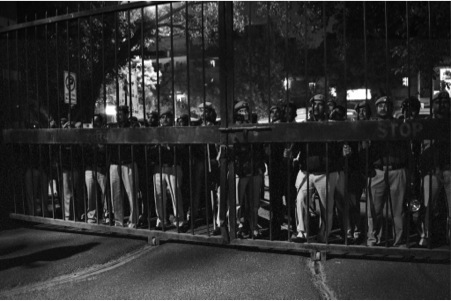
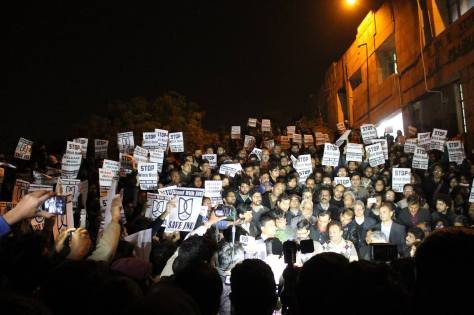
Restore Normalcy in JNU, Release All Detained Students, Delhi Police Quit JNU

12716438_10153221773131150_2421721007167708352_o
Students, Professors and Staff of JNU Stand Together in Protest on February 12, 2016 against the Police Action on Campus and the Assault on JNU by ABVP-BJP

In an unprecedented and draconian move, Delhi Police personnel entered the precincts of Jawaharlal Nehru University in Delhi yesterday afternoon, and began a search operation based on malicious complaints against ‘unnamed persons’ filed by a Delhi BJP leader in response to an event titled – ‘Country Without a Post Office’ – organized by some students to commemorate and protest against the execution of Afzal Guru on February 9th.

Continue reading Restore Normalcy in JNU, Release All Detained Students, Delhi Police Quit JNU

Arrest of Kanhaiya Kumar : A Short Summary of the law of Sedition in India

News reports are indicating that an FIR has been registered with respect to a public meeting organized on the JNU campus on the evening of 9th February. These reports claim that the meeting was about the hanging of Afzal Guru, and it is alleged that during its course, some people raised incendiary slogans. According to reports, the FIR has been registered under Section 124A of the Indian Penal Code (sedition), and the Police have already arrested one person.

It is important to note that under the Indian law of sedition, the events at the public meeting, even if completely true, do not even come close to establishing an offence. In Kedar Nath Singh’s Case, 5 judges of the Supreme Court – a Constitution bench – made it clear that allegedly seditious speech and expression may be punished only if the speech is an ‘incitement’ to ‘violence’, or ‘public disorder’. Subsequent cases have further clarified the meaning of this phrase. In Indra Das v State of Assam and Arup Bhuyan v State of Assam, the Supreme Court unambiguously stated that only speech that amounts to “incitement to imminent lawless action” can be criminalized. In Shreya Singhal v Union of India, the famous 66A judgment, the Supreme Court drew a clear distinction between “advocacy” and “incitement”, stating that only the latter could be punished.


Continue reading Arrest of Kanhaiya Kumar : A Short Summary of the law of Sedition in India

Farewell to Vidrohi: Pallavi Paul

Guest Post by Pallavi Paul

[ Rama Shankar Yadav ‘Vidrohi’, was a familiar figure for students, especially in Jawaharlal Nehru University in Delhi. He was a friend, a companion, a comrade, a mentor. Though rusticated many years ago from JNU, where he had been a student, for his participation in a  protest, he had never left the campus of JNU, and had become, over the years, a beloved feature of campus life. His visceral poetry, often heard at protest gatherings, was passed from person to person by word of mouth. A few days ago, he died while marching with his beloved student friends in a protest against cuts in education in Delhi.  Pallavi Paul, a filmmaker and artists, who made short films featuring Vidrohi, remembers him in this tribute..]

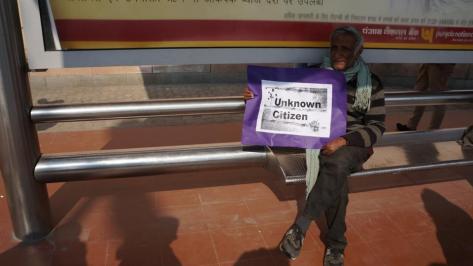
Unknown Citizen Vidrohi
Vidrohi as the ‘Unknown Citizen’ at a Protest to ‘Reclaim the Republic’ on 26 January 2013

Yesterday, as I was looking out a window of an old house in Ballygunge, Kolkata- my phone buzzed. I ignored it.  I was in the middle of telling a friend how happy I was to be away from Delhi for sometime. How the sights and smells of a different city were rejuvenating. The feeling of not having a ‘special connection’ with anyone or anything here felt liberating.

Much later, I opened the message from my friend Uday. ‘Vidrohiji passed away’, he wrote. Just three words.  In our conversations with him, Vidrohiji had often spoken about his death. We had revisited the scenario over and over again. Like a dream or a film – it had a grand setting. He had told us “Now that you are recording me, i know that i will say goodbye in the most glorious way possible. Very few people can say that about their death, while they are still alive.” On another day he had said to us, “As my fame has increased, so have the dangers. Now what i need is guarantee. Your records are guarantee against that largest threat of being killed. I say to my enemies, that if you want to kill me – then shoot me in the eyes. Because i will keep staring back at you till my last breath. Your records will help me stare back at them even after I am gone. “

Continue reading Farewell to Vidrohi: Pallavi Paul

An ‘Anti National’ Response from JNU to the ‘Nationalist’ RSS: Pratim, Gargi and Lenin

Guest Post by Pratim, Gargi and Lenin.

As writers, historians, scientists, film makers, poets, actors and others return their awards in protest against the rising intolerance and anti-rational climate in this country, we in JNU keep stocking up accolades of a different kind. These accolades are ones which are very generously gifted to us from the RSS and its affiliates. These accolades come in more than fifty shades, only highlighting the deep seated trouble that these folks have in seeing this University up to them, despite their attempts to tarnish it. A few days back the ever-so-absurd/islamophobic/irrational Subramaniam Swamy endowed JNU students with the honours of being ‘Jehadis’, ‘Naxal’ and ‘Anti-National’.

Continue reading An ‘Anti National’ Response from JNU to the ‘Nationalist’ RSS: Pratim, Gargi and Lenin

The Move to Professionalise Research: Aswathy Senan

This is a guest post by ASWATHY SENAN

Researchers all over the country are protesting the move by the UGC to scrap the non-NET fellowship and students have gathered in hundreds to resume their agitation at the UGC office through OccupyUGC. it appears that one should be clear about what the student reaction means: it is much more than as a demand for monetary benefits. The student mobilization happened after the committee that met at the UGC office in Delhi to discuss and increase the non-NET fellowship, decided to scrap it. Following the protests that lasted through the nights from 21 October, the Minister of Human Resources Development tweeted that the fellowship shall be continued leaving out one crucial detail: its availability to new students. This decision to end all financial support of researchers doing their MPhil and PhD until they qualify NET or JRF is a huge threat for the research community in India as this is a clear move to professionalise research and make it a mere add on to teaching career. Continue reading The Move to Professionalise Research: Aswathy Senan

The Murky Fourth Estate: Asifa Zunaidha

This is a guest post by ASIFA ZUNAIDHA.

[Some time ago, I wrote on Kafila about my experience of attending a televised interaction with HRD Minister Smriti Irani. The audience, packed with supporters of the particular party Irani belongs to, was set up in that debate as the neutral ‘public’, thereby killing two birds with one stone – boosting the popularity of the Minister on news media, and legitimising the news channel as a site of punchy political debate. We have below a similar case of manipulation of the powerful medium of electronic news media, this time by another channel.] 

What is the role of the news media in a society if not to disseminate information and opinions as an impartial media(tor)? ‘Half truth is no truth’ is a popular aphorism, but ‘selective’ truth is also a lie and certainly does not befit the content of a news channel. It seems that in an age of corporate media, one would be foolish to expect impartial truths, let alone ‘undiluted or uncensored’ opinion of diverse groups. A recent episode inside the JNU campus shows how ‘news’ presented by News Channels can be easily manipulated and the opinion of a ‘select few’ is showcased as the ‘unanimous opinion’ emerging from the premier higher educational institute of the country.

Continue reading The Murky Fourth Estate: Asifa Zunaidha

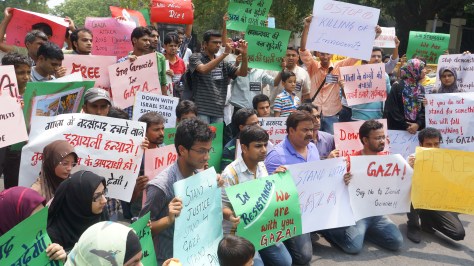
Delhi Police Prevents Peaceful Protest in Front of Israeli Embassy – Students, Others, Injured and Detained

A Tale of Two Protests, On Two Days.

Protests against the situation in Gaza have been held in Delhi yesterday, (Sunday, 13th July, and today, 14th July, in the morning). Yesterday, on Sunday morning, there was a peaceful protest in front of the Israeli Embassy – this came out of a call for protest by individuals. Yesterday, about a hundred odd people, including many young people, had gathered. I was present at this gathering. Some people made statements condemning the Israeli state’s aggression against the Palestinian people. The Delhi Police was present, but did not try to disrupt or disturb the protest. The protest happened right in front of the Israeli Embassy gates on Aurungzeb Road.

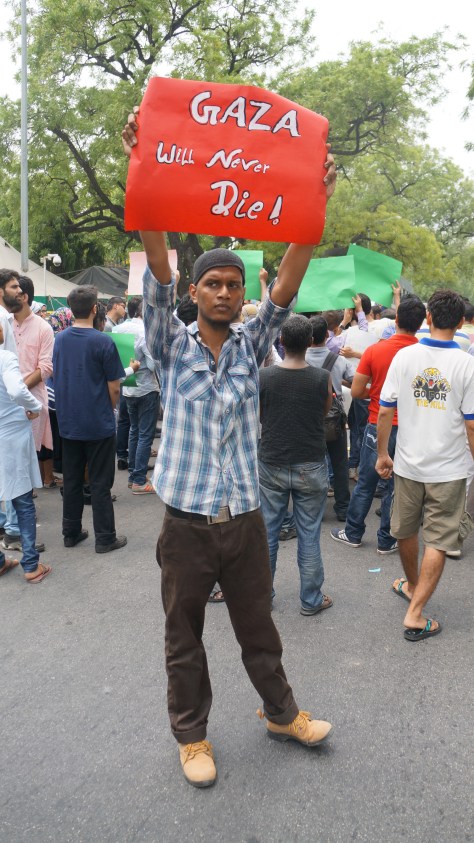
Protestor in front of the Israeli Embassy in Delhi on Sunday, 13th July 2014
Protestors with Signs against Israeli State's Aggression on Gaza, in front of the Israeli Embassy in New Delhi, 13th July, 2014
Protestors with Signs against Israeli State’s Aggression on Gaza, in front of the Israeli Embassy in New Delhi, 13th July, 2014

Continue reading Delhi Police Prevents Peaceful Protest in Front of Israeli Embassy – Students, Others, Injured and Detained