Tag Archives: Kashmir

Kolkata Rally against Killings & Mayhem in Kashmir: Dwaipayan Banerjee

Guest Post by Dwaipayan Banerjee

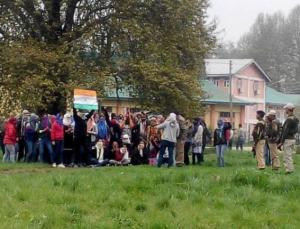
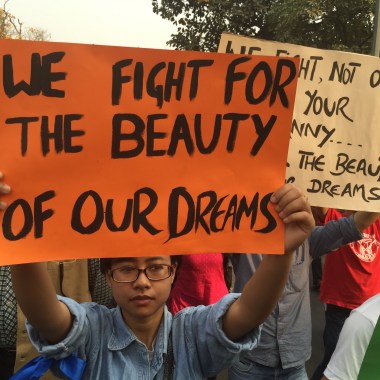
Close to five hundred people came out in a rally yesterday, 15th July, to protest the ongoing killings and mayhem in Kashmir by the Indian State. The overwhelming majority of participants were students, but they were joined in good numbers by feminists, queer-activists, trade union activists, writers, journalists, academics, human rights activists, dalit rights activists, cultural activists, with many among them not affiliated with any organisation. Student and youth activists carrying flags and placards of PDSF (Progressive Democratic Student Federation), USDF ( United Students Democratic Front), AISA (All India Students’ Association), Progressive Youth League (PYL) and many from other student-youth organisations were present in good numbers, so were human rights activists from APDR (Association for Protection of Democratic Rights) and those from Bastar Solidarity Network (BSN). Many carried with them their own banners and posters. Like the rally in Delhi, protesters carried with them hand-written, hand-painted and printed placards with the names of civilians recently killed in Kashmir inscribed on it, and through those posters a connection of shared pain and solidarity flowed from the streets of Kolkata to the turbulent and stormy blood-stained streets in Kashmir. Those posters were reaching out to the people of Kashmir with messages that they were not alone in their hour of sorrow, anguish and mourning. Some of the protesters had written verses by the Kashmiri poet Agha Shahid Ali on their posters. One of those many posters summed up the mood of the rally, ‘Kashmir belongs to Kashmiris’.


[ Video by Peoples’ Camera]

Continue reading Kolkata Rally against Killings & Mayhem in Kashmir: Dwaipayan Banerjee
Citizens’ Protest in Delhi Against Killings of Kashmiris by the Indian State

Several hundred people from all walks of life (Civil Rights Activists, Labour Activists,  Peace Activists, Feminists, Queer Activists, Advocates, Students, Workers, Artists, Writers, Academics, Filmmakers,Independent Left Activists, and unaffiliated individuals across generations, from Jammu & Kashmir, from Delhi, and from other parts of India) gathered this afternoon (July 13, 2016) for a silent protest march and meeting at Jantar Mantar, to protest against the last three days of brutal assault by police, paramilitaries and armed forces in the Kashmir valley that have left 35 dead, several blinded (especially due to the indiscrimnate use of pellet guns) and scores of people critically injured over the last three days.

The protestors at Jantar Mantar wore black bands, and carried signs condemning the state’s violence. The protestors carried signs with the names of each of the thirty six individuals who have been identified as having died over the last three days. Each sign identified a deceased person by name, the town or village they were from, and asserted that they “will not be forgotten“. In this way, this corner of India’s capital bore witness to each person, man, woman or child killed by the Indian state since troops began firing into protests that began to mourn the extra-judicial assassination of Burhan Wani three days ago.

This slideshow requires JavaScript.

Continue reading Citizens’ Protest in Delhi Against Killings of Kashmiris by the Indian State

The Killings in Kashmir: Kavita Krishnan

Guest Post by KAVITA KRISHNAN

An appeal to the conscience of every Indian citizen – to tune down the shrill media noise for a bit, take a step back from the easy, packaged ‘discourse’ being dished out, and ask try and ask ourselves some uncomfortable but necessary questions. 

I am being asked by various persons in the media to comment on my apparently ‘controversial’ and ‘shocking’ claim that Burhan Wani’s killing was extra-judicial’ and must be probed. Let me begin with a few remarks about this issue.

For most Kashmiris, it may not matter all that much whether or not Burhan Wani was killed in a ‘fake’ encounter or a ‘genuine’ one. What matters is that the Indian State killed him – just as it has killed and is killing so many other Kashmiri youngsters. Their grief, their rage, does not depend on the authenticity or otherwise of the encounter. They have no expectations of due process or of justice from the Indian State. It it civil liberties activists who – in what sometimes feels like an exhausting, futile exercise – demand that due process be followed, that the mandates of the Indian Constitution be respected, that the armed forces in conflict areas be held accountable.

Continue reading The Killings in Kashmir: Kavita Krishnan

Kashmir Burns, Again

A hundred and twelve lives, most of them young, some very young, were lost in Kashmir when the army, paramilitaries and police forces opened fire on several occasions from June to September in 2010. That was only six years ago. The latest reports indicate that around twenty three lives have already been lost in the last two days alone, in the aftermath of state troopers, soldiers and paramilitaries firing at funeral protests, after Burhan Wani, a twenty two year old insurgent, who had acquired the aura of a folk hero in Kashmir, was killed in an ‘encounter’, along with two of his associates, on Friday morning in a village in Kokernag.

Several more people have sustained serious injuries. The body count is likely to rise. Curfews have returned, phone and internet links are suspended, but nothing seems to keep people from spilling out onto the streets, and unlike previous instances, the communications ban seems to be unworkable. No one can pretend that Kashmir is not in crisis, again, today.

The people in power, at the state and the centre, were different in 2010. Omar Abdullah, then chief minister of Jammu and Kashmir, was offering mealy mouthed rationalizations for killing kids then, while Mehbooba Mufti, was weeping crocodile tears. It is the other way round right now. Omar is being ‘sensitive’, Mehbooba, who the roll of the dice has placed in the position of chief minister now, is ’sullenly’ presiding over a badly timed by-election victory. Prime Minister Manmohan Singh was silent then, Prime Minister Narendra Modi is playing percussion instruments in Africa now. If Nero played the harp while Rome burnt, Modi beats drums while Kashmir goes up in flames.

Continue reading Kashmir Burns, Again

Kashmir Under a State of Emergency: JKCCS

Guest Post by JKCCS : Jammu & Kashmir Coalition for Civil Society

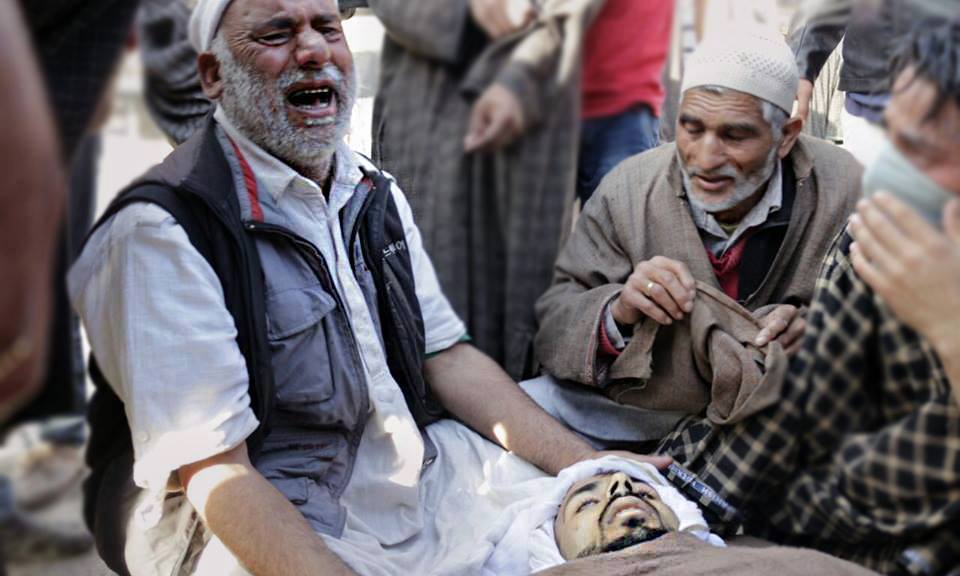
Since the extra-judicial execution of Commander Burhan Wani and two other members of Hizbul Mujahideen, Indian armed forces and Jammu and Kashmir Police have used excessive force to thwart the mourners from protesting and participating in the funeral processions of the slain militants. So far, around 17 civilians have been killed in Islamabad, Kulgam, Shopian and Pulwama districts, while as more than 350 people have been injured from across all districts of the Kashmir valley. There are reports that CRPF and Police have been involved in the destruction of movable and immovable properties. Curfew has been strictly imposed in all districts of Kashmir, but people are defying the curfew at various places.

It is shocking and painful that Indian armed forces have yet again unleashed terror on the mourners and protesters, resulting in massive civilian casualties. The police and armed forces appear to have free hand to kill, injure, torture and destroy property. The government of India and Jammu and Kashmir lack the will to institute a crowd control policy, which can ensure no or minimized civilian casualties. On the one hand armed forces are preventing the injured to be ferried to hospitals, at the same time senior police officials without any credible investigations have begun to accuse the dead and the injured for their own bloodshed. Additional Director General of Police, S.M. Sahai, yesterday in the press conference accused the protestors of looting the weaponry from the Police Station Damhal Hanjipora and then for using it against the police men. Government should reveal the names of those police personnel who were injured by the firearm used by the civilians and where are they being treated; otherwise Mr. Sahai claim is part of the regular government psy-ops. Continue reading Kashmir Under a State of Emergency: JKCCS

Kashmir IG Police Refuses to Speak with Handwara Minor Girl: JKCCS

Guest Post by Jammu & Kashmir Coalition  of Civil Society

Since last 3 days, JKCCS has been approaching the Inspector General (IG) of JK Police, Javed Geelani for a meeting in connection with the illegal detention of the minor girl and her family. Yesterday evening the Handwara minor girl spoke to JKCCS team on phone. She and her family informed that against their will the police has shifted them to a stranger’s house 15 kms from Handwara town. After detailed discussion JKCCS proposed her to call the IGP Kashmir and Chairperson of the State Commission for Women, Nayeema Mehjoor directly to inform them about her ordeal in the illegal police detention, her demand for free movement and an immediate access to her lawyers. 
The minor girl called the IG several times but only once he picked up the phone. After she identified herself, the IG cancelled the call. JKCCS team called DIG Ghulam Hassan Bhat and requested him to inform the IG that the minor girl wants to talk to him urgently. We were assured that the IG will speak to the girl. 

Immediately after that the police personnel went inside the house where the girl is detained and threatened her to not call the IG Kashmir, Javed Geelani.

The minor girl was able to speak to Nayeema Mehjoor and gave her detailed statement and requested her to facilitate her conversation with IGP Javed Geelani. Ms. Mehjoor promised to help.

The minor girl and her family wanted to communicate to the highest police officials that the police should stop her illegal detention and allow her to meet her lawyers so that she can herself alongwith her family proactively contribute in the legal struggle. 

The Difference between What They Tell Us and What We Know: Shehla Rashid

Guest Post by Shehla Rashid. Based on a Status Update on her Facebook Page.

They tell us that the military is meant for fighting the “terrorists”; But most of the time, it is the civilians who are killed.

They tell us that “special powers” for the army are necessary for national unity; But the army only teaches us how to hate India.

They say the University is anti-national because it wants to break India; But it’s the University that teaches us to love Indians.

Then, who is anti-national? Those who teach us how to hate India, or those who teach us how to love Indians?

Yes, we see the difference between India and Indians; India is at war with Indians throughout India.

I wish the Indian state could also see the difference between Kashmir, which it claims as its own, and Kashmiris who belong to no one; They claim to love Kashmir but hate and kill Kashmiris.

Continue reading The Difference between What They Tell Us and What We Know: Shehla Rashid

Shoot to Kill: Standard Operating Procedure in Kashmir

Nothing unusual has happened in Handwara. The Indian state has once again proved to be a killer  in Kashmir. Three people have lost their lives because the Indian armed forces and the J&K Police decided to defend themselves against people protesting against what they perceived to be a soldier’s harassment and molestation a Kashmiri woman.

Blood on the streets of Handwara
Blood on the streets of Handwara, Kashmir

The troops that defend India’s honour, unity and integrity and other such stuff have been trained to shoot to kill rather than answer a town’s questions about the sense of impunity that the Armed Forces Special Powers Act and the entire apparatus of a de-facto military occupation gives to Indian soldiers in the Kashmir valley. Lets stop pretending this is an exceptional situation, an excess, an anomaly, or even an instance of troopers going rogue. Whatever be the facts of the case, if the name the village of Kunan Poshpora, or of two women called Nilofar and Asiya mean anything to you, you will know that a predatory sexual profile is part of the operational signature of the Indian armed forces and local police in Kashmir.

Continue reading Shoot to Kill: Standard Operating Procedure in Kashmir

NIT and the Never Ending Story of Kashmir: Jagjit Singh

Guest post by JAGJIT SINGH

[The incidents in NIT Srinagar follow those in a number of universities and institutions of higher education and at one level, reflect a similar pattern. Yet, at another level, they – and the forces active behind them – play on a very different template of politics to achieve the same result. The story is similar and yet, radically different. The key dramatis personae are, understandably, the same. How do we make sense of what is happening in NIT Srinagar? Today’s Indian Express story by Nirupama Subramanian gives a sense of one part of the backdrop – life in NIT Srinagar before the incidents. The piece below gives us another sense of the larger history.]

NIT Srinagar non-Kashmiri students demonstrate
NIT Srinagar non-Kashmiri students demonstrate, image courtesy The Hindu

I remember when I was kid and was trying to make sense of a sport which looked very dull and boring but generated passions I had never seen in my hometown. Every time the game ends, the streets would be flooded by countless people with music and firecrackers and slogans in the background. Sometimes we could see fireworks even from our balcony, and some other times we would be locked inside our homes. Only thing we knew was ‘situation is tensed outside’. The game was Cricket and my hometown was Jammu. Jammu has always been RSS’s stronghold, and there are two Muslim-majority areas in Old City, Jammu. The whole tension surrounded these two areas only. Even that time slogan shouting was the test of your love for your country. The more violent and high-pitched your slogan is the more cheers you receive from the crowd. Continue reading NIT and the Never Ending Story of Kashmir: Jagjit Singh

Nation and its Violences: Sanjay Kumar

Guest Post by Sanjay Kumar

Violent thoughts and deeds are increasingly getting justified in the name of Indian nation. A mob of lawyers has attacked students, teachers and journalists, right in the middle of a court complex in the national capital. Leaders of these patriotic lawyers were later caught bragging on camera about how they will next time throw bombs on anti-nationals. A young woman in Delhi has received emails and face book posts threatening her with acid attack and sexual assault, because she happens to be a sister of Umar Khalid, one of the organisers of the JNU programme, during which according to police anti-India slogans were raised. The mere being of this woman, and her defence of her brother, is enough of a provocation for many men and women of the country to justify the threat of ultimate male violence against women. Another man, Mr Adarsh Sharma put posters in the central district of the capital announcing an award of Rs 11 lakh for anyone who kills Mr Kanhaiya Kumar, the president of  the JNUSU, charged with sedition. Mr Sharma claims that his ‘blood boiled’ when he saw Mr Kumar’s much publicised speech after his release on bail. The popular movie Pyasa (1957) of Gurudutt had a song ‘Jinhen Naz hai Hind par vo kahaan hain’, which used the reality of social degradation to question celebrations of the nation. Sahir’s poem worked because it asked Indians to look at themselves in the mirror of public morality of the recently independent India. That mirror has been cracked for long. With the brazenly violent now claiming that their violence and threat to violence should really be the pride of the nation, we are now witnessing the final shattering of that mirror. Continue reading Nation and its Violences: Sanjay Kumar

Rebellion as Contagion

IMG_2231

Perhaps this is the infection, the gangrene, that Justice Pratibha Rani fears: a slogan, chanted in the streets of Srinagar as a matter of routine, finds an opening at a university campus in New Delhi. Freed from the usual suspects, unmoored from the routine skirmishes, deaths, and encounters, along the Line of Control, the slogan floats through a university corridor – distracting rows of disciplined students from their academic pursuits.

A slogan’s explosive power, it seems, is not just about what is shouted – but rather where it appears, and who takes up the call. This realisation offers us an opportunity, long sought, to think through this troubling question of “Freedom of Expression.” Read the rest of this piece here

A Conversation about the Meaning of the word ‘Azadi’ (‘Freedom’) in the Wake of Events at JNU

Signal to Noise Ratio

There has been a lot of talk about what exactly ‘Azadi’ (freedom) means, especially in the wake of Kanhaiya Kumar’s post release midnight speech at JNU on the 4th of March. So lets talk some more. No harm talking. If there is noise, there must also be a signal, somewhere.

Kanhaiya Kumar clarified in his electrifying, riveting speech that his evocation of Azadi was a call for freedom ‘in’ India, not a demand, or even an endorsement of a demand for freedom ‘from’ India.

This may come as a sigh of relief to some, – Kanhaiya , the man of the moment, proves his ‘good’ patriotic credentials, leading to an airing of the by now familiar ‘good nationalist vs. bad nationalist’ trope. And everyone on television loves a nationalist, some love a good nationalist even more.

Perhaps this was a way of dealing with a bail order that was at the same time a gag order.

[ P.S. : Since writing this last night, a more careful reading of the bail order has suggested to me that the actual terms of bail are not so bad after all. Bail is in fact granted, as far as I can see, fairly unconditionally. Kanhaiya is not asked, for instance, to step down from his position in the students’ union, nor are restrictions placed on his movement and activity. So in technically legal sense, the bail provisions need not be interpreted in a tightly restricted manner. The egregious political hortations, the references to infection, antibiotics, amputation and gangrene, which are over and above the legal instructions, are indeed terrible, but operationally, they have no executive authority backing them.]

But to say just that the text of the bail order is what shaped Kanhaiya’s midnight speech would be ungenerous, and miserly, especially in response to the palpably real passion that someone like Kanhaiya has for a better world, and for a better future for the country he lives and believes in. I have no doubt about the fact that coming as he does from the most moderate section of the Indian Left (the CPI – well known for their long term affection for the ‘national bourgeoisie’ despite the national bourgeouisie’s long term indifference/indulgence towards them), Kanhaiya is a genuine populist nationalist patriot [I have corrected ‘nationalist’ to ‘patriot’ here in response to the criticism and suggestion held out by Virat Mehta’s comment – see below in the comments section] and a democrat moulded as he says, equally by Bhagat Singh and Dr. Ambedkar. There is a lot to admire in that vision, even in partial disagreement. And while some may not necessarily share his nationalism, this does not mean that one has to treat it with contempt either. I certainly don’t.

Continue reading A Conversation about the Meaning of the word ‘Azadi’ (‘Freedom’) in the Wake of Events at JNU

Caste, sedition, oppression: JNU round-up

Earlier this week, I tried to join the many dots of violence at universities into a coherent pattern. My central contention is:

Spirited resistance in campuses across the country suggests the politics of India’s youth are more fluid and assertive than expected. The mid-1990s empowerment of historically oppressed castes, narratives of economic aspiration from the 2000s and an instinctive suspicion of authoritarianism have come together to forge a bold poetic new politics of desire that has befuddled even ruthless and astute politicians like the prime minister.

and

Modi’s government uses outdated laws, a pliant police force and Hindu student organizations as a battering ram to crush this awakening, exacerbating the discord between a prime minister determined to stamp his authority on an unruly nation and students enraptured by a thrilling moment of unlikely solidarities that could define their generation.

Read the rest of the piece here:

Statement on the Events at HCU and JNU From Faculty of the Tata Institute of Social Sciences


We, the undersigned, are deeply shocked and dismayed by the processes that led to the suicide of Rohith Vemula at HCU in January and the ongoing attacks on students and faculty of JNU. At Hyderabad Central University, RohithVemula a Dalit research scholar was labelled as anti-national and driven to suicide in January through systematic persecution. At Jawaharlal Nehru University (JNU), New Delhi over the past few days, Kanhaiya Kumar, the President of the JNU Students Union is held in police custody on the trumped up charge of sedition. On February 15, 2016, the police stood by as mute spectators while a group of lawyers and hooligan elements attacked students and faculty of JNU who had gone to the Patiala House courts in Delhi in solidarity with Kanhaiya Kumar who was to be produced there. Continue reading Statement on the Events at HCU and JNU From Faculty of the Tata Institute of Social Sciences

Solidarity with JNU and Conversations on Kashmir: JKCCS

Guest Post by Jammu Kashmir Coalition of Civil Society

Jammu Kashmir Coalition of Civil Society (JKCCS) expresses its solidarity with the striking students and teachers of Jawaharlal Nehru University, New Delhi. We have watched with a sense of horror and dismay, the violent criminalizing of student democracy and dissent, not just at Jawaharlal Nehru University but across Indian campuses in the recent past. Having long and intimate knowledge of violent repression and legalized impunity that Indian state is capable of, especially against those it considers ‘anti-national’ we are not surprised by these events, but have a special empathy with all who suffer its horrors. We demand the release of all student dissenters and political prisoners in the custody of the Indian state, and an end to acts of policing and surveillance on campuses, and targeting of students on the basis of political beliefs and speech.

The Kashmiri students in different colleges and universities in India, who have always faced discrimination and intimidation time to time, are now feeling the extreme regressive and oppressive means used by right wing groups and the government. After being hounded, Kashmiri students have begun leaving Delhi. There are several places where the landlords, in whose properties Kashmiri students were renting flats, have asked the students to vacate. These experiences of Kashmiri students are part of the larger reality faced by Kashmiri youth in Jammu and Kashmir and in India. The voices of dissent in Jammu and Kashmir have been dealt with administrative detentions under Public Safety Act, illegal detentions, torture, surveillance and killings by armed forces including the most recent one of Asif and Shaista at Pulwama on 14th of February.

We also view with alarm, the reports about the cynical use of Kashmiri students studying in Delhi as hostages in the politically illegitimate process of government formation in Srinagar.

We are dismayed that the public narrative about the recent events has often descended into disputes over Indian ‘patriotism’ and the shrill condemnation of a few ‘fringe’ ‘radical’ ‘traitors’ for ‘irresponsible’ slogans. These sentiments are neither mere slogans nor represent the ‘fringe’ in Kashmir, the very place they were made in reference to. As Kashmiris, we believe that the right to self-determination is inseparable from the right to political association, dissent and free expression, and these rights cannot be selectively asserted or upheld. In the competitive public proclamations of nationalistic credentials, what has been lost is that courageous act of defiant solidarity with the Kashmiri people’s struggle for justice and self-determination, that lies at the heart of these debates. Despite the disavowals and the state repression, the solidarity with the political rights of the Kashmiris is growing and spreading, as events in Jadavpur University demonstrate. We acknowledge the emerging spaces in Indian civil society to converse on the question of Kashmir, beyond nationalist framings. We hold out hope for future alliances with students, groups and individuals willing to engage in honest conversations, in which they alone do not determine the boundaries of what can or cannot be said, thought or felt.

Spokesperson
JKCCS

अता मोहम्मद खान के लिए दो मिनट का मौन

एक ‘कब्र खोदनेवाले’ के जनाज़े में इतने लोग शायद पहले कभी नहीं जुटे हों। अलबत्ता पिछले दिनों जब 75 साल की उम्र में अटटा मोहम्मद खान का इन्तक़ाल हुआ, तब यही नज़ारा दिख रहा था।
उत्तरी कश्मीर के सीमावर्ती शहर उरी के चहाल बिम्बयार गांव के निवासी रहे अटटा मोहम्मद खान ने अपने घर में ही अंतिम सांस ली थी। लम्बे समय से वह अस्थमा से पीड़ित थे। सोचने की बात थी कि ऐसे शख्स के लिए इतने सारे लोग क्यों मातम में थे ?
असल बात यह है कि वह कोई मामूली ‘कब्र खोदनेवाले’ नहीं थे। वह कश्मीर के रक्तरंजित इतिहास के एक ऐसे साक्षी थे, जिन्होंने अपनी रेगिस्तानी आंखों में बहुत कुछ समेट कर रखा था। वह कश्मीर की सिविल सोसायटी में चर्चित चेहरा थे, जबसे उन्होंने सूबे में फैली अचिन्हित कब्रों (unmarked graves) को ढंूढने में इन संस्थाओं की सहायता की थी। और जब हुक्मरानों की तरफ से बुलावा आया तो किसी से बिना डरे खुल कर वह सबकुछ बयां किया था। कुछ साल पहले राजधानी से निकलने वाले एक अंग्रेजी अख़बार /’Tragedies buried in Kashmir’  , मेल टुडे ने 28 मार्च, 2008/ ने जब कश्मीर में दफनायी गयी इन तमाम त्रासदियांे को उकेरना चाहा, तो अनाम, अचिन्हित कब्रों की अपनी रिपोर्ट में अट्टा मोहम्मद खान से भी की गुफतगू शामिल थी। वर्ष 2013 में उन्होंने अपना बयान निबंधों की एक किताब में दर्ज किया था, जिसका संकलन स्थानीय पत्रकार फहद शाह ने किया था।

Continue reading अता मोहम्मद खान के लिए दो मिनट का मौन

Occupational Hazard- Militarisation and Disaster Vulnerability in Jammu and Kashmir: J&K Coalition of Civil Society

Guest post by JAMMU AND KASHMIR COALITION OF CIVIL SOCIETY 

Jammu and Kashmir Coalition of Civil Society recently released a report called ‘Occupational Hazard: The Jammu Kashmir Floods of September 2014. The full report is available at jkcss.net. The following is a short executive summary. 

The Jammu and Kashmir floods of September 2014, occurred in the most densely militarized occupied territory in the world, located in one of its most ecologically fragile– the Western Himalayan region—called the ‘third pole’ for its enormous glacial reserves of fresh water. Warfare, armed conflict and prolonged occupations are widely considered among the most environmentally destructive activities known to mankind. Yet the role of the massive military deployment, and the militarised governance structures of Jammu and Kashmir has not received much attention in this analysis. The military occupation of J and K has included the expropriation, and weaponization of huge areas of land, the building of large scale permanent military installations, and the creation of militarised infrastructure in the ecologically fragile Himalayas, which have contributed directly to the region’s disaster vulnerability. The occupation of civic amenities, public buildings and community spaces has also had a direct impact on emergency preparedness, evacuation and humanitarian response. Using official documents, news reportage, case studies, and oral narratives, the report explores the causes and impacts of the flooding, and local community responses, in terms of survival, rescues and relief. It also presents an analysis of the dominant media framing of the disaster, and the local resistance to media narratives of the militarised humanitarianism of the Indian occupying forces. This report thus raises questions of accountability, governance, media representation, political participation and democracy in the backdrop of a militarised occupation, at the disputed borders of a security state.  Continue reading Occupational Hazard- Militarisation and Disaster Vulnerability in Jammu and Kashmir: J&K Coalition of Civil Society

Storm in a Kahwa Cup: Organizers of the Kashmiri Food Counter at the International Food Festival, JNU 2015

Guest Post by Organizers of the Kashmiri Food Counter at the International Food Festival, JNU 2015

Universities are supposed to be the centers of free inquiry, speech and expression. However, in the recent months universities and other democratic spaces have been under attack from right wing fascist elements across India. University authorities under the influence of right wing forces have increased surveillance on sections of students and have started to monitor and control campuses. As a premier institute of learning Jawaharlal Nehru University (JNU) has always has preserved its democratic culture and has resisted such attacks tooth and nail. However, in recent days even JNU is experiencing pressures from the right wing fascist forces.

Every year, JNU organizes an International Food Festival (IFF) where students from diverse cultures and nations displaying their flags come together to offer global cuisines. This year on 20thJanuary, a group of students from Kashmir booked a counter at the IFF. After completing necessary formalities and depositing security amount the festival organizers allotted space for Kashmir food counter along with the Tibet food counter. However, International students association (ISA), body that organizes the festival started receiving threats from the ABVP goons. The president and other members of the organization were harassed and intimidated. The organizers received open warnings from ABVP threatening them with disrupting the festival in case Kashmiris were allowed to open their food counter. International students who organize the festival were threatened with legal action and deportation. Just two days before the festival the booking for Kashmiri food counter was cancelled by the organization. Continue reading Storm in a Kahwa Cup: Organizers of the Kashmiri Food Counter at the International Food Festival, JNU 2015

“Haider” – Hamlet in Kashmir: Suhas Munshi

This is a guest post by SUHAS MUNSHI

The challenge of telling stories of a conflict is its victims. Each, traumatized in their own way, needs their own story. The narrator is bound to fail not only those he didn’t include but those who didn’t see their stories recreated faithfully. Had Basharat Peer set himself the task of faithfully adapting the violence done to Kashmiris he would have had to script a pornographic narrative for the screen. Some of the bile directed at him from Kashmiris comes from a dissatisfaction of not depicting the true extent of the brutality of the Indian army and rendering its casualties adequately pitiful. An opinion piece written on the movie in ‘The Parallel Post’ titled ‘Setting the wrong precedent’ condemns torture scenes in the movie as having actually undermined the actual extent of army atrocity in Kashmir. The piece goes on to say, ‘army excesses wane out by the time movie reaches its climax.’

However, the only service that a story teller from Kashmir could do to art and to humanity is to depict the people living there, especially the victims, as humans; as people, just as they are found anywhere else in the world, and not continue to peddle the cliché of the valley being a dehumanized pastoral paradise. Accusations of betrayal, conceit and condescension are being hurled at Basharat Peer, the writer, when he has got, for the first time ever, the words ‘plebiscite’, ‘half-widows’ and the rousing call of ‘Azadi’ in a script, through a movie, on mainstream cinema. Continue reading “Haider” – Hamlet in Kashmir: Suhas Munshi

हैदर: नैतिक दुविधा का बम्बइया संस्करण


“एकतरफा,स्त्री विरोधी और अतिसरलीकृत सपाटदिमागी… रूपात्मक और सौन्दर्यात्मक दृष्टि से भी ‘हैदर’ एक लचर और बोरिंग मसाला फिल्म है जो बहुत लंबी खिंचती है.”

कायदे से दर्शन के युवा अध्येता ऋत्विक अग्रवाल की इस समीक्षा के बाद ‘हैदर’ के बारे में और कुछ  नहीं कहना चाहिए. लेकिन ‘हैदर’ देखकर चुप रहना भी तो ठीक  नहीं.

दिल्ली के पी.वी.आर रिवोली सिनेमा हाल में ‘हैदर’ देखना यंत्रणादायक अनुभव था. हाल में काफी  कम दर्शक थे. ज़्यादातर युवा थे. फिल्म शुरू हुई और कुछ देर आगे बढ़ी कि फुसफुसाहटें तेज़ होने लगीं.फिर वह दृश्य आया जिसमें हैदर का चाचा उसकी माँ के साथ ठिठोली कर रहा है.और किसी हास्यपूर्ण प्रसंग की प्रतीक्षा में बैठी जनता ने हँसना शुरू कर दिया. विशाल भारद्वाज ने सोचा होगा कि वे एक बहुत तनावपूर्ण दृश्य रच रहे हैं जिसमें हैदर में हैमलेट की आत्मा प्रवेश करती है.जनता ने इसमें ‘कॉमिक रिलीफ’ खोज लिया. ध्यान रखिए,फिल्म में अभी कुछ देर पहले इस औरत के पति को फौज उठा ले गई है और उसका घर उड़ा दिया गया है!फिर तो जगह-जगह हँसी का फौवारा फूट पड़ता था. चाहे सलमान खान के दीवाने दो सरकारी मुखबिरों का दृश्य हो या हैदर को प्यार करने वाली अर्शी का कश्मीरी उच्चारण हो! लोग जैसे हंसने के लिए तैयार बैठे थे और कोई मौक़ा हाथ से जाने न देना चाहते थे . मैंने सोचा कि फिल्म आगे चलकर दर्शकों को शर्मिन्दा कर देगी और खामोश भी. लेकिन वह न होना था,न हुआ. आख़िरी हिस्से में जहाँ बर्फ पर कब्र खोदते हुए बूढ़े नाटकीय ढंग से गा रहे हैं, फिर हँसी छूट पड़ी. बिलकुल अंत में जब इखवानियों और इन बूढों के बीच गोली-बारी हो रही है, एक बूढा उसी गीत को गाता है और हाल में हँसी तैरने लगती है. Continue reading हैदर: नैतिक दुविधा का बम्बइया संस्करण

Unwrapping the Soldier from the Flag – Kashmir after the Flood: Chirag Thakkar

Guest Post by Chirag Thakkar

Witnessing a culture of wounds trying to put itself together in times of a grave catastrophe is a difficult pursuit. For the archivist of State violence, the horror with which TRP-hungry television studios build a spectacle that is acutely wedded to a deep-rooted, pungent nationalism around catastrophe and relief in Kashmir, is frustrating. The insensitivity with which the Indian media has rubbed salt in the wounds of a people is appalling. One wonders if ours is a culture of calculated amnesia or of sightless apathy.
There is something very unique about the way in which we relate with the pain of the other. What is unique is the precision with which we reproduce perceptions about the masculine, hardened sons of soil – the security forces – and yet, at the same time, remain unmoved in failing to recognise the state of exception Kashmir has been in. What is also unique is how measured and stingy we are with our sympathy. Continue reading Unwrapping the Soldier from the Flag – Kashmir after the Flood: Chirag Thakkar