Tag Archives: sedition

I am a Muslim, an Atheist, an Anarchist: Salmaan Mohammed

Guest Post by Salmaan Mohammed

[ Salmaan Mohammed, a twenty five year old philosophy student was arrested in Thiruvananthapuram on 19 August 2014 for sedition, and for allegedly dishonouring the national flag and national anthem. The complaint against him originated as a response to his refusing to stand while the national anthem was played in a cinema during a screening. Salman is currently out on bail, but still faces the prospect of a life term in prison if he is found guilty of sedition by the judicial process. We at Kafila have been in touch with Salman and he has recently sent us a translation of an audio interview he did after coming out of prison on bail so that the world outside Kerala (and those who do not read or speak Malayalam) can understand what he has been thinking.]

Continue reading I am a Muslim, an Atheist, an Anarchist: Salmaan Mohammed
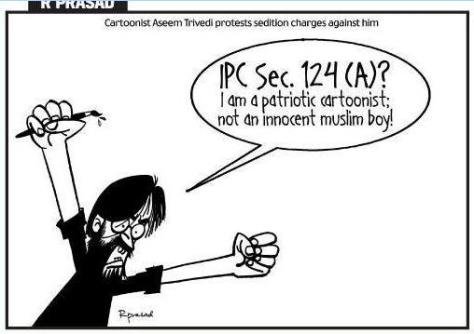
Sedition? Who, me?

I am taking the liberty of sharing here this brilliant cartoon by R PRASAD of Mail Today

We Are All Seditious Now

Zero tolerance for democracy – Kudankulam, Omkareshwar, Aseem Trivedi

Which of these three images brings dishonour to India?

This one?

The full coercive force of the state slams down on villagers who have been so far peacefully protesting the location of a nuclear power plant in Kudankulam, Tamil Nadu.

Charges of sedition have been laid on hundreds of protesters in Kudankulam.

The women of Kudankulam wrote recently in a moving message to their fellow citizens:

When we carried the dead body of democracy and burnt it in the outskirts of our village on Aug 15th, 2012, little did we realize that so soon we would witness the real death of democracy. As this last nail is being tightened on our lives, we realize how insignificant has been our voice. But this has only strengthened our vow to be together.

(Read the latest update from Kudankulam below)

Continue reading Zero tolerance for democracy – Kudankulam, Omkareshwar, Aseem Trivedi

Flashreads for Free Speech: Readings for 14 February

Let this 14 February be Free Speech Day – the text below comes to us via NILANJANA S. ROY; for more, see Akhond of Swat or follow #flashreads on Twitter. Flashreads are being organised across India – see Facebook event page.

Poster by Sanjay Sipahimalani


THE IDEA: To celebrate free speech and to protest book bans, censorship in the arts and curbs on free expression

WHY FEBRUARY 14? For two reasons. In 1989, the Ayatollah Khomeini issued a fatwa ordering the death of Salman Rushdie for writing the Satanic Verses. In GB Shaw’’s words: “Assassination is the extreme form of censorship.” Continue reading Flashreads for Free Speech: Readings for 14 February

Blasphemy, Sedition, Democracy

Have you ever wondered?

Why does our media get so worked up when someone in Pakistan is accused of or convicted for blasphemy but is not overly perturbed when someone is charged with or convicted for Sedition in India?

Is this differentiated response occasioned by the belief that a modern state should overlook things like blasphemy but give no quarter to sedition?

Do anti-Blasphemy laws encroach upon Individual freedom while anti-sedition laws protect national interests? Is convicting someone for blasphemy essentially undemocratic but doing the same for sedition not so?

Let’s for the time being leave these major issues aside and engage ourselves with more mundane issues. Continue reading Blasphemy, Sedition, Democracy

Un-Indianizing Kerala: How to defend K K Shahina

Like the unseasonal and tenebrous rain clouds that are hovering over Thiruvananthapuram in what should be a sunny, light-mist-adorned January, a pall of gloom, of impending danger, hangs around my everyday life in Kerala. This is not a general feeling. It is however shared by many of us who write and speak critically about the powers that be. The space to speak and write thus has been shrinking for a while now, but now there is a sense of dangerously teetering on the edge: the Indian state seems to be upon us, and with a vengeance. Continue reading Un-Indianizing Kerala: How to defend K K Shahina

Suddenly Sanyal: The Many Arrests of Narayan Sanyal

First published in The Hindu

Narayan Sanyal is a 74-year-old man with white hair parted to one side and fibromatosis in both hands. His arrest memo notes that he wears dentures, has spots on his body and smokes cigarettes. “My health is not going well, arthritis is a new thing catching up, age is telling,” he writes in a letter addressed to a ‘Dear friend V’. This letter and two others became crucial evidence in the conviction last week of Mr. Sanyal, Kolkata businessman Pijush Guha and eminent doctor and human rights activist Binayak Sen.
Behind their conviction lies a curious paradox to which the Chhattisgarh police has never given a satisfactory answer: Why was Mr. Sanyal — whose Maoist connections led to charges against the co-accused in the first place — himself never charged with sedition or conspiracy to wage war or even with belonging to or supporting an unlawful organisation until well after Dr. Sen’s arrest under those serious offences?

Continue reading Suddenly Sanyal: The Many Arrests of Narayan Sanyal

Silence as Sedition

A true measure of being democratic is not the cycles of elections – it is the dignity given to disagreement, to dissent. Why must we dignify dissent? There are the arguments that we hear everyday: so that the views of the majority cannot silence the voices of a few; so that no one view or institution may becomes so dominant as to become authoritarian; and the value of freedom of speech and expression in and of themselves. Any memory of the Emergency in 1975-77 is testimony to why any of these are important. Yet there is a more fundamental reason why dissent is the cornerstone of a democracy: it is the action of a free citizen.

Speech is an action. An action within a democratic framework – an action that simultaneously shows a continuous faith in the polity, the state and the people even as one (often virulently) disagrees with it. An action that keeps a democratic system alive. You dissent as a citizen, in the name of your constitution. You dissent because you have the freedom to do so – not a freedom you have been “given” but one that you possess because you, as part of the people, are sovereign. This is more important than what we are taught in our textbooks – being able to voice our disagreement is as central as the ability to walk to a ballot box and cast our vote. This is a freedom we give to each other as democratic citizens and that we must protect, especially when we disagree.

Continue reading Silence as Sedition

A Case of Conscience: Shiv Viswanathan writes to Manmohan Singh on the conviction of Binayak Sen

This open letter by SHIV VISWANATHAN has been circulated by Communalism Combat

Dear Professor Manmohan Singh,

I hope you don’t mind the temerity of this letter. It is written as one scholar to another, one citizen to another. I know you are a PM and people like me may not be influential. However some things must be said and said clearly.

I was aghast to find that Doctor Binayak Sen has been given a life term for sedition. Let me put it simply. I think it is an appalling act of injustice and a betrayal of an ethical vision.  Continue reading A Case of Conscience: Shiv Viswanathan writes to Manmohan Singh on the conviction of Binayak Sen

On sedition: Sarim Naved

In this guest post, SARIM NAVED gives a chronological account of sedition in Indian law, and discusses the procedural aspects laid down for a magistrate to take cognisance of sedition

After the 1857 revolt, the Press Act of 1857 which prohibited all publications, without licensing, was passed. This Act known as Lord Canning’s Act  applied to all kinds of publication, including books in all languages and other printed papers in all languages. 1860 saw the enactment of the Indian Penal Code, which remains in force today in a relatively unchanged manner. The Indian Penal Code, while not directly dealing with the press, does incorporate provisions that impinge upon and regulate the activities of the press. The code dealt with issues ranging from offences against a person’s body or property to criminal breach of trust to offences like defamation and obscenity that directly concerned editors.  In the words of Rajeev Dhavan, “It was a comprehensive code. Not all these provisions were directed against free speech but virtually all could be used against it.” Amendments were later introduced to bring in the offence of sedition in 1870, the offence of promoting enmity between classes in 1898, the offence of outraging religious feelings in 1928 and imputations or assertions prejudicial to national integration, which were added by the government of independent India in 1972. Continue reading On sedition: Sarim Naved

Clamping down on the dissenting voice

Part 3 of a 3 part series by SIDDHARTH NARRAIN. First published on The Hoot.
 

While the Supreme Court’s decision lay to rest the debate on the scope and constitutional validity of the sedition law, the life of the sedition law is entangled with that of political dissent in the country. A brief search for reported High Court and Supreme Court cases on sedition gives us an indication of the kinds of situations where the sedition law is commonly used.

For instance, in 1967, the government prosecuted Ghulam Rasood Choari, the editor of an Agra based Urdu weekly called Ehsas for exhorting the Muslims of the country, especially the Muslims of Kashmir to violence against the government and bringing the readers of the paper into ‘hatred’ and contempt and dissatisfaction with the government (Ghulam Rasool Choari v. The State 1968 CriLJ 884).

Continue reading Clamping down on the dissenting voice

How Sedition crept into the constitution: Siddharth Narrain

Part 2 of a 3 part series by SIDDHARTH NARRAIN. First published on The Hoot

While in their Draft Constitution, the Constitutional Framers included ‘sedition’ and the term ‘public order’ as a basis on which laws could be framed limiting the fundamental right to speech (Article 13), in the final draft of the Constitution though, both ‘public order’ and sedition were eliminated from the exceptions to the right to freedom of speech and expression (Article 19 (2)).Commenting on this omission many years later, Justice Fazl Ali said: 

The framers of the Constitution must have therefore found themselves face to face with the dilemma as to whether the word “sedition” should be used in article 19(2) and if it was to be used in what sense it was to be used. On the one hand, they must have had before their mind the very widely accepted view supported by numerous authorities that sedition was essentially an offence against public tranquillity and was connected in some way or other with public disorder; and, on the other hand, there was the pronouncement of the Judicial Committee that sedition as defined in the Indian Penal Code did not necessarily imply any intention or tendency to incite disorder.

Continue reading How Sedition crept into the constitution: Siddharth Narrain

We are all seditious now, but when did this start?

I am afraid that unlike in Sholay, where the reply to Gabbar’s question and in our time, the reply to Nivedita’s question would have to be more than ‘Do sarkar’. But regardless of the rather large numbers, given the extreme nervousness which prompts a law like sedition, hopefully, they will still return to the sarkar, khaali haath.

As a part of the We Are All Seditious series, I am posting three guest posts written by SIDDHARTH NARRAIN which provides us with an overview of the history and the politics of sedition law in India.

These posts have been hosted by The Hoot, a highly recommended site for keeping track of the media in India. The first in the series looks at three major trials,  Gandhi’s trial and those of Tilak and Shiekh Abdullah. Continue reading We are all seditious now, but when did this start?

Kitne aadmi the? We are all seditious now

Here is a very short, utterly incomplete, hastily compiled list of people charged under Section 124 A in the last two years alone.

Our very own Shuddhabrata Sengupta figures  in this roll of honour.

(Incidentally, KK Shahina, who has guest posted with us, faces charges from the Karnataka Police under IPC 506 for intimidating witnesses. Her expose in Tehelka showed how the police case against Abdul Nasar Madani, head of the People’s Democratic Front (PDP), accused in 2008 Bengaluru blasts, was fragile and based on non-existent and false testimonies.)

There would be hundreds more, not named here, charged with sedition for “criticizing” the government, for exposing corruption and police nexus with mafias, or for expressing views that run counter to official wisdom on the “integrity” of India.

As if “integrity” is something pre-existing and eternal rather than something that has to be produced at every point. The existence of a nation is a daily plebiscite, said even historian Ernst Renan, a staunch supporter of the nation form. Not so Rabindranath Tagore, who was highly suspicious of the “fetish of nationalism”. He called the Nation nothing but the “the organization of politics and commerce” and warned that when this Nation “becomes all-powerful at the cost of the harmony of the higher social life, then it is an evil day for humanity.” (In his lectures on nationalism, published by Rupa and Co. 1994) Continue reading Kitne aadmi the? We are all seditious now

Minutes of the seminar on ‘Azadi: The Only Way’

(Shuddhabrata Sengupta has written eloquently his account of the day-long seminar, ‘Azadi: The Only Way’. The seminar was organised by the Committee for the Release of Political Prisoners. Given below are CRPP’s minutes of the seminar. You can also see, on YouTube, two short videos showing the ruckus that some Kashmiri Pandits created before Syed Ali Shah Geelani was to speak (1, 2). Also on YouTube, in two parts (1, 2), is Arundhati Roy’s speech, for which some want her booked for sedition. Those on Facebook can also see most of SAS Geelani’s speech (1, 2, 3). A small part of Geelani’s speech is on Youtube, here. Those hurling abuses at Roy and Geelani would do well to read this text, see these videos, and engage with these ideas intellectually, instead of asking for individuals to be jailed and persecuted.)

Continue reading Minutes of the seminar on ‘Azadi: The Only Way’

The Restitution of the Conjugal Rights of the State

Despite the many thoughtful critiques of the relationship between family and the state, I have always found it a little surprising that there is very little commentary on the relationship between two strange legal fictions. The first is the idea of the restitution of conjugal rights (RCR), and the other is sedition. The restitution of conjugal rights basically consists of the right of a spouse to demand that his or her- though more often his than her- spouse cohabit with him after she has ‘withdrawn from his society’. Away from the misty world of legal euphemisms, we all know what this means: that you can be forced to sleep with a somewhat less than pleasant person against your wishes. A legal commitment to love in a marriage is a serious thing indeed which only warns us that we must proceed with such a choice very carefully.

But like many marriages, the question of choice is somewhat restricted for many people- as is indeed the case of the choice of loving your country. After all isn’t sedition a crime of passion, and the punishment of an offence of the withdrawal of love for your nation. It is interesting to see that while treason in Sec. 121 of the IPC is about the waging of war against the state, sedition is about a forced love. It is about the creation of ‘disaffection’. As Nivedita Menon points out in her post, disaffection means “the absence or alienation of affection or goodwill; estrangement”.

A legal commitment to love your nation is also a serious thing indeed, and what then is the punishment of sedition if not, the restitution of the conjugal rights of the state?

Sedition: ‘The highest duty of a citizen’

Sedition: the attempt “to excite disaffection towards the Government established by law in India”, a crime under Section 124 A of the Indian Penal Code, a provision introduced by the British colonial government in 1860.

The only revisions to this colonial legal provision since its passing have been over the years, to remove anachronistic terms like “Her Majesty”, “the Crown Representative”, “British India”, “British Burma” and “Transportation for life or any shorter term”.

But it seems “Disaffection towards the government”, the archaic usage notwithstanding, is a timeless crime. Section 124A, therefore, these few cosmetic changes apart, has remained unchanged for the last 150 years.

Continue reading Sedition: ‘The highest duty of a citizen’

Sedition provision gags free speech: Barun Das Gupta

This is a guest post by BARUN DAS GUPTA

The detractors of Arundhati Roy have found a fresh casus belli against her for her recent speech (Oct. 21) in New Delhi, on Kashmir. The participants in the polemics include such intellectuals as Swapan Dasgupta, a journalist and a BJP leader. The burden of their criticism is that Arundhati should be arrested for sedition because by her speeches she has caused hatred and disaffection towards the Government and actually championed the secession of a part of India, that is, Jammu and Kashmir.

Let us examine this matter of “creating hatred and disaffection” towards the Government, not from the legal point of view but from the political point of view. Section 124A of the Indian Penal Code says: “Whoever brings or attempts to bring in hatred, contempt or excites disaffection towards the Government shall be punished ……” Before proceeding further, let us note that the concerned section speaks of “disaffection towards the Government”, without specifying whether by “Government” the Central Government is meant or the State Governments. Since there is no explanation, it may be inferred that “Government” means both Central and State Governments. Continue reading Sedition provision gags free speech: Barun Das Gupta

Azadi: The Only Way – Report from a Turbulent Few Hours in Delhi

Dear Friends,

I was present and speaking a few hours ago at a meeting titled ‘Azadi: The Only Way’ on the situation in Jammu and Kashmir, organized by the Committee for the Release of Political Prisoners at the Little Theatre Group in Delhi yesterday (21st October). I was not present from the beginning of the meeting as I was traveling from another city, but can vouch for what occurred from around 4:30 pm till the time that the meeting wound up, well after 8:00 pm in the evening.

The meeting took place in the packed to capacity auditorium of the Little Theatre Group on Copernicus Marg at the heart of New Delhi. Several speakers, including the poet Varavara Rao, Prof. Mihir Bhattacharya, Sujato Bhadra, Gursharan Singh, Mr. Shivnandan (?) an activist from Jammu, Professor G.N.Saibaba, Professor Sheikh Showkat Hussain – Professor of Law, Srinagar University, the journalist Najeeb Mubaraki, Dr. N. Venuh of the Naga Peoples Movement for Human Rights, the writer Arundhati Roy and myself spoke at the meeting. (I may be missing out some names, for which I apologize, but I was not present for a part of the meeting, at the very beginning) The climax of the meeting was a very substantive and significant speech by Syed Ali Shah Geelani of the Hurriyat Conference (G), which spelt out the vision of liberation (Azaadi) and Justice that Syed Ali Shah Geelani held out before the assembled public, of which I will write in detail later in this text.

Continue reading Azadi: The Only Way – Report from a Turbulent Few Hours in Delhi