Male Dominance, Exploitation and Hypocrisy in Malayalam Film Industry: Interview with Shakeela by Dalit Camera

Guest post. SHAKEELA interviewed by DALIT CAMERA

[With English translation of transcript also by Dalit Camera]

DC: In the early 2000’s, your movies were very popular while those of mainstream heroes were flops. At that time, the government places several restrictions on your movies. What is your response to that?

Shakeela: Even I have watched the movies of these big stars. They have the just as much “glamour” scenes. However, they have termed only my movies as soft porn, A-film, Shakeela movies, bit movies, etc. That is because Kerala, in particular, is a male dominated society. Therefore, their domination is very evident. Men are given preference. Even if girls study well, they are never encouraged. In such a place, can they accept a woman from another state achieving such high status? Yes, it true. There were several problems.

Continue reading Male Dominance, Exploitation and Hypocrisy in Malayalam Film Industry: Interview with Shakeela by Dalit Camera

An Open Letter to the President of India – Please take sexual harassment seriously

STATEMENT BY CONCERNED CITIZENS

It is shocking that the Hon’ble Visitor appointed Prof Bidyut Chakrabarty to the Executive Council of JNU on 8 October 2015 and his name now features as a candidate for the prestigious position of the Vice Chancellor of the University of Delhi, if this is accurately reported in the media. [1] Both these positions—either as a Vice Chancellor or as a nominated member in an Executive Council of a University—demand impeccable record of academic excellence and integrity. However, it would appear that a record of sexual harassment does not impact the process of appointments in Universities.

It is well known that a sexual harassment case was made by an employee of Gandhi Bhawan on 4.4.07 against the Director, Prof Bidyut Chakrabarty. The Delhi University Apex Committee on Sexual Harassment vide its report that was tabled and accepted by the Executive Council Resolution No 114 dated 8.10.07 resolved that:

  1. A letter of warning be issued to Prof Bidyut Chakrabarty.
  2. He should be asked to step down from the Directorship of Gandhi Bhawan.
  3. He should be debarred from holding any administrative post in the University for a period of three years.

Prof Chakrabarty was removed from the position of Director, Gandhi Bhawan, Head of the Department of Political Science and Dean, Faculty of Social Sciences. Continue reading An Open Letter to the President of India – Please take sexual harassment seriously

Evening out the Odds, Learning from the BRT Fiasco

The Chief Minister of Delhi has come out with a very practical idea, an Idea, whose time has come as the American would say. Anyone who says that Delhi’s air is a killer is only putting it mildly. The number of those dying of respiratory ailments on a daily basis stands today at 23, this translates to 161 per week, 644 per month and 7728 per year. The figures were half this 4 years ago.

Even if pollution levels do not worsen in future the cumulative effects of exposure to these high levels of pollution will keep pushing up the death rate and increasingly it will be the kids born today who will grow into wheezing asthmatics, inhaling this deadly cocktail of pollutants increasingly becoming unfit, as they grow, for doing anything that calls for even mild exertions. The resultant costs on medical expenses incurred by their families, in the face of the rapid withdrawal of government spend on public health will assume the shape of a horror movie gone real and it can only get worse unless something is done and done fast. Read the full article, published in Catch News, here

Beyond Trumpism and Rumpism- Thoughts on People Against Fascism in Kerala

The so-called People Against Fascism (PAF), a meeting at Kochi last weekend, will be remembered perhaps as the first open enunciation of neocon anti-Muslim rhetoric in Kerala. This is important considering the fact that even the Hindutva rightwing here is yet to draw on this virulent discourse. The terrible – and sadly laughable- irony is that it is the self-styled social and political radicals who claim that it is a move against Hindutva politics. Continue reading Beyond Trumpism and Rumpism- Thoughts on People Against Fascism in Kerala

गाय के नाम पर जनतंत्र वध

हिंगोनिया गोशाला, जयपुर के प्रभारी मोहिउद्दीन चिंतित हैं। जयपुर म्युनिसिपल कॉरपोरेशन द्वारा संचालित इस गोशाला में नौ हजार से अधिक गायें रखी गई हैं। इनमें 30 से 40 गायें लगभग हर रोज मर रही हैं, मगर कोई देखने वाला नहीं है। वहां न इनके खाने-पीने का सही साधन है, न ही बीमार गायों के इलाज का कोई उपाय। लिहाजा, 200 से अधिक कर्मचारियों वाली इस गोशाला में गायों की मौत पर काबू नहीं हो पा रहा है। वैसे, एक अखबार के मुताबिक अप्रैल में अकेले जयपुर शहर में हर रोज 90 गायों की मृत्यु हुई, जिनकी लाशें हिंगोनिया भेज दी गईं।

याद रहे, राजस्थान देश का पहला राज्य है जहां स्वतंत्र गोपालन मंत्रालय की स्थापना की गई है। लेकिन जयपुर में प्रति माह 2,700 गायों की मौत के बावजूद इस मसले पर मंत्री महोदय कुछ भी कर नहीं पाए। दरअसल असली मामला बजट का है। मोदी सरकार ने सामाजिक क्षेत्रों की सब्सिडी में जबर्दस्त कटौती की है, जिसका असर पशुपालन, डेयरी तथा मत्स्यपालन विभाग पर भी पड़ा है। पिछले साल की तुलना में इस साल 30 फीसदी की कटौती की गई है। Continue reading गाय के नाम पर जनतंत्र वध

Release Santosh-Somaru! Enact protection law for journalists, Repeal CSPSA: Statement of Solidarity

Statement of Solidarity for journalists’ movement in Chhattisgarh

We extend our unconditional support to the journalists’ movement proposed on December 21, 2015 in Jagdalpur district of Chhattisgarh demanding the enactment of a protection law for scribes and immediate release of two reporters Santosh Yadav and Somaru Naag, who were arrested in September and July this year in fabricated cases and charged under Chhattisgarh Special Public Security Act (CSPSA). We have seen a surge in the attack on right to freedom of expression in recent times where journalists have been intimidated, bullied and even killed in different parts of the country. This has raised questions over legitimacy of democratically elected governments and is threatening the basic principles of democracy. Continue reading Release Santosh-Somaru! Enact protection law for journalists, Repeal CSPSA: Statement of Solidarity

More than 500 jhuggis demolished in Shakur Basti, slum dwellers left on their own to grapple with bone chilling winter.

Report by BIGUL MAZDOOR DASTA

IMG_20151214_095246

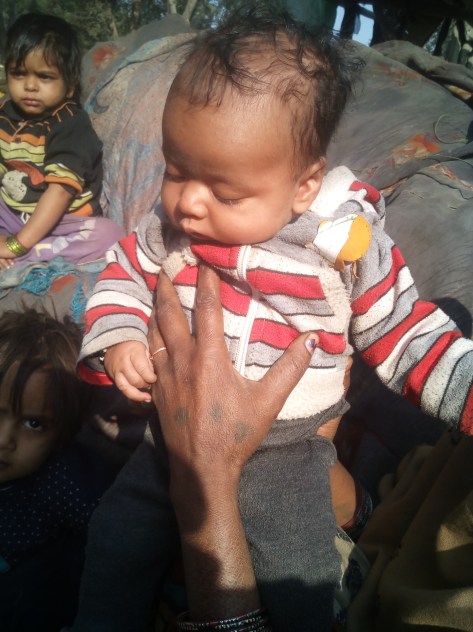
More than 500 jhuggis have been demolished by the Railways in Shakur Basti, Delhi. The demolition took place on last Saturday leading to the death of a six month old child, leaving many injured and an odd 10,000 people homeless in the chilling Delhi winters. The Railway minters Suresh Prabhu is allegedly shocked and unaware. Mr Kejriwal took to twitter to condemn the demolition. Ajay Maken of congress too condemned the demolition. On Monday Rahul Gandhi briefly visited the razed down site where once the shanties stood and thats that! All these electoral political parties have even made what is a tragedy and a very difficult time for the slum dwellers an opportunity of mud slinging onto each other which also doesn’t come as a surprise.

Continue reading More than 500 jhuggis demolished in Shakur Basti, slum dwellers left on their own to grapple with bone chilling winter.

Why media is creating such a panic about juvenile : Kishore


Guest Post by Kishore

Date of a release of the juvenile involved in “Nirbhaya” rape case is coming close and media is once again has started its vicious campaign against juveniles. It is the same media that declared the juvenile most brutal without any basis. Later they were exposed by statement by chief investigation officer that final charge sheet filed by police did not say that juvenile was most brutal. Some of them did a small story in inside pages to rectifying their mistake of calling him most brutal in headlines for months.

Media and certain section of society are very concerned about the prospective threat posed by Juvenile involved in so called “Nirbhaya” rape case. He will be released on 15th December and many sections of the media are “worried” that what if again he commits crime and poses threat to the society. Same papers are not bothered as what happened in last three years to rehabilitate reform and reintegrate him in the society. Same papers did not raised questions if government has made any individual care plan for him with a long term plan to rehabilitate him. May be they were sure that nothing had been done. In fact they believe that nothing can be done and best option is to keep him in jail for life. They are just waiting that he will come out and commit another crime again so they can say that “we told you earlier” Continue reading Why media is creating such a panic about juvenile : Kishore

Three Years Later – Women Struggle for Justice and Freedom from Fear: Statement on the eve of December 16th

Statement by women’s groups, students’ groups, progressive groups and individuals

As 2015 comes to a close, we remember the tumultuous times in December 2012 when thousands of people – young and old – poured into the streets of Delhi in pain, rage and outrage. This was, of course, in the aftermath of the brutal gang rape and assault on a young woman that eventually led to her tragic death. That it occurred in the heart of Delhi, the capital of the country, is a shocking truth that people demanded and the government pledged to change.

Yet, in the three years since December 2012, women continue to face violence in every space they occupy, including their own homes, in public places, on public transport and at workplaces. There have been many attacks on women and girls, some accompanied by huge media coverage, but most taking place away from the public glare. Violence is the weapon used to keep them “in their place” on the basis of their identities, including caste, class race, religion and dis/ability.

These range from sexual assaults and rapes and even murder of adivasi women and girls in Bijapur, Chhattisgarh, by CRPF men; on Muslim women in Muzaffarnagar, Uttar Pradesh; on Dalit women in Haryana, on women from Northeast India, either in their own states or in the places they move to in search of brighter opportunities.

Women occupying workplaces in the informal and formal sectors are facing increasing levels of backlash. From women working in fields, mines or inside homes, on construction sites or tending roadside stalls, to women working in corporate offices, non-governmental organisations, educational institutions, law offices or in the media, countless cases bear testament to the systematic sexual harassment they face at workplaces. While some have taken courage to file cases against their perpetrators, the severe consequences that have had to face from the media and the courts for speaking out are a matter of deep concern. Continue reading Three Years Later – Women Struggle for Justice and Freedom from Fear: Statement on the eve of December 16th

डा अम्बेडकर के नये मुरीद

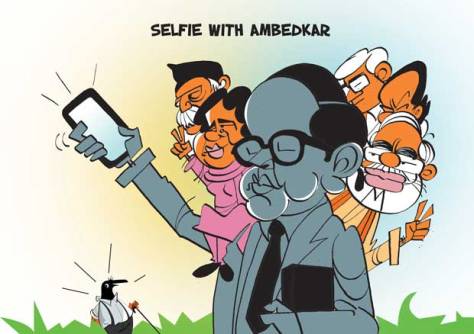
selfie with ambedkar

(Image : Courtesy – http://www.tehelka.com)

शोषित-उत्पीड़ित अवाम के महान सपूत बाबासाहब डा भीमराव अम्बेडकर की 125 जयन्ति के बहाने देश के पैमाने पर जगह जगह आयोजन चल रहे हैं। इसमें कोई दोराय नहीं कि वक्त़ बीतने के साथ उनका नाम और शोहरत बढ़ती जा रही है और ऐसे तमाम लोग एवं संगठन भी जिन्होंने उनके जीते जी उनके कामों का माखौल उड़ाया, उनसे दूरी बनाए रखी और उनके गुजरने के बाद भी उनके विचारों के प्रतिकूल काम करते रहे, अब उनकी बढ़ती लोकप्रियता को भुनाने के लिए तथा दलित-शोषित अवाम के बीच नयी पैठ जमाने के लिए उनके मुरीद बनते दिख रहे हैं।

ऐसी ताकतों में सबसे आगे है हिन्दुत्व ब्रिगेड के संगठन, जो पूरी योजना के साथ अपने अनुशासित कहे जानेवाली कार्यकर्ताओं की टीम के साथ उतरे हैं और डा अम्बेडकर – जिन्होंने हिन्दु धर्म की आन्तरिक बर्बरताओं के खिलाफ वैचारिक संघर्ष एवं व्यापक जनान्दोलनों में पहल ली, जिन्होंने 1935 में येवला के सम्मेलन में ऐलान किया कि मैं भले ही हिन्दु पैदा हुआ, मगर हिन्दू के तौर पर मरूंगा नहीं और अपनी मौत के कुछ समय पहले बौद्ध धर्म का स्वीकार किया /1956/ और जो ‘हिन्दु राज’ के खतरे के प्रति अपने अनुयायियों को एवं अन्य जनता को बार बार आगाह करते रहे, उन्हें हिन्दू समाज सुधारक के रूप में गढ़ने में लगे हैं। राष्टीय स्वयंसेवक संघ (RSS) के मुखिया जनाब मोहन भागवत ने कानपुर की एक सभा में यहां तक दावा किया कि वह ‘संघ की विचारधारा में यकीन रखते थे’ और हिन्दु धर्म को चाहते थे।

इन संगठनों की कोशिश यह भी है कि तमाम दलित जातियां – जिन्हें मनुवाद की व्यवस्था में तमाम मानवीय हकों से भी वंचित रखा गया – उन्हें यह कह कर अपने में मिला लिया जाए कि उनकी मौजूदा स्थितियों के लिए ‘बाहरी आक्रमण’ अर्थात इस्लाम जिम्मेदार है। गौरतलब है कि मई 2014 के चुनावों में भाजपा को मिली ‘ऐतिहासिक जीत’ के बाद जितनी तेजी के साथ इस मोर्चे पर काम चल रहा है, उसे समझने की जरूरत है।

प्रस्तुत है दो पुस्तिकाओं का एक सेट: पहली पुस्तिका का शीर्षक है ‘ंहेडगेवार-गोलवलकर बनाम अम्बेडकर’ ( http://www.isd.net.in/Publication/Booklet/2015/Booklet-66.pdf) और दूसरी पुस्तिका का शीर्षक है ‘ हमारे लिए अम्बेडकर’। (http://www.isd.net.in/Publication/Booklet/2015/Booklet-67.pdf)

पहली पुस्तिका में जहां संघ परिवार तथा अन्य हिन्दुत्ववादी संगठनों द्वारा डा अम्बेडकर को समाहित करने, दलित जातियों को मुसलमानों के खिलाफ खड़ा करने, भक्ति आन्दोलन के महान संत रविदास के हिन्दूकरण तथा छुआछूत की जड़े आदि मसलों पर चर्चा की गयी है। वहीं दूसरी पुस्तिका में दलित आन्दोलन के अवसरवाद, साम्प्रदायिकता की समस्या की भौतिक जड़ें आदि मसलों पर बात की गयी है। इस पुस्तिका के अन्तिम अध्याय ‘डा अम्बेडकर से नयी मुलाक़ात का वक्त़’ में परिवर्तनकामी ताकतों के लिए डा अम्बेडकर की विरासत के मायनों पर चर्चा की गयी है।

Simply for Making Speeches Some Go to Jail in Kerala: Nasarudheen Mannarkkad

This is a Guest post by NASARUDHEEN MANNARKKAD

In a democracy, it is beyond argument that court procedures should  be accountable and transparent. If the courts start to give its verdicts relying upon the false made up stories of police and the media influenced by its own make-believe ‘public opinion’, that spells disaster for democracy. There is nothing more dangerous than a manipulated and biased court verdict and that can be fatal to the public trust in the judiciary, which is the only claim for an unelected body to be credible before the nation. Continue reading Simply for Making Speeches Some Go to Jail in Kerala: Nasarudheen Mannarkkad

Observing Human Rights by Defending Food Rights of Dalit-Bahujans and Muslims: Sudarshan, Osmania University

Guest post courtesy DALIT CAMERA

[On 10th December 2015 Osmania University students celebrated Beef festival to mark Human Rights Day in a novel fashion. BJP MLA Raja Singh few days before stated he would kill or get killed to protect the cow. It is strange because the Osmania Uuniversity students had only said they would eat beef which is already available in the market, they never said they would kill cow, but the BJP/VHP was spreading rumours that OU students are killing cow. Print and Electronic media gave a full coverage for the BJP/VHP activists). With threats pouring in from different corners (Police, Judiciary, Administration) OU students organized the Beef festival, and in their support EFLU, TU, UoH organized beef festival. Most importantly TVV organization ate beef in Delhi Red Fort.

Why did OU students hold the Beef festival? Here we present an interview of Sudarshan, key organizer of the Beef Festival in OU for the larger public. The interview was conducted and transcribed by Dharma Teja.]

Continue reading Observing Human Rights by Defending Food Rights of Dalit-Bahujans and Muslims: Sudarshan, Osmania University

The ‘Pinga’ Controversy, Caste and Subversion: Sneha Gole

Guest Post by SNEHA GOLE

Recently the song ‘Pinga’, from Sanjay Bhansali’s ‘Bajirao Mastani’ went online on YouTube and the song has given rise to a tide of criticism,  mostly from self-professed ‘Puneris’ and ‘Maharashtrians’. Much of the criticism is aimed at what is perceived as the lack of authenticity of the song – that it is unlikely that Kashibai and Mastani would dance together, that the costumes worn by the actresses in the song are historically inappropriate, that a queen would not wear such revealing clothes and dance like an ‘item girl’ along with a ‘courtesan’ etc. While I am in no ways arguing that the song is historically accurate and I can understand the discomfort of those arguing against the song, the tone of much of that writing is troubling to say the least.

While accusing the director of stereotyping, much of this writing is working from an assumption that equates Maharashtrian to Bramhin. One of the posts even talks about how “no Maharashtrian lady would be caught bobbing her head like that” (emphasis mine). Which Maharashtrian women are we talking about? There is also a distinct racist tinge to the criticisms, with a few posts commenting on Priyanka Chopra’s ‘dusky’ skin as unsuitable for Kashibai (with her fair, delicate, ‘Chitpavan’ looks)! Continue reading The ‘Pinga’ Controversy, Caste and Subversion: Sneha Gole

Reflections On The Limitations Of The Call For Full Criminalisation Of Marital Rape: Madhu Mehra

Guest Post by MADHU MEHRA

I will critically discuss the campaign for (full) criminalisation of marital rape to call attention to ways by which this campaign reduces a potentially tranformatory agenda on gender, sexuality and marriage, to one of law, crime and punishment. There is no denying that there is widespread sexual and other forms of intimate partner violence against women within marriage (including marital rape), and the absolute necessity of criminalizing such violence. Yet, the campaign for criminalsing marital rape is troubling – in terms of the aspects it selectively probelematises as harmful to women and aspects relating to sexuality and marriage that it is completely silent on. It is also problematic for privileging the criminal law remedies, over non-punitive interventions which require a broader engagement with concerns related to marriage and sexuality that are equally hurtful to women.

Let us first summarise the legal position on marital rape. Continue reading Reflections On The Limitations Of The Call For Full Criminalisation Of Marital Rape: Madhu Mehra

Farewell to Vidrohi: Pallavi Paul

Guest Post by Pallavi Paul

[ Rama Shankar Yadav ‘Vidrohi’, was a familiar figure for students, especially in Jawaharlal Nehru University in Delhi. He was a friend, a companion, a comrade, a mentor. Though rusticated many years ago from JNU, where he had been a student, for his participation in a  protest, he had never left the campus of JNU, and had become, over the years, a beloved feature of campus life. His visceral poetry, often heard at protest gatherings, was passed from person to person by word of mouth. A few days ago, he died while marching with his beloved student friends in a protest against cuts in education in Delhi.  Pallavi Paul, a filmmaker and artists, who made short films featuring Vidrohi, remembers him in this tribute..]

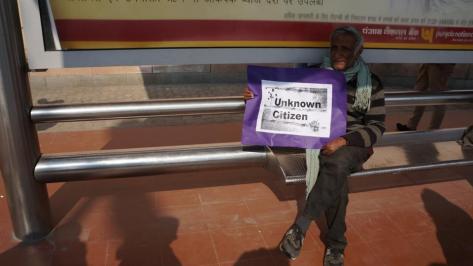
Unknown Citizen Vidrohi
Vidrohi as the ‘Unknown Citizen’ at a Protest to ‘Reclaim the Republic’ on 26 January 2013

Yesterday, as I was looking out a window of an old house in Ballygunge, Kolkata- my phone buzzed. I ignored it.  I was in the middle of telling a friend how happy I was to be away from Delhi for sometime. How the sights and smells of a different city were rejuvenating. The feeling of not having a ‘special connection’ with anyone or anything here felt liberating.

Much later, I opened the message from my friend Uday. ‘Vidrohiji passed away’, he wrote. Just three words.  In our conversations with him, Vidrohiji had often spoken about his death. We had revisited the scenario over and over again. Like a dream or a film – it had a grand setting. He had told us “Now that you are recording me, i know that i will say goodbye in the most glorious way possible. Very few people can say that about their death, while they are still alive.” On another day he had said to us, “As my fame has increased, so have the dangers. Now what i need is guarantee. Your records are guarantee against that largest threat of being killed. I say to my enemies, that if you want to kill me – then shoot me in the eyes. Because i will keep staring back at you till my last breath. Your records will help me stare back at them even after I am gone. “

Continue reading Farewell to Vidrohi: Pallavi Paul

The Pocso Act: A Quick Review: Srishti Agnihotri and Minakshi Das

Guest post by SRISHTI AGNIHOTRI and MINAKSHI DAS

On the 30th of November 2015, Shri Rajiv Chandrashekhar, a Member of Parliament, spoke at an Open House on ‘Why we need to start talking about Child Sexual Abuse and protect our children’. With the enactment of the Protection of Children from Sexual Offences Act in 2012, and rising awareness among civil society groups, there is an unprecedented momentum regarding protecting our children from sexual abuse. Issues that were earlier being brushed under the carpet, are now being openly addressed. We thought this was a good time to talk about the progress of the POCSO Act. Has it lived up to its promise? What more do we need to do to make this legislation effective in the fight against sexual violence?

The Protection of Children from Sexual Offences Act (‘POCSO Act’) was enacted in the year 2012 with the aim to protect children from sexual offences, such as, sexual assault, sexual harassment and pornography. This Act also provides for the establishment of special courts for trial of child sexual abuse matters. In the past decade, India has recorded an alarmingly high level of sexual assault cases on children. While, the Government of India has made a sincere attempt to address the issue of sexual exploitation of children through the POCSO Act, the impact of the legislation remains to be seen. Continue reading The Pocso Act: A Quick Review: Srishti Agnihotri and Minakshi Das

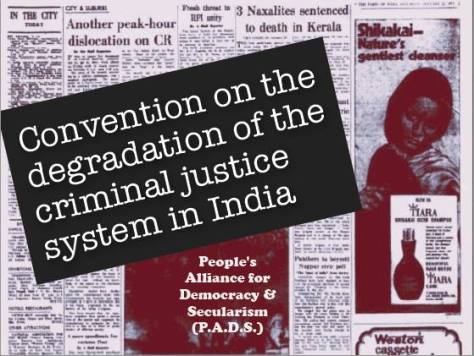
Convention on the Degradation of the Criminal Justice System in India

Guest Post by People’s Alliance for Democracy and Secularism (P.A.D.S.)

convention

People’s Alliance for Democracy and Secularism
Invites You to a Convention on
Degradation of Criminal Justice System
A fair, transparent and functional criminal justice system is essential for any democracy. It is necessary for the basic security of citizens, and also for creating conditions under which citizens can live a life of freedom. Unfortunately India’s criminal justice system has been undergoing a prolonged process of corruption by dominant class and caste interests. Rather than upholding justice in a fair and symmetric manner, it is often seen to be working for the powerful and the rich. After the victory of the BJP in the general elections of 2014, the communal manipulation of institutions of justice and police has been intensified. Within weeks of the election, selective leaks were made to derail Gopal Subramanium’s elevation to the Supreme Court. Earlier this year Public Prosecutor Ms Rohini Salian revealed that she was pressurized to soften the case against members of Hindutva terror groups accused in the Malegaon blast. Retired Sessions Judge Jyotsana Yagnik, who convicted Gujarat minister Maya Kodnani and Babu Bajrangi in the Naroda Patiya massacre case was targeted with threatening phone calls and letters. Prosecution witnesses in several such cases, including the 2007 Samjhauta Express bombing case, have been changing their statements. Such incidents indicate a systematic political attempt to undermine the autonomous functioning of the criminal justice system by pressurizing or otherwise influencing the police, investigating agencies, public prosecution and the judiciary.
Why is there such a big gap between the liberal and social-democratic promises of the Constitution of India and the reality of the criminal justice system? What specific dangers do the majoritarian and authoritarian politics of the Hindutva forces present to this system? How can democratic forces counter this process of degradation? The Convention is a means of starting a long-term debate and a program of advocacy for an impartial system of criminal justice.
Dec 12-13, 2015
Gandhi Peace Foundation, D. D. U. Marg, New Delhi
The link for facebook event is https://www.facebook.com/events/1496545783979881/ .

Ambedkar For Our Times!

( Till 1992, 6 th December was remembered as ‘Parinirvan Divas’ of Dr Ambedkar, legendary son of the oppressed who had clearly recognised the true meaning of Hindutva and warned his followers about the dangers of Hindu Rashtra ; post 1992, 6 th December has an added meaning and it relates to the demolition of Babri Mosque undertaken by these very forces.

Apart from the fact that this event led to the biggest communal conflagaration at the national level post-independence, whose repercussions are still being felt and whose perpetrators are still roaming free, we should not forget that it was the first biggest attack on the principles of secularism and democracy, which has been a core value of the Constitution drafted under the Chairmanship of Dr Ambedkar.

What follows here is an edited version of the presentation made at Dept of Social Work, Delhi University, during their programme centred around 1 st Ambedkar Memorial Lecture)


“If Hindu Raj does become a fact, it will no doubt, be the greatest calamity for this country. No matter what the Hindus say, Hinduism is a menace to liberty, equality and fraternity. On that account it is incompatible with democracy. Hindu Raj must be prevented at any cost.”

– Ambedkar, Pakistan or Partition of India, p. 358

‘Indians today are governed by two ideologies. Their political ideal set in the preamble of the constitution affirms a life of liberty, equality and fraternity whereas their social ideal embedded in their religion denies it to them’

– Ambedkar

Continue reading Ambedkar For Our Times!

Moving With Darkness: Rekha Revathy

Guest Post by REKHA REVATHY

A so-called normal person may sometimes wonder how blind people like myself travel to work or move about in other public places like railway stations, bus stands, airports and roads. Large numbers of blind people also travel as commuters in metro trains in Mumbai as well as in buses and local trains, autorikshaws and other transport. They face many difficulties, big and small, in their travel. Some are comfortable with their daily commuting because they have adjusted to the conditions which they have endured for long. Some blind people always take the help of an escort during such travels. But finding an escort daily is not easy and also, what if a blind person depends on his/her colleague in office or a friend to travel to school or work daily, if on any day that colleague or friend is not able to come, then he/she becomes helpless. And in such situations they will be put to a new challenge of reaching their destination in time by themselves. And of course, moving to a different place or a new place is much more difficult for a blind person.

Moving about at the work place is less challenging than traveling in buses or trains for the blind, although there are still difficulties like climbing the stairs, locating their seats, keeping things in their place, going to the dining room, using the wash room and so on. But there are blind people who do all these things without any sighted help because they have adapted to their environment. But it also takes some time. Any changes made in the premises puts them in confusion – changes such as construction of a new counter, changing the positions of chairs tables etc, fitting of a new door or changing the positions of water jars. It is also a fact that blind people cannot always find a person to help them out in their work places. And sometimes they end up injuring themselves. Continue reading Moving With Darkness: Rekha Revathy

Holding Kings to Ransom – Royal Women in Matrilineal Kerala: Manu Pillai

[Below is an edited excerpt from Manu S.Pillai’s forthcoming book from Harper Collins, The Ivory Throne: Chronicles of the House of Travancore. The book throws interesting light on gender and political power in the matrilineal royal houses, and offers tantalizing hints about the pre-colonial roots of brahminical patriarchy in the region. The exclusion of women from full political power seems to have begun here in the 18th century, from the time of the much-revered modernizer Marthanda Varma, and colonial power seems to have built its patriarchal structures on it. Nevertheless, the memory of women ruling as full potentates — Queens – and not as Queen-Mothers, remained in popular memory and indeed surfaced in the early twentieth century in Travancore. These were of course times in which modern politics was taking shape and modern gender was becoming a taken-for-granted truth.

Manu’s book retells the story of the transition of the female ruler in Travancore from Queen to merely the Queen-Mother in fascinating detail.]
Continue reading Holding Kings to Ransom – Royal Women in Matrilineal Kerala: Manu Pillai

Armed Forces as livelihood and State power: Gautam Navlakha

Guest post by GAUTAM NAVLAKHA

Notwithstanding popular perception, professional soldiers do not join the armed services out of overwhelming ‘patriotism’. They are in fact driven by the desire to get a job that offers material security for them and their family. It is predominantly their own livelihood needs that drives people to enlist. On the other hand, the main objective of any government’s concern is to keep the morale of such professional soldiers high, so that they would go out and fight anyone as directed by the government, whether it is ‘enemies’ outside the nation’s borders or within – conducting the predatory war for ‘development’ which profits the corporate class or suppressing popular movements.

More than 101 Districts out of 680 in India are notified as ‘Disturbed Area’ where the military forces enjoy immunity from prosecution and exercise extraordinary authority. In addition, in 35 other districts similar conditions operate even though these have not been notified as “Disturbed Area”. However, the  Union Ministry of Home Affairs exempts the personnel, through a notification, from  prosecution for any crime they commit in course of their service in the designated areas. In the ‘Disturbed Areas’ the Army has begun to exercise veto power over both withdrawal of troops as well as  removal of Armed Forces Special Powers Act.  That apart, the very size of the military force, its use and misuse, its degradation, the fiscal ramifications and socio-political consequences of a bloated military are some of the aspects that invite scrutiny. Continue reading Armed Forces as livelihood and State power: Gautam Navlakha