All posts by Aditya Nigam

Alleged Maoist on His Release From Prison and Other Matters: Interviewed by Shailza Sharma

Guest post. BACHCHA PRASAD SINGH who was recently released from Patiala Central Jail, interviewed by SHAILZA SHARMA

Bachcha Prasad Singh was released from Patiala Central Jail on May 31, 2016 after being kept in illegal judicial custody for an extra three days. In a time when all verification processes are possible online, he was dragged by police officials on a 32 hour road journey from Patiala to Kanpur, for verification of his identity and pending cases. When the Kanpur court and jail authorities refused to take him in custody since he had been granted bail in the FIR registered at Kanpur, the jail authorities could not do much and he was again taken back to Patiala. There were murmurs among the police officials ‘isko Punjab se nahin chhodna’ (He should not be released from Punjab).  Only when a habeas corpus was filed in Hon’ble Punjab and Haryana High Court by the Senior Advocate R.S. Bains, the Patiala jail authorities were compelled to release Bachcha Prasad. Harassment at the hands of the Patiala jail authorities was his fate on the day of his release as well, his barrack, his belongings and his bags, which were already in custody of the jail authorities were stripped and searched and he was thoroughly humiliated.

Knowing that it is the modus operandi of the State to re-arrest political prisoners, immediately upon their release on false pretexts, it was the apprehension of his lawyers that the State was creating circumstances which could lead to his re-arrest. However, it is a testament to the dedication and life of the 57 year old revolutionary who after more than 6 years of imprisonment, considered this episode in his life nothing but a brief pause. Continue reading Alleged Maoist on His Release From Prison and Other Matters: Interviewed by Shailza Sharma

Democratic Centralism – Public Issue, Private Debate: Rajinder Chaudhary

Guest post by RAJINDER CHAUDHARY

Recent expulsion/resignation of Jagmati Sangwan from CPI(M) is reflective of organizational structure and functioning of the left. It has implications beyond the immediate specific issue of whether alignment of Party with the Congress in recently held Vidhan Sabha elections in Bengal was right or not, or for CPI(M) itself. At stake is principle of ‘democratic centralism’.  Jagmati Sangwan episode has reminded me of an episode of my student days in Panjab University in early 80’s. I was convener of ‘Democratic Students’ Forum’ an independent left leaning student group on the campus (with no link with any political party as such). I was convener but found that my opinion was most often than not a minority opinion. So, effectively I was doing things, implementing decisions that I did not agree with. After many months of very intense work, I expressed my desire to be relieved of the responsibility. This was not accepted. Friends tried to persuade me to change my mind and continue with the responsibility as I ‘was making very valuable contribution’. Organisational colleagues were also personal friends, rather the only personal friends. One had no life beyond the organization. So, there was both organizational as well personal/emotional appeal to continue with the post but I found it was too much to carry out decisions with which one personally differed on grounds of principle. I requested at least a break, a breather from hectic schedule for some time. But rather than accepting my request/resignation from the post of convener, I was “expelled” from the organisation.  And this was just a small, independent left leaning student group that called itself ‘democratic students’ forum’ rather than a unit of a communist party, which goes on to indicate that the problem is rather deep rooted and wide ranging. (I have cross checked my memory of this episode with some other key participants of this incident.) Continue reading Democratic Centralism – Public Issue, Private Debate: Rajinder Chaudhary

The ‘Congress Question’ in the CPI(M) and the Problem of Historical Relevance

The CPI(M) is currently being rocked by an internal ‘debate’ over what has emerged, to put it in somewhat old-style communist speak, the ‘Congress Question’. I put the word ‘debate’ in quotation marks because, there is a touch of innocence to the way positions in support of a possible alliance with the Congress are being expounded by respected, senior intellectuals like Irfan and Sayera Habib in their letter to the party politbureau or Badri Raina in his article in a leading newspaper. These statements follow the dramatic exit of another widely respected Central Committee (CC) member, Jagmati Sangwan, from the party for precisely the opposite reason – of the CC going soft on the Bengal CPM for having gone against the commonly arrived at understanding in allying with the Congress. There is undoubtedly a potential debate here but since the common reference point in both – the Habibs’ letter as well as in Raina’s article – happens to be the recent election in West Bengal, one cannot help feeling that it is either a  ‘debate’ over a non-problem or is, at best, a question badly posed.

I say this for two reasons. First, the West Bengal CPI(M) [henceforth CPM-WB] is not really fighting any principled battle – all its exertions in West Bengal, contra Irfan and Sayera Habib, are directed, not against the proto-fascist Modi regime but against the Trinamool Congress whose local party apparatus is substantially what it has inherited from the CPM-WB itself. In the present context of West Bengal, what is urgently required is a different Left platform (with different faces that speak a different language) that can take the place vacated by the CPM-WB. In the absence of any such alternative, nothing can prevent the BJP from emerging as the main opposition party – and if that happens, that will be the end of any kind of Left politics for a very long time to come. A ramshackle CPM-Congress alliance as the opposition to the TMC is the surest way of making the Left (even in name) irrelevant in the state’s politics. The CPM-WB’s desire for an alliance with the Congress is motivated not by the need to defeat the Modi regime’s incursions but rather to return to power any which way. This seemed such a distant dream before the elections that the latter was prepared to go into an alliance with the Congress and entertain the possibility of a joint Congress-CPM-WB ministry, even as junior partner, were electoral fortunes to be reversed by the coming into being of the alliance. Thankfully, this possibility seems ever so remote now, following the election results, despite the alliance that we need not worry about it anymore. Continue reading The ‘Congress Question’ in the CPI(M) and the Problem of Historical Relevance

Citizens’ Statement On Kashmir

How Background Works – Reflections on NLS Socio-Economic ‘Census’ 2015-16: Chirayu Jain

Guest post by CHIRAYU JAIN

Last year I carried out a study to record background and performance data of all students at NLS. Managing to get 97.9% compliance, the data helped in preparing the report “The Elusive Island of Excellence”, which provides a microanalysis of the institution touted as the country’s best law school, and answers two broad questions: who is likely to get admitted to NLS, and how much does background influence one’s performance within NLS? This article details why this year-long study was conducted, reflections on certain key findings and insights received from academics and scholars hypothesizing probable reasons for the outcomes of the report.

When the final figures of the Census were tabulated, the dearth of Muslims or the financial affluence of the under-graduate students at NLS came as no surprise. But what was shocking was the magnitude. Muslims form not even 1% of the student body and with average family incomes being higher than Rs. 20 lakhs per annum- majority of the NLS students come from top one percentile of the country! Not a single student who declared their caste as scheduled caste/tribe was admitted through general category, and Brahmins continue to be disproportionately dominate the numbers by forming more than a quarter of the student body. Likewise, 77.8% of the students came from families where even their grandparents had gone to college, while 26% are those with even longer history of graduates in their families.

Continue reading How Background Works – Reflections on NLS Socio-Economic ‘Census’ 2015-16: Chirayu Jain

Bihari Bashing and ‘Backwardness’ – A Case for Bihari Sub-Nationalism: Mayank Labh

Guest post by MAYANK LABH

The recent “Toppers” scam in Bihar has served as a breeding ground to denigrate Biharis for their alleged corruption and backwardness. This is not the first time that Bihari bashing has surfaced as a favourite pastime of the self-indulgent elites of India. In fact, it is a continuous process with its periodic shifts. Ironically, the people who abuse people for the belief that India has gone intolerant and the people who denigrate Bihar constitute largely the same set of people reflecting the illusory, self-satisfying belief of Indian superiority and the unsuitability, other-worldliness of Bihar to suit that image of India.

Most of the trending stereotypes about Bihar, thanks to social media, seek to gain its legitimacy under the cloak of backwardness in Bihar. What is missing in the entire brouhaha and the mockery of Biharis is an attempt to delve into the processes that operate beneath the backward nature of Bihar.

One of the stark reasons, which the article would focus upon, for the alleged backwardness is that Biharis have failed to forge a concrete sub-national identity which can infuse a sense of provincial ownership over the region. It is no surprise then that elites of Bihar often hate to be termed as Biharis and, in fact, actively take part in Bihar bashing.  They even go to the extent of denying their roots and to vindicate that they come up with different kind of explanations and excuses to distance themselves from the ignominy of being a Bihari. They cower down to the societal pressures of conformity so that they can live a relatively comfortable though pride-less personal life. They use English or for that matter, Hindi – both hegemonic languages – to show their progressive nature. It is an index of the lack of sub-national identity that neither of the official languages of the state, Hindi or Urdu, is the mother-tongue of a single major population group. This is despite the fact that there were languages like Maithili, which had their own literary heritage – and this leads to isolation and disillusionment to the people who do not share the language of Hindi. Continue reading Bihari Bashing and ‘Backwardness’ – A Case for Bihari Sub-Nationalism: Mayank Labh

Saffronization, Yoga and the Kerala Left: CP Geevan

Guest post by CP GEEVAN

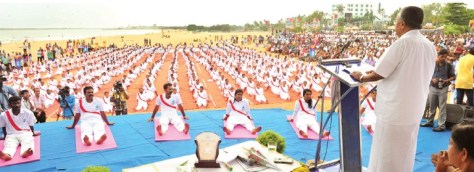
There are many ways in which ‘saffronization’ is being carried out at various levels. It takes the form of virulent battles at one extreme and persistent soft-campaigns at the other. It really does not require deep skills in socio-political analysis to see this entire spectrum of insidious divisive politics – all of that are in the clearly visible band. Surprisingly, the CPI(M) seems to have taken the attitude of a friendly match when it comes to certain variants of soft-saffronization, pretending not to see what is going on behind often innocuous-sounding things like Yoga – the latest weapon being deployed in the saffronization campaign. Instead of questioning the premises of this misplaced ‘national celebration’ and its belligerent imposition that defines the Modi government move, the party has chosen to play a friendly match by wholeheartedly joining the soft-saffronization race.

Pinarayi Vijayan at CPI-MK's Yoga event
Pinarayi Vijayan at CPI-MK’s Yoga event

The CPI(M, Kerala syndicate) has, in many ways, outperformed the RSS in Kerala so much so that the hyper-active media in Kerala had very little to report on how BJP and RSS celebrated yoga day in God’s Own Country. It seemed the Sanghis were pleasantly surprised at the saffronization of the CPI(M) itself! May be, the CPI(M) is gloating over how it out-smarted the Sanghis at their own game but that is not how it works in the world of everyday politics. For their part, the Sanghis could find nothing to object to in the way the new government in Kerala celebrated yoga. It seemed the Gods came to the CPI(M) party headquarters to pay obeisance to the newly enthroned in their glorious new clothes, new language, new style, new gait, new approach, and, of course, some inklings of a new, disquieting politics.

Continue reading Saffronization, Yoga and the Kerala Left: CP Geevan

Gandhi – A Religion of the Question: Ajay Skaria

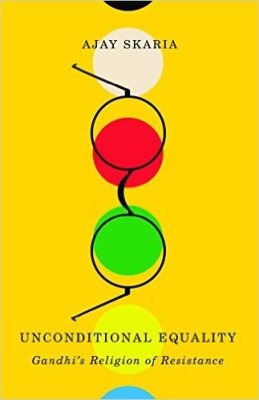
[The following is the ‘Preface’ to AJAY SKARIA’s recent book, Unconditional Equality: Gandhi’s Religion of Resistance by Ajay Skaria. The preface raises interesting questions not only about Gandhi’s politics but also about the idea/s of secularism and religion in what we might call a postsecular world – a world that is, where the naive and uninterrogated binary between the two terms is constantly put into question. Also of interest to readers might be the attempt made by the author to read Gandhi’s writings as a long and ongoing struggle to articulate or ‘understand’ his own politics – a politics that Skaria claims is as much premised on equality among humans as it is on the equality of all being/s.]

Unconditional Equality by Ajay Skaria

Somewhere in the early 2000s, while preparing to teach Mohandas Karamchand Gandhi’s English translation of Hind Swaraj to my undergraduate class, a passage about history in the text intrigued me. Since I happened to have the Gujarati version of that text at hand, I consulted it. The divergence is striking. The Gujarati text criticizes “history” (the English word occurs in the Gujarati text) and contrasts  it to itihaas [usually translated as “history”]. The English text criticizes “history,” but in it there is no equivalent for itihaas; the contrast between history and itihaas is thus obscured. The gap between the Gujarati and English texts, I have since come to realize, is symptomatic of Gandhi’s struggles to think his politics. What this politics involves is by no means clear to him; perhaps he writes so prolifically and indefatigably (his collected works run to ninety-eight volumes in English) precisely in order to try and understand his own politics. This politics becomes even more intriguing when we attend not only to Gandhi as an author or “intending subject,” but to his writing.[1] By dwelling in and on the gaps (between Gujarati and English and also within each of these languages) in his writing, this book tries to draw out his politics.

For me, writing this book has been difficult also because of another gap—that between Gandhi’s insistence that there can be “no politics without religion” and the secular inheritance that I have, as far as I know, no desire to abandon. Gandhi repeatedly describes satyagraha (his most famous neologism, which he coins initially as a translation of “passive resistance”) as his “dharma” or “religion,” even as the religion that stays in all religions.[2] Symptomatic of my difficulty with this religious politics was my inability for long to even recognize it. When Vinay Lal first asked me in 2007 to write an essay on Gandhi’s religion for a volume he was planning on political Hinduism, I protested that I was not interested in this aspect of Gandhi. But with his characteristic persistence, Vinay did not accept my protests, and I ended up writing that essay, which became a precursor of this book.

In the process, my own understanding of dharma and religion as “concepts” has been transformed.[3]

Continue reading Gandhi – A Religion of the Question: Ajay Skaria

Teacher Killings Ignite Calls for Revolution in Mexico

The violent police crackdown on teachers’ union protests recently have spurred widespread condemnation of the government’s privatization drive, backed by repression. The following is extracted from two reports by Lauren McCauley, staff writer, Common Dreams (commondreams.org)

Oaxaca protests, Mexico
Oaxaca protests- teachers block highway, Mexico, (Photo: Luis Alberto Hernandez/ AP)

An initial report in Common Dreams, on 20 June 2016 reported: ‘A Mexican teacher protest against neoliberal education policies turned deadly on Sunday, with nine people killed, after police unleashed gunfire on the demonstrators’ road blockade.

According to TeleSUR, teachers from the dissident union, Coordinadora Nacional de Trabajadores de la Educación (CNTE), “had set up the blockade as part of protests over an education reform implemented by President Enrique Peña Nieto and the arrest of several of the unions’ leaders over the past week,” which they said, were politically motivated.


Continue reading Teacher Killings Ignite Calls for Revolution in Mexico

Ambedkar Cannot be Adopted or Appropriated by Hindutva: K Satyanarayana

Transcript and translation of lecture  by Prof. K.SATYANARAYANA, speaking at the launch of book, Ambedkar Can Neither Be Adopted Nor Appropriated by The Hindutva Elements. The book, authored by Bojja Tharakkam, K. Satyanarayana, K. Laxminarayana and K. Y. Ratnam. It was launched in Hyderabad in July last year and is a reply to RSS’ Organiser special edition on Ambedkar. The text and video of the original Telugu lecture received by us via DALIT CAMERA.

All the friends who gave me this opportunity, to the many Ambedkarites present in this hall and to the very senior members, activists and intellectuals, I thank you all. After Anand Teltumbde has spoken, there isn’t much left to speak because he covered all the information in this book and also described completely about a lot of aspects about Maharashtra, about Ambedkar’s like and his work. Therefore there might not be much new information in my speech, but while writing this book, the distortions they made, or the attempts of RSS in relation to Ambedkar, as there is a need for historical context, I will speak about some of those issues. Firstly what Respected Mr. Tarakam has said is, to read some of the names of essays in the Organiser as the book is not available to everybody. When this book Organiser came out, generally RSS-BJP, when they talk about Ambedkar or about Babri-masjid, what we think is that they speak lies, false words, and mistruths and therefore there isn’t any danger as nobody will believe in their load of rubbish and lies. We think that way and if people understand the lies and if they don’t follow those words, there is no danger, but with this same type of propaganda, they completely changed the normal common-sense of the people and today Modi, as a K.D (drawn from an old colonial police/ legal category, it has become a Telugu expression that suggests a person with undesirable traits), as our brother has sung, is sitting in power.

Continue reading Ambedkar Cannot be Adopted or Appropriated by Hindutva: K Satyanarayana

Statement of Solidarity with Kancha Ilaiah

[The following is a statement in support of scholar-activist Prof  Kancha Ilaiah, who is under attack from a number  of Hindutva organizations and  against whom the Hyderabad police recently registered a case for ‘hurting religious sentiments’. The tendency to  resort to police cases, in order to stifle any criticism of Hindutva and the regime has assumed menacing proportions, against which we stand  firmly with Kancha Ilaiah. Those who wish to add their names to the statement and express solidarity may do so by adding them as comments.]

We, the undersigned, strongly condemn the continued harassment, attacks on and intimidation of Prof Kancha Ilaiah at the hands of various Brahmin / brahminical organizations, police and the state administration of Telengana for his political writings and views.  We also hold responsible for this intimidatory environment, the Telugu media that reportedly published distorted and misleading reports of Prof Ilaiah’s speech.

While speaking at the Centre of Indian Trade Unions, a wing of the Communist Party of India (Marxist) on May 14, 2016, at Vijayawada (Amaravathi), Prof. Ilaiah had  said: “The Brahmins as a community have not contributed anything to the production process of the Indian nation. Even now their role in the basic human survival based productive activity is not there. On the contrary, they constructed a spiritual theory that repeatedly tells people that production is pollution.” Continue reading Statement of Solidarity with Kancha Ilaiah

Condemn the Attack on Kancha Ilaiah for asking, ‘Is God a democrat?’

[We at Kafila condemn the repeated  attacks on scholar activist Professor Kancha Ilaiah by the Hindu Right and  the recent case registered against him by the Hyderabad police. According to a Times of India report, Ilaiah had on May 14 delivered a lecture in Vijayawada in a programme entitled `Nationalism and Divergent Views’ organised by CITU where he reportedly criticised Hindu gods and scriptures, according to the police. Following this an advocate filed a private petition in the court of the XI Metropolitan Magistrate court, Ranga Reddy , requesting to register an FIR under relevant sections of IPC. The court directed cops to register a case under sections 295 A (deliberate and malicious acts, intended to outrage religious feelings of any class by insulting its religion or religious beliefs),153 A (promoting enmity between different groups on grounds of religion) and 298 (uttering, words, etc. with deliberate intent to wound the religious feelings of any person) of IPC.”

Earlier, last year the  VHP had initiated a campaign against him which was followed by the filing of a case against him by the Hyderabad police. That was in relation to an article Kancha Ilaiah had written, asking ‘Is God a Democrat?’ The story by Ajaz Ashraf from Scroll.in linked below refers to last year’s case but due to an inadvertent mix-up, was initially extracted by us as the one in the eye of the current controversy. The error is seriously regretted and we thank one of our readers for pointing this out. The Times of India report linked to above gives refers to the speech that is currently in the eye of the storm.

Professor Ilaiah has now himself described the current attacks on him in this piece in Scroll.in, where he signs his article as Kancha Ilaiah Shepherd, recalling his caste name (translated into English, in order to mark his distance from the brahmans).

The attacks on  Professor Ilaiah are totally unacceptable. We have all read and long admired his writings. Many of us have hugely benefited and learnt a lot from them. The time has come for us to collectively put our heads together and fight this menace of Hindutva, which after hurting every living being’s dignity and sentiments, has now begun claim to be the perpetual and universal victim. Dalits today cannot speak of the indignities and oppression that they have suffered at the hands of the Hindus – even that has become a matter of ‘hurt sentiments’. The response has to be worked out politically and intellectually so that the law is not repeatedly turned into a surrogate of Hindutva politics.]

The Hyderabad police have registered a case against renowned social scientist Kancha Ilaiah, after Vishwa Hindu Parishad activists complained that an opinion piece he wrote in the Telugu newspaper Andhra Jyothi had hurt their religious sentiments.

They filed their complaint at Hyderabad’s Sultan Bazar Station was filed on May 9, the day Ilaiah’s article titled Devudu Prajasamya Vada Kada? (Is God a democrat?) was published.

VHP activists Pagudakula Balaswamy, Thirupathi Naik and two others accused Ilaiah of comparing Hinduism with Islam and Christianity, insulting Hindu Gods by comparing them to mortals, mocking their worship, and for attempting to trigger clashes between upper and lower classes (by which they presumably meant castes).

On the basis of their complaint, Inspector P. Shiva Shankar Rao wrote a letter to the Senior Assistant Public Prosecutor, who advised the police to register a case under Section 153 (A) and Section 295 (A), which empower the authorities to act against people who commit deliberate and malicious acts aiming at outraging religious sentiment and spreading enmity between groups.

Case under investigation

The public prosecutor’s legal opinion led to a case being filed on May 15 against Ilaiah, the management of the Andhra Jyothi newspaper, its editor and publisher. The case is currently under investigation, at the completion of which a decision will be taken to whether to chargesheet them.

A police officer at the station told Scroll that Ilaiah is in the habit of articulating provocative views in his articles, which can and do hurt the sentiments of people. “Why does he have to make comments against practices which are dear to people?” the officer said, declining to give his name.

Read the full article here

Niyamgiri – An Unending Struggle for Livelihoods and Habitat: Kamal Nayan Choubey

Guest post by KAMAL NAYAN CHOUBEY

On the 6th of May, 2016 the Supreme Court rejected Odisha government’s petition for conducting Gram Sabha meetings for a second time in villages near Niyamgiri hills for the extraction of bauxite. Earlier, in August 2013, following Supreme Court directions, the Dongria Kondh tribals of Niyamgiri clearly decided in 12 Gram Sabha meetings that they would not give any permission for mining in their place of worship. The Odisha government filed an interlocutory application in February 2016 and argued that situation had changed in that area because mining was now proposed to be done by Odisha Mining Corporation (OMC) instead of a joint venture project between OMC and Vedanta. The Odisha government filed the petition to help the Anil Agrawal-owned Sterlite (formerly Vedanta Alumina) company, which wants to extract bauxite from Niyamgiri hill in Kalahandi for its Lanjigarh refinery. The Supreme Court, however, rejected the arguments of Odisha government and accepted the validity of August 2013 Gram Sabha meetings. Now, the Odisha government can claim that it wants to ensure the development of all groups of the state and create more alternatives for marginalized groups like Dongria-Kondhs. The question, however, is whether the Odisha government can claim, on moral grounds, that it has not been working as an agent of corporate capital? What can a marginalized group do when it finds that a democratically elected government is relentlessly working against its interest and violating constitutional provisions? Indeed the Niyamgiri experience has raised many questions not just about the violence caused by dominant ‘development’ model against marginalized adivasi groups, but also about the crisis of constitutionalism and the role of democratically elected government in using/misusing state apparatus for the benefit of capitalists.

Continue reading Niyamgiri – An Unending Struggle for Livelihoods and Habitat: Kamal Nayan Choubey

Staking the Terrain – Political Economy, Environmental History and Nature Conservation: Shashank Kela

Guest post by SHASHANK KELA

The aim of this essay is to make connections between things that are usually studied separately – environmental history, political economy, conservation practice and adivasi politics – and I apologize in advance for the demands it makes upon the reader’s attention. The belief that this potential convergence could do with wider discussion is my sole justification for putting it up here.

Environmental history in India is not a very old discipline – the first mongraphs began appearing in the 1980s, and more and more books and papers have been added to the historiography since 2000. Let us examine certain themes as outlined in a cross-section of recent scholarship.

One key debate centers upon whether the colonial period can be regarded as an ecological watershed. An influential book by Ramchandra Guha and Madhav Gadgil argued that, before the advent of colonialism, there existed a harmonizing tendency between human beings and the environment, a balance between resource use and preservation mediated largely through the caste system: colonialism shattered this equilibrium and the values associated with it.[1] This idealizing view, eliding different time periods and state structures, was bound to come under attack and much subsequent scholarship has been devoted to unpicking its conclusions.

Sumit Guha shows how at least one natural resource, namely wild grass for fodder, had become scarce in the Deccan by the Maratha period thanks to the demands of armies, nobles and zamindars, who engrossed it by enclosing tracts of common land. This fierce arbitrariness fostered a system of free grazing and discouraged sustainable management through collective protection of the commons.[2] Meanwhile the argument that sacred groves are strands of untouched forest – repositories of biodiversity – is refuted by Claude Garcia and J-P Pascal in their study of Kodagu.[3] Far from being untouched, groves there are heavily used and managed, and show clear signs of degradation associated with use. Continue reading Staking the Terrain – Political Economy, Environmental History and Nature Conservation: Shashank Kela

Degrees of Self-Deception: Rama Srinivasan

Guest post by RAMA SRINIVASAN

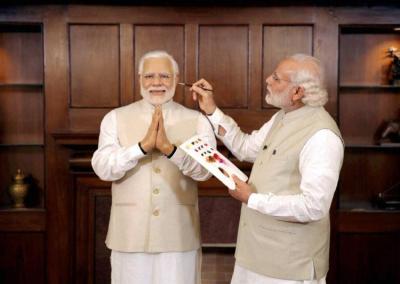
Modi and his double, image courtesy, IndiaTV news

As the crisis of fake degrees blows over I want to be the one to ask the naïve question: Why would Narendra Modi lie? I know it is a naïve question because lies are the most banal political strategy ever. There is a man in US today who repeatedly states that he will make the Mexican government pay for a beautiful, great wall on the border of US and Mexico and people believe him with a degree of sincerity that is frightening. In 2014, at least 31 percent of eligible Indian voters believed in Modi’s promises of development and some of them still do. There may be some who, at the end of the five years, actually believe that Modi has delivered on those promises. But such lies are different. My question is simply: why would he lie on an affidavit which functions as a legally-binding oath?

In his previous election affidavit filed for 2012 Gujarat elections he had left the spouse’s name column empty but following ‘strict legal advice’ he agreed to mention his wife’s name on the affidavit filed for Lok Sabha elections. Technically he had withheld information in previous affidavits which amounts to a legal offence since he had not filed his papers to ‘the best of his knowledge’ but this is not the same as actively lying as it now turns out could be the case with his educational qualifications. Legal experts will determine what is tantamount to punishable crime but if Modi did have legal counsel, who advised him to “come clean on the marriage” as this Times of India article states, why would he continue to provide inaccurate information on other aspects of life?

One speculative answer could be that he knew he was being closely watched as he made his bid for the PM’s post and that his papers would be scrutinised and compared with previous drafts. So it made sense to remain consistent with some of the information even though he had obviously been cornered on the question of his marital status. And yet, as the story of how Modi came to acknowledge the existence of his wife Jashodaben proves, if he had to reveal inconsistencies in previous records, 2014 would have been the best time to do this. No amount of exposés could have hurt the man at that time – his bhakt army, on and offline, on Twitter, were efficiently managing the show and could provide a useful media spin/misdirection to take the focus away from the affidavit that declared to the world that Jashodaben’s repeated claims regarding her marriage and abandonment were not unfounded. Even as the Gujarat Congress urged the state Election Commission, unsuccessfully, to reject his application on the grounds that he had not provided information regarding his spouse’s assets or PAN card number, Modi cruised to victory since his deliberate inconsistencies seem to matter very little to voters.

At that point Modi, indeed, seemed invincible. He was giving explosive speeches and deftly avoiding uncomfortable questions from journalists. In an interview with Rajdeep Sardesai, Modi replied to an indirect question on 2002 with this classic deflection tactic: “My best wishes are with you, Rajdeep Sardesai. You have been living off this issue for the last 10 years … I have heard that those who curse Modi get Rajya Sabha seats or Padma awards. So you have my best wishes to continue this campaign (against Modi) and reach Rajya Sabha or win Padma awards with help of your friends.” What was apparent in the interview is now widely acknowledged as the process of constructing a larger-than-life image, where the man referred to himself in third person. Continue reading Degrees of Self-Deception: Rama Srinivasan

Folk Singer Kovan Lampoons Jayalalitha’s Promise

Kovan, the Dalit-activist poet and singer and member of a revolutionary organisation PALA (People’s Arts And Literary Association), from Trichy district in Tamil Nadu, has been in the news lately. One of his anti-Jayalalitha songs earned him the ire of the state government, which slapped a Sedition case against him in December 2015.

In this video sent to us by Vinavu Thalam, Kovan lampoons Jayalalitha’s promise of “step by step prohibition” as “peg by peg de-addiction”!

Seduce the gullible voters with false promise/ File sedition cases against those who fight/ This is her game/ The game of a cheat/

In Chennai slang, “Bongu” means, a Cheat! She is the AMMA of all cheats!

Suicide of a Worker: Shankar Gopalakrishnan and Trepan Singh Chauhan

Guest post by SHANKAR GOPALAKRISHNAN and TREPAN SINGH CHAUHAN

On April 11th, a memorial meeting was held at Gandhi Park, Dehradun. You probably haven’t heard of Sadhuram, the person for whom it was held. Thousands of people have indeed heard of him. But it reflects the divided world we live in – the world that Sadhuram fought to change – that it’s very unlikely that you are one of them.

Sadhu Ram
Sadhu Ram

Sadhuram was a Dalit, a mason and a resident of Jakhan, Dehradun. He was also the vice president of the Uttarakhand Nav Nirman Mazdoor Sangh, a union of unorganised sector workers. To the daily wage workers of Jakhan, he was a daily presence at the mazdoor chowk, the place where people stand for work in the morning; some of them affectionately referred to him as “mantri-ji.” Late on the night of March 26th, Sadhuram committed suicide.

Why did he do it? That question has many partial answers. On December 5th, 2014, his wife Geeta Devi died of kidney failure. Geeta was not one to give up easily; her death came after a long battle against a painful disease and the extortions of private doctors. That very night, Sadhuram’s younger son, Ravi, lay down on the tracks outside Dehradun station and committed suicide. Sadhuram was left an angry, saddened man, having lost the two most important people in his life. His remaining son cared little for either the union or Sadhuram. They had frequent fights, and his son often beat him. Nor was that the only atrocity in Sadhuram’s life. After Ravi’s death, he was entitled to Rs. 50,000 in compensation under the Building Workers’ Act; that 50,000 might have meant the difference between continuing abuse and independence. But for an entire year the Labour Department sat on the application, notwithstanding at least twenty meetings and even a personal direction from the CM.

Continue reading Suicide of a Worker: Shankar Gopalakrishnan and Trepan Singh Chauhan

NIT and the Never Ending Story of Kashmir: Jagjit Singh

Guest post by JAGJIT SINGH

[The incidents in NIT Srinagar follow those in a number of universities and institutions of higher education and at one level, reflect a similar pattern. Yet, at another level, they – and the forces active behind them – play on a very different template of politics to achieve the same result. The story is similar and yet, radically different. The key dramatis personae are, understandably, the same. How do we make sense of what is happening in NIT Srinagar? Today’s Indian Express story by Nirupama Subramanian gives a sense of one part of the backdrop – life in NIT Srinagar before the incidents. The piece below gives us another sense of the larger history.]

NIT Srinagar non-Kashmiri students demonstrate
NIT Srinagar non-Kashmiri students demonstrate, image courtesy The Hindu

I remember when I was kid and was trying to make sense of a sport which looked very dull and boring but generated passions I had never seen in my hometown. Every time the game ends, the streets would be flooded by countless people with music and firecrackers and slogans in the background. Sometimes we could see fireworks even from our balcony, and some other times we would be locked inside our homes. Only thing we knew was ‘situation is tensed outside’. The game was Cricket and my hometown was Jammu. Jammu has always been RSS’s stronghold, and there are two Muslim-majority areas in Old City, Jammu. The whole tension surrounded these two areas only. Even that time slogan shouting was the test of your love for your country. The more violent and high-pitched your slogan is the more cheers you receive from the crowd. Continue reading NIT and the Never Ending Story of Kashmir: Jagjit Singh

Statement of Solidarity for Hyderabad Central University from UK-based academics

STATEMENT OF SOLIDARITY FOR HYDERABAD CENTRAL UNIVERSITY STRUGGLE

We, the undersigned, who are UK-based concerned scholars, express our deep dismay over the police brutality directed at students and faculty members of Hyderabad Central University, starting on March 22, 2016. We are alarmed that students and staff calling for justice at the University have had charges pressed against them, have been disappeared from the campus, and that there are reports of assaults on them in custody. We condemn the police presence on campus, the authorities’ denial of water, electricity, and food to those remaining in student accommodation, and the brutal attack on a PhD scholar for cooking in University premises.

These actions, coming in the aftermath of events culminating in the suicide of a Dalit scholar Rohith Vemula, constitute a severe assault on democratic rights of free expression and thought, assembly and association. They go against the very purpose of universities as places for critical thinking, and damage the international reputation of HCU. As scholars who admire the work of many academic colleagues and alumni at HCU, we are concerned that HCU seems to be fast descending into a campus of unrestrained repression of dissenting voices among students and staff. Continue reading Statement of Solidarity for Hyderabad Central University from UK-based academics

Medico Friend Circle Welcomes Report of Parliamentary Standing Committee to Clean up Medical Education Regulation

A statement from MEDICO FRIENDS CIRCLE

Mfc (Medico Friend Circle) wholeheartedly welcomes the 92nd Parliamentary Committee Report on the Functioning of the Medical Council of India (MCI) that was presented to the Rajya Sabha on March 8, 2016.

The Report is comprehensive, wide ranging and has come out with sound recommendations. Implementing these recommendations is in the best interests of the health of the people of India and the medical profession.

The MCI was expected to be the regulator with everything related to medical education but has ended up being the single major factor in the country responsible for the commoditization and corruption of medical education. Successive occupants of top posts at the MCI have perfected the MCI as an ATM. Every requirement of approval of a private (and public) medical college had a price and still does. We agree with the Report that unless there is a whole sale exit of vested interests that have clogged the MCI, nothing can change and it will be ‘business’ as usual. Continue reading Medico Friend Circle Welcomes Report of Parliamentary Standing Committee to Clean up Medical Education Regulation

JNUTA Statement on Suspension of Dr Shreya Bhattacharji in Jharkhand Central University

The Following is a statement from JNUTA

30 March 2016

On actions of the VC of Central University of Jharkhand

The JNUTA condemns in the strongest possible terms the suspension of Dr. Shreya Bhattacharji and her removal from administrative positions by the Vice Chancellor of Central University of Jharkand. What is simply outrageous is the action on her part that has been deemed as ‘misconduct’ – namely, inviting an eminent academic to be a Guest of Honour at a function in the University. She was assigned the responsibility to organize the event. The presumption underlying the accusation – that the credentials of the invited scholar, Professor M.N. Panini, were questionable as he is considered to be “mentor of the group of students of JNU, who were involved in anti-national activities in JNU campus recently” – would be laughable if it were not a scandal.

Clearly, the maligning of Professor Panini is simply on account of his association with JNU, where he served on the faculty with distinction for many years before his retirement, and has absolutely no relation with recent incidents in JNU.

Continue reading JNUTA Statement on Suspension of Dr Shreya Bhattacharji in Jharkhand Central University