All posts by Aditya Nigam

56 इंच का सीना और बोलती बंद?

सरकती जाए है रुख़ से नक़ाब, अहिस्ता, अहिस्ता….

इसे कहते हैं ५६ इंच की छाती

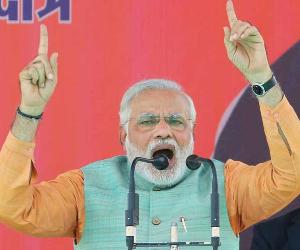
बहुत दहाड़ते हैं फेकू महाराज. गुजरात के शेर. 56 इंच के सीने वाले. यकीन न हो तो यह देख लीजिये बाएँ बाज़ू पर छपी तस्वीर. गरजते हुए शेर के कम लग रहे हैं? ऐसा दहाड़ना, ऐसा गरजना की अच्छे अच्छों की रूह कांप जाए. और क्यों न हो? कौन भूल सकता वो दिन – जिसे आज मीडिया की धुआंदार बमबारी भुला देने पर अमादा है. अंग्रेजी में एक शब्द है इस तरह की बमबारी के लिए – carpet bombing, यानि कालीन कि माफ़िक बम से ज़मीन को ढक देना. पिछले कुछ वक़्त से हमारी इन्द्रियों पर जो हमला हो रहा, कुछ इसी किस्म का है. मगर वो लाख चाहे कि इन महाशय की सारी करतूतें भुला दी जाएँ, ऐसा कैसे हो सकता है? जब जब यह शक्ल सामने आती है तब तब नाखूनों में खून दिखाई दे जाता है. वैसे भूलने भुलाने वाले भी अजीब मिट्टी के बने होते हैं. अब देखिये न जी, हिन्दुओं से कहते हैं की चार सौ साल पुरानी मस्जिद भी मत भूलना – बाबर का बदला लेना है और मुसलमानों से कहते हैं इतनी पुरानी बात – 2002 का रोना अब भी रोये जा रहे हो? इसे कहते हैं “चित भी मेरी, पट भी मेरी – और अंटा मेरे बाप का”. खैर जिन्हें बदला लेना था उन्होंने ले लिया. किस का बदला किससे – कौन जाने? क्या फ़र्क पड़ता है आखिर? वैसे गनीमत है कि पब्लिक सब जानती है – इसलिए ज्यादातर हिन्दू भी इनकी नहीं सुनते. इसी लिए इन्हें हर चुनाव से पहले आग लगानी होती है. खैर, ये तो ठहरे मर्जी के बादशाह – मगर उन मीडिया वालों की क्या कहिये, या उन नए नवेले भक्तों और भक्तिनों की जो सब जान कर अनजान बने हैं?

मज़े की बात यह है कि जैसे की यह शेर अकेले में धर लिया जाता है – जहाँ खुले मैदान में दहाड़ना क़ाफ़ी नहीं, जहाँ सवाल का जवाब देना ही होता है, जहाँ चालाकी से किसी को भी “पाकिस्तानी एजेंट” वगैरह कहा नहीं जा सकता है – वहीँ फेकूराम बगलें झाँकने लगते हैं. घूँट भरते हैं, पानी मांगते हैं और फिर मौन व्रत. एक बार तो स्टूडियो से ही उठ कर चल दिए थे. अभी हाल में हेलिकोप्टर में फँस ही गए तो चेहरा फीका पड़ गया (देखिये नीचे दूसरा वीडियो).

Continue reading 56 इंच का सीना और बोलती बंद?

Revenge is the Only Motive of the Vindictive Modi government – A Statement in Support of Teesta and Others

The following is a Statement issued by SAHMAT in Support of Teesta Setalvad and others

We are shocked and outraged by the continuing attempt of the highly vindictive Modi government and the Gujarat police to somehow implicate activists Teesta Setalvad and Javed Anand, along with three victim-survivors of the state-sponsored Gujarat carnage in 2002 on patently trumped-up charges.

This is nothing but a desperate bid to delay or derail the justice process, in particular Zakia Jafri’s appeal which is now before the Gujarat High Court. Mrs. Jafri has accused Gujarat chief minister and home minister, Narendra Modi along with 59 other top politicians, police officers and civil servants of conspiracy for mass murder and other serious criminal offences.

It is significant that the Supreme Court appointed amicus curiae in the case, Mr. Raju Ramachandran, has told the apex court there was enough prima facie evidence to prosecute Modi. Continue reading Revenge is the Only Motive of the Vindictive Modi government – A Statement in Support of Teesta and Others

फेकू की भजन मंडली उर्फ़ खिसियानी बिल्ली खम्बा नोचे

फेकूराम की भजन मंडली का ‘नमो नमो’ मन्त्र तो एक लम्बे अरसे से चल ही आ रहा था, मगर भक्तों में होड़ लगी तो कुछ को लगा की अब शिवजी की जगह इन्हीं को बैठा दिया जाए – सो ‘हर हर महादेव’  भी हड़प लिया गया. भला हो शिव भक्तों का कि उन्होंने यह दांव चलने नहीं दिया. और फिर खुद शंकराचार्य ने इस पर एतराज़ कर दिया. खैर, यह तो रहा परिवार के भीतर का झगडा. सुलट जायेगा.

मगर इसी बीच एक मोर्चा बनारस में खुल गया. फेकूराम के बैंड बजे तो दिल्ली तक में हमारी नींद उड़ाये हुए थे ही मगर अचानक एक अदना सा आम आदमी जा कर उसे ललकार आया. भक्तों ने अंडे फेंके, स्याही फेंकी – हर जतन कर के देख लिया. मगर आख़िरकार उसने पोल खोल ही दी. कहने लगे कभी इन्होने कांग्रेसियों को या कांग्रेसियों ने इन्हें काले झंडे दिखाए? अंडे फेंके? तो ये बौखलाहट किस लिए है जी? आप दोनों की नूरा कुश्ती चलती रहती और सब आपस में बाँट कर लूट लेते – जैसे करते आये हैं – तो कोई परेशानी नहीं होती. आप की बौखलाहट से हे तो कई राज़ एक साथ खुलने लगे हैं.

तभी एक भक्तिन को लगा की उनकी भारत माता के साथ ‘गैंगरेप’ हो रहा है. देखिये नीचे इन भक्तन की ट्वीट. जैसे उन्हें मजबूर किया जा रहा है की वे अपनी माँ का सामूहिक बलात्कार देखें. अब तक तो अम्बानी, मनमोहन, चिदम्बरम, सिबल और फेकूराम की फ़ौज भारत माँ की आरती उतार रही थी – कहाँ से चले आये ये बलात्कारी! आरती उतर रहे थे वो विहिपई और बजरंगी सेनानी जो प्रेमी युगलों को सरे बाज़ार बेआबरू कर रहे थे. पबों से निकाल निकाल कल निर्वस्त्र कर रहे थे. आरती उतार रहा था राज ठाकरे. किसी ने इन भक्तिन के उद्गार उस वक़्त देखे?

 
Photo: The shamelessness of Madhu Kishwar... Her employer CSDS as well as her political mentor Mr Narendra Modi must clear their stand on this...
भारत माता की 1984 में आरती उतारी गयी, 1992 में बाबरी मस्जिद का ध्वंस करके आरती उतारी गयी और फिर 2002 में गुजरात में उतारी गयी.

Continue reading फेकू की भजन मंडली उर्फ़ खिसियानी बिल्ली खम्बा नोचे

Narendra Modi’s Plans for India if He Becomes PM!


Narendra Modi’s Plans for India
For a detailed explanation of how Mr. Narendra Modi plans to run the country if elected Prime Minister, Click here.

A Corruption Scandal in Turkey: Tamer Söyler

Guest post by TAMER SӦYLER 

A corruption Scandal in Turkey first broke on December, 17th last year. Under instructions by the public prosecutor Celal Kara, the financial police took into custody several suspects comprising famous businessmen (Ali Agaoğlu and Reza Zarrab), family members of three ministers from the cabinet (sons of ministers Muammer Güler, Zafer Çaglayan and Erdoğan Bayraktar) and high level bureaucrats. Main suspects were immediately arrested by the court.
Prime Minister Erdoğan declared that this was a fabricated investigation to humiliate his government on the eve of coming elections. The Prime Minister accused Fethullah Gülen, the founder of the Gülen Movement, living in a self-imposed exile in the US for the last 15 years, for placing a plot to overthrow his government.

Continue reading A Corruption Scandal in Turkey: Tamer Söyler

Naked Bias Threatens Media’s Credibility – A Statement by Some Mediapersons

An Appeal to Indian Journalist Fraternity by a Group of Media persons, released in Chandigarh, 16 March, 2014

In a terse comment, Aam Aadami Party leader Arvind Kejriwal said that a part of the media, particularly some TV channels “sold itself to Bharatiya Janta Party (BJP) and is indulging in running a propaganda spree in favor of BJP’s Prime Ministerial candidate, Narendra Modi”. As has happened earlier in many cases relating to deprived and unprivileged sections of the Indian society, that section of media took an undue offence to the comment that was completely out of proportion, and it launched a virulent campaign against AAP. This section of media is peeved at Arvind Kerjriwal’s remarks that if his party came to power, a punitive action would be taken against those media outlets which have been biased in their news coverage and suppressed the anti Modi news stories projecting his false claim to an ‘unparalleled development of Gujarat’.

During his field tour to Gujarat, Kejriwal started taking on Modi , attempting to expose the chinks in ‘Gujarat Vikas’, which according to him, is a ‘hollow projection’ made with ‘active support’ of a section of media. In what could be called an overreaction, a naked anti-Kejriwal slant became a routine affair in the coverage of some media outlets. It is not difficult to smell from the reports and debates of these media outlets that their journalists (by order from above or own their own) have shamelessly started walking in the footsteps of Hitler’s notorious spin doctor Joseph Goebbels, who also did a stint in journalism. Continue reading Naked Bias Threatens Media’s Credibility – A Statement by Some Mediapersons

Time For a Code of Conduct for Media

Let us make no mistake, the Big Media in India does not merely report; it is a player in Indian politics in general and elections in particular.

Now that the debate is out in public it is time to insist on a code of conduct for the media as well. After Arvind Kejriwal’s recent allegations against four television channels that have been blown out of proportion and misrepresented, there has been an uproar. A burst of righteous anger, not only from those accused by Kejriwal of having been bought out by a particular party, but also by professional bodies like the News Broadcasters Association (NBA), the Editor’s Guild, the Broadcast Editors Association (BEA) and other senior journalists.

The NBA, which is a private association, threatened to black out Kejriwal and AAP news and then went on to assert its objectivity and fairness against the “unsubstantiated and unverified allegations” against the news channels.

The BEA said in its statement:

“BEA condemns Arvind Kejriwal’s irresponsible statement on media. BEA believes that electronic media is discharging its responsibility in a fair and objective manner. It is wrong to say that TV channels are pursuing a biased agenda in favour of any person or party. BEA believes that such statements are a conspiracy to dilute the credibility of media. We have strong faith in the self regulatory institutions that electronic media has developed…”

Let us concede for the sake of argument that Arvind Kejriwal went overboard and his statement about ‘jailing mediapersons’ was uncalled for. But does the claim of the BEA, NBA and other bodies really stand up to scrutiny? Is the electronic media really dïscharging its  responsibility in a fair and objective manner”? What precisely, may we ask, are the “self regulatory institutions that electronic media has developed” and what have they done by way of reigning in the Indian media that have sunk to new lows in recent years with “paid news”and “advertorials” – not to mention private treaties with big corporations ? We ask the BEA and the NBA and 0ther defenders of the media, is this the ethical behavior they talk of? Is this self-regulation? Maybe Kejriwal’s allegations are “unsubstantiated” in the sense that there is no “proof”, but there is little doubt from the instructions that journalists have been receiving from their bosses, that a lot more than mere reporting is at stake. And just for the record, the the Chairman of one of media houses accused by Kejriwal, Subhash Chandra of Zee News, is currently facing a case of extortion – using his channel’s news-gathering for blackmail. We would love to hear how this qualifies as ‘fair and objective’in the eyes of the BEA and other luminaries. Continue reading Time For a Code of Conduct for Media

Capital, Growth and Molecular Socialism

A slightly modified version of a talk delivered at the Conference on ‘Democracy, Socialism and Visions for the 21st Century’, 7-10 March, at Hyderabad 

Today we stand at a moment of history that is very different from the conjuncture at the turn of the 1980s and onset of the 1990s, which marked the collapse of actually existing socialism and the eventual victory of neo-liberalism. ‘Capital’ looked victorious and invincible and everything that was associated with socialism stood discredited. This is no longer the case today. The struggle for a new kind of left imagination, for a re-signification of the idea of socialism, is now evident in large parts of the world. The neo-liberal emperor has been revealed to have no clothes. Many neoliberals, incidentally, still live in the 1990s, sincere in their belief that History had come to an end at that moment. Simply because twentieth century socialism stood discredited, it was assumed that that meant the end of popular struggles and challenges to capital’s domination over the world. Today, two and a half decades after the collapse of socialism and the victory of neoliberalism, the latter stands challenged as perhaps, never before. 

The difficulty however, is that while the spirit of the Left animates struggles and movements, an actual programmatic vision is still not quite in sight.  The weight of dead generations still weighs like a nightmare on the brains of the living. Revolutionaries have long conceded defeat and accepted that capitalism is the only salvation and that they too must build capitalism wherever they are in power, even if rhetorically, they still hold on to the idea of transcending capitalism. The problem has little to do with the intentions of the revolutionaries; it is fundamentally a matter of a vision that is predicated upon the productivist and ‘progressist’ imagination of the past three centuries or more. In our contemporary everyday language, we could even call it the growth-fetishist vision – a vision that fails to differentiate between cancerous growth of capital on the social body, and the all round improvement in the lives of ordinary people. The fact that twentieth century socialists too remained captive to that vision is perhaps the reason they could not pose any serious challenge to capital.

Productivism and Progress

This productivist imagination was put in place over a few centuries through the conjunction of a range of new bodies of knowledge – moral philosophy, Lockean political theory and political economy – later economics. At one level, the twentieth century socialist imagination too partook of the fundamental assumptions that lay behind this modernist vision and sought to defeat capitalism on its own ground. That was an impossible task. It was impossible for it never radically questioned the fundamentals of the new capitalist creed, namely economics. Economics was and remains a discipline constituted by capital and ‘socialist economics’ is, strictly speaking, an oxymoron. For, apart from the ecological imperative, to which I will turn in a moment, the discipline was fundamentally hostile to all but bourgeois forms of property and production. Continue reading Capital, Growth and Molecular Socialism

A Temporary Respite from Ordinance Raj: Apurv Mishra

Guest post by APURV MISHRA

The Roman legalist Julius Paulus once said that, “One who contravenes the intention of a statute without disobeying its actual words, commits a fraud on it.” With the model code of conduct declared on Wednesday, the country was spared the possibility of a fresh round of ordinances that would have amounted to yet another fraud on the constitution by the UPA government. Believers in constitutionalism, for whom a constitutional impropriety is as disturbing as a blatantly unconstitutional act, can now breathe a temporary sigh of relief.

The phrase “fraud on the constitution” is not of my own making. It was used by the Supreme Court in a case that at once represents the best and worst of Indian polity. Between 1967 and 1981, the governor of Bihar promulgated an astonishing 256 ordinances which were kept alive for up to 14 years, including a fateful day on which 50 ordinances were passed at one go. The state assembly meanwhile, passed only 189 Acts in the same period. This was a brazen disregard for the basic structure of our constitution of which “separation of power” is an essential component- a simple and intuitive scheme where the legislature makes laws after careful deliberations and the executive branch of the government implements them.

It required two extraordinary individuals to put an end to this “complete nonsense”- Dr D C Wadhwa, who meticulously collected data on the systematic abuse of power by the Bihar government at grave personal cost and then-Chief Justice of India P N Bhagwati, who delivered an outstanding judgment (on the PIL filed by Dr Wadhwa ) which stated in no uncertain terms that the power to promulgate an ordinance is essentially an emergency power to be used to meet an extraordinary situation and “it cannot be allowed to be perverted to serve political ends.” Continue reading A Temporary Respite from Ordinance Raj: Apurv Mishra

Modi and Godhra – Review of Manoj Mitta’s ‘The Fiction of Fact-finding’: Monobina Gupta

MONOBINA GUPTA reviews The Fiction of The Fact-finding: Modi and Godhra by Manoj Mitta, Harper Collins India, 2014

My most embarrassing moment during my recent Eastern UP trip was hearing RSS and BJP men sing praises of the media. “Aap log Modiji ka bahut madat kar rahen hain” (You all in media are really helping Modiji), they said warmly, throwing cheerful smiles all around. “Sometime ago, you were giving Arvind Kejriwal too much of coverage. Now you have brought the focus back on Modiji,” was the discomfiting refrain in these upbeat quarters.

I squirmed beneath my fake smile and grumbled to myself: this was a stiff penalty to pay for covering these fraught general elections. I would rather these men complain about why we in the media were still so troubled about Narendra Modi’s role in the 2002 Gujarat riots; why were we still persisting with our questioning the process of investigation, particularly the role of the Special Investigation Team (SIT), that led to Modi’s exoneration in the charge of complicity in the 2002 pogrom.

But that’s not how political discourse in the run up to the 2014 elections is shaping up. Skeptics holding the judiciary to be fallible are blasted for daring to express doubts about the ‘hallowed’ courts; those not rushing in to embrace Modi’s acquittal as manifestation of the truth and nothing but the truth are regularly shouted down on television talk shows. Dissidence is drowned out in the noisy din raised by Modi drum-beaters. Continue reading Modi and Godhra – Review of Manoj Mitta’s ‘The Fiction of Fact-finding’: Monobina Gupta

Crafting the Modi Mask – India Inc and the Big Media

AAP Rally in Gujarat. Courtesy Mukul Sinha

Two things stand out for their sublime quality in the current round of pre-election campaigning. First, the danger to Indian democracy has assumed unprecedented proportions, and there is a clear sense of desperation in the air. The threat emanates, you guessed right, from a group of anarchists who are poised to take over Indian democracy.  This is perhaps the dirtiest and most dangerous election that India has ever seen – what with the bunch of anarchists ‘fixing the media‘, ‘spreading anarchy‘, ‘hijacking democracy‘, ‘taking foreign funds‘ for their election campaign (while the others, the impeccable democrats of the BJP and the Congress have to make do with ‘local’ capitalists like  Mukesh Ambani). What’s more, these people are ‘political mercenaries‘,  urban Maoists in disguise and they want to wreck the neatly and painstakingly built edifice of our hallowed democracy. This widespread love of democracy is touching. For someone like me who has closely watched (and participated in) politics from the mid 1970s, the panic evident in the tone of those attacking AAP is as unprecedented as it is revealing. It is revealing of the fact that the political class is thrown into disarray by this new way of doing politics that AAP represents. In BJP’s case, in particular, one can discern complete befuddlement – neither its hope to reap the benefit of the mass anger against the Congress, nor its tried and tested polarizing communal vocabulary seem to have any meaning any more.

Thus, during the days of AAP rule in Delhi, the official BJP state executive resolution came up with this claim:

“Delhi is currently being ruled by a bunch of political mercenaries hired, supported and controlled by Congress party. The words and action of AAP leaders expose the fact that it is a Maoist outfit.”

Of course, the Maoists are “hired, supported and controlled by the Congress”!

Continue reading Crafting the Modi Mask – India Inc and the Big Media

Despatch from Ayodhya: Monobina Gupta

Guest post by MONOBINA GUPTA

Ayodhya, Faizabad: As our taxi approaches the site of the controversial Ram temple, two young men on motorcycle ride alongside our car. “ We will be your guides. Want to see the temple? Only hundred rupees,” they shout. My unofficial ‘guide’ Vineet Maurya, a fierce crusader against representing the site as the birthplace of Ram, rolls down the window and snaps back,” We are not here to see the temple.” Further down the lane, more young men run behind the car with similar offers. Temple sightseeing has turned into a veritable industry at Ayodhya.

From the narrow alley, the disputed plot, closely barricaded with high yellow railings and watched 24/7 by men from the Central Reserve Police Force (CRPF) and Provincial Armed Constabulary(PAC), images a heavily guarded fortress: one that is in danger of imminent attack. This is the holy site over whose ownership Hindus, led by the Bharatiya Janata Party (BJP), had waged such a fierce battle and spilled so much of blood. The manifestations of that unholy battle are overwhelmingly present in the form of deployment of countless security forces guarding Ram Lalla. What is lost in this murky stand-off is the sanctity of a holy place.  Ayodhya ranks among the top holy sites of India. Continue reading Despatch from Ayodhya: Monobina Gupta

जनता की महालूट का तमाशा अनवरत जारी है ! : अनुराग मोदी

Guest post by ANURAG MODI

हमारा विकास का मॉडल और हमारी राजनीति,  सविंधान कि मूलभावना के ही विपरीत है. सविधान में जहाँ, समाजवादी  गणराज्य की स्थापना, जिसमे हर नागरिक को आर्थिक, सामाजिक और राजनैतिक बराबरी के अधिकार होंगे, की बात है. हमारी राजनीति, यह भूल गई विकास के वैकल्पिक मॉडल के बिना न तो समाजवाद आएगा, और न ही राजनैतिक और सामाजिक और आर्थिक बराबरी स्थापित होगी. बल्कि, हम पिछले ६६ सालों से विकास की मृग-मरीचिका के पीछे भागते रहे, और देश के संसाधन की महालूट का तमाशा अनवरत ज़ारी रहा; जिसके चलते 1% लोगों के हाथों में देश के संसाधन से उपजी कमाई जमा हो गई. और देश की आम-जनता, विकास और राजनीति के हाशिए पर तमाशबीन बनी खडी रही.

यह स्थीति पिछले 10 सालों (2001-11) में और बिगड़ी है : कृषी प्रधान देश होने के बावजूद, 2,70, 940 किसानों ने  आत्महत्या कर ली; जितने लोग रोजगार में लगे हो उससे ज्यादा बेरोजगार हो; गैरबराबर बढी हो;शिक्षा, स्वास्थ्य, बिजली, पानी, सड़क, यहाँ-तक की राशन जैसी सामाजिक सुरक्षा के कामों से सरकार गायब हो गई- उसे निजी हाथों में दे दिया हो. Continue reading जनता की महालूट का तमाशा अनवरत जारी है ! : अनुराग मोदी

CHS, JNU Statement on the Wendy Doniger Issue

The following is the text of a statement issued by the Faculty of the CENTRE FOR HISTORICAL STUDIES, Jawaharlal Nehru University, protesting against the recent decision by Penguin India to withdraw and pulp all remaining copies of Wendy Doniger’s Hinduism. An Alternative History

We are outraged by the news that Penguin India has agreed to withdraw Wendy Doniger’s much acclaimed book The Hindus: An Alternative History and pulp all existing copies of the book in stock. Professor Doniger is one of the most respected Indologists in the world. She has spent a lifetime exploring the richness of India’s religious pasts, showcasing the creative interplay between multiple traditions — the Puranic and the Vedantic, the folkloric and the Brahmanic. Innovatively drawing on many disciplines, she has investigated the variegated world of Hindu mythology and theology, to explore what they say about order and chaos, morality and ethics, the good and the evil, the erotic and the non-erotic. Her reading of Hinduism has inevitably disturbed those who wish to sanitize and straitjacket Hinduism, and repress the multiplicity of traditions that constitute it. While welcoming all critical engagements with the book, the faculty of the CHS condemns any attempt to curtail the circulation of this book in any form.

The decision of Penguin India to sign an out-of-court settlement to withdraw Professor Doniger’s book is therefore an act of abandoning the basic ethics of publishing. What is most disturbing is the fact that Penguin Books — which had in the past a sturdy reputation of defending freedom of expression — has agreed to a settlement even without the Indian state or the Indian judiciary taking a position against the book. This decision will affirm the power of the forces of religious intolerance, encourage further attacks on authors who question the fundamentalist interpretation of the past, and subvert the right to freedom of expression. It will undermine further the rapidly eroding public space wherein critical debates and discussions can take place. This is a space that all who believe in democratic values — publishers included — need to preserve and defend.

Please note that individual names are not being listed in this statement as this is emanating from the entire faculty.

Thank you,

Professor Rajat Datta

Statement by Scholars in North American Universities on Withdrawal of Wendy Doniger’s book

This statement expresses the views of the individuals listed below and does not represent the views of the University of Chicago or any of its departments.

We, the undersigned, as students of South Asia, strongly condemn the withdrawal by Penguin Press India of Wendy Doniger’s The Hindus: An Alternative History from distribution in India. We believe that this work has been attacked because it presents a threat to orthodox Brahminical interpretations of Hinduism. We believe that this attack is part of ongoing attempts by upper-caste extremist Hindu forces to stifle any alternative understandings of Hinduism. As students in the United States, we are acutely aware that North American organizations of the Hindu right initiated the protests against Wendy Doniger’s scholarship. Hindu right wing organisations in India have worked in tandem with their North American counterparts to suppress alternative voices in India and too often violently. We are deeply concerned about the alarming increase in attacks on any academic study of Hinduism that does not fit these groups’ narrow and exclusionary vision of Hinduism which is part of their desire to create a Hindu India that excludes the religious minorities of Indian Muslims and Indian Christians. Continue reading Statement by Scholars in North American Universities on Withdrawal of Wendy Doniger’s book

Are you celebrating free speech, Mr. Lit Fest? Harsh Snehanshu

Guest post by HARSH SNEHANSHU

This January, in a session at the Jaipur Literature Festival (JLF), the award-winning writer Jerry Pinto said something that sent most of us into a tizzy.

“We are sitting in the ‘Google’ Mughal Tent discussing how crucial the freedom of expression is for us writers,” Pinto said wringing his hands animatedly. “It’s the same Google that reads all our mails, encroaches on our privacy, and here, under its roof, we are discussing how we should feel free to say whatever we want without any fear.” The crowd was amused, and left with some food for thought. Would it have been possible to organize an event as grand as the JLF, free for all, without Google’s help? I asked myself. The answer was a no. Google’s deep pockets couldn’t be ignored. Should I refrain from attending the fest just because of Google’s invasion of my privacy? The answer, after some thought, was again a no. Google monitoring my mails doesn’t affect my freedom of expression that I prize most as a writer.

Two weeks later, another literature festival has arrived, this time in New Delhi. Run by arguably India’s most revered newspaper, The Hindu’s Lit for Life is being held at the Siri Fort Auditorium, New Delhi, on 8th February after its successful three day stint at Chennai in mid-January. The guest-list is embellished with names of noted luminaries like the writers Rana Dasgupta, Sam Miller, Rahul Bhattacharya among others, the Olympian Mary Kom, and politicians Shazia Ilmi and Manish Tewari. The entry, like every other literary festival nowadays, is free. The beautifully designed logo is aptly shaped as the fountain pen, representing the craft that it celebrates. However there is something below the logo that disturbs me. It says, ‘Powered by VIT University.’ Continue reading Are you celebrating free speech, Mr. Lit Fest? Harsh Snehanshu

In Defense of the ‘Post-Ideological’ Aam Aadmi – Yet Again!

On the morning of 17 January, the very day after Somnath Bharti carried out his vigilante act – and I maintain, despite Arvind Kejriwal and Yogendra Yadav, that it was a vigilante act – I wrote a post relating to the dangers of xenophobia, racism and vigilantism that this act portended. I felt called upon to write that post because one of the valuable political lessons I have learnt over the years is that there can be no unconditional support for any political formation. Every support must be is contextual and conjunctural,  never for all eternity. My criticism was therefore of someone who is invested in the process that AAP and Kejriwal have unleashed and I want it to succeed. In invoking xenophobia and racism, my point, however, was that the leadership of the party has a role to play in relation to political education and cannot simply flow with the local sentiment.

I have always maintained, right from the days of the anti-corruption movement led by the IAC, that the movement and its later avatar, the AAP, had opened out a space of new possibilities. The mass support that the movement and now AAP is drawing is primarily, in my view, a function of the fact that it can mean many things to many people. ‘Clarity’ on every issue concerning the world is not its agenda. This is why some of us have been arguing that the movement/ party is still taking shape. It does not yet have a ready-made, given ideological form. This is why it can be shaped. Its future is radically open. I see no reason to change that position yet. Yes, it is in the design of things that there are Kumar Vishwases and Somnath Bhartis in that formation, and it disturbs our sensibilities no end. But that is precisely the challenge – if we cannot deal with them, we cannot deal with ordinary folk either. Moreover, everybody can change and it is simply arrogant upper class presumptuousness to mock at the ‘uncouthness’ of someone or hold their past against them (in the case of Vishwas). In any case, for anyone seriously interested in changing the existing state of affairs, it should be quite clear that the entire business is about changing ‘common sense’, to put it in Gramscian language. We don’t live in an already transformed universe. Continue reading In Defense of the ‘Post-Ideological’ Aam Aadmi – Yet Again!

The English Media and AAP – Should One Rush to Endorse the Party: Shankar Gopalakrishnan

Guest post by SHANKAR GOPALAKRISHNAN

Over the last few weeks, the blizzard of news about the Aam Aadmi Party – and the move of many independent intellectuals and some activists into the party – has seemed like a roller coaster ride. One week we were told the world had changed, the following week that it had collapsed, and now we have no idea what next week is going to bring. But the roller coaster should not blind us to the deeper dynamics at work. In particular, there’s one that is uncannily familiar – the role being played by the English media. Those rushing to endorse and celebrate AAP should pause to consider recent events before they do so.

A good place to start is the India Against Corruption protests, which were clearly a media mobilisation. It was the media – particularly the English and Hindi electronic media – that called people on to the streets, that announced the locations and demands of the protests, and that consistently described the movement as being “universal” and about “ordinary people” (for examples, see the paragraph in this article on Times Now’s role in April 2011; or The Hoot’s analysis of TV coverage). Social media, the Sangh Parivar and the IAC’s local committees did so too, but they all jumped in after the mainstream media did, and they continued to rely on it. No other mass mobilisation of recent times, except the anti-rape protests, has received this kind of treatment at the hands of the media. Continue reading The English Media and AAP – Should One Rush to Endorse the Party: Shankar Gopalakrishnan

Why I joined AAP and Quit the CPI: Kamal Mitra Chenoy

Guest post by KAMAL MITRA CHENOY

I first became conscious of politics as a student of economics in Kirorimal College, Delhi University in 1969 when I was elected to the students union executive committee. The same year I was persuaded by a senior to stand for the Delhi University Students Union’s Supreme Council. The latter body elected the DUSU office bearers. These were heady days with some of the leading pro- Naxalites students, students like Avdesh Sinha, who later became a highly respected IAS officer, and Rabindra Ray now a sociology professor in Delhi University. Another leading star who has written on his experiences was Dilip Simeon. I also became Left but did not agree with armed struggle. At this stage I watched the mainstream Left parties and along with Marxist texts read some Left Party pamphlets.

However, a deeper and much more expansive debate was snowballing where I joined in JNU in 1972. Prakash Karat who had earlier written a thought provoking book on the nationality and language question in India was widely respected as a political leader of the JNU students and a formidable theorist. In 1973, the Student Federation of India and the All India Students Federation of which I was the unit secretary aligned for the first time after the split in the communist movement in 1964. We called the alliance progressive democratic front. We were also attacked by an extremely erudite Trotskyist Jairus Banaji who considered us revisionist and quoted extensively from Marxist classics as well as literature, philosophy and the social sciences. Because of this challenge all of us had to do our readings. Continue reading Why I joined AAP and Quit the CPI: Kamal Mitra Chenoy

Xenophobia, Racism and Vigilantism – Danger Signals for AAP

The bizarre drama yesterday, involving one of the Aam Aadmi Party ministers, Somnath Bharti, should make the AAP leadership sit up and think. Here is a brief extract from a report:

Less than 24 hours after he led a midnight raid and tried to bully police into arresting some “Nigerians or Ugandans” who he alleged were members of “a prostitution-and-drug ring”, Delhi Law Minister Somnath Bharti returned to the very spot on Thursday and asked residents to draw up a list of houses where “such people” live and said he would personally check each one.

The minister got embroiled in a full-scale confrontation with the ACP, BS Jakhar, who insisted, correctly that the police were not legally empowered to do this. According to the same report, Jakhar said, “The minister told me that the women inside are part of a drug racket and that we should conduct a raid in all houses in the area. I told him that the law does not permit us to barge into someone’s house, so late in the night, without a search warrant.” But to not effect. The minister was not only unfazed; he even went on say that he had “received a lot of complaints from women in this locality against foreign nationals, yeh hum aur aap jaise nahin hain (They are not like you or me).” Continue reading Xenophobia, Racism and Vigilantism – Danger Signals for AAP

Climate, Culture, Cosmopolitanism – Notes from Shillong: Nabanipa Bhattacharjee

Guest post by NABANIPA BHATTACHARJEE

Surrounded by lush green hills, Shillong, the capital city of Meghalaya is widely known for its salubrious climate and natural beauty. As one of oldest hill stations of the sub-continent, Shillong was chosen – after the failure of the British administrators and soldiers to continue operating out of Cherrapunjee – to house the headquarters of the colonial government including the Sylhet Light Infantry in 1864. Following the creation of Assam as a Chief Commissioner’s province (carved out of the Bengal Presidency) in 1874, Shillong, a small town then, was declared its capital. Shillong scored over others in that part of the empire, among others, due to two important factors. First, its climate and second, the town being best suited to serve the colonial administrative, commercial and strategic interests.

As a result of the reorganised political geography of the region substantial number of European, Assamese and Bengali officers and clerks of the colonial bureaucracy lived and settled in Shillong. And so did a large number of tea planters of Assamese and European origins, Nepali staff of the colonial army, Marwari entrepreneurs and, so forth. Indeed, the quaint hill town, which was essentially populated by the Khasi tribe, acquired by the turn of the twentieth century a vibrant, cosmopolitan character which stood substantively (and perhaps best) reflected in the organisation of its cultural space. Shillong’s spirit of cosmopolitanism, as its socio-cultural history shows, was deeply embedded in the ideology of the recognition (and not mere political management) of cultural difference. Continue reading Climate, Culture, Cosmopolitanism – Notes from Shillong: Nabanipa Bhattacharjee