All posts by subhash gatade

Where Have all the Swings gone?

School kids hold up a sign given to them by activists at a demonstration at Langata Primary Road School.Photo Courtesy : Brian Inganga/AP

Who ‘stole’ our playground ?

There are occasions when simple questions raised by innocent people – even by kids – invite brutal wrath of the authorities. The kids of Langata Road Primary School in Nairobi learned it a very hard way.  Back from Christmas vacations when they found that the playground of the school – which provided them enough space to unwind themselves – has just ‘disappeared’ behind ‘iron walls’ with security people guarding it, they had raised this simple question. Sympathetic teachers had told them that a dominant politician in Nairobi, who wanted space to park cars of people visiting a neighbouring mall owned by him, has ‘taken over’ their playground.

Definitely it was not an unusual event – at least in Nairobi which happens to be one of the fastest growing real estate markets in the world – where real estate mafias are so powerful that with the connivance of political masters they are able to ‘acquire’ vacant or unmarked land plots without much difficulty. And land belonging to public schools is considered ‘under threat’ of land sharks as it is not properly delineated to them.

But nobody could have predicted that the kids in Langata School would prove to be biggest stumbling block in their ‘peaceful’ expansion and would literally ‘make history’. As rightly pointed out by an analyst these kids did what ordinary Kenyans are rarely able to do: defend disappearing public space. Continue reading Where Have all the Swings gone?

Under the Saffron Flag

The Long Forgotten battle against Hindutva Terror

Title page1
Not some time ago a very brief write-up by Younus SK had shared news items  revealing Hindus posing as Muslims to be committing mischief to whip up anti-Muslim frenzy.

If Amiya Sarkar was found to be behind putting up posters in Kolkata under the name of “Jamaat ul Mujahideen Bangladesh” threatening to bomb West Bengal, a VHP worker Deshraj Singh was arrested by police in Muzaffarnagar for placing slabs of buffalo meat in three Hindu temples, one Sushil Chaudhary was caught for sending threat mails to Rajasthan ministers under the name of ““Indian Mujahideen (IM) terrorist” , a Hindu boy adopting a fake Muslim identity was held by Bangalore police for posting threatening tweets to bomb the city.

Underlining the fact that in all the four cases, which were reported in the month of December itself from different parts of the country, and the manner in which police released them with minor rebuke, without finding any larger terror conspiracy behind their actions convincing ‘us that the men were stressed, depressed or mentally unsound’ it had posed a simple query whether they could be considered ‘random events or an RSS ploy’.

In the backdrop of ascendance of majoritarian forces at the centre and the consequent de-emphasising of battle against Hindutva terror – which had begun albeit half-heartedly under the UPA regime – it needs to be reminded that it is far from over and should be taken to its logical conclusion. Read a recent overview of the menace in ‘fountainink’,  a monthly magazine of narrative journalism.

After the Charlie Hebdo Massacre, Support those Fighting the Religious-Right : Statement by concerned citizens

Statement by concerned citizens

After the massacre in Charlie Hebdo in Paris on January 7, 2015, expressing indignation, as so many are doing, is not enough.

A quick look at the English-speaking media shows that whilst many condemn the violence itself, they also assert that Charlie Hebdo courted (and maybe deserved?) a strong response from “Muslims”. Charlie’s regular cartoonists did not spare Islam, any other religion, nor fanatics and bigots.

This trend in the media requires our attention. Apparently secularists, agnostics and atheists must keep silent and do not deserve the kind of respect that believers are entitled to; nor can they enjoy free speech to the same degree.

In the name of “respect” of religions and of the religious sentiments of believers, it is indeed the fanatical religious-Right that is being supported and given centre stage. Meanwhile, those who are on the forefront of countering armed fundamentalists are left to their own devices. It is high time to give these secularists prominence, to recognise their courage and their political clarity and to stop labelling them “Islamophobic”.

In October 2014, secularists – including atheists, agnostics and believers from many countries, in particular many Muslim-majority countries, met in London to denounce the religious-Right and to demand being seen as its alternative. It is high time to learn from their analysis and lived experiences.

The tragic massacre in Paris will undoubtedly give fuel to the traditional xenophobic far-Right and the immediate danger is an increase in racism, marginalization and exclusion of people of Muslim descent in Europe and further. We do not want to witness “anti-Muslim witch hunts” nor do we welcome the promotion of “moderate” Islamists by governments as official political partners. What is needed is a straightforward analysis of the political nature of armed Islamists: they are an extreme-Right political force, working under the guise of religion and they aim at political power. They should be combated by political means and mass mobilisation, not by giving extra privileges to any religion.

Their persistent demand for the extension of blasphemy laws around the world is a real danger for all. France has a long – and now growingly endangered – tradition of secularism; which allows dissent from religions and the right to express this dissent. It has had a rich tradition to mock and caricature powers that be – religious or otherwise. Let us keep this hard won right which cost so many lives in history, and, alas, still does – as Charlie Hebdo’s twelve dead and numerous wounded demonstrate.

Signed:
Marieme Helie Lucas, Algerian Sociologist and Secularism is a Women’s Issue Founder
Maryam Namazie, Iranian-born Spokesperson of Council of Ex-Muslims of Britain, One Law for All and Fitnah and Co-host of Bread and Roses TV
Karima Bennoune, Professor and Martin Luther King Jr. Hall Research Scholar, University of California, Davis School of Law
Ali al-Razi, Ex-Muslim Forum
Amel Grami, Professor at the Tunisian University of Manouba
Anissa Daoudi, Birmingham University, Head of Arabic Section
Ayesha Imam, Coordinator of the Nigerian Women’s Rights Organisation BAOBOB
Braema Mathi, Human Rights Activist, Singapore
Chris Moos, Secularist Activist and Researcher
Christine M. ShellskaPresident of Atheist Alliance International
Codou Bop, Groupe de recherche sur les femmes et les mois au Sénégal
Daayiee Abdullah, Imam of Light of Reform Mosque
Deeyah Khan, Norwegian Filmmaker and Founder/CEO of Fuuse
Esam Shoukry, Defence of Secularism and Civil Rights of Iraq and Left Worker Communist Party of Iraq
Fahima Hashim, Director of Salmmah Women’s Resource Centre in Sudan
Fariborz Pooya, Founder of the Iranian Secular Society and Co-host of Bread and Roses TV
Farzana Hassan, Writer
Fatou Sow, International Director of Women Living Under Muslim Laws
Fiammetta Venner, Writer and Filmmaker
Gita Sahgal, Founder of Centre for Secular Space
Gona Saed, Campaigner and Activist
Hala Aldosari, Women’s Health Researcher and Women’s Rights Women’s Activist
Harsh Kapoor, South Asia Citizens Web
Houzan Mahmoud, Kurdish Women’s Rights Activist
Imad Iddine Habib, Founder of the Council of Ex-Muslims of Morocco
Inna Shevchenko, Leader of FEMEN
Julie Bindel, Writer
Kate Smurthwaite, Comedian and Activist
Laura Guidetti, Marea Italian Feminist Review
Lila Ghobady, Iranian Writer and Filmmaker
Magdulien Abaida, Libyan Activist and President of Hakki (My Right) Organization for Women Rights
Meredith Tax, Centre for Secular Space
Mina Ahadi, International Committees against Stoning and Execution
Nadia El Fani, Tunisian Filmmaker
Nina Sankari, Vice President of Atheist Coalition of Poland
Nira Davis-Yuval, Founder member of Women Against Fundamentalism and the International Research Network on Women in Militarized Conflict Zones
Peter Tatchell, Director, Peter Tatchell Foundation
Ramin Forghani, Founder of the Ex-Muslims of Scotland and Vice-Chair of the Scottish Secular Society
Safak Pavey, MP for Istanbul, Turkish Parliament
Sara Hakemi, Secular Greens and Giordano Bruno Foundation
Siamak Bahari, Political Activist and Editor of Children First Publication
Sultana Kamal, Bangladeshi Human Rights Activist
Taslima Nasrin, Bangladeshi-born Writer
Tehmina Kazi, Director of British Muslims for Secular Democracy
Soad Baba Aïssa, Founder of Association pour la mixité, l’égalité et la laïcité
Terry Sanderson, President of the National Secular Society
Waleed Al-Husseini, Palestinian blogger and Founder of the Council of Ex-Muslims of France
Yasmin Rehman, Women’s Rights Advocate

Love Godse, Hate Tipu Sultan

Why the ‘Tiger of Mysore’ Still Troubles the Saffrons

image : http://www.tntmagazine.in

The saffrons have done it again.

They have once again showed utter contempt towards the legacy of legendary Tipu Sultan, (20 November 1750  – 4 May 1799) one of those rare kings who was martyred on the battlefield, while fighting the Britishers at the historic battle at Srirangpatnam and whose martyrdom fighting the colonials preceded the historic revolt of the 1857 by around 50 years. Not very many people even know that he had even sacrificed his children while fighting them.

The immediate reason for stigmatisation of Tipu Sultan, by the leaders of Hindutva Brigade, concerns move by the Karnataka state government led by the Congress to celebrate Tipu Jayanti or Tipu’s birth anniversary. The Chief Minister Siddaramaiah had made this announcement releasing a book ‘Tipu Sultan: A Crusader for Change’ by historian Prof B Sheik Ali.

A ruler much ahead of his times Tipu Sultan, a scholar, soldier and a poet, was an apostle of Hindu-Muslim unity, was fond of new inventions, and is called innovator of the world’s first war rocket, one who felt inspired by the French Revolution and who despite being a ruler called himself Citizen and even had planted the tree of ‘Liberty’ in his palace. History bears witness to the fact that Tipu sensed the designs of the British and tried to forge broader unity with the domestic rulers and even tried to connect with French and the Turks and the Afghans to give a fitting reply to the hegemonic designs of the British and had defeated the British army twice with his superior planning and better techniques earlier. Continue reading Love Godse, Hate Tipu Sultan

Harvest of Innocent Blood – The Democracy Deficit in Bodoland, Assam: New Socialist Initiative

Statement by New Socialist Initiative

Photo courtesy: PTI
Photo courtesy: PTI

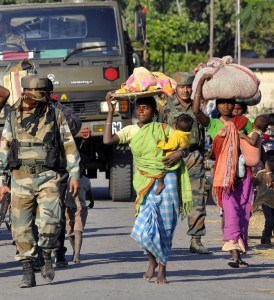
Once again, and very soon after the last instance of mass killings and displacement, another series of bloodshed and violence has rocked Bodoland Territorial Autonomous Districts (BTAD) – Assam. On 21st December 2014, two suspected militants of the National Democratic Front of Bodoland- Songbijit Faction (NDFB-S) were killed by the security forces in an alleged cold blooded encounter in the Chirang district of BTAD-Assam. In retaliation, on 23rd December, armed militants of NDFB-S attacked Adivasi villages in Kokrajhar, Chirang and Sonitpur districts. Since then it has resulted in the death of 81 people – 73 Adivasis including many women and children as well as 3 Adivasis killed in police firing on protestors.  As a mode of retaliation Adivasi mobs killed at least 8 Bodo civilians.  Since 23rd December, the entire BTAD and adjoining areas like Sonitpur district have been extremely volatile and under curfew. On 25th December, the Home Minister Mr. Rajnath Singh, in a meeting with the top security top brass, which was also attended by the Assam chief minister Mr Tarun Gogoi, declared Government of India’s resolve to fight terrorism and reportedly asked the security and intelligence apparati to ensure the elimination of the top leadership of NDFB-S within the next six months. Around 50 additional companies of paramilitary forces are being sent to Assam. The Army has also reportedly launched major operations in the Assam-Arunachal border region, in search of the NDFB-S militants.

 The NDFB-S massacre of Adivasi civilians is not a pre-modern tribal savagery. In fact such violence is justified by notions of exclusive ethnic-homelands and nations, and their corollaries like aspiration for spatial homogenization and monopolization of resources by particular communities. The Northeast of the country is home to many armed mobilisations against the domination of Indian state that are driven by an ethnic conception of political community in a contiguous territory. The Bodos of the Assam valley started an armed movement for Bodoland in 1980s against their marginalisation by the dominant non-tribal Assamese. Following the time tested carrot and stick policy, the Government of India managed to win over a faction of the armed groups in exchange for internal autonomy under the Sixth Schedule of the Constitution. The BTAD was formed in 2003. Curiously, even while the majority of citizens under the BTAD area identify themselves as non-Bodos the distribution of seats under the BTAD agreement is so designed that Bodos enjoy majority in the elected body.  While a faction of the Bodo leadership settled to run the BTAD, the seeds were sown for inter-ethnic clashes and violence. Continue reading Harvest of Innocent Blood – The Democracy Deficit in Bodoland, Assam: New Socialist Initiative

The Secular Stake- A Burden, or a Democratic Imperative? Sanjay Kumar

Guest Post by Sanjay Kumar

Mr Asaduddin Owaisi, the leader of MIM recently remarked in a media conclave that ‘Muslims are not coolies of secularism’. The statement made perfect sense for his politics. He is the leader a party that aims to mobilise voters on the basis of them being Muslim. The unprecedented success of Hindutva under Mr Modi in recent elections has upset many old electoral calculations, and opened new opportunities. Mr Owaisi is smelling a chance for the MIM to expand beyond its turf in Hyderabad, to regions where non-BJP parties have been getting the major chunk of Muslim votes with the slogan of secularism, seen principally as the promise of protection from riots. For Mr Owaisi, the remark serves multiple purposes. Average Muslim citizens are deeply disillusioned with a political process that has resulted in the utter marginalisation of their community.  For such voters, the statement is intended to clearly distinguish his party from the so-called secular non-BJP parties. It is calibrated to raise a doubt in their mind, why should only Muslims be expected to vote for such parties, when significant sections of the Hindus have sided with the communal BJP? It is also a preemptive answer to his political competitors and ideological critics, who are likely to accuse him of being communal.

Otherwise too, the secular discourse in India has largely become a minorities’ affair. It is said to be under threat when minorities are attacked. It is claimed to be flourishing when minorities rights are protected. A corollary belief among major sections of the so called majority community is that India  could have as well been non-secular if there were no minorities in the country, or if they are put in their place as the RSS political programme demands. Continue reading The Secular Stake- A Burden, or a Democratic Imperative? Sanjay Kumar

Impossible Lessons: Ravi Sinha

Guest Post by RAVI SINHA

Far away from Peshawar five men and a woman sat in a physician’s waiting room in Lucknow. The television screen that ordinarily shows some Bollywood film or a cricket match had a news channel on. It was day after the slaughter of children. The assistant who maintains the waiting list of patients and collects the doctor’s fee said something very predictable, even if heart-felt, expressing his horror and revulsion. The matter would have passed as unremarkably as most things do most of the times, except for what an elderly gentleman waiting to see the doctor had to say in response.

In a feeble yet firm voice whose conviction and sincerity was unmistakable, he said – dhaarmikata ko badhaava doge to kattarta badhegi; kattarta badhegi to aatank upajega, haivaaniyat saamne aayegi. (If you will promote religiosity, fundamentalism will grow, and from that will emerge terror and barbarism.) After a pause he added – hamaare desh mein bhee yahee ho rahaa hai, haalaan ki abhee hum pehle daur mein hain, dhaarmikata badhaane ke daur mein. (Same thing is happening in our country too, although we are in the first phase so far – that of promoting religiosity.) Continue reading Impossible Lessons: Ravi Sinha

‘Sant Rampal’ – Farmer’s Son Challenges Hegemony of Arya Samaj, RSS Ally In Haryana : Jaspal Singh Sidhu

Jaspal Singh Sidhu looks at the genesis of Sant Rampal and ‘Satlok Ashram’ the religious centre he established.

The arrest of former public servant -turned-godman 63-year-old Rampal from his Barwala (Hissar) ashram seems to have ended the two-week long much publicized drama enacted by the Haryana police, but it has, rather, widened social and religious gulf among the people of the area . The police operation took life of five women and a child, injuring of many others including two dozen media persons covering the event. Technically, Rampal’s arrest was sought by the Punjab and Haryana high court in a case of ‘criminal contempt of court’ following his persistent in refusal to appear before the court.

The Barwala event signals much more than what one gathers from the media. Rampal’s abortive defiance appears to be (consciously or unconsciously) challenging the hegemony of the Sangh Privar ideology based on Aryans and non- Aryans divide which uses the Vedic literature as manifestation of the Aryan race. The media story, invariably, only covers the present happenings. And, it is meant for the consumption of general public only interested in the day-to-day developments. For obvious reasons, such reporting suits both the government of the day and the media outlets. By and large, the media (newspapers and TV channels) reels out largely that information (official version) which police and official machinery serves them with punctuation of a little-bit material on the root cause of the controversy which has climaxed to the dramatic custody of Rampal by the police.

Read the rest of the article here.

Feed The Poor, Go To Jail

image : Courtesy eideard.com

Whether serving food to the homeless is a crime?

Ask Arnold Arbott, known as Chef Arbott, a 90 year old man from Fort Lauderdale, Florida, who along-with two other members of a Church charity faces potential jail term for at least six months for the same ‘offence’. In fact his name finds prominent mention in the police records in the past week for breaking the new city ordinance which has come into effect recently which characterises his act as breach of law, according to reports.

Talking to a newsperson he said:

“These are the poorest of the poor. They have nothing. They don’t have a roof over their head. And who could turn them away?”

Continue reading Feed The Poor, Go To Jail

Ghulam Azam : Death of a War Criminal

Wily strategists meet their nemesis in unexpected ways.

Ghulam Azam, the once all powerful leader of Jamaat-e-Islami Bangladesh, who died recently, might have brooded over this old dictum, in his last days in detention. It was only last year that he was sentenced to 90 years of imprisonment for his crimes against humanity which he committed when people of the then East Pakistan – todays Bangladesh – had risen up against the occupation army of Pakistan in the year 1971.

It was not surprising that the funeral of this man who evoked intense hatred and loathing from a large cross-section of the population of B’desh for his role during and after the liberation of the country witnessed protest demonstrations all over the country. There were even demands that his body be sent to Pakistan for final rites and should not be buried here.

“The janaza (funeral prayer) of a war criminal can never be held at the national mosque,”

Ziaul Hasan, chairman of Bangladesh Sommilito Islami Jote, an alliance of progressive Islamic parties, said at a human chain near the Baitul Mukarram National Mosque where Azam’s body was taken for funeral prayers. (The Telegraph, 27 th Oct 2014). Continue reading Ghulam Azam : Death of a War Criminal

Rip Van Winkle and Raman Singh Government

Can an elected Panchayat deprive a section of its own people belonging to a minority community its constitutionally granted right to practise its religion – e.g. organise prayers or engage in religious propaganda and have sermons?

Or can it ever deprive them of their mandatory quota of grain under PDS (public distribution system) which is focused more on persons living below poverty line?

Anyone conversant with rudimentary understanding of law would reply in the negative. It appears that in Chattisgarh they do it differently. In fact, Sirisguda, Kunguda and many other villages in Jagdalpur and adjoining areas in the state are in the news for similar reasons. Continue reading Rip Van Winkle and Raman Singh Government

Can Caste Be Swept Away? New Socialist Initiative

Statement by New Socialist Initiative, Delhi State Chapter
It is cleaning season in India. Country’s prime minister has gone to town with a broom. He started the campaign to clean India by sweeping a dalit neighburhood of erstwhile untouchables, seemingly breaking many caste barriers. There are very few public defenders of caste system nowadays. Upper caste men and women, whose ancestors only three generations ago fought tooth and nail to not yield even an inch of their caste privileges, now cry and organise under the slogan of Equality, once affirmative action for lower castes in educational institutions and government jobs has begun to have some traction. Is now not an opportune time to sweep away the garbage of caste into the dustbin of history?
Reality is too complex for this simple hope. If caste appears to be disregarded, or flouted, in some domains, its prejudices and violence are flourishing in others. The day country’s news channels were busy showing the prime minister sweeping a dalit basti in the heart of the capital, a young woman of Madurai in Tamil Nadu was burnt alive by her family for marrying a dalit. She could have been from anywhere in the country, from Haryana in the North to Maharashtra in the West, or Bihar in the East, to have met a similar fate; if not murder, certainly social ostracism. In all villages, where majority of Indians live, habitation areas are divided along caste lines; upper castes occupying the most secure central areas with easiest access to public utilities like road, school, and panchayat ghar; and dalits on the outskirts. In cities too, where caste markers are less visible, caste networks are the most potent resource the poor fall back upon while searching for job and habitation.

Continue reading Can Caste Be Swept Away? New Socialist Initiative

Swachh Bharat Abhiyan: Too Many Erasures

The Hindu Social Order is based upon a division of labour which reserves for the Hindus clean and respectable jobs and assigns to the untouchables dirty and mean jobs and thereby clothes the Hindus with dignity and heaps ignominy upon the untouchables.

(The Revolt of the Untouchables, Excerpted from Essays on Untouchables and Untouchability : Dr Babasaheb Ambedkar, Writings and Speeches, Vol 5 (Mumbai : Govt of Maharashtra, 1989, 256-58)

1.

The inauguration of the Swachh Bharat Abhiyan, (Clean India Campaign) with much fanfare, with ministers, bureaucrats and others holding Jhadoos evoked an interesting reaction from a ragpicker Sanjay who lives in Mehrauli with his parents. “These are the same people from whose houses we pick up garbage every day. This is part of our life. We don’t really understand why they are making it such a big deal,” Continue reading Swachh Bharat Abhiyan: Too Many Erasures

Report on Alleged Plan of Cow Slaughter in JJ Colony Bawana: IFTU,PMS,PDSU

A team comprising of Dr. Mrigank (Delhi Committee, Indian Federation of Trade Unions, IFTU), Poonam Kaushik (Gen. Secy. Pragatisheel Mahila Sangathan, PMS), Rajeev (Convener, Progressive Democratic Students’ Union, PDSU) visited JJ Colony Bawana and made investigations into the reports of alleged planned cow slaughter and intimidation of Muslims.

Bawana JJ Colony is situated opposite CRPF Camp near Bawana City. It has resettled people, displaced from Yamuna Pushta, Saraswati Vihar, Laxmi Nagar etc. its population is about 1.5 lakh and about 70% are Muslims (as we were told). It is under Outer Delhi district of Delhi Police and two Police stations covers the area. Bawana PS covers village and Narela covers JJ Colony. Mr. Udit raj of BJP is MP here, who has not even been seen by the people. We were told by people that CPI (M-L) New Democracy has sent an urgent e-mail to Commissioner of Police, Delhi demanding urgent deployment of forces. Continue reading Report on Alleged Plan of Cow Slaughter in JJ Colony Bawana: IFTU,PMS,PDSU

Of Money-in-the-Blood and Blood-Money: Ravi Sinha

Guest Post by Ravi Sinha

Recently, the Indian Prime Minister had occasion to report to the Japanese on his genealogy and haematic chemistry. Addressing a house-full of corporate honchos in Tokyo he declared, “I am a Gujarati, money is in my blood”. One does not know what percentage of Gujaratis would feel insulted by such a description. It can be asked, perhaps more meaningfully, if great civilizations are created by money-in-the-blood types and one may wonder if Gujarati greats such as Narsi Mehta, Narmad, Govardhan Ram or Gandhi, too, had money flowing in their blood.

There is also some irony in the situation – prime minister of a country with the largest number of world’s poor boasting about ‘money in the blood’ to the richest men of a country that has, in the post-war decades, made more money per capita than any other on the planet. This prime minister can be accused of many things but not of lacking in hubris unencumbered by learning and cultivation.

One may wonder about something else too. The Indians may deserve their new prime minister and all his speeches – on the Independence Day, the Teacher’s Day and on all the other days. After all, they have elected him. But what have the Japanese done to deserve this? What forces them, despite the depth and dignity of their civilization, to lap up such crassness and banality?

The answer can be given in one word – money. Continue reading Of Money-in-the-Blood and Blood-Money: Ravi Sinha

Scribbling in Dark Times


“In the dark times 
Will there also be singing? 
Yes, there will also be singing.
About the dark times.”

-Bertolt Brecht

 I.

There are moments in one’s life when one really feels perplexed.

You find yourself in a situation which you had never envisaged before.

Most of your predictions about the unfolding situation have gone awry or have not proved upto the mark.

One wants to remain calm, to contemplate things around you, take a break, but I know that for people gathered here – activists, writers committed to a cause, political workers – there is no such luxury. As rightly put by Jose Maria Sison, Filipino poet and revolutionary in one of his short poems

“The Tree Wants to be Calm

But the wind will not stop”

Continue reading Scribbling in Dark Times

Idiocy as Scholarship


It was probably late sixties or early seventies – when this pen pusher was a school student – one came across an article by a gentleman called P N Oak in a Marathi magazine called ‘Amrit’. The article made a particular case about Taj Mahal which it termed as ‘Tejo Maha Aalay’ or hindu god Shiva’s abode. It tried to establish through various ‘explanations’ that a Shiva Temple was destroyed to build Taj Mahal and if we dig deep we can find ‘remnants’ of the earlier structure.

For someone who was taught in an ambience, where few of our teachers never lost any opportunity to fill our gullible minds about the ‘hated other’, it was rather difficult to immediately grasp the lie which was peddled by this soldier turned writer. Nobody could then have the premonition also that such false claims – that their places of worship were buried beneath the Mosques as a lame excuse to demolish them – would become order of the day, in Hindutva politics. Continue reading Idiocy as Scholarship

The ‘Patriots’ of Our Times !

India is a land of surprises, say many.

And how can Bihar, which they say has been witness to a glorious past, be an exception. Of course nobody could have imagined that ‘surprise of surprises’ or (should I call) ‘mother of all surprises’ would be reserved for the Bihar police. In fact it was one life time experience for all of them there where they found how ‘Rs 50,000 can balloon into Rs 1.14 crore’.

The central character in the still unfolding drama is Giriraj Singh, a RSS activist since his childhood days, and a senior leader in the state, who has already carved out a name for himself nationally for his controversial statements. People would remember how he proposed to Modi opponents to go to Pakistan during election campaign or how he eulogized Brahmeshwar Singh, leader of Ranveer Sena, the private army of landlords which had been allegedly responsible for hundreds of killings of innocents as ‘true Gandhian of our times’ when the dreaded figure was killed in a gang war. As an aside it needs be mentioned here that Giriraj Singh was one of the first in the state who had vouched for Mr Narendra Modi’s PM candidature also. Continue reading The ‘Patriots’ of Our Times !

Pearls of Wisdom of A RSS Leader – ‘Elections equivalent to Independence Struggle’

Suresh Soni, RSS’s point person with the BJP, who facilitated ‘anointment’ of fellow Pracharak as PM candidate last year and smoothly engineered the marginalisation of the senior Advani and proved his clout within the organisation, is in news these days albeit for wrong reasons.

News has come in that he along with his former supremo (the late) K S Sudarshan were also beneficiaries of the yet unfolding MPEB scam which has already claimed the head of a senior minister – another fellow Pracharak – in Shivraj Singh Chauhan’s cabinet. Laxmikant Sharma, the said minister, who earlier handled important portfolios like mining, culture, human resources had claimed at the time of his arrest that he has been made a sacrificial lamb and when time comes he would also ‘reveal the truth’. He allegedly facilitated appointment of Mihir, a personal assistant to the late Sudarshan, as a ‘Nap Taul Inspector’ at the behest of Suresh Soni. Continue reading Pearls of Wisdom of A RSS Leader – ‘Elections equivalent to Independence Struggle’

Statement on the Murder of Three Young Persons in Badaun and Pune: P.A.D.S.

People’s Alliance for Democracy and Secularism (P.A.D.S.)  Statement on the murder of three young persons in Badaun and Pune
 
 
While introducing the Draft Constitution in the Constituent Assembly, Dr B. R. Ambedkar had observed, “Democracy in India is only a top-dressing on an Indian soil, which is essentially undemocratic.”  The same continues to hold true sixty four years later. A few weeks ago the people of India participated in the largest-ever election of their representatives in a largely free and fair process. However, other events since then have revealed the shallowness of this democratic top-dressing along with the tyrannical side of our society and polity.
 
On 27 May two girls aged 12 and 14 from an oppressed caste family of Katra Sadatganj in Badaun district of UP were sexually assaulted and killed when out to answer nature’s call. The rapists, belonging to the local dominant caste, hung their bodies from a tree in a public display of their power.
 
On 2 June in Pune, twenty-eight year old Mohsin Shaikh, an information technology professional was beaten to death by a group of men belonging to an outfit called Hindu Rashtra Sena. The killers even celebrated their cruelty in messages declaring that the ‘the first wicket is down’.  

Continue reading Statement on the Murder of Three Young Persons in Badaun and Pune: P.A.D.S.

Statement on the Hate Crime in Pune: Concerned IT professionals

Circulated by Concerned IT professionals from Pune

We, the undersigned express our deep shock at the gruesome incident of hate crime reported in the city of Pune earlier this week. A 28 year old IT professional Shaikh Mohsin Sadiq was thrashed to death by a group of people suspected to be connected with a radical Hindu outfit called Hindu Rashtra Sena.

Mohsin was reportedly returning home after offering namaz at a mosque on Monday night when he found himself caught by the mob. As is the case in every hate crime, a skull cap on head and beard were enough for the killers to pounce on him with deadly intentions. The city was witnessing bandh and violent street protests by Shiv Sena, BJP and other radical Hindu organizations in the wake of Facebook post(s) with allegedly derogatory references to Shivaji and former Shiva Sena Chief Bal Thackeray. The assailants were apparently involved in similar protests when they spotted Mohsin on Monday night in Bankar colony in Hadapsar area of Pune.

One cannot help seeing this incident vis-à-vis forthcoming assembly elections in Maharashtra. As a run-up to the elections which are due in a few months, an attempt to polarize the masses on communal lines with the sheer intention of electoral gains, as we have seen elsewhere, seems to be on the cards. We appeal to the state government to thwart any such attempts with alacrity while ensuring safety to every citizen; we also appeal to the people of Maharashtra to not fall prey to such hideous designs and uphold the progressive tradition of the state that has seen peaceful co-existence of various sects, religions and cultural groups with no place for hatred.

While offering our deepest condolences to the bereaved family members and friends of Mohsin, we extend our heartfelt solidarity to each and every member of minorities/disadvantaged communities in struggle to preserve the values of democracy, secularism and justice.

Sd/—

Neeraj Kholiya

Dhanesh Birajdar

Bharatbhooshan Tiwari

Nitin Agarwal

Vinod Pillai

Kamesh

Gokul Panigrahi

Rajat Johari

Ujjwal Barapatre

Kshitij Patil

Sanind Shaikh

Akbar Ali

Prince Shelley

Mohamed Shazad

Shaikh Asfaque Hossain