All posts by Shuddhabrata Sengupta

Life in a ‘Sterilized’ Zone, Hebron, Palestine: Ravinder Kaur

Guest Post and Photograps by RAVINDER KAUR

Map of Hebron, Courtesy ‘Breaking the Silence

On 12th June, 2014, the kidnapping of three Israeli teenagers near Hebron resulted a massive military search operation in the area. Since 30th June when their dead bodies were found north of Hebron, a Palestinian teenager has been abducted and killed in a revenge attack in East Jerusalem, and concerted air strikes have been launched on Gaza by the Israeli forces as punishment to Hamas who Israel holds responsible for the abduction and murder of the teenagers. In ten days of Israeli air strikes more than 216 have been killed in Gaza, and rocket firing by Hamas has claimed one life in Israel. A ground invasion began yesterday evening. Even as talks of a possible ceasefire, and resuming normal life, take shape, one might consider what ‘normality’ constitutes in a place like Hebron that has been at the center of the current conflict. It is in the normal, the routine that the spectacular violence takes shape.

Continue reading Life in a ‘Sterilized’ Zone, Hebron, Palestine: Ravinder Kaur

Delhi Police Prevents Peaceful Protest in Front of Israeli Embassy – Students, Others, Injured and Detained

A Tale of Two Protests, On Two Days.

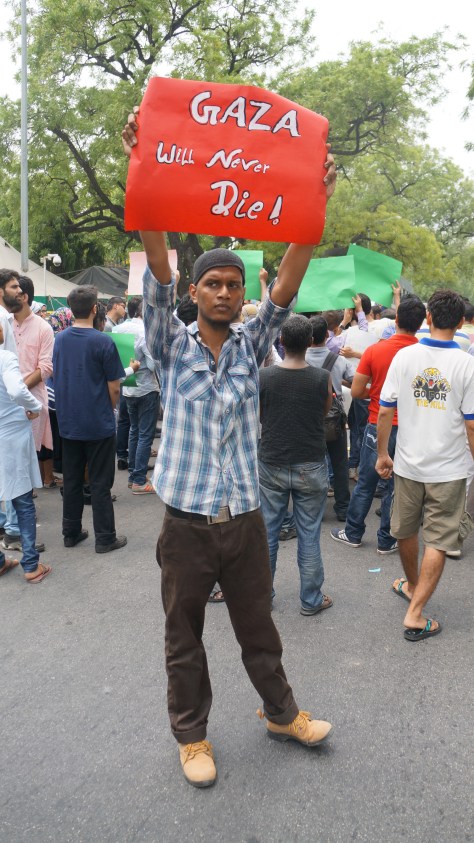
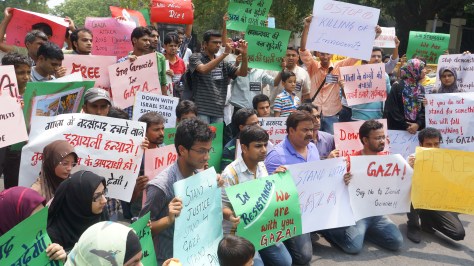
Protests against the situation in Gaza have been held in Delhi yesterday, (Sunday, 13th July, and today, 14th July, in the morning). Yesterday, on Sunday morning, there was a peaceful protest in front of the Israeli Embassy – this came out of a call for protest by individuals. Yesterday, about a hundred odd people, including many young people, had gathered. I was present at this gathering. Some people made statements condemning the Israeli state’s aggression against the Palestinian people. The Delhi Police was present, but did not try to disrupt or disturb the protest. The protest happened right in front of the Israeli Embassy gates on Aurungzeb Road.

Protestor in front of the Israeli Embassy in Delhi on Sunday, 13th July 2014
Protestors with Signs against Israeli State's Aggression on Gaza, in front of the Israeli Embassy in New Delhi, 13th July, 2014
Protestors with Signs against Israeli State’s Aggression on Gaza, in front of the Israeli Embassy in New Delhi, 13th July, 2014

Continue reading Delhi Police Prevents Peaceful Protest in Front of Israeli Embassy – Students, Others, Injured and Detained

How Goldman Sachs Got it Wrong on Football, The World Cup and Economics: Tushar Dhara

Guest Post by TUSHAR DHARA

In May this year the investment banking powerhouse Goldman Sachs released a report that predicted Brazil would win the FIFA world cup. The prediction relied on statistical modelling and used tools like “Regression Analysis”, “Poisson Distribution”, “Stochastic model” and “Monte Carlo Simulation”. In other words, the methodology is incomprehensible to anyone except those with an advanced degree in Statistics or Econometrics. In hindsight, the prediction looks silly, given the 7-1 score line in the semi-final match between Germany and Brazil. However, the report is a perfect example of the failures of modern economics, particularly the financial voodoo economics pushed by the likes of Goldman Sachs.

When “The World Cup and Economics 2014” was released on May 27 it gained a lot of press publicity globally. The report predicted that Spain would reach the semi-final stage and lose to Argentina, which would lose to Brazil in the final. Goldman’s research division analyzed reams of data, including about 14,000 matches since 1960, national teams’ Elo rankings, average goals scored per team, home country and home continent advantage. To be sure, the report states that the predictions are just “probabilities” of teams advancing. Still the report states, “The most striking aspect of our model is how heavily it favours Brazil to win the World Cup”, and, “the extent of the Brazilian advantage in our model is nevertheless striking.” Continue reading How Goldman Sachs Got it Wrong on Football, The World Cup and Economics: Tushar Dhara

The Memory of Fifty Seven Seconds: After Watching an Israeli Missile Strike in the Gaza Strip on Al-Jazeera

A short fragment of video, fifty seven seconds long, taken from behind a window in a building in the Gaza Strip which was aired last night on Al Jazeera television brought home (once again) the sheer horror of the Israeli Defence Forces’ (IDF) brutal, ongoing offensive against the people of Palestine with devastating clarity.

Continue reading The Memory of Fifty Seven Seconds: After Watching an Israeli Missile Strike in the Gaza Strip on Al-Jazeera

A Stolen Verdict: Nirmalangshu Mukherji

Guest Post by NIRMALANGSHU MUKHERJI

The Bharatiya Janata Party secured about 19% votes in the general elections of 2009 to win 116 seats in the Parliament. With this most impressive conversion ratio, they had more or less exhausted their possibilities in their ‘safe’ states like Gujarat, Madhya Pradesh, Chhattisgarh, Jharkhand, Karnataka, and the like. They were still 157 seats away from a simple majority in the Loksabha. Even assuming the impressive conversion ratio, they needed at least 26% more of the vote share, that is 45% in all, to form a government.

When the elections for 2014 were announced, it was hard to see where the BJP would get these additional votes from. Moreover, unlike the NDA of 1999-2004, they had rather modest support from other parties with most of the big parties like AIADMK, TMC, JDU, BJD, and the like staying away. Hence, even if we factor in some rise in number of seats in ‘safe’ states, plus handsome gains in Rajasthan, Maharashtra etc., their ability to reach anywhere near the 272+ mark looked rather dim.

Continue reading A Stolen Verdict: Nirmalangshu Mukherji

The Triumph of the Will(ie): Prasannarajan Anoints Modi in the Open

The televised coronation (or should I say Rajyabhishek) of Narendrabhai Damodardas Modi has featured a supremely photogenic set (the Dasashwamedh Ghat in Benaras), a chorus line of calisthenic priests lining the riverfront of the Ganga with blazing torches, a script (being written, even as the epic is being canned, in every television studio and editorial office) talented producers and art directors, an army of happy-clappy extras, and even its own battalion of masked stunt doubles.

Modi at Dasashwamedh Ghat, Varanasi/Benaras on 17 May 2014. Courtesy, Amar Ujala website.
Amit Shah, Rajnath Singh and Narendra Modi,  at Dasashwamedh Ghat, Varanasi/Benaras on 17 May 2014. Courtesy, Amar Ujala website.

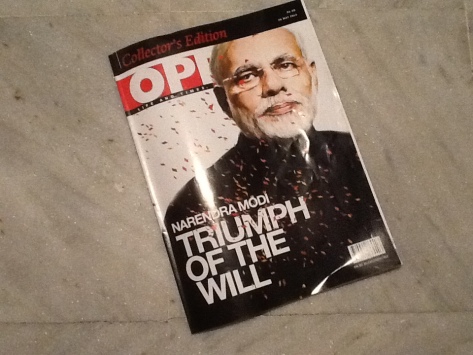
Like any good bollywood blockbuster, it cannot but be a homage to an extant cinematic classic. S. Prasannarajan, editor of the Open Magazine has even told us what that classic is. On the cover of Open, beneath a pensive, tight lipped and determined Narendrabhai looking out at the magazine’s reader through a shower of rose petals and rimless Bulgari glasses, four words spell out in bold capitals the film’s name – ‘TRIUMPH OF THE WILL’. Dejavu, anyone?

'Triumph Of the Will' Open Magazine, May 26, 2014
”Triumph Of the Will’ Open Magazine – ‘Collectors’ Issue’, May 2014

Continue reading The Triumph of the Will(ie): Prasannarajan Anoints Modi in the Open

The UAPA in Madhya Pradesh – The JTSA Report in Perspective, and Beyond: Sharib Ali

Guest Post by SHARIB ALI

REPEAL UAPA: JTSA REPORT IN PERSPECTIVE, AND BEYOND

The state fabricates terror. There is enough evidence to take it to court on that count. Yet, how does one construe ‘fabrication’- what is implied by it? First, that the state has orchestrated elaborate attacks- violence to terrorize its people for certain legal, electoral and political ends. Second, that it has, through the use of laws like Unlawful Activities Prevention Act (UAPA)  against specific segments of its population has consciously manufactured a state of terror- a collectively imagined perception of threat that the nation faces from a particular people. The ends, always remain the same.

Though there is evidence of the agencies of the state, or actors within them, expressly participating in orchestrating large scale terror attacks (think col. Purohit), it is the latter- where terror within specific communities is manufactured in the eyes of the law and the people- that I deal with here, today. ‘Guilt by Association’The JTSA (Jamia Teachers Solidarity Association) report on UAPA cases in Madhya Pradesh, is a crucial case in point.

Continue reading The UAPA in Madhya Pradesh – The JTSA Report in Perspective, and Beyond: Sharib Ali

Why the Law may still Catch Up with Amit Shah: Warisha Farasat

Guest Post by WARISHA FARASAT 

Amit Shah seems to be on a roll this election season. First, he escaped any punishment after delivering one of the most disturbing hate speeches made during the 2014 election campaign. After the Muzaffarnagar riots, attempts were made by political parties to capitalize on the suffering of the locals, and provoke certain communities to vote for them. And when Amit Shah was censured by the Election Commission for indulging in objectionable speeches during the election campaign in Uttar Pradesh, BJP Primeminsterial candidate Narendra Modi came to the defence of his most loyal lieutenant. Clearly, Amit Shah’s statement was made with the intention of polarizing the voters in a politically surcharged environment in Uttar Pradesh and amounted to hate speech. However, the Election Commission soon did a u-turn, diluted its own stand, withdrew the ban against Shah and allowed him to go ahead with his campaign. The withdrawal of ban against Amit Shah ignoring the drastic implications of his hate speech during the campaign was alarming.

And now, the CBI has not named Shah as an accused in the Ishrat Jehan fake encounter case stating that there is no ‘prosecutable evidence’ available against him. But Shah and his supporters should not think that this so-called ‘clean chit’ absolves him of all criminal responsibility for indulging in fake encounters in Gujarat. If we believe the CBI in the Ishrat Jehan case when they claim that there is no prosecutable evidence against Shah, consequently, we also need to trust their investigations in atleast two other fake encounters, namely the Sohrabuddin Shiekh and the Tulsiram Prajapati cases where the CBI have named Shah as an accused. Shah is presently being tried in these cases and is able to campaign during these elections only because he is out on bail.

Continue reading Why the Law may still Catch Up with Amit Shah: Warisha Farasat

Universal Adult Francise? A Reality Check: Reena Gupta

Guest Post by REENA GUPTA

When polling began on the morning of April 10, our team coordinating the Aam Aadmi Party campaign in Bawal was expecting to respond to complaints of money and alcohol distribution. During the jan sabhas throughout the area, Yogendra Yadav, the AAP candidate for the constituency, had made it amply clear that, “na toh hum shraab bechenge, nah hum bikne denge.” We had spent days training booth volunteers who would be available to assist voters with information and monitor elections throughout the 200 odd villages in Bawal. Our mobile teams would document any violations of the electoral code and lodge complaints with the requisite authorities. Having campaigned in the Delhi elections for AAP, I knew firsthand that the secrecy of the ballot gave people the chance to rise above external pressures and inducements. After the hard yards of campaigning, voting day seemed set to be relaxing and I occupied myself with preparations for lunch for the numerous volunteers who were streaming in and out of our office.

Bawal is less than 100 kms from Delhi and is one of 9 legislative constituencies that comprise the Gurgaon Parliamentary constituency. In fact, Bawal falls within the National Capital Region and has been proclaimed as soon joining the constellation of Delhi’s satellite towns. There are already hi-tech factories strewn along the Delhi-Ajmer Highway and then there’s the buzz about the upcoming Delhi-Mumbai Industrial Corridor. Of course, the symptoms of lop-sided development are visible right behind the façade of big industrial complexes. With one quick turn off the highway, the roads fall apart and you are welcomed to villages with virtually non-existent education and public health infrastructure. However, I realized the extent of the distance between Bawal and Delhi only after our phones started ringing on the morning of 10th April and we set out to see for ourselves the manner in which citizens are allowed to exercise their electoral rights, in the world’s largest democracy.

Continue reading Universal Adult Francise? A Reality Check: Reena Gupta

EFLU Hyderabad Rusticates Students for Wanting to Keep Library Open: Sudha and Muhammad Afzal

Guest Post by Sudha K F and Muhammed Afzal P

The semester break seems to be the most active time for the English and Foreign Languages University (Hyderabad) administration. What are these activities that the administration invests so much of its energies in, when most students have left the campus for their vacation? It is sending memos, show cause notices and the latest: the RUSTICATION of two significant student leaders on the EFLU campus.

When the word ‘fascist’ has become an everyday term, to talk about the Modi nightmare and its anxieties, we have more to add to that list from EFLU, Hyderabad. Mohan Dharavath, President of Dalit Adivasi Bahujan Minority Students’ Association and Satish N, General Secretary of Telengana Students’ Association, have been rusticated from the University for two years, the latest in a series of draconian and undemocratic moves, on the part of the autocratic EFLU administration. The two students, along with another student, Subhash Kumar, were given show cause notices by the Proctor’s office on 24 March, to which they responded, denying the baseless charges levelled against them. The rustication is part of the disciplinary action against these students who were part of a massive protest that took place against the administration, called forth by the EFLU Students’ Union. This protest was against the absolute closure of the only 24-hour reading room, and library, on the small EFLU campus in the first week of March 2014.

Continue reading EFLU Hyderabad Rusticates Students for Wanting to Keep Library Open: Sudha and Muhammad Afzal

Some Reflections on the neutrality of political institutions and the project of making Modi more palatable: Moiz Tundawala

Guest Post by MOIZ TUNDAWALA

“ … . however good a Constitution may be, it is sure to turn out bad because those who are called to work it, happen to be a bad lot. However bad a Constitution may be, it may turn out to be good if those who are called to work it, happen to be a good lot. The working of a Constitution does not depend wholly upon the nature of the Constitution. The Constitution can provide only the organs of State such as the Legislature, the Executive and the Judiciary. The factors on which the working of those organs of the State depend are the people and the political parties they will set up as their instruments to carry out their wishes and their politics.”

[Dr. Bhimrao Amdedkar]

These observations of Babasaheb Ambedkar, made on the 25th of November, 1949, one day before the Constitution was finally adopted after three years worth of labour, should suffice for anyone who dismisses Modi skeptics as excessive scare mongers. As a second year law student in 2006-07, I couldn’t quite understand why our revered constitutional law teacher Prof. M.P. Singh would keep reiterating these sentiments in class, something which I thought was so axiomatic it did not need emphases. With only a few days left for the outcome of what is being called an election for the soul of India, I now realize the wisdom underlying those constant reminders, especially in a law school converted by the culture and priorities of its students into a factory churning out smart but unreflective products for the corporate sector. I think those of us who find Modi problematic, but would still vote him in for the lure of the promised economic miracle, while at the same time consoling ourselves with the talk of sufficiently robust political institutions capable of surviving any onslaught, must listen to Ambedkar carefully. The Constitution is an artefact, a human creation, constantly needing ‘good people’ at the helm to work it out. If nothing else, resistance to Modi’s rise to power is at least resistance against the enthronement of ‘bad people’, who deep down have only harboured contempt for the Constitution as a foreign document.

Continue reading Some Reflections on the neutrality of political institutions and the project of making Modi more palatable: Moiz Tundawala

Implausible Deniability – Reading Amish Tripathi’s ‘Shiva’ Trilogy: Eric Gurevitch

Guest Post by Eric .M. Gurevitch

A few years ago I had the pleasure of sitting in on a seminar Wendy Doniger taught on Hindu Mythology. On the final day of the class, Professor Doniger was addressing the continuing questions of students. A young man raised his hand and was called upon. “Professor Doniger,” he said somewhat sheepishly, “why do Indians keep retelling the same stories over and over again?” The rest of the students looked on somewhat aghast—clearly this student hadn’t understood the point of the class at all. But Doniger just chuckled. “Well,” she said, a sly grin creeping across her face, “because they can never get them quite right.” Her point is a simple but powerful one. As she went on to explain to the class (and in her book The Implied Spider), the stories we tell reflect the world around us. And as soon as we write a story down, the world we were trying to capture has changed. We cannot help but retell the stories that we value—after all, they are never quite right for us—in our time. And even if we manage to get them quite right, they are only right for us—other people living around us will have different reasons for telling similar stories, for appealing to the same stock of authoritative figures for different purposes. The importance of analyzing the implications of retelling of Indian stories takes on new meaning in a modern India where Wendy Dongier’s controversial book The Hindus, an Alternative History is no longer sold in stores.

Continue reading Implausible Deniability – Reading Amish Tripathi’s ‘Shiva’ Trilogy: Eric Gurevitch

Two Tendencies in Industrial Areas: From Faridabad Majdoor Samachar

Even as news of elections seemingly eclipses everything else in India.  life, in the industrial suburbs of the National Capital Region, continues as usual. A report from Faridabad Majdoor Samachar. New Series 310, April, 2014.

Continue reading Two Tendencies in Industrial Areas: From Faridabad Majdoor Samachar

मर्दवादी और असमान सामाजिक व्यवस्था में स्त्री प्रतिरोध – ‘हाईवे’: धर्मराज कुमार

Guest Post by धर्मराज कुमार

वर्त्तमान परिदृश्य में हमारे इर्द-गिर्द जितने भी विमर्श मंडराते नजर आ रहे हैं उन सबके के आक्रामक शुरुआत को सोलह दिसंबर की बलात्कार की घटना से जोड़े बगैर नहीं देखा जा सकता है। इसमें कोई शक नहीं कि उस रात को दहला देने वाली घटना तक को कई खांचों में रखकर देखा जाता है। उदाहरणस्वरूप, आलोचना के तौर पर यह भी कहा गया कि निर्भया अभिजात वर्ग से आती थी इसलिए उसके बलात्कार ने पूरे देश की राजनीति को झकझोर कर रख दिया। जबकि उसी दरम्यान दिल्ली के करीब हरियाणा में कई दलित और सामाजिक रूप से प्रताड़ित लड़कियों और महिलाओं का निर्ममता से बलात्कार किया गया और मारकर फ़ेंक दिया गया और जिसका आज तक कोई अता-पता तक नहीं है। इससे भी इंकार नहीं किया जा सकता कि दिसंबर की घटना के पहले भी अनगिनत बलात्कार की घटनाएं हररोज हो रही थी और उसके बाद भी हो रही है। मगर कभी भी किसी विरोध ने इतना विकराल रूप धारण नहीं किया जिससे देश की राजनीति को हिलानी तो दूर उससे आजतक न्याय प्रक्रिया में गति तक आ सके। इसके कई कारण हैं।
मेरा उद्देश्य उस तरफ ध्यान खींचना कतई नहीं है। मेरा उद्देश्य है मुख्यधारा में इन मुद्दों से जुड़ती सवालों को उठाये जाने की तरफ ध्यान ले जाना। मैं बात कर रहा हूँ मुख्यधारा में चल रही फिल्मों और उससे जुड़े सवालों के ऊपर। फ़िल्म समीक्षा की दुनिया में ऐसा कम ही देखने को मिलता है जब कोई फ़िल्म अपनी रिलीज के बाद एक चर्चा का विषय हो या विवाद का हिस्सा हो। बल्कि तमाम विचारधारा से जुड़े लोग जब किसी फ़िल्म के ऊपर अपनी प्रतिक्रिया जताने लगे इसका मतलब है कि ऐसी फिल्में लोगों को संवाद करने के लिए विवश कर रही हैं। Continue reading मर्दवादी और असमान सामाजिक व्यवस्था में स्त्री प्रतिरोध – ‘हाईवे’: धर्मराज कुमार

Jamaate-E-Islami’s Tryst With Politics – Tilting at the Electoral Windmills: Fahad Hashmi

Guest Post by FAHAD HASHMI

‘It was all very well to say “Drink me”, but the wise little Alice was not going to do that in a hurry. “No, I’ll look first,” she said, “and see whether it’s marked ‘poison’ or not”; for she had read several nice little stories about children who had got burnt, and eaten up by wild beasts, and other unpleasant things, all because they would not remember the simple rules their friends had taught them: such as, that a red-hot poker will burn you if you hold it too long; and that, if you cut your finger very deeply with a knife, it usually bleeds; and she had never forgotten that, if you drink much from a bottle marked “poison,” it is almost certain to disagree with you, sooner or later.’

(Alice’s Adventure in Wonderland)

Continue reading Jamaate-E-Islami’s Tryst With Politics – Tilting at the Electoral Windmills: Fahad Hashmi

The ‘Occupy Library’ Protest in EFLU, Hyderabad: Anonymous

Guest Post by a student who wishes to remain anonymous

The recent incidents in the English and Foreign Languages University (EFLU), Hyderabad, shows yet another move from the part of the administration to bypass democratic procedures and suppress the voice of the student community. Ever since she took charge, the current VC Sunaina Singh has managed to acquire infamy for her anti-student and totalitarian mode of governance. The most recent one was closing down the common reading room for students, which was functional 24*7. The initial reason given was that it was under renovation. Later, notifications were put out stating that the previous reading room will be attached to the library (which closes down at 8pm on weekdays and at 6pm on weekend). Separate reading rooms were allotted for male and female students in their respective hostels, each of which cannot accommodate more than 20 students at a time (the total strength of the university is 2500+).

This decision, in effect, meant that boys and girls had no place to study/ work together after the stipulated working hours of the library. The authorities even posed the question as to why it was necessary that boys and girls have to study together. Excuse my hyperbole, but probably the next step would be to prohibit the formation of mixed groups for class works, assignments and presentations.

This particular incident of closing down the common reading room has to be viewed by placing it in the context of the larger issue- the regulations imposed on the students over the past one year and attempts to curb the liberal values that EFLU has always held up.  Continue reading The ‘Occupy Library’ Protest in EFLU, Hyderabad: Anonymous

Report of a Protest by Students at UP Bhavan in Delhi against Harrassment and Slapping of Sedition Charges on Kashmiri Students at SVSU, Meerut: Kashif Ahmed Faraz

Guest Post by KASHIF AHMED FARAZ

Several students protested on the 7th of March in Delhi against the harassment and eviction of Kashmiri students in SVSU (Swami Vivekanand Subharti University), Meerut and the slapping of sedition charges against 67 Kashmiri students. The protesters included activists, students from universities, mostly from JNU and also Kashmiri Students residing in Delhi. The protest took place at Uttar Pradesh Bhawan, New Delhi.

Signs at Protest at UP Bhavan against Harrassment of Kashmiri Students in Meerut

Continue reading Report of a Protest by Students at UP Bhavan in Delhi against Harrassment and Slapping of Sedition Charges on Kashmiri Students at SVSU, Meerut: Kashif Ahmed Faraz

Demand to Reconsider and Revise Sections 153a and 295a of the Indian Penal Code to Protect Freedom of Expression in India: Concerned Academics and Public Intellectuals

Statement by Concerned Academics and Public Intellectuals: Ananya Vajpeyi, Sheldon Pollock, Partha Chatterjee, Laurie Patton, Romila Thapar, David Shulman and many others

We the undersigned are appalled by the recent settlement reached between Dina Nath Batra for the Shiksha Bachao Andolan and Penguin Books India, to cease the publication of Wendy Doniger’s The Hindus: An Alternative History (Penguin USA 2009; Penguin India 2010), and to withdraw and destroy remaining copies of the book on Indian territory. Continue reading Demand to Reconsider and Revise Sections 153a and 295a of the Indian Penal Code to Protect Freedom of Expression in India: Concerned Academics and Public Intellectuals

Open Letter to AAP and the Public on Continuing Racism in Khirkee Village: Aastha Chauhan, Malini Kochupillai & Friends

Guest Post by AASTHA CHAUHAN, MALINI KOCHUPILLAI, and several AFRICAN RESIDENTS OF DELHI

Dear Mr. Arvind Kejriwal, Mr.Yogendra Yadav and Aatishi Marlena,

Being witness to the events occuring in Khirkee this past month, we, a group of artists, architects, activists and local residents have felt  the need to frame an open letter addressed to your party, the AAP & the public. The media-frenzy associated with these events has been accompanied by the usual kind of misinformation and hyperbole. However, in the ensuing noise, the real stories of the underlying racism that afflicts our society and the negative repercussions of the raid on the African residents of the neighborhood, have been lost.  We hope this letter will clarify some facts and put across a few of our concerns.

Our intention is not to encourage confrontation, it is to propose solutions. Delhi is a tough place for all immigrants alike, how will we make this a more inclusive compassionate city? These are the larger questions. These were the issues we were hoping to tackle. Continue reading Open Letter to AAP and the Public on Continuing Racism in Khirkee Village: Aastha Chauhan, Malini Kochupillai & Friends

Pulping Doniger Can Put Penguin in Peril

It was with great anger and sadness that many readers in India heard yesterday of Penguin Books India’s decision to enter into an out-of-court settlement with a group of busy-bodies led by one Dina Nath Batra of the so called ‘Shiksha Bachao Andolan’ (Save Education Movement) – one of the many poisonous heads of the RSS hydra – to recall and pulp all extant copies of Wendy Doniger’s “The Hindus: An Alternative History” (Penguin India, 2009).

Dina Nath Batra (infamous for leading the campaign that led to the withdrawal of A.K. Ramanujan’s essay on the Ramayana from the Delhi University syllabus) and others, through their advocate, one Monika Arora, had filed a suit in a Saket, New Delhi against Wendy Doniger (whom they address, as ‘You, Noticee’) and Penguin Books on the grounds that Doniger’s book offends their religious sentiments. Continue reading Pulping Doniger Can Put Penguin in Peril

Homophobia and Islamobphobia – The Jamaat e Islami Hind and the Supreme Court’s Decision on Section 377: Fahad Hashmi

Guest Post by Fahad Hashmi

[ Yesterday, the Supreme Court of India, dismissed the ‘review petition’ that had been filed with a plea to reverse the Supreme Court’s recent (December 2013) decision to uphold the constitutionality of Section 377 of the IPC. This decision effectively ‘re-criminalized’ Homosexuality in India and is a severe blow to human rights. Various religious groups, Hindu, Muslim and Christian had appealed to the Supreme Court to act against the rights and interests of homosexuals. In a sad instance of the erosion of  secular and democratic values, the Supreme Court has endorsed their view. The Jamaat -e-Islami Hind, a right wing, muslim fundamentalist organization that claims to speak for Indian Muslims has welcomed the Supreme Court’s decision. This post by Fahad Hashmi attacks the Jamaat-e-Islami Hind’s position on homosexuality and challenges its claim to speak in the name of muslims and their faith. We see it as an important contribution to the ongoing discussion on section 377 on Kafila ]

“There was once…a sad city, the saddest of cities, a city so ruinously sad that it had forgotten its name.
In the north of the sad city stood mighty factories in which (so I’m told) sadness was actually manufactured, packaged and sent all over the world, which never seemed to get enough of it. Black smoke poured out of the chimneys of the sadness factories and hung over the city like bad news”.
(Haroun and Sea of Stories, Salman Rushdie)

It is one of the ironies of democracies across the world that minorities of all shades are always in the crosshairs of majoritarianism. This minority-majority is a function of numbers and power though this is not a thorough definition since we have had seen altered power equation of this binary. The apartheid South Africa is a case in point. For stating the obvious the strength of a democracy is a function of safety and rights that minorities enjoy in it. However, minorities on the whole are always drawing majority’s fire. On the subcontinent one could see this happening in Pakistan, Bangladesh, Sri Lanka, and of course India is not an exception.

Continue reading Homophobia and Islamobphobia – The Jamaat e Islami Hind and the Supreme Court’s Decision on Section 377: Fahad Hashmi