All posts by Nivedita Menon

A Response to the Fading Queerness: Navadeep

NAVADEEP writes in Gaylaxy on the responses around the matrimonial advertisement for a gay man placed by his mother, in which she specified “Caste no bar, (though Iyer preferred)”.

It has been a few days since the first gay-matrimonial ad of the country has been out, and as expected, it has gathered a great deal of attention both from gay and straight people. Lack of available information would keep me from commenting on the reactions among the straight crowd. But being a part of the gay community, I have witnessed two different arguments emerging:

1. It is a great progressive step from a loving mother for her gay son and is also a potentially visible statement of the gay community in mainstream society.

2. While appreciating the aforementioned, a section of people in the community are extremely agitated about how the matrimonial ad mentions a preference of caste. This has lead to the debate of contesting the regressive part of the ad (where, of course, I find my place)….

Where does one’s choice start and where does it end? How absolute and independent an identity can this choice and preference claim? Is this choice/preference free from conditioning? Is it just an individual’s sole conscious choice/preference or product of the society he is part of? Do personal choices and preferences have no social and political connotations? Do they not have any historical and cultural context?

Read the rest of this thought-provoking piece here, and do read the comments section too, for an interesting debate.

Imperial Ejaculations – Reflections on “Ten Books that Shaped Empire”: Dilip Menon

Guest Post by Dilip M. Menon

Unlike Salman Rushdie, I did not grow up kissing books, I merely collected them. From provision stores, sidewalks, and from booksellers who were eccentric enough to try and survive by selling second hand books, in the small towns and yet-to-become cities of post independent India. The books came with a fine patina of dust that no amount of smacking against one’s thigh or the flat of one’s palm could get rid of. Kissing them was out of the question. In what was called the mofussil, or the provinces, the detritus of empire and the war that ended it gathered, as the collections of effects of the British who departed, as much as those who stayed on and died, gathered in the auction houses and bookstores.

It was on a summer afternoon in 1973 that I cycled down to the local provision store in Pune and saw beside the sacks of rice, wheat and spices, a pile of books, periodicals and rather lurid posters of European women with very long legs and few clothes on. I had always imagined Europe to be a cold place. In the pile were old Penguins; books by Enid Blyton, Anthony Buckeridge, Capt. WE Johns, Rider Haggard; periodicals like Boys Own Weekly, Gem, and Magnet; and of course the war comics (the staple reading of Allied troops posted in India and South East Asia), from which I learnt my German. At school, during the break, we were always running through the corridors shouting Schnell, Schnell and calling our Kamerads Schweinhunds. But on that summer day, I found two authors that I had not heard of: George Orwell and Frank Richards. The former had written a book about some fat pigs and the latter, one about a fat boy, and being rather plump myself, I was favourably disposed.

{AC8E3D54-0D18-423F-A888-DAE1A6C73C6C}Img400 Continue reading Imperial Ejaculations – Reflections on “Ten Books that Shaped Empire”: Dilip Menon

What’s wrong with these headlines? (Answer – It’s Election time, Stupid)

Another disputed mosque sparks Ballabgarh riots” (The Hindu)

Ballabhgarh Communal tension: At heart of dispute lie a temple and half-built mosque” (The Indian Express)

ballabgarh

Muslim families at Ballabhgarh city police station on Wednesday night after fleeing riots in their village.(Express Photo by: Gajendra Yadav)

This one image should be issued as a ceremonial postage stamp to commemorate one year of Modi’s rule. We have said it many times already, but here it is, once more, with feeling – this is a bloody, violent Hindutvavaadi regime, with a cool headed, coldly vicious master-mind at its head – he of the Swarovski eye glasses, the 10 Lakh Rupee Suit, the diamond Movado watch – he of the infinite silences on All That Matters.

Continue reading What’s wrong with these headlines? (Answer – It’s Election time, Stupid)

A Hindu View of Sanitation: Ardhendu Sen

Guest Post by ARDHENDU SEN

The Swachh Bharat Abhiyan has many components but the main thrust is on the building of new toilets, both public and private. Why is it that we have so few toilets so many decades after independence? Many would blame the policy paralysis of the UPA II government and there is no denying the truth in that charge. Many others would go back decades and ask if any government before the present one ever paid adequate attention to such important social problems. Looking back into our hoary past, we come across an important ancient cause of our present misfortune.

It is now a well-known fact that India had aircrafts and spacecrafts long before other nations could even conceive of flying. The western educated, liberal (meaning Nehruvian) sceptic has only to visit the official website of the Indian Science Congress to convince herself of this. We know about one of these crafts in some detail because the 1903 edition of an old paper by one Rishi Bhardwaj has survived. The paper describes a fairly large craft, sixty feet by sixty feet that could not only fly in air but was suitable for interplanetary travel. This huge flying machine like that must have carried hundreds of people.

It is logical to assume that these crafts were fitted with chemical toilets. An aeroplane may do without one for a while but a spacecraft cannot because there is no force of gravity to help us get rid of the stuff. Ask Sunita Williams and she would be happy to explain it to you.  Continue reading A Hindu View of Sanitation: Ardhendu Sen

Branding Mother India: Sarojini N, Anindita Majumdar, Veena Johari and Priya Ranjan

Guest post by SAROJINI N, ANINDITA MAJUMDAR, VEENA JOHARI AND PRIYA RANJAN

Indian motherhood is finally, officially being advertised. Recent news reports regarding the launch of the Japanese advertising conglomerate Dentsu Mama Labs in India, have left many of us working on women’s reproductive lives in a serious quandary. How does one explain the unthinking coverage that the firm has received?

This is their pitch (or ‘branding’, as the Corporation puts it):

Dentsu Mama Lab aims to be a thought leader on mothers, motherhood and mothering.

The beautifully shot launch advertisement of pregnant women in a scenic desert village in India, using Japanese products and living in evident prosperity belies the true nature of what Mama Labs is representing, or rather misrepresenting.

Continue reading Branding Mother India: Sarojini N, Anindita Majumdar, Veena Johari and Priya Ranjan

Chal Chaliye – Majma

For Website

From the website of Majma

Majma is “a platform committed to creating and promoting progressive arts and media”.

Listen to the song Chal Chaliye, a stark, defiant, yet joyous indictment of the Indian “Republic” and the good times it’s going through.

Cancer – getting the story right: Harmala Gupta

Guest post by HARMALA GUPTA

Despite the almost daily dose of information on some aspect of cancer or the other in the national and international media these days, the confusion around cancer persists. The reports and their headers are calculated to catch the public eye rather than inform: “tetanus shot may boost brain cancer survival”; “extra oxygen could help you fight cancer”, etc. The reality on the ground is far removed and infinitely more complex.

To begin with, cancer is one word used to describe a number of different diseases. Furthermore, despite the progress made, we are still far from curing a majority of cancers, from preventing them or finding them early enough to ensure long term survival. The progress that has been made is largely in the West and can be attributed to screening techniques which are able to detect cancers earlier than they did before. In fact, some would argue, too early.

The question being asked is: should we be meddling with pre- cancerous or early stage tumours that are unlikely to ever become life threatening?  Studies show that in some people, for no clear reason, these tumours do not progress. Once again, the baffling question is: Are these tumours best left alone? And if so, at what stage should we begin to engage with them? Only now are we learning that the mammogram touted as the gold standard for detecting breast cancer works best for women over 50 years of age. Before that age there are too may false positives with their attendant consequences to ethically warrant its regular use as a diagnostic tool. Shame that it took medical science so long to work this out. In the meantime, thousands of women have had surgeries and gone through emotional trauma they could have avoided.

Continue reading Cancer – getting the story right: Harmala Gupta

Seminar on Balochistan Missing Persons at Karachi University despite administration refusing permission

mama3

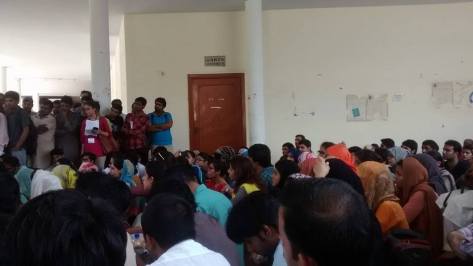
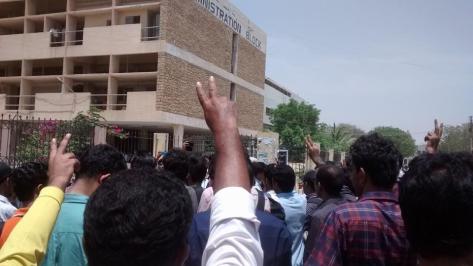
Sabin Mahmud was killed after organizing an event on Balochistan in T2F in Karachi, and more recently, Syed Wahidur Rehman, a Karachi professor was also shot dead. But far from being silenced, the resistance of democratic forces in Pakistan is growing. Today, Karachi University faculty organized a seminar on Balochistan missing persons to massive response, despite the administration refusing permission and locking the doors of the venue. The event was held in the Arts lobby, from where it seems to have spilt outside too.

11214139_10152694077270870_338189832357349941_n

A determined audience sits on the floor outside the locked room where it was to have taken place.

11019548_10152694076845870_5299594296544608541_n

Audience outside KU Administration Block

Read the report in The Tribune

Images sent by Nida Kirmani, Asst Prof at LUMS, Lahore, Pakistan, via Shipra Nigam

Jalsatyagrah at Omkareshwar MP – Appeal to PM: Narmada Bachao Andolan

Statement for wider endorsement, sent by Narmada Bachao Andolan

jalsatyagraha_650x400_61429559020

Ousted for Narmada’s Omkareshwar Dam, Farmers on Jalsatyagraha in Madhya Pradesh (NDTV)

The jalsatyagrah at Omkareshwar M.P. going on to its 26th day now, with around 24 people in water for 24 hours, under deteriorating health conditions, protesting the proposed raise in the height of the dam and the complete disregard of promised R&R policy by the authorities.

The situation at the Omkareshwar-dam site is very serious as the voices, land and and livelihood of the people are being drowned.

We urge you to pledge your support in a petition to Prime Minister Narendra Modi, as the project is a joint venture with 51% central government stake and 49% state control. Despite repeated attempts, we have not received any response from CM Shivraj Singh Chouhan.

Please send your endorsement to this email address nba.khandwa@gmail.com.

TEXT OF STATEMENT

The people of the Narmada valley are in battle once again, this time, for their land rights and against the forcible and illegal submergence being brought in the Omkareshwar dam by the Madhya Pradesh government and the project company NHDC Limited since the 11th of April 2015.

Continue reading Jalsatyagrah at Omkareshwar MP – Appeal to PM: Narmada Bachao Andolan

Coallateral: Research Collective of Programme for Social Action

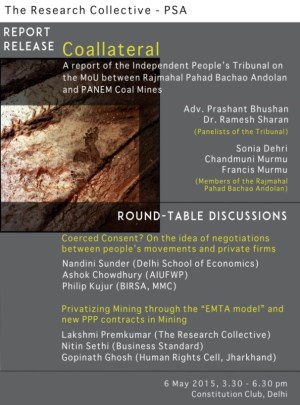
Executive Summary by RESEARCH COLLECTIVE of Programme for Social Action, of the Report of the Independent People’s Tribunal on the MoU between Rajmahal Pahad Bachao Andolan and PANEM Coal Mines.

Press Invite

Release of the Report and Panel Discussion on May 6, 2015 at Constitution Club

The Independent People’s Tribunal, held on 16 November 2014 in Ranchi, established that PANEM Coal Mines repeatedly violated human rights of Adivasis, used violence against them to force their consent to operationalise the project, and has not adequately resettled and rehabilitated project affected families. PANEM Coal Mines, which acquired Adivasi lands in 2002 in Pakur district of Jharkhand, violated the Santhal Parganas Tenancy Act, 1949 and the rights of Adivasi (indigenous) people granted under the fifth schedule of the Indian Constitution.

PANEM Coal Mines, a Joint Venture company between Punjab State Electricity Board (now PSPCL) and EMTA Group, required land from Adivasi communities in Alubera and Pachwara panchayats in Pakur to operationalise the Pachwara Central Coal Block mining project. Fearing that the large-scale mining project would ultimately destroy their homeland, the Santhal and Pahadia people did not consent to the acquisition of their land. They organized themselves as the Rajmahal Pahad Bachao Andolan (RPBA) and militantly opposed the project between 2000 and 2006. In an unexpected turn of events, on 30 November 2006, RPBA signed a Memorandum of Understanding (MoU) with PANEM and allowed the company to acquire land and mine coal.

Continue reading Coallateral: Research Collective of Programme for Social Action

The Body-politic and Death of the Farmer: R Umamaheshwari

Guest Post by R. UMAMAHESHWARI

Until now suicides happened in an almost invisible ‘intimate’ ‘psychic’ space of the farmer and his (almost always it was a male) loneliness and pain and anguish; we only got to know of it after the act was committed. But for the first time, a farmer committed suicide in full public view, and his body was consumed by the world at that moment of his committing the act. In a leading Hindi newspaper, the following day, there was a photograph, on the front page. The images showed the gradual metamorphosis of a living man, with a profession (that of a farmer), with a history and a family turning into a mere dead body. The photographer had actually recorded this metamorphosis, image by image in sequence, second by second. Not a moment had been left out. (See Amar Ujala, dated 23rd April 2015) With one loop the man, named Gajendra, became yet another body; yet another dispensable body, to be consumed by the entire nation through photographs and TV images. It was the signifier of our times: an act in the theatre of the absurd that democracy has come to be. The farmer will increasingly be ‘seen’ when he dies. Continue reading The Body-politic and Death of the Farmer: R Umamaheshwari

Lessons learnt from the misdeeds of Paralympic Committee of India – Continuing to speak up: Pragya Deora

Guest post by PRAGYA DEORA

The 15th National Para-Athelitic Championship held in Ghaziabad in March 2015 was my first national-level athletic competition that I was participating in. I did not know much about the world of sports, the associated pressures for sportsmen, politics at different levels and most importantly the amount of compromises that the participants had been making in all these years.

Our team left for Ghaziabad and even before we reached we were a little surprised. The condition of roads leading to the stadium was so terrible that we were confused if we were reaching the right place. After we reached, we realized there was worse to come. Working on issues of accessibility in my campus for making our campus barrier free for persons with disabilities, there was an expectation from the organizers that this would be a model of the way a sports competition should be organized in terms of infrastructure, procedures and attitudes. But it was a far cry from it. What screamed at each step was complete insensitivity towards persons with disabilities. Continue reading Lessons learnt from the misdeeds of Paralympic Committee of India – Continuing to speak up: Pragya Deora

Save Handlooms – Don’t Repeal the Handloom Reservation Act!

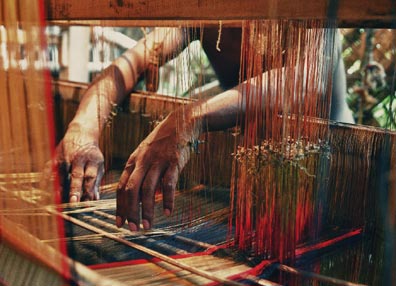
Please sign this petition to the Prime Minister drafted by LAILA TYABJI  of Dastkar Delhi, appealing against the proposed repeal of  The Handloom Reservation Act, which protects both an ancient body of knowledge and skill, as well as the livelihoods of hundreds of thousands of handloom weavers.

16040_S_handloom-tant-weaver

Image courtesy Facenfacts

SIGN THE PETITION HERE. TEXT OF PETITION BELOW

Handlooms are India’s unique heritage and the livelihood of lakhs of skilled handloom weavers.

A move is on to repeal The Handloom Reservation Act, which since 1985 has been protecting traditional Handloom weaves, especially saris, from being copied by their machine-made and powerloom competitors. It was a small but important protection for Handloom weavers, who otherwise struggle to survive. Their yarn, their designs and their markets are under attack.

Now the influential powerloom lobby has agitated successfully that this Act be withdrawn. To say that because we have powerlooms, we don’t need handlooms does not make sense. The handloom can create thousands of distinctive regional weaves and designs that no powerloom can replicate, and a tactile wonderful drape that is also irreplaceable by mechanised means. Globally too, more and more ecologically sensitive international buyers look to India as a source for the hand made.

Each weave has a cultural tradition and a story, each linking us to our social and cultural roots. If we remove the protection and incentives for handloom weavers to continue weaving their traditional products and saris, we would suddenly be bereft of both our past and our future.

Handloom lovers, it’s time to raise your voice! Join us in lobbying against the repeal of The Handloom Reservation Act.

SIGN THE PETITION HERE.

Bangladesh – Stifling A Country: Mahmud Rahman

Guest Post by MAHMUD RAHMAN

Mahmud Rahman is a writer and translator from Bangladesh who lives in California. He is one of 23 persons  who are facing possible contempt of court charges from the International Crimes Tribunal 2 in Dhaka for having signed a statement expressing concern over the same tribunal’s contempt of court sentence on the journalist David Bergman for some of his blog posts.

When I think about the state of free speech in the land of my birth, my memories take me back to 1970-71 when I was a higher secondary student in Dhaka, a time of upheaval when East Pakistan was making its way towards independent Bangladesh. Officially we were still under martial law, Ayub’s decade-long dictatorship deposed in favor of Yahya’s rule that came with the promise of elections. Political parties could organize, detainees were set free, the press could publish with fewer restrictions, and people began to launch new magazines and newspapers.

Every stripe of opinion found expression in print. Pushing aside the go-slow conservatism of existing newspapers, new ones emerged. Bengali nationalism, socialism, communism of various hues – all found expression in print. The main Islamist party’s paper acquired a modern press. Books were not that widespread, but you could easily get your hands on Russell and English socialists, and Marx, Engels, Lenin, or Mao. I remember engaging in a mix of agnostic, atheist, socialist, and liberal discussions.

There is something in that sort of ‘spring’ that beckons the young to amplify their voice. Two friends and I wanted to publish a magazine. We came up with a name – The Rebel – and of course, a logo. We split the writing among us. I can’t remember much other than we were inclined towards independence for East Bengal. Our perspective was no doubt seditious but we couched our language with a bit of caution. Did we even know that British-era laws required that publications be registered? In that climate, we felt the state wasn’t looking all that carefully.

Continue reading Bangladesh – Stifling A Country: Mahmud Rahman

All that is solid melts into air – the hologram protests in Spain: Geeta Seshu

Guest post by GEETA SESHU

The recent hologram protest projected on the street before Spain’s Parliament is an innovative attempt to subvert the country’s ‘citizen security’ provisions that criminalises public protest.

The video of the hologram protest is riveting and surreal, as ghostly figures of women and men march shouting slogans amidst night-time traffic. The figures are clearly distinguishable, the faces discernible. This isn’t computer-aided animation. It’s the real thing.

Or as close to real as a virtual thing can be.

The website ‘hologramasporlalibertad’ (Holograms for Freedom) provides for the subscriber to record her own message and, with a click, a hologram is created. An online petition explains that the ‘citizen security laws’, which obtained final assent in Spain in March, will ‘repress the freedom of peaceful assembly’.

Screen Shot 2015-04-22 at 11.13.01 pm

Continue reading All that is solid melts into air – the hologram protests in Spain: Geeta Seshu

Are We Legit? Roanna Gonsalves

ROANNA GONSALVES writes in Southern Crossings, a new blog run by a writers’ collective based in Australia, which aims “to reimagine Australia, South Asia, and the world, through South Asian bodies and minds.”

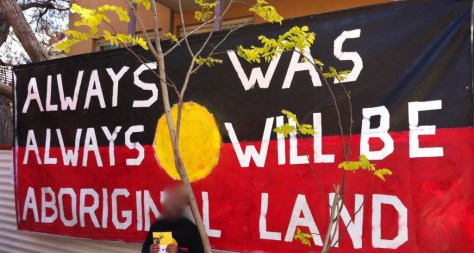
Aboriginal-flag-1-1024x548

One rainy Mumbai day, sitting in an Udipi restaurant, chai cup in hand, I told a dear friend I would soon leave for Australia.

“I’ll never leave India and be a second class citizen in another country”, my friend said. My chai turned colder and a crinkly skin formed on its surface.

Seventeen years later, I realise that in perceiving a hierarchy of citizens in Australia, my friend was right, but in a manner that he did not intend…

…[T]here were certain fundamental truths that I did not grasp before I got here: Indigenous people i.e. Aboriginal people and Torres Strait Islanders, are the First Peoples of this land and the waters that surround it; they formed the First Nations of this continent; this always was and always will be Aboriginal land.

We are not the perpetrators, the ones who wielded the guns in the forgotten wars between invading white settlers and Indigenous Peoples. We are not the victims. However, as mainly economic migrants from South Asia (I acknowledge the many South Asian refugees from the conflict zones of Afghanistan and Sri Lanka), we are not absolved of complicity.

We are beneficiaries of the genocide of Aboriginal people, the dispossession of their land, the loss of their homes, their families, their cultural values, their tongues, their songs. It is such soil that we step on when we first step into Australia, soaked not just with the promise of a ‘first world lifestyle’, but squelchy with the memory of massacre.

Read the rest of this uncompromising and challenging set of reflections here.

Media and the Death of Democracy: Nissim Mannathukkaren

Guest Post by NISSIM MANNATHUKKAREN

We live in a world where there is more and more information, and less and less meaning—Jean Baudrillard

Recently, there has been an outpouring of scathing critique against Arnab Goswami and his television programme, The Newshour in some sections of the English-language Press. One magazine cover story called him, “The Man Who Killed TV News.” The immediate context of this critique is Goswami’s branding of some prominent ecological and political activists as “anti-national” and his calling for a ban on the Nirbahaya documentary and legal action against a competing channel which was supposed to be air the documentary. This unprecedented and shockingly ironic position against free speech by a leading media personality was rightfully termed by a critic “as low as a journalist can sink.”

While these criticisms of the “murderous rage” evoked by Goswami draped in the nationalist tri-colour every night and the punishment he metes out to his opponents in a “medieval-style kangaroo court,” also known as an “open debate,” are entirely apt and necessary, they also miss the forest for the trees. Goswami is only a symptom of the post-liberalization corporatized and privatized media landscape of India. If Goswami did not exist, he would have been created. It is not Goswami alone who has killed news, it is the vast majority of the media, especially, television that has done so. What is more obscene than Goswami’s execrable theatrics is how he is deeply enmeshed in the structures of capital and power that he seemingly rails against every night. These structures have not just enmeshed him, but the others as well who are aghast at his aesthetics (or the lack of it).  Continue reading Media and the Death of Democracy: Nissim Mannathukkaren

Why are we always Encroachers? Tribal farmers in Khammam District, Telangana: Vasudha Nagaraj

Guest Post by VASUDHA NAGARAJ

Korsa Subba Rao, a man from Koya tribe, cultivates about three acres of forest land in a village in Khammam district. His family has been doing so for several generations. Subba Rao has a ration card, voter identity card, Aadhar Card and a NREGA job card. However, for the land that he tills, he has no papers whatsoever. Ironically the only evidence he has is an FIR issued by the Forest department. For committing a forest offence of encroaching into the forest – cutting down trees and putting it to podu cultivation.

Like Korsa Subba Rao, in Khammam district, there are thousands of farmers belonging to Koya, Konda Reddis and Lambadi tribal communities cultivating one to four acres in forest lands. Most of them have been cultivating since the times of their forefathers. Often this is their only income. However, factors such as scanty rain, untimely rain or pest can drastically reduce this income. The prevalence of malaria and other mosquito borne diseases also adds to the toll.

Here, it needs to be understood that forest lands do not always imply green forests. A forest land can be dense forest, moderate forest, shrub growth and also barren land. In Khammam district, thousands of acres of forest lands have been put to cultivation since several decades. But any cultivation of forest land is considered to be illegal, as it is an offence as per the AP Forest Act, 1967. In this scheme of things, the tribal farmers are seen as “encroachers”. The irony is that they are encroachers inspite of being the original inhabitants of the land. Because of this illegality and because of the power of the Forest Department to register criminal cases, the tribal farmers live in a constant fear of eviction from their lands. Continue reading Why are we always Encroachers? Tribal farmers in Khammam District, Telangana: Vasudha Nagaraj

Ambedkar’s Ideology – Religious Nationalism and Indian Constitution: Ram Puniyani  

Guest Post by RAM PUNYANI

In order to gain larger legitimacy, RSS has been making claims of sorts. One of that which was made few months back was that Gandhi was impressed by functioning of RSS. Now on the heels of that comes another distortion that Ambedkar believed in Sangh ideology (Feb 15, 2015). This was stated recently by RSS Sarsanghchalak, Mohan Bhagwat. There cannot be bigger contrasts between the ideology of Ambedkar and RSS. Ambedkar was for Indian Nationalism, Secularism and social justice while the RSS ideology is based on two major pillars. One is the Brahmanic interpretation of Hinduism and second is the concept of Hindu nationalism, Hindu Rashtra.

Where does Ambedkar stand as for as ideology of Hinduism is concerned? He called Hinduism as Brahminic theology. We also understand that Brahmanism has been the dominant tendency within Hinduism. He realized that this prevalent version of Hinduism is essentially a caste system, which is the biggest tormentor of untouchables-dalits.

Continue reading Ambedkar’s Ideology – Religious Nationalism and Indian Constitution: Ram Puniyani  

Ban-man on the prowl again: Malvika Sharad

Guest Post by MALVIKA SHARAD on the recent call by Delhi University Students’ Union for a ban on the street play by Khalsa College theatre group, Ankur.

24lead6

Image courtesy rediff.com

One evening in 2013, a group of ‘street play seniors’ as we call them, visited us in the front lawns of my college, Lady Shri Ram College for Women. They were from various colleges across DU who had been actively involved in street theatre, and had been invited to give the newly formed street play team of that year, an introduction to the art form. Among those seniors was a dynamic young chap from Khalsa College, who reiterated several times that street theatre fills you with such immense courage that you end up doing things you never thought you would, for that courage comes from the sheer truth and brutal honesty that street theatre is based upon. He said that freedom of expression is taken to a whole new level when you perform amidst crowds, and state the truth looking directly into their eyes. A fire is born within you that cannot be extinguished, it burns brighter with every performance of the play. You become fearless in voicing your opinions and thoughts, so fearless that you don’t even realize how far you have pushed your own limits and emerged triumphant.

After a whole year dedicated to doing street plays in Delhi, I have learnt how right he was, that young student not much older than us. I find I have come out of my shell, shedding my inhibitions at a pace and scale I had never imagined. Torn chappals don’t bother me anymore, my sun-burned skin makes me look beautiful, I don’t flinch with embarrassment while sitting, sometimes lying, on the floor of the metro station out of sheer weariness, though co passengers stare at me with judgemental eyes, I can’t bring myself to stop romanticizing the mud and the dirt that hug me every time I wear my soiled street play kurta… But above all, I can articulate my thoughts properly now, I am not scared of speaking in public unlike the times when I was a meek docile person, cocooned in the comforts of home and parental pampering. I owe this change in my attitude and personality to street theatre, which taught me what it is to live confidently and fearlessly.

Continue reading Ban-man on the prowl again: Malvika Sharad

People’s Union for Democratic Rights Condemns Bans on Cow Slaughter

Statement by People’s Union for Democratic Rights 
On March 16th 2015, the Haryana Government unanimously passed Haryana Gauvansh Sanrakshan and Gausamvardhan Bill with main opposition parties INLD and Congress supporting the Bill. The new bill passed by the Haryana Government bans cow slaughter and sale of beef and imposes a punishment of rigorous imprisonment of not less than three years extending up to 10 years and fines ranging from Rs. 30,000 to Rs. one lakh. The Haryana Government’s move comes just days after the President’s assent to Maharashtra Animal Preservation (Amendment) Bill 1995 early this month. Maharashtra Animal Preservation (Amendment) Bill 1995 not only banned beef but also extended the prohibition to slaughter of bulls and oxen. There was already a ban on slaughter of cows in Maharashtra since 1976.  The new amended act imposes a fine of Rs. 10,000 and a maximum prison term of five years for selling or even possessing beef.
What needs to be underlined here is that these bans on cow slaughter are not new; they were in existence in many of the states for many-many years. For example in Delhi, Bihar, Andhra Pradesh, slaughter of cows and calves is totally prohibited. In Goa and Andhra Pradesh, ‘cow’ is defined to include heifer, or a male or female calf of a cow under the Goa, Daman and Diu Prevention of Cow Slaughter Act 1978 and Andhra Pradesh Prohibition of Cow Slaughter and Animal Preservation Act 1977, respectively. In some states like Karnataka, Andhra Pradesh, Goa and Madhya Pradesh slaughter of bulls, bullocks and adult buffalos is permitted on ‘fit for slaughter’ certificate if the cattle is over 12 or 15 years of age, is not likely to become economical for draught, breeding or milk. Assam and West Bengal provides for slaughter of all cattle which includes bull, bullocks, calves, cows and buffalo on ‘fit for slaughter’ certificate. Meghalaya and Nagaland have no legislation to this effect.

Continue reading People’s Union for Democratic Rights Condemns Bans on Cow Slaughter