All posts by Nivedita Menon

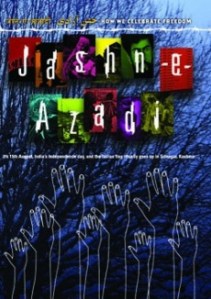
Screening Jashn-e-Azadi at Presidency University, Kolkata: Waled Aadnan

Guest post by Waled Aadnan

It can be said that 86/1 College Street, Calcutta, has seen a microcosm of the history of modern India unfold within its walls. Since 1874 when the already fifty-nine year old Presidency College shifted to its current address, future Presidents and Prime Ministers of  India, Pakistan and Bangladesh; Nobel Laureates, freedom fighters, an Academy Award winner, Bharat Ratnas; the leadership of the Naxalite movement of the 60s and 70s; and eminent judges, writers, journalists, scientists and actors, have spent their student days at 86/1.

Two years ago, soon after I joined the institution, the Left Front government upgraded Presidency College to the status of a state University in a last-gasp bid to hold on to the votes of the bhadralok intellectuals. 2012 dawned with no Student Union elections having been held the previous year, and it is in this backdrop that the following events unfold.

Salman Rushdie’s well-publicised ostracism from the Jaipur Literature Festival was met not with outrage in Presi’s canteen addas, but with the absence of even a poster put up in protest. News filtered in of a seminar in Symbiosis University being “threatened.” But little awareness existed among students who were more inclined to read tabloid-like, unputdownable newspapers than their relatively austere counterparts, including The Hindu which broke the story.

Continue reading Screening Jashn-e-Azadi at Presidency University, Kolkata: Waled Aadnan

Some pictures from Occupy the World

Continue reading Some pictures from Occupy the World

Compounding the Error – Marks inflation at Delhi University: Shobhit Mahajan

Guest post by SHOBHIT MAHAJAN

In politics, policy making or indeed any interaction with the larger world, one notices a distinct characteristic – one makes a decision, then facts or circumstances make it obvious that it was a wrong or bad one.  And what does one do? In most cases, one continues to take further decisions to bolster the impression that the original decision taken was correct and in the process, makes matters worse. This is relatively innocuous in normal social interaction but disastrous in the public sphere as we have witnessed in mishandling of the events related to the Lokpal movement. A very similar situation has recently emerged in the University of Delhi. Continue reading Compounding the Error – Marks inflation at Delhi University: Shobhit Mahajan

The Book of Mothers: P K Medini

P K MEDINI still recollects the day when she first sang for the election campaign of the Communist party. Now, six decades later, the spirit isn’t one bit lost for the veteran singer. Medini, 78, says she sang first for Communist leader T V Thomas. Since then, she had been a regular presence at the election campaigns of the Communist party.”  From expressbuzz April 1, 2011

Delhi-based journalist JACOB SEBASTIAN sent us his translation of a piece by PK Medini in Malayalam (published in the journal Mathrubhumi earlier this month ), along with a background note that he wrote for our readers.

The following piece was written by P.K. Medini, the one-time ‘singing sensation’ of the Communist Party in Kerala. It originally appeared in the Matrubhumi Weekly, as part of a series where people talk about their favourite books. It offers a glimpse of a time and place where literature and books and the whole culture of reading, mattered in an urgent and vital way.


She gives us an intimate snapshot of the new reading culture at the time when it was putting down its first tentative roots. For someone who readily admits that her own reading was ‘impoverished’, she shows a keen awareness of the power of ideas – and of books as objects of an almost talismanic power – andreveals their absolute centrality to the social and political transformations of the time.

If such a thing is unimaginable to us today, even more unexpected are the ways in which it actually played out – the many tortuous routes the word had to take before it could become flesh (she calls it ‘social reading’). She also has a sharp eye for how political propaganda actually works ‘on the ground’. Along with other movements, Medini’s party too can take some credit for the fact that life in Kerala isn’t so desperate today that a society could catch fire from a book.

Continue reading The Book of Mothers: P K Medini

Open Letter to Haryana CM on Forced Land Acquisition for Gorakhpur Nuclear Power Plant, Fatehabad

Farmers of Gorakhpur village hold a protest in Fatehabad against acquisition of their agricultural land by the Haryana government for a nuclear power plant in the area, August 2010. (The Tribune on-line)


January 16, 2012

Bhupinder Singh Hooda,
Chief Minister, Haryana
Chandigarh

Dear Mr. Chief Minister,

It was with gravest concern and misgivings that we heard of Section 9 of the Land Acquisition Act, 1894, being issued in Fatehabad, Haryana, to forcibly acquire land for the proposed Gorakhpur Nuclear Power Plant Project. This action by the Harayana State Govt. is completely unacceptable on the following two counts:

Farmers of Gorakhpur and nearby villages have been sitting in continuous opposition to the proposed nuclear power plant from August 2010. They are fighting for their right to life, livelihood and to safeguarding their fertile and irrigated, three-crop land, all of which will be severely threatened if the project were passed. The fact that a community is in such a long drawn and strong opposition to this project, is of crucial concern and cannot be ignored arbitrarily or repressed in democracy. Continue reading Open Letter to Haryana CM on Forced Land Acquisition for Gorakhpur Nuclear Power Plant, Fatehabad

Tribute to Homai Vyarawalla, India’s first woman photojournalist

Homai Vyarawalla passed away at the age of 98 yesterday. We reproduce here the curator’s note written by cinematographer SABEENA GADIHOKE, biographer and friend of the legend, on the occasion of her staging a retrospective of Vyarawalla’s work at the National Gallery of Modern Art in 2011.

Having worked for thirty three years of her life Homai Vyarawalla gave it all up one day. Why did she give up photography?

Often meant for a fleeting glimpse in the newspaper, press photographs become visual archives of the future. Homai Vyarawalla’s photographs chronicling the defining moments of India’s Independence have acquired an iconic status and are now integral to a Nationalist version of history. According to this version, some people led and others followed. As important people dominated photographs, ordinary citizens or `the masses’ frequently found themselves relegated to the margins. Sometimes, they would be `cropped’ from the frame to accommodate more prominent figures.

Continue reading Tribute to Homai Vyarawalla, India’s first woman photojournalist

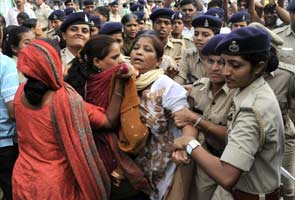
Women’s groups stopped from meeting Soni Sori in Raipur

Press statement from Saheli, Delhi; Women Against Sexual Violence and State Repression (WSS), Delhi; WSS Orissa and Madhya Pradesh Mahila Manch, Bhopal.

A team of women representing various women’s groups from across the country were in Raipur on 12-13th January to meet Ms. Soni Sori, currently lodged in Raipur Central Jail. Ms Sori is a tribal school teacher who has been hounded by the Chhattisgarh Police as a Maoist conduit. She was arrested in October 2011 and was brutally assaulted sexually in police custody on the night of 8-9th October.

Even after applying for permission as per procedure and repeated requests to various concerned officials on 12th, the women were denied permission to meet her, despite already having an assurance from the Principal Secretary, Mr. Baijendra Kumar, during his visit to Delhi in October.For two whole days the team was shuttled from one authority to the other and back, with each and every official avoiding taking a decision or give in writing any denial or reasons for it. Finally, permission was denied on 13th citing `security’ concerns.

Read full statement here.

The Regulation of Surrogacy in India – Questions and Concerns: SAMA

Guest post by SAMA, a resource group for women and health.

As the clamor dies down, of news reports celebrating the ‘miracle of science’ that made the arrival of Aamir Khan and Kiran Rao’s baby boy possible,  it would serve to look more closely at commercial surrogacy in India.  Estimated to be a multi-million dollar industry, Assisted Reproductive Technologies  (ARTs, through which surrogacies are conducted) are a recent and fast-growing addition to India’s medical market and medical tourism sector. Their unregulated proliferation over the last few years has raised serious issues of safety, ethical practice, costs, and rights. While the proposed Draft Assisted Reproductive Technologies (Regulation) Bill & Rules-2010 is a long-awaited step towards regulation, several clauses, especially concerning commercial surrogacy, leave much to be desired.

Continue reading The Regulation of Surrogacy in India – Questions and Concerns: SAMA

Why are Americans so mean to Walmart? Never mind, come to India

They don’t want you in California…


They don’t want you in Chicago… Continue reading Why are Americans so mean to Walmart? Never mind, come to India

Indian Government’s Claims About Corporate Retail and the Reality: Shankar Gopalakrishnan

The vociferous supporters of corporate retail in India seem to believe, or would like us to believe, that there is no previous experience of corporate retail anywhere in the world to learn lessons from. In this guest post, SHANKAR GOPALAKRISHNAN analyses available data on the experience of the entry of corporate retail globally, to outline the disastrous consequences it has had everywhere it has been introduced.  On the basis of extensive research, he concludes:  “The growth of corporate retail not only will not address the key problems plaguing India’s economy today – it will greatly exacerbate many of them. In particular, the crisis in agriculture, environmental destruction, declines in land productivity, urban unemployment, price volatility and unequal access to resources would all be worsened by unchecked growth of corporate retail.” Shankar’s article follows.

In the flood of rhetoric following the government’s decision to permit FDI in retail, the actual reality of what this will mean is being lost. For that it is necessary to look at international data and what it shows about the claims being made. Commerce Minister Anand Sharma’s letter offers a good place to start. His claims can be summarised as follows: Continue reading Indian Government’s Claims About Corporate Retail and the Reality: Shankar Gopalakrishnan

When an Ecofeminist Dies: Anupam Pandey

Guest post by ANUPAM PANDEY

“The government said, “If they only planted trees, we wouldn’t bother with them. But they also plant ideas. And I say, it’s true”

Wangari Mathaai (1940-2011)

When the death of Steve Jobs evoked such unprecedented emotions of manic proportions in India which is not even a market of consequence for Apple, it is astounding that the passing away of Wangari Mathaai (a few days before Jobs’ death) did not even create a ripple of interest. But then, in the power hierarchy of global capitalism, what is the worth of the life of an ecofeminist compared to that of the one which is associated with one of the most popular consumer brands in the world? Continue reading When an Ecofeminist Dies: Anupam Pandey

Andre Schiffrin in conversation with S Anand

‘Most publishing conglomerates are owned by people very far to the right’ said André Schiffrin to S Anand of Navayana, his Indian publisher, during this conversation, of which a short version appeared in The Hindu Sunday Magazine on 20 November 2011.

Legendary publisher André Schiffrin warns us that we are witnessing ‘a rebirth of the old colonialist methods of export and import’.  Schiffrin founded the The New Press in 1991 after being forced to quit Pantheon (a division of Random House), where he could no longer work with the new CEO, Alberto Vitale, who would ask Schiffrin who Carlos Ginzburg was and why books could not have a sell-by date like cheese and milk do. Schiffrin, who has published Jean-Paul Sartre, Michel Foucault, Noam Chomsky, Günter Grass, Art Spiegelman, Matt Groening, Margurite Duras and Gunnar Myrdal among others, was in India earlier in November for the launch of the Indian edition of his memoir The Business of Words, a combined edition of The Business of Books (2001) and Words & Money (2010). Continue reading Andre Schiffrin in conversation with S Anand

Some FAQs about Koodankulam and Nuclear Power: Nityanand Jayaraman and G. Sundar Rajan

Steel drums with nuclear waste. The inescapable byproduct generated from the fission of nuclear fuel in the form of uranium or plutonium creates what is called nuclear waste. This waste comes in a huge variety of extremely radioactive material with half-lives ranging from 8 days to hundreds of thousands of years. In other words their radioactivity takes a really, really long time to decay, thousands of times our human life-times. These fission products if released to the environment will last a long time, and it is almost impossible to decontaminate them.

NITYANAND JAYARAMAN and G. SUNDAR RAJAN of the Chennai Solidarity Group for Koodankulam Struggle developed  the  fact-sheet below in response to real questions that they encountered during the course of street and college campaigns. They say: “The questions were sincere, so we felt a sincere response was warranted.”

Continue reading Some FAQs about Koodankulam and Nuclear Power: Nityanand Jayaraman and G. Sundar Rajan

Air India Hostesses Vindicated: Press statement by Air India hostesses

It’s been a long struggle for Air India hostesses who have been fighting for the basic right to be treated equally with their male counterparts. What follows is  a press statement they issued after finally having won the right to be considered for appointments to the position of In-Flight Supervisor, the person in charge of all the cabin crew. It is shocking enough that Air India maintained a system where only men could be appointed to this post until December 2005, when a Delhi High Court decision finally permitted women to be considered for the post. Even more disturbing is the fact that the union claiming to represent the ‘workers’ of Air India, the Air India Cabin Crew Association, chose to contest this decision, as if the women employees of Air India are not as much ‘workers’ as the men are. Continue reading Air India Hostesses Vindicated: Press statement by Air India hostesses

Statement on the killing of Niyamat Ansari and “apology” by the CPI (Maoist)

Summarized version of statement by concerned academicians, students and activists.

For full text of the statement visit

http://www.petitions.in/petition/statement-on-the-killing-of-niyamat-ansari-and-apology-by-the-cpi-maoist/1492

and http://www.pragoti.in/node/4567 .

In a statement of apparent ‘self-criticism’, dated September 1 2011, the Communist Party of India (Maoist) has offered an apology for the posters threatening Aruna Roy, Jean Dreze, Gokul Vasant and Nandlal Singh and members of Gram Swaraj  Abhyan.  But they have not tendered an unconditional apology for the brutal murder of NREGA activist Niyamat Ansari and threat to Bhukan Singh for allegedly being ‘police informers’ and ‘cheating local people’ of their forest land.

86 families in Kope Gram Panchayat, including Bhukhan and Niyamat, were part of a larger movement to secure legal entitlements over forest land under the Forest Rights Act, 2006, which was opposed by the same corrupt contractors involved in committing malpractices in the NREGA Programme. His team exposed a scam involving Rs 2.5 lakhs leading to an FIR being filed against the local Block Development Officer. Within days after this, on 2nd March 2011, Niyamat was beaten to death. The fact finding report published by Gokul Basant- Nandlal Singh has hinted towards possible involvement of Maoist with corrupt middlemen, illegal contractors, forest department and local administration.

Continue reading Statement on the killing of Niyamat Ansari and “apology” by the CPI (Maoist)

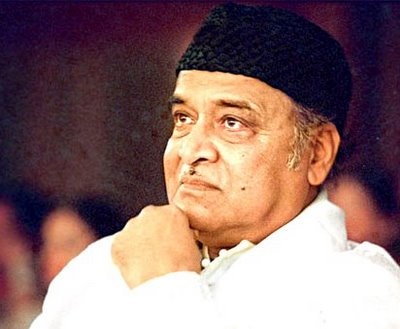
Bhupen Hazarika – The Sub-nationalist Imagination of a Universalist: Bikram Bora

Guest post by BIKRAM BORA

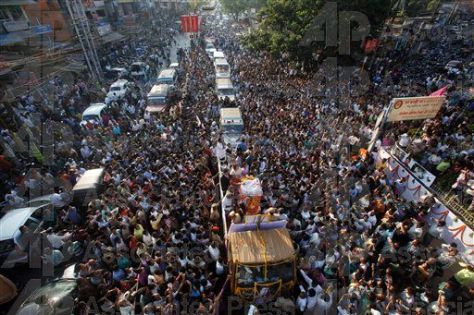
The unprecedented number of mourners crowding the otherwise sleepy streets of Guwahati at night following the demise of the maestro, proves testimony to his genius. In his life, there was no dearth of followers, some logical, some blind; while in his death, grief engulfs both the sections. What could be the reasons for Hazarika’s powerful grip over people’s emotions? It can’t be just his musical dexterity; it’s more the aura surrounding him, emanating from his multi-dimensional persona and life-span.

Continue reading Bhupen Hazarika – The Sub-nationalist Imagination of a Universalist: Bikram Bora

Taking the Jajabor’s Journey Forward – The troubled legacy of Bhupen Hazarika: Mayur Chetia and Nayanjyoti

Guest post by MAYUR CHETIA and NAYANJYOTI

Mourning people from across Assam assemble in miles and miles of roads leading up to Bhupen Hazarika’s funeral. He’s a restless jajabor/wanderer no more. Paeans after paeans are being sung now after the ‘great cultural hero’, the ‘greatest Assamese’, the believer in ‘the power of the nation’ (the ‘nation’ being Akhand Bharat or Brihottor Axom, depending on whichever variety of nationalists sing). Bhupenda is dead.  Assam is in despair.

Continue reading Taking the Jajabor’s Journey Forward – The troubled legacy of Bhupen Hazarika: Mayur Chetia and Nayanjyoti

The nuclear energy debate in India: Response to Dr APJ Abdul Kalam from Dr Surendra Gadekar

Dr. SURENDRA GADEKAR is a well-published physicist of international renown, and a Gandhian. After an MSc and PhD (in theoretical physics) in 1979 from IIT Kanpur, he worked for two years as a post-doctoral fellow at Iowa State University, US and then two years as a research associate at IISc in Bangalore. He resigned in 1986 (a little before Chernobyl) to do antinuclear work when the Kakrapar Nuclear Power Plant was started. In 1987, he started Anumukti A Journal Devoted to Non-Nuclear Indiaand has carried out and published studies of the impact of nuclear energy around the plants at Kakrapar, Rawatbata and Jadugoda.  He has also carried out a study at Pokharan, which is as yet unpublished. Dr Gadekar’s response follows:

Dr A P J Abdul Kalam and‭ ‬Mr.‭ ‬Srijan Pal Singh deserve a special thanks for their article in the Sunday edition of The Hindu‭ (‬November‭ ‬6,‭ ‬2011‭) ‬entitled‭ ‬“Nuclear power is our gateway to a prosperous future.‭”‬

Although most of what they write is irrelevant to their topic and the rest just plain wrong,‭ ‬the very fact that the establishment has to bring out its‭ ‬‘Big Guns‭’‬ to answer the questions raised by the Koodankulam movement,‭ ‬is a testimony to the success of the movement.

Originally I had intended to write a point by point refutation of their article,‭ ‬but I have been deterred by the sheer length of the article.‭ ‬What I intend to do here instead is to paraphrase their points and answer them one by one.‭ ‬I would urge activists to visit the Hindu website at and to read the article in the full. I make this request specially so that friends can point out if I have been unfair in summarizing their work or have missed something important.

Continue reading The nuclear energy debate in India: Response to Dr APJ Abdul Kalam from Dr Surendra Gadekar

Bistirno Parore: A tribute to Bhupen Hazarika

Bhupen Hazarika was cremated this morning in Guwahati, at a ceremony on the banks of the Brahmaputra that was attended by an estimated 100,000 people present to pay their tribute to the legendary singer.

His politics did go  somewhat awry in his last years,  but I don’t want to think about that right now.  Here is Bhupen Hazarika, with the original Assamese of the song many of us have heard him sing in Hindi, Ganga behti ho kyon.  While studying at Columbia University, New York, Hazarika met Paul Robeson, whose song Ol’ Man River moved him so much that he rendered it into his mother tongue Assamese as bistirno parore.   In  Ol’ Man River, Robeson had adapted to the context of slavery, an American folk song of the Mississipi region. It is believed that this song in turn was an American version of a popular Russian song, Song of the Volga Boatmen. Hear the song in Robeson’s voice here.

Hooligans of Bhagat Singh Kranti Sena strike again

Maraa, a media and arts collective in Bangalore, has been organizing a monthly event called Pause: Creative Practice in Conflict.  This is a public event, inviting one speaker to present examples of creative practice in a conflict afflicted area. Previous events have showcased examples from Palestine and Afghanistan. In November, Maraa had planned a similar event on Kashmir, scheduled to be held on November 5th 2011.  

Bhagat Singh Kranti Sena (the same people who physically assaulted Prashant Bhushan recently for his statement on Kashmir), and its president, Mr. Tejinder Pal Singh Bagga, wrote a letter to the police alleging that the event which was to be held in the premises of a theatre organization, rafiki, was being organized by the Hurriyat Conference, at which Syed Shah Geelani or Mirwaiz Umar Farukh from the Hurriyat Conferece would speak. They warned the police that if they would not come to stop the event, their organization would make it a situation with unpleasant consequences.

Further, the Bhagat Singh Kranti Sena and Mr. Tejinder Pal Singh Bagga, posted online invitations on social networking site, Facebook, inviting people to come with stones, paint, eggs and tomatoes, to merge in with the audience, and then create chaos. There have been various comments responding to it, by promising violence to those who attend and organize such events.

The following statement has been issued by Maraa in this context:

Continue reading Hooligans of Bhagat Singh Kranti Sena strike again

Naming the Seven Billionth Child: Mitu Sengupta

Photo via The Hindu / Subir Roy

Guest post by MITU SENGUPTA

Last Monday, Nargis Yadav was declared the world’s symbolic seven billionth resident by Plan International, a child rights group. She was born to a family of farmers in a sleepy little village in Uttar Pradesh.

Nargis is surely an unwelcome child, given the grim projections that surrounded the UN Population Fund’s declaration last month, that the world’s population was about to breach seven billion.  Experts have issued sombre warnings of the devastating impact of the growing number of humans on earth. We face a bleak future of environmental distress and scarcity, they say, in which even the basics of food and water will be in short supply.

One wonders why, on October 31st – Halloween, to be precise – the UN did not name a blue-eyed baby boy from Washington, Bonn, Sydney or Toronto as our uncertain world’s symbolic seven billionth? To be sure, this would be politically incorrect, for we live in times when the well-meaning, in their bid to be representative and inclusive, scramble to push women and minorities to the forefront.  But here is an instance where keeping to pedantic liberal pieties has suppressed an honest portrayal of things as they are.

Continue reading Naming the Seven Billionth Child: Mitu Sengupta