All posts by Nivedita Menon

The Politics of Prizes and Silencing of Adivasi Voice: Nandini Sundar

Guest post by NANDINI SUNDAR


Adivasi Mahasabha rally in Raipur

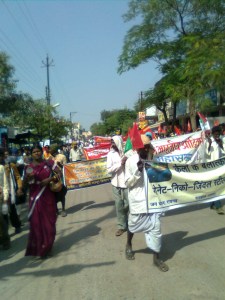
Last weekend, I attended a wonderful rally by the Adivasi Mahasabha in Raipur – some 10-15 busloads of people came from Dantewada and Bastar alone, while large numbers came from other parts of Chhattisgarh and even other states like Maharashtra, Orissa and West Bengal. The procession was flagged off by Dhurwa dancers while the rear end was brought up by Marias with their large dhols and bison horns. In between were thousands of militant marchers shouting slogans against militarization, demanding peace talks, the release of their arrested leaders, the implementation of the Supreme Court judgement on Salwa Judum, and all their constitutional rights with respect to land, forest and water.  These were men and women who had lost everything to arson and loot by Salwa Judum, who had been interned in camps but managed to return home and pick up their ploughs again, who face the daily threat of arrests, beatings and encounters by the security forces, who have to negotiate with the Maoists everytime they wanted to access panchayat funds, who live a life on the razor edge of survival.  And yet here they were, laughing, cheering and vowing to fight till the last breath, fight for their constitutional rights and in a constitutional way.

This remarkable struggle has been waged, not just over one weekend, but over years.  Indeed, the Salwa Judum leaders themselves credit the CPI with the destruction of their movement – both through mass actions and through legal means.

Continue reading The Politics of Prizes and Silencing of Adivasi Voice: Nandini Sundar

Everybody Loves a Good War – Tehelka and Essar: Bobby Kunhu

Update: A Day after the publication of this post, Tehelka changed the status of Essar from “Principal Sponsor” to merely one of several “patrons” on the Goa ThinkFest website.

Guest post by BOBBY KUNHU

Tehelka: Free, Fair, Fearless?

Without doubt, one of the most important documents to make its appearance after the arrest of Soni Sori by the Chattisgarh Government in Delhi on 4th October 2011 was the cover story titled, “The inconvenient truth of Soni Sori” that appeared in Tehelka, written by Shoma Chaudhary. It tells the story of Soni Sori and her nephew Linga Kodopi as narrated to Tehelka and the sequence of events that led to their persecution.

Nonetheless there is an intriguing twist to how this story was framed. The introduction of the story goes:  “Why were two tribals and the Essar group framed by the Chhattisgarh police? Why are Soni Sori and Linga Kodopi being systematically silenced? This chilling story of one family reveals more about India’s Naxal crisis than any official document can.”

In other words, Tehelka is arguing that Essar is also being framed in this narrative along with Soni Sori and Linga Kodopi.

Continue reading Everybody Loves a Good War – Tehelka and Essar: Bobby Kunhu

Letter from Japan to the Prime Minister of India

Respected Prime Minister of India, and Chief Minister of Tamilnadu:

We are residents and organisations from Japan, and are intimately aware of the unpredictability and uncontrollable nature of nuclear power. We are the unfortunate witnesses of two nuclear holocausts.  It is with pain that we see the Indian Government pursuing a dangerous path of constructing large nuclear power plants within even larger nuclear “parks” where power generation capacities are pegged at up to 10,000 MW.

Continue reading Letter from Japan to the Prime Minister of India

Which populism?: Saroj Giri

Guest post by SAROJ GIRI

As I read it, neither Aditya, nor Partha nor Gyan seems to deny that the Anna Hazare movement is populist. The debate here seems to be about: what kind of populism is it? Aditya is saying that this populism can lead to progressive political consequences, ‘by the presence of an anti-institutional dimension, of a certain challenge to political normalization’, while Partha (and Gyan too if I read him correctly) seem to be arguing that this populism is not progressive even if sometimes anti-institutional. And here Aditya reads Laclau contra Partha: that populism may indeed be the royal road to the constitution of the political. Partha and Gyan maintain that this populism works with a notion of ‘we the people’ who are free from corruption defined against ‘they the corrupt enemy’ (the government and netas). This ‘we the people’ can very well gloss over all internal contradictions, social divides and heterogeneities – hence Gyan points out that Dalits and minorities will not be counted or simply assumed away.

Continue reading Which populism?: Saroj Giri

Against Corruption = Against Politics: Partha Chatterjee

Guest post by PARTHA CHATTERJEE

Shuddhabrata Sengupta has done a great service by opening up the question of corruption which lies at the heart of the Anna Hazare movement but which has been, surprisingly, accepted quite uncritically as a universally known and universally condemned evil. It is actually quite puzzling how this effect has been achieved. It is a question which, I think, touches the core of the populist mobilization brought about by the Anna Hazare movement.

Think of it. Who are the beneficiaries of corruption? The entire middle class in India (lower, upper, aspirant lower to upper, whatever category one wants to use) seems to think that it is the victim of corruption. “It touches the lives of everybody”, as Nivedita Menon said in her recent piece in Kafila. But then who are the engineers, the accountants, the babus in the offices, the touts who surround the courts and the hospitals and the railway ticket counters? Aren’t they our uncles and nephews and sisters-in-law? The corrupt people of India are blood relations of those who are flocking Ramlila Maidan. But, needless to say, no one you meet there will accept that.

Continue reading Against Corruption = Against Politics: Partha Chatterjee

What is right-wing about the anti-corruption movement? – Saroj Giri

Guest post by SAROJ GIRI


A draft for discussion

A ruling class contradiction is being played out as anti-corruption movement. It is however politically articulated as ‘a movement of the people’ with possibly a space for the left to intervene. Can the tide be turned against the right-wing upper classes?

“What we are witnessing (the anti-corruption movement) is nothing short of a revolution. Only on two earlier occasions in recent memory such grand scale people’s participation was recorded. The first was under Loknayak Jayaprakash Narayan in mid-seventies. The second was during the Ayodhya movement, in the early nineties, propelled by L K Advani’s historic Rath yatra.” This is the RSS Organiser magazine (August 21-28, 2011).

“The anti-corruption movement must resist repression in every form and align itself with the struggles for democratic transformation in India. Only then can it defeat the UPA Government’s efforts to defend corruption and unleash repression, and expose the BJP’s false claims of championing democracy and resisting corruption.” This is the CPIML Liberation (ML Update, 07-13 June 2011)

Continue reading What is right-wing about the anti-corruption movement? – Saroj Giri

If only there were no people, democracy would be fine…

This post has been jointly written by Nivedita Menon and Aditya Nigam

At Ramlila Maidan

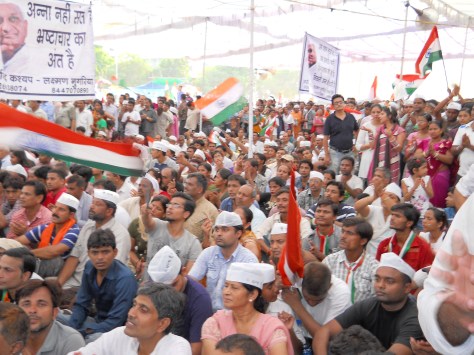
We went to Ramlila Maidan yesterday, the four of “us” considerably swelling the numbers of about a lakh and a half of people there by 6.30 pm, when we left. They were either sitting inside, milling about outside all around its walls, or pouring in having walked from India Gate.  (Is the media exaggerating the numbers? In our opinion it is underestimating them considerably).

Continue reading If only there were no people, democracy would be fine…

We should be there: The Left and the Anna moment

My head has been in a whirl the past few days with a single question – how do we on ‘the Left’ manage so unerringly to be exactly where ‘the people’ are not, time after time?

At this moment I don’t mean the organized Left, for the Left parties  have been cautious about criticizing  the current upsurge; they strongly defended the right to democratic protest when Anna Hazare and his colleagues were arrested, and now have launched a Third Front initiative on the issue of corruption and the Lokpal Bill; the students’ front of CPI (ML), AISA, has been organizing militantly on the issue for a very long time now, and is very much part of the campaign.

I mean the few hundreds who form my own community, the people with whom I have organized protests and run campaigns and sat on dharna and drafted petitions;  struggled against communal violence and sexual harassment,  for queer freedom and workers’ rights, against the nuclear bomb and nuclear energy, in support of reservations and against the moves in our universities to hold up appointments to reserved posts. Many of these people I know personally, some are among my closest friends, and many more I know as part of the broad Left/secular non-party tendency in the country’s politics, where I feel most at home.

Continue reading We should be there: The Left and the Anna moment

Indian Academics Urge Divestment from POSCO: Sign petition

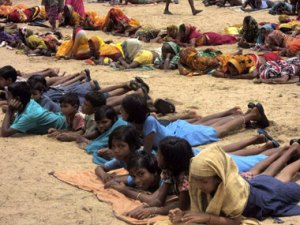
Children and women of Gobindpur village in  Jagatsinghpur district form a human chain to stop the forces from destroying their homes

The US-based Mining Zone Peoples Solidarity Group (MZPSG) has been working on an international solidarity campaign as part of the anti POSCO campaign in Orissa. They  launched a divestment campaign some months ago aimed at four retirement funds, all of which have significant investments in POSCO.

One of these is the TIAA CREF, that is, the US-based Teachers Insurance and Annuity Association – College Retirement Equities Fund, a financial services non-profit organization that is the leading retirement provider for people who work in the academic, research, medical and cultural fields.

As part of the campaign 600 US based faculty wrote to TIAA CREF some weeks ago, asking it to divest from POSCO. They are now seeking support from faculty based in India, expressing solidarity with their US -based colleagues and pressing upon TIAA CREF the urgency of the need to divest from POSCO.

Please consider signing the petition using the link provided below.

PLEASE DO NOT SIGN IN AS ANONYMOUS.

Indian Academics Urge Divestment from POSCO

If you do sign, please forward this to at least five to ten colleagues and friends working in your university or any other Indian university/college.

Please note that the signatures page will be updated manually by the admin, so you may not see your signature immediately on signing the petition.

Breivik’s model nation and migrants in South Korea: Bonojit Hussain

Guest post by Bonojit Hussain

Norwegian mass killer Anders Behring Breivik, in his manifesto, hailed Hindutva forces in India as an important ally in his envisaged fight against what he calls the “cultural Marxist/social humanist” world order. But he seems to be far more impressed by the conservative cultural milieu of South Korea as far as migrants are concerned; so much so that his manifesto is not only replete with praises for South Korean society and State but also his stated goal for Europe is to achieve a “mono-cultural” ethos, modeled on South Korea. Breivik believes that South Korea being a “scientifically advanced, economically progressive” society “out rightly rejects multiculturalism and Marxist cultural principles”.

Breivik’s manifesto might appear to be full of rambling political rants; but it seems he is not radically off the mark in understanding Korea’s hatred for migrants. So much so that right wing groups in Korea must have smiled and said in Unison “At last! Somebody recognizes our real value”.

Continue reading Breivik’s model nation and migrants in South Korea: Bonojit Hussain

The terrorist and the madman: Nandagopal R. Menon

Guest post by Nandagopal R. Menon

Scepticism is warranted only when patterns are broken. Normally, prejudice alone will suffice. So if there is a bomb blast in a Western capital, it can only be an Islamist “terror plot”. The motivations could be chosen from a short list of grievances of a peculiarly “Islamic” nature –  anger against illegal occupation of “Muslim lands” being the most favourite among them.

In the immediate aftermath of the July 22 terrorist attacks in the government quarters of Oslo, there was no room for doubt. All that was left to be done was to identify the exact name of the “jihadi” group involved (Ansar al-Jihad al-Alami, The New York Times concluded after a swift investigation); and the specific motive that propelled the attack (first choice: presence of Norwegian troops in Afghanistan; second: publication of the infamous Danish cartoons in the Norwegian press; and a distant third: Colonel Gaddafi’s retaliatory attack for Norway’s participation in bombing Libya). Whatever the motive or the group, it was indisputable that it was a “terrorist” attack.

Continue reading The terrorist and the madman: Nandagopal R. Menon

Delhi Police solve Mumbai blasts case

The Times of India reported today that Delhi Police intercepted a call immediately after the Mumbai blasts on Wednesday, which has given them crucial clues to solving this case.

Read the full report here

Basically, immediately after the blasts,  the ever alert Delhi police intercepted a call from  Mumbai  to the NCR to ask the person in the NCR if  ‘the work had been done’ and whether ‘Sharif” had been informed. On getting the answer ‘yes’, the caller hung up, and not just hung up, but ‘immediately’ hung up. The call lasted for about a minute.

This brief call was not too brief for the Delhi Police’s keen forensic skills.

Continue reading Delhi Police solve Mumbai blasts case

Solidarity letter to anti-POSCO movement from Korean jail: Sung-Hee Choi

Madhumita Dutta has sent us this powerful letter in solidarity with the people of Jagatsinghpur opposing the POSCO project, written by a South Korean activist SUNG-HEE CHOI, in prison for opposing a naval base.

Dear residents in Jagatsinghpur,

I am a woman and activist living in South Korea, the country of the POSCO you oppose. I am currently being jailed in the Jeju prison, under the charge of ‘interruption of business’, because of my resistance against the enforcement of the naval base construction in the Jeju Island located in the south of South Korea. As of today, July 3, I met 46th day since my arrest and 44th day since my being restrained.

I accidently happened to see two of your struggle photos and a photo in the Korean Times, June 13, 2011 had a  caption underneath it:
‘Anti POSCO action in India: A village sprays water to relieve children lying with other villages along the entry point to prevent policemen and officials from entering their area at Jagatsinghpur district, about 140 kilometers(87 miles) east of eastern Bhubareshwary India, Saturday. The villagers have been protesting against turning their farmland into an industrial developed area for a $12 billion steal plant of South Korean conglomerate POSCO (AP-Yonhap).’

Continue reading Solidarity letter to anti-POSCO movement from Korean jail: Sung-Hee Choi

Don’t let Mumbai blasts investigations fall victim to prejudice and shortcuts: JTSA

Statement by Jamia Teachers’ Solidarity Association

JTSA offers its heartfelt sympathies to the bereaved and the injured in the Mumbai serial blasts. We sincerely hope that the perpetrators of this mindless violence will be brought to justice swiftly. There are early indicators though that this investigation will be marred by prejudiced investigating agencies. There are news items appearing in various media outlets which cite the interrogation report of Md. Salman, a supposed operative of the Indian Mujahideen (IM) to establish that Mumbai was on IM’s sights.

Already we see that, though the Home Ministry has restrained from holding any group culpable, the investigation is being gently pushed in one direction. But even if one leaves aside for a moment the criticism that investigators react in stereotypical ways, their compass needle invariably pointing towards Azamgarh, there are serious issues arising out of this reliance on Salman’s interrogation report for getting to the bottom of the Mumbai serial blasts conspiracy.

Continue reading Don’t let Mumbai blasts investigations fall victim to prejudice and shortcuts: JTSA

These rapes aren’t rapes? Amrita Nandy

Guest post by AMRITA NANDY

Like the French, Mona, a 30-year old sex worker in Delhi, is intrigued and amazed over the hullabaloo around the DSK sexual assault case.  From her one-room shed, she has been keenly following television channels for the latest on the scandal. She asked me if I had any updates, adding: “That man may be in jail for 25 years! Really? Unbelievable. For us, being assaulted at work is a regular part of it. I tolerate some of it and ignore the rest. But you see… I cannot complain if I am harassed. A sex worker is a doll in the hands of her customer. No one will play with the doll if she complains!”

While Mona’s fatalism may have helped her cope, the risks at work are especially dire for non-brothel sex workers.  Some have nearly been killed.

Continue reading These rapes aren’t rapes? Amrita Nandy

Women Against Sexual Violence and State Repression condemns crackdown on anti-corruption protesters

WSS strongly condemns the midnight crackdown on thousands of people staging a ‘Satyagraha’ and hunger strike at Ramlila Maidan with Baba Ramdev for demands related to corruption and black money.

We are astonished at Mr Manmohan Singh’s defense of police action saying that there was no alternative. The attack on the protesters was absolutely unwarranted as the ‘satyagraha’ was neither causing any law and order problems nor was it disrupting the peace of the city in any manner.

We are not supporters of Baba Ramdev but clearly see the role of dissent in upholding a democratic society. Continue reading Women Against Sexual Violence and State Repression condemns crackdown on anti-corruption protesters

Make Delhi Metro safe for women! Please Mend The Gap

PLEASE MEND THE GAP is a citizen- led initiative to promote gender equality and commuter safety in public spaces. 

Follow these two links for some background:

A few weeks ago, a friend was molested on the Yellow line of the Delhi Metro

A flash mob of citizens got together to protest against the Delhi Metro, claiming that it is promoting a gender divide.

Sign PMTG’s Petition to Chief Minister and DMRC

We believe that a majority of women do not feel safe while travelling in the Delhi Metro. We have spoken to a cross-section of Metro commuters who have shared with us their experiences most of which include instances of verbal and physical harassment mostly faced by women, specifically in the women’s-only compartment. In fact, a few days ago, some of the members of our group who were traveling at night observed that the women’s-only compartment was populated with men who had occupied almost all the seats forcing the women to stand, leaving them with no choice but to actively demand the seats they were entitled to. The men were unapologetic and dismissive. Most shrugged off the women’s protest by claiming falsely that the women’s-only compartment turns general post 9 p.m..

Women who choose to travel in the general compartment are also harassed. There have been many instances where men have told women that they are not welcome in this compartment and should use the compartment reserved for them. This attitude has become so deeply entrenched in commuters’ mindsets that most accidentally refer to the general compartment as the ‘men’s compartment’. There have been times when authorities have driven out men from the women’s-only compartments, but without having imposed any fine whatsoever…

The situation needs to change. It is the duty of the State and the DMRC to spearhead this change.

Read the full petition and sign.

Dominique Strauss-Kahn and the union maid: Dean Baker

A little-reported fact of the Dominique Strauss-Kahn case is that his accuser is a union member – with rights the IMF opposes, says Dean Baker in the Guardian.

But do listen to this song first!


“The reason that this is an important part of the story is that it is likely that Strauss-Kahn’s alleged victim might not have felt confident enough to pursue the issue with either her supervisors or law enforcement agencies, if she had not been protected by a union contract. The vast majority of hotel workers in the United States, like most workers in the private sector, do not enjoy this protection.

Received via Mini Mathew

‘End of the Left’ in India? Statement by Leftists after recent election results

Text of statement by Jairus Banaji, Sukumar Muralidharan, Dilip Simeon, Satya Sivaraman and Rohini Hensman endorsed by 224 others.

In a minor replay of 1989 and the fall of the Berlin Wall, the Indian media have been gloating at the defeat of the Left Front in West Bengal especially and have repeatedly suggested that this signals the ‘end of the Left in India’. Even at the best of times our news channels tend to avoid serious analyses of the underlying trends within the country, since they have transformed the news itself into a form of entertainment on models surpassed only by the U.S. news networks.

For its part the CPI(M) leadership has been at pains to minimise the significance of the defeat (in Bengal especially) and said that it would be wrong to write off the Left. For them ‘the Left’ means the Left Fronts in Bengal and Kerala and of course chiefly the CPI(M) itself.  They stress the fact that they still retain a considerable vote share, just over 40% in West Bengal for example, and there is indeed some truth in this claim.

Continue reading ‘End of the Left’ in India? Statement by Leftists after recent election results

Choice in the labour market – sex work as “work”

The summary of preliminary findings of the first pan-India survey of sex-workers is now available on-line.  3000 women from 14 states and 1 UT were surveyed, all of them from outside collectivised/organised and therefore politically active spaces, precisely  “in order to bring forth the voices of a hitherto silent section of sex workers.”

The significant finding is this: About 71 percent of them said they had entered the profession willingly.

(The data on male and transgender sex workers has not been processed yet).

The study was conducted by Rohini Sahni and  V Kalyan Shankar under the aegis of the Center for Advocacy on Stigma and Marginalisation (CASAM),  supported by Paulo Longo Research Initiative (“a collaboration of scholars, policy analysts and sex workers that aims to develop and consolidate ethical, interdisciplinary scholarship on sex work to improve the human rights, health and well being of women, men and transgenders who sell sex.”). The study was supported by a large number of groups, organizations and individuals in each state, who helped to conduct the surveys.

This background is important, because it appears to be a study that is well grounded, and drawing on large networks of local interconnections.

Continue reading Choice in the labour market – sex work as “work”

Music and politics – the power of minimalism: Prasanta Chakravarty

Guest post by Prasanta Chakravarty

I want to tell you about a song.  A song and a singer that few will call political. I want to talk about a song called Daya Karo (Have Mercy) sung by Mousumi Bhowmik, which appears originally in her album Ami Ghor Bahir Kori/ In and Out of My Room (2001).

Though she would routinely perform in certain public events and campus fests in Kolkata, Bhowmik has always been a peripheral figure in the popular imagination on Bangla singers who appear in the last couple of decades. She does not qualify as a mainstream modern popular singer. It is an equally barbed proposition to accommodate her within a new group of singers who would tilt the popular musical scenario in Kolkata and its suburbs by some straight talking, angst ridden compositions and solo performances throughout the nineties. Some of these singers have of late plunged into active politics and one of them has even become a Member of Parliament.

Continue reading Music and politics – the power of minimalism: Prasanta Chakravarty